
Administration of Intravenous Medications Principles of IV Therapy

- Slides: 38
Administration of Intravenous Medications Principles of IV Therapy BSN 336 Spring QR 09
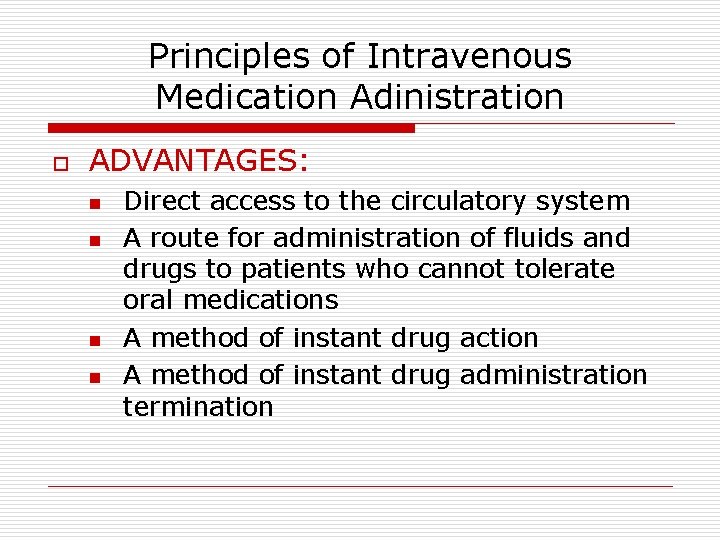
Principles of Intravenous Medication Adinistration o ADVANTAGES: n n Direct access to the circulatory system A route for administration of fluids and drugs to patients who cannot tolerate oral medications A method of instant drug action A method of instant drug administration termination
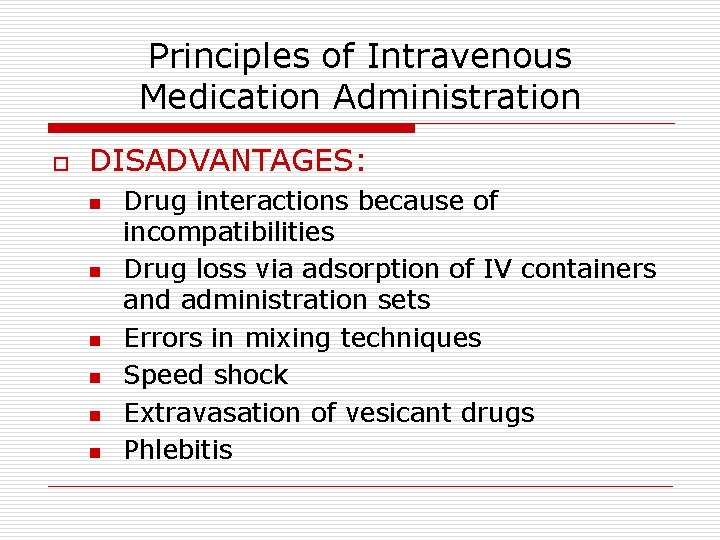
Principles of Intravenous Medication Administration o DISADVANTAGES: n n n Drug interactions because of incompatibilities Drug loss via adsorption of IV containers and administration sets Errors in mixing techniques Speed shock Extravasation of vesicant drugs Phlebitis
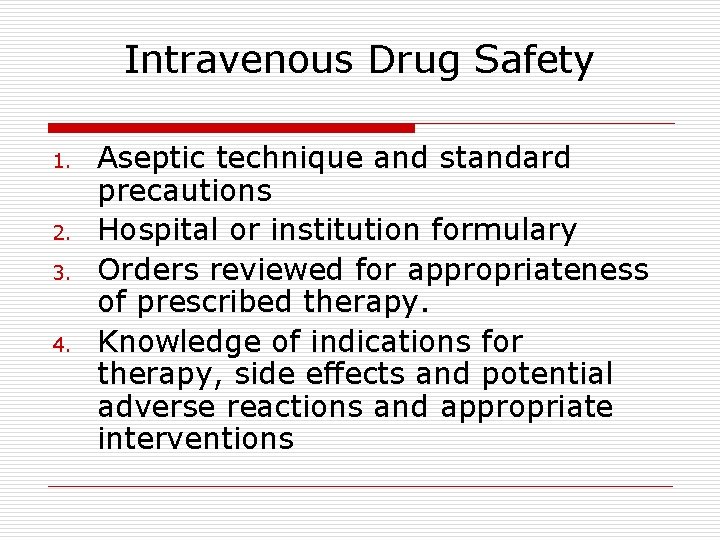
Intravenous Drug Safety 1. 2. 3. 4. Aseptic technique and standard precautions Hospital or institution formulary Orders reviewed for appropriateness of prescribed therapy. Knowledge of indications for therapy, side effects and potential adverse reactions and appropriate interventions
Intravenous Drug Safety (cont) 5. 6. 7. Appropriately label all containers, vials, and syringes: identify patient, verify contents, dose, rate, route, expiration date, integrity of the solution Evaluate, monitor effectiveness of therapy; document response, adverse events, and interventions Medications discarded after 24 hr
Intravenous Drug Safety (cont) Common Types of Drug errors o Incomplete patient information o Unavailable drug information o Miscommunication of drug orders: poor hand writing, similar names, misuse of zero, decimal points, dosing units, abbreviations o Lack of appropriate labeling
Drug Compatibility o Physical Incompatibility n Insolubility and absorption o o Never administer a drug that forms a precipitate Do not mix drugs prepared in special diluents with other drugs Prepare each drug in a separate syringe Use the proper diluents to reconstitute a drug
Drug Compatibility o Chemical Incompatibility n o Alterations of the integrity and the potency of the active ingredient Therapeutic Incompatibility n Undesirable effect occurring in a patient as a result of two or more drugs being given concurrently o Pt may fail to show the expected clinical response
Intravenous Medication Administration o General Guidelines n n n Is the prescribed route appropirate Use aseptic technique and Standard Precautions when preparing drug Check for expiration date Follow the manufactures guidelines Monitor the patient response
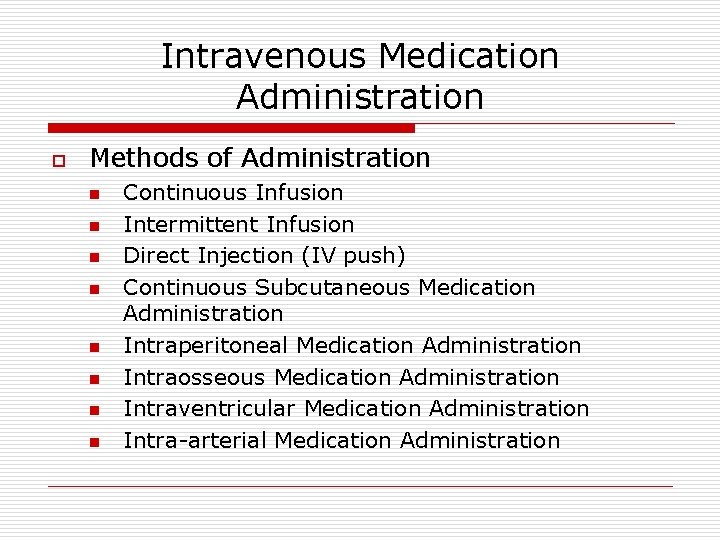
Intravenous Medication Administration o Methods of Administration n n n n Continuous Infusion Intermittent Infusion Direct Injection (IV push) Continuous Subcutaneous Medication Administration Intraperitoneal Medication Administration Intraosseous Medication Administration Intraventricular Medication Administration Intra-arterial Medication Administration
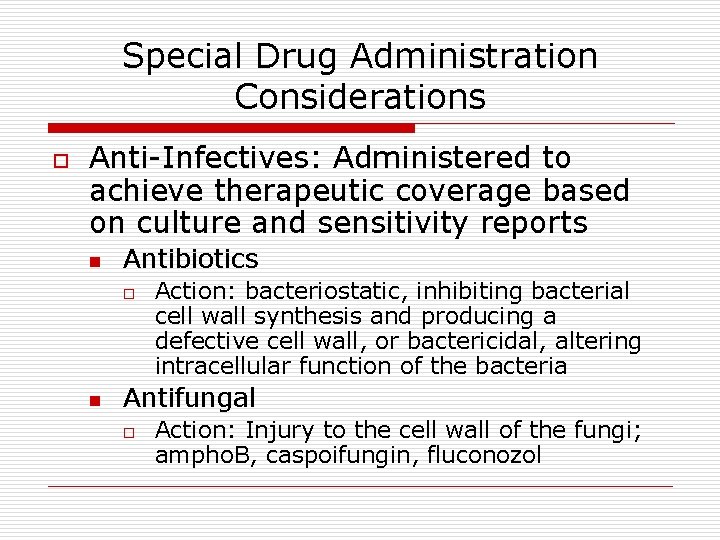
Special Drug Administration Considerations o Anti-Infectives: Administered to achieve therapeutic coverage based on culture and sensitivity reports n Antibiotics o n Action: bacteriostatic, inhibiting bacterial cell wall synthesis and producing a defective cell wall, or bactericidal, altering intracellular function of the bacteria Antifungal o Action: Injury to the cell wall of the fungi; ampho. B, caspoifungin, fluconozol
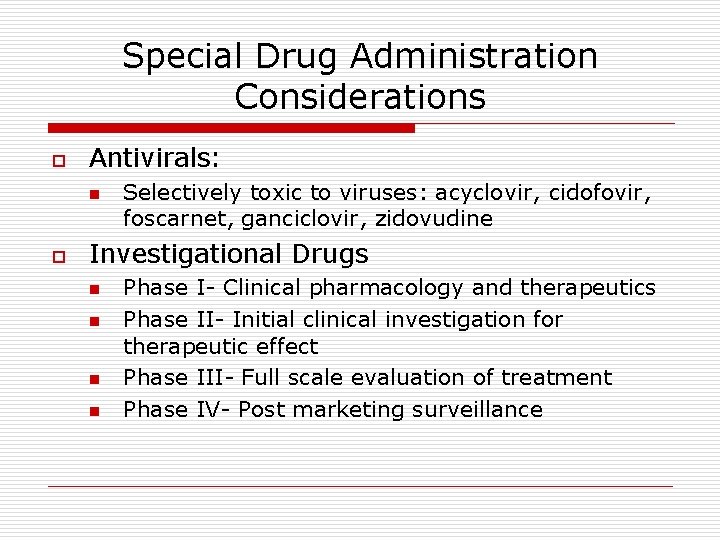
Special Drug Administration Considerations o Antivirals: n o Selectively toxic to viruses: acyclovir, cidofovir, foscarnet, ganciclovir, zidovudine Investigational Drugs n n Phase I- Clinical pharmacology and therapeutics Phase II- Initial clinical investigation for therapeutic effect Phase III- Full scale evaluation of treatment Phase IV- Post marketing surveillance
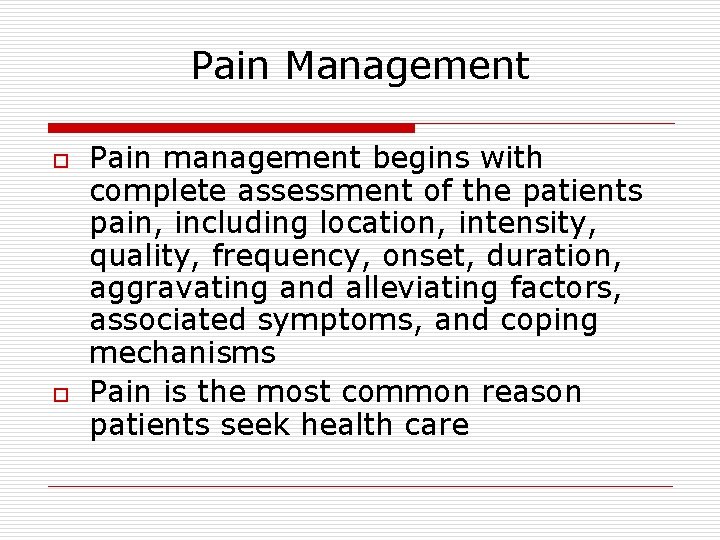
Pain Management o o Pain management begins with complete assessment of the patients pain, including location, intensity, quality, frequency, onset, duration, aggravating and alleviating factors, associated symptoms, and coping mechanisms Pain is the most common reason patients seek health care
Pain Management Definition of Pain “What ever the experiencing person says it is, existing whenever he says it does” Margo Mc. Caffery
Pain Management o Landmark study from 1973 showed that pain is generally undertreated n n Authorized prescribers underperscribe Nurses administer fewer analgesics than prescribed Patients request fewer analgesic medications than they need The as needed regimen of administering opioid agents ensures that the patient will experience pain.
Pain Management o Study from 1998 and 2003 shows that little has changed in n o Attitudes Knowledge Behaviors in managing pain Negative language is the most difficult barrier n n Narcotic rather than Opioid Complains of pain rather than patient reports pain
Pain Management o The concern for iatrogenic addiction (addiction inadvertently cause from valid medical use of opioids) from families and health care workers is over estimated n Actual incidence is less than 1%
Pain Management o American Academy of Pain Management, American Pain Society, and the American Society of Addiction state the following definitions n Addiction: a primary, chronic, neurobiological disease with genetic, psychosocial, and environmental factors influencing its development and manifestation.
Pain Management n n Behaviors include: o Impaired control over drug use, o Compulsive use o Continued use despite harm, and craving Physical Dependence state of adaptation that is manifested by a drug class-specific withdrawal syndrome following o abrupt cessation o rapid dose reduction o decreasing blood levels o And/or administration of an antagonist
Pain Management o o Tolerance: state of adaptation in which exposure to a drug induces changes that result in diminution of one or more of the drug’s effects over time Use of words n n n Drug seeker Clock watcher Addicted to their pain medication
Pain Management o Patient not behaving inappropriately n The treatment for pain is o o o Not the right medication Not the right dose Not the right dosing interval
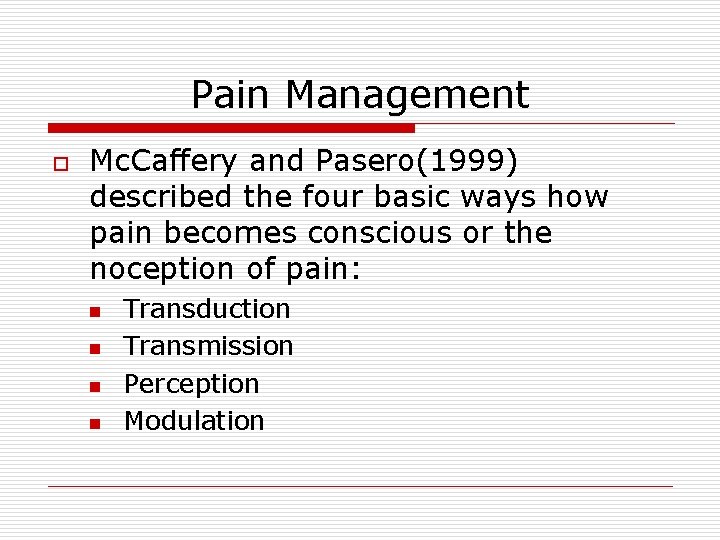
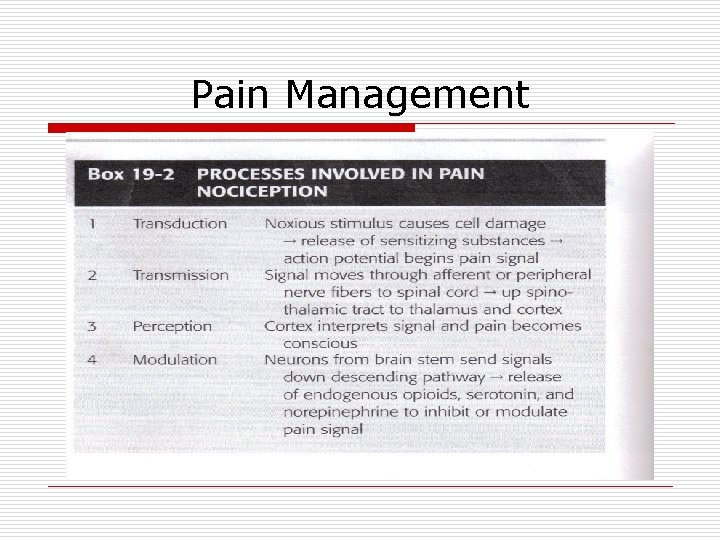
Pain Management o Mc. Caffery and Pasero(1999) described the four basic ways how pain becomes conscious or the noception of pain: n n Transduction Transmission Perception Modulation
Pain Management
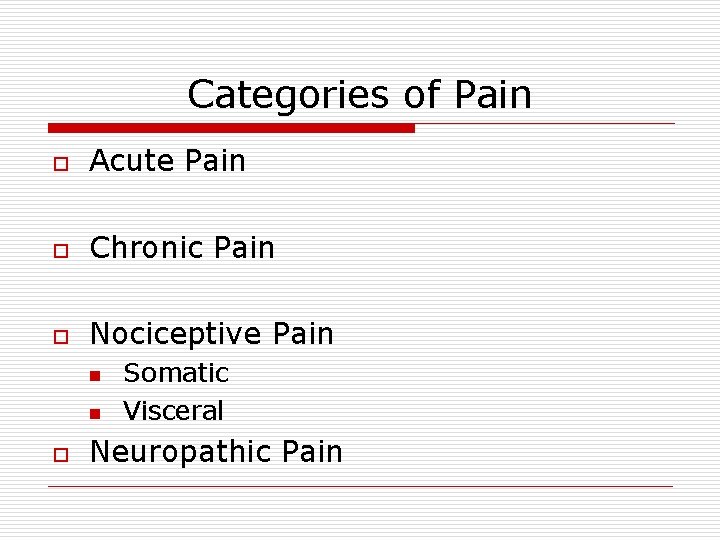
Categories of Pain o Acute Pain o Chronic Pain o Nociceptive Pain n n o Somatic Visceral Neuropathic Pain
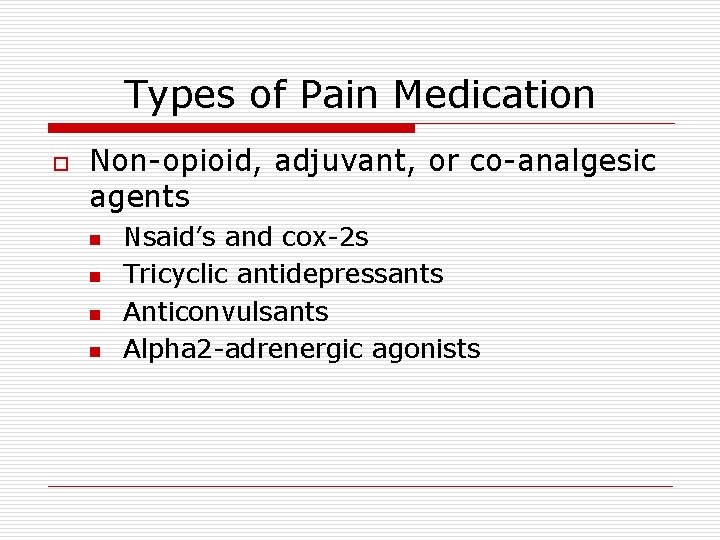
Types of Pain Medication o Non-opioid, adjuvant, or co-analgesic agents n n Nsaid’s and cox-2 s Tricyclic antidepressants Anticonvulsants Alpha 2 -adrenergic agonists
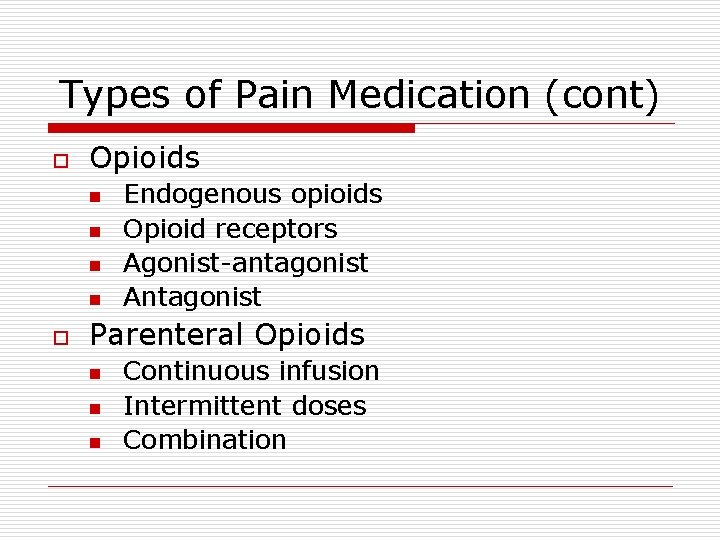
Types of Pain Medication (cont) o Opioids n n o Endogenous opioids Opioid receptors Agonist-antagonist Antagonist Parenteral Opioids n n n Continuous infusion Intermittent doses Combination
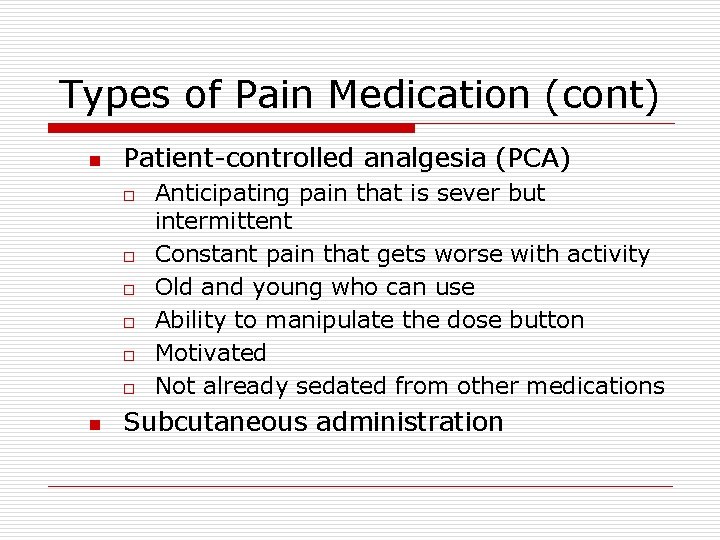
Types of Pain Medication (cont) n Patient-controlled analgesia (PCA) o o o n Anticipating pain that is sever but intermittent Constant pain that gets worse with activity Old and young who can use Ability to manipulate the dose button Motivated Not already sedated from other medications Subcutaneous administration
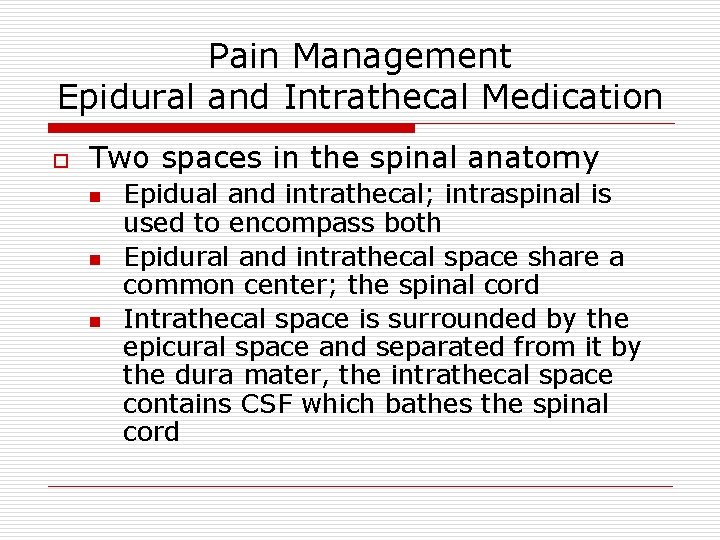
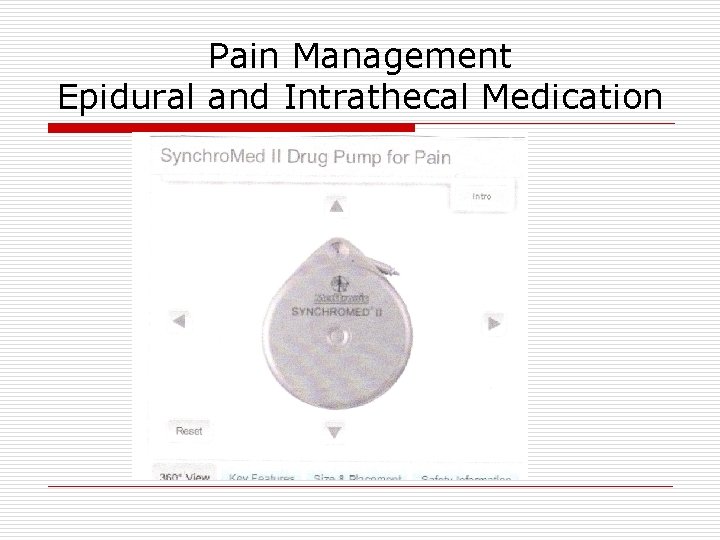
Pain Management Epidural and Intrathecal Medication o Two spaces in the spinal anatomy n n n Epidual and intrathecal; intraspinal is used to encompass both Epidural and intrathecal space share a common center; the spinal cord Intrathecal space is surrounded by the epicural space and separated from it by the dura mater, the intrathecal space contains CSF which bathes the spinal cord
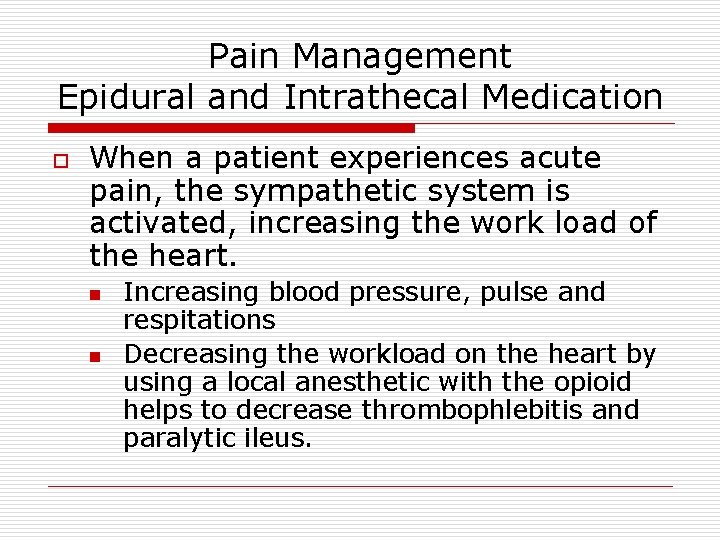
Pain Management Epidural and Intrathecal Medication o When a patient experiences acute pain, the sympathetic system is activated, increasing the work load of the heart. n n Increasing blood pressure, pulse and respitations Decreasing the workload on the heart by using a local anesthetic with the opioid helps to decrease thrombophlebitis and paralytic ileus.
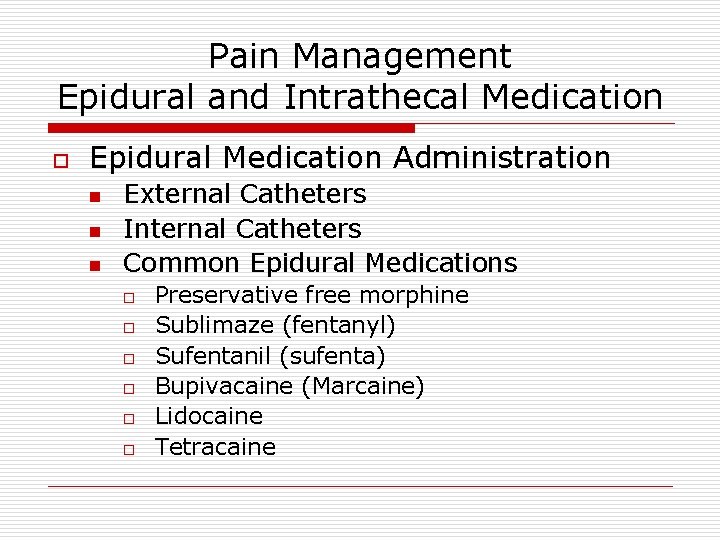
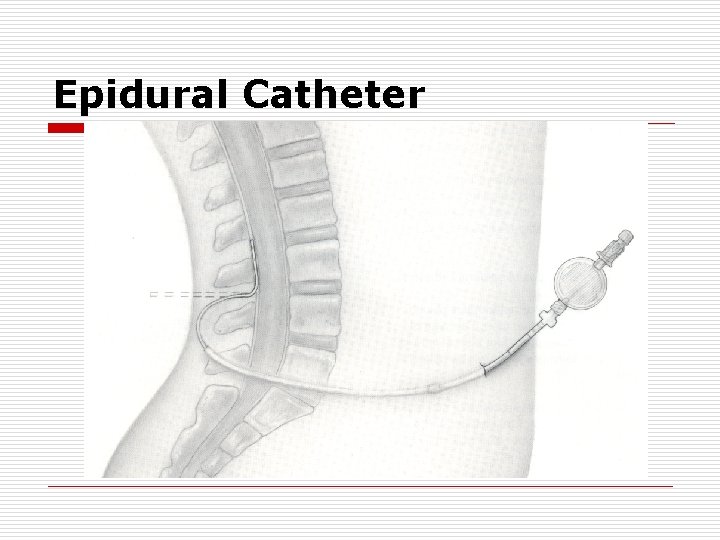
Pain Management Epidural and Intrathecal Medication o Epidural Medication Administration n External Catheters Internal Catheters Common Epidural Medications o o o Preservative free morphine Sublimaze (fentanyl) Sufentanil (sufenta) Bupivacaine (Marcaine) Lidocaine Tetracaine
Epidural Catheter
Pain Management Epidural and Intrathecal Medication
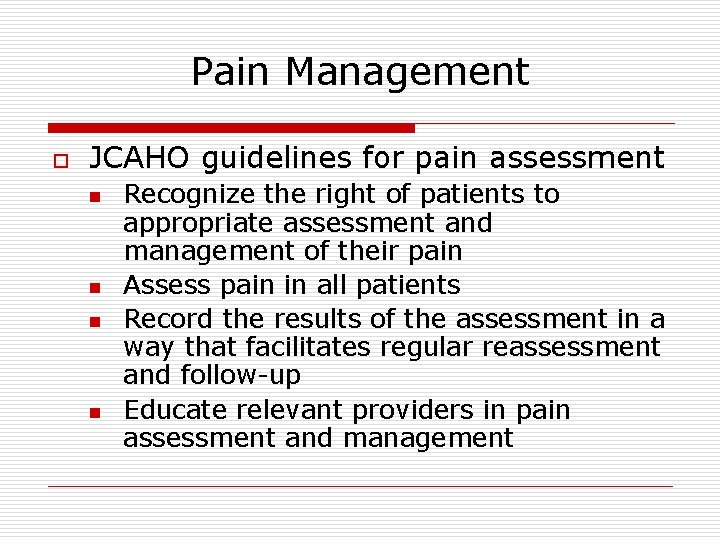
Pain Management o JCAHO guidelines for pain assessment n n Recognize the right of patients to appropriate assessment and management of their pain Assess pain in all patients Record the results of the assessment in a way that facilitates regular reassessment and follow-up Educate relevant providers in pain assessment and management
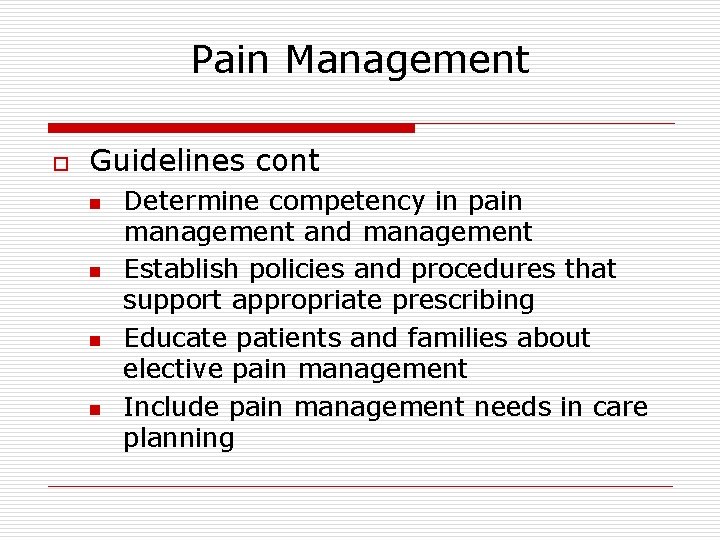
Pain Management o Guidelines cont n n Determine competency in pain management and management Establish policies and procedures that support appropriate prescribing Educate patients and families about elective pain management Include pain management needs in care planning
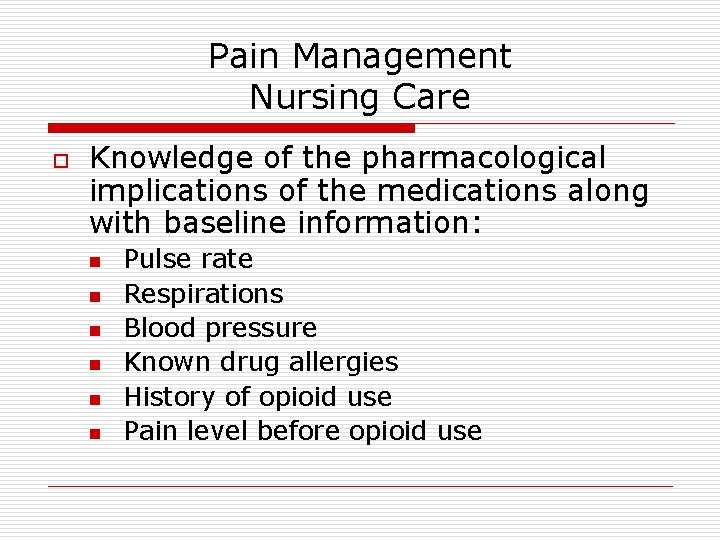
Pain Management Nursing Care o Knowledge of the pharmacological implications of the medications along with baseline information: n n n Pulse rate Respirations Blood pressure Known drug allergies History of opioid use Pain level before opioid use
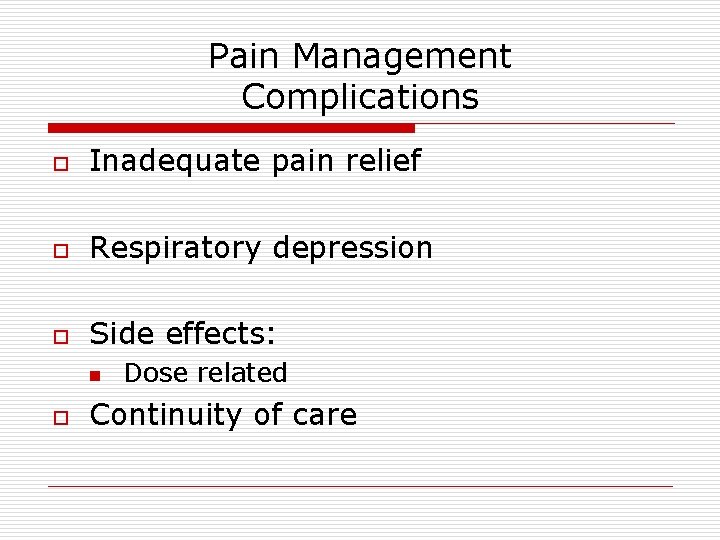
Pain Management Complications o Inadequate pain relief o Respiratory depression o Side effects: n o Dose related Continuity of care
Pain Management o Moderate Sedation/Analgesia n Conscious sedation
Questions?