
ADJUSTING RECIPES Increasing or Decreasing a Recipe Yield
- Slides: 9
ADJUSTING RECIPES Increasing or Decreasing a Recipe Yield Changing Ingredients 1
Increasing or Decreasing a Recipe Yield n n The YIELD of a recipe tells how many people you can serve and how much each person will get. It may be necessary to increase or decrease a recipe’s yield in order to prepare the number of servings needed or to adjust the serving size. 2
Increasing or Decreasing a Recipe Yield n n If more, or larger, servings are needed than the recipe will yield, it is necessary to increase the amounts of ingredients used. If less, or smaller, servings are needed, one can either decrease the amounts of ingredients used OR prepare the recipe as indicated and have leftovers. 3
Increasing or Decreasing a Recipe Yield, contd. n When increasing or decreasing the yield and ingredients in recipes, it is usually necessary to make additional changes in: n Equipment size n Equipment shape n Cooking temperature n Cooking time 4
Increasing or Decreasing a Recipe Yield, contd. The steps for changing a yield are: 1. Divide the desired yield by the recipe’s original yield. The result is called the conversion factor. 2. Multiply all recipe ingredients by the conversion factor. 3. Convert the measurements into logical, manageable amounts. n 5
Changing Ingredients Recipe ingredients are often changed for reasons other than increasing or decreasing the yield. Adjusting for substitute ingredients: n Ingredients in recipes are often substituted. Some reasons for changing recipe ingredients include: n Unavailable ingredients n Cost of ingredients n Decreasing/increasing nutritional value n Creativity 6
Changing Ingredients, contd. n Some recipes are easier to adjust than others. Those with NON-ESSENTIAL ingredients are easily adjusted. Recipes with ESSENTIAL ingredients are really difficult to change n n NON-ESSENTIAL ingredients are those that act independently of each other. ESSENTIAL ingredients are those that have specific functions in a recipe and are so sensitive to changes that the appearance, taste, or texture of the product are affected 7
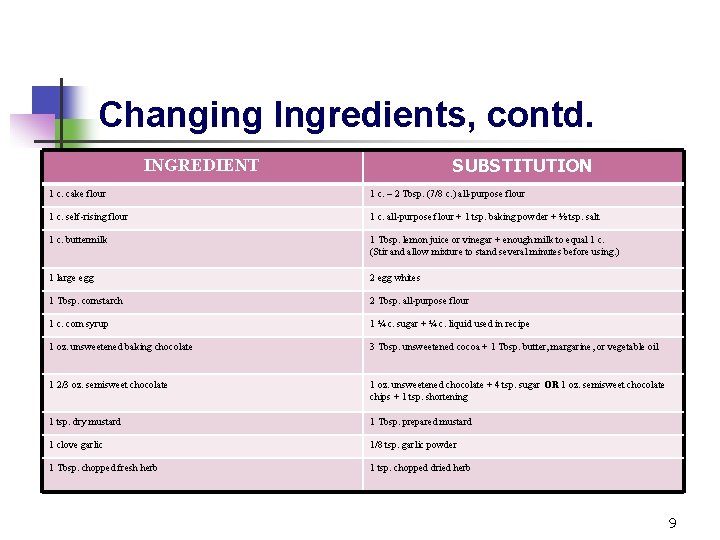
Changing Ingredients, contd. n Well-written cookbooks and the Internet are good sources for common ingredient substitutions. These ingredient substitutions can usually be made without any significant difference in the final product. 8
Changing Ingredients, contd. SUBSTITUTION INGREDIENT 1 c. cake flour 1 c. – 2 Tbsp. (7/8 c. ) all-purpose flour 1 c. self-rising flour 1 c. all-purpose flour + 1 tsp. baking powder + ½ tsp. salt 1 c. buttermilk 1 Tbsp. lemon juice or vinegar + enough milk to equal 1 c. (Stir and allow mixture to stand several minutes before using. ) 1 large egg 2 egg whites 1 Tbsp. cornstarch 2 Tbsp. all-purpose flour 1 c. corn syrup 1 ¼ c. sugar + ¼ c. liquid used in recipe 1 oz. unsweetened baking chocolate 3 Tbsp. unsweetened cocoa + 1 Tbsp. butter, margarine, or vegetable oil 1 2/3 oz. semisweet chocolate 1 oz. unsweetened chocolate + 4 tsp. sugar OR 1 oz. semisweet chocolate chips + 1 tsp. shortening 1 tsp. dry mustard 1 Tbsp. prepared mustard 1 clove garlic 1/8 tsp. garlic powder 1 Tbsp. chopped fresh herb 1 tsp. chopped dried herb 9