
Adjustable Transport for LWFA Electrons Kay Dewhurst Univ

Adjustable Transport for LWFA Electrons Kay Dewhurst Univ. of Manchester and The Cockcroft Inst.

Contents • What is LWFA? • What are the challenges? • Why do we need adjustable transport? • Current design Kay Dewhurst, Manchester Group Meeting, December 2019

What are Laser Wakefield Accelerated (LWFA) Electrons? • • An intense laser pulses ionises a gas, forming plasma The laser leaves a “wake” of electrons behind it Some of these electrons are accelerated to high energy Energy is transferred from the laser pulse to the electrons Ponderomotive Force Kay Dewhurst, Manchester Group Meeting, December 2019
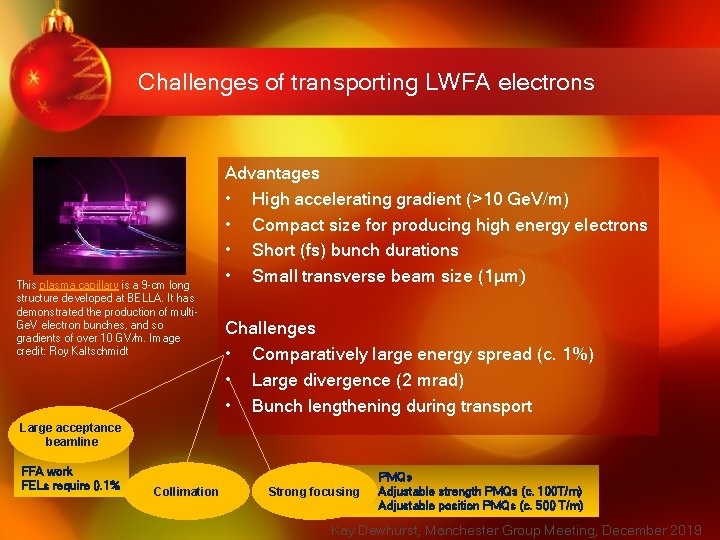
Challenges of transporting LWFA electrons This plasma capillary is a 9 -cm long structure developed at BELLA. It has demonstrated the production of multi. Ge. V electron bunches, and so gradients of over 10 GV/m. Image credit: Roy Kaltschmidt Advantages • High accelerating gradient (>10 Ge. V/m) • Compact size for producing high energy electrons • Short (fs) bunch durations • Small transverse beam size (1μm) Challenges • Comparatively large energy spread (c. 1%) • Large divergence (2 mrad) • Bunch lengthening during transport Large acceptance beamline FFA work FELs require 0. 1% Collimation Strong focusing PMQs Adjustable strength PMQs (c. 100 T/m) Adjustable position PMQs (c. 500 T/m) Kay Dewhurst, Manchester Group Meeting, December 2019
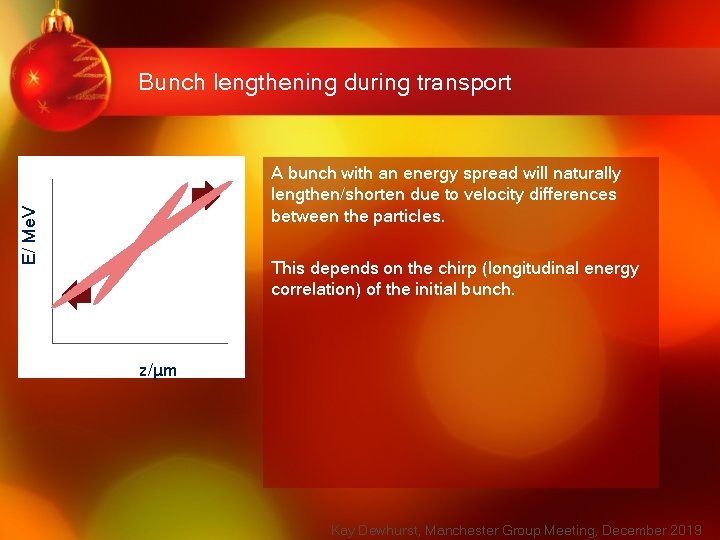
Bunch lengthening during transport E/ Me. V A bunch with an energy spread will naturally lengthen/shorten due to velocity differences between the particles. This depends on the chirp (longitudinal energy correlation) of the initial bunch. z/µm Kay Dewhurst, Manchester Group Meeting, December 2019
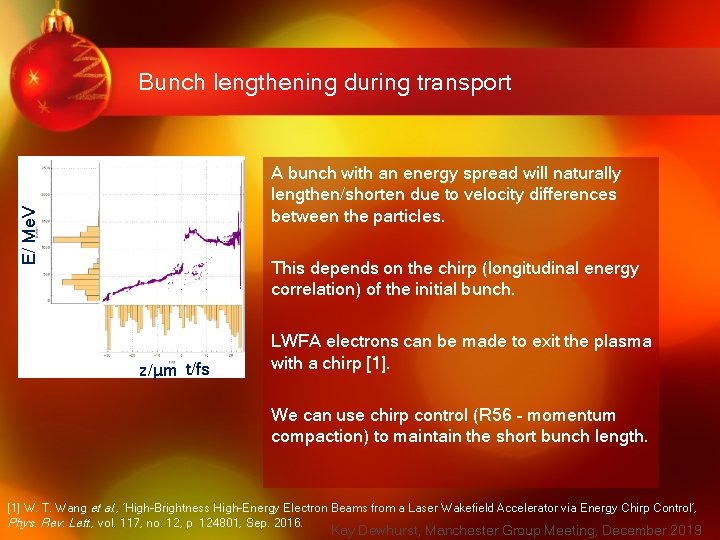
Bunch lengthening during transport E/ Me. V A bunch with an energy spread will naturally lengthen/shorten due to velocity differences between the particles. This depends on the chirp (longitudinal energy correlation) of the initial bunch. z/µm t/fs LWFA electrons can be made to exit the plasma with a chirp [1]. We can use chirp control (R 56 – momentum compaction) to maintain the short bunch length. [1] W. T. Wang et al. , ‘High-Brightness High-Energy Electron Beams from a Laser Wakefield Accelerator via Energy Chirp Control’, Phys. Rev. Lett. , vol. 117, no. 12, p. 124801, Sep. 2016. Kay Dewhurst, Manchester Group Meeting, December 2019
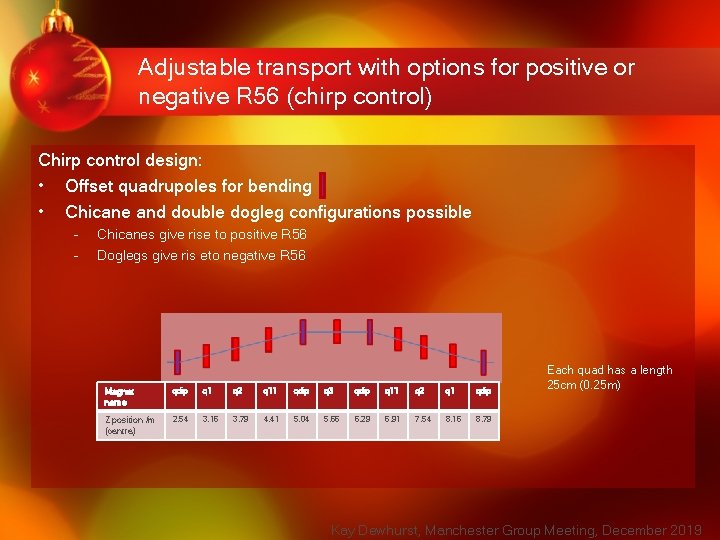
Adjustable transport with options for positive or negative R 56 (chirp control) Chirp control design: • Offset quadrupoles for bending • Chicane and double dogleg configurations possible – – Chicanes give rise to positive R 56 Doglegs give ris eto negative R 56 Magnet name qdip q 1 q 2 q 11 qdip q 3 qdip q 11 q 2 q 1 qdip Z position /m (centre) 2. 54 3. 16 3. 79 4. 41 5. 04 5. 66 6. 29 6. 91 7. 54 8. 16 8. 79 Each quad has a length 25 cm (0. 25 m) Kay Dewhurst, Manchester Group Meeting, December 2019
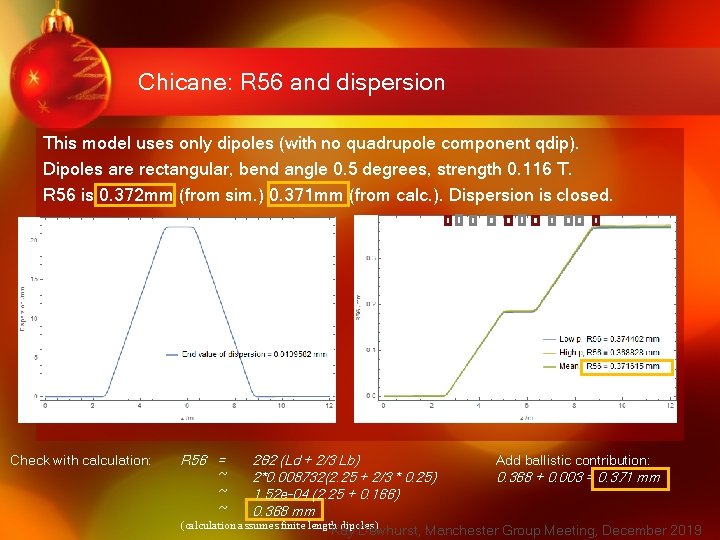
Chicane: R 56 and dispersion This model uses only dipoles (with no quadrupole component qdip). Dipoles are rectangular, bend angle 0. 5 degrees, strength 0. 116 T. R 56 is 0. 372 mm (from sim. ) 0. 371 mm (from calc. ). Dispersion is closed. Check with calculation: R 56 = ~ ~ ~ 2θ 2 (Ld + 2/3 Lb) 2*0. 008732(2. 25 + 2/3 * 0. 25) 1. 52 e-04 (2. 25 + 0. 166) 0. 368 mm (calculation assumes finite length dipoles) Add ballistic contribution: 0. 368 + 0. 003 = 0. 371 mm Kay Dewhurst, Manchester Group Meeting, December 2019
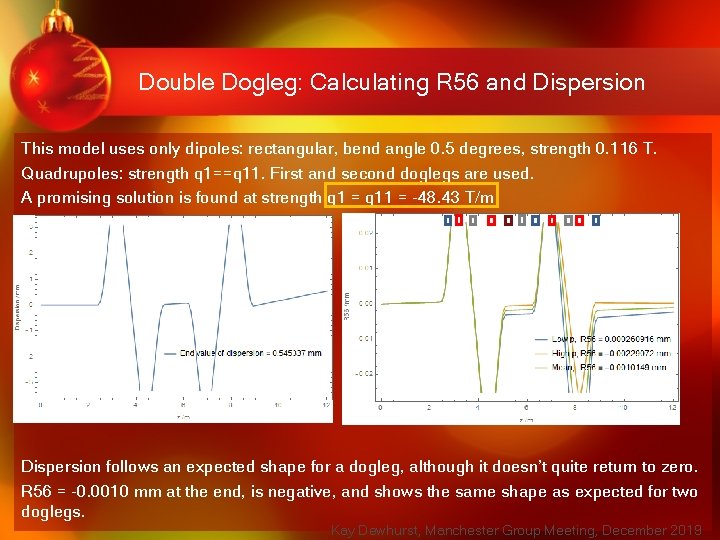
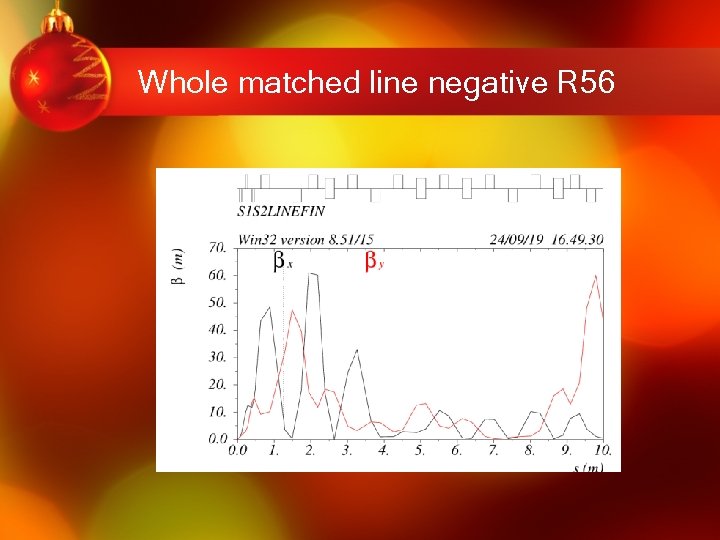
Double Dogleg: Calculating R 56 and Dispersion This model uses only dipoles: rectangular, bend angle 0. 5 degrees, strength 0. 116 T. Quadrupoles: strength q 1==q 11. First and second doglegs are used. A promising solution is found at strength q 1 = q 11 = -48. 43 T/m. Dispersion follows an expected shape for a dogleg, although it doesn’t quite return to zero. R 56 = -0. 0010 mm at the end, is negative, and shows the same shape as expected for two doglegs. Kay Dewhurst, Manchester Group Meeting, December 2019
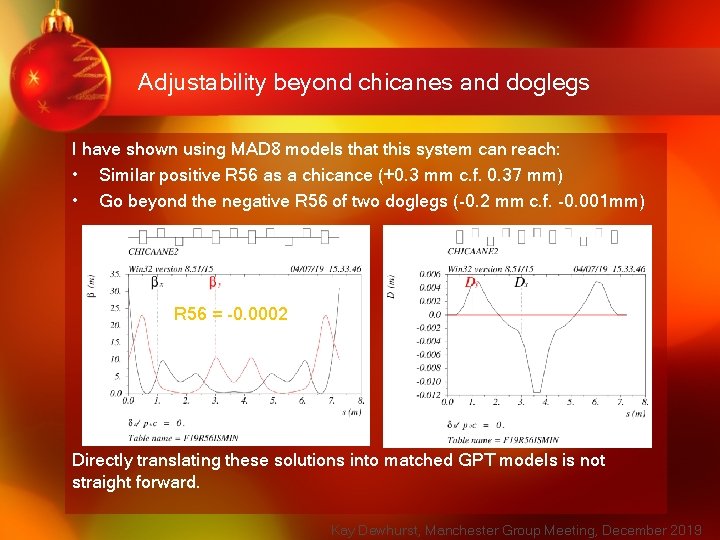
Adjustability beyond chicanes and doglegs I have shown using MAD 8 models that this system can reach: • Similar positive R 56 as a chicance (+0. 3 mm c. f. 0. 37 mm) • Go beyond the negative R 56 of two doglegs (-0. 2 mm c. f. -0. 001 mm) R 56 = -0. 0002 Directly translating these solutions into matched GPT models is not straight forward. Kay Dewhurst, Manchester Group Meeting, December 2019
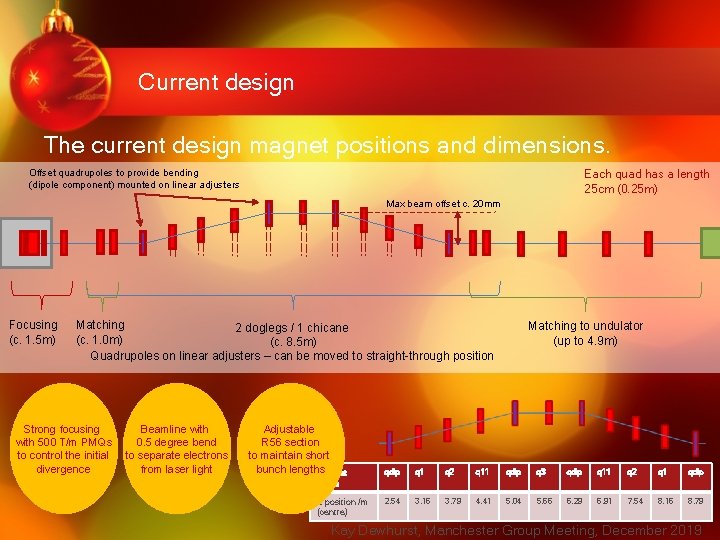
Current design The current design magnet positions and dimensions. Offset quadrupoles to provide bending (dipole component) mounted on linear adjusters Each quad has a length 25 cm (0. 25 m) Max beam offset c. 20 mm Focusing (c. 1. 5 m) Matching 2 doglegs / 1 chicane (c. 1. 0 m) (c. 8. 5 m) Quadrupoles on linear adjusters – can be moved to straight-through position Strong focusing with 500 T/m PMQs to control the initial divergence Beamline with 0. 5 degree bend to separate electrons from laser light Adjustable R 56 section to maintain short bunch lengths Magnet Matching to undulator (up to 4. 9 m) qdip q 1 q 2 q 11 qdip q 3 qdip q 11 q 2 q 1 qdip 2. 54 3. 16 3. 79 4. 41 5. 04 5. 66 6. 29 6. 91 7. 54 8. 16 8. 79 name Z position /m (centre) Kay Dewhurst, Manchester Group Meeting, December 2019

Thank You Any questions for me? Kay Dewhurst kay. dewhurst@postgrad. manchester. ac. uk www. linkedin. com/in/kay-dewhurst-physics 2000
Whole matched line negative R 56
- Slides: 13