
Adjointbased observation impact monitoring at NRLMonterey 1 Rolf
Adjoint-based observation impact monitoring at NRL-Monterey 1 Rolf H. Langland Naval Research Laboratory – Monterey, Ca. USA Gary G. Love, Nancy L. Baker Fourth Workshop on Observing System Impact in NWP WMO, Geneva, 19 -21 May 2008
Outline of Talk 2 1. Methodology 2. Observation impact examples 3. On-line observation monitoring system
Goal for observation impact monitoring system 3 Develop a method to estimate the impacts of all assimilated observations on a measure of short-range forecast error in an operational NWP system Must be computationally efficient – run in nearreal-time for routine observation monitoring
Forecast Model and Analysis Procedure 4 Analysis procedure: NAVDAS: NRL Atmospheric 3 d-Variational Data Assimilation System (0. 5 o lat-lon, 60 levels) • Adjoint provides sensitivity to observations, including moisture data Forecast model: NOGAPS: Navy Operational Global Atmospheric Prediction System (T 239 L 30) • Adjoint run at T 239 L 30, includes simplified vertical mixing, large-scale precipitation
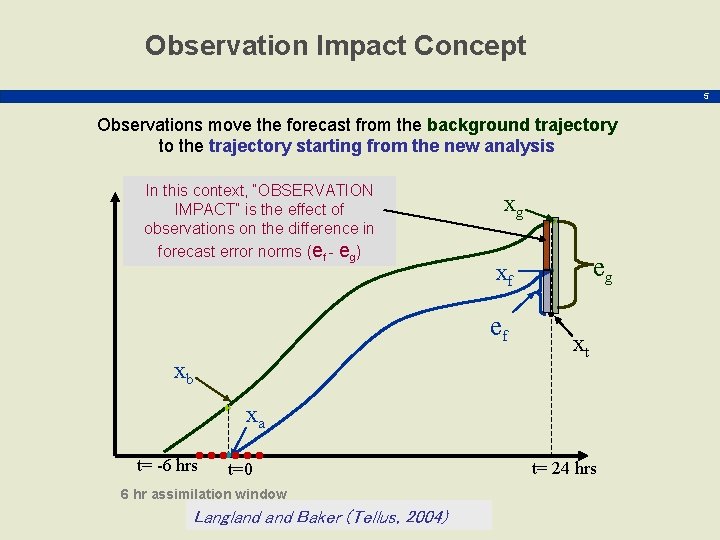
Observation Impact Concept 5 Observations move the forecast from the background trajectory to the trajectory starting from the new analysis In this context, “OBSERVATION IMPACT” is the effect of observations on the difference in forecast error norms (ef - eg) xg ef xb eg xf xt xa t= -6 hrs t=0 6 hr assimilation window Langland Baker (Tellus, 2004) t= 24 hrs
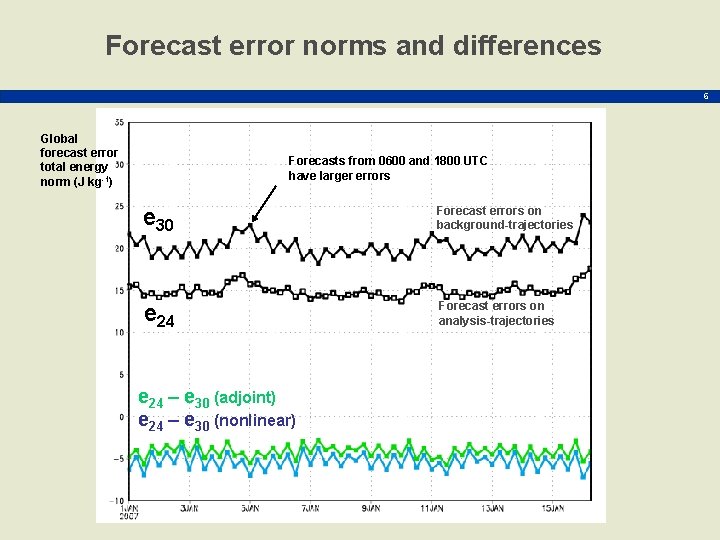
Forecast error norms and differences 6 Global forecast error total energy norm (J kg-1) Forecasts from 0600 and 1800 UTC have larger errors e 30 Forecast errors on background-trajectories e 24 Forecast errors on analysis-trajectories e 24 – e 30 (adjoint) e 24 – e 30 (nonlinear)
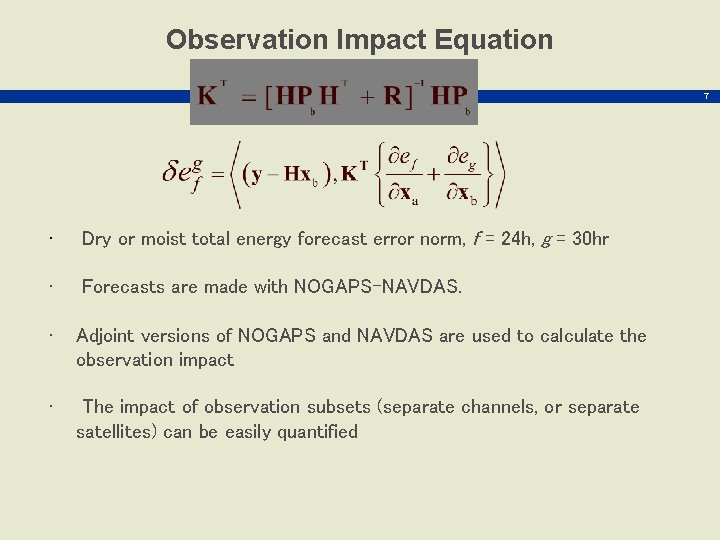
Observation Impact Equation 7 • Dry or moist total energy forecast error norm, f = 24 h, g = 30 hr • Forecasts are made with NOGAPS-NAVDAS. • Adjoint versions of NOGAPS and NAVDAS are used to calculate the observation impact • The impact of observation subsets (separate channels, or separate satellites) can be easily quantified
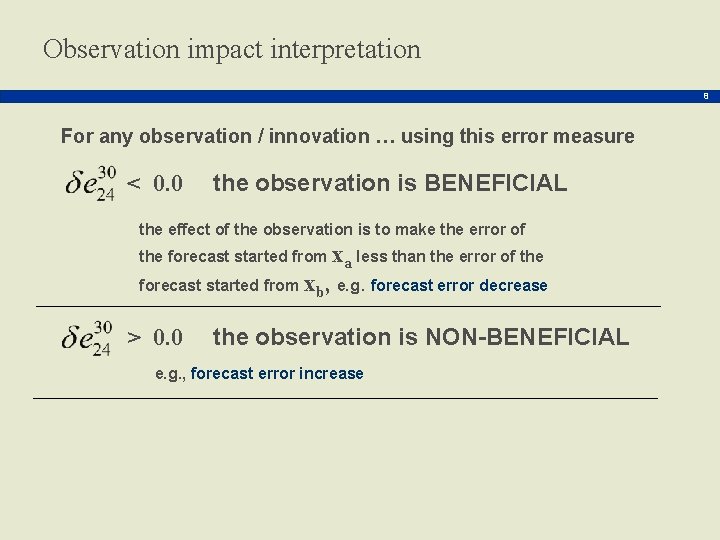
Observation impact interpretation 8 For any observation / innovation … using this error measure < 0. 0 the observation is BENEFICIAL the effect of the observation is to make the error of the forecast started from xa less than the error of the forecast started from xb, e. g. forecast error decrease > 0. 0 the observation is NON-BENEFICIAL e. g. , forecast error increase
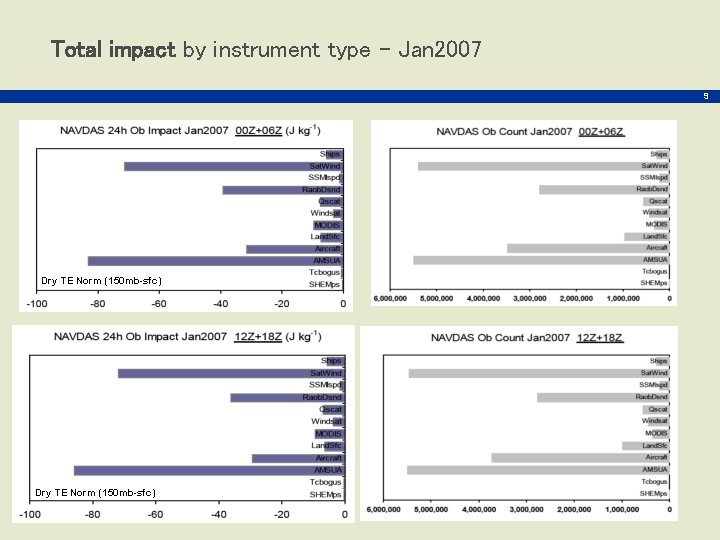
Total impact by instrument type – Jan 2007 9 Dry TE Norm (150 mb-sfc)
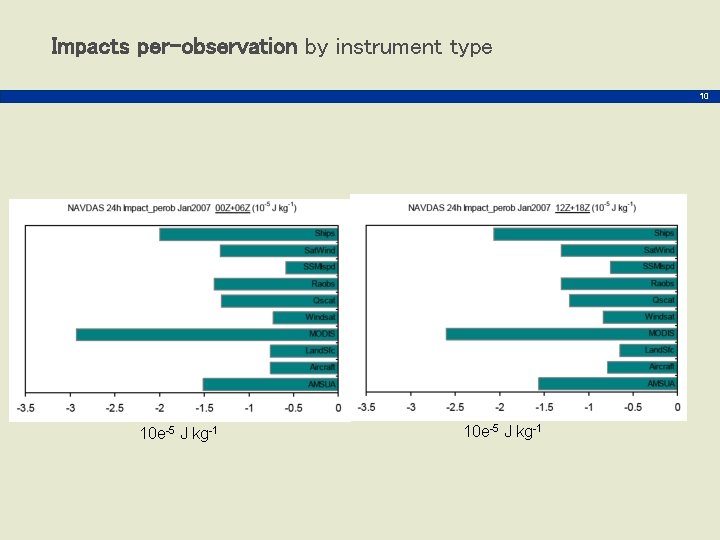
Impacts per-observation by instrument type 10 10 e-5 J kg-1
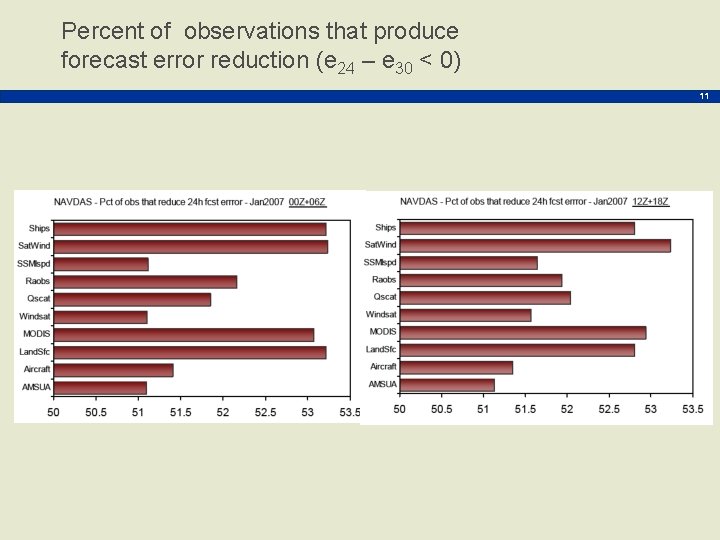
Percent of observations that produce forecast error reduction (e 24 – e 30 < 0) 11
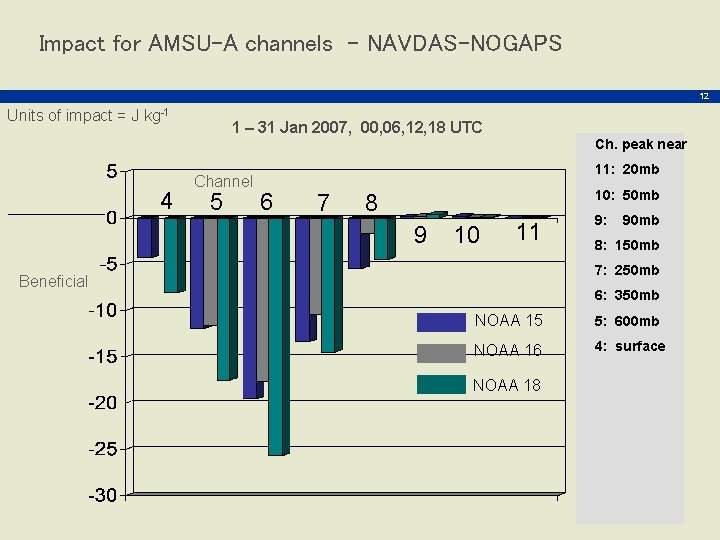
Impact for AMSU-A channels - NAVDAS-NOGAPS 12 Units of impact = J kg-1 1 – 31 Jan 2007, 00, 06, 12, 18 UTC Ch. peak near 4 Channel 5 11: 20 mb 6 7 10: 50 mb 8 9 10 11 9: 90 mb 8: 150 mb 7: 250 mb Beneficial 6: 350 mb NOAA 15 5: 600 mb NOAA 16 4: surface NOAA 18
Why do some “good data” have non-beneficial impact ? 13 • Observation and background error statistics for data assimilation cannot be precisely specified • This implies a statistical distribution of beneficial and nonbeneficial observation impacts • Assimilating the global set of observations improves the analysis and forecast, even though 40 -50% of observation data are non-beneficial in any selected assimilation Information about the impact of individual observations and subsets of observations can be used to improve the data assimilation and observation selection procedures
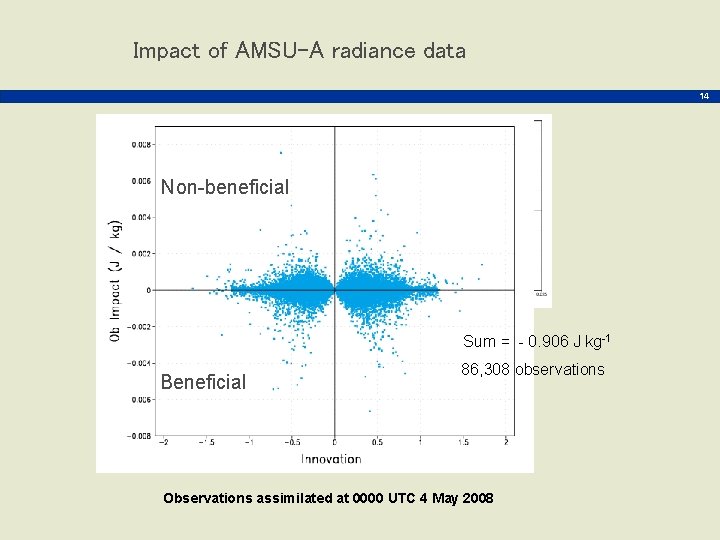
Impact of AMSU-A radiance data 14 Non-beneficial Sum = - 0. 906 J kg-1 Beneficial 86, 308 observations Observations assimilated at 0000 UTC 4 May 2008
Interpretation of observation impact 15 • Non-beneficial impacts: look for data QC issues, instrument accuracy, specification of observation and background errors, bias correction, or model (background) problems … • Beneficial impacts: associated with heavily weighted observations in sensitive regions; “good”, but extreme impacts indicate need for greater observation density … Best strategy: many observations which produce small to moderate impacts, not few observations which produce large impacts …
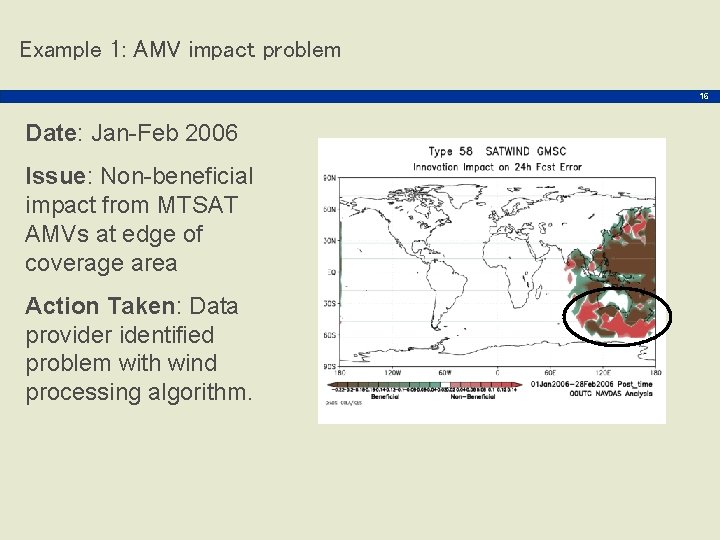
Example 1: AMV impact problem 16 Date: Jan-Feb 2006 Issue: Non-beneficial impact from MTSAT AMVs at edge of coverage area Action Taken: Data provider identified problem with wind processing algorithm.
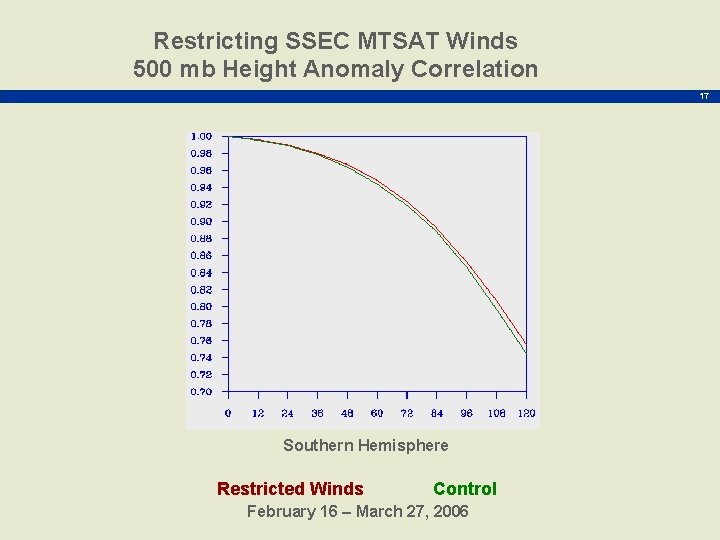
Restricting SSEC MTSAT Winds 500 mb Height Anomaly Correlation 17 Southern Hemisphere Restricted Winds Control February 16 – March 27, 2006
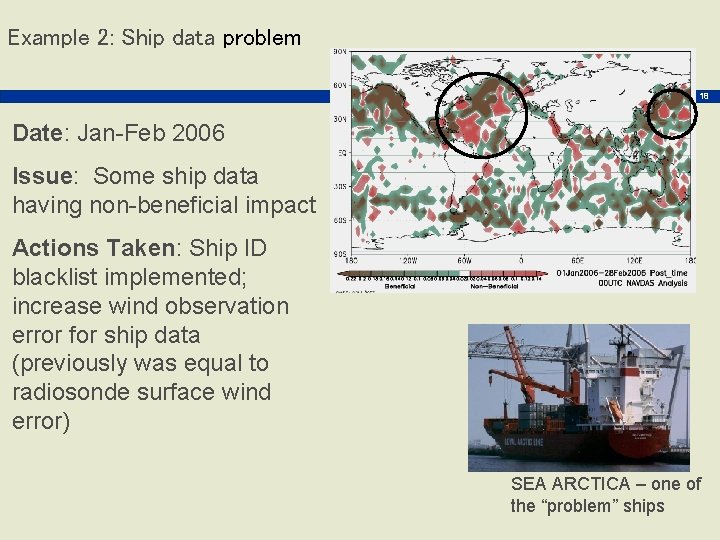
Example 2: Ship data problem 18 Date: Jan-Feb 2006 Issue: Some ship data having non-beneficial impact Actions Taken: Ship ID blacklist implemented; increase wind observation error for ship data (previously was equal to radiosonde surface wind error) SEA ARCTICA – one of the “problem” ships
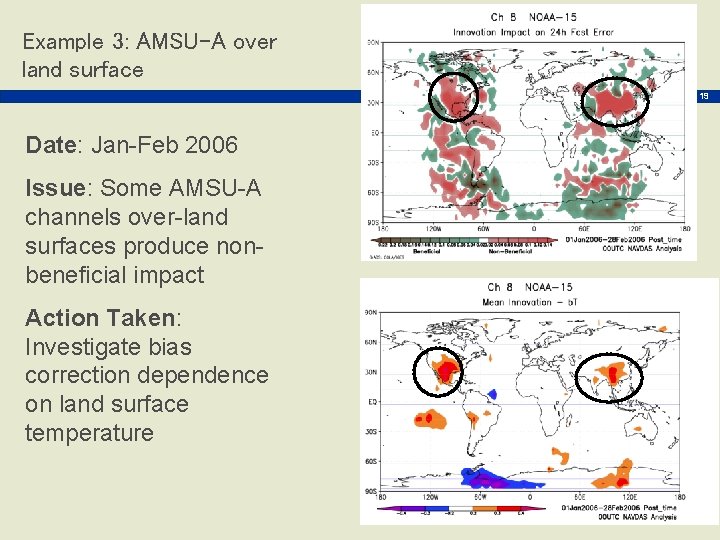
Example 3: AMSU-A over land surface 19 Date: Jan-Feb 2006 Issue: Some AMSU-A channels over-land surfaces produce nonbeneficial impact Action Taken: Investigate bias correction dependence on land surface temperature
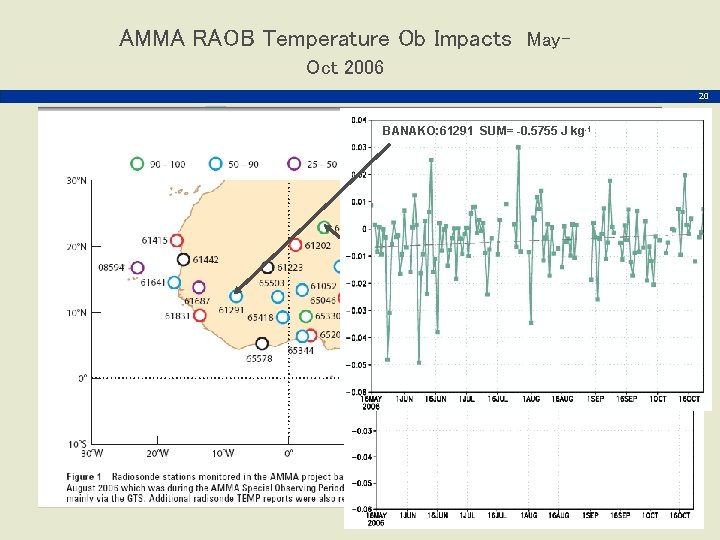
AMMA RAOB Temperature Ob Impacts May. Oct 2006 20 BANAKO: 61291 SUM= -0. 5755 J kg-1 TAMANASET: 60680 SUM= -0. 2791 J kg-1
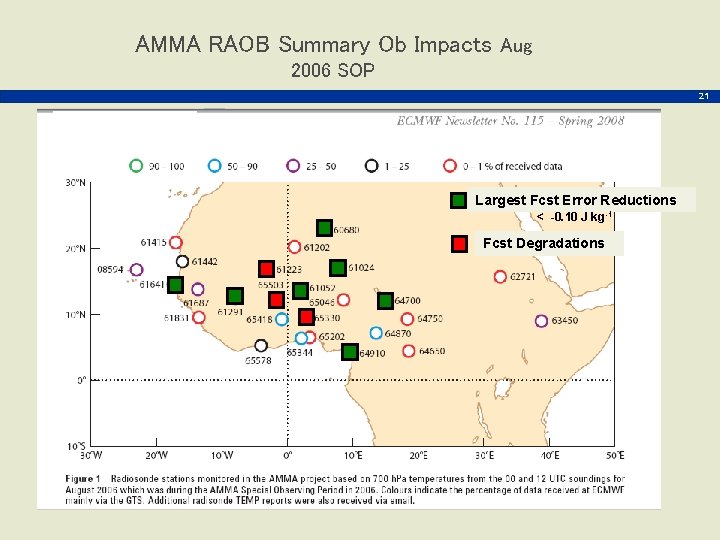
AMMA RAOB Summary Ob Impacts Aug 2006 SOP 21 Largest Fcst Error Reductions < -0. 10 J kg-1 Fcst Degradations
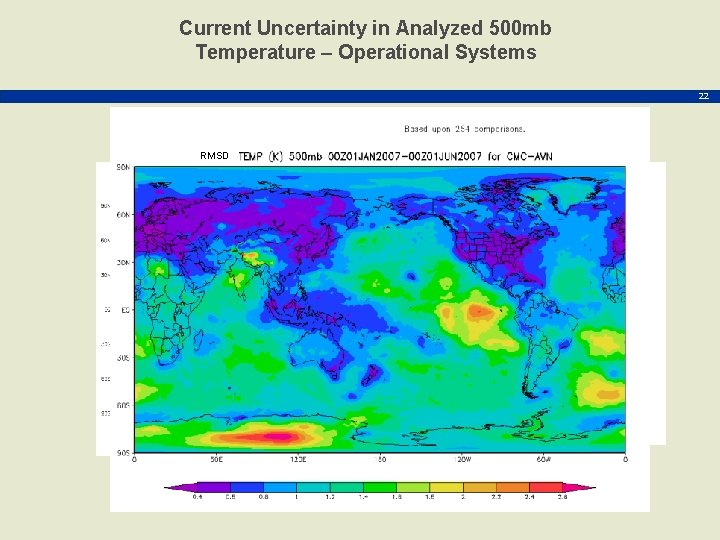
Current Uncertainty in Analyzed 500 mb Temperature – Operational Systems 22 RMSD
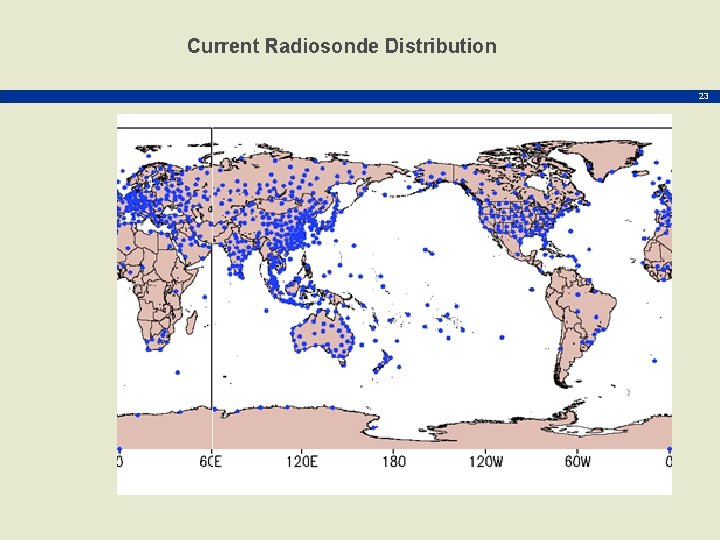
Current Radiosonde Distribution 23
Applications of observation impact information 24 • Adjoint-based observation impact information is a valuable supplement to “conventional” data impact studies (OSEs, OSSEs) • Provides quantitative information about every observation that is assimilated and spatial patterns in observation impact • Identifies possible problems with NAVDAS (observation and background error, bias correction, etc. ) • Information is relevant to QC issues and daily monitoring of observations in operational data assimilation
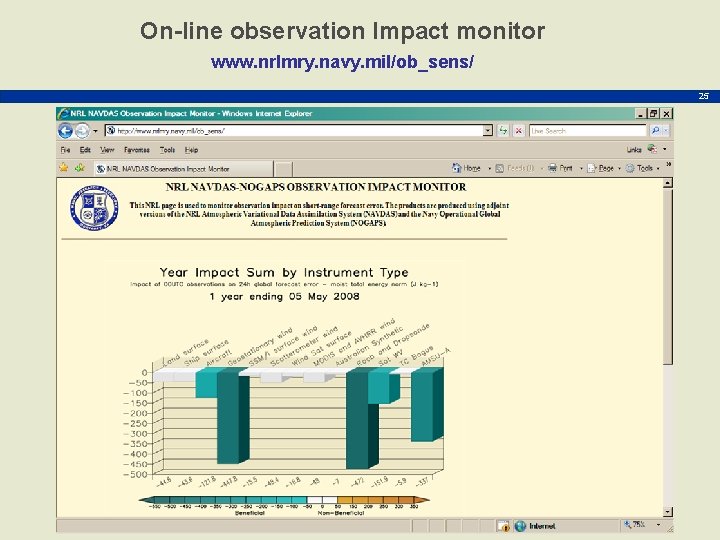
On-line observation Impact monitor www. nrlmry. navy. mil/ob_sens/ 25
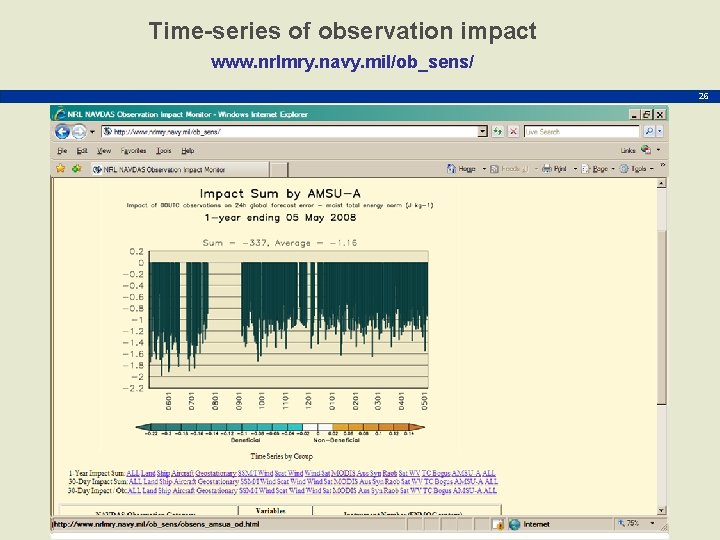
Time-series of observation impact www. nrlmry. navy. mil/ob_sens/ 26
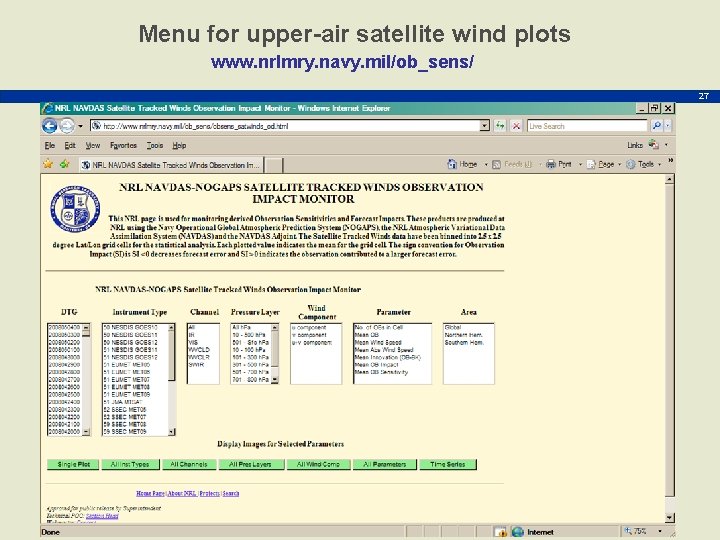
Menu for upper-air satellite wind plots www. nrlmry. navy. mil/ob_sens/ 27
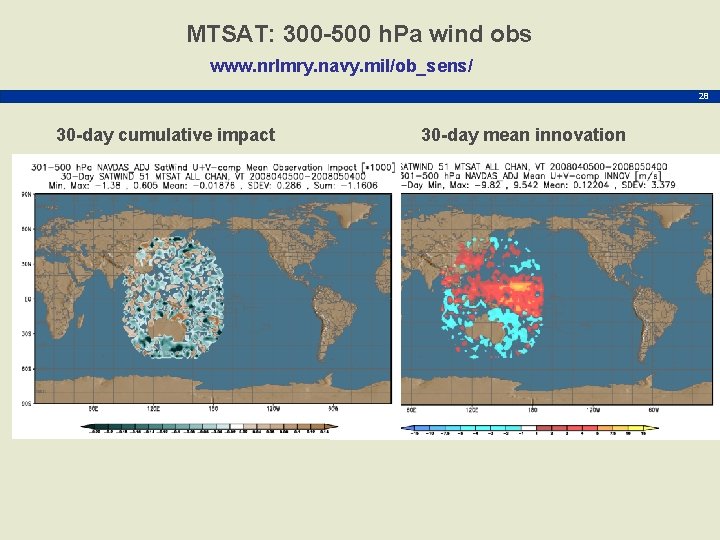
MTSAT: 300 -500 h. Pa wind obs www. nrlmry. navy. mil/ob_sens/ 28 30 -day cumulative impact 30 -day mean innovation
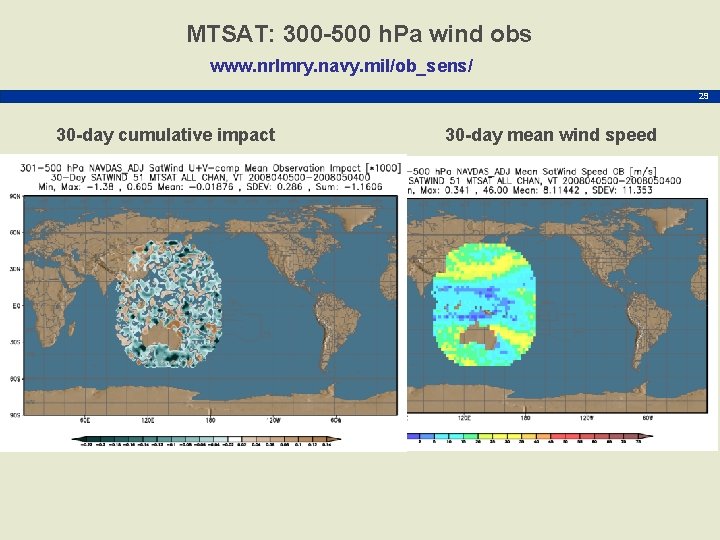
MTSAT: 300 -500 h. Pa wind obs www. nrlmry. navy. mil/ob_sens/ 29 30 -day cumulative impact 30 -day mean wind speed
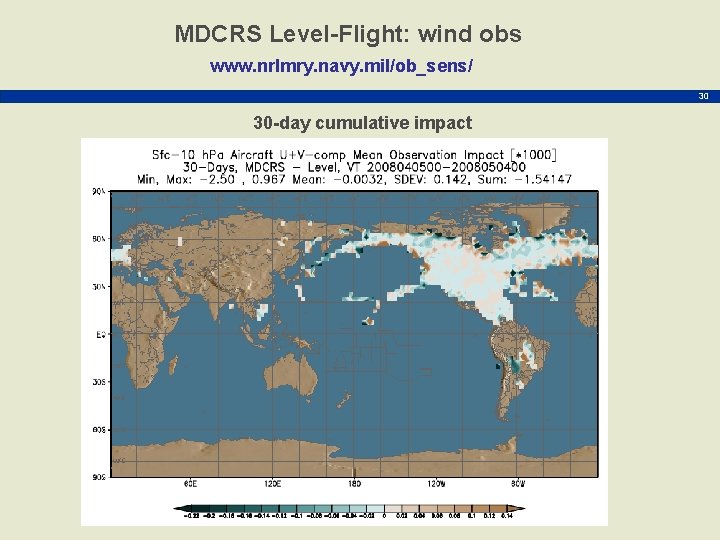
MDCRS Level-Flight: wind obs www. nrlmry. navy. mil/ob_sens/ 30 30 -day cumulative impact
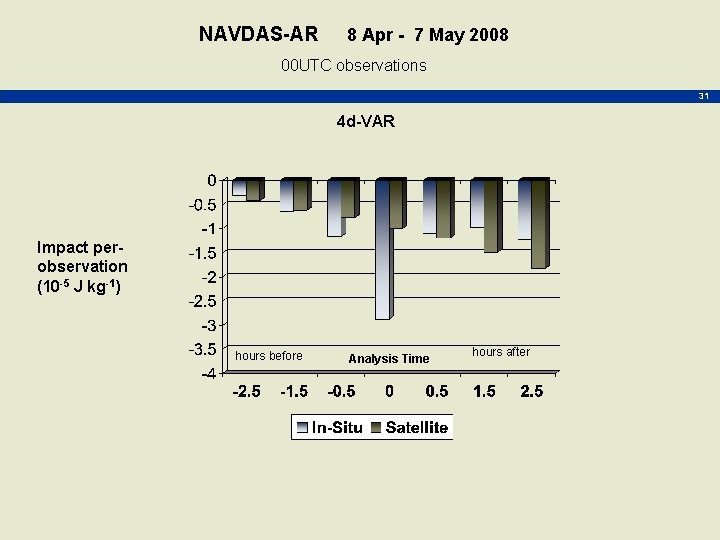
NAVDAS-AR 8 Apr - 7 May 2008 00 UTC observations 31 4 d-VAR Impact perobservation (10 -5 J kg-1) hours before Analysis Time hours after
Summary 32 • An adjoint-based system has been developed for daily (currently for 00 UTC) monitoring of all observations used in data assimilation (3 d-VAR and 4 d-VAR) at NRL-FNMOC • Computational cost is slightly less than the regular data assimilation and (24 h) nonlinear forecast • Information can be used for observation quality-control and improvement of the data assimilation procedure – valuable supplement to data-denial or data-addition experiments
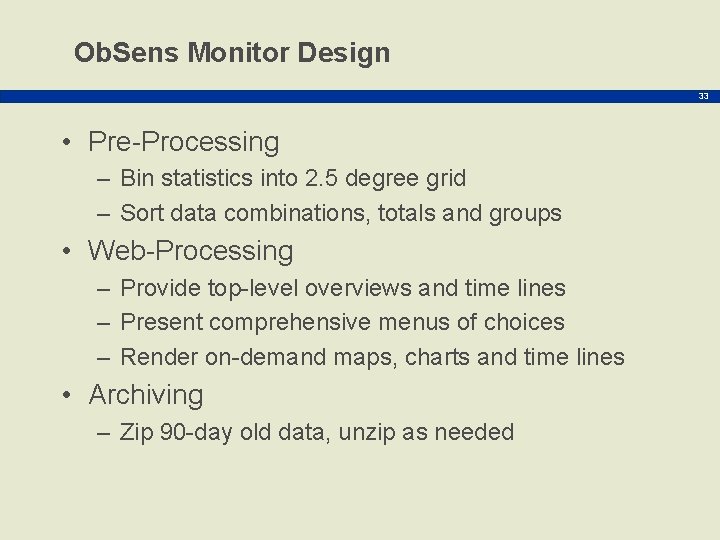
Ob. Sens Monitor Design 33 • Pre-Processing – Bin statistics into 2. 5 degree grid – Sort data combinations, totals and groups • Web-Processing – Provide top-level overviews and time lines – Present comprehensive menus of choices – Render on-demand maps, charts and time lines • Archiving – Zip 90 -day old data, unzip as needed
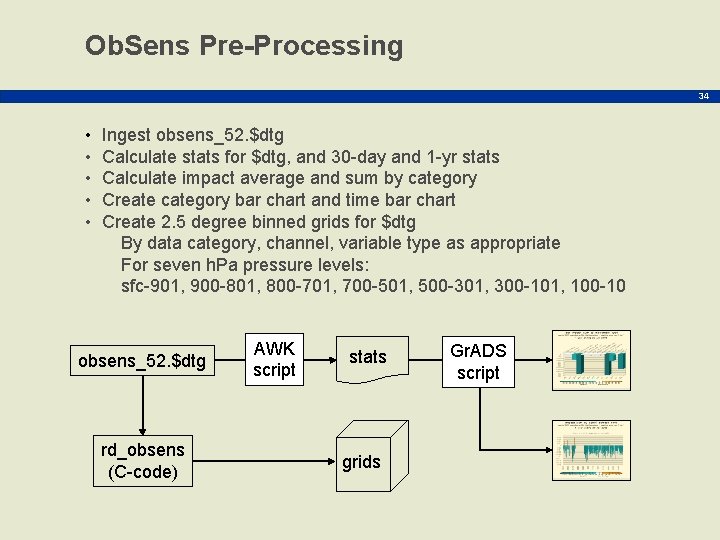
Ob. Sens Pre-Processing 34 • • • Ingest obsens_52. $dtg Calculate stats for $dtg, and 30 -day and 1 -yr stats Calculate impact average and sum by category Create category bar chart and time bar chart Create 2. 5 degree binned grids for $dtg By data category, channel, variable type as appropriate For seven h. Pa pressure levels: sfc-901, 900 -801, 800 -701, 700 -501, 500 -301, 300 -101, 100 -10 obsens_52. $dtg rd_obsens (C-code) AWK script stats grids Gr. ADS script
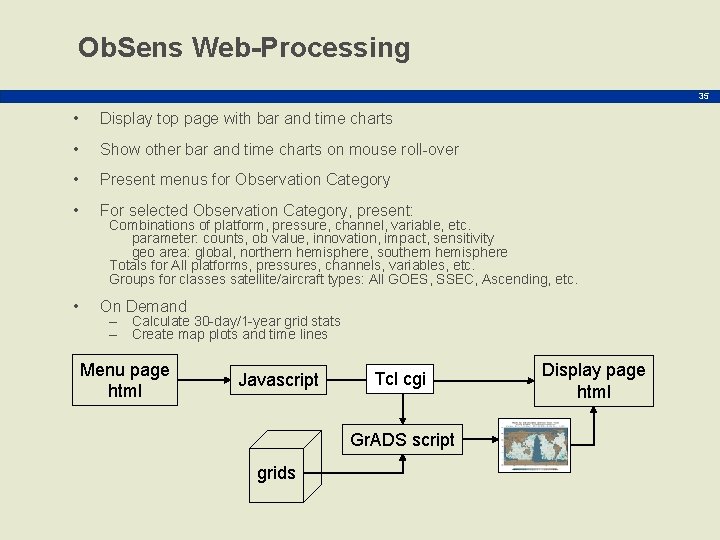
Ob. Sens Web-Processing 35 • Display top page with bar and time charts • Show other bar and time charts on mouse roll-over • Present menus for Observation Category • For selected Observation Category, present: • On Demand Combinations of platform, pressure, channel, variable, etc. parameter: counts, ob value, innovation, impact, sensitivity geo area: global, northern hemisphere, southern hemisphere Totals for All platforms, pressures, channels, variables, etc. Groups for classes satellite/aircraft types: All GOES, SSEC, Ascending, etc. – Calculate 30 -day/1 -year grid stats – Create map plots and time lines Menu page html Javascript Tcl cgi Gr. ADS script grids Display page html
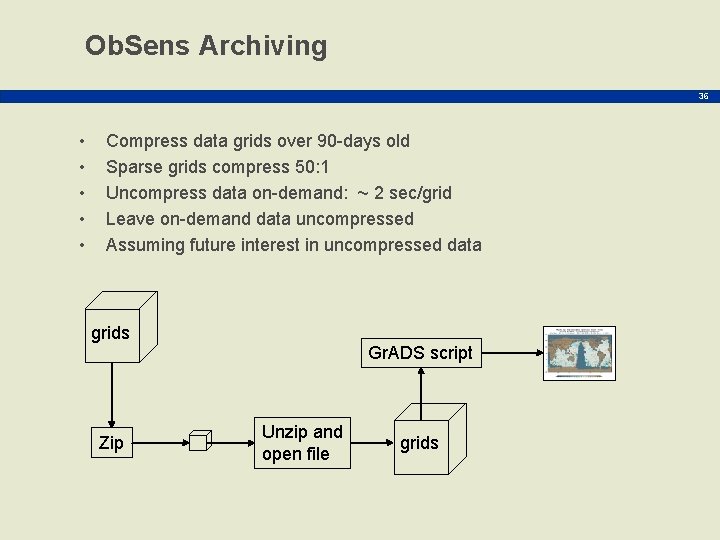
Ob. Sens Archiving 36 • • • Compress data grids over 90 -days old Sparse grids compress 50: 1 Uncompress data on-demand: ~ 2 sec/grid Leave on-demand data uncompressed Assuming future interest in uncompressed data grids Zip Gr. ADS script Unzip and open file grids
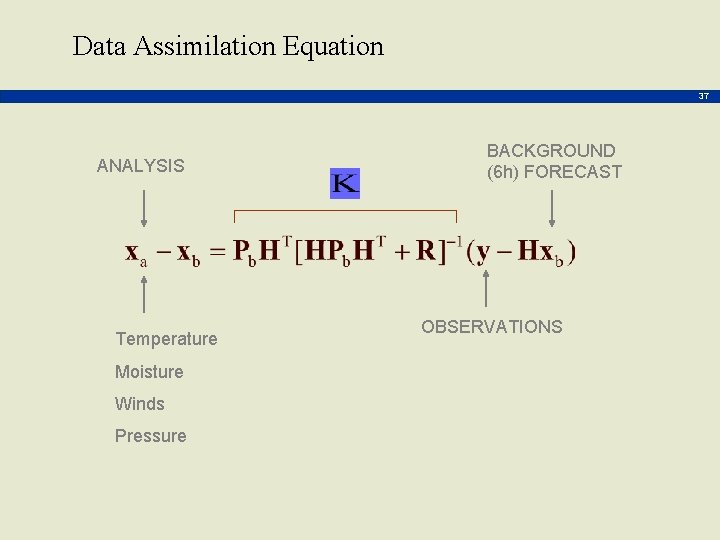
Data Assimilation Equation 37 ANALYSIS Temperature Moisture Winds Pressure BACKGROUND (6 h) FORECAST OBSERVATIONS
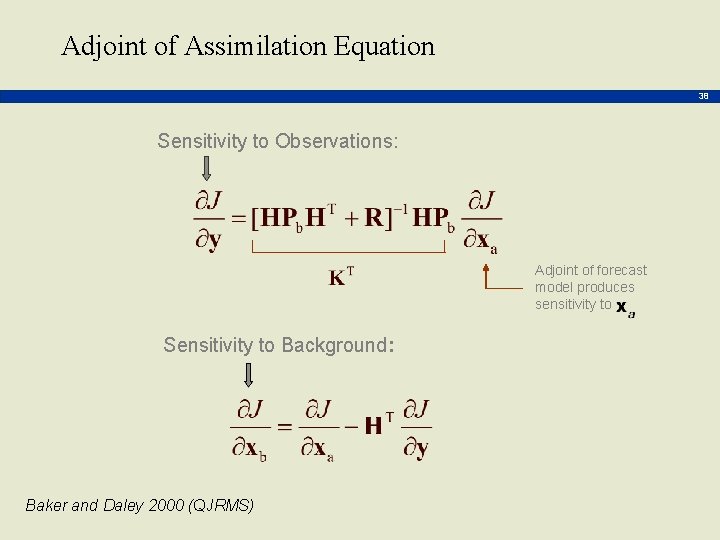
Adjoint of Assimilation Equation 38 Sensitivity to Observations: Adjoint of forecast model produces sensitivity to Sensitivity to Background: Baker and Daley 2000 (QJRMS)
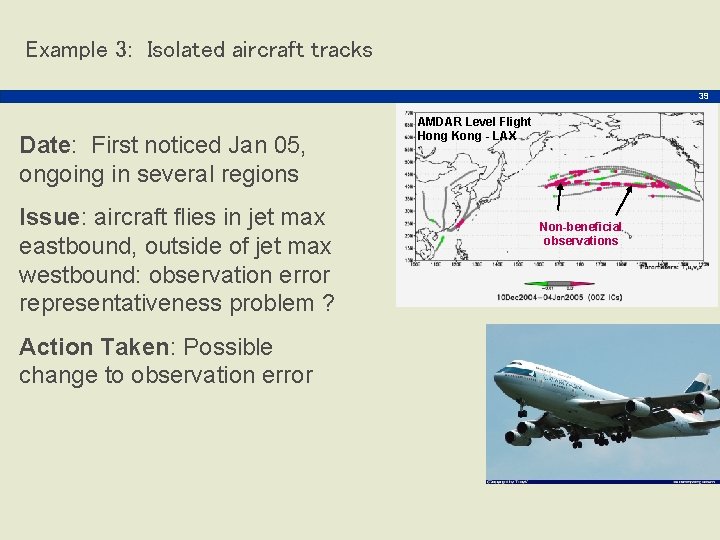
Example 3: Isolated aircraft tracks 39 Date: First noticed Jan 05, ongoing in several regions Issue: aircraft flies in jet max eastbound, outside of jet max westbound: observation error representativeness problem ? Action Taken: Possible change to observation error AMDAR Level Flight Hong Kong - LAX Non-beneficial observations
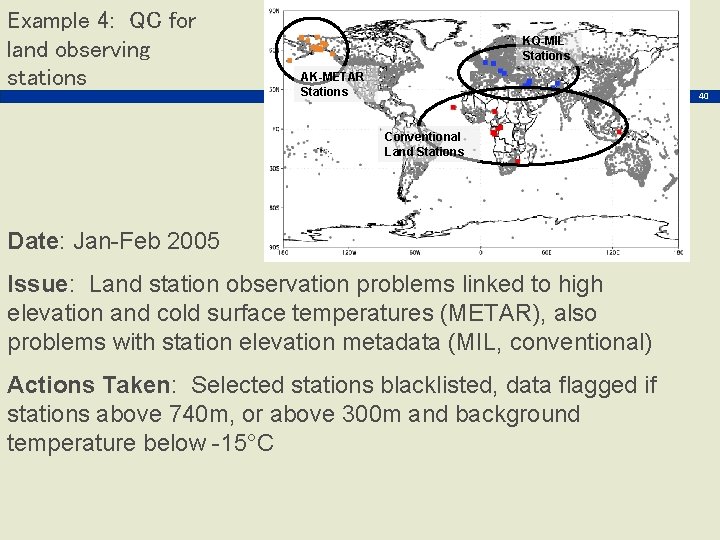
Example 4: QC for land observing stations KQ-MIL Stations AK-METAR Stations 40 Conventional Land Stations Date: Jan-Feb 2005 Issue: Land station observation problems linked to high elevation and cold surface temperatures (METAR), also problems with station elevation metadata (MIL, conventional) Actions Taken: Selected stations blacklisted, data flagged if stations above 740 m, or above 300 m and background temperature below -15°C
- Slides: 40