
ADJECTIVES WHAT IS AN ADJECTIVE Adjectives are words

- Slides: 22
ADJECTIVES
WHAT IS AN ADJECTIVE? • Adjectives are words that describe nouns. • Adjectives answer such questions as: What kind? Which one? How many? How much? etc.
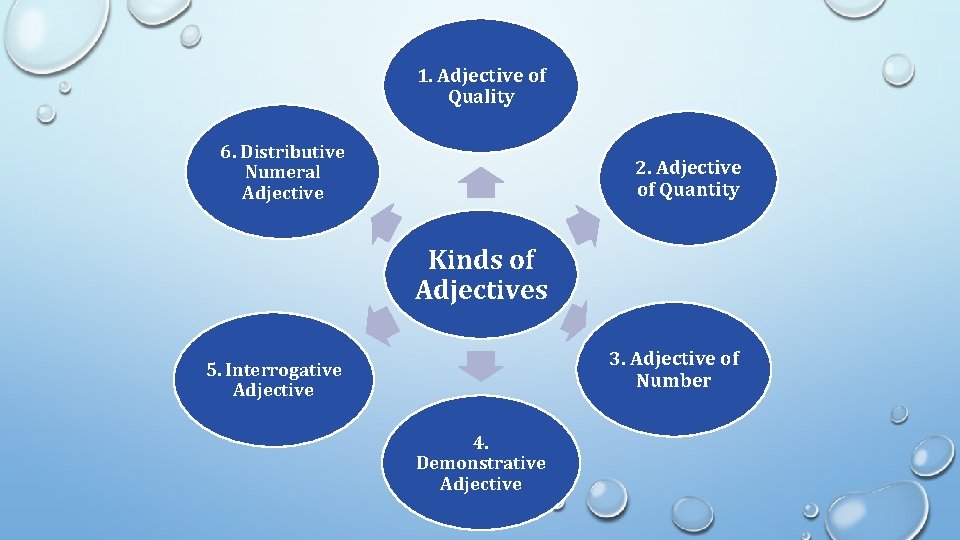
1. Adjective of Quality 6. Distributive Numeral Adjective 2. Adjective of Quantity Kinds of Adjectives 3. Adjective of Number 5. Interrogative Adjective 4. Demonstrative Adjective
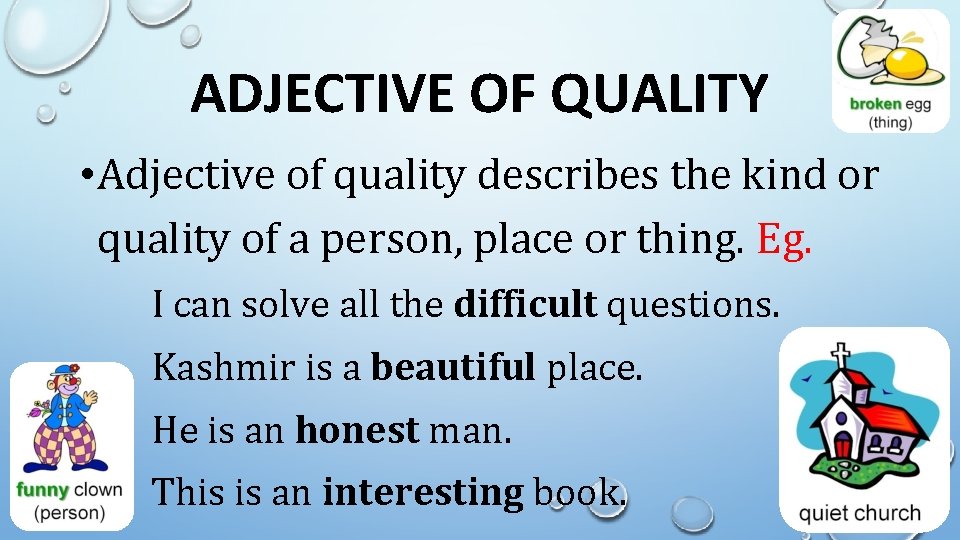
ADJECTIVE OF QUALITY • Adjective of quality describes the kind or quality of a person, place or thing. Eg. I can solve all the difficult questions. Kashmir is a beautiful place. He is an honest man. This is an interesting book.
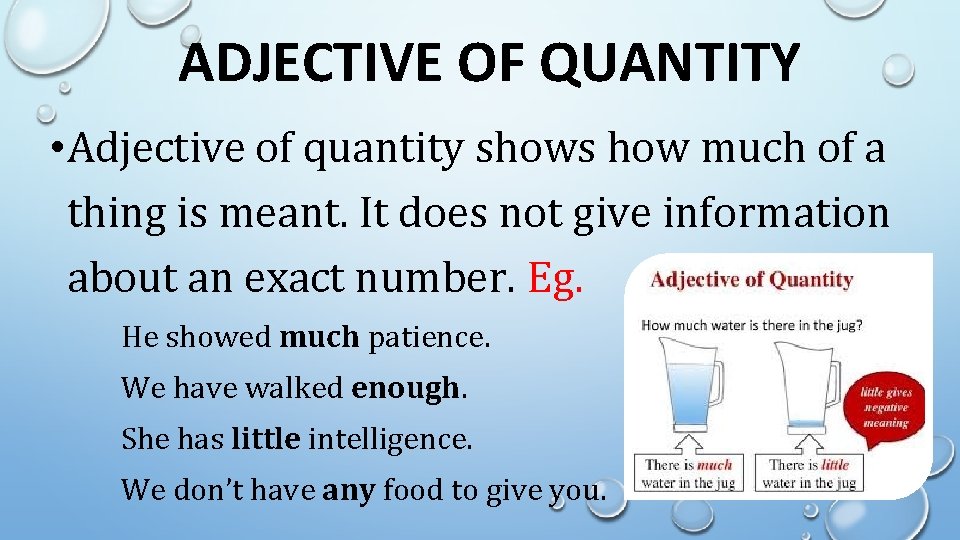
ADJECTIVE OF QUANTITY • Adjective of quantity shows how much of a thing is meant. It does not give information about an exact number. Eg. He showed much patience. We have walked enough. She has little intelligence. We don’t have any food to give you.
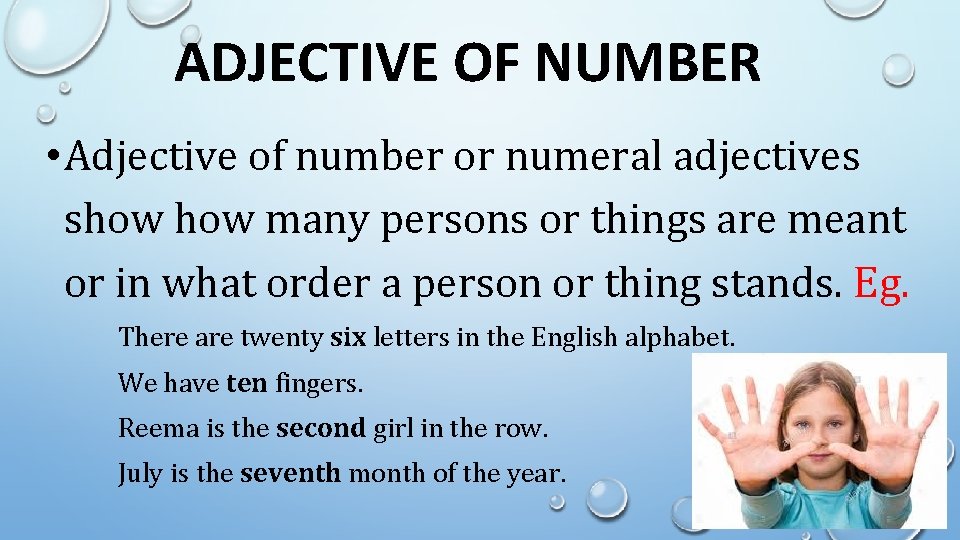
ADJECTIVE OF NUMBER • Adjective of number or numeral adjectives show many persons or things are meant or in what order a person or thing stands. Eg. There are twenty six letters in the English alphabet. We have ten fingers. Reema is the second girl in the row. July is the seventh month of the year.
DEMONSTRATIVE ADJECTIVES • Demonstrative adjectives point out particular persons or things. They answer the question ‘which’. They are followed by a noun. Eg. This boy is hardworking. That house belongs to us. These books are new. Those flowers are fresh.
INTERROGATIVE ADJECTIVES • Interrogative adjectives are used with nouns to ask questions. Eg. Whose house is this? What time is it? Which book do you want?
DISTRIBUTIVE NUMERAL ADJECTIVES • Distributive numeral adjectives refer to each one of a number. Eg. Each boy must take his turn. Every word of the news is false. There are lush green trees on either side of the road. Neither of the boys was honest.
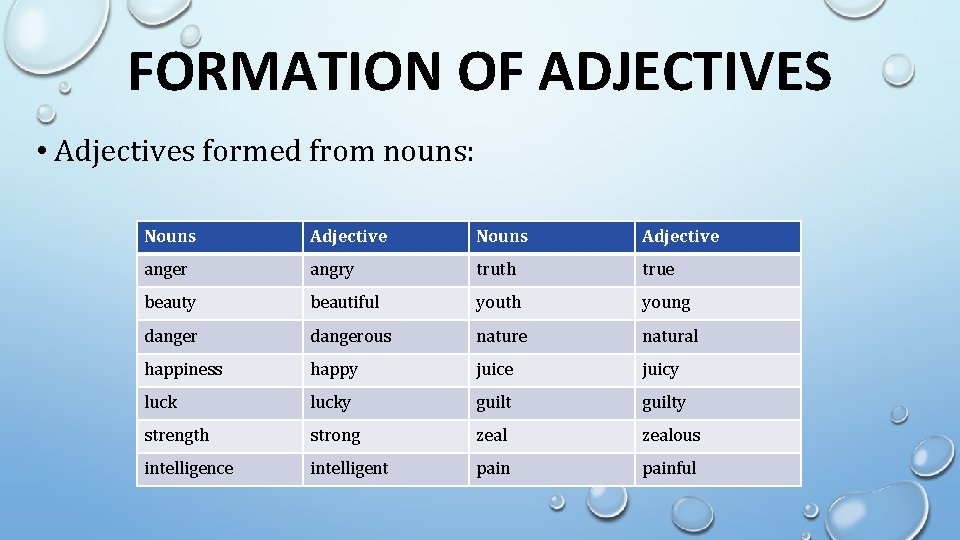
FORMATION OF ADJECTIVES • Adjectives formed from nouns: Nouns Adjective anger angry truth true beauty beautiful youth young dangerous nature natural happiness happy juice juicy lucky guilty strength strong zealous intelligence intelligent painful
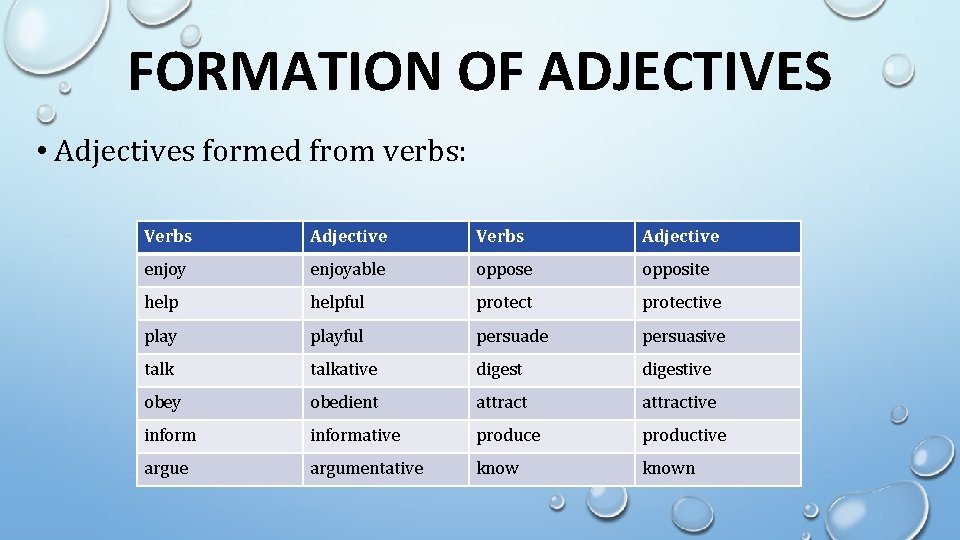
FORMATION OF ADJECTIVES • Adjectives formed from verbs: Verbs Adjective enjoyable opposite helpful protective playful persuade persuasive talkative digestive obey obedient attractive informative productive argumentative known
COMPARISON OF ADJECTIVES There are three forms of comparison: • POSITIVE • COMPARATIVE • SUPERLATIVE
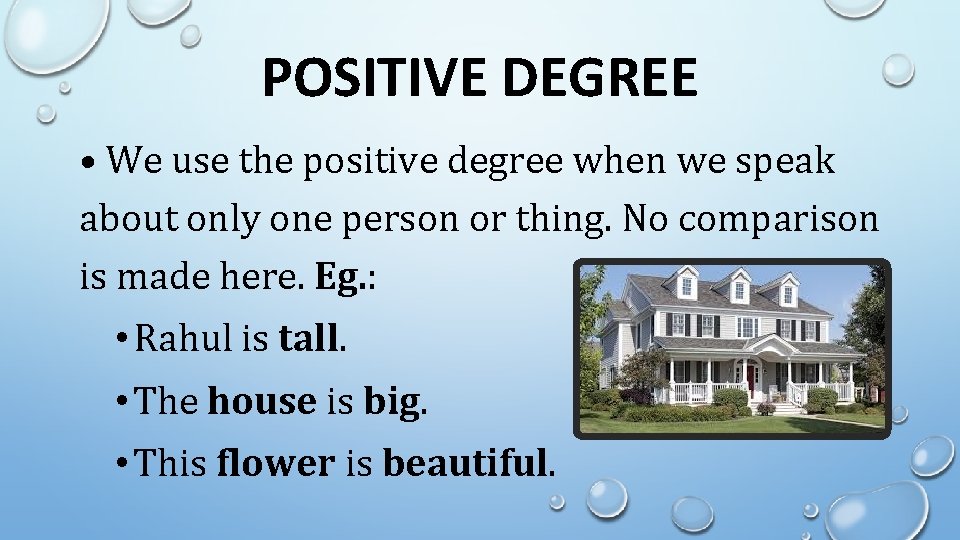
POSITIVE DEGREE • We use the positive degree when we speak about only one person or thing. No comparison is made here. Eg. : • Rahul is tall. • The house is big. • This flower is beautiful.
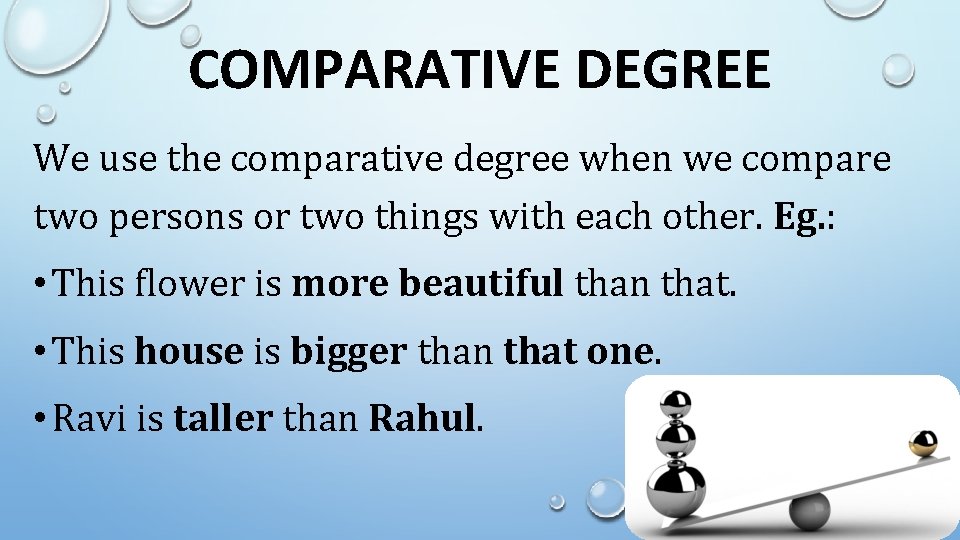
COMPARATIVE DEGREE We use the comparative degree when we compare two persons or two things with each other. Eg. : • This flower is more beautiful than that. • This house is bigger than that one. • Ravi is taller than Rahul.
SUPERLATIVE DEGREE We use the superlative degree when we compare more than two persons or things with one another. It is the highest degree of the quality. Eg. : • Peter is the smartest boy in class. • Alice is the sweetest girl in the neighbourhood. • The blue whale is the largest of all animals.
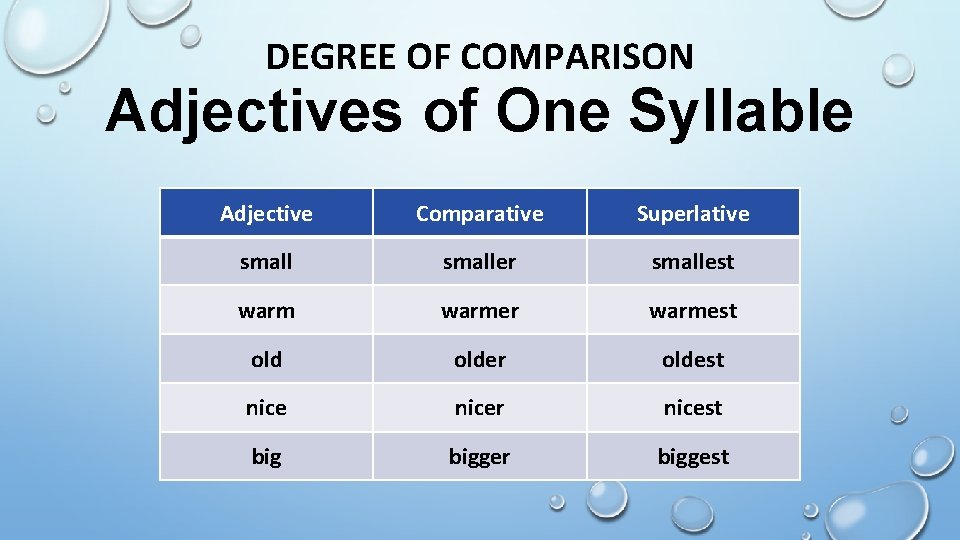
DEGREE OF COMPARISON Adjectives of One Syllable • Adjectives of one syllable add -er and -est in comparative and superlative degrees respectively. • Adjectives ending on 'e' just add -r and -st. • Some adjectives double the final consonant.
DEGREE OF COMPARISON Adjectives of One Syllable Adjective Comparative Superlative smaller smallest warmer warmest older oldest nicer nicest bigger biggest
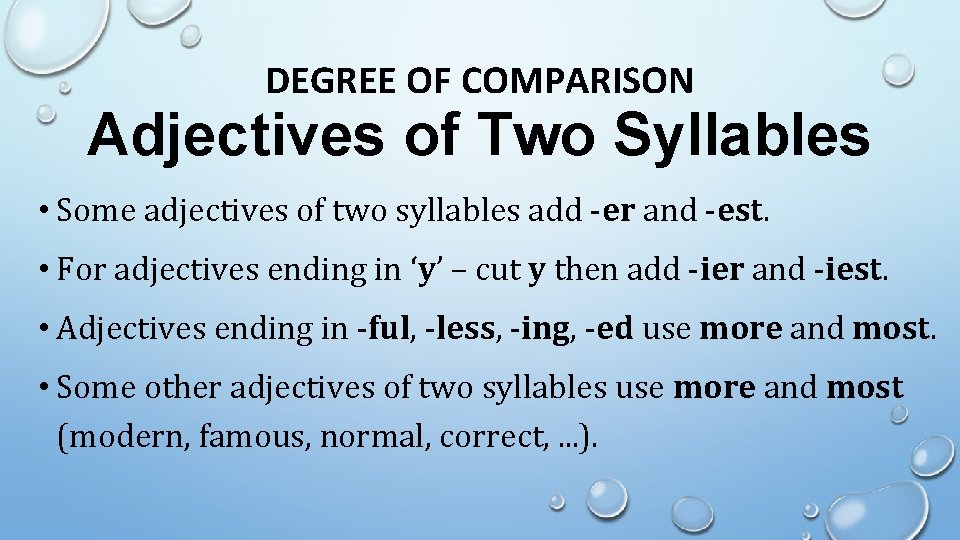
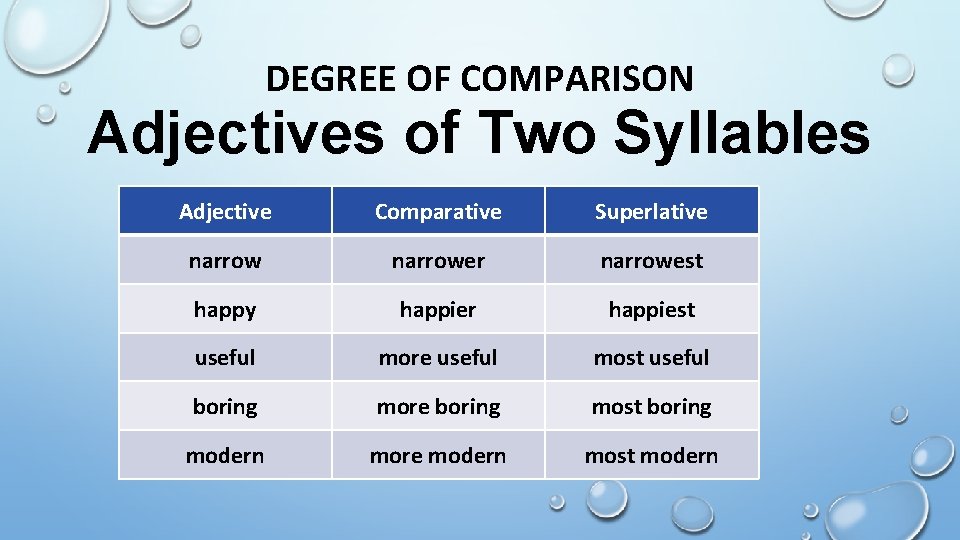
DEGREE OF COMPARISON Adjectives of Two Syllables • Some adjectives of two syllables add -er and -est. • For adjectives ending in ‘y’ – cut y then add -ier and -iest. • Adjectives ending in -ful, -less, -ing, -ed use more and most. • Some other adjectives of two syllables use more and most (modern, famous, normal, correct, . . . ).
DEGREE OF COMPARISON Adjectives of Two Syllables Adjective Comparative Superlative narrower narrowest happy happier happiest useful more useful most useful boring more boring most boring modern more modern most modern
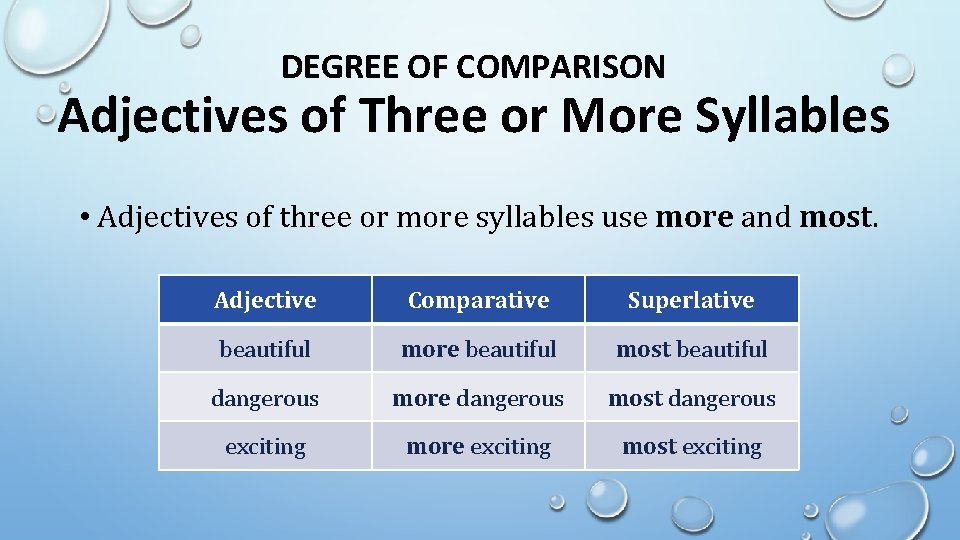
DEGREE OF COMPARISON Adjectives of Three or More Syllables • Adjectives of three or more syllables use more and most. Adjective Comparative Superlative beautiful more beautiful most beautiful dangerous more dangerous most dangerous exciting more exciting most exciting
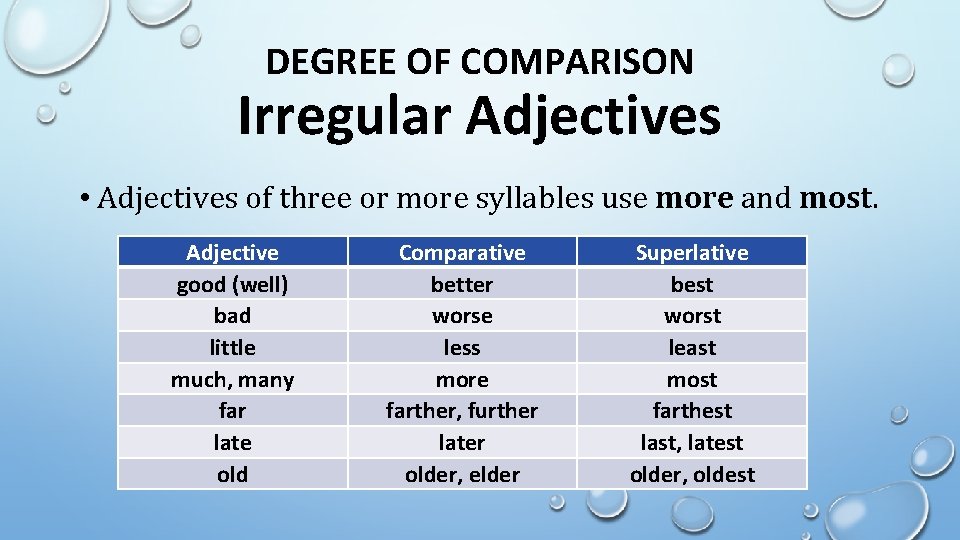
DEGREE OF COMPARISON Irregular Adjectives • Adjectives of three or more syllables use more and most. Adjective good (well) bad little much, many far late old Comparative better worse less more farther, further later older, elder Superlative best worst least most farthest last, latest older, oldest