
ADJECTIVES Lecture 6 An adjective an open class

- Slides: 23
ADJECTIVES Lecture 6
An adjective: • an open class of words • describes words • qualifies a noun or noun phrase, giving more information about the object signified • new adjectives formed via derivation
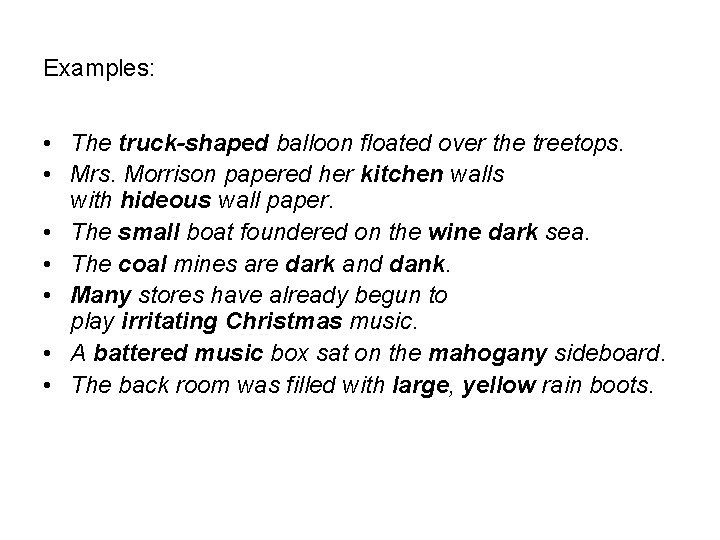
Examples: • The truck-shaped balloon floated over the treetops. • Mrs. Morrison papered her kitchen walls with hideous wall paper. • The small boat foundered on the wine dark sea. • The coal mines are dark and dank. • Many stores have already begun to play irritating Christmas music. • A battered music box sat on the mahogany sideboard. • The back room was filled with large, yellow rain boots.
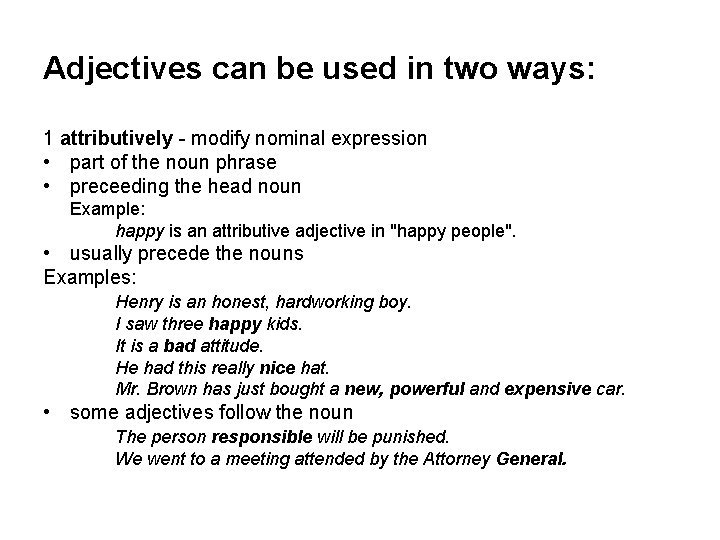
Adjectives can be used in two ways: 1 attributively - modify nominal expression • part of the noun phrase • preceeding the head noun Example: happy is an attributive adjective in "happy people". • usually precede the nouns Examples: Henry is an honest, hardworking boy. I saw three happy kids. It is a bad attitude. He had this really nice hat. Mr. Brown has just bought a new, powerful and expensive car. • some adjectives follow the noun The person responsible will be punished. We went to a meeting attended by the Attorney General.
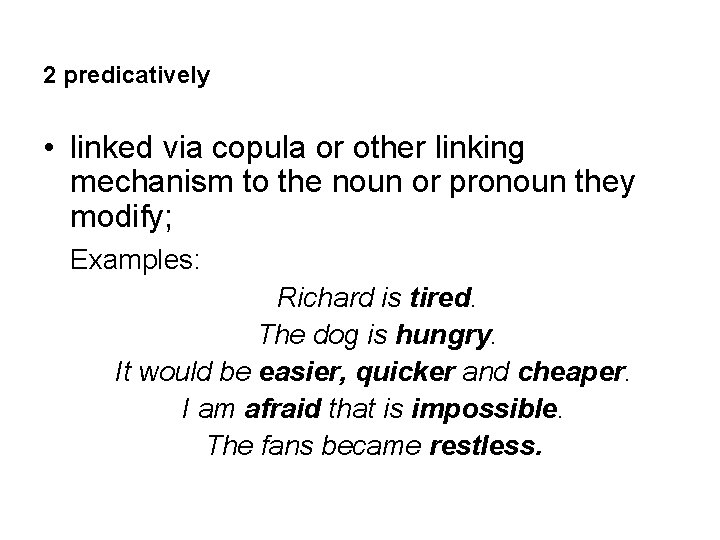
2 predicatively • linked via copula or other linking mechanism to the noun or pronoun they modify; Examples: Richard is tired. The dog is hungry. It would be easier, quicker and cheaper. I am afraid that is impossible. The fans became restless.
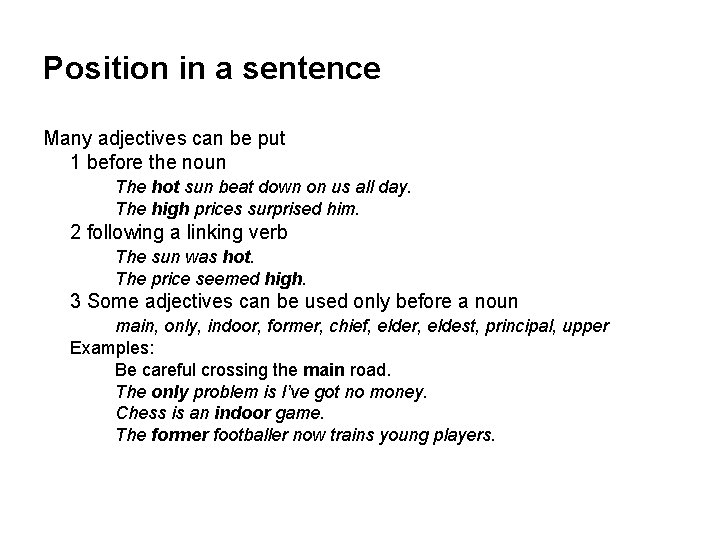
Position in a sentence Many adjectives can be put 1 before the noun The hot sun beat down on us all day. The high prices surprised him. 2 following a linking verb The sun was hot. The price seemed high. 3 Some adjectives can be used only before a noun main, only, indoor, former, chief, elder, eldest, principal, upper Examples: Be careful crossing the main road. The only problem is I’ve got no money. Chess is an indoor game. The former footballer now trains young players.
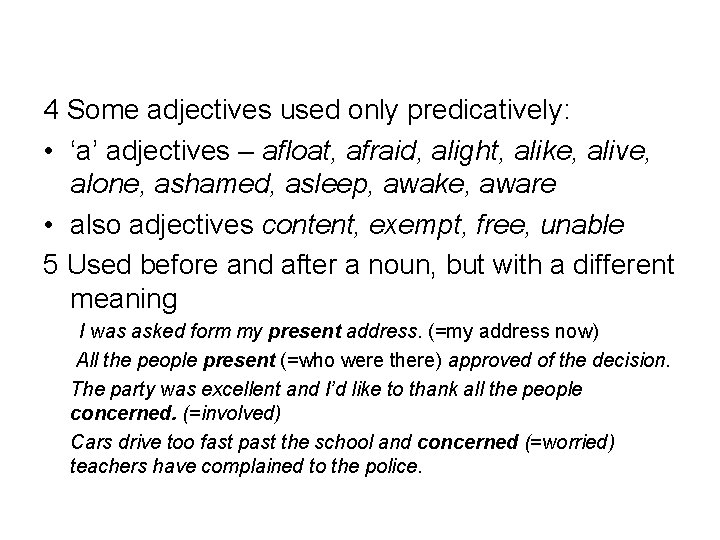
4 Some adjectives used only predicatively: • ‘a’ adjectives – afloat, afraid, alight, alike, alive, alone, ashamed, asleep, awake, aware • also adjectives content, exempt, free, unable 5 Used before and after a noun, but with a different meaning I was asked form my present address. (=my address now) All the people present (=who were there) approved of the decision. The party was excellent and I’d like to thank all the people concerned. (=involved) Cars drive too fast past the school and concerned (=worried) teachers have complained to the police.
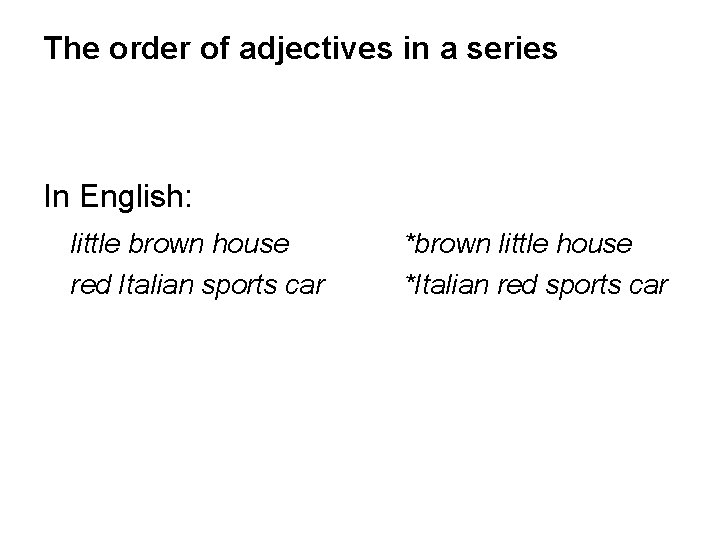
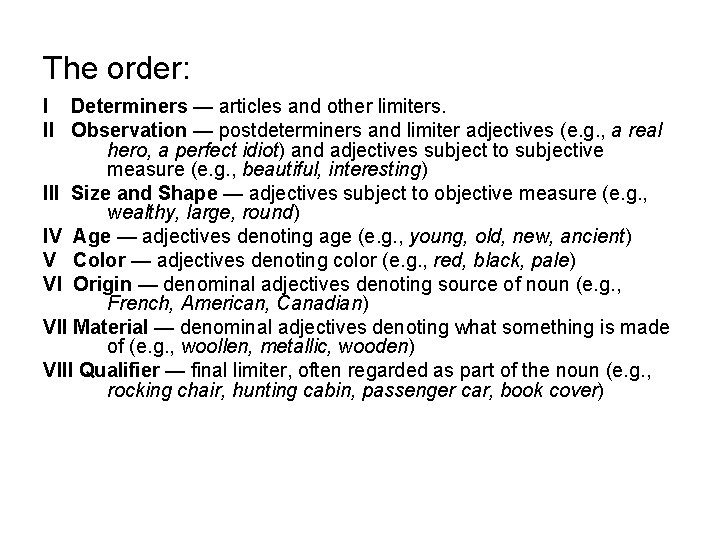
The order of adjectives in a series In English: little brown house red Italian sports car *brown little house *Italian red sports car
The order: I Determiners — articles and other limiters. II Observation — postdeterminers and limiter adjectives (e. g. , a real hero, a perfect idiot) and adjectives subject to subjective measure (e. g. , beautiful, interesting) III Size and Shape — adjectives subject to objective measure (e. g. , wealthy, large, round) IV Age — adjectives denoting age (e. g. , young, old, new, ancient) V Color — adjectives denoting color (e. g. , red, black, pale) VI Origin — denominal adjectives denoting source of noun (e. g. , French, American, Canadian) VII Material — denominal adjectives denoting what something is made of (e. g. , woollen, metallic, wooden) VIII Qualifier — final limiter, often regarded as part of the noun (e. g. , rocking chair, hunting cabin, passenger car, book cover)
The order of adjectives in a series Determiner observation size shape age color │ origin material qualifier noun a beatiful an expensive four gorgeous old antique long-stemmed red her short our big one nice Italian touring car silver silk roses black old little old white mirror hair English brick sheep-dog house
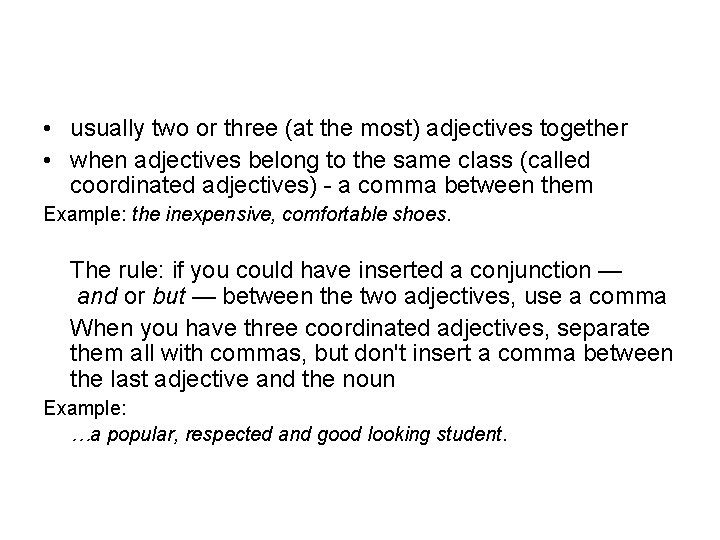
• usually two or three (at the most) adjectives together • when adjectives belong to the same class (called coordinated adjectives) - a comma between them Example: the inexpensive, comfortable shoes. The rule: if you could have inserted a conjunction — and or but — between the two adjectives, use a comma When you have three coordinated adjectives, separate them all with commas, but don't insert a comma between the last adjective and the noun Example: …a popular, respected and good looking student.
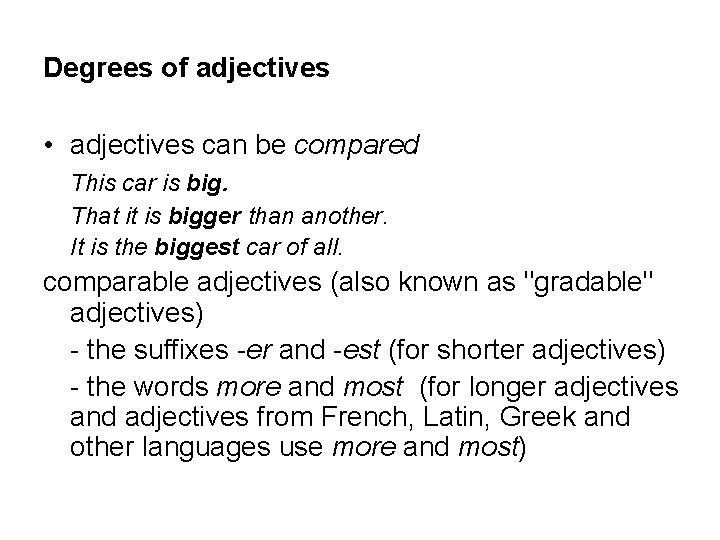
Degrees of adjectives • adjectives can be compared This car is big. That it is bigger than another. It is the biggest car of all. comparable adjectives (also known as "gradable" adjectives) - the suffixes -er and -est (for shorter adjectives) - the words more and most (for longer adjectives and adjectives from French, Latin, Greek and other languages use more and most)
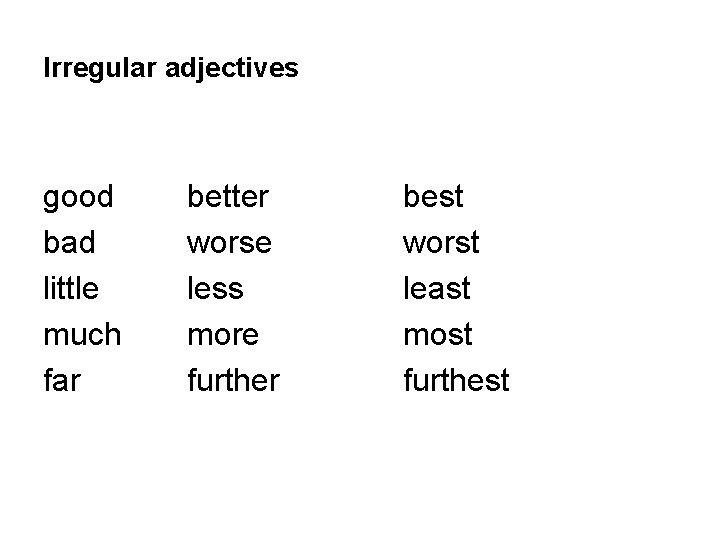
Irregular adjectives good bad little much far better worse less more further best worst least most furthest
Formation of adjectives New adjectives formed with derivational affixes and compounding 1 Participal adjectives • both –ing and –ed participle form can be used as a participle adjective Examples: -ing: promising, amazing, boring, exciting, increasing -ed: surprised, determine, ashamed, bored, complicated
2 Derived adjectives • derived by an adjectival suffix • common derivational suffixes: -al – central, final, general, annual, equal, legal, professional, total -ent – ancient, apparent, current, decent, dependent, excellent, recent, silent -ive – active, attractive, conservative, effective, expensive, massive, negative, passive -ous – anxious, conscious, serious, various, dangerous, nervous, obvious, previous -ate – appropriate, private, separate, accurate, adequate, immediate, intimate, moderate -ful – awful, cheerful, doubtful, grateful, helpful, painful, powerfu -less – endless, helpless, homeless, useless.
Adjectival compounds • a compact and integrated expression of information • have many shapes 1 adjective + adjective (greyish-blue) 2 adjective + noun (full-time) 3 noun + adjective (buterfly-blue) 4 adjective + adverb (overly-protective) Infolve also participal forms: open-minded, psychologically-disturbed, classroombased
Adjectival Opposites The opposite (the negative aspect) formed in a number of ways. 1. to find an adjective to mean the opposite – an antonym • Example: beautiful vs. ugly, tall vs. short
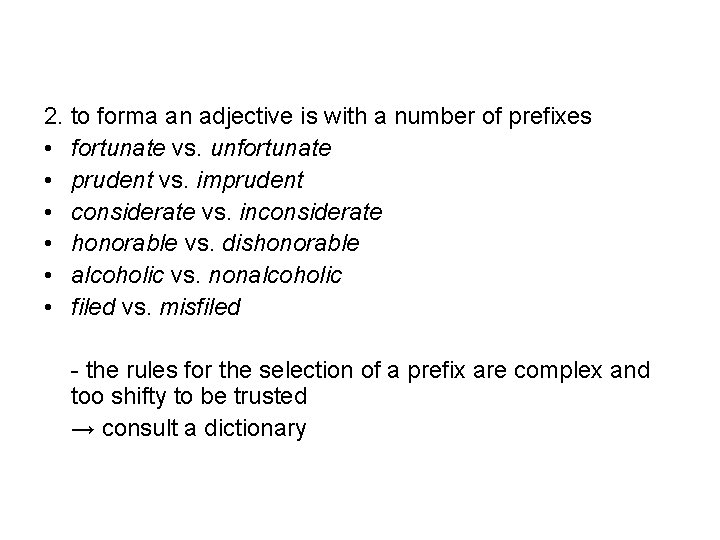
2. to forma an adjective is with a number of prefixes • fortunate vs. unfortunate • prudent vs. imprudent • considerate vs. inconsiderate • honorable vs. dishonorable • alcoholic vs. nonalcoholic • filed vs. misfiled - the rules for the selection of a prefix are complex and too shifty to be trusted → consult a dictionary
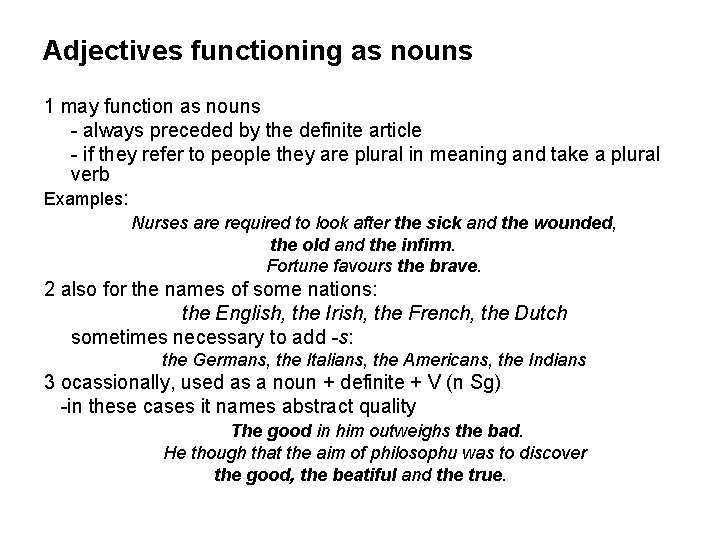
Adjectives functioning as nouns 1 may function as nouns - always preceded by the definite article - if they refer to people they are plural in meaning and take a plural verb Examples: Nurses are required to look after the sick and the wounded, the old and the infirm. Fortune favours the brave. 2 also for the names of some nations: the English, the Irish, the French, the Dutch sometimes necessary to add -s: the Germans, the Italians, the Americans, the Indians 3 ocassionally, used as a noun + definite + V (n Sg) -in these cases it names abstract quality The good in him outweighs the bad. He though that the aim of philosophu was to discover the good, the beatiful and the true.
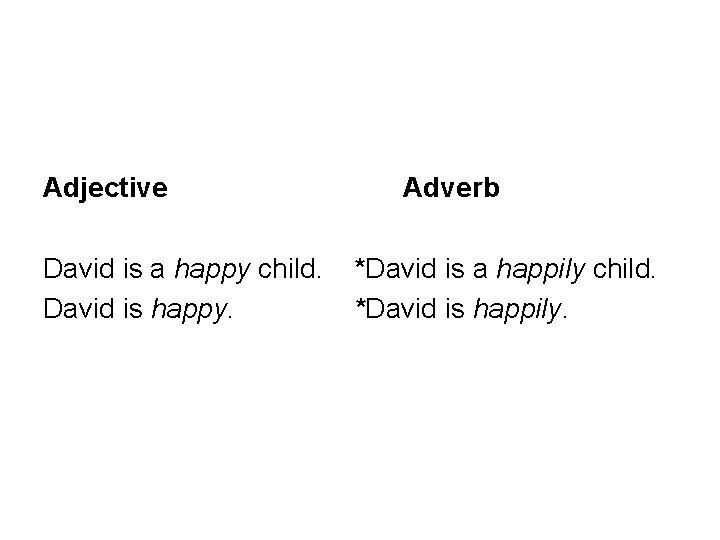
Adjectives and adverbs with the same form • in some cases both the adjective and adverb have the same form • have important characteristics in common 1 gradability, 2 have comparative and superlative forms. An important distinguishing feature - adverbs do not modify nouns, either attributively or predicatively:
Adjective David is a happy child. David is happy. Adverb *David is a happily child. *David is happily.
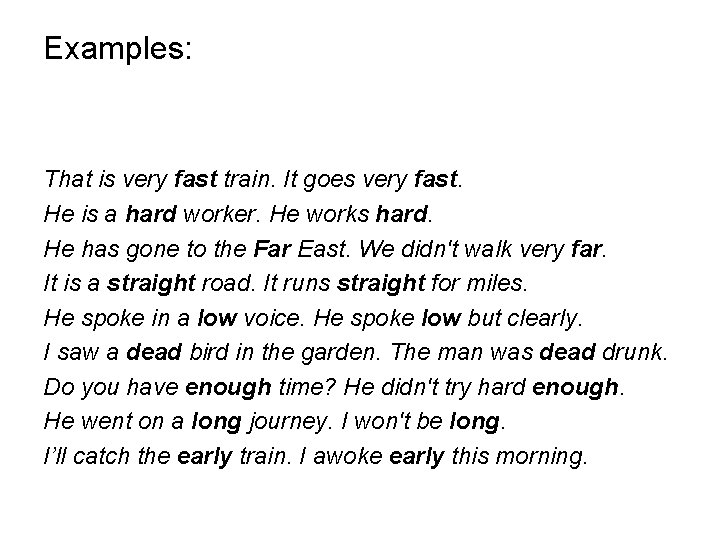
Examples: That is very fast train. It goes very fast. He is a hard worker. He works hard. He has gone to the Far East. We didn't walk very far. It is a straight road. It runs straight for miles. He spoke in a low voice. He spoke low but clearly. I saw a dead bird in the garden. The man was dead drunk. Do you have enough time? He didn't try hard enough. He went on a long journey. I won't be long. I’ll catch the early train. I awoke early this morning.
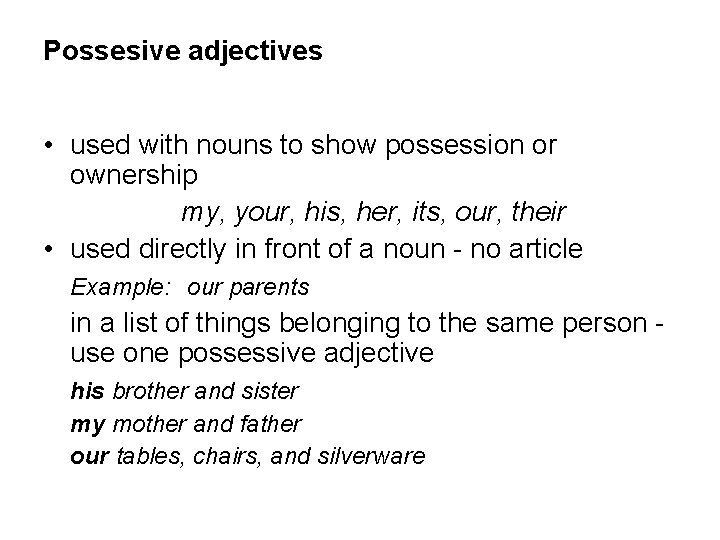
Possesive adjectives • used with nouns to show possession or ownership my, your, his, her, its, our, their • used directly in front of a noun - no article Example: our parents in a list of things belonging to the same person use one possessive adjective his brother and sister my mother and father our tables, chairs, and silverware