
Adjectives Describing Things 1 Adjectives Help with Details
Adjectives Describing Things 1

Adjectives: Help with Details and Descriptions • Consider the following sentence: • “The dog jumped on the man. ” • What does the dog look like in your mind’s eye? • What does the man look like? • Do you think your mental picture is the same as the one the person next to you has? Why or why not?
Adjectives • The sentence on the previous slide was missing adjectives. • An Adjective is a word that describes a noun or pronoun. They answer the questions “What kind? ” “Which one? ” and “How many? ” • Our original sentence could be rewritten: • “The small, white, shaggy dog jumped on the tall, serious man. ” • Which words tell us more about the dog? Which words tell us more about the man? • Adjectives are said to modify or describe the nouns they tell us more about. (So “small” modifies “dog” in our rewritten sentence, for example. )
Where can I put an adjective in a sentence? • Adjectives can be placed in two different locations. • Location 1: Before the word the adjective is modifying. – Examples: – Angry man – Green car – Late bus • Location 2: After a linking verb. – Example: The man is angry. (“Angry” modifies “man. ”) – Example: The flower smells good. (“Good” modifies “flower. ”)
Two More Rules About Adjectives • “Good” is an adjective. Only use it when you are describing a noun or pronoun. – Example: “He sings good. ” This is incorrect because “good” is modifying “sings, ” which is not a noun or pronoun. The correct sentence is “He sings well. ” • When adjectives occur in a list, try reading the list with “and” in between each of the adjectives. If the “and” sounds natural, you need a comma. If the “and” does not sound natural, you do not need a comma. – Example: He is a retired English teacher. (“He is a retired AND English teacher” sounds strange, so there is no comma. ) – Example: It was a gray, cloudy day yesterday. (“Gray AND cloudy” sounds natural, so you need a comma. )
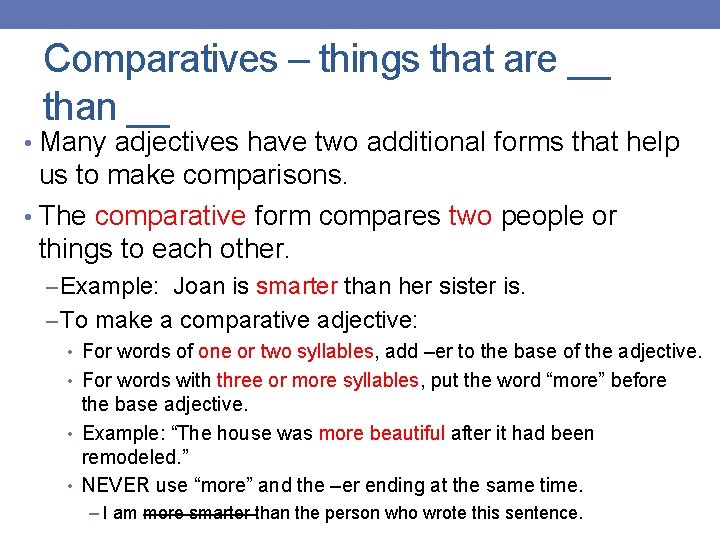
Comparatives – things that are __ than __ • Many adjectives have two additional forms that help us to make comparisons. • The comparative form compares two people or things to each other. – Example: Joan is smarter than her sister is. – To make a comparative adjective: • For words of one or two syllables, add –er to the base of the adjective. • For words with three or more syllables, put the word “more” before the base adjective. • Example: “The house was more beautiful after it had been remodeled. ” • NEVER use “more” and the –er ending at the same time. – I am more smarter than the person who wrote this sentence.
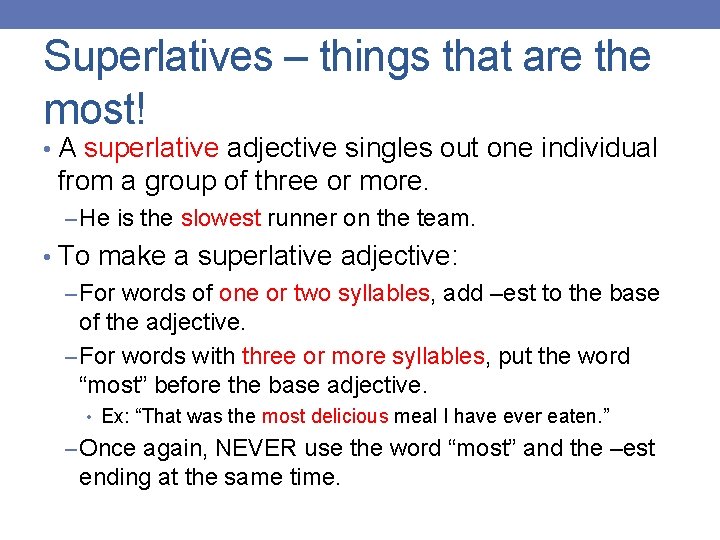
Superlatives – things that are the most! • A superlative adjective singles out one individual from a group of three or more. – He is the slowest runner on the team. • To make a superlative adjective: – For words of one or two syllables, add –est to the base of the adjective. – For words with three or more syllables, put the word “most” before the base adjective. • Ex: “That was the most delicious meal I have ever eaten. ” – Once again, NEVER use the word “most” and the –est ending at the same time.
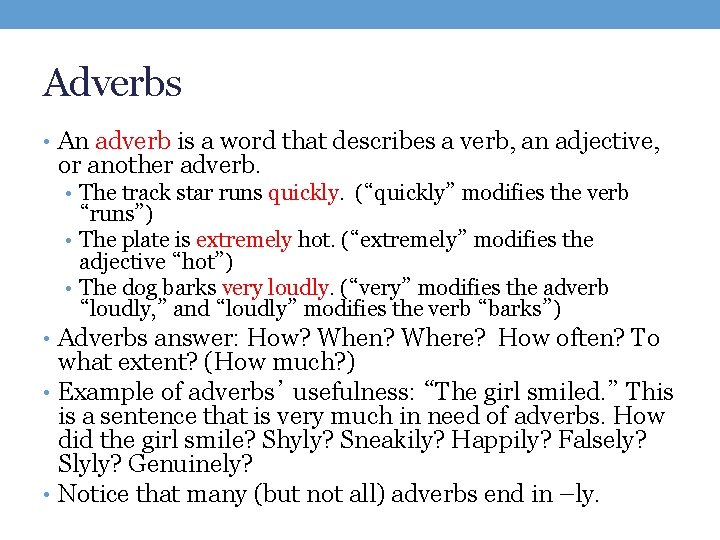
Adverbs • An adverb is a word that describes a verb, an adjective, or another adverb. • The track star runs quickly. (“quickly” modifies the verb “runs”) • The plate is extremely hot. (“extremely” modifies the adjective “hot”) • The dog barks very loudly. (“very” modifies the adverb “loudly, ” and “loudly” modifies the verb “barks”) • Adverbs answer: How? When? Where? How often? To what extent? (How much? ) • Example of adverbs’ usefulness: “The girl smiled. ” This is a sentence that is very much in need of adverbs. How did the girl smile? Shyly? Sneakily? Happily? Falsely? Slyly? Genuinely? • Notice that many (but not all) adverbs end in –ly.
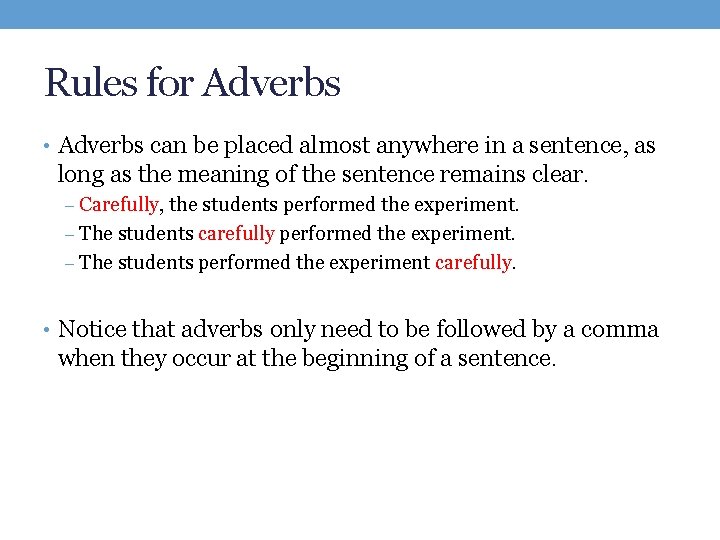
Rules for Adverbs • Adverbs can be placed almost anywhere in a sentence, as long as the meaning of the sentence remains clear. – Carefully, the students performed the experiment. – The students carefully performed the experiment. – The students performed the experiment carefully. • Notice that adverbs only need to be followed by a comma when they occur at the beginning of a sentence.
BREAK TIME – 15 MINS When We Return: Discussing the Readings and Consumer Issues
The Buzz on Caffeine – Page 89 • Discussion Questions: 1. Do you think this is an important consumer issue? Why 2. 3. 4. 5. or why not? Why do you think the National Coffee Association is unclear about how much coffee is a “cup”? Do you agree or disagree that caffeine should be considered an “recreational chemical”? The writer uses several casual or informal words—buzz, rep, rap, and detox. Does the use of these words change the essay or your perception of the author? Look at thesis statement and structure.
Purposes of Informative Writing: 1. Describing a topic accurately and vividly. Be specific. Have a narrow, focused topic. Use details. Look carefully at our example essays. See how they use specific details and vivid descriptions? Imitate this in your own writing. 2. Communicating information clearly and descriptively. Use your writing to educate and inform. 3. To Share Specialized Knowledge
General Tips about Thesis Statements • A statement that contains the essay’s topic and point(s) • Gives the reader a sense of what the essay will be about • Most thesis statements are only one sentence and it must be a complete sentence. • Should not be a question. • Everything in the essay must support thesis. • Usually comes at the end of the introduction: • Introduction paragraph should follow this format: • Attention getter (commonly known as a “hook”) • Introduce the topic and give background leading up to thesis
Brainstorm Your Topic Ideas! • Look at the prompt for the Informative Essay again. • On the back, (or in your notebook if you prefer) start brainstorming your topic ideas. • I will give everyone 5 -10 minutes to brainstorm. Write down as many ideas as you can think of. • When I call “Time!”, find a partner and “interview” each other about your informative essay topic ideas. o Help each other come up with even more ideas!
See You Tomorrow! • Check the schedule for the homework! • ASLO READ “Back to School: Students Must Be Prepared to Use Debt Wisely” on page 140
- Slides: 15