
ADJECTIVES ADVERBS ADDING DESCRIPTION WHY We use adjectives
ADJECTIVES & ADVERBS: ADDING DESCRIPTION
WHY? � We use adjectives and adverbs to add specific details about people, objects, and actions. Without such words, our language and writing would be increasingly straightforward and bland.
ADJECTIVES � Notice how adjectives make the second sentence in this pair more descriptive. Coyotes startled the campers. Noisy coyotes startled the sleepy campers.
WHAT IS AN ADJECTIVE? � An adjective is a word that modifies, or describes, a noun or pronoun. �A heavy rainstorm soaked the campsite. �Adjectives help you see, feel, taste, hear, and smell all the experiences you read about.
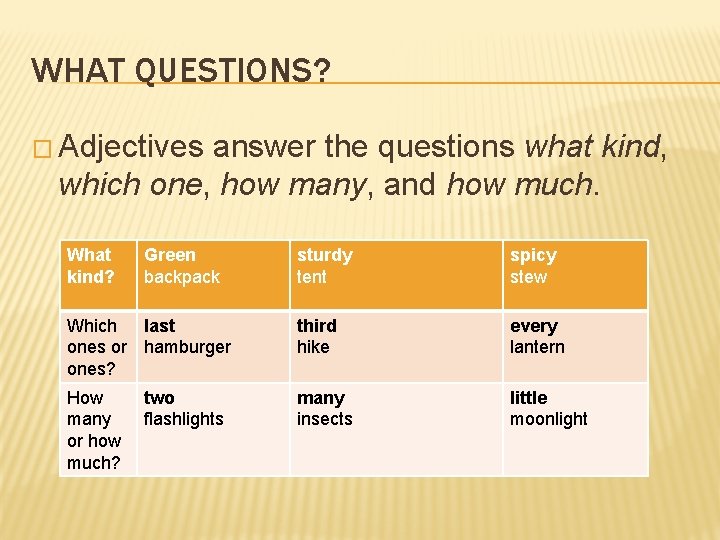
WHAT QUESTIONS? � Adjectives answer the questions what kind, which one, how many, and how much. What kind? Green backpack sturdy tent spicy stew Which last ones or hamburger ones? third hike every lantern How many or how much? many insects little moonlight two flashlights
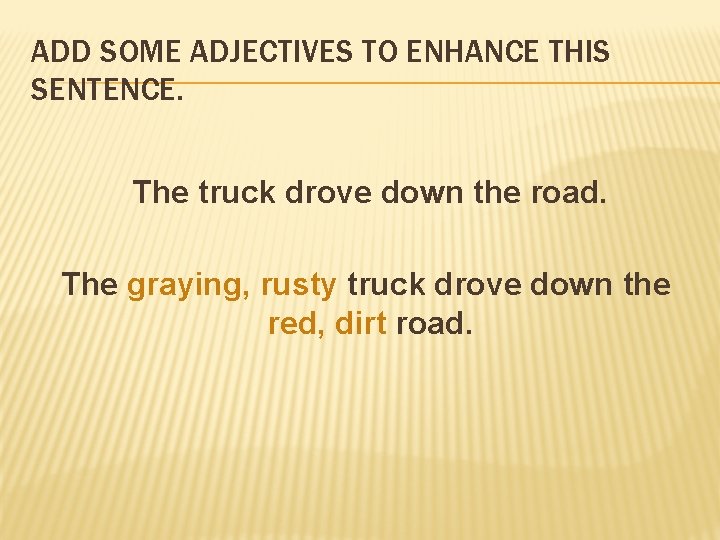
ADD SOME ADJECTIVES TO ENHANCE THIS SENTENCE. The truck drove down the road. The graying, rusty truck drove down the red, dirt road.
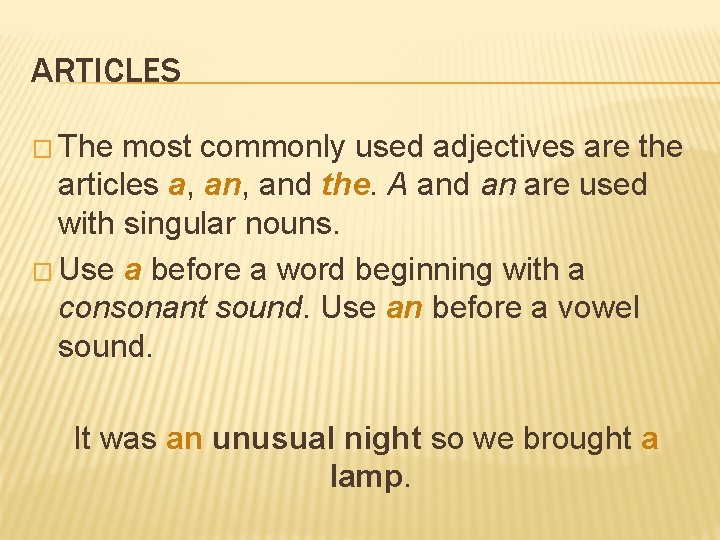
ARTICLES � The most commonly used adjectives are the articles a, and the. A and an are used with singular nouns. � Use a before a word beginning with a consonant sound. Use an before a vowel sound. It was an unusual night so we brought a lamp.
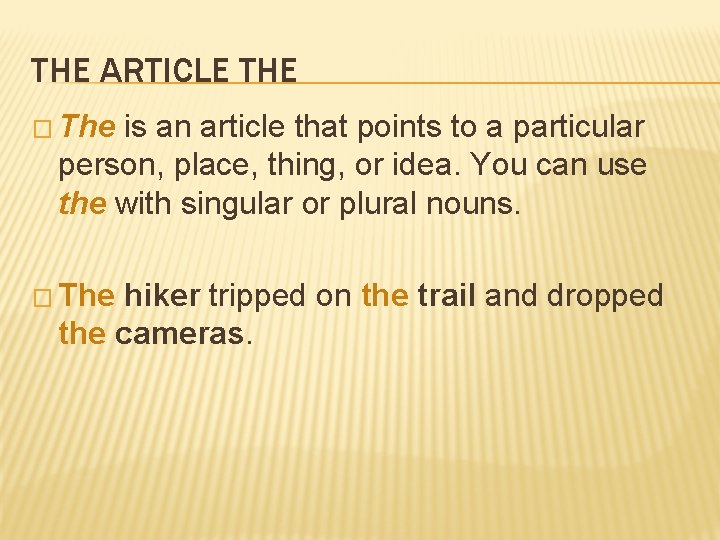
THE ARTICLE THE � The is an article that points to a particular person, place, thing, or idea. You can use the with singular or plural nouns. � The hiker tripped on the trail and dropped the cameras.
THE DIFFERENCE BETWEEN A AND THE � Notice how the sentence changes depending on the article you use. � Bring me the water bottle from the refrigerator. � Bring me a water bottle from the refrigerator.

PREDICATE ADJECTIVES �A predicate adjective is an adjective that follows a linking verb and describes the verb’s subject. A volcanic eruption is violent. subject linking verb It is explosive. adjective
PREDICATE ADJECTIVES � Pred. adjs. Can follow other linking verbs. Forms of taste, smell, feel, look, become, and seem are often used as linking verbs. The lava looks thick. Lava becomes hard when it cools.
ADVERBS � What is an adverb? �An adverb is a word that modifies a verb, an adjective, or another adverb. Explorers eagerly chase adventure. Some explorers visit amazingly beautiful places. Others quite bravely explore the unknown—
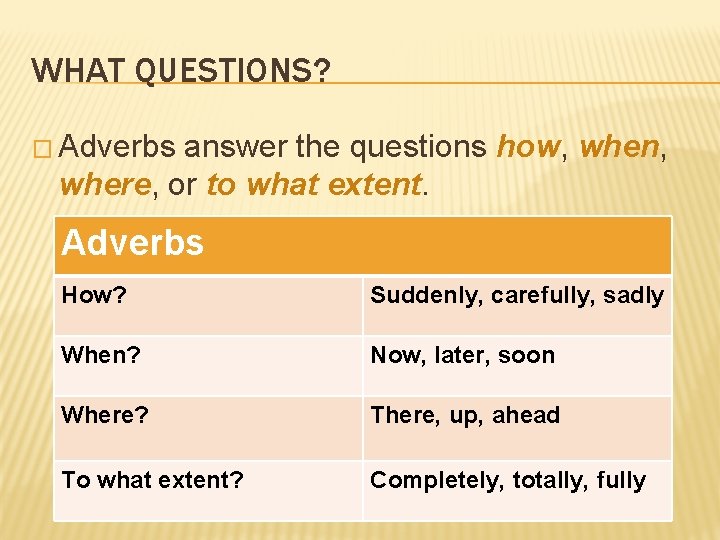
WHAT QUESTIONS? � Adverbs answer the questions how, when, where, or to what extent. Adverbs How? Suddenly, carefully, sadly When? Now, later, soon Where? There, up, ahead To what extent? Completely, totally, fully
POSITIONS IN THE SENTENCE � Adverbs can appear in different positions in sentences. (after verb) The tourists boarded the bus eagerly. (before verb) The tourists eagerly boarded the bus. (at beginning) Eagerly, the tourists boarded the bus.
(MORE) PREDICATE ADJECTIVES 1. The sun is bright. 2. The curry tastes spicy. 3. Last night’s homework was impossible. 4. James’s water bottle was empty. 5. His parents were proud.
ADJECTIVE OR ADVERB? � Some pairs of adjectives & adverbs are often confused. � Good � Real � Bad and Well and Really and Badly
GOOD AND WELL � Good is always an adjective; it modifies a noun or pronoun. Well is usually an adverb, modifying a verb, an adverb, or an adjective. That was a good documentary about Mt. Everest. The filmmaker presented the information well.
REAL AND REALLY � Real is always an adjective. Really is always an adverb; modifying a verb, adverb, or adjective. She prefers real mountains to paintings of mountains. The Grand Canyon is really beautiful in the morning.
BAD AND BADLY � Bad is always an adjective. Badly is always an adverb. That wasn’t a bad hike, even though we planned it badly. I often feel bad about staying indoors so much.
PRACTICE �Turn to page 137 in your grammar books. (the little one) �Complete numbers 1 -10 �Then turn to the exercise bank on page 548 and complete 1 -10 �Then complete 115 & 116 in WB.
MAKING COMPARISONS Adjectives and adverbs can be used to compare people or things. Special forms of these words are used to make comparisons. The atmosphere is thinner in the mountains. The water is shallowest by the shore.
COMPARATIVE FORMS � Use the comparative form of an adjective or adverb when you compare a person or thing with one other person or thing. Mt. Rainer is higher than Mt. Hood. Mountain climbing is more dangerous than skydiving.
SUPERLATIVE FORMS � Use the superlative form of an adjective or adverb when you compare someone or something with more than one other person or thing. Mt. Everest is the highest of the three mountains. I think Mt. Fuji is the most beautiful mountain of all.
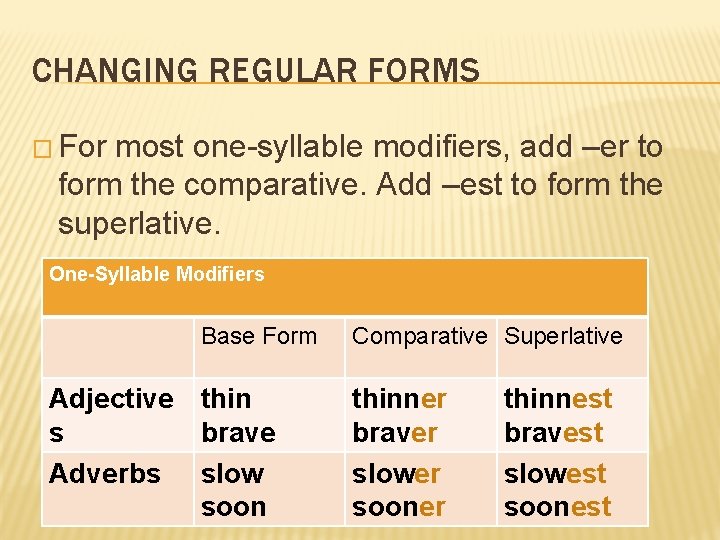
CHANGING REGULAR FORMS � For most one-syllable modifiers, add –er to form the comparative. Add –est to form the superlative. One-Syllable Modifiers Base Form Adjective thin s brave Adverbs slow soon Comparative Superlative thinner braver slower sooner thinnest bravest slowest soonest
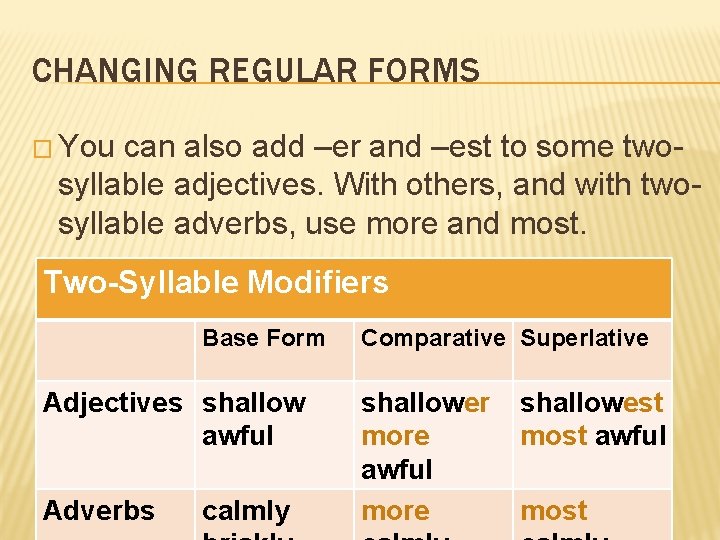
CHANGING REGULAR FORMS � You can also add –er and –est to some twosyllable adjectives. With others, and with twosyllable adverbs, use more and most. Two-Syllable Modifiers Base Form Adjectives shallow awful Adverbs calmly Comparative Superlative shallower more awful more shallowest most awful most
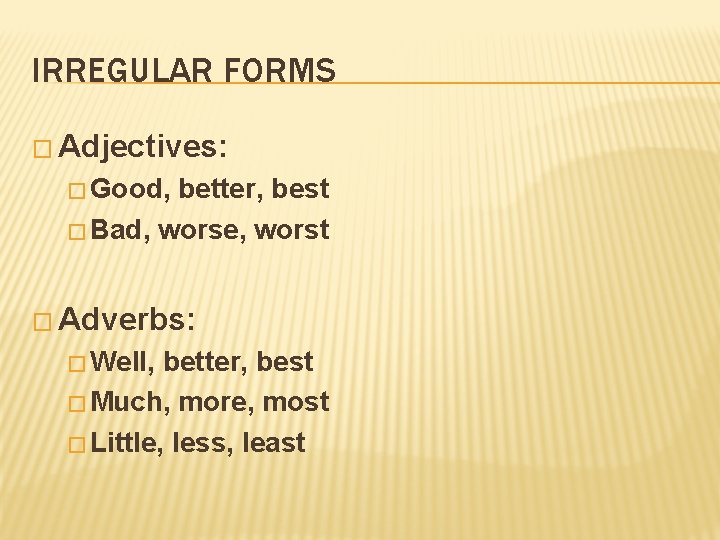
IRREGULAR FORMS � Adjectives: � Good, better, best � Bad, worse, worst � Adverbs: � Well, better, best � Much, more, most � Little, less, least
- Slides: 26