
Adjectives Adjetivos Pgina 32 1 Objetivo Voy a
Adjectives Adjetivos Página 32 1
Objetivo: Voy a comprender acordancia de adjetivos y escribir oraciones con adjetivos. I will understand adjective agreement and I will write sentences using adjectives. 2

3
Los adjetivos: ü Adjectives: Words that modify (describe) nouns ü En español, most adjectives have either two or four forms ü When using adjectives in Spanish, one must always consider gender & number AGREEMENT. 4
ADJECTIVE AGREEMENT: If an adjective ends in O, you need to change the ending to. . . • OS when describing a masculine / plural noun. • A when describinga a feminine / singular noun • AS when describing a feminine / plural noun. • Leave the O when describing a masc. / sing. noun Thus, adjectives that end in o usually have four forms and the form that you use in any given sentence must agree with the noun that it modifies. simpático (m/s) simpática (f/s) simpáticos (m/p) simpáticas (f/p) 5
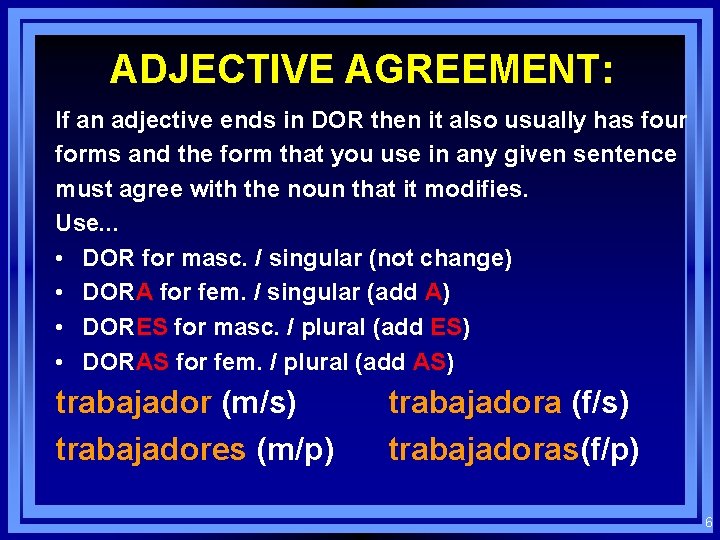
ADJECTIVE AGREEMENT: If an adjective ends in DOR then it also usually has four forms and the form that you use in any given sentence must agree with the noun that it modifies. Use. . . • DOR for masc. / singular (not change) • DORA for fem. / singular (add A) • DORES for masc. / plural (add ES) • DORAS for fem. / plural (add AS) trabajador (m/s) trabajadores (m/p) trabajadora (f/s) trabajadoras(f/p) 6

ADJECTIVE AGREEMENT: If an adjective ends in something other than these (O , OR) then it will usually have only two forms – singular and plural. It is not gender specific. To make the adjective plural add. . . s if it ends in a vowel es if it ends in a consanent inteligente (s) joven (s) inteligentes (p) jóvenes (p) 7
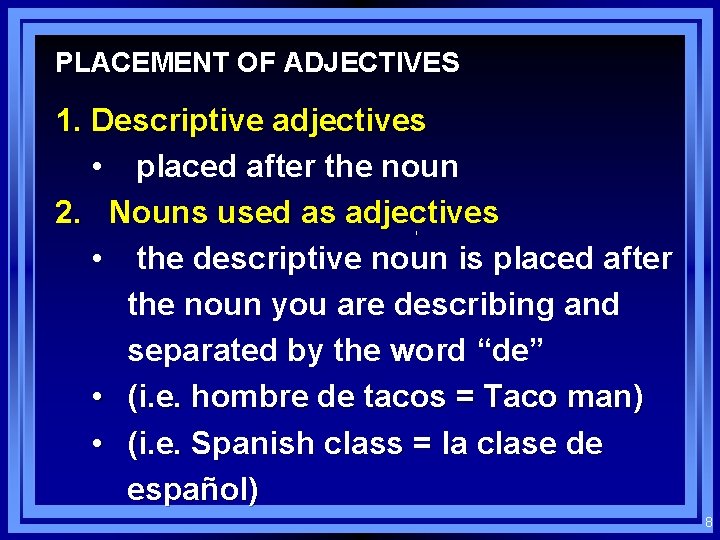
PLACEMENT OF ADJECTIVES 1. Descriptive adjectives • placed after the noun 2. Nouns used as adjectives • the descriptive noun is placed after the noun you are describing and separated by the word “de” • (i. e. hombre de tacos = Taco man) • (i. e. Spanish class = la clase de español) 8
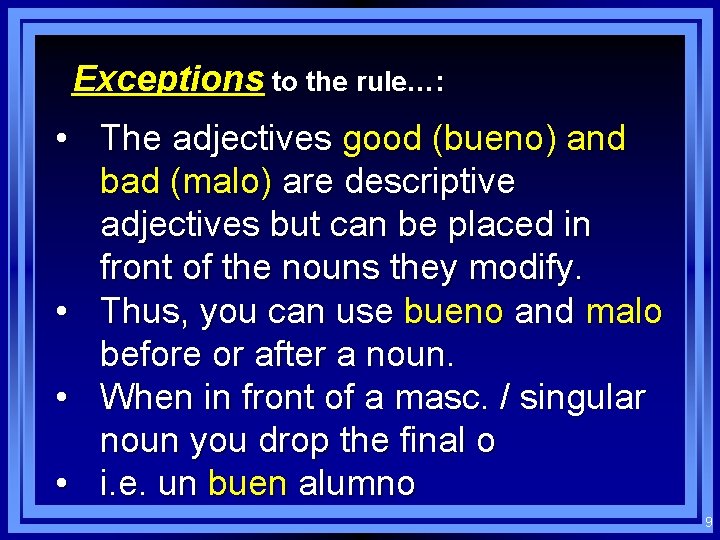
Exceptions to the rule…: • The adjectives good (bueno) and bad (malo) are descriptive adjectives but can be placed in front of the nouns they modify. • Thus, you can use bueno and malo before or after a noun. • When in front of a masc. / singular noun you drop the final o • i. e. un buen alumno 9
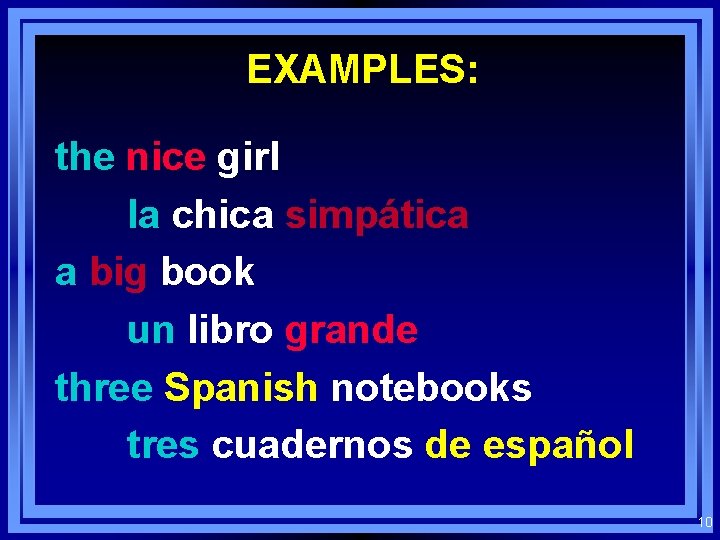
EXAMPLES: the nice girl la chica simpática a big book un libro grande three Spanish notebooks tres cuadernos de español 10

PRACTICE: • • • some smart students a big book five Spanish books two blond students (feminine) a disorganized notebook four hard working boys 11
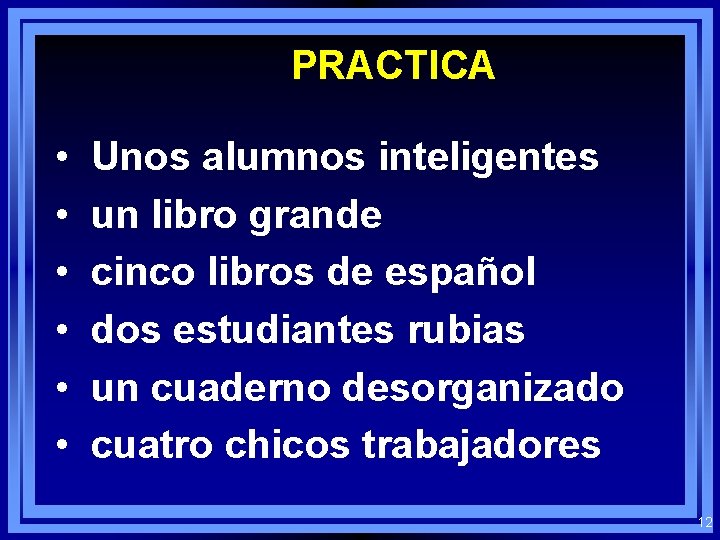
PRACTICA • • • Unos alumnos inteligentes un libro grande cinco libros de español dos estudiantes rubias un cuaderno desorganizado cuatro chicos trabajadores 12
- Slides: 12