
ADHD The Finer Points of Assessment Learning Objectives
ADHD: The Finer Points of Assessment
Learning Objectives • Present evidence-based information about ADHD to patients and their families (Section 1) • Assess special populations for ADHD: preschoolers, adolescents, parents, complicated children (Section 2) • Discuss the effective use of ADHD rating scales (Section 3) Copyright © The REACH Institute. All rights reserved.

44, 500, 000 Copyright © The REACH Institute. All rights reserved.
ADHD DSM-5 Criteria Copyright © The REACH Institute. All rights reserved.
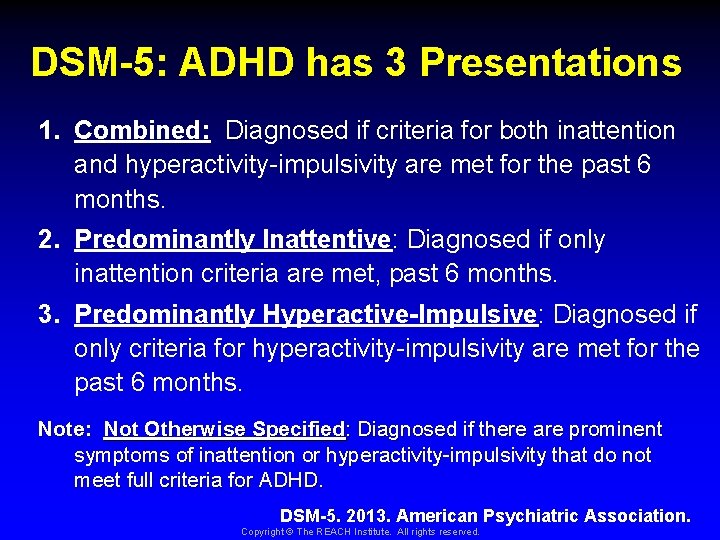
DSM-5: ADHD has 3 Presentations 1. Combined: Diagnosed if criteria for both inattention and hyperactivity-impulsivity are met for the past 6 months. 2. Predominantly Inattentive: Diagnosed if only inattention criteria are met, past 6 months. 3. Predominantly Hyperactive-Impulsive: Diagnosed if only criteria for hyperactivity-impulsivity are met for the past 6 months. Note: Not Otherwise Specified: Diagnosed if there are prominent symptoms of inattention or hyperactivity-impulsivity that do not meet full criteria for ADHD. DSM-5. 2013. American Psychiatric Association. Copyright © The REACH Institute. All rights reserved.
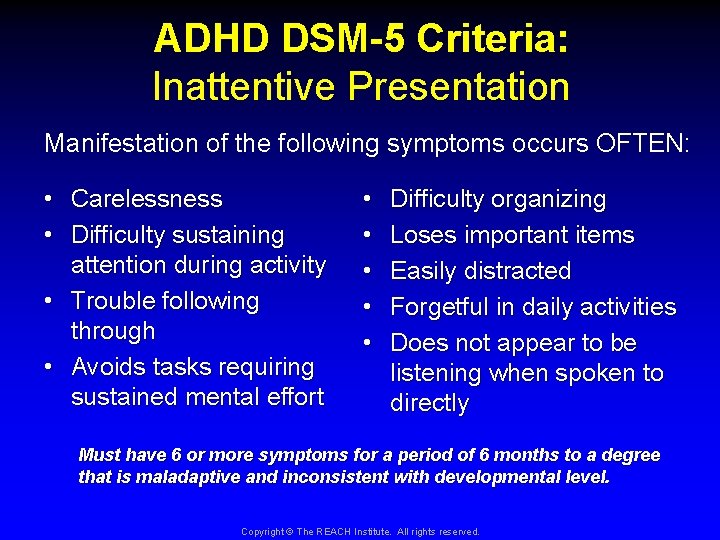
ADHD DSM-5 Criteria: Inattentive Presentation Manifestation of the following symptoms occurs OFTEN: • • Carelessness Difficulty sustaining attention during activity • Trouble following through • Avoids tasks requiring sustained mental effort • • • Difficulty organizing Loses important items Easily distracted Forgetful in daily activities Does not appear to be listening when spoken to directly Must have 6 or more symptoms for a period of 6 months to a degree that is maladaptive and inconsistent with developmental level. Copyright © The REACH Institute. All rights reserved.
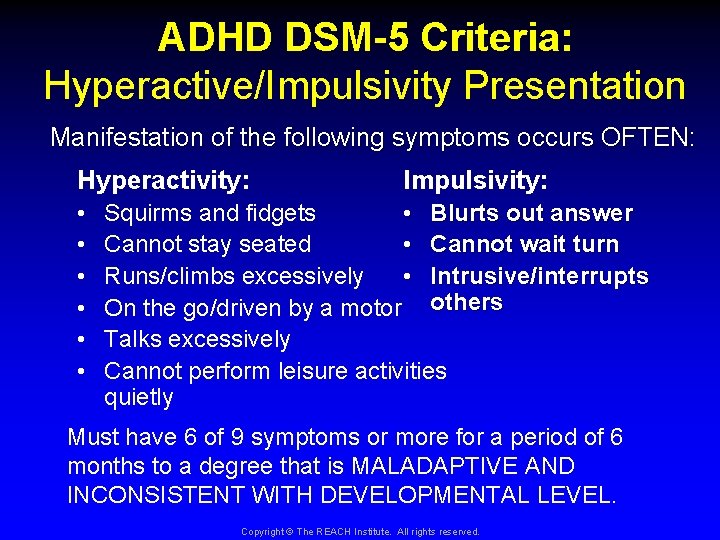
ADHD DSM-5 Criteria: Hyperactive/Impulsivity Presentation Manifestation of the following symptoms occurs OFTEN: Hyperactivity: • • • Impulsivity: Squirms and fidgets • Blurts out answer Cannot stay seated • Cannot wait turn Runs/climbs excessively • Intrusive/interrupts On the go/driven by a motor others Talks excessively Cannot perform leisure activities quietly Must have 6 of 9 symptoms or more for a period of 6 months to a degree that is MALADAPTIVE AND INCONSISTENT WITH DEVELOPMENTAL LEVEL. Copyright © The REACH Institute. All rights reserved.
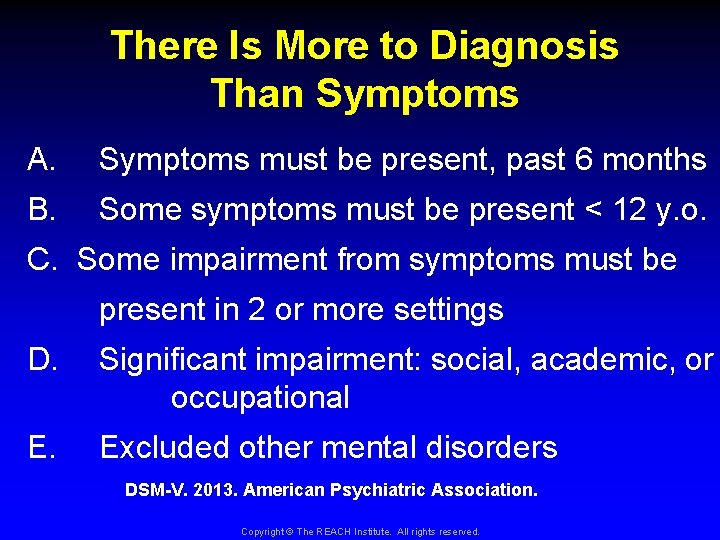
There Is More to Diagnosis Than Symptoms A. Symptoms must be present, past 6 months B. Some symptoms must be present < 12 y. o. C. Some impairment from symptoms must be present in 2 or more settings D. Significant impairment: social, academic, or occupational E. Excluded other mental disorders DSM-V. 2013. American Psychiatric Association. Copyright © The REACH Institute. All rights reserved.
Section 1 The 8 Most Important Questions You Need To Be Able To Answer About ADHD Copyright © The REACH Institute. All rights reserved.
Table Activity: Practice Answering the Tough Questions • Look in the middle of your table for your group’s “tough questions” (J 1. 1) about ADHD. • As a group, discuss and practice how to most effectively answer these questions. 5 minutes! • Choose a rep for your table. • Your table’s rep will answer the “tough question” with a tough parent! Copyright © The REACH Institute. All rights reserved.
#1 ADHD is not real, it is an attempt to “take the boyhood out of the boy”! Copyright © The REACH Institute. All rights reserved.
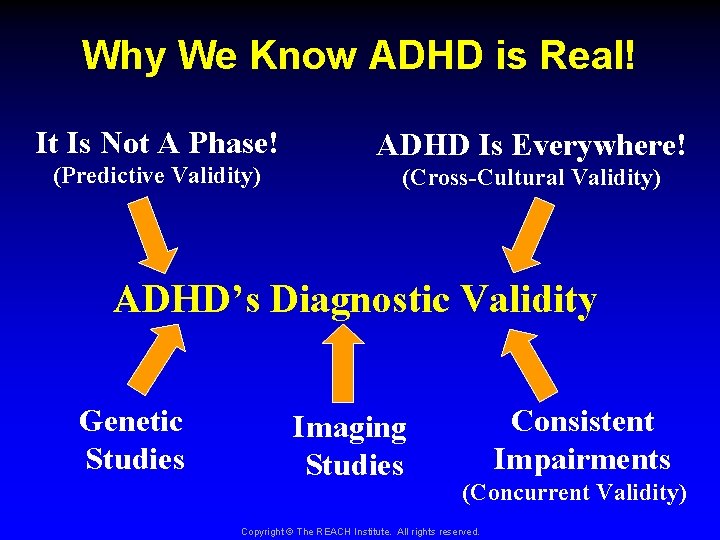
Why We Know ADHD is Real! It Is Not A Phase! ADHD Is Everywhere! (Predictive Validity) (Cross-Cultural Validity) ADHD’s Diagnostic Validity Genetic Studies Imaging Studies Consistent Impairments (Concurrent Validity) Copyright © The REACH Institute. All rights reserved.

#2 Johnny can play Gameboy all day, but when it comes to math homework, he is just lazy! Copyright © The REACH Institute. All rights reserved.
What is the Current Concept about ADHD? • Brain disorder of response inhibition in executive functioning (prefrontal) • Attention is different for different tasks (exciting stimuli may draw attention) Copyright © The REACH Institute. All rights reserved.
#3 What or who caused my child to have ADHD? Copyright © The REACH Institute. All rights reserved.
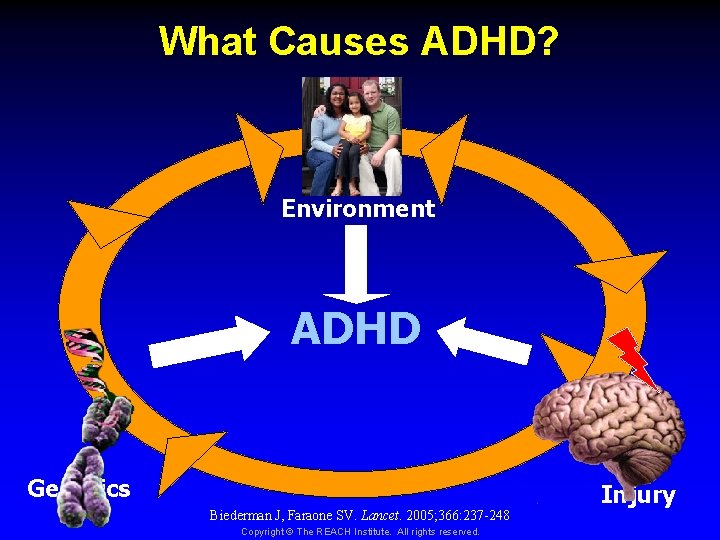
What Causes ADHD? Environment ADHD Genetics Biederman J, Faraone SV. Lancet. 2005; 366: 237 -248 Copyright © The REACH Institute. All rights reserved. CNS Injury
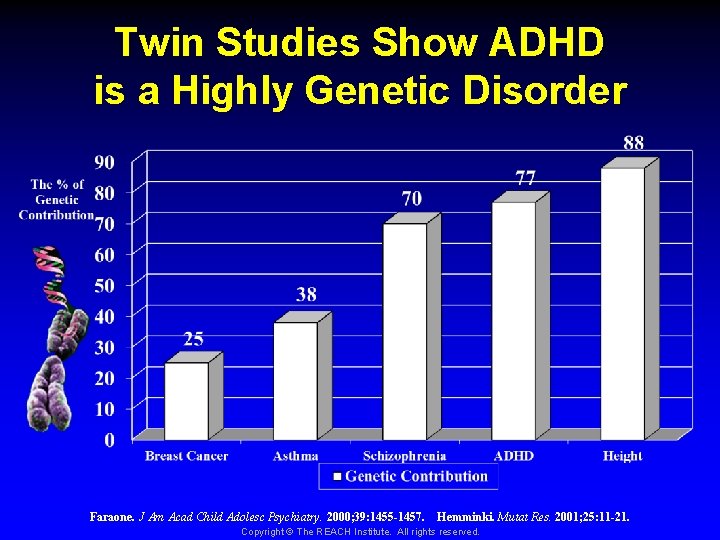
Twin Studies Show ADHD is a Highly Genetic Disorder Faraone. J Am Acad Child Adolesc Psychiatry. 2000; 39: 1455 -1457. Hemminki. Mutat Res. 2001; 25: 11 -21. Copyright © The REACH Institute. All rights reserved.
#4 Will my child ever grow out of their ADHD? Copyright © The REACH Institute. All rights reserved.
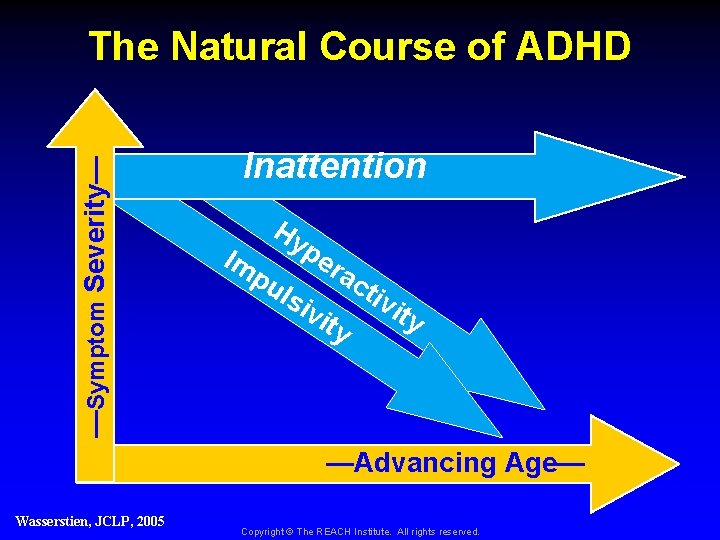
—Symptom Severity— The Natural Course of ADHD Inattention Im Hy pu ls pe ivi ra c ty tiv ity —Advancing Age— Wasserstien, JCLP, 2005 Copyright © The REACH Institute. All rights reserved.
Bonus Question for All! Isn’t ADHD only a school-based problem? Copyright © The REACH Institute. All rights reserved.
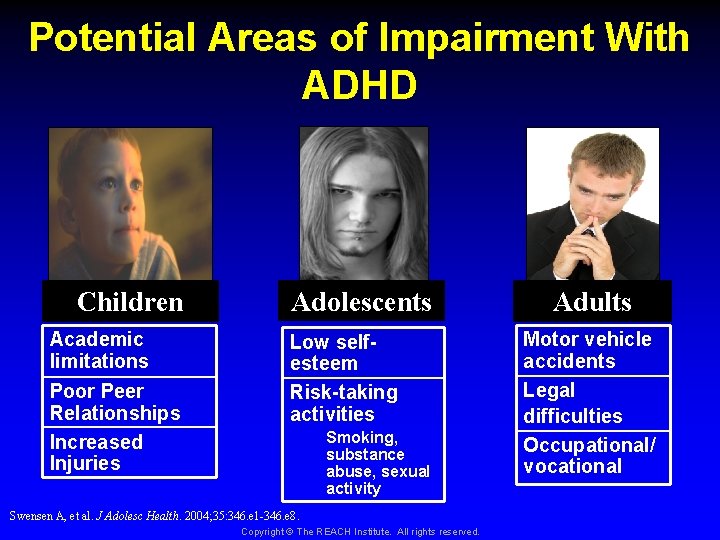
Potential Areas of Impairment With ADHD Children Academic limitations Poor Peer Relationships Increased Injuries Adolescents Low selfesteem Risk-taking activities Smoking, substance abuse, sexual activity Swensen A, et al. J Adolesc Health. 2004; 35: 346. e 1 -346. e 8. Copyright © The REACH Institute. All rights reserved. Adults Motor vehicle accidents Legal difficulties Occupational/ vocational
Section 2 ADHD Assessment in Special Populations: Preschoolers, Adolescents, Parents, and Neurobehavioral Disorders Copyright © The REACH Institute. All rights reserved.
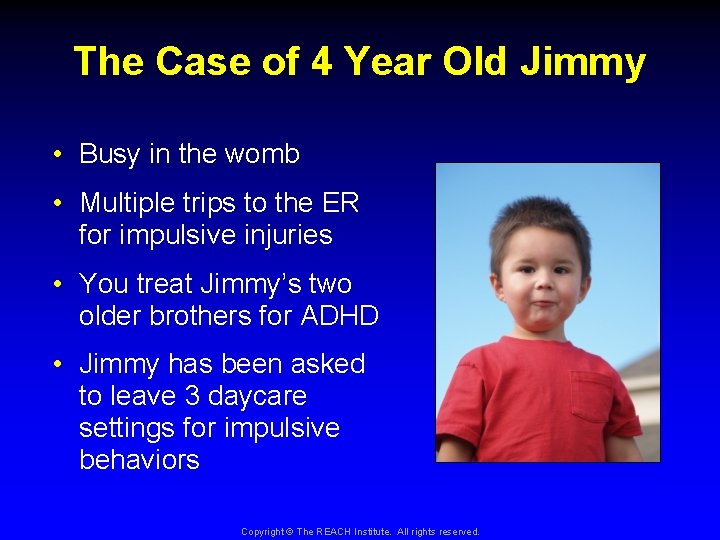
The Case of 4 Year Old Jimmy • Busy in the womb • Multiple trips to the ER for impulsive injuries • You treat Jimmy’s two older brothers for ADHD • Jimmy has been asked to leave 3 daycare settings for impulsive behaviors Copyright © The REACH Institute. All rights reserved.
The Case of Emily, a 16 y/o Female • Bright young woman with no learning disabilities • Emily did well academically until the 6 th grade when she began a steady academic decline • She appears demoralized about her poor grades but not clinically depressed • No substance use • Review of school records indicate mild chronic organizational problems but until the 6 th grade no significant impairment Copyright © The REACH Institute. All rights reserved.
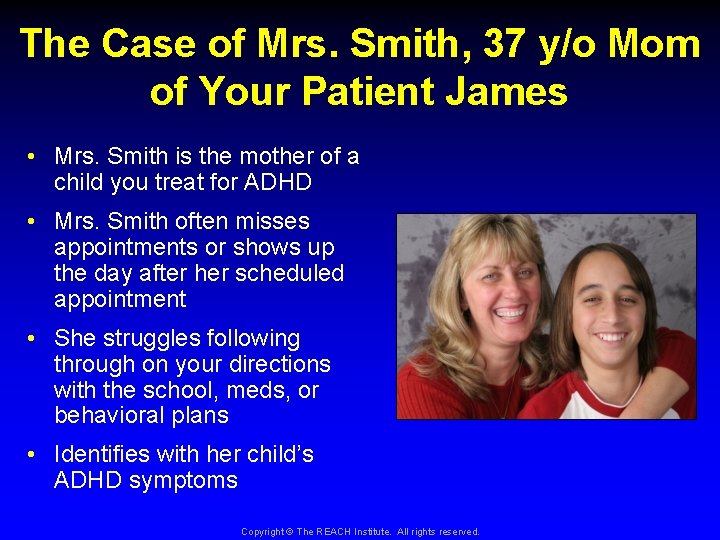
The Case of Mrs. Smith, 37 y/o Mom of Your Patient James • Mrs. Smith is the mother of a child you treat for ADHD • Mrs. Smith often misses appointments or shows up the day after her scheduled appointment • She struggles following through on your directions with the school, meds, or behavioral plans • Identifies with her child’s ADHD symptoms Copyright © The REACH Institute. All rights reserved.
The Case of Jessica, a 6 y/o girl with Fetal Alcohol Exposure • Jessie was exposed to a significant amount of alcohol during fetal period • IQ 70 with clumsiness, a speech disorder and fine motor impairment • Dx: alcohol-related neurodevelopmental disorder (absence of FAS facial features, microcephaly, and short stature) • Hyperactivity, impulsivity and inattention occur in the classroom and when interacting with peers/parents Copyright © The REACH Institute. All rights reserved.
Table Activity 1. Identify the specific challenges and obstacles to assessing ADHD in this population (5 minutes), and then…. 2. Identify strategies how you can overcome these problems! (5 minutes) 3. Debrief…(5 minutes) Copyright © The REACH Institute. All rights reserved.
What do you find difficult about assessing preschoolers for ADHD? Copyright © The REACH Institute. All rights reserved.
Assessment Challenges for Preschool Children • ADHD-like behaviors may be developmentally normal in this group when they are mild to moderate and without impairment • ADHD versus environmental versus developmental disorder versus ODD/BPD • Early intervention change trajectory? Copyright © The REACH Institute. All rights reserved.
Pre-School ADHD Presentation • Very hyperactive: always, always on the go • Dangerously daring • Multiple accidental injuries • Very destructive play • Difficulty with the initiation of sleep is common • Lower levels of adherence • Difficulty sustaining baby sitters or day care Greenhill LL. J Clin Psychiatry. 1998; 59: 31 -41 Copyright © The REACH Institute. All rights reserved.
Assessment Challenges for Preschool Children • Examples of scales to use: – Assessment scales: Connors Scales – Treatment monitoring: SNAP IV – Vanderbilt • Careful assessment of parenting first and referral to parent training when indicated Copyright © The REACH Institute. All rights reserved.
What are some of the challenges in assessing adolescents with ADHD? Copyright © The REACH Institute. All rights reserved.
Factors Which Will Delay a Diagnosis of ADHD • Primary Inattentive Presentation • Female Sex • Highly Supportive Family • High IQ • Well Developed Social Skills Copyright © The REACH Institute. All rights reserved.
Factors Complicating the Assessment of ADHD in Adolescents • Multiple teachers for shorter periods of observation • Less observation time with the parents • Different clinical presentation of ADHD in adolescents • How do we assess clinical information and rating scales from the teen, parents and teachers? • Increased rate of co-morbid conditions in adolescents compared to elementary school-age children Copyright © The REACH Institute. All rights reserved.
What We Know About ADHD Assessment in Adolescents • Teacher scales may be less valuable • Self reports help with rapport and gives an opening to teach the adolescent but may not be diagnostically helpful • Review school records for some evidence of chronicity of symptoms • Look for the higher rates of co-morbid conditions Copyright © The REACH Institute. All rights reserved.
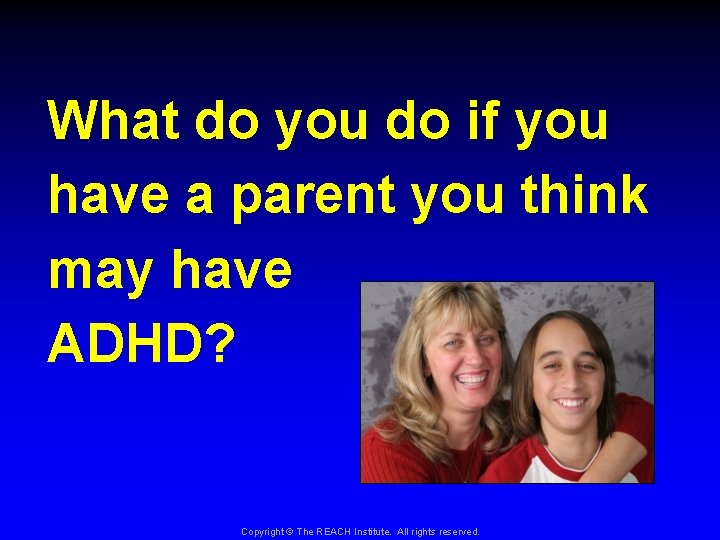
What do you do if you have a parent you think may have ADHD? Copyright © The REACH Institute. All rights reserved.
What About Children with a Neurodevelopmental Disorder? • Children with neurodevelopmental disorders are often hyperactive, impulsive and inattentive • ADHD can be diagnosed using standard behavioral criteria • Neurodevelopmental disorders associated with ADHD: – – – – Fetal alcohol syndrome Alcohol related neurodevelopmental disorder Down syndrome Prader-Willi syndrome Williams syndrome Tourette syndrome Turner syndrome • Studies with small samples show benefit from stimulant medication Copyright © The REACH Institute. All rights reserved.
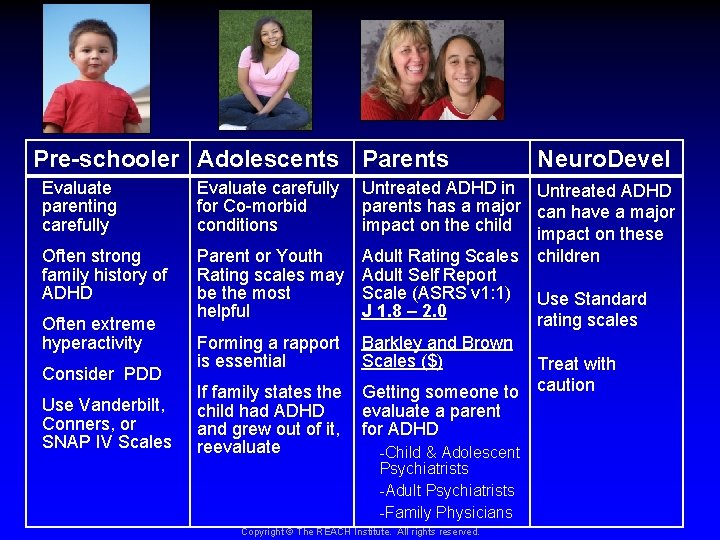
Pre-schooler Adolescents Parents Evaluate parenting carefully Often strong family history of ADHD Often extreme hyperactivity Consider PDD Use Vanderbilt, Conners, or SNAP IV Scales Evaluate carefully for Co-morbid conditions Neuro. Devel Untreated ADHD in Untreated ADHD parents has a major can have a major impact on the child impact on these Parent or Youth Adult Rating Scales children Rating scales may Adult Self Report be the most Scale (ASRS v 1: 1) Use Standard helpful J 1. 8 – 2. 0 rating scales Forming a rapport Barkley and Brown is essential Scales ($) Treat with If family states the Getting someone to caution child had ADHD evaluate a parent and grew out of it, for ADHD reevaluate -Child & Adolescent Psychiatrists -Adult Psychiatrists -Family Physicians Copyright © The REACH Institute. All rights reserved.
Section 3 ADHD Rating Scale Boot Camp Copyright © The REACH Institute. All rights reserved.
Table Activity: ADHD Rating Scale Boot Camp Copyright © The REACH Institute. All rights reserved.
Your Mission Objectives • Learn how to score a Vanderbilt rating scale • Learn how to clinically and meaningfully use rating scales when trying to establish a diagnosis. Copyright © The REACH Institute. All rights reserved.

Table Activity 1. Silently read the Vanderbilt scoring instructions in Workbook, p. J 1. 3 2. As a group, score Jimmy’s Teacher Vanderbilt, p. J 1. 4 -1. 5 3. SCRIBES: On the flipchart, write all the scores for the “Office Use Only” box, p. J 1. 5 (except last line, “Average Performance Score”) Copyright © The REACH Institute. All rights reserved.
Summary of the Finer Points of ADHD Assessment • Practice answering tough questions using evidence based information • Remember how to adjust the ADHD assessment process for different age groups • Use standardized ADHD rating scale to assist in the assessment of ADHD and other co-morbid psychiatric conditions • Implement practical interventions in you office to save time and get paid (more to come) Copyright © The REACH Institute. All rights reserved.
Additional Points for ADHD Assessment & Treatment Planning • Refer to childhood mental health specialist for additional evaluations and behavioral • therapy (parent training), esp. children < 6 • Your initial evaluation sets the stage and prepares parents for helpful interventions, such as teacher education, parent management, relaxation, problem-solving and social/communication skills. Copyright © The REACH Institute. All rights reserved.

REMINDER: Please fill out Unit J evaluation Copyright © The REACH Institute. All rights reserved.

Getting it Paid For: Self-Study Do you know how to code these cases so you will get paid? Do you know when to use these coding variations? Copyright © The REACH Institute. All rights reserved.
Jimmy’s Diagnosis 314. 01 Attention deficit disorder, with mention of hyperactivity, combined inattentive subtype n 314. 9 Unspecified hyperkinetic syndrome, Attention deficit hyperactivity disorder, NOS n Copyright © The REACH Institute. All rights reserved.
Jimmy’s Visit: 99214 With the exception of Jimmy’s father’s observations of his son’s behavior and the comments regarding his own behaviors, over 50% of this encounter was spent in counseling the father and trying to come to some common understanding n Reasonable length of the visit: 25 min. n Copyright © The REACH Institute. All rights reserved.
Jimmy’s Visit: Procedures n Vanderbilt ADHD Scale: Father n Mother’s Vanderbilt Scale and Pediatric Symptom Checklist-17 had presumably been administered, scored and interpreted at previous visit Copyright © The REACH Institute. All rights reserved.
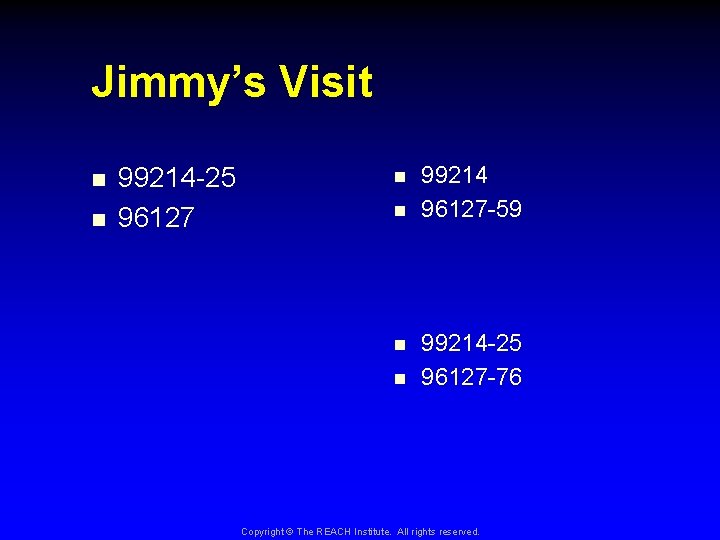
Jimmy’s Visit n n 99214 -25 96127 n n 99214 96127 -59 99214 -25 96127 -76 Copyright © The REACH Institute. All rights reserved.
- Slides: 50