
ADHD Characteristics as Predictors of Adult Attachment Types
- Slides: 1
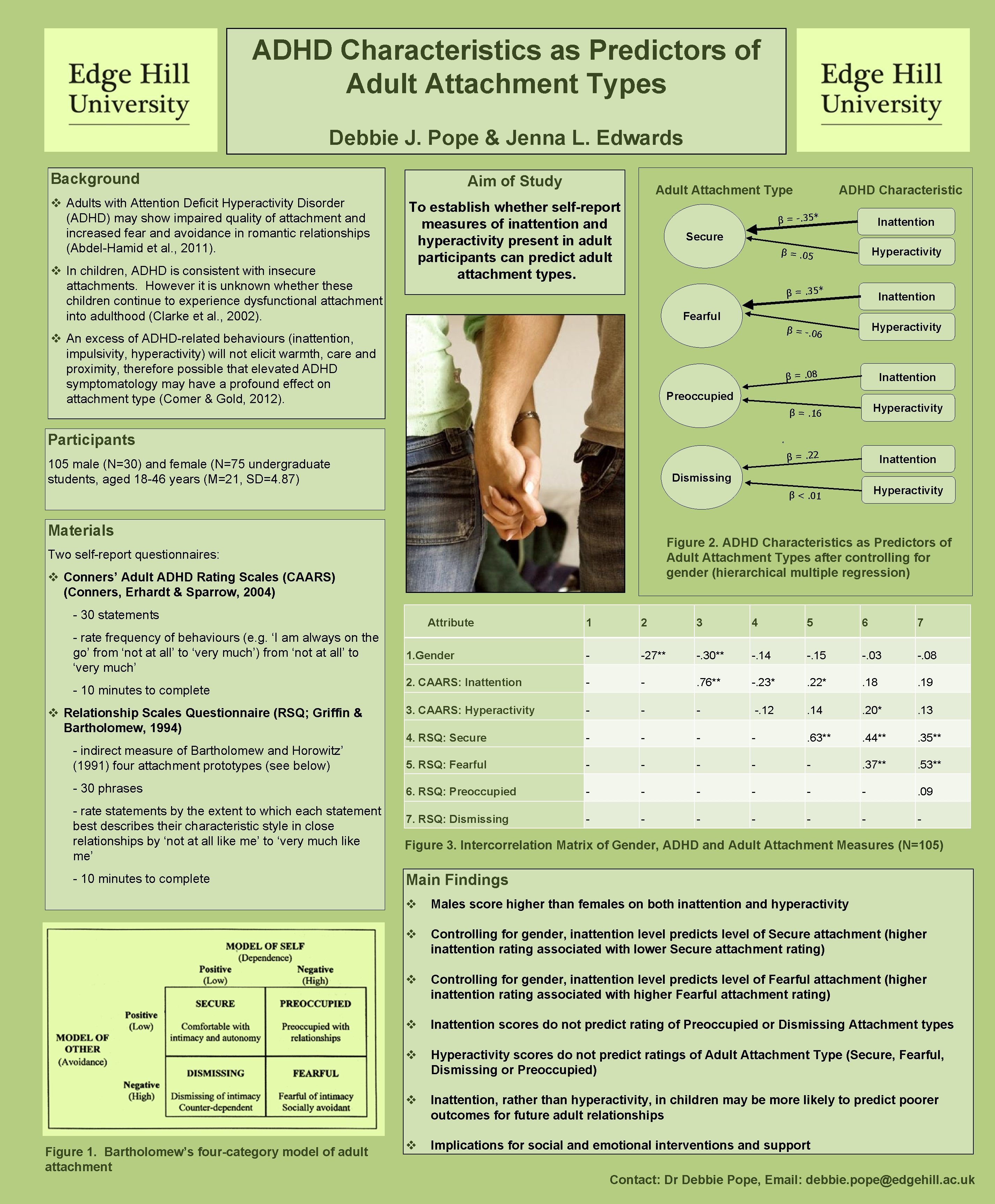
ADHD Characteristics as Predictors of Adult Attachment Types Debbie J. Pope & Jenna L. Edwards Background v Adults with Attention Deficit Hyperactivity Disorder (ADHD) may show impaired quality of attachment and increased fear and avoidance in romantic relationships (Abdel-Hamid et al. , 2011). v In children, ADHD is consistent with insecure attachments. However it is unknown whether these children continue to experience dysfunctional attachment into adulthood (Clarke et al. , 2002). Aim of Study Adult Attachment Type To establish whether self-report measures of inattention and hyperactivity present in adult participants can predict adult attachment types. ADHD Characteristic β = -. 35* Inattention β =. 05 Hyperactivity Secure β =. 35* Inattention Fearful v An excess of ADHD-related behaviours (inattention, impulsivity, hyperactivity) will not elicit warmth, care and proximity, therefore possible that elevated ADHD symptomatology may have a profound effect on attachment type (Comer & Gold, 2012). β = -. 06 Hyperactivity β =. 08 Inattention Preoccupied β =. 16 Hyperactivity β =. 22 Inattention β <. 01 Hyperactivity Participants 105 male (N=30) and female (N=75 undergraduate students, aged 18 -46 years (M=21, SD=4. 87) Dismissing Materials Figure 2. ADHD Characteristics as Predictors of Adult Attachment Types after controlling for gender (hierarchical multiple regression) Two self-report questionnaires: v Conners’ Adult ADHD Rating Scales (CAARS) (Conners, Erhardt & Sparrow, 2004) - 30 statements - rate frequency of behaviours (e. g. ‘I am always on the go’ from ‘not at all’ to ‘very much’) from ‘not at all’ to ‘very much’ - 10 minutes to complete v Relationship Scales Questionnaire (RSQ; Griffin & Bartholomew, 1994) - indirect measure of Bartholomew and Horowitz’ (1991) four attachment prototypes (see below) - 30 phrases - rate statements by the extent to which each statement best describes their characteristic style in close relationships by ‘not at all like me’ to ‘very much like me’ - 10 minutes to complete Figure 1. Bartholomew’s four-category model of adult attachment Attribute 1 2 3 4 5 6 7 1. Gender - -27** -. 30** -. 14 -. 15 -. 03 -. 08 2. CAARS: Inattention - - . 76** -. 23* . 22* . 18 . 19 3. CAARS: Hyperactivity - -. 12 . 14 . 20* . 13 4. RSQ: Secure - - . 63** . 44** . 35** 5. RSQ: Fearful - - - . 37** . 53** 6. RSQ: Preoccupied - - - . 09 7. RSQ: Dismissing - - - - Figure 3. Intercorrelation Matrix of Gender, ADHD and Adult Attachment Measures (N=105) Main Findings v Males score higher than females on both inattention and hyperactivity v Controlling for gender, inattention level predicts level of Secure attachment (higher inattention rating associated with lower Secure attachment rating) v Controlling for gender, inattention level predicts level of Fearful attachment (higher inattention rating associated with higher Fearful attachment rating) v Inattention scores do not predict rating of Preoccupied or Dismissing Attachment types v Hyperactivity scores do not predict ratings of Adult Attachment Type (Secure, Fearful, Dismissing or Preoccupied) v Inattention, rather than hyperactivity, in children may be more likely to predict poorer outcomes for future adult relationships v Implications for social and emotional interventions and support Contact: Dr Debbie Pope, Email: debbie. pope@edgehill. ac. uk