
Adequate Yearly Progress AYP Academic Performance Index API


- Slides: 34
Adequate Yearly Progress (AYP) Academic Performance Index (API) and Assessing California Standards Test (CST) Data
Purpose of the Session: 1. To establish the direct relationship between Adequate Yearly Progress (AYP), Academic Performance Index (API) and the California Standards Test (CST). 2. To accurately assess California Standards Test (CST) results so a school may make tactical changes in classroom practice and customize interventions utilized in IWT.
Adequate Yearly Progress No Child Left Behind Testing Accountability: Required Elements
Adequate Yearly Progress (AYP) and Annual Measurable Objectives (AMO) n n n All Title I Schools must meet Adequate Yearly Progress (AYP) school wide. Failure to meet AYP for two consecutive years in a single curricular area or AYP component will move a school into Program Improvement (PI) status. Curricular Areas: Language Arts and Math
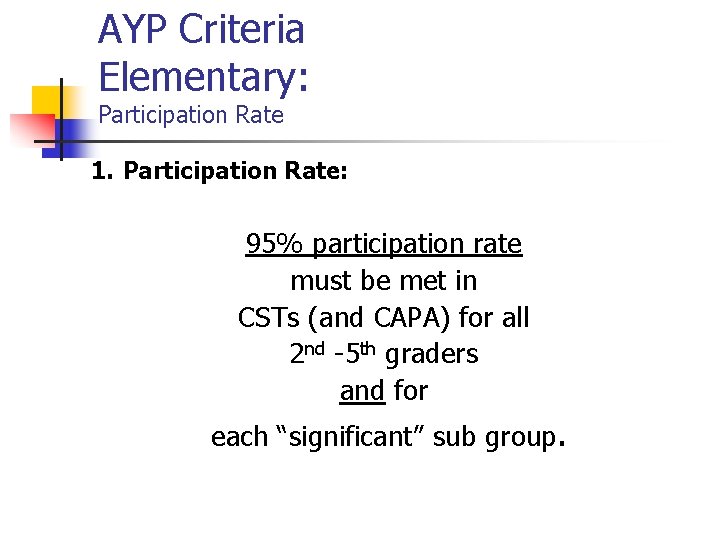
AYP Criteria Elementary: Participation Rate 1. Participation Rate: 95% participation rate must be met in CSTs (and CAPA) for all 2 nd -5 th graders and for each “significant” sub group.
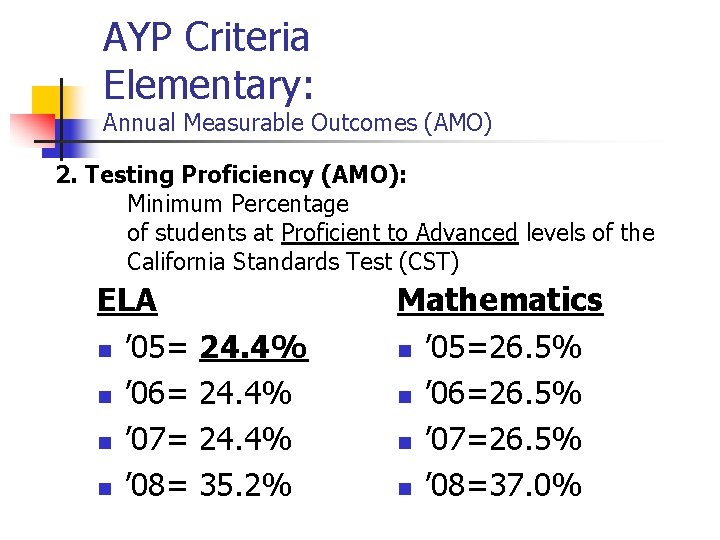
AYP Criteria Elementary: Annual Measurable Outcomes (AMO) 2. Testing Proficiency (AMO): Minimum Percentage of students at Proficient to Advanced levels of the California Standards Test (CST) ELA n ’ 05= n ’ 06= n ’ 07= n ’ 08= 24. 4% 35. 2% Mathematics n ’ 05=26. 5% n ’ 06=26. 5% n ’ 07=26. 5% n ’ 08=37. 0%
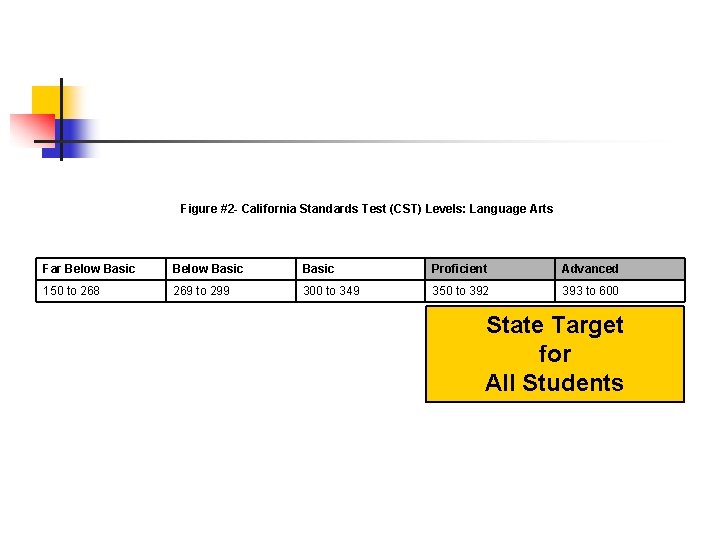
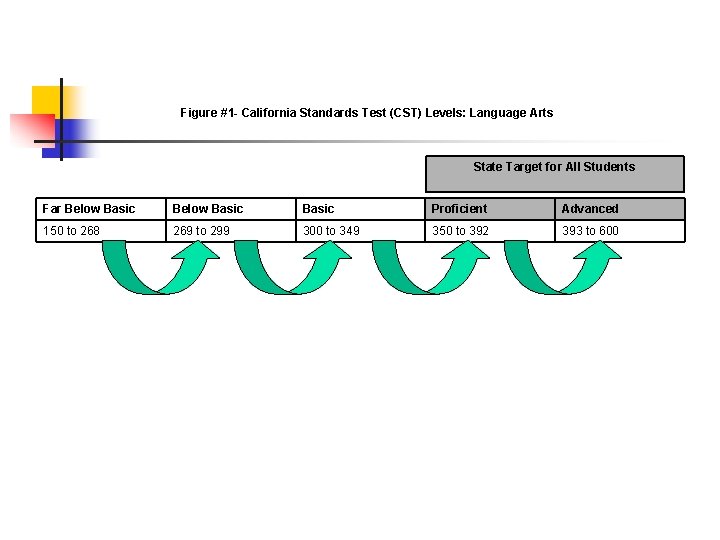
Figure #2 - California Standards Test (CST) Levels: Language Arts Far Below Basic Proficient Advanced 150 to 268 269 to 299 300 to 349 350 to 392 393 to 600 State Target for All Students
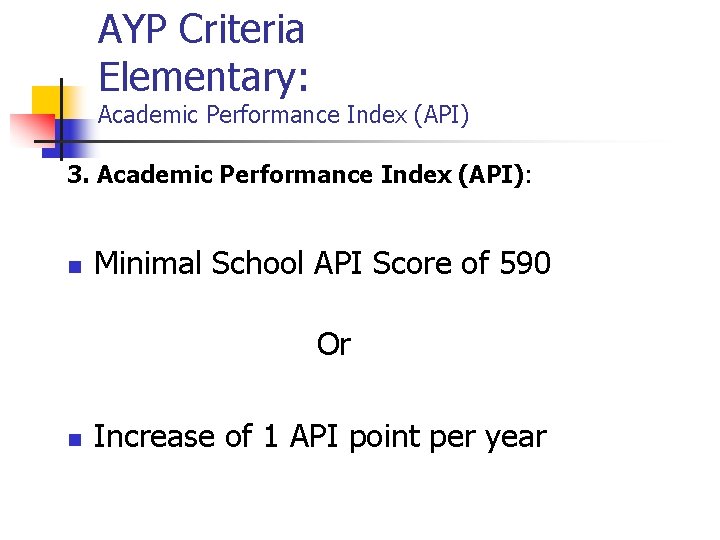
AYP Criteria Elementary: Academic Performance Index (API) 3. Academic Performance Index (API): n Minimal School API Score of 590 Or n Increase of 1 API point per year
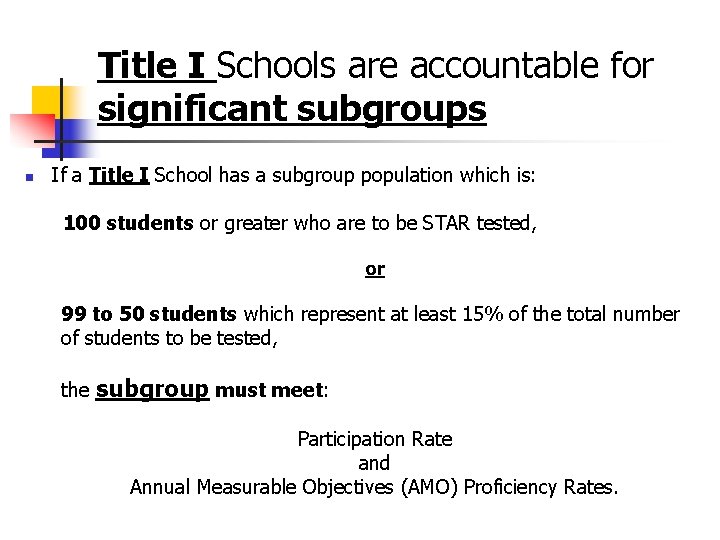
Title I Schools are accountable for significant subgroups n If a Title I School has a subgroup population which is: 100 students or greater who are to be STAR tested, or 99 to 50 students which represent at least 15% of the total number of students to be tested, the subgroup must meet: Participation Rate and Annual Measurable Objectives (AMO) Proficiency Rates.
What About Academic Performance Index? API
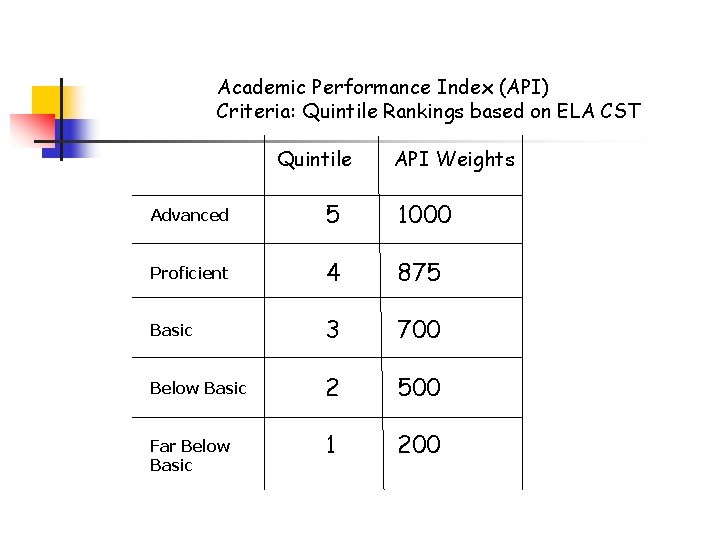
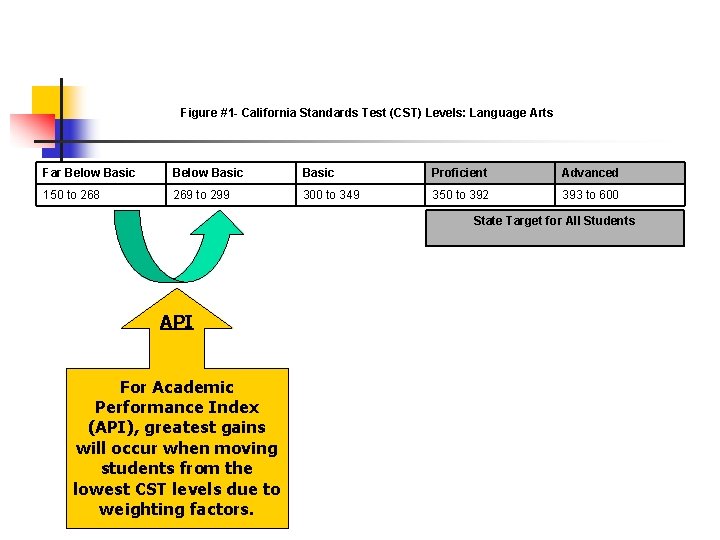
Academic Performance Index (API) Criteria: Quintile Rankings based on ELA CST Quintile API Weights Advanced 5 1000 Proficient 4 875 Basic 3 700 Below Basic 2 500 1 200 Far Below Basic
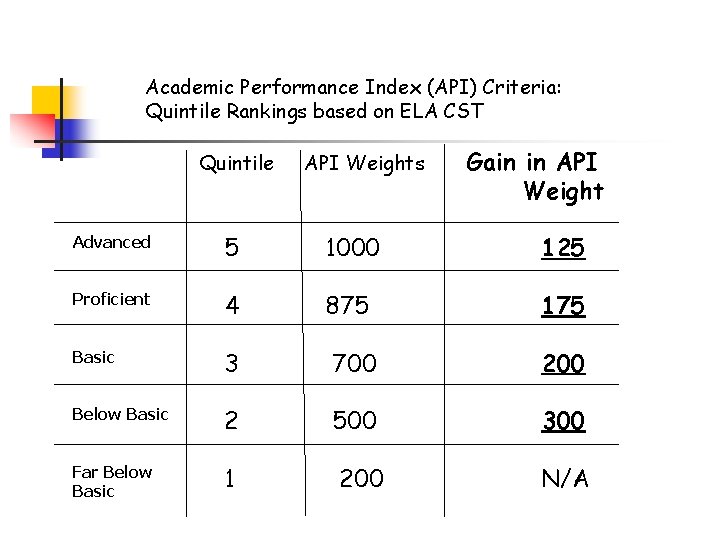
Academic Performance Index (API) Criteria: Quintile Rankings based on ELA CST Quintile API Weights Gain in API Weight Advanced 5 1000 125 Proficient 4 875 175 Basic 3 700 200 Below Basic 2 500 300 Far Below Basic 1 200 N/A
Figure #1 - California Standards Test (CST) Levels: Language Arts Far Below Basic Proficient Advanced 150 to 268 269 to 299 300 to 349 350 to 392 393 to 600 State Target for All Students API For Academic Performance Index (API), greatest gains will occur when moving students from the lowest CST levels due to weighting factors.
Key to Meeting Adequate Yearly Progress (AYP) and Increasing Academic Performance Index (API): Positive Annual Gains
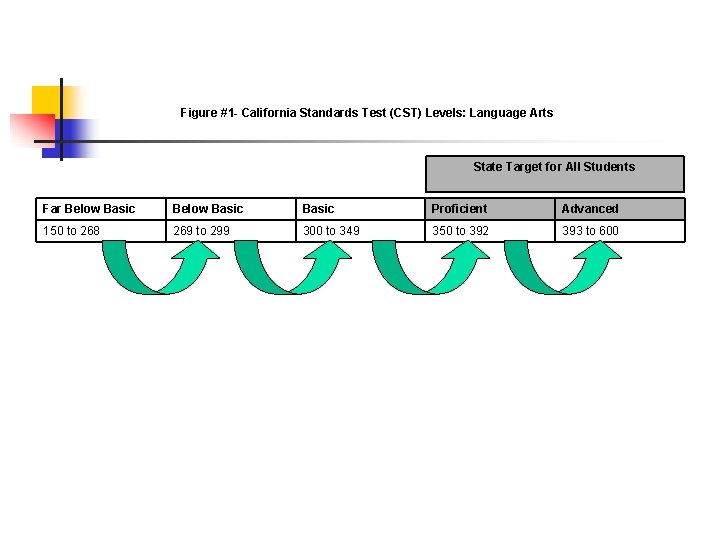
Goal: n Move One Testing Level Per Year regardless of assessed level.
Figure #1 - California Standards Test (CST) Levels: Language Arts State Target for All Students Far Below Basic Proficient Advanced 150 to 268 269 to 299 300 to 349 350 to 392 393 to 600
How Do We Get Them To Proficiency? First step is to accurately assess California Standards Test (CST) results so a school may make tactical changes in classroom practice and customize interventions utilized in IWT.
Procedure: 1. 2. Use STAR Master List to assess individual CST Reporting Clusters by each separate grade and quintile level Use the Introduction/CST Test Release Questions as a tool for assessing the summarized weaknesses to: 1. 2. Determining the need for any tactical changes in classroom practice. Better customized targeted interventions
CST Assessment Protocol: Simplifying the Data n 1. 2. 3. 4. 5. Use STAR Master List to assess individual CST Reporting Clusters: Word Analysis Vocabulary Reading Comprehension Literary Response Writing Conventions Writing Strategies
CST Assessment Protocol: Simplifying the Data n 1. 2. 3. 4. 5. Use STAR Master List to assess by each Quintile Level: Advanced: ADV Proficient: PRO Basic: B Below Basic: BB Far Below Basic: FBB
Figure #1 - California Standards Test (CST) Levels: Language Arts State Target for All Students Far Below Basic Proficient Advanced 150 to 268 269 to 299 300 to 349 350 to 392 393 to 600
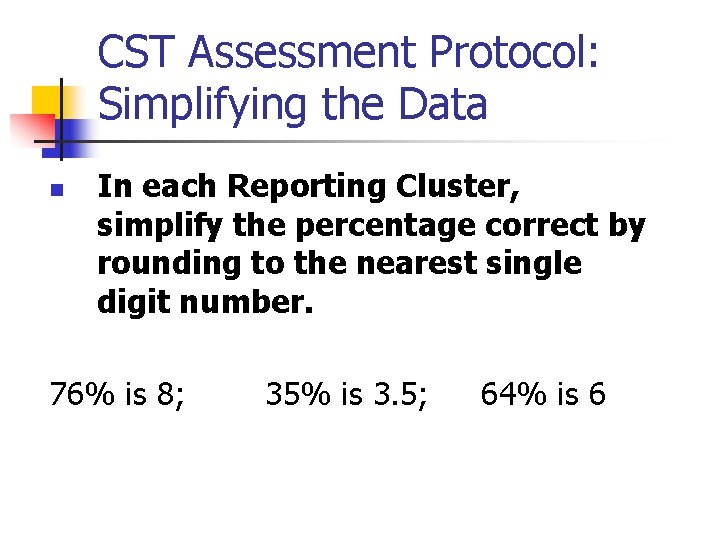
CST Assessment Protocol: Simplifying the Data n In each Reporting Cluster, simplify the percentage correct by rounding to the nearest single digit number. 76% is 8; 35% is 3. 5; 64% is 6
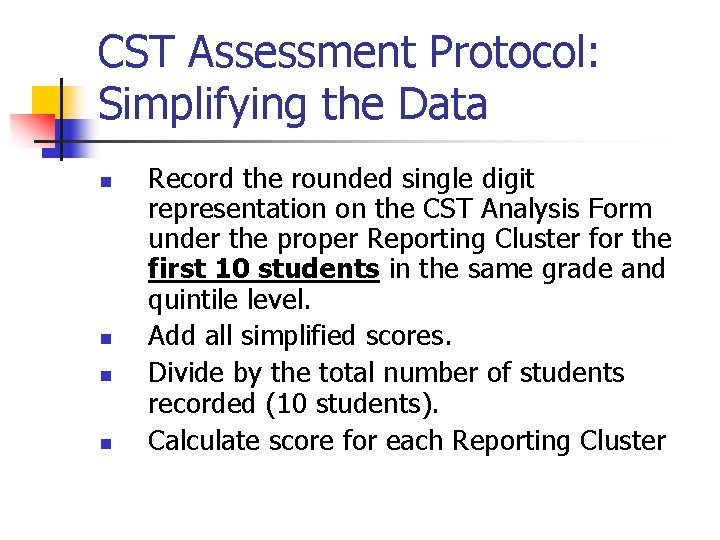
CST Assessment Protocol: Simplifying the Data n n Record the rounded single digit representation on the CST Analysis Form under the proper Reporting Cluster for the first 10 students in the same grade and quintile level. Add all simplified scores. Divide by the total number of students recorded (10 students). Calculate score for each Reporting Cluster
Work Period 10 minutes
Analysis of Data
CST Assessment Protocol: Narrowing the Focus n n Read Test Release Questions Introduction Reporting Cluster Description and Standards. Key observations in job alike groups: Refer to the Test Blue Print Page for Word Analysis. Which Standards have the greatest number of questions asked within the Word Analysis Strand? Which Standard has the least number of questions? Which Reporting Cluster has the greatest number of questions asked on the test? The least number of questions?
CST Assessment Protocol: Narrowing the Focus n Within the Word Analysis Vocabulary Reporting Cluster/Strand: n Use Test Release Questions, Test Release answer key and Testing Blue Prints to match sample questions with the standards.
CST Assessment Protocol: Narrowing the Focus n Using the Testing Blue Print page, prioritize Standards which comprise the Word Analysis Vocabulary Reporting Cluster/Strand by number of questions asked: Highest to Lowest
CST Assessment Protocol: Narrowing the Focus n Insert sample questions under corresponding Standard.
Work Period 10 minutes
Analysis of Information
CST Assessment Protocol: Strategizing by Recording Cluster and Quintile Ranking n n n Select a Reporting Cluster/Strand Select a Quintile Ranking Begin brainstorming to determine the need for any tactical changes in classroom practice. Begin with analysis of your core program implementation. Exhaust all core program resources and materials first. Focus on IWT for initial intervention period.
Purpose of the Session: 1. To establish the direct relationship between Adequate Yearly Progress (AYP), Academic Performance Index (API) and the California Standards Test (CST). 2. To accurately assess California Standards Test (CST) results so a school may make tactical changes in classroom practice and customize interventions utilized in IWT.
Wade Hayashida Title I Coordinator, Local District 8 310 354 -3416