
AdenosineDeaminase ADA Deficiency ADA is responsible gene in
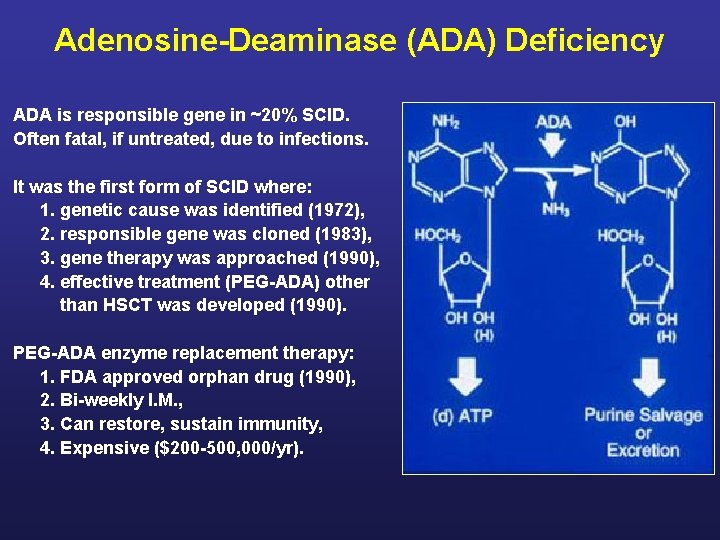
Adenosine-Deaminase (ADA) Deficiency ADA is responsible gene in ~20% SCID. Often fatal, if untreated, due to infections. It was the first form of SCID where: 1. genetic cause was identified (1972), 2. responsible gene was cloned (1983), 3. gene therapy was approached (1990), 4. effective treatment (PEG-ADA) other than HSCT was developed (1990). PEG-ADA enzyme replacement therapy: 1. FDA approved orphan drug (1990), 2. Bi-weekly I. M. , 3. Can restore, sustain immunity, 4. Expensive ($200 -500, 000/yr).
ENZYME REPLACEMENT THERAPY WITH BOVINE ADA (PEG-ADA) • Correction of metabolic abnormalities. • Variable restoration of immune functions, with 20% non responders and >50% still on IVIG. • Last survey (Hershfield, ESID 2002) overall survival 83% (n=113) (73% including patients who underwent BMT). • 10% developed neutralizing antibodies. • Autoimmune syndromes in 5 patients (fatal in 3).
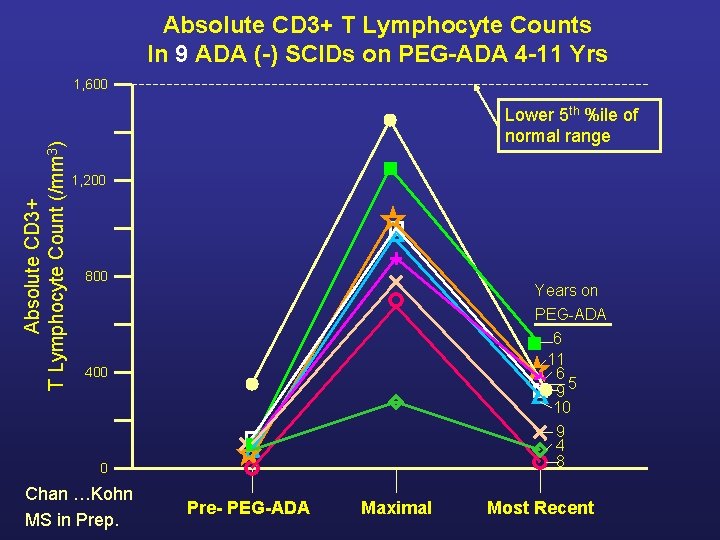
Absolute CD 3+ T Lymphocyte Counts In 9 ADA (-) SCIDs on PEG-ADA 4 -11 Yrs Absolute CD 3+ T Lymphocyte Count (/mm 3) 1, 600 Lower 5 th %ile of normal range 1, 200 800 Years on PEG-ADA 6 11 6 5 9 10 400 9 4 8 0 Chan …Kohn MS in Prep. Pre- PEG-ADA Maximal Most Recent
Bone Marrow Transplantation for ADA-SCID • HLA-identical sibling BMT (treatment of choice) – Survival 75 -90%. Neurological and behavioral alterations observed in the long term follow-up. • Non HLA-identical BMT – Without conditioning (haplo): 33% engraftment (n=15) (Buckley et al. , presented at ESID 2002). – With conditioning: overall survival 23% (n=29) (EBMT/ESID registry, Antoine et al. , Lancet, 2003, 361: 553 -560). • Overall survival at Great Ormond Street Hospital (B. Gaspar/A. Thrasher), presented at EBMT, 2004 • HLA-id sibling/family donor (84%) (n=13) • Matched unrelated donor or UCB (50%) (n=4) • Haploidentical donor (23%) (n=13)

Survival after HLA-mismatched Bone Marrow Transplantation for SCID (EBMT/ESID registry, Antoine et al. , Lancet, 2003, 361: 553 -560) • ADA-SCID MUD + haploidentical 23% • SCID T-B+ (including X-SCID) MUD Haploidentical 66% 50%
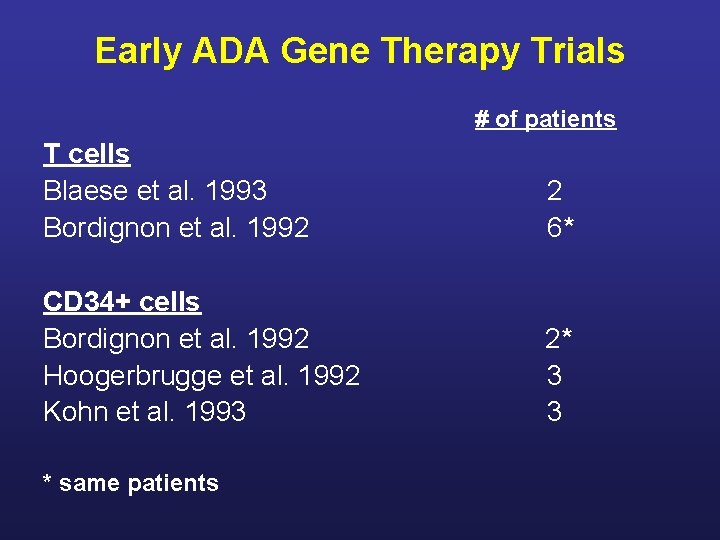
Early ADA Gene Therapy Trials # of patients T cells Blaese et al. 1993 Bordignon et al. 1992 2 6* CD 34+ cells Bordignon et al. 1992 Hoogerbrugge et al. 1992 Kohn et al. 1993 2* 3 3 * same patients
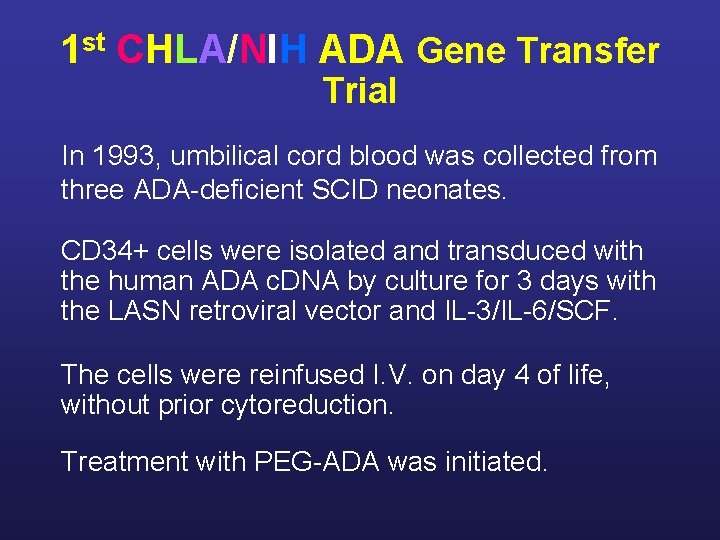
1 st CHLA/NIH ADA Gene Transfer Trial In 1993, umbilical cord blood was collected from three ADA-deficient SCID neonates. CD 34+ cells were isolated and transduced with the human ADA c. DNA by culture for 3 days with the LASN retroviral vector and IL-3/IL-6/SCF. The cells were reinfused I. V. on day 4 of life, without prior cytoreduction. Treatment with PEG-ADA was initiated.

Frequency of Gene-Containing Leukocytes Measured Using Semi-Quantitative PCR PEG-ADA (U/kg/wk) UPN #ADA 101 X=gran; = PBMC; M=monocytic; T= T cell; B= B cell Months after birth Kohn et al, Nat Med 4: 775 -780, 1998.
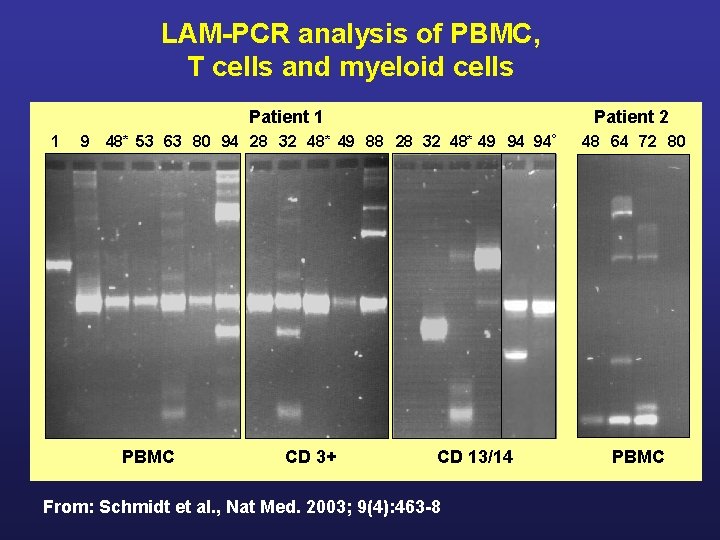
LAM-PCR analysis of PBMC, T cells and myeloid cells Patient 1 1 Patient 2 9 48* 53 63 80 94 28 32 48* 49 88 28 32 48* 49 94 94° PBMC CD 3+ CD 13/14 From: Schmidt et al. , Nat Med. 2003; 9(4): 463 -8 48 64 72 80 PBMC
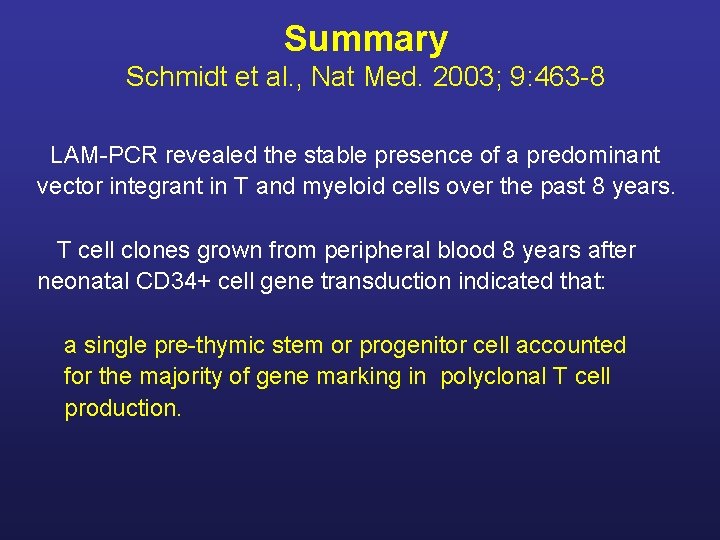
Summary Schmidt et al. , Nat Med. 2003; 9: 463 -8 LAM-PCR revealed the stable presence of a predominant vector integrant in T and myeloid cells over the past 8 years. T cell clones grown from peripheral blood 8 years after neonatal CD 34+ cell gene transduction indicated that: a single pre-thymic stem or progenitor cell accounted for the majority of gene marking in polyclonal T cell production.
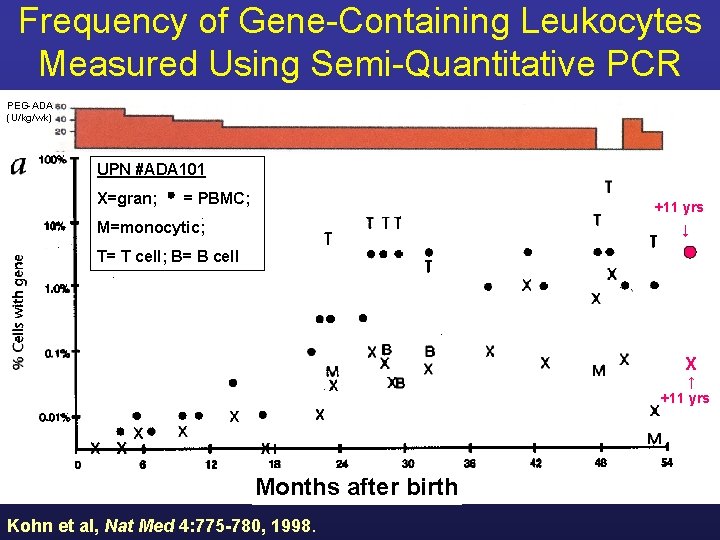
Frequency of Gene-Containing Leukocytes Measured Using Semi-Quantitative PCR PEG-ADA (U/kg/wk) UPN #ADA 101 X=gran; = PBMC; +11 yrs M=monocytic; ↓ T= T cell; B= B cell X ↑ +11 yrs Months after birth Kohn et al, Nat Med 4: 775 -780, 1998.
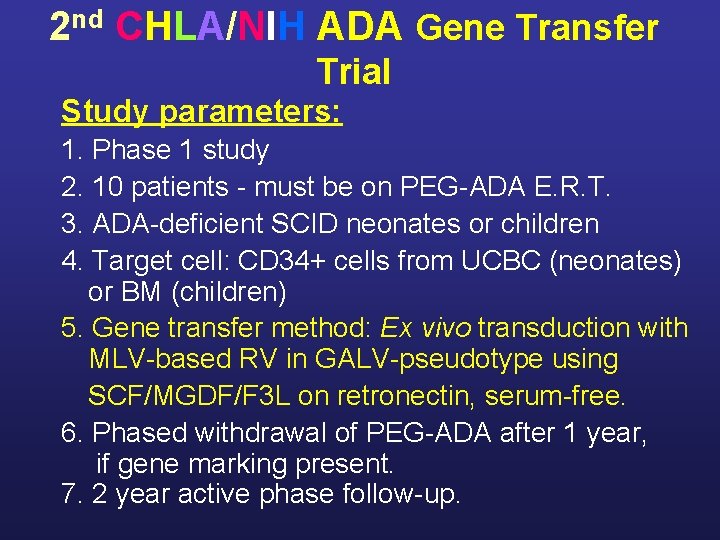
2 nd CHLA/NIH ADA Gene Transfer Trial Study parameters: 1. Phase 1 study 2. 10 patients - must be on PEG-ADA E. R. T. 3. ADA-deficient SCID neonates or children 4. Target cell: CD 34+ cells from UCBC (neonates) or BM (children) 5. Gene transfer method: Ex vivo transduction with MLV-based RV in GALV-pseudotype using SCF/MGDF/F 3 L on retronectin, serum-free. 6. Phased withdrawal of PEG-ADA after 1 year, if gene marking present. 7. 2 year active phase follow-up.
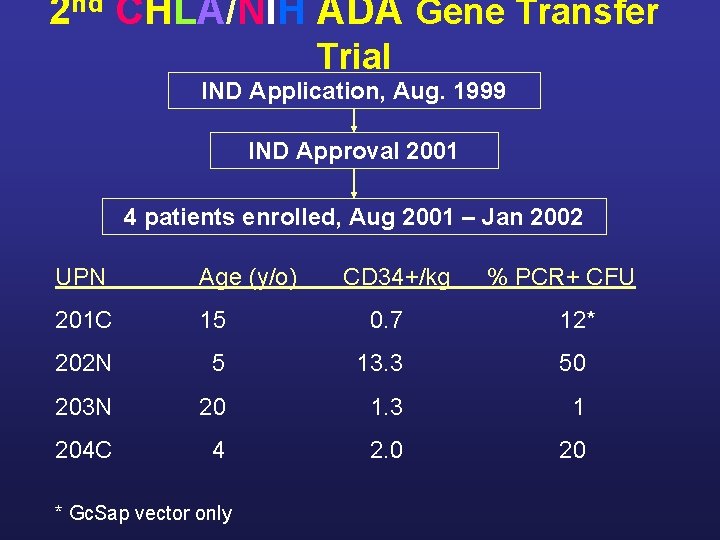
2 nd CHLA/NIH ADA Gene Transfer Trial IND Application, Aug. 1999 IND Approval 2001 4 patients enrolled, Aug 2001 – Jan 2002 UPN Age (y/o) 201 C 15 0. 7 12* 202 N 5 13. 3 50 203 N 20 1. 3 1 204 C 4 2. 0 20 * Gc. Sap vector only CD 34+/kg % PCR+ CFU
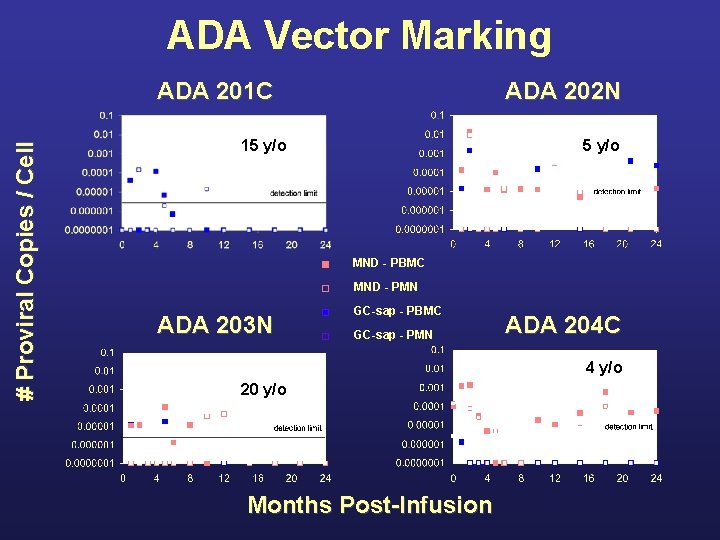
ADA Vector Marking # Proviral Copies / Cell ADA 201 C ADA 202 N 15 y/o MND - PBMC MND - PMN ADA 203 N GC-sap - PBMC GC-sap - PMN ADA 204 C 4 y/o 20 y/o Months Post-Infusion
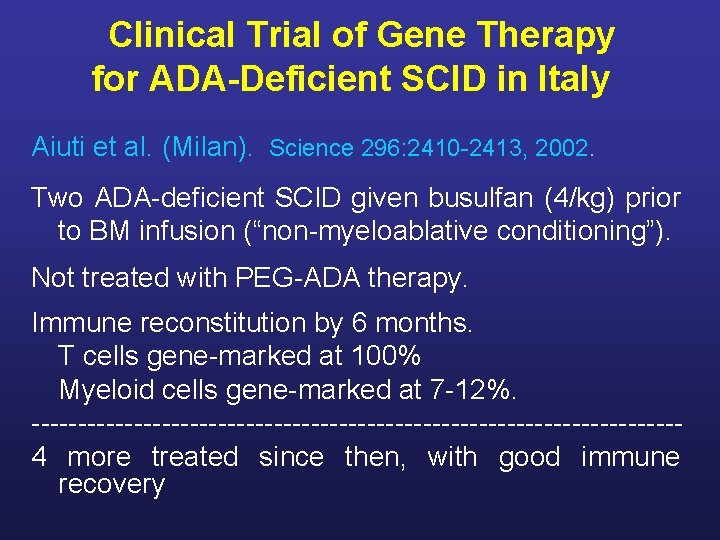
Clinical Trial of Gene Therapy for ADA-Deficient SCID in Italy Aiuti et al. (Milan). Science 296: 2410 -2413, 2002. Two ADA-deficient SCID given busulfan (4/kg) prior to BM infusion (“non-myeloablative conditioning”). Not treated with PEG-ADA therapy. Immune reconstitution by 6 months. T cells gene-marked at 100% Myeloid cells gene-marked at 7 -12%. -----------------------------------4 more treated since then, with good immune recovery
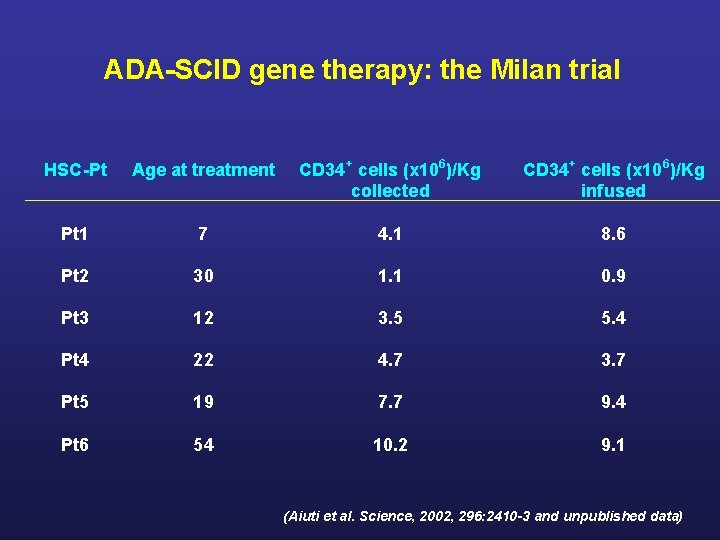
ADA-SCID gene therapy: the Milan trial HSC-Pt Age at treatment CD 34+ cells (x 106)/Kg collected CD 34+ cells (x 10 6)/Kg infused Pt 1 7 4. 1 8. 6 Pt 2 30 1. 1 0. 9 Pt 3 12 3. 5 5. 4 Pt 4 22 4. 7 3. 7 Pt 5 19 7. 7 9. 4 Pt 6 54 10. 2 9. 1 (Aiuti et al. Science, 2002, 296: 2410 -3 and unpublished data)
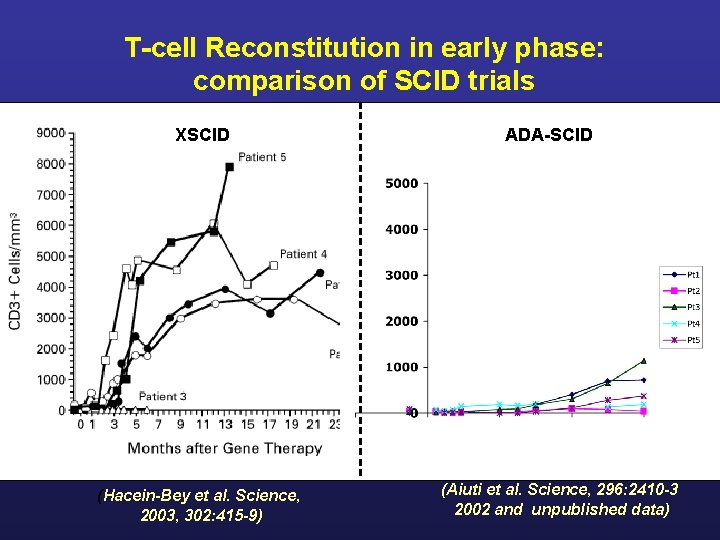
T-cell Reconstitution in early phase: comparison of SCID trials ADA-SCID T cells/microl XSCID X-SCID 0 2 4 6 Months of follow up (Hacein-Bey et al. Science, 2003, 302: 415 -9) (Aiuti et al. Science, 296: 2410 -3 2002 and unpublished data)
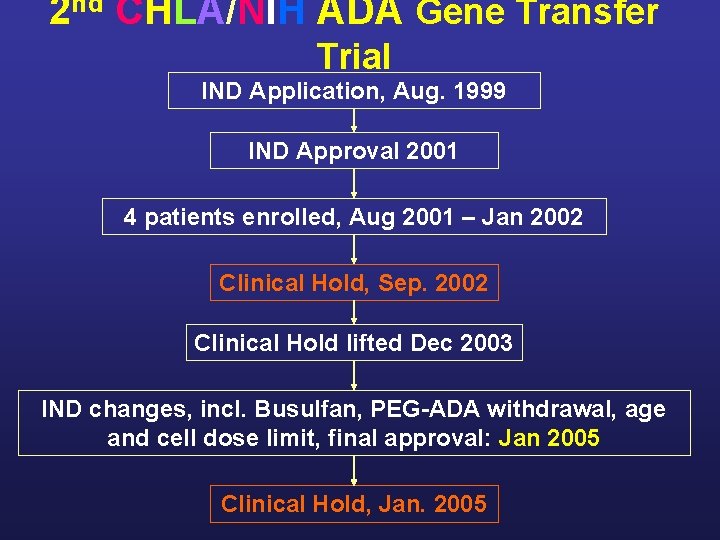
2 nd CHLA/NIH ADA Gene Transfer Trial IND Application, Aug. 1999 IND Approval 2001 4 patients enrolled, Aug 2001 – Jan 2002 Clinical Hold, Sep. 2002 Clinical Hold lifted Dec 2003 IND changes, incl. Busulfan, PEG-ADA withdrawal, age and cell dose limit, final approval: Jan 2005 Clinical Hold, Jan. 2005
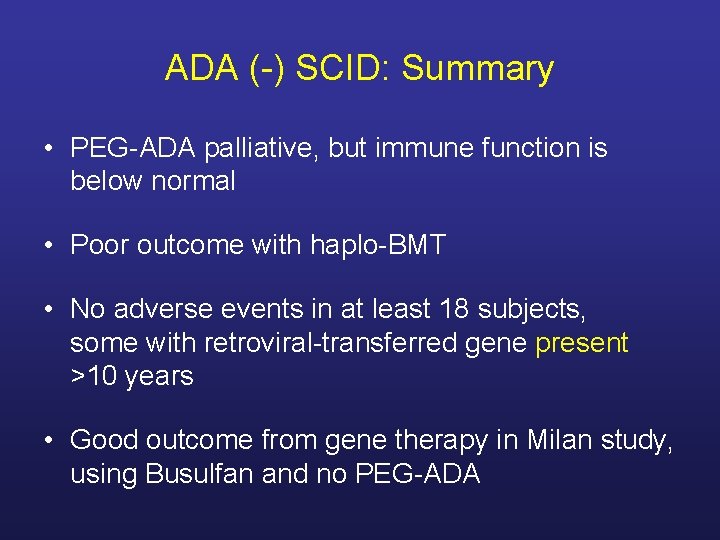
ADA (-) SCID: Summary • PEG-ADA palliative, but immune function is below normal • Poor outcome with haplo-BMT • No adverse events in at least 18 subjects, some with retroviral-transferred gene present >10 years • Good outcome from gene therapy in Milan study, using Busulfan and no PEG-ADA
- Slides: 19