
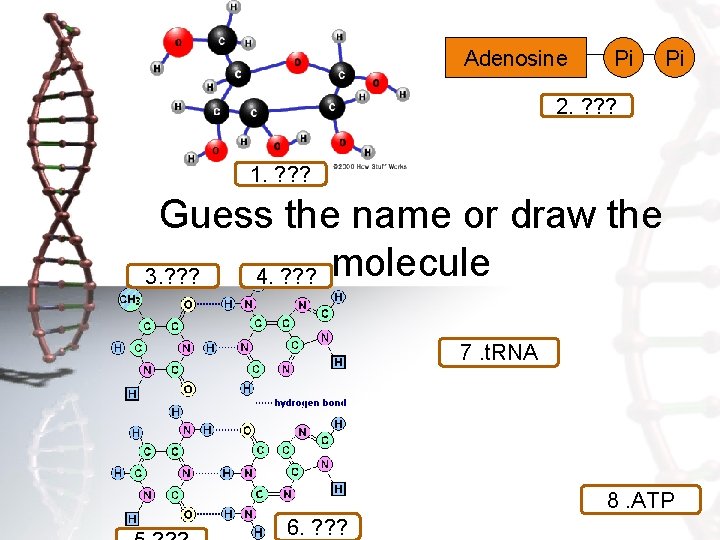
Adenosine Pi Pi 2 1 Guess the name
- Slides: 22
Adenosine Pi Pi 2. ? ? ? 1. ? ? ? Guess the name or draw the 3. ? ? ? 4. ? ? ? molecule 7. t. RNA 8. ATP 6. ? ? ?
• Explain how glucose is broken down in a number of enzyme controlled steps to produce ATP • Identify the 3 stages of respiration as glycolysis, citric acid cycle and electron transport chain, alongside key molecules in the process. • Understand the carrier molecules and their function
Respiration occurs in 3 stages; – Glycolysis – Citric acid cycle – Electron transport chain • Split into 3 groups • Research one and teach the rest of the class • Produce a learning aid for pupils to do (fill in the blanks/flow chart/diagram to annotate) • One method of checking pupils understand • EVERYONE in your group must understand be able to answer any question I/others will ask. • Must cover what is on you card.
Resources Available. . . • 3 x computers • 2 x text books • 1 x 10 minute tutorial from teacher Extras • Poster paper/pencils /pens/plasticine etc. 3
Hints • Who is doing what? • Think about key words to research • How will you use the time with me most effectively? • How will you check everyone in your group will know all you have done?
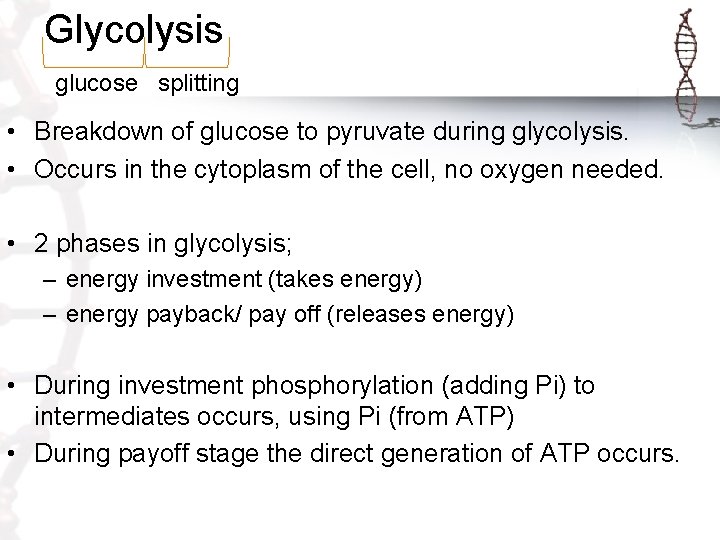
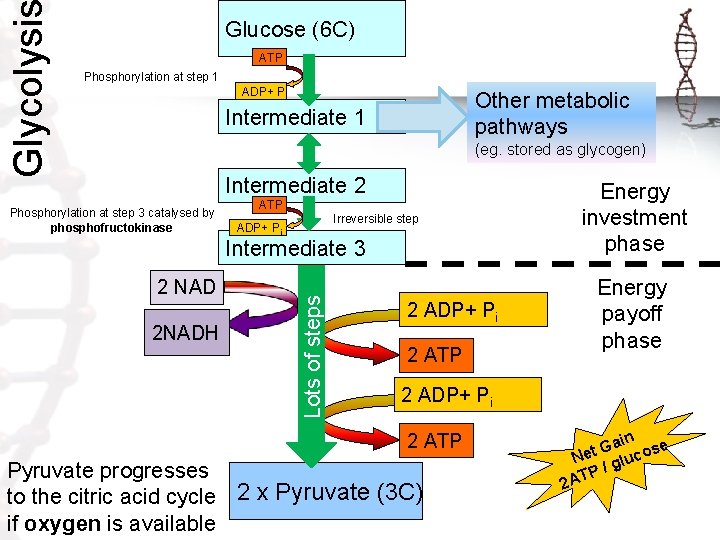
Glycolysis glucose splitting • Breakdown of glucose to pyruvate during glycolysis. • Occurs in the cytoplasm of the cell, no oxygen needed. • 2 phases in glycolysis; – energy investment (takes energy) – energy payback/ pay off (releases energy) • During investment phosphorylation (adding Pi) to intermediates occurs, using Pi (from ATP) • During payoff stage the direct generation of ATP occurs.
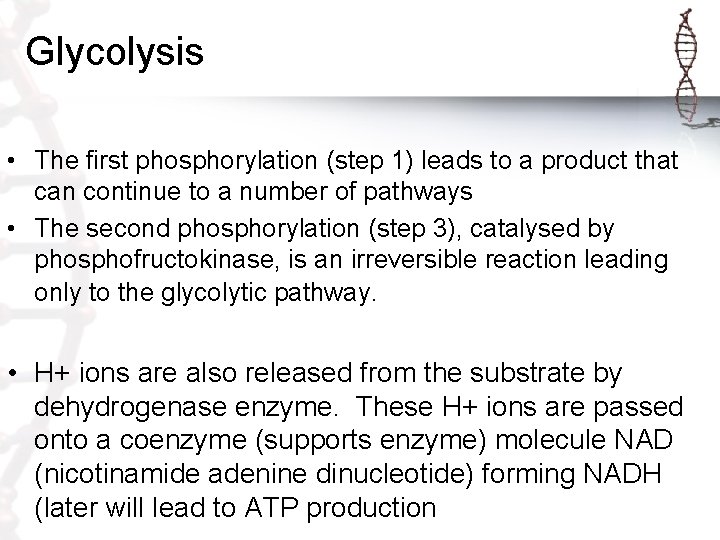
Glycolysis • The first phosphorylation (step 1) leads to a product that can continue to a number of pathways • The second phosphorylation (step 3), catalysed by phosphofructokinase, is an irreversible reaction leading only to the glycolytic pathway. • H+ ions are also released from the substrate by dehydrogenase enzyme. These H+ ions are passed onto a coenzyme (supports enzyme) molecule NAD (nicotinamide adenine dinucleotide) forming NADH (later will lead to ATP production
Glycolysi Glucose (6 C) ATP Phosphorylation at step 1 ADP+ Pi Other metabolic pathways Intermediate 1 (eg. stored as glycogen) Intermediate 2 Phosphorylation at step 3 catalysed by phosphofructokinase Energy investment phase ATP Irreversible step ADP+ Pi 2 NAD 2 NADH Lots of steps Intermediate 3 Energy payoff phase 2 ADP+ Pi 2 ATP Pyruvate progresses to the citric acid cycle 2 x Pyruvate (3 C) if oxygen is available 2 ain se G t Ne gluco / ATP
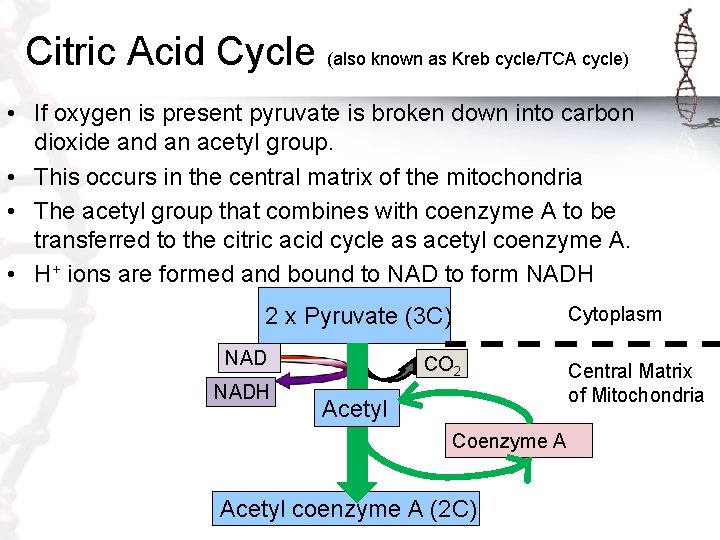
Citric Acid Cycle (also known as Kreb cycle/TCA cycle) • If oxygen is present pyruvate is broken down into carbon dioxide and an acetyl group. • This occurs in the central matrix of the mitochondria • The acetyl group that combines with coenzyme A to be transferred to the citric acid cycle as acetyl coenzyme A. • H+ ions are formed and bound to NAD to form NADH 2 x Pyruvate (3 C) NADH Cytoplasm CO 2 Acetyl Coenzyme A Acetyl coenzyme A (2 C) Central Matrix of Mitochondria
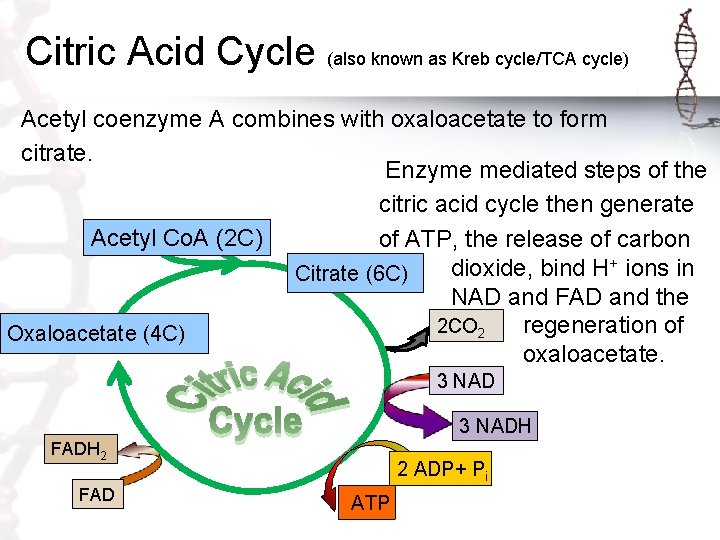
Citric Acid Cycle (also known as Kreb cycle/TCA cycle) Acetyl coenzyme A combines with oxaloacetate to form citrate. Enzyme mediated steps of the citric acid cycle then generate Acetyl Co. A (2 C) of ATP, the release of carbon dioxide, bind H+ ions in Citrate (6 C) NAD and FAD and the 2 CO 2 regeneration of Oxaloacetate (4 C) oxaloacetate. 3 NADH FADH 2 FAD 2 ADP+ Pi ATP
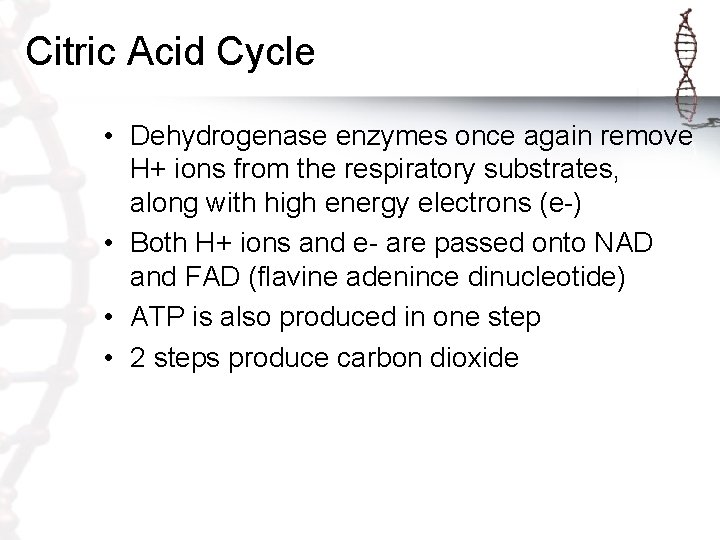
Citric Acid Cycle • Dehydrogenase enzymes once again remove H+ ions from the respiratory substrates, along with high energy electrons (e-) • Both H+ ions and e- are passed onto NAD and FAD (flavine adenince dinucleotide) • ATP is also produced in one step • 2 steps produce carbon dioxide
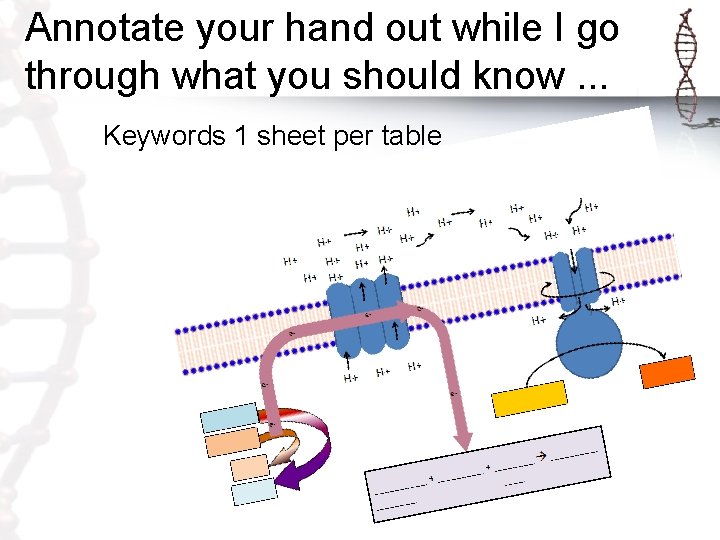
Annotate your hand out while I go through what you should know. . . Keywords 1 sheet per table
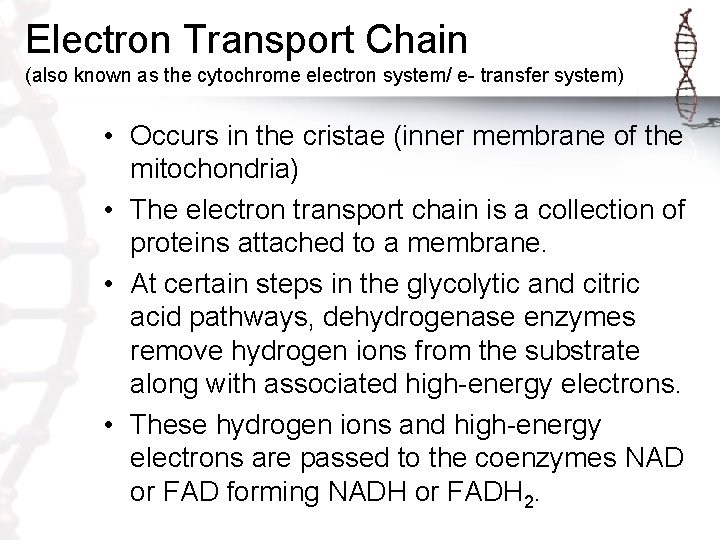
Electron Transport Chain (also known as the cytochrome electron system/ e- transfer system) • Occurs in the cristae (inner membrane of the mitochondria) • The electron transport chain is a collection of proteins attached to a membrane. • At certain steps in the glycolytic and citric acid pathways, dehydrogenase enzymes remove hydrogen ions from the substrate along with associated high-energy electrons. • These hydrogen ions and high-energy electrons are passed to the coenzymes NAD or FAD forming NADH or FADH 2.
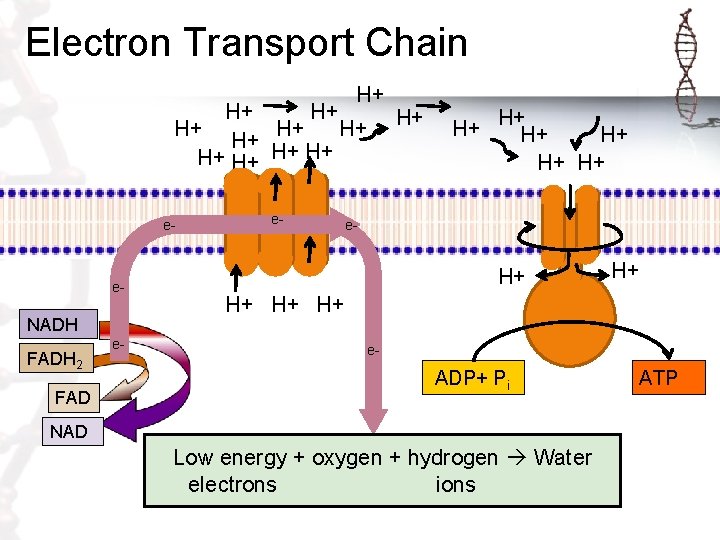
Electron Transport Chain H+ H+ H+ e- e- NADH FADH 2 FAD e- e- H+ H+ e- H+ H+ H+ e- ADP+ Pi NAD Low energy + oxygen + hydrogen Water electrons ions ATP
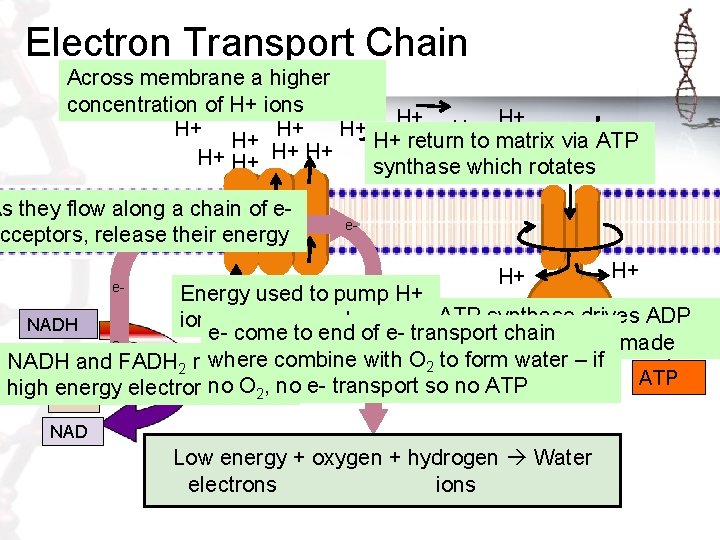
Electron Transport Chain Across membrane a higher concentration of H+ H+ ions H+ H+ H+ via ATP H+ H+ H+ return to matrix H+ H+ H+ synthase which rotates As they flow along a chain of e-eecceptors, release their energy e- e- H+ H+ Energy used to pump H+ H+ ATP synthase drives ADP ions across membrane NADH e- come to end of e- transport eto ATP, chain most ATP made e. FADHand where combine with O 2 here to form water – if NADH FADH 2 release 2 ADP+ Pi ATP no ATP high energy electronsno O 2, no e- transport so FAD NAD Low energy + oxygen + hydrogen Water electrons ions
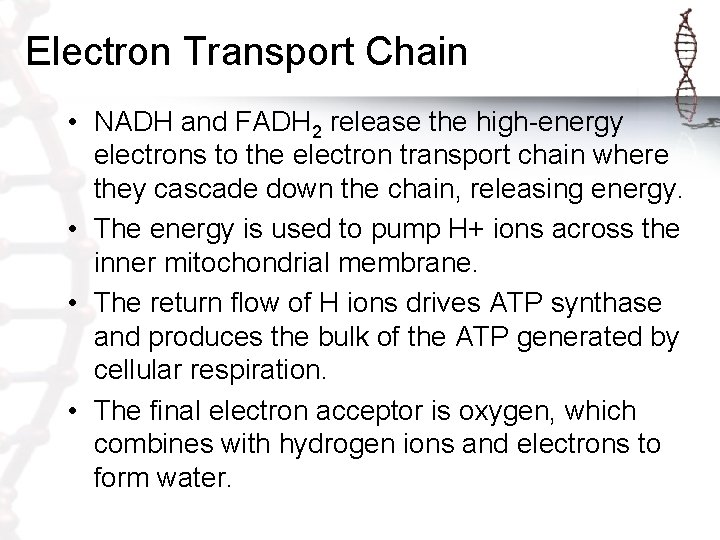
Electron Transport Chain • NADH and FADH 2 release the high-energy electrons to the electron transport chain where they cascade down the chain, releasing energy. • The energy is used to pump H+ ions across the inner mitochondrial membrane. • The return flow of H ions drives ATP synthase and produces the bulk of the ATP generated by cellular respiration. • The final electron acceptor is oxygen, which combines with hydrogen ions and electrons to form water.
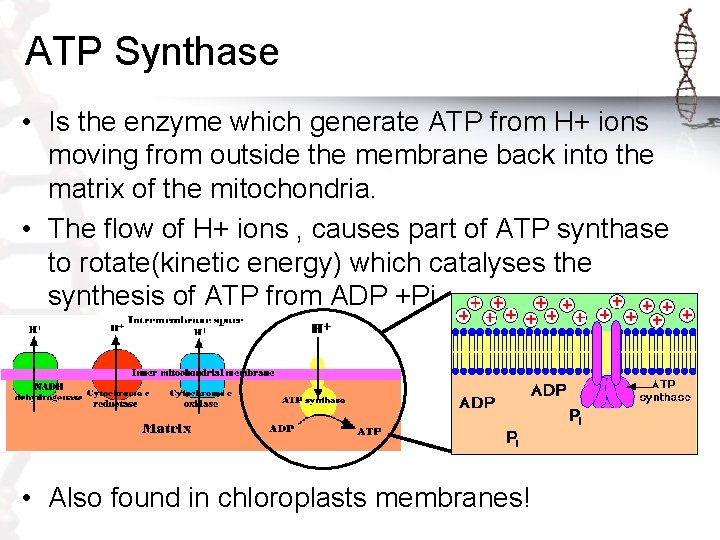
ATP Synthase • Is the enzyme which generate ATP from H+ ions moving from outside the membrane back into the matrix of the mitochondria. • The flow of H+ ions , causes part of ATP synthase to rotate(kinetic energy) which catalyses the synthesis of ATP from ADP +Pi • Also found in chloroplasts membranes!
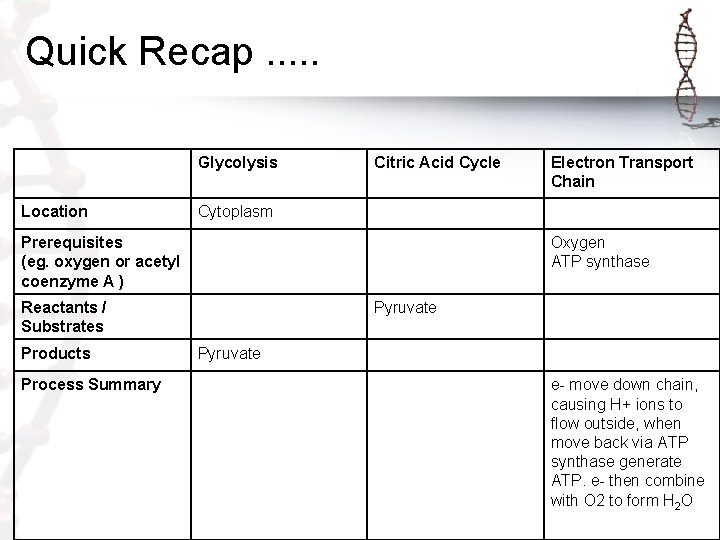
Quick Recap. . . Glycolysis Location Citric Acid Cycle Cytoplasm Prerequisites (eg. oxygen or acetyl coenzyme A ) Oxygen ATP synthase Reactants / Substrates Products Process Summary Electron Transport Chain Pyruvate e- move down chain, causing H+ ions to flow outside, when move back via ATP synthase generate ATP. e- then combine with O 2 to form H 2 O
Respiration Game
SQA Arrangements p 23 • The breakdown of glucose to pyruvate during glycolysis. The phosphorylation of intermediates in glycolysis in an energy investment phase and the direct generation of ATP in an energy pay off stage. The first phosphorylation leads to a product that can continue to a number of pathways and the second phosphorylation, catalysed by phosphofructokinase, is an irreversible reaction leading only to the glycolytic pathway. Pyruvate progresses to the citric acid cycle if oxygen is available. • Pyruvate is broken down to an acetyl group that combines with coenzyme A to be transferred to the citric acid cycle as acetyl coenzyme A. Acetyl coenzyme A combines with oxaloacetate to form citrate, followed by the enzyme mediated steps of the citric acid cycle with some generation of ATP, the release of carbon dioxide and the regeneration
• The electron transport chain as a collection of proteins attached to a membrane. At certain steps in the glycolytic and citric acid pathways, dehydrogenase enzymes remove hydrogen ions from the substrate along with associated high-energy electrons. These hydrogen ions and high-energy electrons are passed to the coenzymes NAD or FAD forming NADH or FADH 2. • NADH and FADH 2 release the high-energy electrons to the electron transport chain where they cascade down the chain, releasing energy. The energy is used to pump H ions across the inner mitochondrial membrane. The return flow of H ions drives ATP synthase and produces the bulk of the ATP generated by cellular respiration. The final electron acceptor is oxygen, which combines with hydrogen ions and electrons to form water.
ATP synthase – p 22 • Glucose is broken down in a series of enzyme controlled steps. Hydrogen and high energy electrons are removed by dehydrogenase enzymes and used to yield ATP. • To synthesise the bulk of its ATP requirements, a cell uses a source of high energy electrons to pump H ions across a membrane. The return flow of these ions rotates part of the membrane protein ATP synthase, catalysing the synthesis of ATP.