
Addressing the challenges of deforestation and forest degradation
- Slides: 19
‘Addressing the challenges of deforestation and forest degradation to tackle climate change and biodiversity loss’ - Bonn, 31 March 2009 Valérie Merckx European Commission DG Environment
Context • Deforestation contributes to around 20% of CO 2 emissions (5, 8 Gt. CO 2) • More than total EU-27 greenhouse gas emissions (5, 1 Gt. CO 2/yr) Limiting climate change to 2°C can not be achieved without action on deforestation.
Context • Deforestation is one of the main cause of biodiversity loss • 1, 6 billion people depend on forest resources and 60 million indigenous people depend directly on forests for their survival.
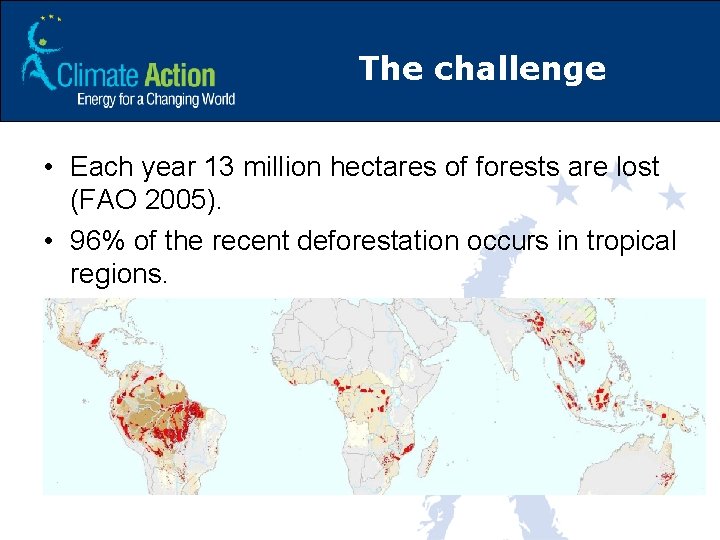
The challenge • Each year 13 million hectares of forests are lost (FAO 2005). • 96% of the recent deforestation occurs in tropical regions.
Deforestation is not new … What is new is: • The link to the climate change debate • The recognition that incentives are needed to counterbalance the economic drivers of deforestation
The policy frame Ongoing international negotiations on climate change (UNFCCC) but the benefits of a successful implementation will not be limited to climate change mitigation
A triple win is possible Successful global actions to stop deforestation will contribute to: • Climate change mitigation • Biodiversity conservation • Poverty alleviation
The objectives • To halt global forest cover loss by 2030 at the latest • To reduce gross tropical deforestation by at least 50% by 2020 compared to current levels
Areas for action • Strengthening forest governance and institutions at local and national level = a pre-condition for effective policy answers • Capturing the economic value and rewarding forest ecosystem services; • Ensuring policy coherence ie address the impacts of the demand side • Using the UNFCCC forum to build a global response (with relevant input from CBD and other processes) • Improving quality of information forest monitoring and assessment.
The costs • € 15 – 25 billion/yr will be needed to halve deforestation by 2020 • Resources need to be allocated by developed countries to complement efforts made by developing countries
The Global Forest Carbon Mechanism A financial mechanism under the UNFCCC to reward emission reductions from deforestation and forest degradation in developing countries
How to make the GFCM work? • Focus on reducing deforestation and forest degradation while promoting the conservation, sustainable forest management and enhancement of forest carbon stocks • Contribute to protection of biodiversity and the fight against poverty • Performance based financial support, taking into account respective capabilities • Effective forest governance structures in place • Support for capacity-building • Nationwide implementation to minimise risk of leakage • Monitoring and accounting at national level, with independent verification of emission reductions achieved
REDD in the carbon market? Pre-conditions § - International agreement with ambitious mid-term emission reduction commitments for balanced supply and demand • - Impact of reduced deforestation on carbon emissions properly monitored and verified • - Move from project level to national baselines to avoid leakage (solve methodological problems defining baseline) • - Adequate solution to non permanence of forestry credits and liability issues
Carbon market contribution to combating deforestation • Proceeds of auctioned allowances in the EU ETS as main source of EU contribution to the GFCM in the short term: • Commission ETS review proposal: at least 20% of auctioning proceeds should be used to support climate objectives, including fighting deforestation • European Parliament proposal: “… it is essential that revenues from auctioning …be used to reduce deforestation and increase sustainable afforestation and reforestation”. “Consideration should be given to contributing to a dedicated fund” • Pilot phase to test inclusion of REDD in the carbon markets for government compliance
Carbon market contribution to combating deforestation In the longer term: • Potential recognition of forestry credits – incl. deforestation / REDD – for compliance in the EU ETS – Considered after a review of the pilot phase of using deforestation credits for government compliance – If satisfactory solutions to liability issue, monitoring and verification, and supply and demand balance are found.
A comprehensive policy approach – promote the consumption of sustainably produced timber ; – ensure that EU policies do not increase the pressure on the world's forests ; – fill the existing knowledge gaps.
In conclusion The EU proposal: • is a step on our way to Copenhagen • proposes main lines for a comprehensive EU response • is a contribution to setting the foundations of a viable global response to deforestation
Thank you for your attention! http: //ec. europa. eu/environment/f orests/deforestation. htm Contact: valerie. merckx@ec. europa. eu giuliana. torta@ec. europa. eu
More info on EU climate policy: http: //europa. eu. int/comm/environment/climat/home_en. htm