
Addressing Risks from Total Petroleum Hydrocarbons Gina Ferreira
Addressing Risks from Total Petroleum Hydrocarbons Gina Ferreira U. S. EPA - Region 2 Charles G. Maurice, Ph. D. U. S. EPA – ORD Quarterly State Risk Assessor Call 16 April 2019
Addressing Risks from Total Petroleum Hydrocarbons Background – Total petroleum hydrocarbons are a complex mixture of aliphatic and aromatic compounds of various carbon configurations commonly found at refinery sites. – Many approaches exist for partitioning TPHs into different fractions (e. g. , DRO, GRO, etc. ) • Past laboratory methods relied on gasoline-range and diesel range constituents that lack toxicology data • Relied upon RSLs for BTEX chemicals (benzene, ethylbenzene, toluene, and xylene) and PAHs to address potential site exposure • Ignored potential contribution of exposure to long carbon chain chemicals and those exposures were underestimated in risk assessments Quarterly State Risk Assessor Call 16 April 2019
Addressing Risks from Total Petroleum Hydrocarbons Quarterly State Risk Assessor Call 16 April 2019
Addressing Risks from Total Petroleum Hydrocarbons (C-5 to C 36) Quarterly State Risk Assessor Call 16 April 2019
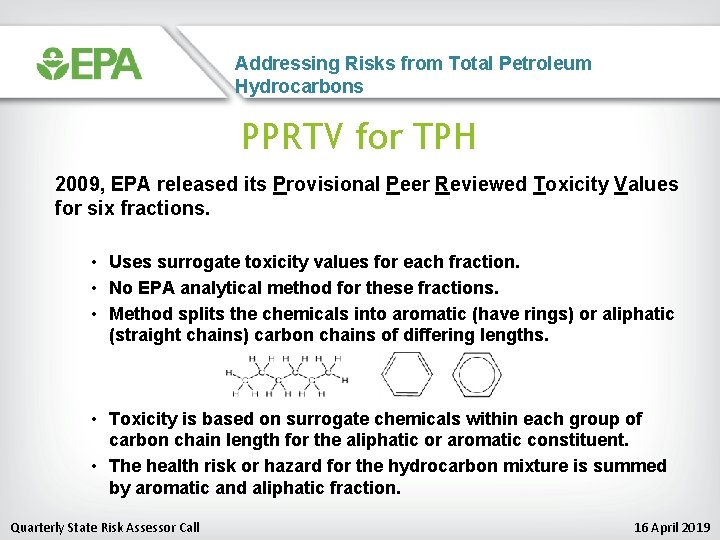
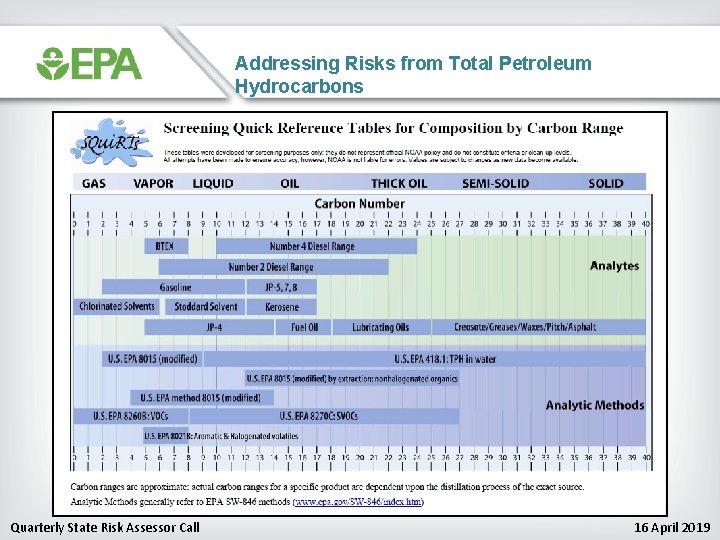
Addressing Risks from Total Petroleum Hydrocarbons PPRTV for TPH 2009, EPA released its Provisional Peer Reviewed Toxicity Values for six fractions. • Uses surrogate toxicity values for each fraction. • No EPA analytical method for these fractions. • Method splits the chemicals into aromatic (have rings) or aliphatic (straight chains) carbon chains of differing lengths. • Toxicity is based on surrogate chemicals within each group of carbon chain length for the aliphatic or aromatic constituent. • The health risk or hazard for the hydrocarbon mixture is summed by aromatic and aliphatic fraction. Quarterly State Risk Assessor Call 16 April 2019
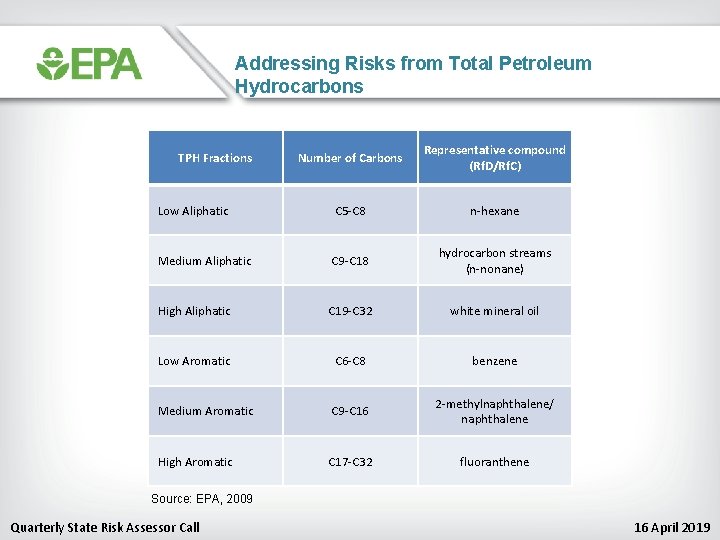
Addressing Risks from Total Petroleum Hydrocarbons Number of Carbons Representative compound (Rf. D/Rf. C) Low Aliphatic C 5 -C 8 n-hexane Medium Aliphatic C 9 -C 18 hydrocarbon streams (n-nonane) High Aliphatic C 19 -C 32 white mineral oil Low Aromatic C 6 -C 8 benzene Medium Aromatic C 9 -C 16 2 -methylnaphthalene/ naphthalene High Aromatic C 17 -C 32 fluoranthene TPH Fractions Source: EPA, 2009 Quarterly State Risk Assessor Call 16 April 2019
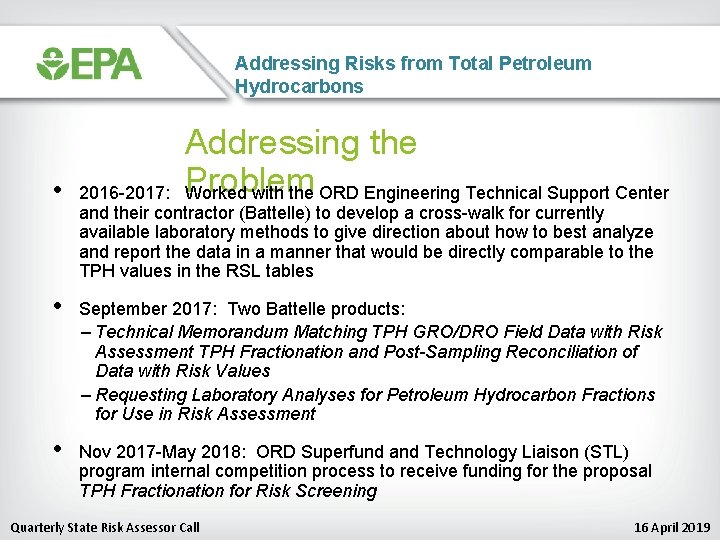
Addressing Risks from Total Petroleum Hydrocarbons Addressing the Problem Worked with the ORD Engineering Technical Support Center • 2016 -2017: and their contractor (Battelle) to develop a cross-walk for currently available laboratory methods to give direction about how to best analyze and report the data in a manner that would be directly comparable to the TPH values in the RSL tables • September 2017: Two Battelle products: – Technical Memorandum Matching TPH GRO/DRO Field Data with Risk Assessment TPH Fractionation and Post-Sampling Reconciliation of Data with Risk Values – Requesting Laboratory Analyses for Petroleum Hydrocarbon Fractions for Use in Risk Assessment • Nov 2017 -May 2018: ORD Superfund and Technology Liaison (STL) program internal competition process to receive funding for the proposal TPH Fractionation for Risk Screening Quarterly State Risk Assessor Call 16 April 2019
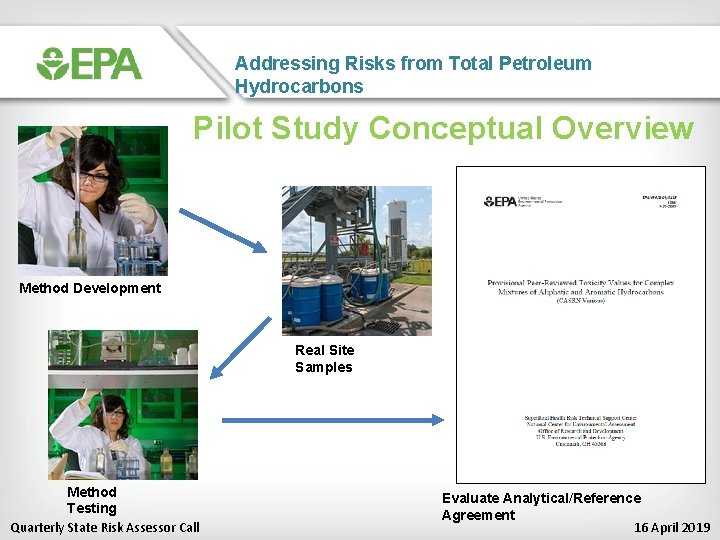
Addressing Risks from Total Petroleum Hydrocarbons Pilot Study Conceptual Overview Method Development Real Site Samples Method Testing Quarterly State Risk Assessor Call Evaluate Analytical/Reference Agreement 16 April 2019
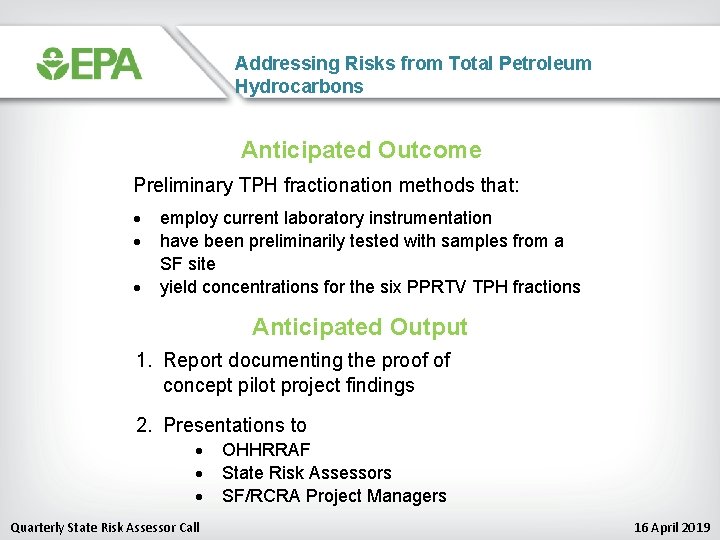
Addressing Risks from Total Petroleum Hydrocarbons Anticipated Outcome Preliminary TPH fractionation methods that: employ current laboratory instrumentation have been preliminarily tested with samples from a SF site yield concentrations for the six PPRTV TPH fractions Anticipated Output 1. Report documenting the proof of concept pilot project findings 2. Presentations to Quarterly State Risk Assessor Call OHHRRAF State Risk Assessors SF/RCRA Project Managers 16 April 2019
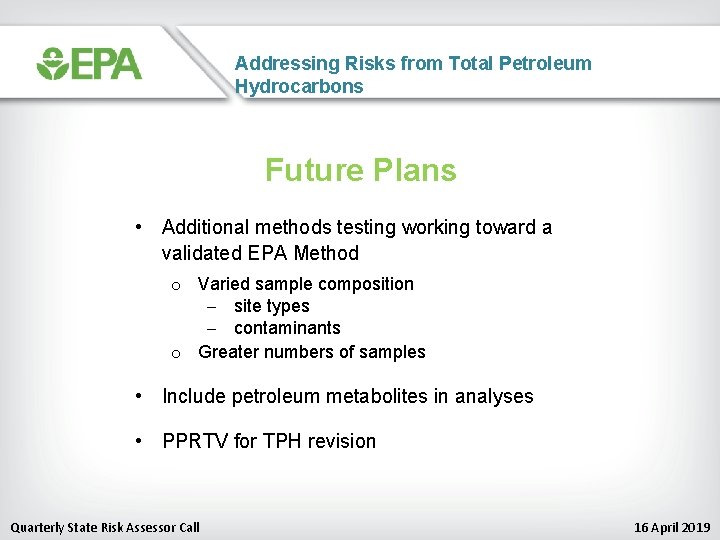
Addressing Risks from Total Petroleum Hydrocarbons Future Plans • Additional methods testing working toward a validated EPA Method o Varied sample composition site types contaminants o Greater numbers of samples • Include petroleum metabolites in analyses • PPRTV for TPH revision Quarterly State Risk Assessor Call 16 April 2019
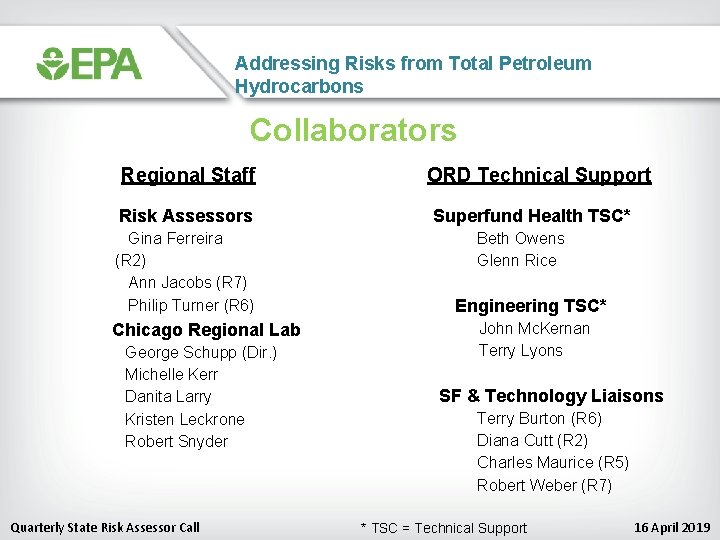
Addressing Risks from Total Petroleum Hydrocarbons Collaborators Regional Staff Risk Assessors Gina Ferreira (R 2) Ann Jacobs (R 7) Philip Turner (R 6) Chicago Regional Lab George Schupp (Dir. ) Michelle Kerr Danita Larry Kristen Leckrone Robert Snyder Quarterly State Risk Assessor Call ORD Technical Support Superfund Health TSC* Beth Owens Glenn Rice Engineering TSC* John Mc. Kernan Terry Lyons SF & Technology Liaisons Terry Burton (R 6) Diana Cutt (R 2) Charles Maurice (R 5) Robert Weber (R 7) * TSC = Technical Support 16 April 2019
- Slides: 11