
Addressing Motivation for Change Introduction to Motivational Interviewing

- Slides: 42
Addressing Motivation for Change: Introduction to Motivational Interviewing Igor Koutsenok, MD, Professor of Psychiatry University of California San Diego, Department of Psychiatry 2019
I guess you would you agree with me that Effective treatment of patients with a variety of acute and chronic conditions is impossible without changes in the patient’s behavior?
If you agree, here is the $10 M question: Why people don’t just change?
You would think. . . That having had a heart attack would be enough for someone to quit smoking and exercise more. That hangovers, damaged relationships, would be enough to convince people to do something about their drinking or drug use That being diagnosed with diabetes will be enough to someone to start a diet and medication That time spent in the jail or prison would dissuade someone from re-offending and sometimes it does. .
Yet so often it is not enough. Why?
Common believes why people do not change The problem with them is. . . They don’t SEE the problem (denial, lack of insight) They don’t KNOW HOW to change They simply don’t CARE
So, if these explanations are true, there are simple solutions, and you don’t need this lecture Give them INSIGHT and KNOWLEDGE, and they will change Give them SKILLS how to change, and they will do it Give them FEAR - make people feel bad or afraid enough, they will change
Let’s experience it Please think about something real in your life that you: want to change need to change should change have been thinking about changing But you haven’t changed yet i. e. – something you’re ambivalent about!
Counselors, please do ONLY the following Listen what is the issue that the person has �Tell the client why he/she should make a change �Tell to the client at least 3 specific benefits of making this change �Tell the client how to change �Emphasize how important it is for them to make the change �Persuade the person to do it!
Part 2 Client “Something I’ve been thinking about changing is…” Counselor Ask, and listen with interest. Give no advise: 1. What do you think you will like about making this change? 2. How might you go about it, in order to succeed? 3. What are three best reasons to do it? 4. What will happen if you don’t make this change? Summarize what you heard. Ask: “What will you do next? ”
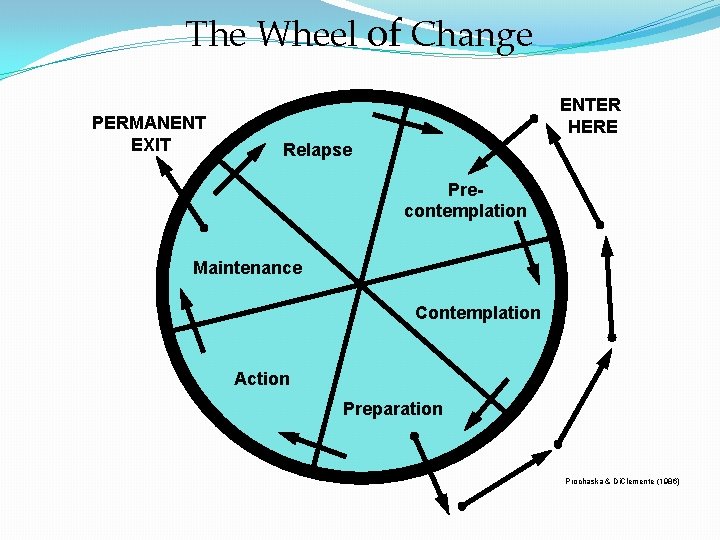
The Wheel of Change PERMANENT EXIT ENTER HERE Relapse Precontemplation Maintenance Contemplation Action Preparation Prochaska & Di. Clemente (1986)
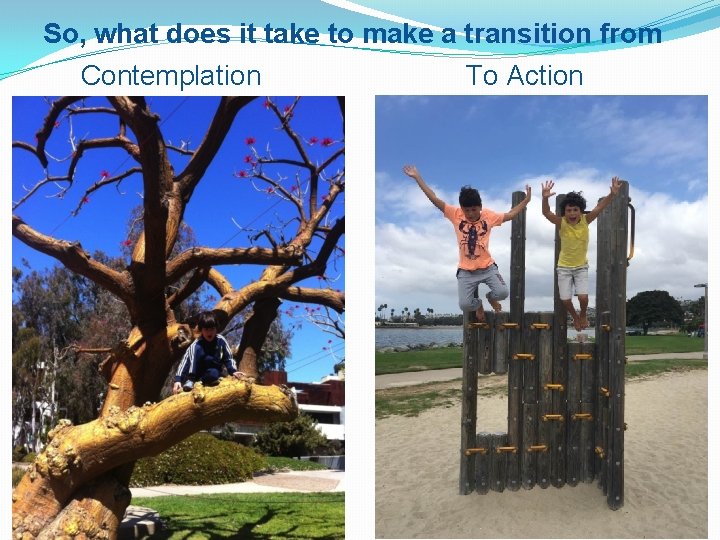
So, what does it take to make a transition from Contemplation To Action
Motivation is: The probability for an individual to initiate and maintain a desirable behavioral change
What is ambivalence? �Ambivalence is having two contradictory thoughts about the same thing (“should I, or I should not…? ) �Ambivalence is exactly the material that Motivational Interviewing works with
So, What Is RESISTANCE? Rolling with Resistance: Wrestling vs. Dancing 1. Resistance is a result of interaction, not a symptom of any pathology 2. Resistance is the Ambivalence Under Pressure 3. Resistance is indicative of a possible breakdown in the relationship
Ambivalence vs. Resistance? Rolling with Resistance: Wrestling vs. Dancing 1. Ambivalence is a reflection of my relationship with the PROBLEM 2. Resistance is a reflection of my relationship with YOU 3. Resistance is a result of interaction, not a symptom of any pathology 4. Resistance is the Ambivalence Under Pressure 5. Resistance is indicative of a possible breakdown in the relationship
What is Motivational Interviewing? Motivational Interviewing is a collaborative, person-centered, and directive communication style to elicit and strengthen motivation for change and address a common problem of ambivalence.
Assumptions of MI �Ambivalence is normal �Motivation is dynamic �Most people know the solution even if they are reluctant to use it
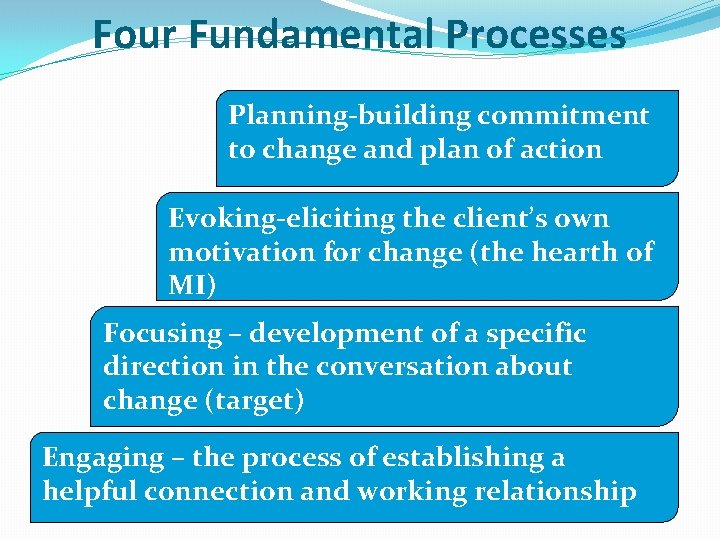
Four Fundamental Processes Planning-building commitment to change and plan of action Evoking-eliciting the client’s own motivation for change (the hearth of MI) Focusing – development of a specific direction in the conversation about change (target) Engaging – the process of establishing a helpful connection and working relationship
Four Processes: ¢Engaging is about “How shall we travel together? ” ¢Focusing asks “Where to? ” ¢Evoking is about “Whether” and “Why” and ¢Planning is about “How” and “When”
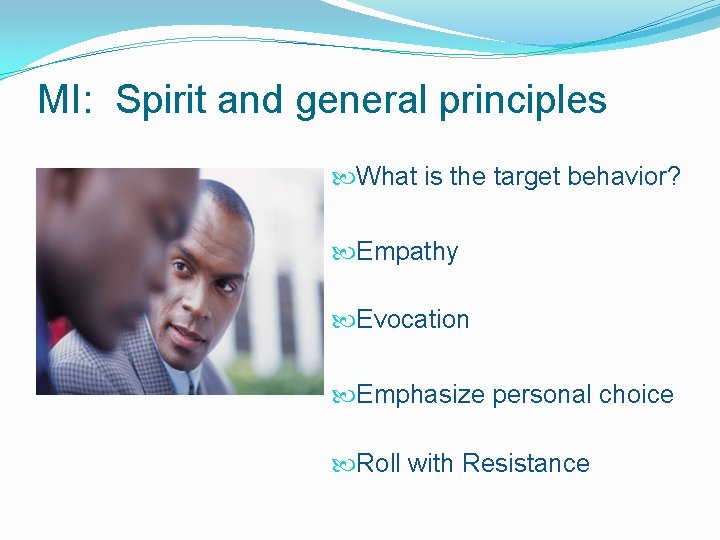
MI: Spirit and general principles What is the target behavior? Empathy Evocation Emphasize personal choice Roll with Resistance
Giving advise and information • • Some times necessary If unsolicited – always leads to defensiveness Offer advise or information with permission A helpful strategy – EPE (elicit-provideelicit)
How do we Roll with Resistance? Avoid arguing for change (you will really have a hard time arguing with me if I do not argue with you) Resistance is a signal to respond differently - Shift the direction Listen and reflect
Expressing Empathy: Reflective Listening: 1) Getting into the client’s shoes 2) They know that you know
Empathy is not: Having had the same experience or problem Identification with your client “Let me tell you my story” Empathy is: The ability to accurately understand your client’s meaning The ability to reflect that accurate understanding back to your client
Empathy is similar to gas in your car – it does not define where will you go, which route will you take, when will you take off or stop. But you certainly are not going anywhere without it.
Effectiveness of MI (over 300 clinical trials) Shown to work in: ◦ Medication adherence ◦ Diet and exercise ◦ Addictions treatment and gambling ◦ Eating disorders ◦ Co-occurring disorders ◦ Adults and youth in criminal justice system
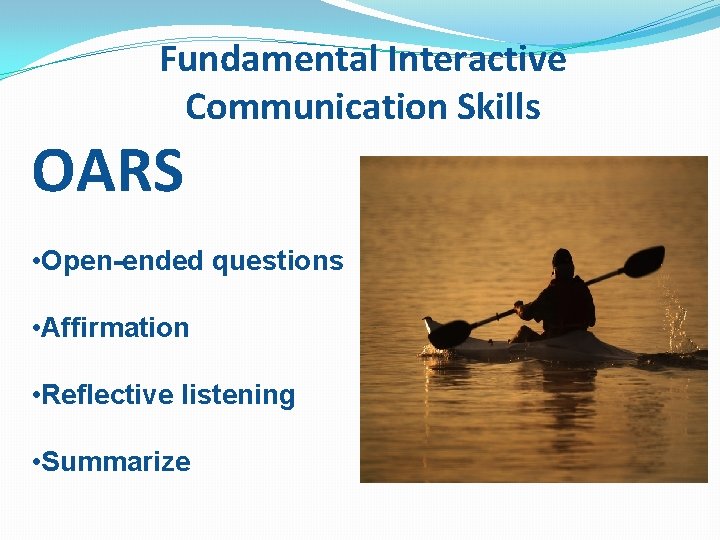
Fundamental Interactive Communication Skills OARS • Open-ended questions • Affirmation • Reflective listening • Summarize
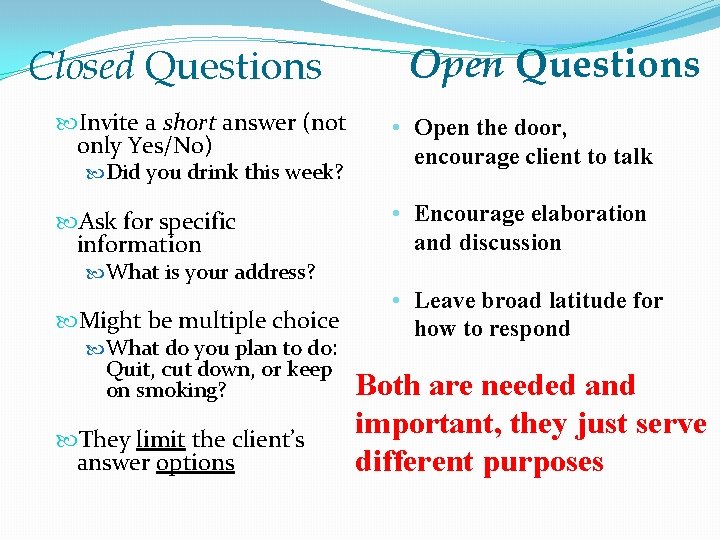
Closed Questions Open Questions Invite a short answer (not only Yes/No) • Open the door, encourage client to talk Ask for specific information • Encourage elaboration and discussion Might be multiple choice • Leave broad latitude for how to respond Did you drink this week? What is your address? What do you plan to do: Quit, cut down, or keep on smoking? They limit the client’s answer options Both are needed and important, they just serve different purposes
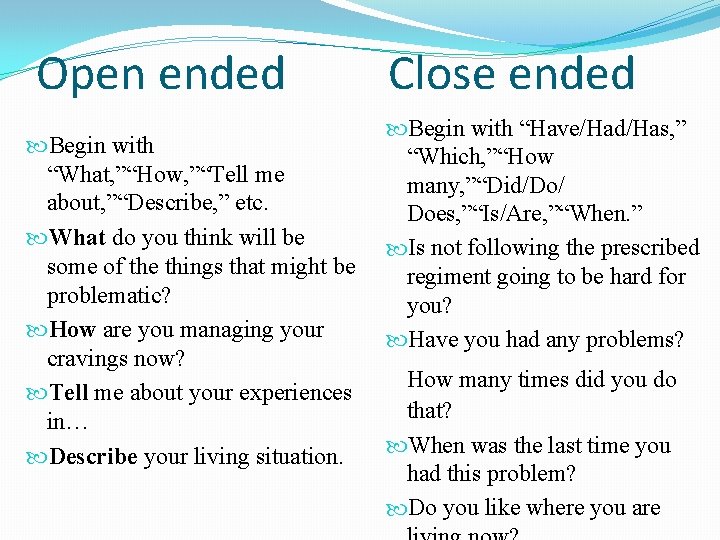
Open ended Begin with “What, ”“How, ”“Tell me about, ”“Describe, ” etc. What do you think will be some of the things that might be problematic? How are you managing your cravings now? Tell me about your experiences in… Describe your living situation. Close ended Begin with “Have/Had/Has, ” “Which, ”“How many, ”“Did/Do/ Does, ”“Is/Are, ”“When. ” Is not following the prescribed regiment going to be hard for you? Have you had any problems? How many times did you do that? When was the last time you had this problem? Do you like where you are
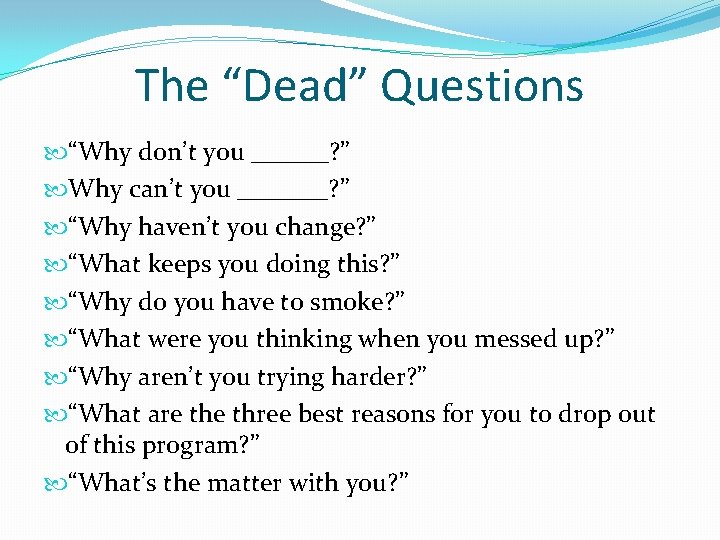
The “Dead” Questions “Why don’t you ______? ” Why can’t you _______? ” “Why haven’t you change? ” “What keeps you doing this? ” “Why do you have to smoke? ” “What were you thinking when you messed up? ” “Why aren’t you trying harder? ” “What are three best reasons for you to drop out of this program? ” “What’s the matter with you? ”
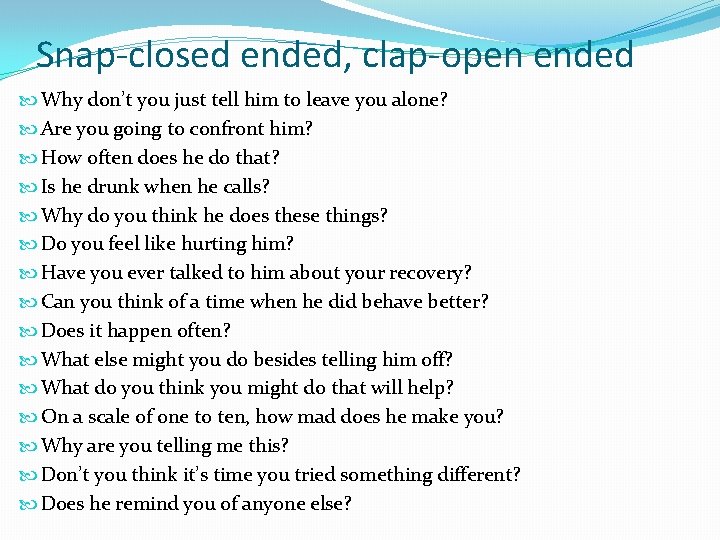
Snap-closed ended, clap-open ended Why don’t you just tell him to leave you alone? Are you going to confront him? How often does he do that? Is he drunk when he calls? Why do you think he does these things? Do you feel like hurting him? Have you ever talked to him about your recovery? Can you think of a time when he did behave better? Does it happen often? What else might you do besides telling him off? What do you think you might do that will help? On a scale of one to ten, how mad does he make you? Why are you telling me this? Don’t you think it’s time you tried something different? Does he remind you of anyone else?
Supporting Self-Efficacy: Affirmations Acknowledgement of… Struggles or difficulties Successes Skills and/or strengths Goals and values Notice and appreciate a positive action − “Catch them doing something right”
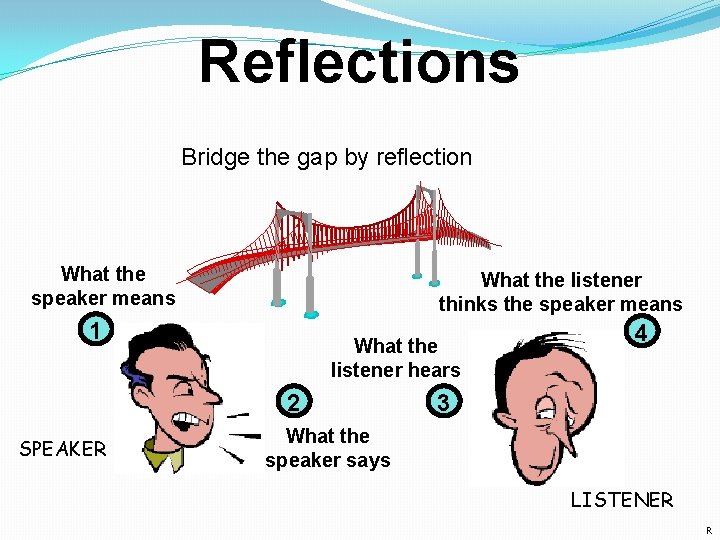
Reflections Bridge the gap by reflection What the speaker means What the listener thinks the speaker means 1 What the listener hears 2 SPEAKER 4 3 What the speaker says LISTENER R
Why the Emphasis on Reflection? Get more and more valid info with reflections than with questions Patients feel listened to, heard and cared about Therefore, they are willing to disclose more and better info Speaks about what’s on his or her mind rather than answering what is on doctor’s mind Less lying
Reflective Listening The most effective way to address resistance, explore ambivalence, and elicit internal motivation The most difficult skill to master Reflections are always statements, not questions. Drop voice at end of sentence. Examples of stems: “It sounds like you…. ” “You are feeling…. ” “You’re wondering if…”
Listen for What? Recognizing, Reinforcing, and Eliciting Change Talk
Change talk vs. Sustain talk Change talk is everything that the patient says in favor of movement in the direction of change. Significantly predictive of real behavioral change Sustain talk is what they say that favors the status quo. Significantly predictive of NO CHANGR Both are always present
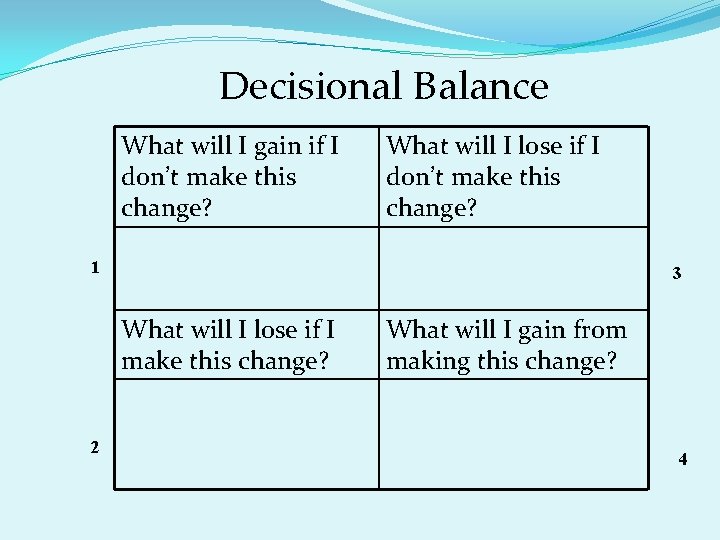
Decisional Balance What will I gain if I don’t make this change? What will I lose if I don’t make this change? 1 3 What will I lose if I make this change? 2 What will I gain from making this change? 4
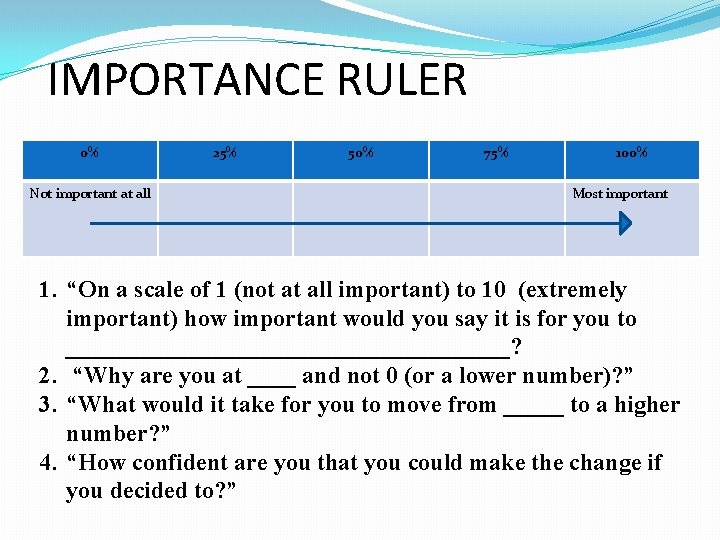
IMPORTANCE RULER 0% Not important at all 25% 50% 75% 100% Most important 1. “On a scale of 1 (not at all important) to 10 (extremely important) how important would you say it is for you to ___________________? 2. “Why are you at ____ and not 0 (or a lower number)? ” 3. “What would it take for you to move from _____ to a higher number? ” 4. “How confident are you that you could make the change if you decided to? ”
Signs of Increasing Motivation for Change Decreased resistance Decreased discussion about the problem More change talk Questions about change Experimenting
Thank you