
Addressing Machine Learning Challenges to Perform Automated Prompting

- Slides: 41
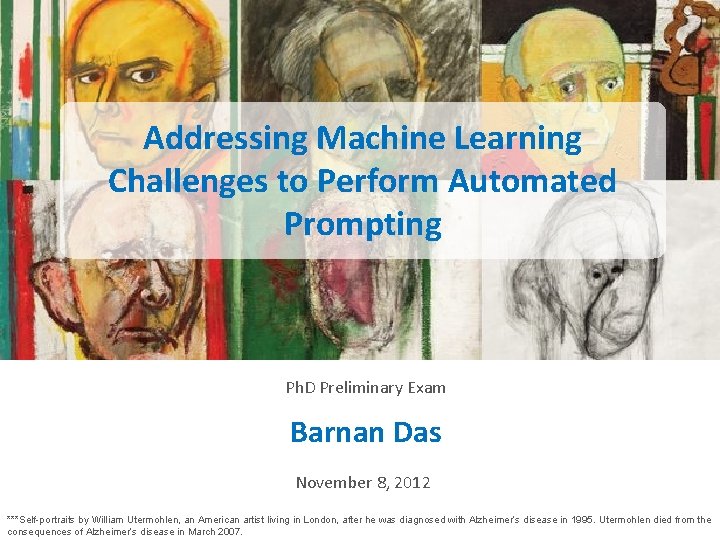
Addressing Machine Learning Challenges to Perform Automated Prompting Ph. D Preliminary Exam Barnan Das November 8, 2012 ***Self-portraits by William Utermohlen, an American artist living in London, after he was diagnosed with Alzheimer’s disease in 1995. Utermohlen died from the consequences of Alzheimer’s disease in March 2007.
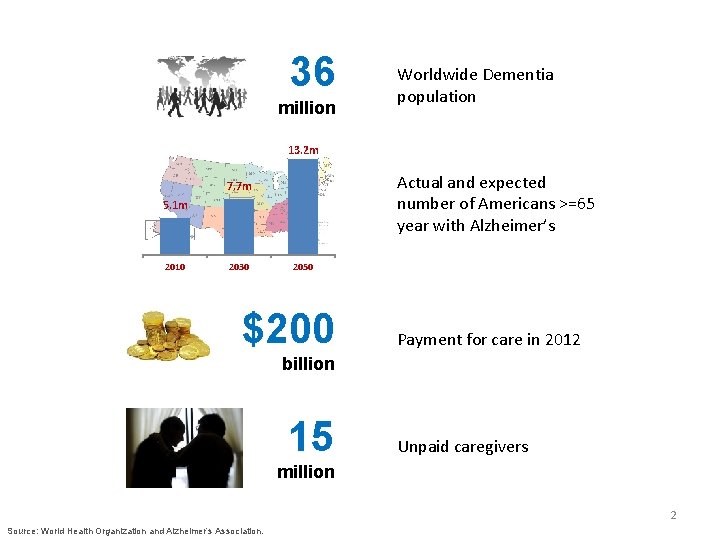
36 million Worldwide Dementia population 13. 2 m Actual and expected number of Americans >=65 year with Alzheimer’s 7. 7 m 5. 1 m 2010 2030 2050 $200 Payment for care in 2012 billion 15 Unpaid caregivers million 2 Source: World Health Organization and Alzheimer’s Association.
3
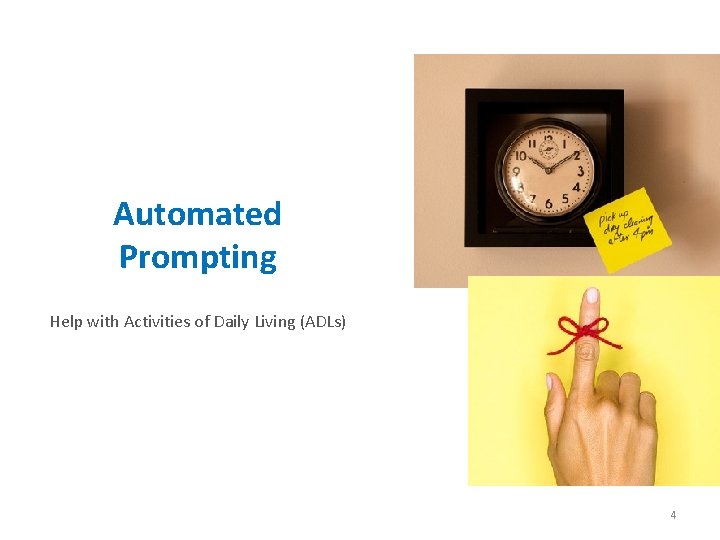
Automated Prompting Help with Activities of Daily Living (ADLs) 4
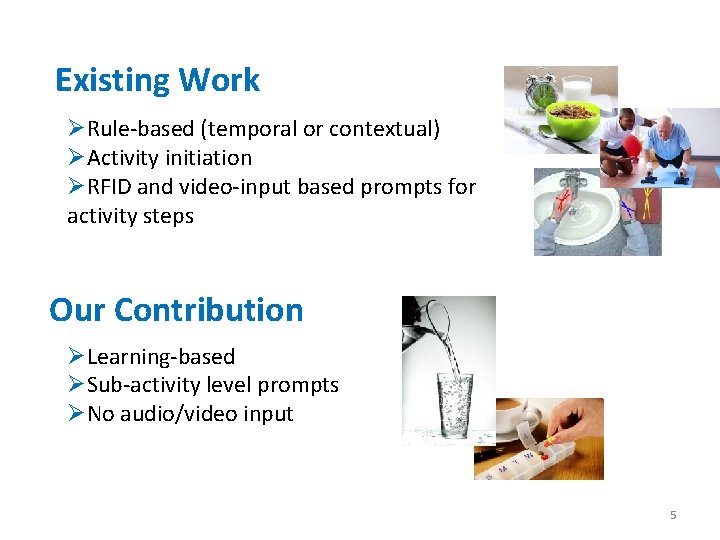
Existing Work ØRule-based (temporal or contextual) ØActivity initiation ØRFID and video-input based prompts for activity steps Our Contribution ØLearning-based ØSub-activity level prompts ØNo audio/video input 5
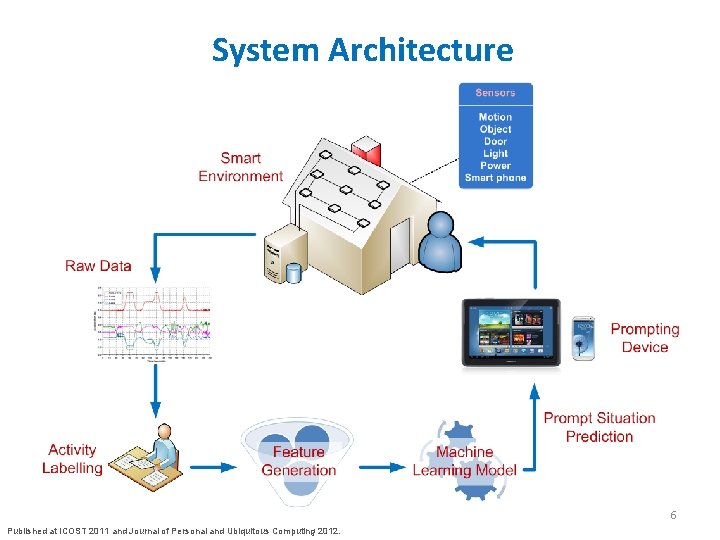
System Architecture 6 Published at ICOST 2011 and Journal of Personal and Ubiquitous Computing 2012.
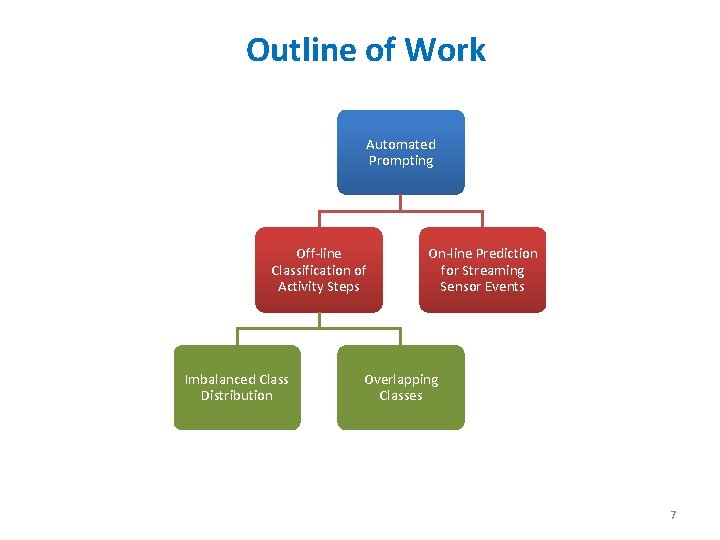
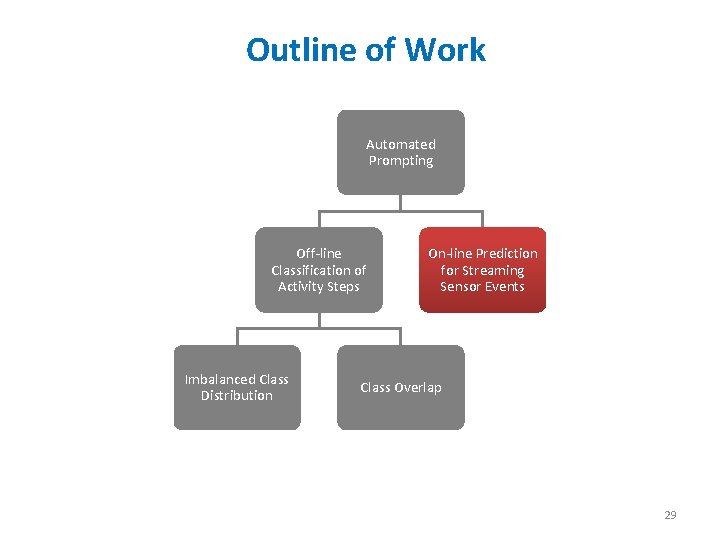
Outline of Work Automated Prompting Off-line Classification of Activity Steps Imbalanced Class Distribution On-line Prediction for Streaming Sensor Events Overlapping Classes 7
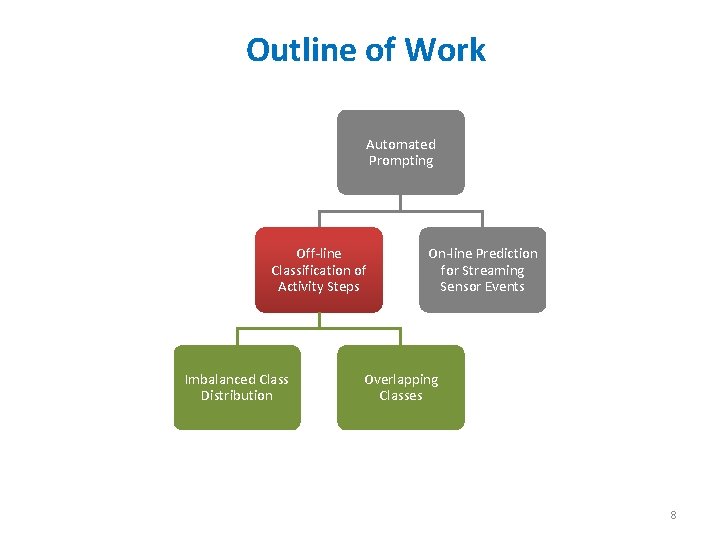
Outline of Work Automated Prompting Off-line Classification of Activity Steps Imbalanced Class Distribution On-line Prediction for Streaming Sensor Events Overlapping Classes 8
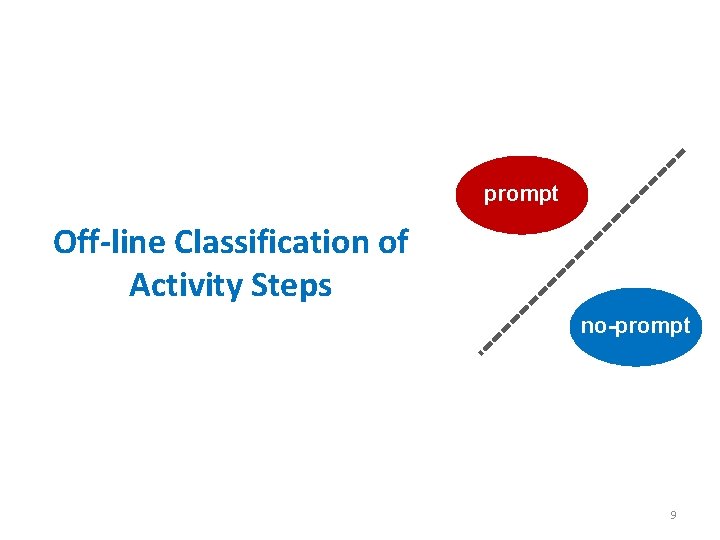
prompt Off-line Classification of Activity Steps no-prompt 9
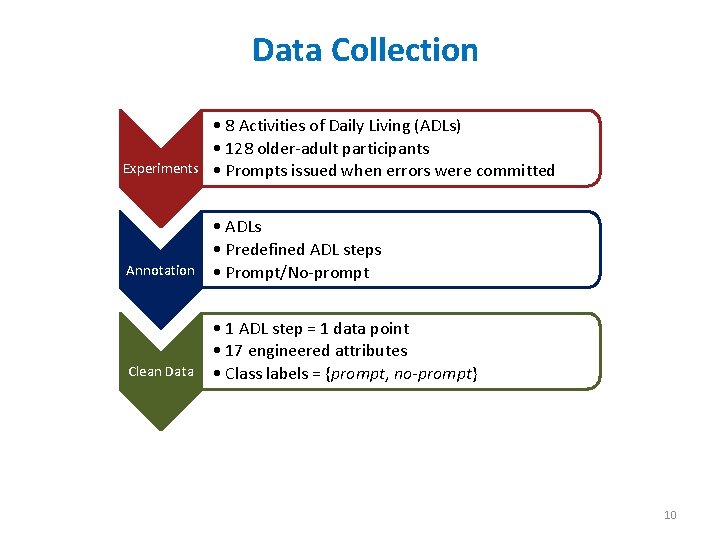
Data Collection • 8 Activities of Daily Living (ADLs) • 128 older-adult participants Experiments • Prompts issued when errors were committed • ADLs • Predefined ADL steps Annotation • Prompt/No-prompt • 1 ADL step = 1 data point • 17 engineered attributes Clean Data • Class labels = {prompt, no-prompt} 10
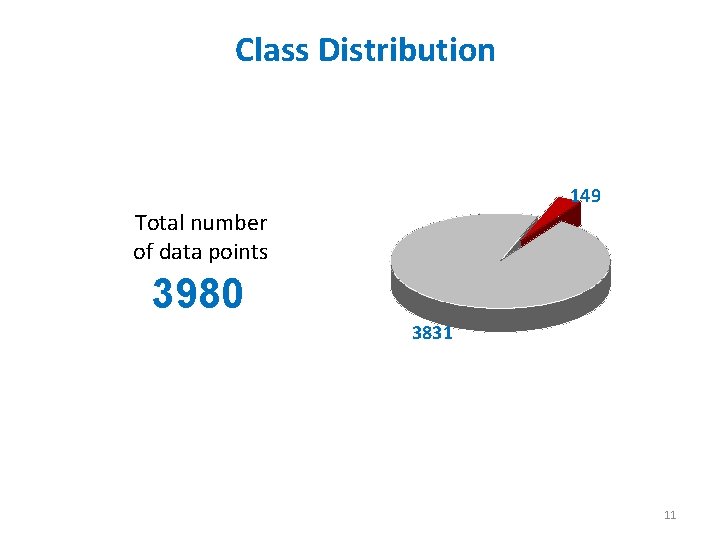
Class Distribution 149 Total number of data points 3980 3831 11
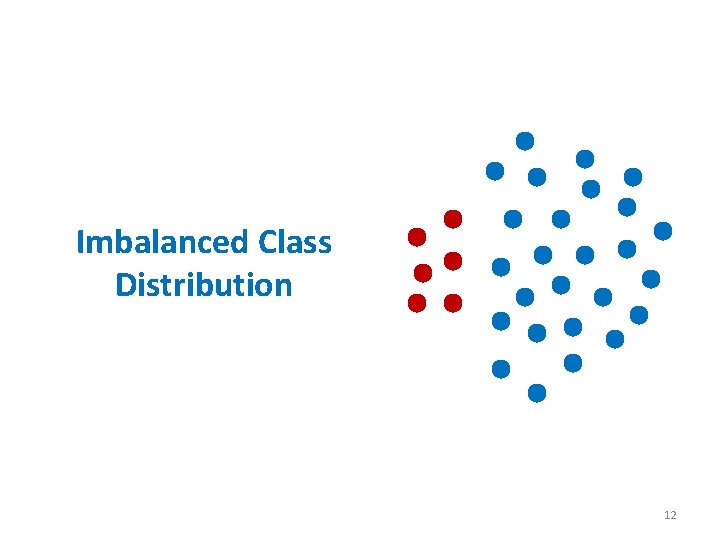
Imbalanced Class Distribution 12
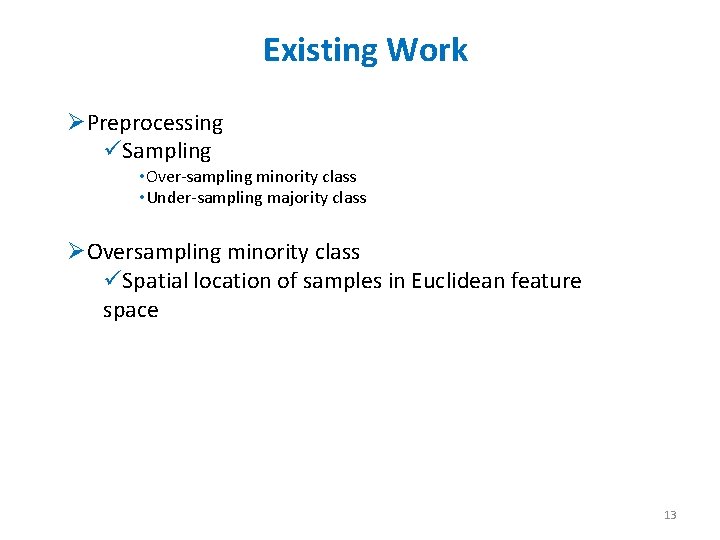
Existing Work ØPreprocessing üSampling • Over-sampling minority class • Under-sampling majority class ØOversampling minority class üSpatial location of samples in Euclidean feature space 13
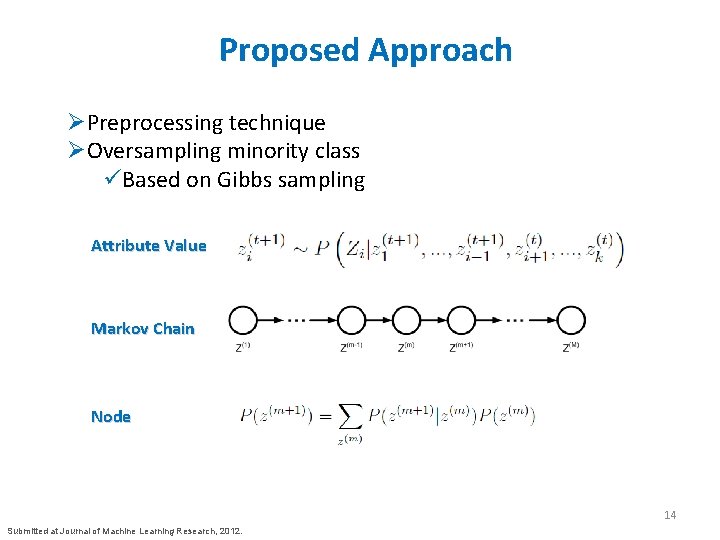
Proposed Approach ØPreprocessing technique ØOversampling minority class üBased on Gibbs sampling Attribute Value Markov Chain Node 14 Submitted at Journal of Machine Learning Research, 2012.
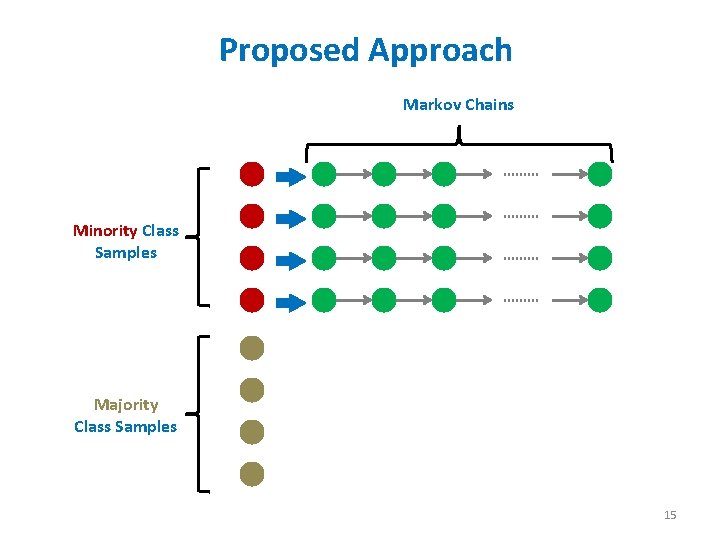
Proposed Approach Markov Chains Minority Class Samples Majority Class Samples 15
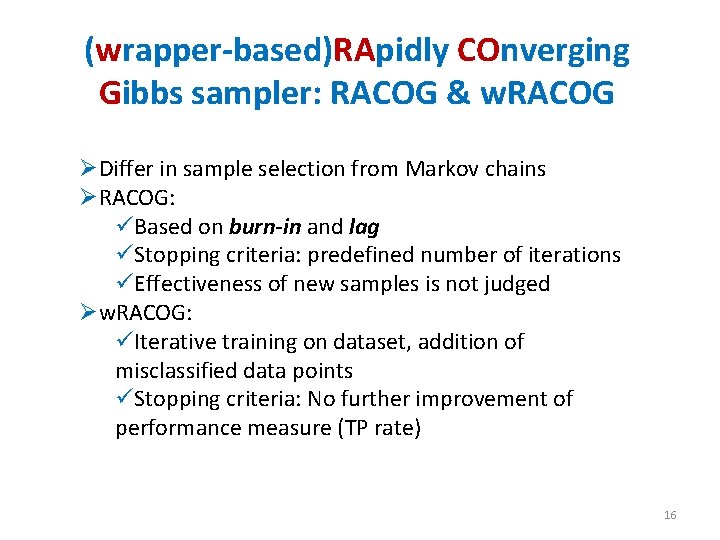
(wrapper-based)RApidly COnverging Gibbs sampler: RACOG & w. RACOG ØDiffer in sample selection from Markov chains ØRACOG: üBased on burn-in and lag üStopping criteria: predefined number of iterations üEffectiveness of new samples is not judged Øw. RACOG: üIterative training on dataset, addition of misclassified data points üStopping criteria: No further improvement of performance measure (TP rate) 16
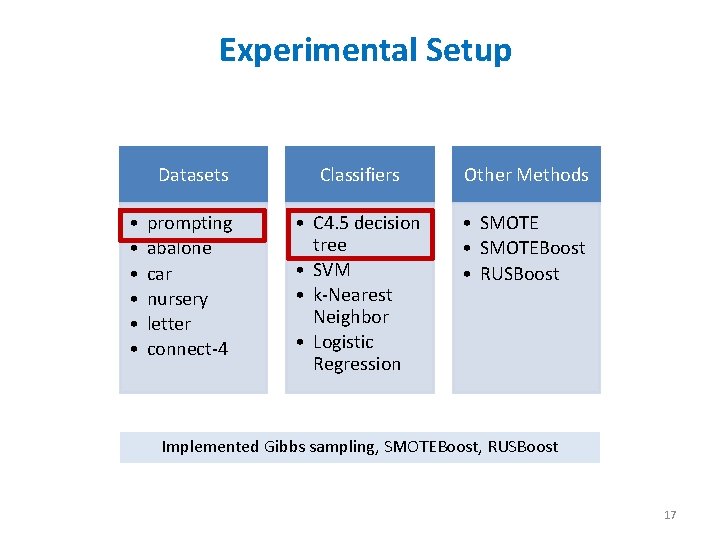
Experimental Setup • • • Datasets Classifiers Other Methods prompting abalone car nursery letter connect-4 • C 4. 5 decision tree • SVM • k-Nearest Neighbor • Logistic Regression • SMOTEBoost • RUSBoost Implemented Gibbs sampling, SMOTEBoost, RUSBoost 17
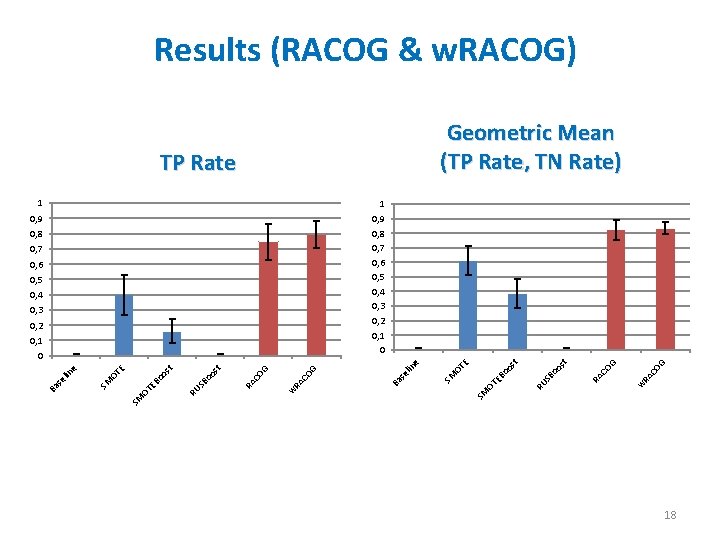
Results (RACOG & w. RACOG) Geometric Mean (TP Rate, TN Rate) TP Rate 1 G w RA CO G CO RA st oo SB RU st oo SM OT EB E OT SM Ba se lin e 0 RU 0, 1 st 0, 2 oo 0, 3 SM OT EB 0, 4 E 0, 5 OT 0, 6 SM 0, 7 se l 0, 8 Ba 0, 9 in e 1 0, 9 0, 8 0, 7 0, 6 0, 5 0, 4 0, 3 0, 2 0, 1 0 18
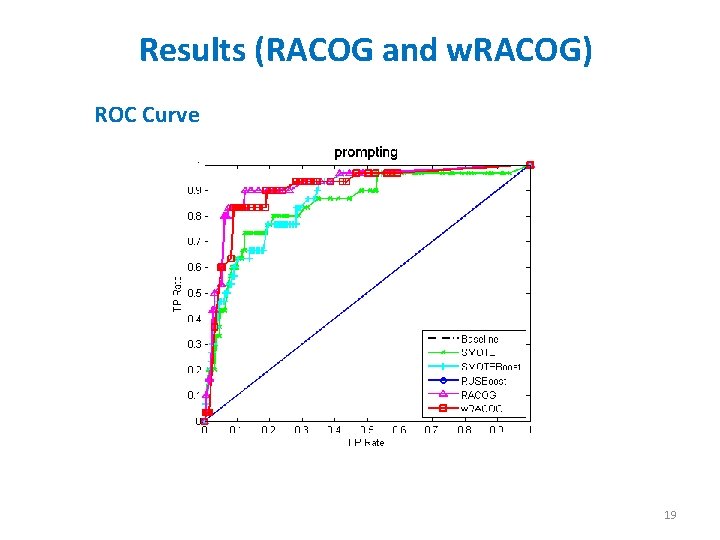
Results (RACOG and w. RACOG) ROC Curve 19
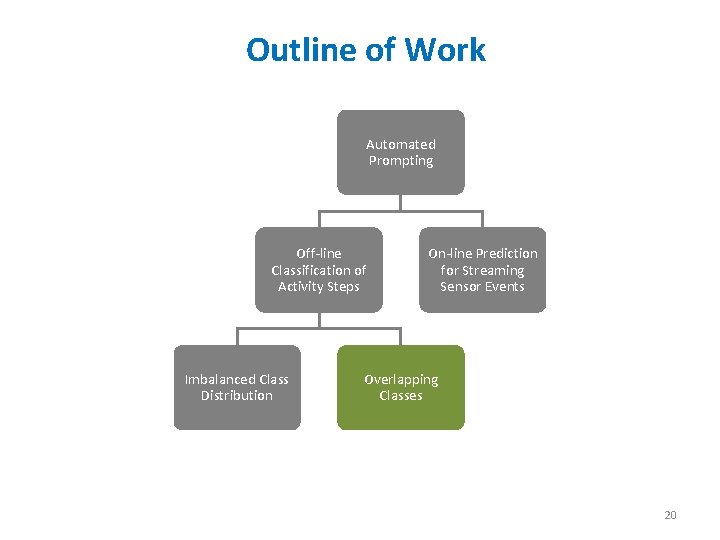
Outline of Work Automated Prompting Off-line Classification of Activity Steps Imbalanced Class Distribution On-line Prediction for Streaming Sensor Events Overlapping Classes 20
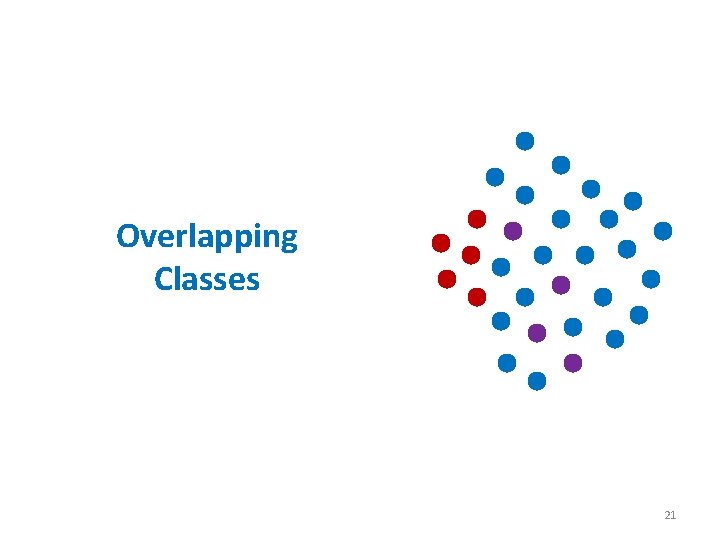
Overlapping Classes 21
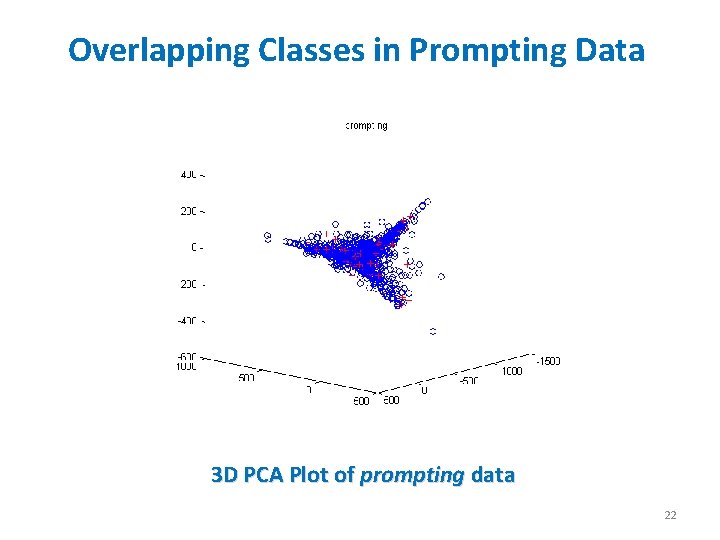
Overlapping Classes in Prompting Data 3 D PCA Plot of prompting data 22
Existing Work ØDiscard data of the overlapping region ØTreat overlapping region as a separate class 23
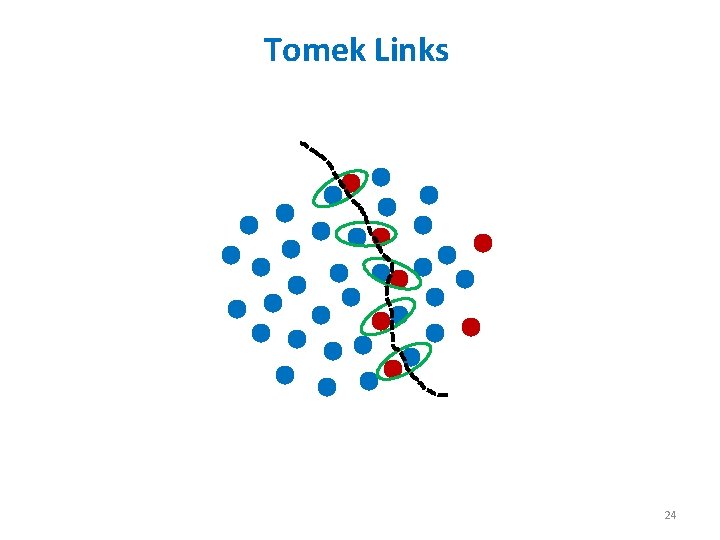
Tomek Links 24
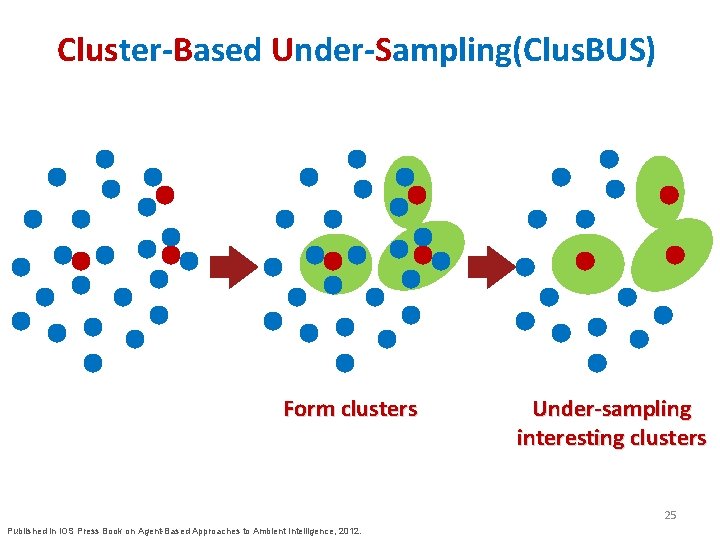
Cluster-Based Under-Sampling(Clus. BUS) Form clusters Under-sampling interesting clusters 25 Published in IOS Press Book on Agent-Based Approaches to Ambient Intelligence, 2012.
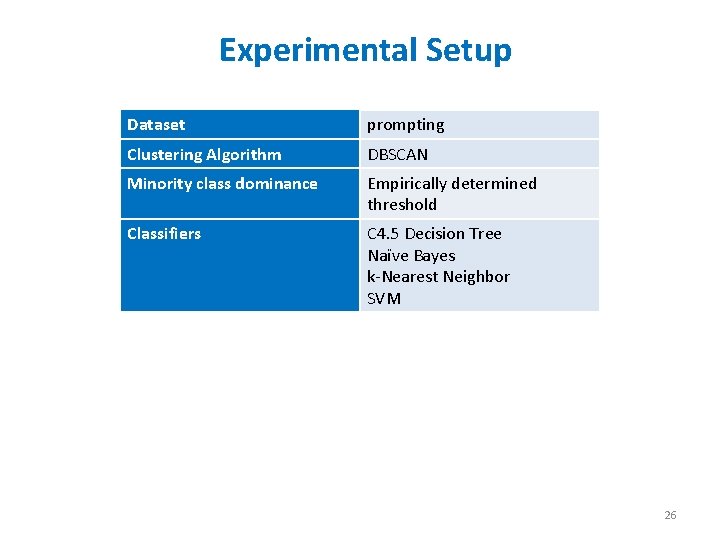
Experimental Setup Dataset prompting Clustering Algorithm DBSCAN Minority class dominance Empirically determined threshold Classifiers C 4. 5 Decision Tree Naïve Bayes k-Nearest Neighbor SVM 26
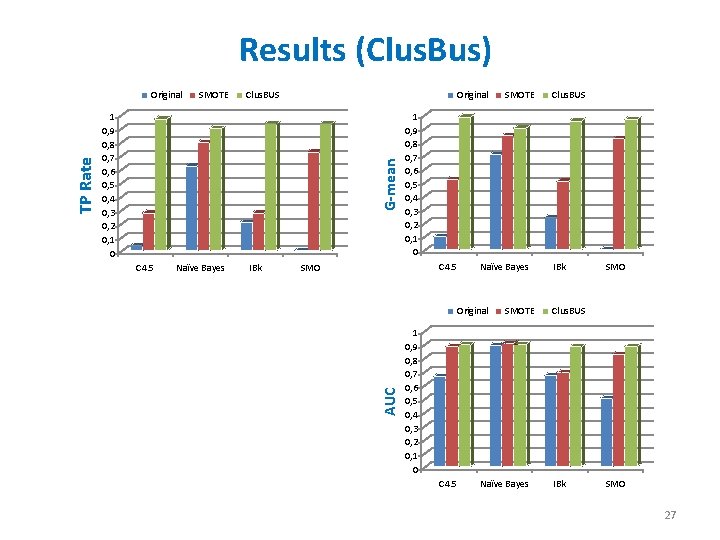
Results (Clus. Bus) SMOTE Clus. BUS Original G-mean 1 0, 9 0, 8 0, 7 0, 6 0, 5 0, 4 0, 3 0, 2 0, 1 0 C 4. 5 Naïve Bayes IBk SMOTE Clus. BUS 1 0, 9 0, 8 0, 7 0, 6 0, 5 0, 4 0, 3 0, 2 0, 1 0 C 4. 5 SMO Naïve Bayes Original AUC TP Rate Original SMOTE IBk SMO Clus. BUS 1 0, 9 0, 8 0, 7 0, 6 0, 5 0, 4 0, 3 0, 2 0, 1 0 C 4. 5 Naïve Bayes IBk SMO 27
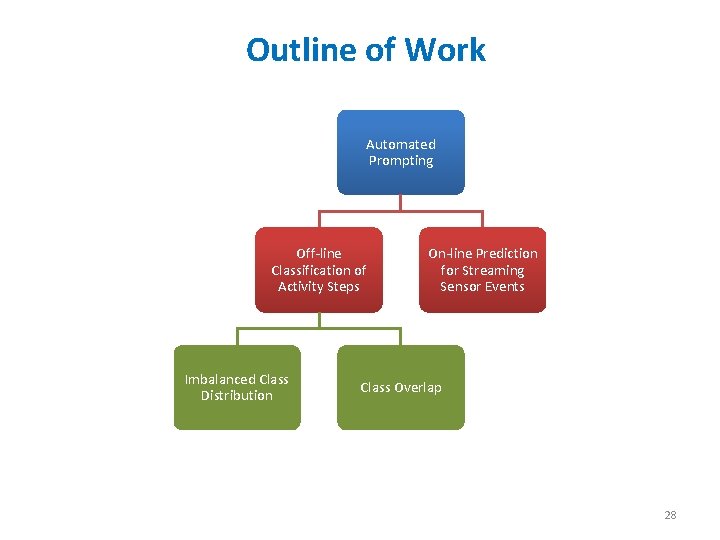
Outline of Work Automated Prompting Off-line Classification of Activity Steps Imbalanced Class Distribution On-line Prediction for Streaming Sensor Events Class Overlap 28
Outline of Work Automated Prompting Off-line Classification of Activity Steps Imbalanced Class Distribution On-line Prediction for Streaming Sensor Events Class Overlap 29
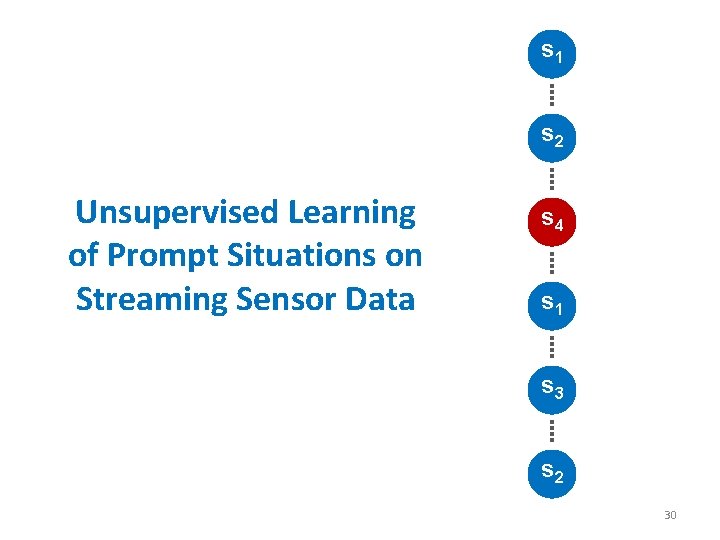
s 1 s 2 Unsupervised Learning of Prompt Situations on Streaming Sensor Data s 4 s 1 s 3 s 2 30
Motivation Ø Several hundred man-hours to label activity steps Ø High probability of inaccuracy Ø Needs activity-step recognition model 31
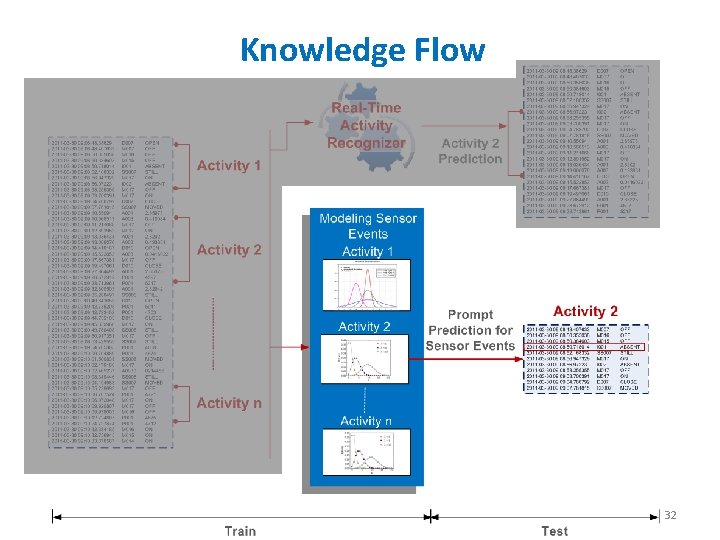
Knowledge Flow 32
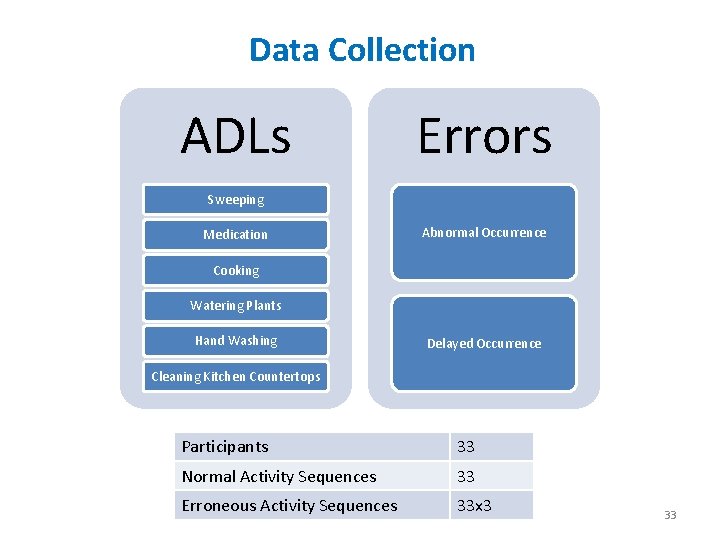
Data Collection ADLs Errors Sweeping Medication Abnormal Occurrence Cooking Watering Plants Hand Washing Delayed Occurrence Cleaning Kitchen Countertops Participants 33 Normal Activity Sequences 33 Erroneous Activity Sequences 33 x 3 33
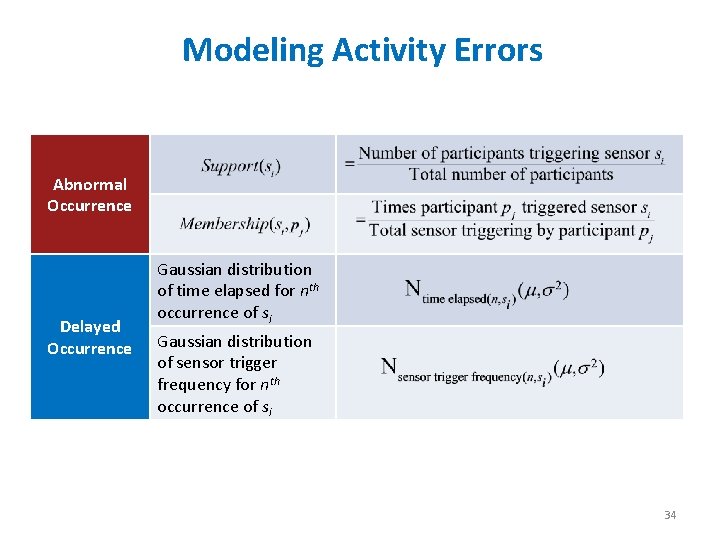
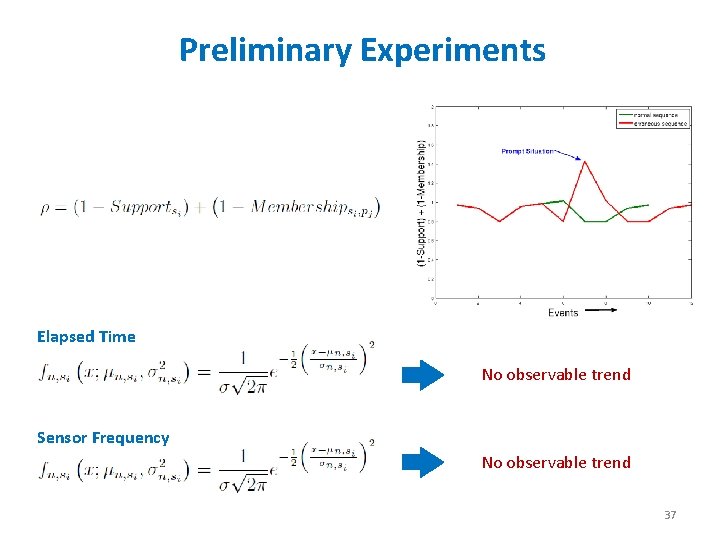
Modeling Activity Errors Abnormal Occurrence Delayed Occurrence Gaussian distribution of time elapsed for nth occurrence of si Gaussian distribution of sensor trigger frequency for nth occurrence of si 34
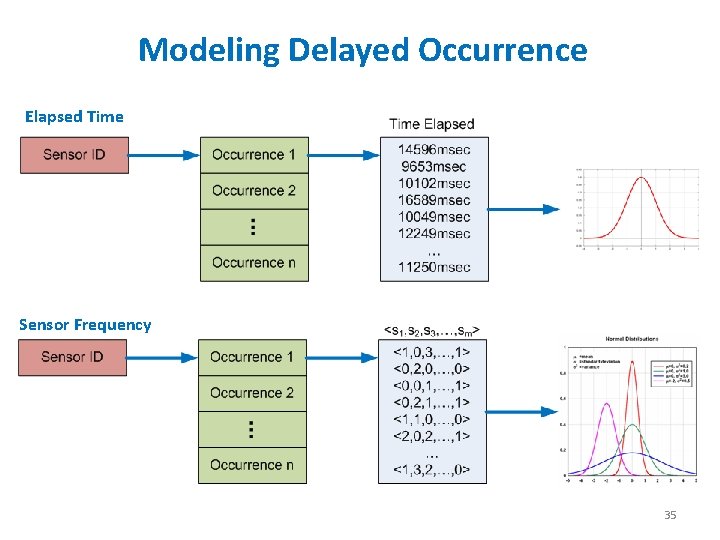
Modeling Delayed Occurrence Elapsed Time Sensor Frequency 35
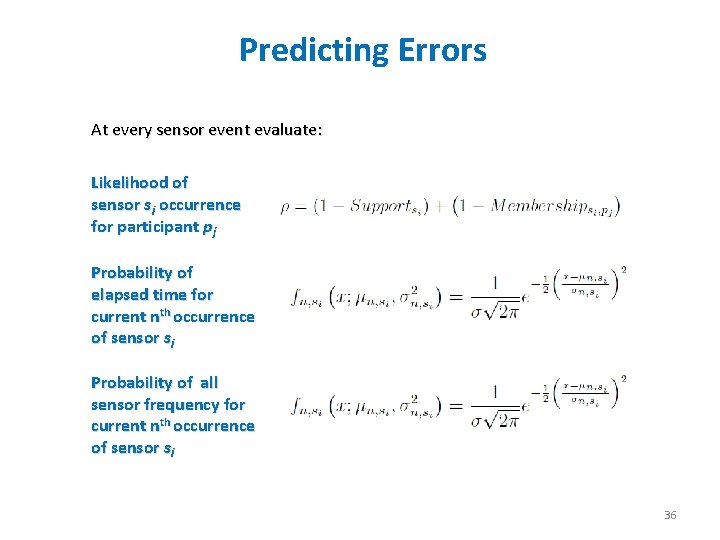
Predicting Errors At every sensor event evaluate: Likelihood of sensor si occurrence for participant pj Probability of elapsed time for current nth occurrence of sensor si Probability of all sensor frequency for current nth occurrence of sensor si 36
Preliminary Experiments Elapsed Time No observable trend Sensor Frequency No observable trend 37
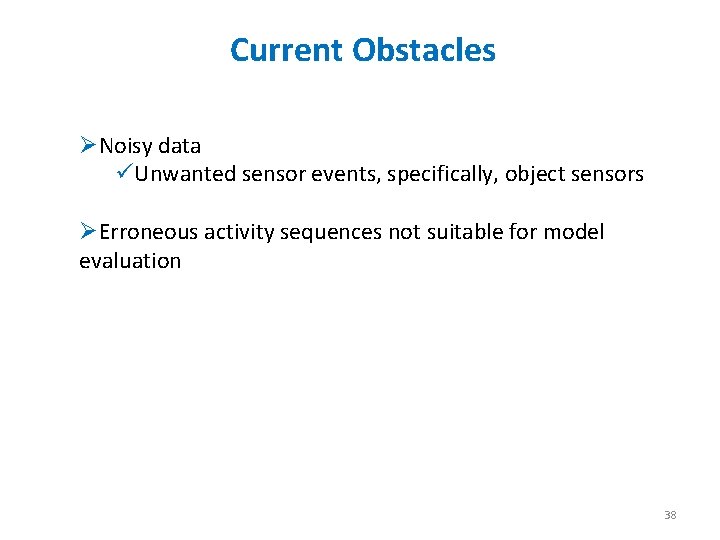
Current Obstacles ØNoisy data üUnwanted sensor events, specifically, object sensors ØErroneous activity sequences not suitable for model evaluation 38
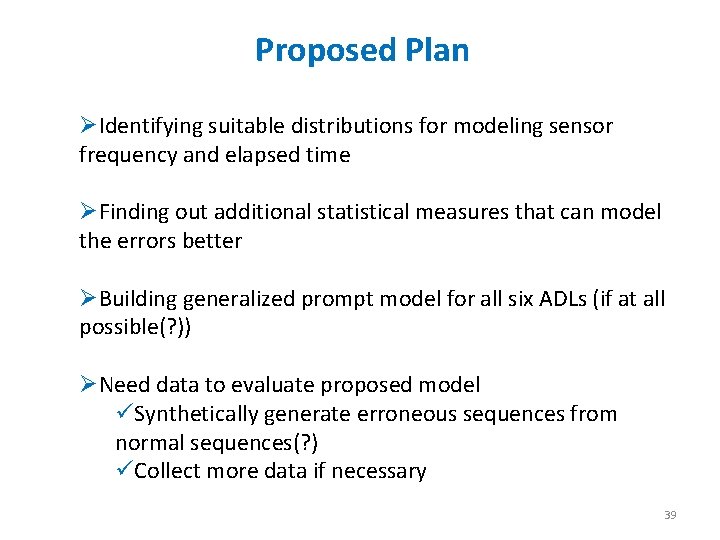
Proposed Plan ØIdentifying suitable distributions for modeling sensor frequency and elapsed time ØFinding out additional statistical measures that can model the errors better ØBuilding generalized prompt model for all six ADLs (if at all possible(? )) ØNeed data to evaluate proposed model üSynthetically generate erroneous sequences from normal sequences(? ) üCollect more data if necessary 39
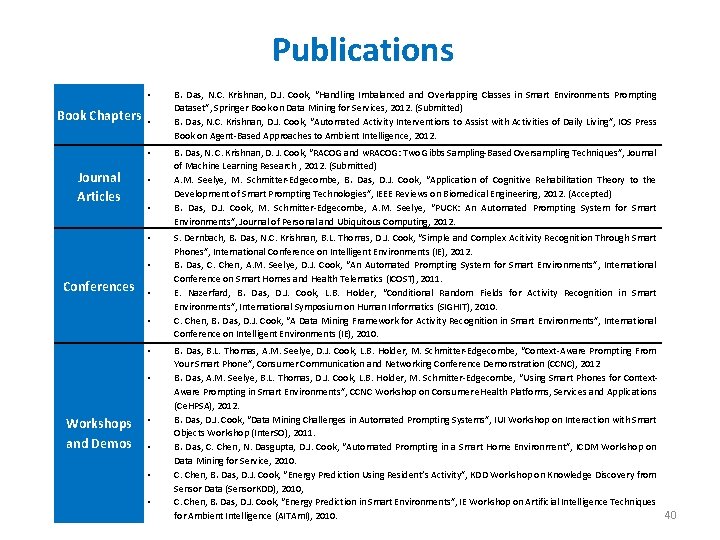
Publications • Book Chapters • • Journal Articles • • Conferences • • Workshops and Demos • • B. Das, N. C. Krishnan, D. J. Cook, “Handling Imbalanced and Overlapping Classes in Smart Environments Prompting Dataset”, Springer Book on Data Mining for Services, 2012. (Submitted) B. Das, N. C. Krishnan, D. J. Cook, “Automated Activity Interventions to Assist with Activities of Daily Living”, IOS Press Book on Agent-Based Approaches to Ambient Intelligence, 2012. B. Das, N. C. Krishnan, D. J. Cook, “RACOG and w. RACOG: Two Gibbs Sampling-Based Oversampling Techniques”, Journal of Machine Learning Research , 2012. (Submitted) A. M. Seelye, M. Schmitter-Edgecombe, B. Das, D. J. Cook, “Application of Cognitive Rehabilitation Theory to the Development of Smart Prompting Technologies”, IEEE Reviews on Biomedical Engineering, 2012. (Accepted) B. Das, D. J. Cook, M. Schmitter-Edgecombe, A. M. Seelye, “PUCK: An Automated Prompting System for Smart Environments”, Journal of Personal and Ubiquitous Computing, 2012. S. Dernbach, B. Das, N. C. Krishnan, B. L. Thomas, D. J. Cook, “Simple and Complex Acitivity Recognition Through Smart Phones”, International Conference on Intelligent Environments (IE), 2012. B. Das, C. Chen, A. M. Seelye, D. J. Cook, “An Automated Prompting System for Smart Environments”, International Conference on Smart Homes and Health Telematics (ICOST), 2011. E. Nazerfard, B. Das, D. J. Cook, L. B. Holder, “Conditional Random Fields for Activity Recognition in Smart Environments”, International Symposium on Human Informatics (SIGHIT), 2010. C. Chen, B. Das, D. J. Cook, “A Data Mining Framework for Activity Recognition in Smart Environments”, International Conference on Intelligent Environments (IE), 2010. B. Das, B. L. Thomas, A. M. Seelye, D. J. Cook, L. B. Holder, M. Schmitter-Edgecombe, “Context-Aware Prompting From Your Smart Phone”, Consumer Communication and Networking Conference Demonstration (CCNC), 2012 B. Das, A. M. Seelye, B. L. Thomas, D. J. Cook, L. B. Holder, M. Schmitter-Edgecombe, “Using Smart Phones for Context. Aware Prompting in Smart Environments”, CCNC Workshop on Consumer e. Health Platforms, Services and Applications (Ce. HPSA), 2012. B. Das, D. J. Cook, “Data Mining Challenges in Automated Prompting Systems”, IUI Workshop on Interaction with Smart Objects Workshop (Inter. SO), 2011. B. Das, C. Chen, N. Dasgupta, D. J. Cook, “Automated Prompting in a Smart Home Environment”, ICDM Workshop on Data Mining for Service, 2010. C. Chen, B. Das, D. J. Cook, “Energy Prediction Using Resident’s Activity”, KDD Workshop on Knowledge Discovery from Sensor Data (Sensor. KDD), 2010, C. Chen, B. Das, D. J. Cook, “Energy Prediction in Smart Environments”, IE Workshop on Artificial Intelligence Techniques for Ambient Intelligence (AITAm. I), 2010. 40
41