
Addressing Health Inequalities in Scotland lessons for screening
- Slides: 27
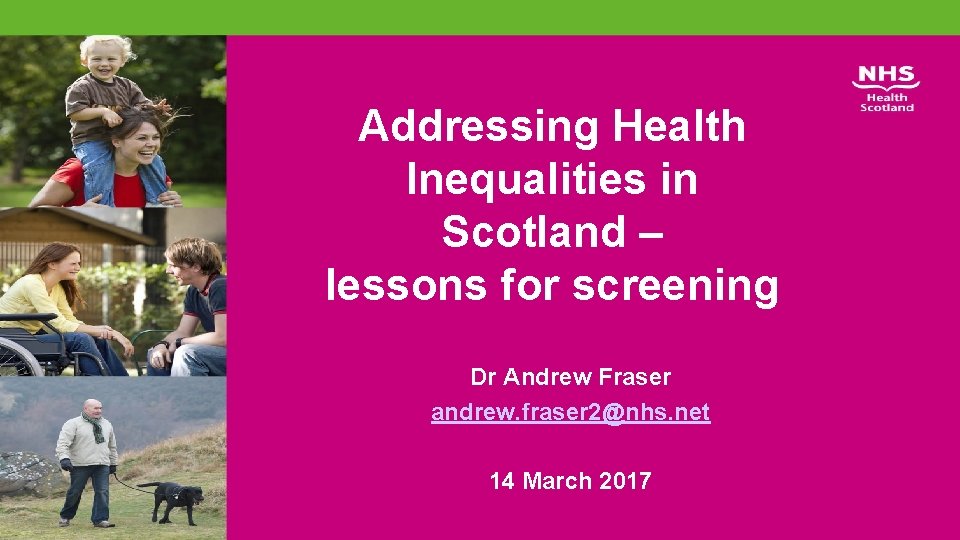
Addressing Health Inequalities in Scotland – lessons for screening Screening and Inequalities Event 14 March 2017 Dr Andrew Fraser
Commitment in the Cancer Plan 2016 to tackle inequalities What do we mean by health inequalities? Health inequalities are: • Unfair differences in health within the population across social classes and between different populations These unfair differences: • Are not random, or by chance, but largely socially determined • Are not inevitable.
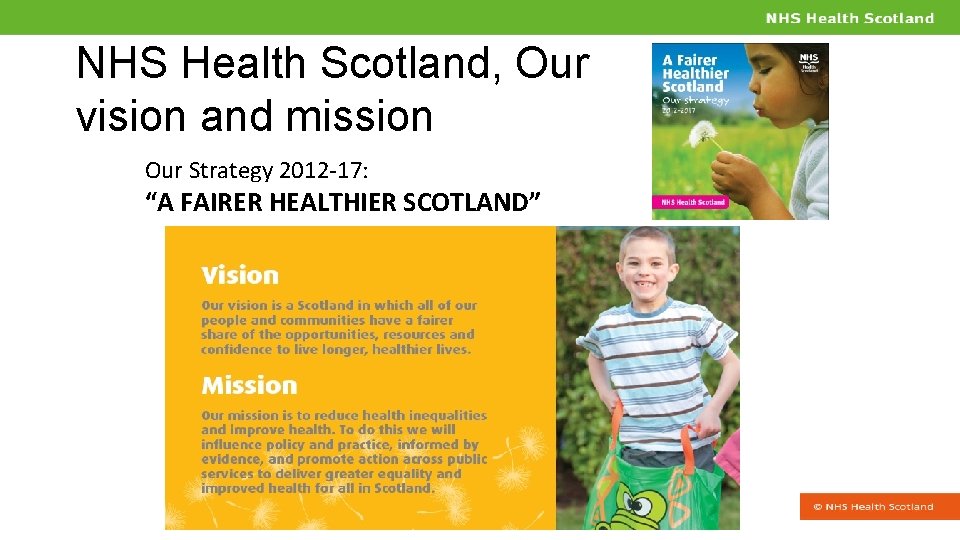
NHS Health Scotland, Our vision and mission Our Strategy 2012 -17: “A FAIRER HEALTHIER SCOTLAND”
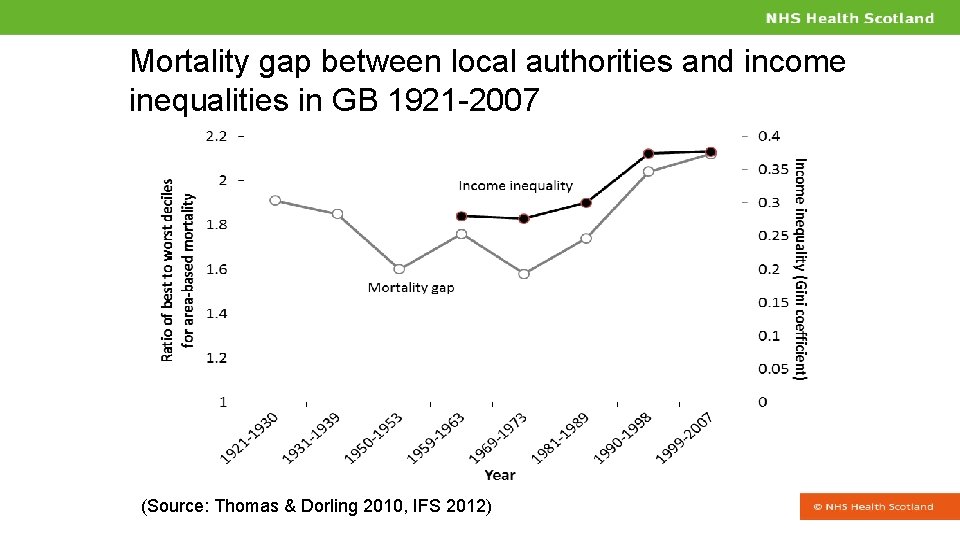
Mortality gap between local authorities and income inequalities in GB 1921 -2007 (Source: Thomas & Dorling 2010, IFS 2012)
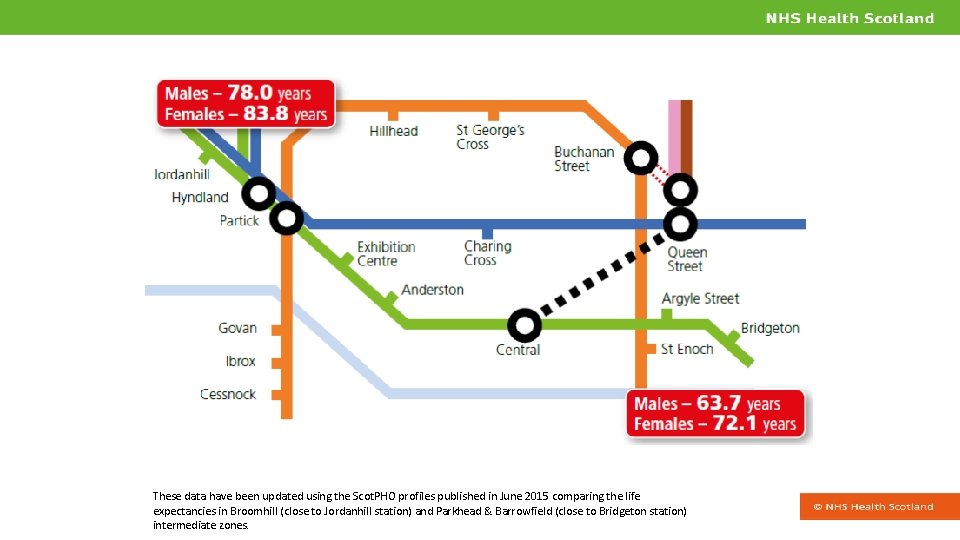
These data have been updated using the Scot. PHO profiles published in June 2015 comparing the life expectancies in Broomhill (close to Jordanhill station) and Parkhead & Barrowfield (close to Bridgeton station) intermediate zones.
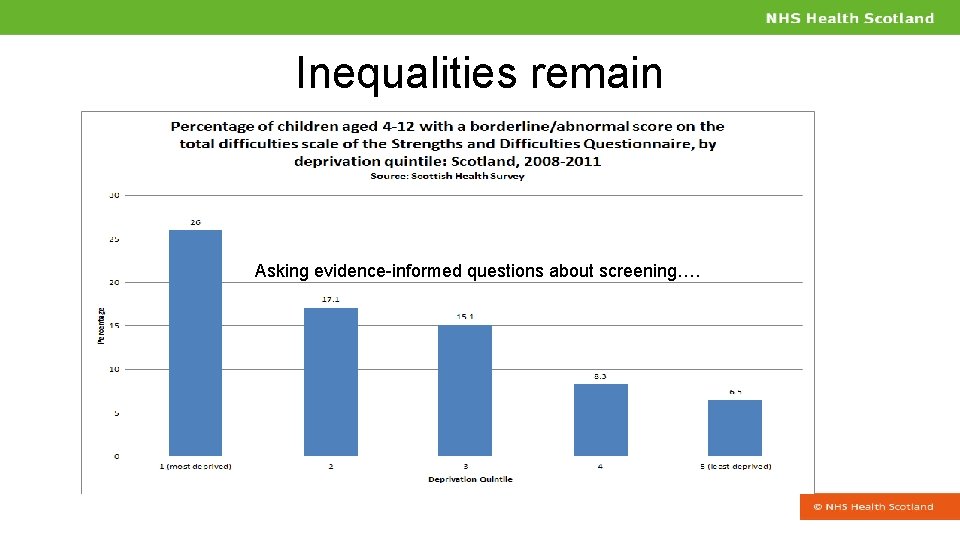
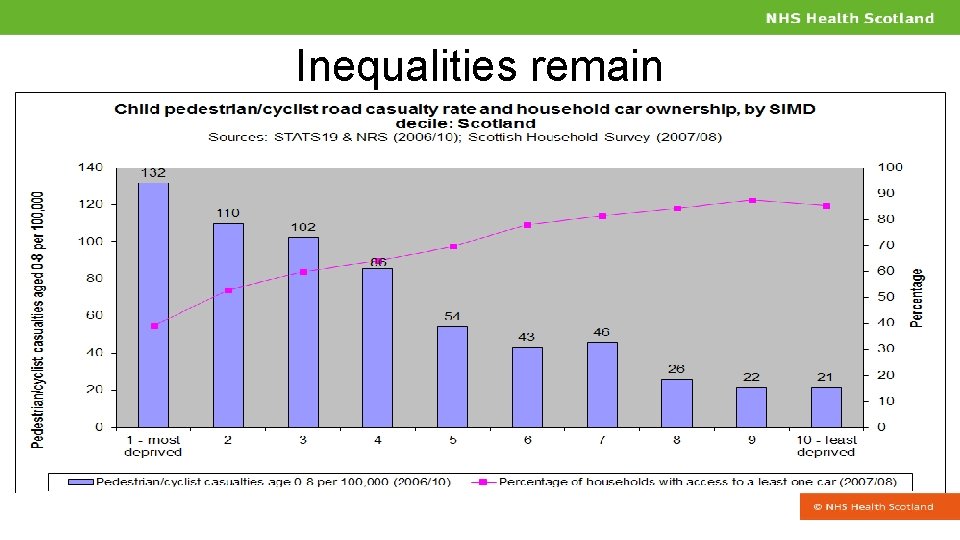
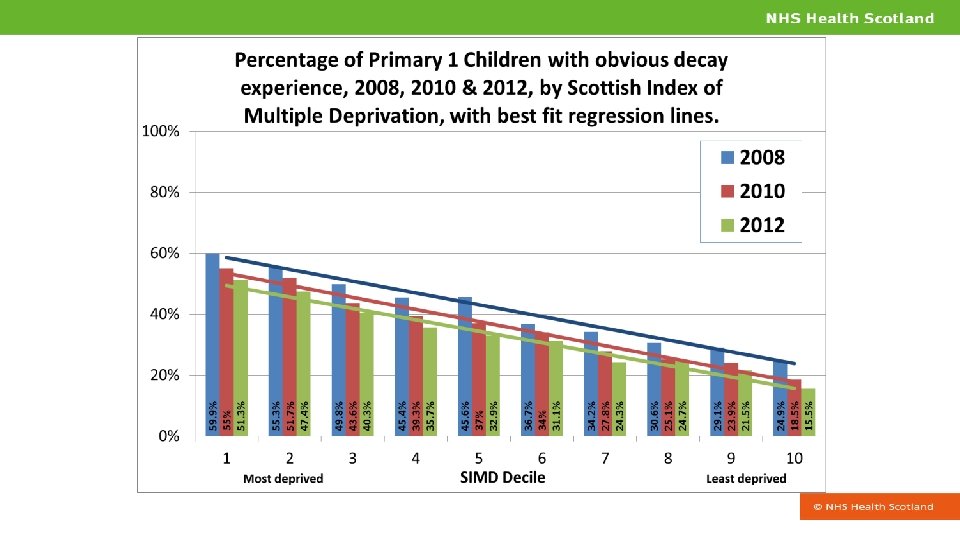
Screening & Inequalities • Inequalities persist, across health, economic and social dimensions of our lives • Everyone has the right to achieve the highest attainable level of health • Inequalities matter – it means years of difference off the lengths of our lives, and expectation of a long and healthy life • We can take action to narrow the gap, lessen the gradient
8
Inequalities remain Asking evidence-informed questions about screening….
Inequalities remain
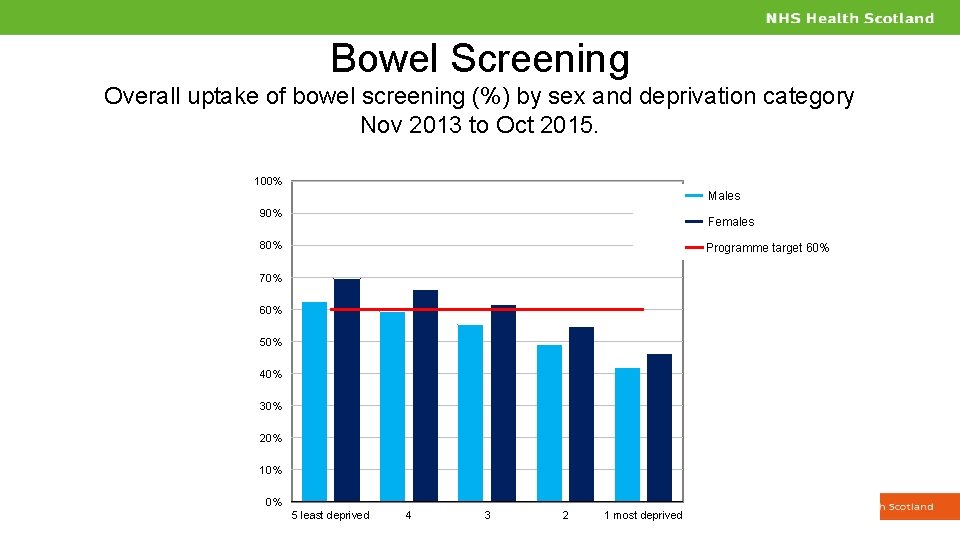
Bowel Screening Overall uptake of bowel screening (%) by sex and deprivation category Nov 2013 to Oct 2015. 100% Males 90% Females 80% Programme target 60% 70% 60% 50% 40% 30% 20% 10% 0% 5 least deprived 4 3 2 1 most deprived
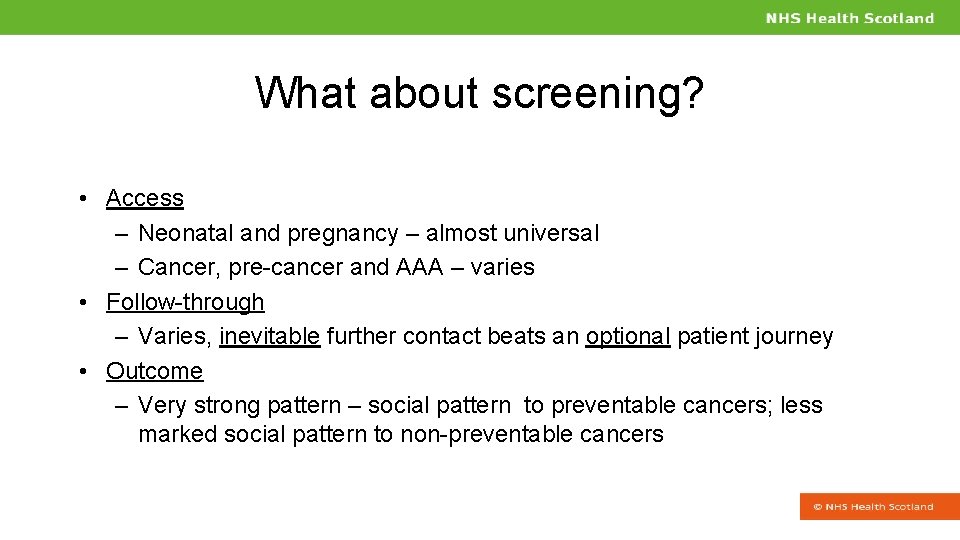
What about screening? • Access – Neonatal and pregnancy – almost universal – Cancer, pre-cancer and AAA – varies • Follow-through – Varies, inevitable further contact beats an optional patient journey • Outcome – Very strong pattern – social pattern to preventable cancers; less marked social pattern to non-preventable cancers
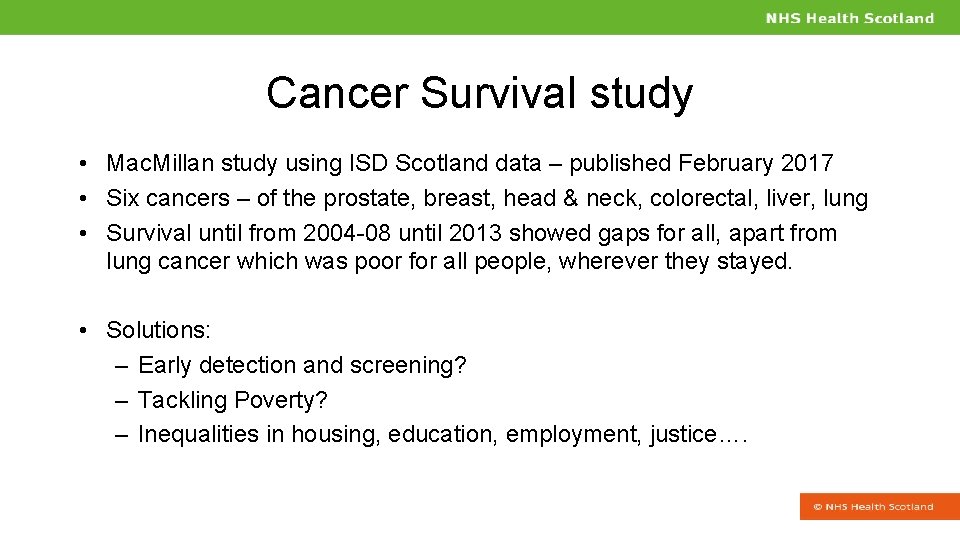
Cancer Survival study • Mac. Millan study using ISD Scotland data – published February 2017 • Six cancers – of the prostate, breast, head & neck, colorectal, liver, lung • Survival until from 2004 -08 until 2013 showed gaps for all, apart from lung cancer which was poor for all people, wherever they stayed. • Solutions: – Early detection and screening? – Tackling Poverty? – Inequalities in housing, education, employment, justice….
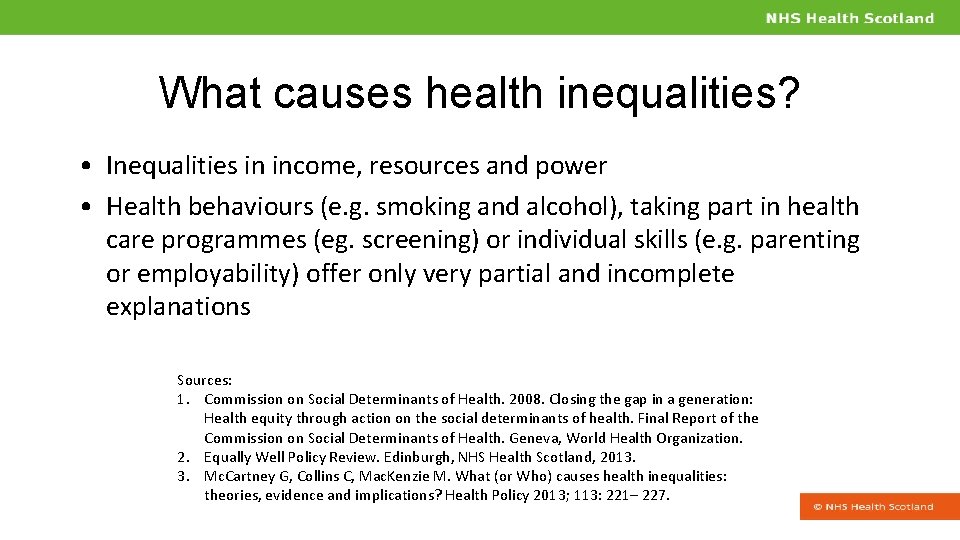
What causes health inequalities? • Inequalities in income, resources and power • Health behaviours (e. g. smoking and alcohol), taking part in health care programmes (eg. screening) or individual skills (e. g. parenting or employability) offer only very partial and incomplete explanations Sources: 1. Commission on Social Determinants of Health. 2008. Closing the gap in a generation: Health equity through action on the social determinants of health. Final Report of the Commission on Social Determinants of Health. Geneva, World Health Organization. 2. Equally Well Policy Review. Edinburgh, NHS Health Scotland, 2013. 3. Mc. Cartney G, Collins C, Mac. Kenzie M. What (or Who) causes health inequalities: theories, evidence and implications? Health Policy 2013; 113: 221– 227.
What do we do to tackle Inequalities?
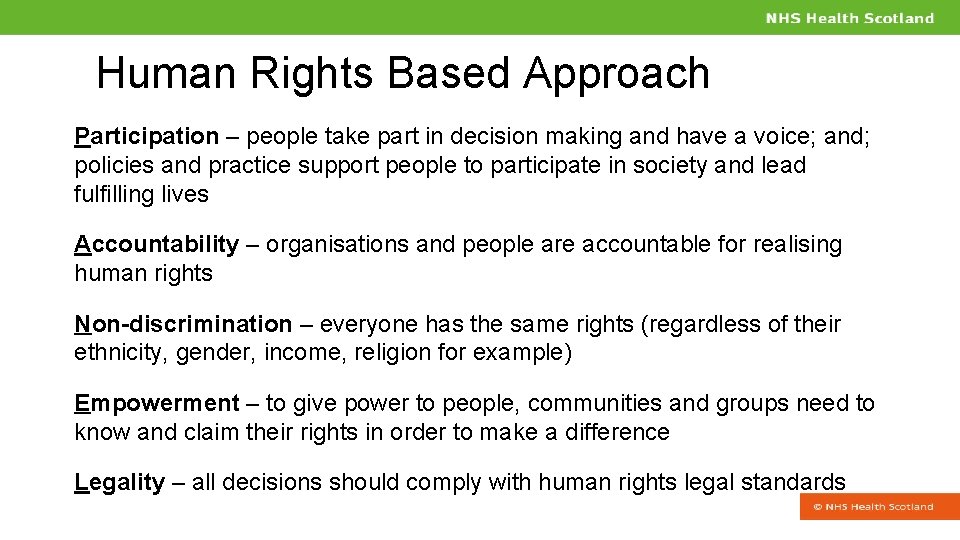
Human Rights Based Approach Participation – people take part in decision making and have a voice; and; policies and practice support people to participate in society and lead fulfilling lives Accountability – organisations and people are accountable for realising human rights Non-discrimination – everyone has the same rights (regardless of their ethnicity, gender, income, religion for example) Empowerment – to give power to people, communities and groups need to know and claim their rights in order to make a difference Legality – all decisions should comply with human rights legal standards
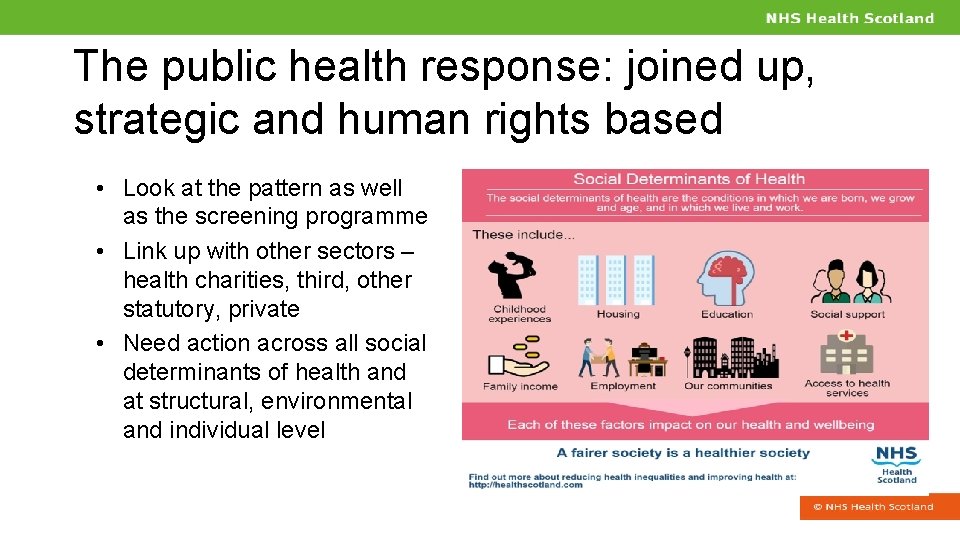
The public health response: joined up, strategic and human rights based • Look at the pattern as well as the screening programme • Link up with other sectors – health charities, third, other statutory, private • Need action across all social determinants of health and at structural, environmental and individual level
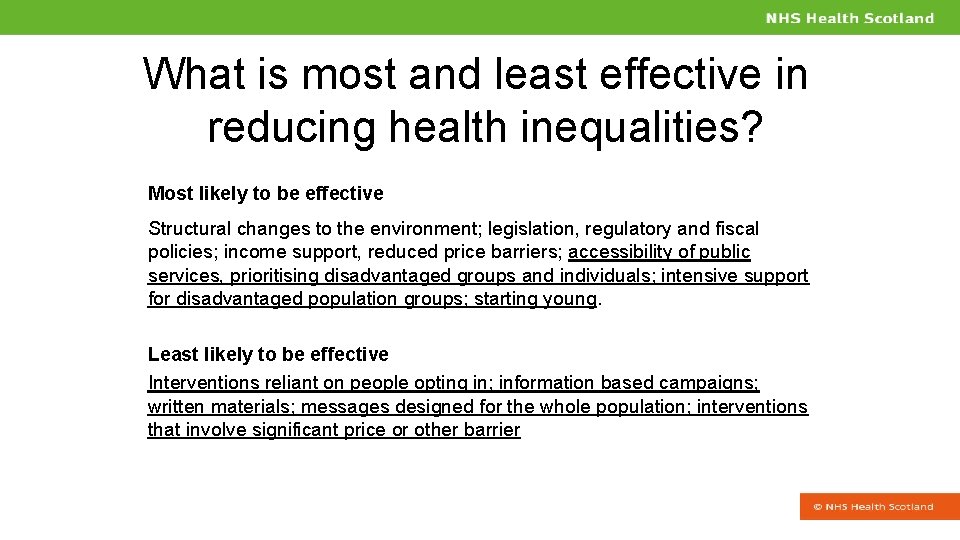
What is most and least effective in reducing health inequalities? Most likely to be effective Structural changes to the environment; legislation, regulatory and fiscal policies; income support, reduced price barriers; accessibility of public services, prioritising disadvantaged groups and individuals; intensive support for disadvantaged population groups; starting young. Least likely to be effective Interventions reliant on people opting in; information based campaigns; written materials; messages designed for the whole population; interventions that involve significant price or other barrier
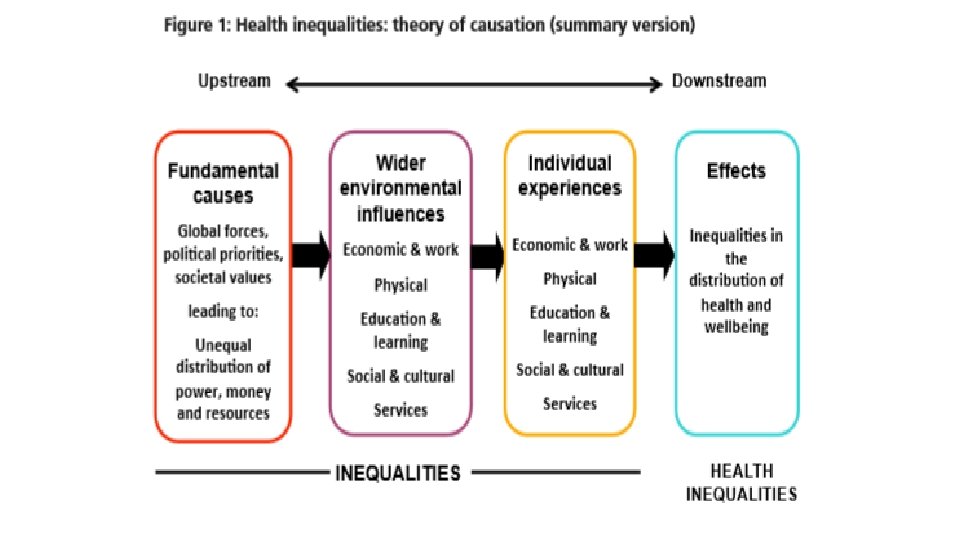
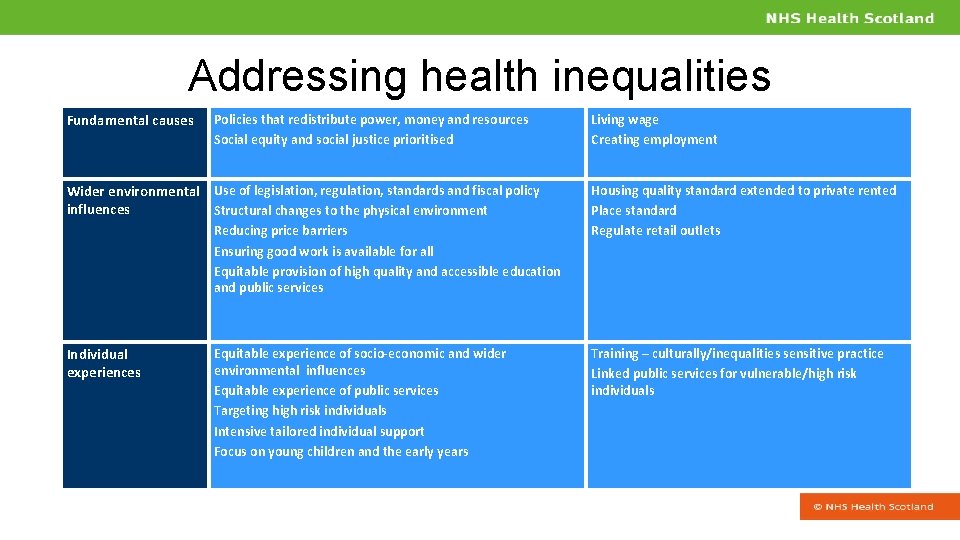
Addressing health inequalities Fundamental causes Policies that redistribute power, money and resources Social equity and social justice prioritised Wider environmental Use of legislation, regulation, standards and fiscal policy influences Structural changes to the physical environment Reducing price barriers Ensuring good work is available for all Equitable provision of high quality and accessible education and public services Individual experiences Equitable experience of socio-economic and wider environmental influences Equitable experience of public services Targeting high risk individuals Intensive tailored individual support Focus on young children and the early years Living wage Creating employment Housing quality standard extended to private rented Place standard Regulate retail outlets Training – culturally/inequalities sensitive practice Linked public services for vulnerable/high risk individuals
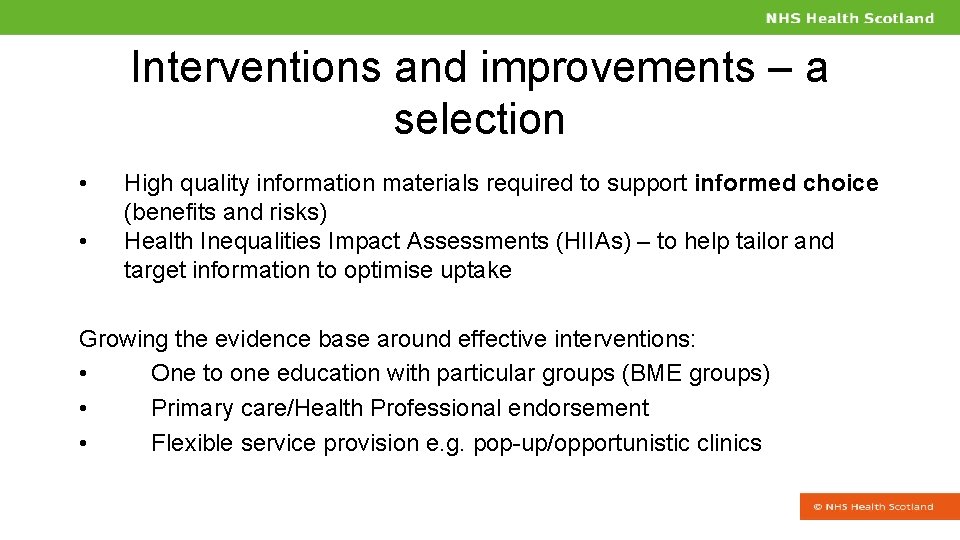
Interventions and improvements – a selection • • High quality information materials required to support informed choice (benefits and risks) Health Inequalities Impact Assessments (HIIAs) – to help tailor and target information to optimise uptake Growing the evidence base around effective interventions: • One to one education with particular groups (BME groups) • Primary care/Health Professional endorsement • Flexible service provision e. g. pop-up/opportunistic clinics
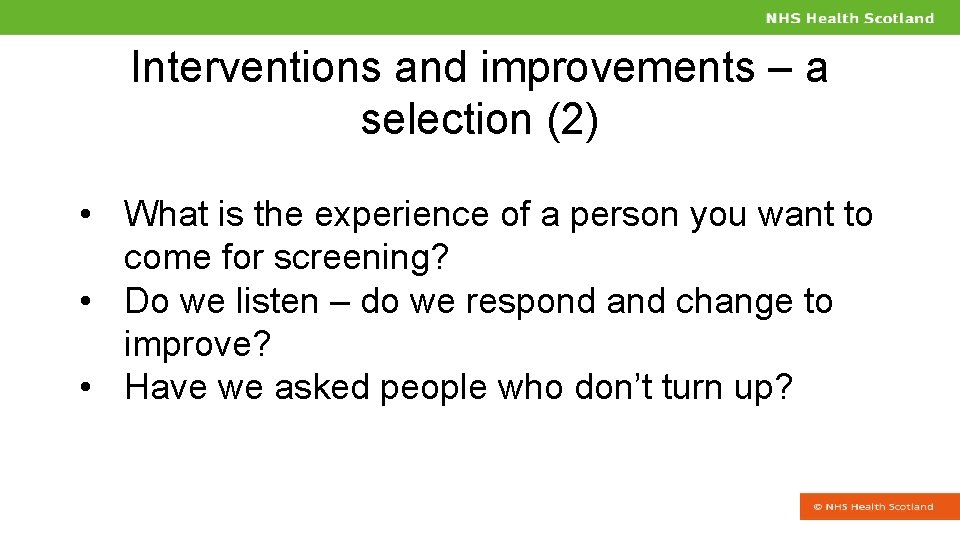
Interventions and improvements – a selection (2) • What is the experience of a person you want to come for screening? • Do we listen – do we respond and change to improve? • Have we asked people who don’t turn up?
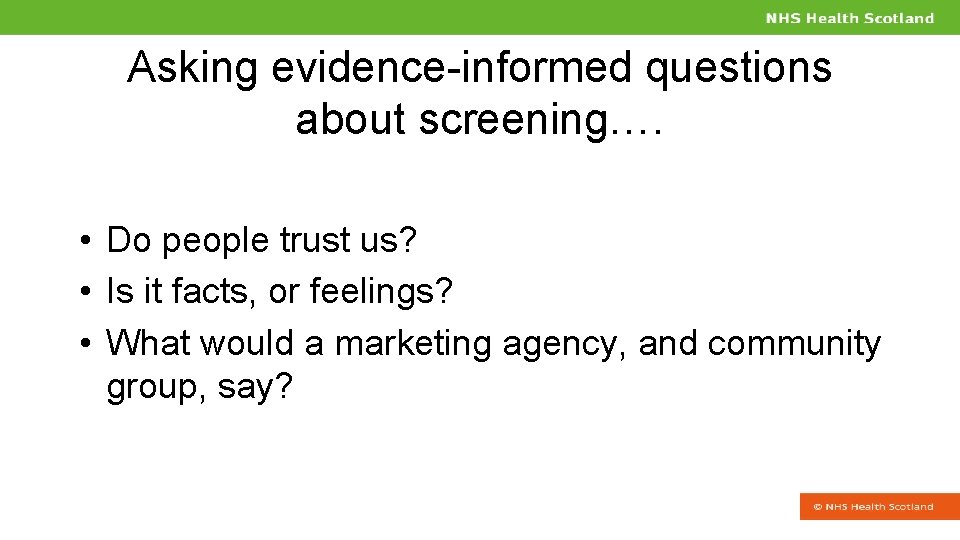
Asking evidence-informed questions about screening…. • Do people trust us? • Is it facts, or feelings? • What would a marketing agency, and community group, say?
Poor Literacy hits health Medical chief’s warning over failing campaigns • The Times, Saturday 11 March 2017
Conclusion Screening and Inequalities • Screening access/uptake, experience and outcomes have clear and consistent social patterns • We have to be sensitive to, and understand, and respond to, the circumstances of people’s lives • We can design services better with the outcome in mind – the health and the human outcome • #scotcancerscreening
Addressing Health Inequalities in Scotland – lessons for screening Dr Andrew Fraser andrew. fraser 2@nhs. net 14 March 2017