
Addressing Gender Equity using the Systemic Discrimination Lens
- Slides: 25
Addressing Gender Equity using the Systemic Discrimination Lens Shaheen Azmi, OHRC
Overview What is systemic discrimination? Diagnosing systemic discrimination in organizations
Gender Equity and Systemic Discrimination • Employing legal human rights approaches to address gender equity has been part of various approaches • The notion of “systemic discrimination” was developed in Canadian law in part in relation to gender discrimination cases in employment • Action Travail des Femmes (1987) • Despite this history gender equity advocates have rarely employed human rights instruments to address systemic concerns
What is systemic discrimination? Definitions, examples, scenarios
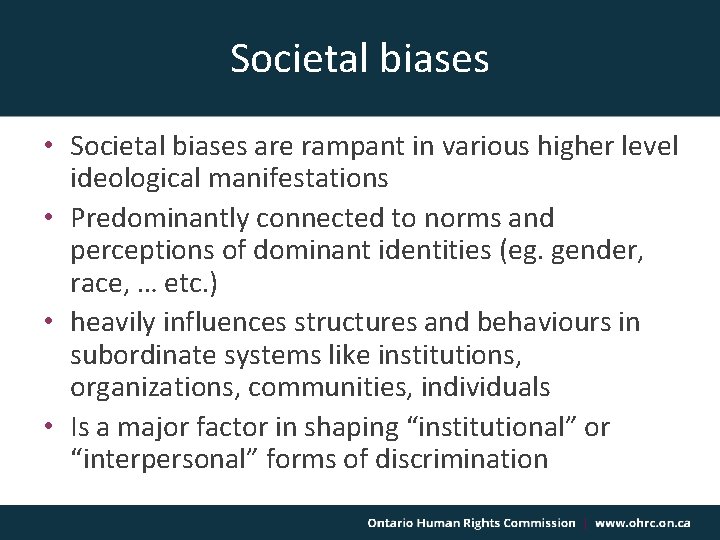
Societal biases • Societal biases are rampant in various higher level ideological manifestations • Predominantly connected to norms and perceptions of dominant identities (eg. gender, race, … etc. ) • heavily influences structures and behaviours in subordinate systems like institutions, organizations, communities, individuals • Is a major factor in shaping “institutional” or “interpersonal” forms of discrimination
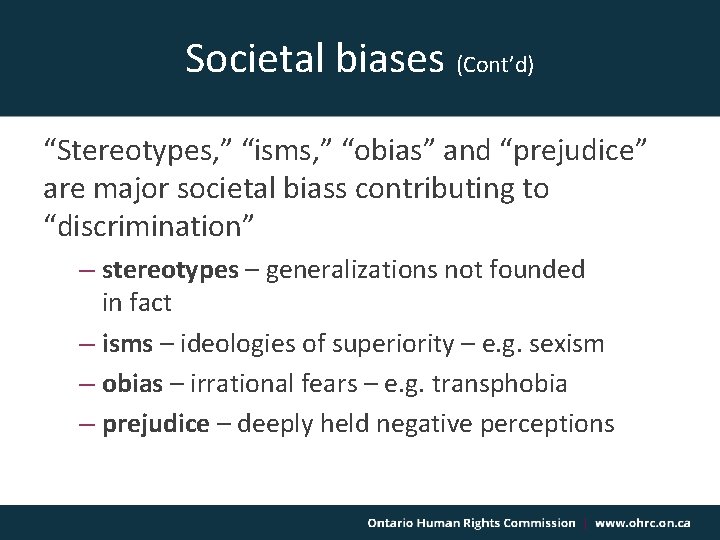
Societal biases (Cont’d) “Stereotypes, ” “isms, ” “obias” and “prejudice” are major societal biass contributing to “discrimination” – stereotypes – generalizations not founded in fact – isms – ideologies of superiority – e. g. sexism – obias – irrational fears – e. g. transphobia – prejudice – deeply held negative perceptions
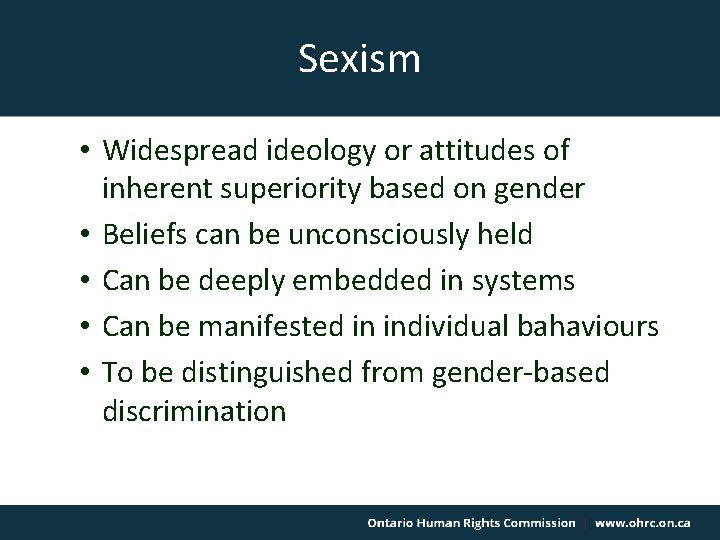
Sexism • Widespread ideology or attitudes of inherent superiority based on gender • Beliefs can be unconsciously held • Can be deeply embedded in systems • Can be manifested in individual bahaviours • To be distinguished from gender-based discrimination
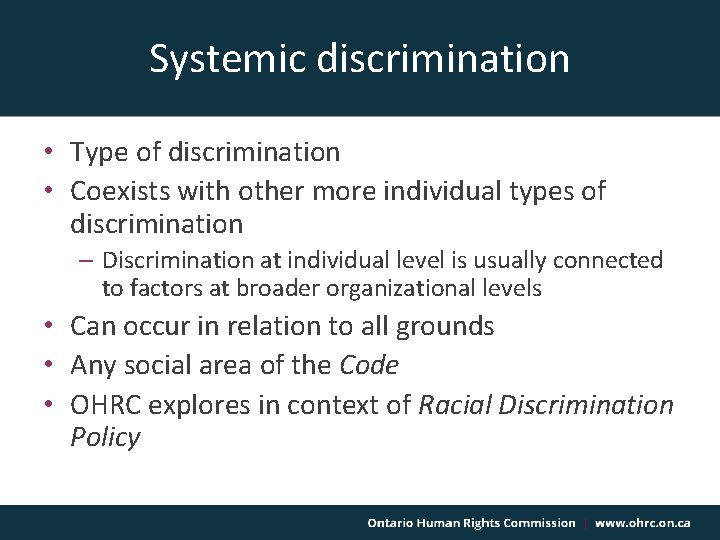
Systemic discrimination • Type of discrimination • Coexists with other more individual types of discrimination – Discrimination at individual level is usually connected to factors at broader organizational levels • Can occur in relation to all grounds • Any social area of the Code • OHRC explores in context of Racial Discrimination Policy
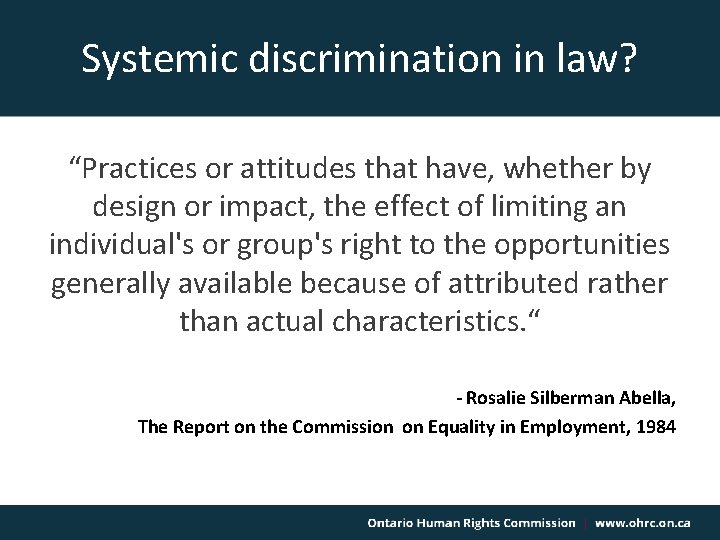
Systemic discrimination in law? “Practices or attitudes that have, whether by design or impact, the effect of limiting an individual's or group's right to the opportunities generally available because of attributed rather than actual characteristics. “ - Rosalie Silberman Abella, The Report on the Commission on Equality in Employment, 1984
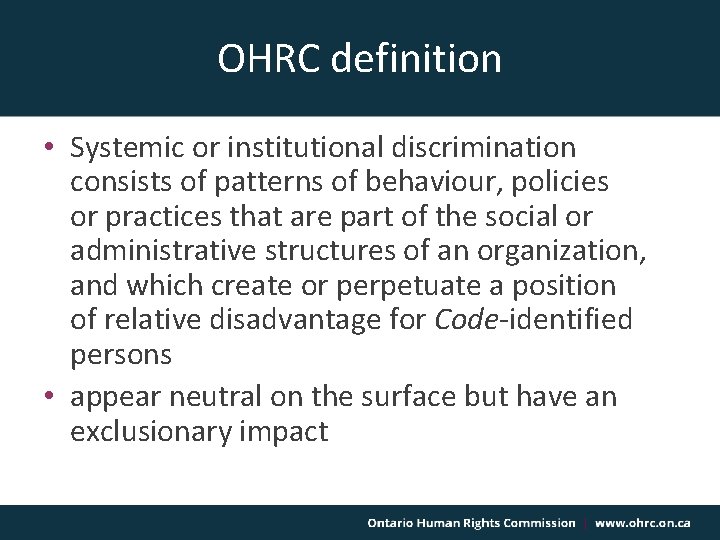
OHRC definition • Systemic or institutional discrimination consists of patterns of behaviour, policies or practices that are part of the social or administrative structures of an organization, and which create or perpetuate a position of relative disadvantage for Code-identified persons • appear neutral on the surface but have an exclusionary impact
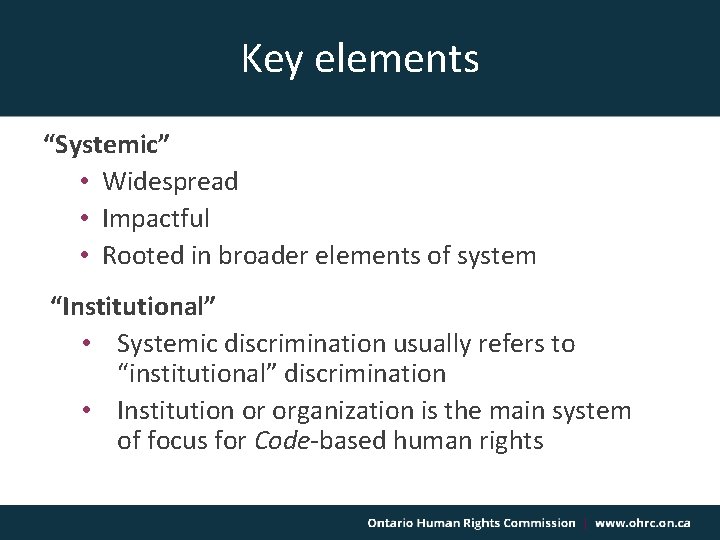
Key elements “Systemic” • Widespread • Impactful • Rooted in broader elements of system “Institutional” • Systemic discrimination usually refers to “institutional” discrimination • Institution or organization is the main system of focus for Code-based human rights
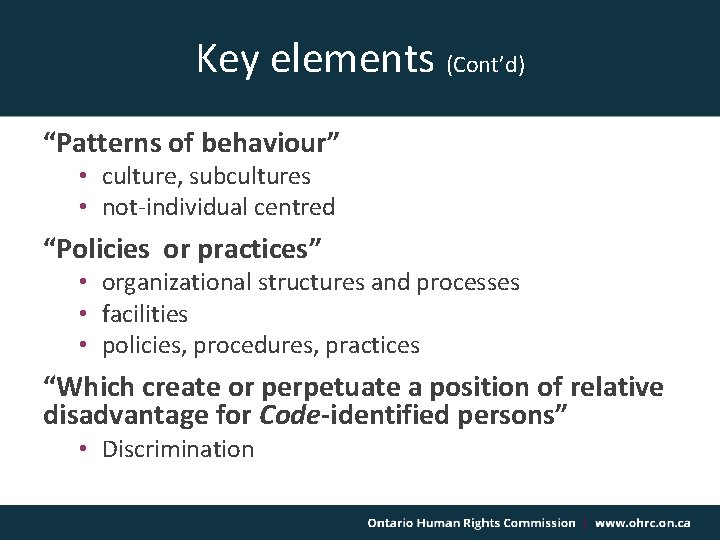
Key elements (Cont’d) “Patterns of behaviour” • culture, subcultures • not-individual centred “Policies or practices” • organizational structures and processes • facilities • policies, procedures, practices “Which create or perpetuate a position of relative disadvantage for Code-identified persons” • Discrimination
Normalized • Systemic discrimination is usually concealed in normalized elements of the system • People are unable to detect systemic discrimination because it is usually seen as simply the way things are or should be
“Adverse impact discrimination” • One type of institutional systemic discrimination • “Adverse impact discrimination” occurs when: – Requirements that apply the same way to everyone and appear neutral on their face – Have a less favourable or more negative impact on members of a Code-identified group (i. e. are “barriers” to equality)
Scenarios For each of the following scenarios: 1. What type of interpersonal discrimination is evident, if any? 2. What institutional elements may be involved? 3. What societal forces may be present, if any?
Scenario #1 Almost all midwives in Ontario are women, most of their clients identify as women and they provide care on a women’s health issue. When midwifery became regulated in Ontario in 1994 pay for midwives was set in relation to but not equal to family physician pay. Over the next two decades, pay grew by 76 per cent for family physicians but midwives’ base salaries increased by only 33 per cent.
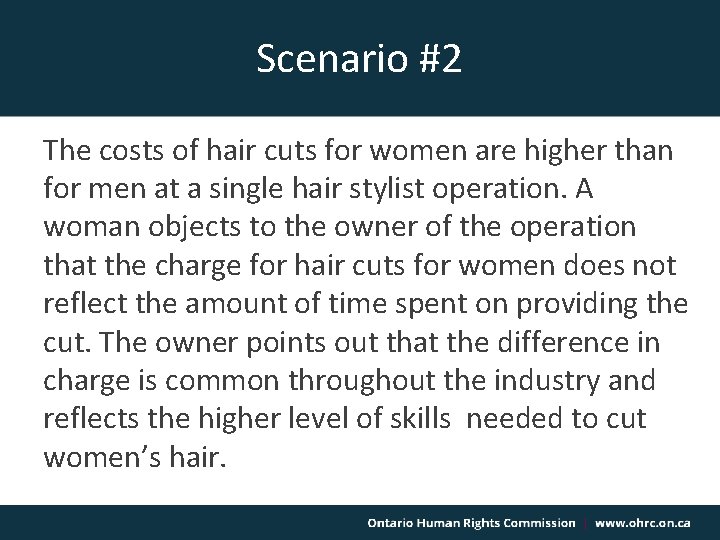
Scenario #2 The costs of hair cuts for women are higher than for men at a single hair stylist operation. A woman objects to the owner of the operation that the charge for hair cuts for women does not reflect the amount of time spent on providing the cut. The owner points out that the difference in charge is common throughout the industry and reflects the higher level of skills needed to cut women’s hair.
Diagnosing systemic discrimination in organizations
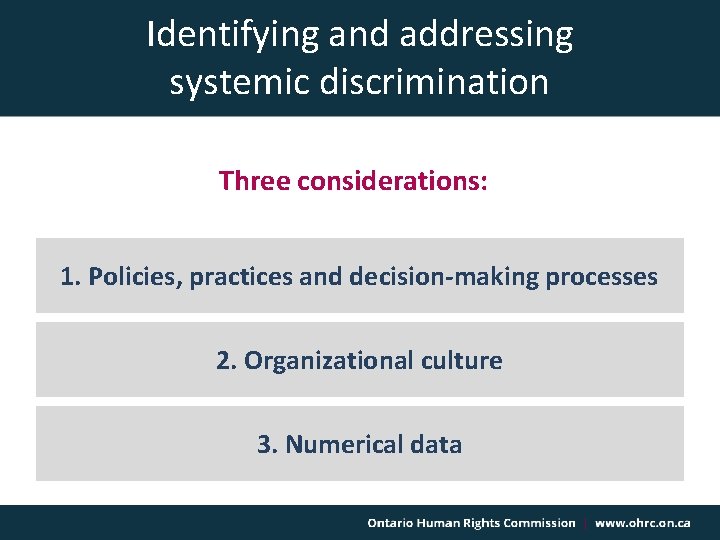
Identifying and addressing systemic discrimination Three considerations: 1. Policies, practices and decision-making processes 2. Organizational culture 3. Numerical data
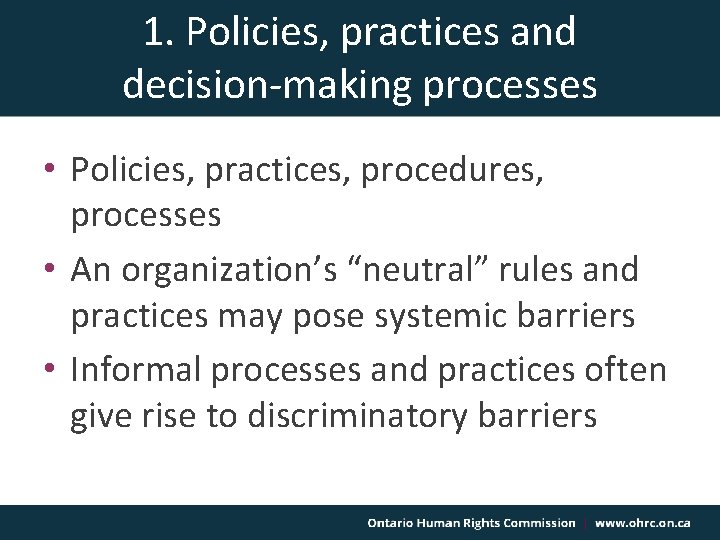
1. Policies, practices and decision-making processes • Policies, practices, procedures, processes • An organization’s “neutral” rules and practices may pose systemic barriers • Informal processes and practices often give rise to discriminatory barriers
2. Organizational culture • Patterns of informal social behaviour, e. g. communication, interpersonal relationships, social networks • Reflect deeply held and unconscious values and behavioural norms • Tendency to undervalue strengths and contributions if seen not to “fit” with dominant norms
3. Numerical data • Looking for disproportionate representation or outcomes • Disproportionate representation or outcomes are an indicator – “strong circumstantial evidence of inequitable practices” • But numbers usually not enough to confirm existence of discrimination
Measures to respond • Internal policies and procedures - e. g. complaint procedures accessibility reviews anti-racism vision statement • • • Training on policies and procedures Inclusive design reviews Data collection Ongoing monitoring and evaluation Human rights organizational change
Data collection • Data collection may be part of duty to prevent Code violations – e. g. monitoring, implementation strategies or evaluation • Should be done when there is a “reason or ought to have reason to believe that discrimination may potentially exist” • In some cases, failure to collect data can foreclose a credible defence that a respondent did not discriminate
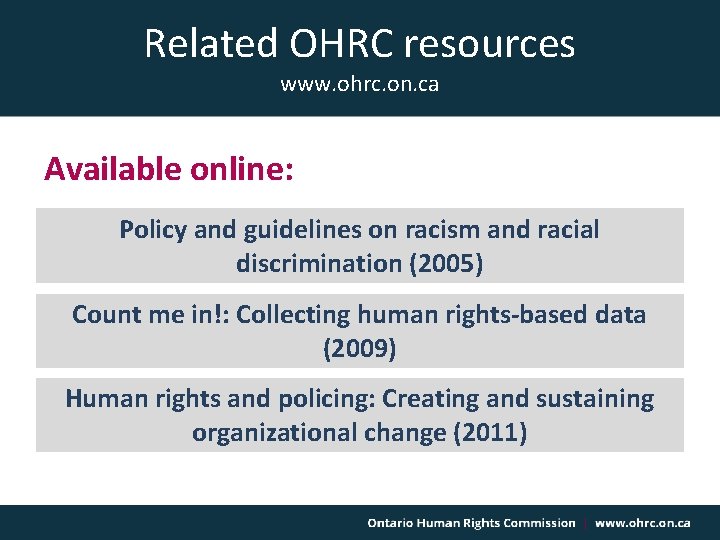
Related OHRC resources www. ohrc. on. ca Available online: Policy and guidelines on racism and racial discrimination (2005) Count me in!: Collecting human rights-based data (2009) Human rights and policing: Creating and sustaining organizational change (2011)