
Address Resolution Protocol Cisco Networking Academy Program ARP

- Slides: 46
Address Resolution Protocol Cisco Networking Academy Program ARP The Address Resolution Protocol • Who are we ARPing for? or • Who for ARP thou?
Address Resolution Protocol Cisco Networking Academy Program Note to Reader • The information explained in this section is a simplification and extrapolation of the actual ARP determination process. • Although conceptually accurate, the actual process is slightly different and more complex. • However, for the purposes of this curriculum, the explanation contained in this section provide a good basis of understanding.
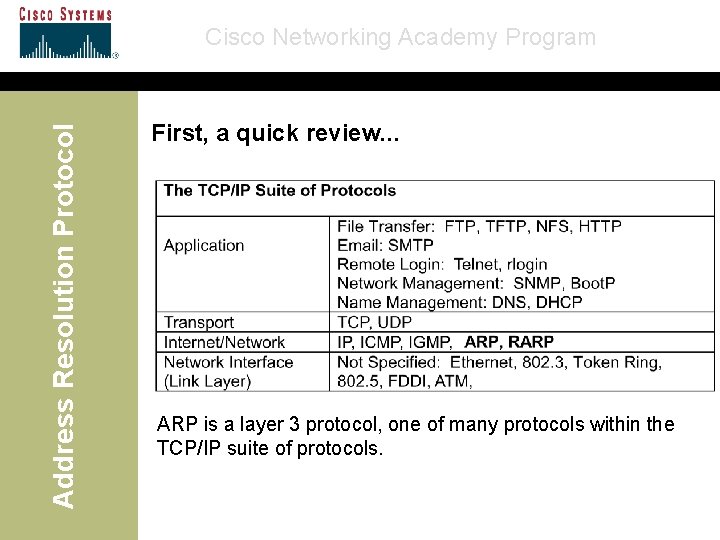
Address Resolution Protocol Cisco Networking Academy Program First, a quick review. . . ARP is a layer 3 protocol, one of many protocols within the TCP/IP suite of protocols.
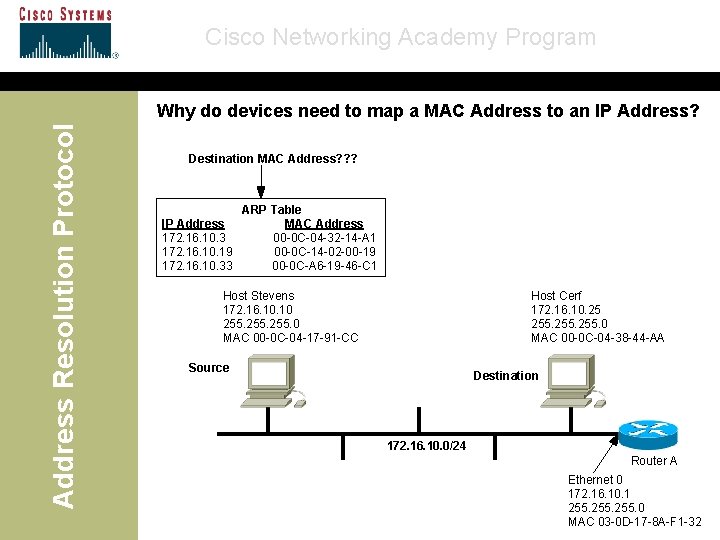
Cisco Networking Academy Program Address Resolution Protocol Why do devices need to map a MAC Address to an IP Address? Destination MAC Address? ? ? IP Address 172. 16. 10. 3 172. 16. 10. 19 172. 16. 10. 33 ARP Table MAC Address 00 -0 C-04 -32 -14 -A 1 00 -0 C-14 -02 -00 -19 00 -0 C-A 6 -19 -46 -C 1 Host Stevens 172. 16. 10 255. 0 MAC 00 -0 C-04 -17 -91 -CC Host Cerf 172. 16. 10. 25 255. 0 MAC 00 -0 C-04 -38 -44 -AA Source Destination 172. 16. 10. 0/24 Router A Ethernet 0 172. 16. 10. 1 255. 0 MAC 03 -0 D-17 -8 A-F 1 -32
Address Resolution Protocol Cisco Networking Academy Program • Devices, (hosts, routers, servers, etc. ) use IP addresses to reach other devices within their own network/subnet or across different networks/subnets. • Layer 3 addresses such as IP addresses, include a source address of the sending device and the destination address of the intended recipient. • In other words the IP addresses consist of the original source address and final destination address.
Address Resolution Protocol Cisco Networking Academy Program • Data Link addresses, such as Ethernet MAC addresses are used to get the IP packet from one hop to the next. • You may wish to review the section on Encapsulation and Routers for more clarification.
Address Resolution Protocol Cisco Networking Academy Program Why do devices need to map a MAC Address to an IP Address? • The simple answer is deliver the IP packet inside an Ethernet frame to the next hop along the way. The next hop may very well be the final destination. • To better explain this, lets use a couple of examples.
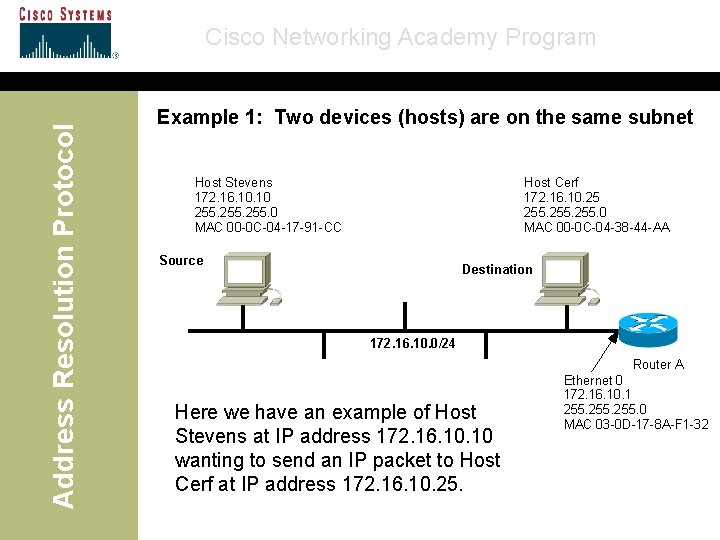
Address Resolution Protocol Cisco Networking Academy Program Example 1: Two devices (hosts) are on the same subnet Host Stevens 172. 16. 10 255. 0 MAC 00 -0 C-04 -17 -91 -CC Host Cerf 172. 16. 10. 25 255. 0 MAC 00 -0 C-04 -38 -44 -AA Source Destination 172. 16. 10. 0/24 Router A Here we have an example of Host Stevens at IP address 172. 16. 10 wanting to send an IP packet to Host Cerf at IP address 172. 16. 10. 25. Ethernet 0 172. 16. 10. 1 255. 0 MAC 03 -0 D-17 -8 A-F 1 -32
Cisco Networking Academy Program Address Resolution Protocol Host Stevens needs to send this packet either: a) directly to the final destination, Host Cerf or b) the default gateway, the router, so it can forward it onward • How does Host Stevens know where it needs to send this packet?
Address Resolution Protocol Cisco Networking Academy Program • Depending upon the answer, Host Stevens will either look for Host Cerf’s IP address of 172. 16. 10. 25 in its ARP table or that of the default gateway, Router A’s IP address of 172. 16. 10. 1 • This is the “big question!”
Address Resolution Protocol Cisco Networking Academy Program The BIG Question Which IP address does the sending host (Stevens) look for in its ARP table? And if that IP address is not there, which IP Address does it send an ARP Request for? Is it: • The IP Address of the destination host? • The IP Address of the default gateway (the router)?
Address Resolution Protocol Cisco Networking Academy Program The Answer • It depends on whether the final destination address is on its same subnet or that of a different subnet or network. • The sending host must determine whether the final destination IP address is on the same subnet as itself.
Address Resolution Protocol Cisco Networking Academy Program Same Subnet • If the final destination is on the same subnet as the sender, then it knows it can send the packet directly to the final destination. • It will look up the final destination IP address in its ARP table for the MAC address. • If the IP address is in the ARP table it will encapsulate the IP packet into the Ethernet frame. • The sender will use the MAC address it got from the ARP table for the Destination MAC address in the Ethernet frame.
Address Resolution Protocol Cisco Networking Academy Program • If the IP address is not in the ARP table the sender will need to send out an ARP Request in order to get the MAC address.
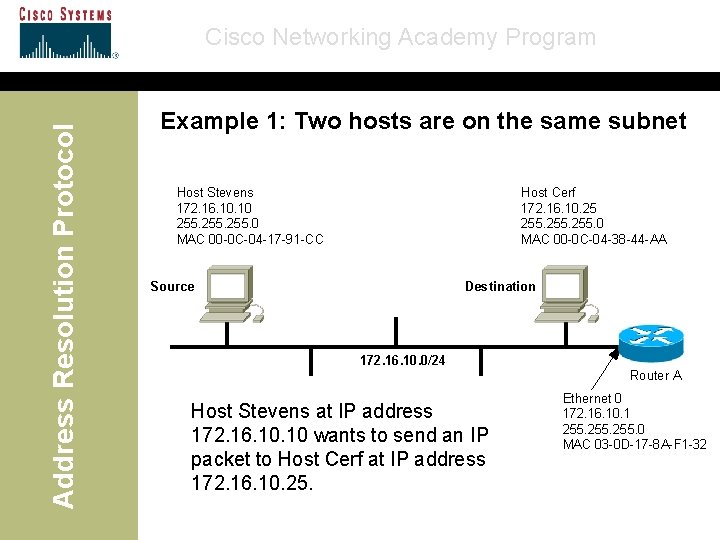
Address Resolution Protocol Cisco Networking Academy Program Example 1: Two hosts are on the same subnet Host Stevens 172. 16. 10 255. 0 MAC 00 -0 C-04 -17 -91 -CC Host Cerf 172. 16. 10. 25 255. 0 MAC 00 -0 C-04 -38 -44 -AA Source Destination 172. 16. 10. 0/24 Router A Host Stevens at IP address 172. 16. 10 wants to send an IP packet to Host Cerf at IP address 172. 16. 10. 25. Ethernet 0 172. 16. 10. 1 255. 0 MAC 03 -0 D-17 -8 A-F 1 -32
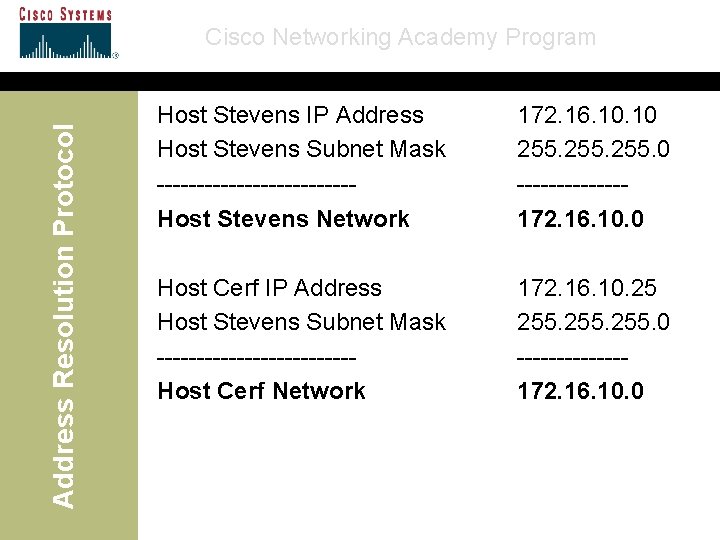
Address Resolution Protocol Cisco Networking Academy Program • The sender, Host Stevens, compares its IP Address with the destination host’s IP Address, using the sender’s (Host Stevens’) subnet mask to extract the network portion for both IP Addresses. • By doing AND operations on both IP Addresses, host Stevens determines whether or not both hosts are on the same network/subnet.
Address Resolution Protocol Cisco Networking Academy Program Host Stevens IP Address Host Stevens Subnet Mask ------------Host Stevens Network 172. 16. 10 255. 0 -------172. 16. 10. 0 Host Cerf IP Address Host Stevens Subnet Mask ------------Host Cerf Network 172. 16. 10. 25 255. 0 -------172. 16. 10. 0
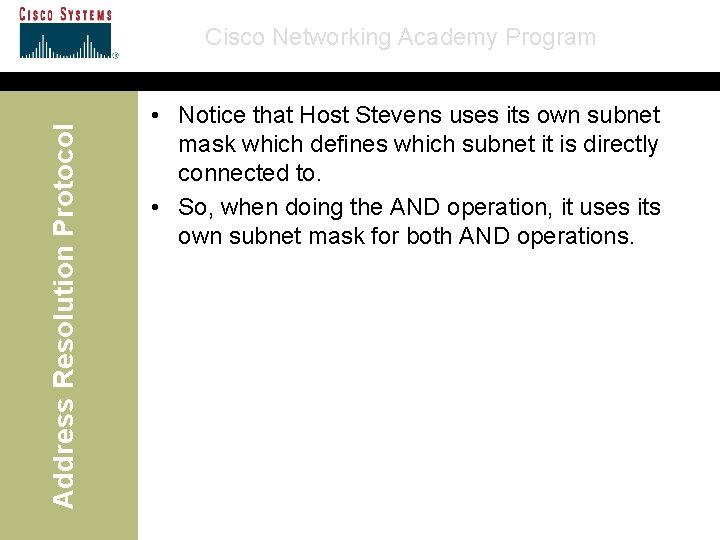
Address Resolution Protocol Cisco Networking Academy Program • Notice that Host Stevens uses its own subnet mask which defines which subnet it is directly connected to. • So, when doing the AND operation, it uses its own subnet mask for both AND operations.
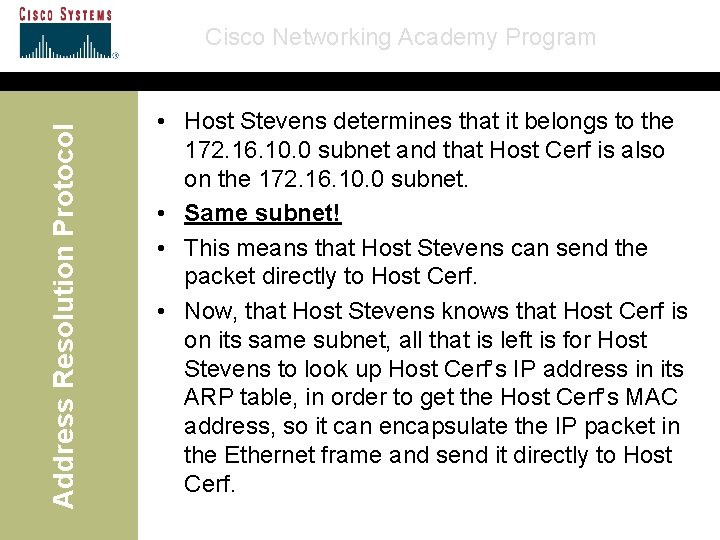
Address Resolution Protocol Cisco Networking Academy Program • Host Stevens determines that it belongs to the 172. 16. 10. 0 subnet and that Host Cerf is also on the 172. 16. 10. 0 subnet. • Same subnet! • This means that Host Stevens can send the packet directly to Host Cerf. • Now, that Host Stevens knows that Host Cerf is on its same subnet, all that is left is for Host Stevens to look up Host Cerf’s IP address in its ARP table, in order to get the Host Cerf’s MAC address, so it can encapsulate the IP packet in the Ethernet frame and send it directly to Host Cerf.
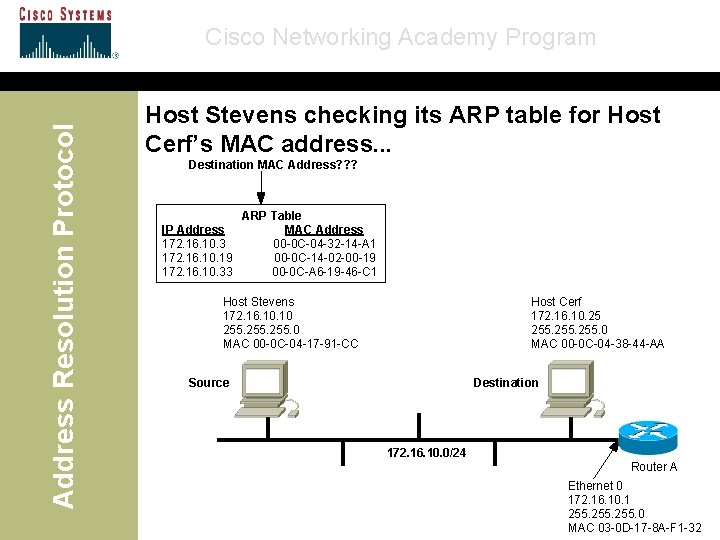
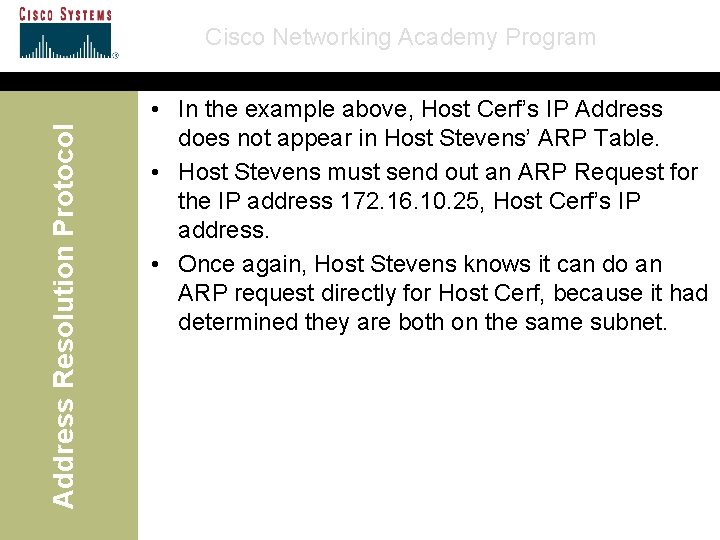
Address Resolution Protocol Cisco Networking Academy Program Host Stevens checking its ARP table for Host Cerf’s MAC address. . . Destination MAC Address? ? ? ARP Table IP Address MAC Address 172. 16. 10. 3 00 -0 C-04 -32 -14 -A 1 172. 16. 10. 19 00 -0 C-14 -02 -00 -19 172. 16. 10. 33 00 -0 C-A 6 -19 -46 -C 1 Host Stevens 172. 16. 10 255. 0 MAC 00 -0 C-04 -17 -91 -CC Host Cerf 172. 16. 10. 25 255. 0 MAC 00 -0 C-04 -38 -44 -AA Destination Source 172. 16. 10. 0/24 Router A Ethernet 0 172. 16. 10. 1 255. 0 MAC 03 -0 D-17 -8 A-F 1 -32
Address Resolution Protocol Cisco Networking Academy Program • In the example above, Host Cerf’s IP Address does not appear in Host Stevens’ ARP Table. • Host Stevens must send out an ARP Request for the IP address 172. 16. 10. 25, Host Cerf’s IP address. • Once again, Host Stevens knows it can do an ARP request directly for Host Cerf, because it had determined they are both on the same subnet.
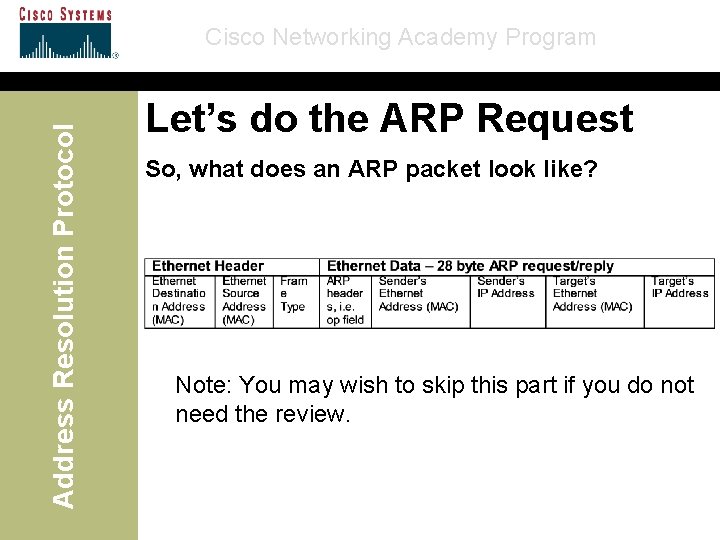
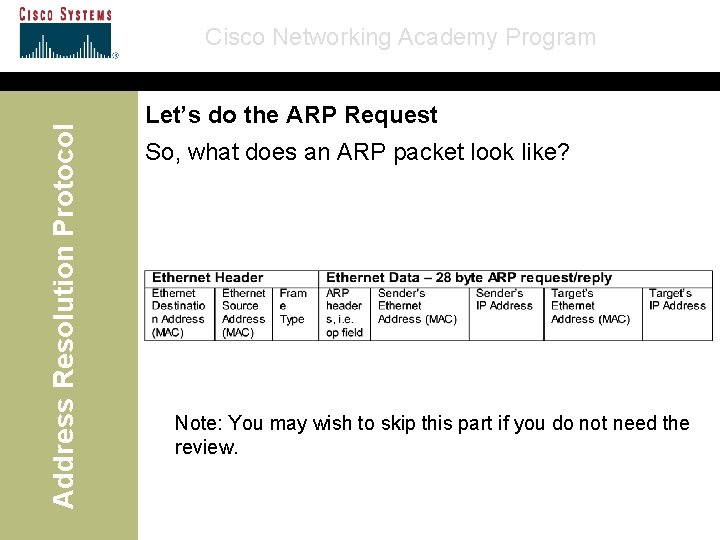
Address Resolution Protocol Cisco Networking Academy Program Let’s do the ARP Request So, what does an ARP packet look like? Note: You may wish to skip this part if you do not need the review.
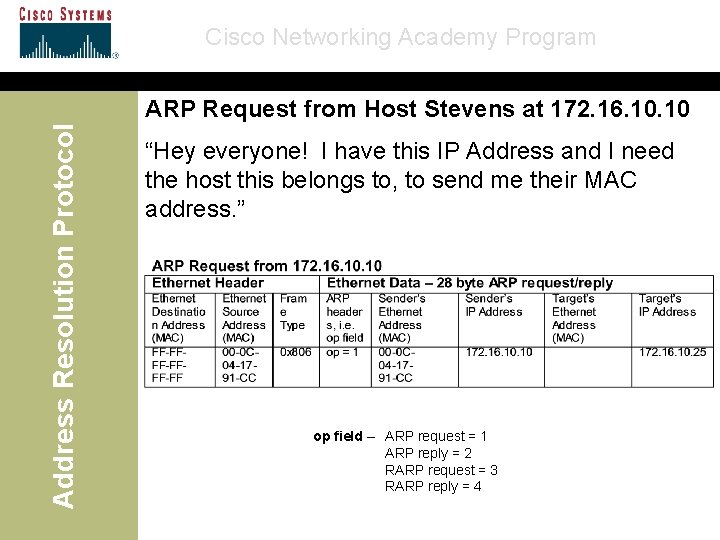
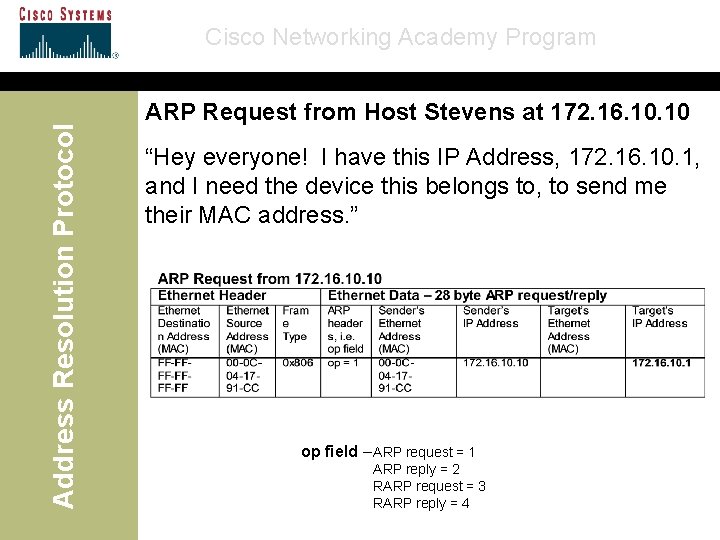
Cisco Networking Academy Program Address Resolution Protocol ARP Request from Host Stevens at 172. 16. 10 “Hey everyone! I have this IP Address and I need the host this belongs to, to send me their MAC address. ” op field – ARP request = 1 ARP reply = 2 RARP request = 3 RARP reply = 4
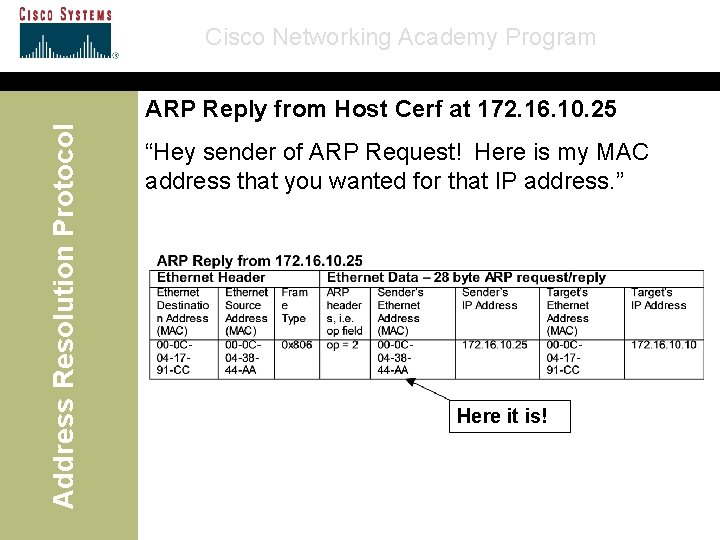
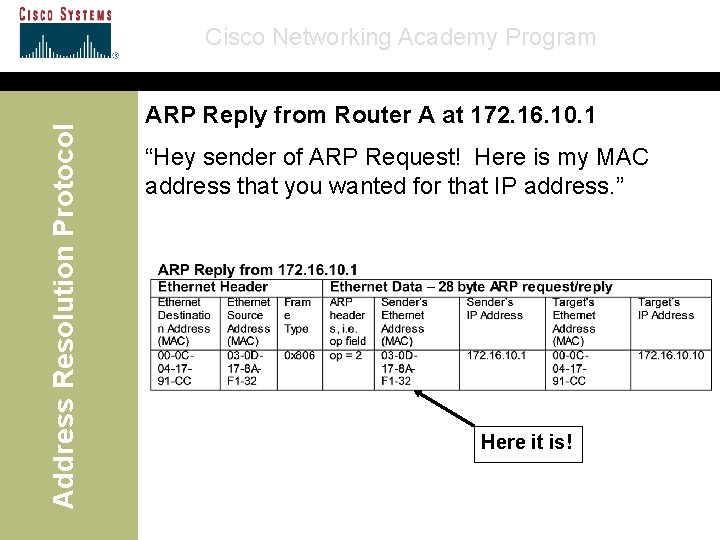
Cisco Networking Academy Program Address Resolution Protocol ARP Reply from Host Cerf at 172. 16. 10. 25 “Hey sender of ARP Request! Here is my MAC address that you wanted for that IP address. ” Here it is!
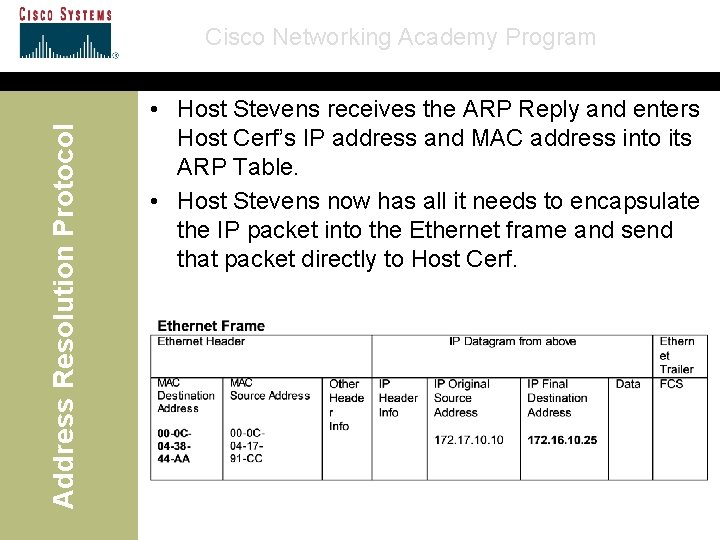
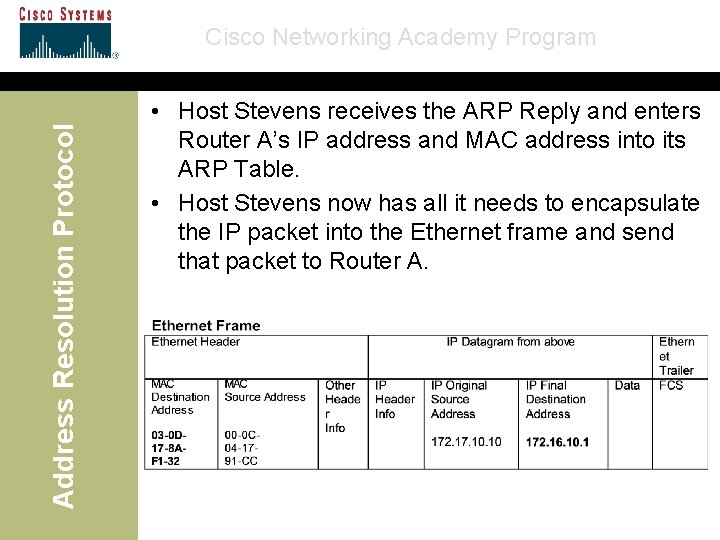
Address Resolution Protocol Cisco Networking Academy Program • Host Stevens receives the ARP Reply and enters Host Cerf’s IP address and MAC address into its ARP Table. • Host Stevens now has all it needs to encapsulate the IP packet into the Ethernet frame and send that packet directly to Host Cerf.
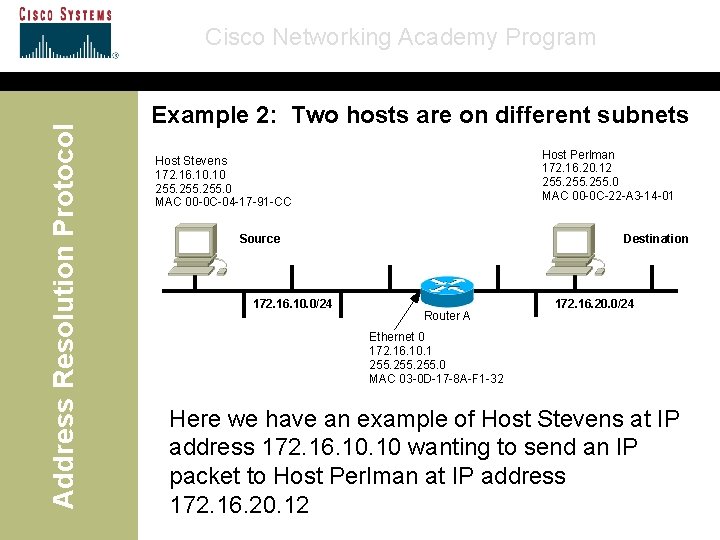
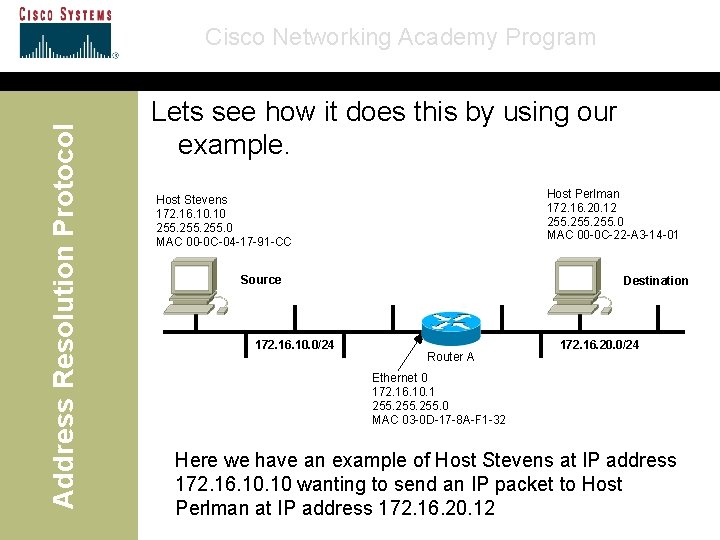
Address Resolution Protocol Cisco Networking Academy Program Example 2: Two hosts are on different subnets Host Perlman 172. 16. 20. 12 255. 0 MAC 00 -0 C-22 -A 3 -14 -01 Host Stevens 172. 16. 10 255. 0 MAC 00 -0 C-04 -17 -91 -CC Destination Source 172. 16. 10. 0/24 Router A 172. 16. 20. 0/24 Ethernet 0 172. 16. 10. 1 255. 0 MAC 03 -0 D-17 -8 A-F 1 -32 Here we have an example of Host Stevens at IP address 172. 16. 10 wanting to send an IP packet to Host Perlman at IP address 172. 16. 20. 12
Address Resolution Protocol Cisco Networking Academy Program Host Stevens needs to send this packet either: a) directly to the final destination, Host Perlman or b) the default gateway, the router, so it can forward it onward • How does Host Stevens know where it needs to send this packet?
Address Resolution Protocol Cisco Networking Academy Program • Depending upon the answer, Host Stevens will either look for Host Perlman’s IP address of 172. 16. 20. 12 in its ARP table or that of the default gateway, Router A’s IP address of 172. 16. 10. 1 • This is the “big question!”
Address Resolution Protocol Cisco Networking Academy Program The BIG Question Which IP address does the sending host (Stevens) look for in its ARP table? And if that IP address is not there, what IP Address does it send an ARP Request for? Is it: • The IP Address of the destination host? • The IP Address of the default gateway (the router)?
Address Resolution Protocol Cisco Networking Academy Program The Answer • It depends on whether the final destination address is on its same subnet or that of a different subnet or network. • The sending host must determine whether the final destination IP address is on the same subnet as itself.
Address Resolution Protocol Cisco Networking Academy Program Different Subnet • If the final destination is on a different subnet then the sender knows it can not send the packet directly to the final destination. • Instead, the sender will look up the IP address of the default gateway. • This is why hosts normally have not only an IP address and subnet mask, but also an IP address of a default gateway.
Address Resolution Protocol Cisco Networking Academy Program • The default gateway is usually a router, which hosts send packets to when the destination IP address is on a different subnet or network. • The sender will look up the default gateway’s IP address in its ARP table for the MAC address of the default gateway. • If the IP address is in the sender’s ARP table it will encapsulate the IP packet into the Ethernet frame and send the packet to the default gateway (i. e. the router).
Address Resolution Protocol Cisco Networking Academy Program • If the IP address is not in the ARP table the sender will send an ARP Request for the MAC address of the default gateway (i. e. the router).
Address Resolution Protocol Cisco Networking Academy Program Lets see how it does this by using our example. Host Perlman 172. 16. 20. 12 255. 0 MAC 00 -0 C-22 -A 3 -14 -01 Host Stevens 172. 16. 10 255. 0 MAC 00 -0 C-04 -17 -91 -CC Source 172. 16. 10. 0/24 Destination Router A 172. 16. 20. 0/24 Ethernet 0 172. 16. 10. 1 255. 0 MAC 03 -0 D-17 -8 A-F 1 -32 Here we have an example of Host Stevens at IP address 172. 16. 10 wanting to send an IP packet to Host Perlman at IP address 172. 16. 20. 12
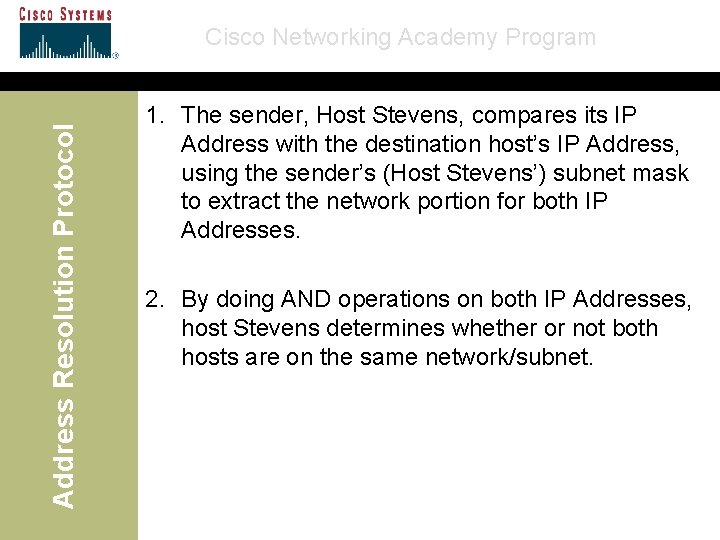
Address Resolution Protocol Cisco Networking Academy Program 1. The sender, Host Stevens, compares its IP Address with the destination host’s IP Address, using the sender’s (Host Stevens’) subnet mask to extract the network portion for both IP Addresses. 2. By doing AND operations on both IP Addresses, host Stevens determines whether or not both hosts are on the same network/subnet.
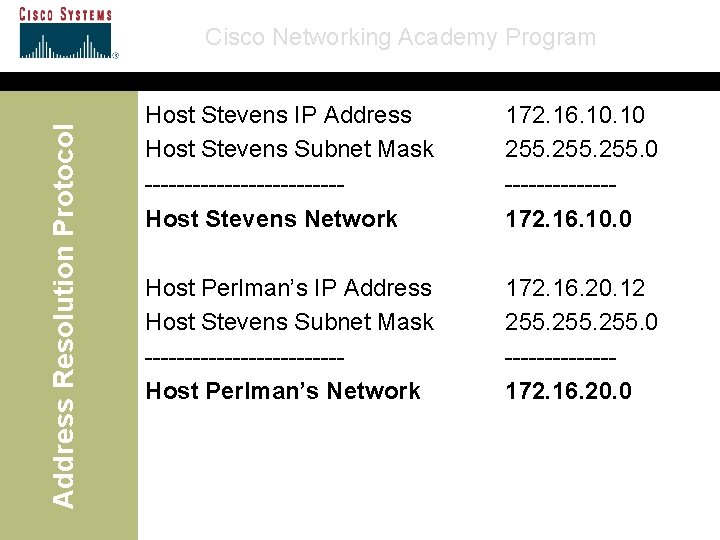
Address Resolution Protocol Cisco Networking Academy Program Host Stevens IP Address Host Stevens Subnet Mask ------------Host Stevens Network 172. 16. 10 255. 0 -------172. 16. 10. 0 Host Perlman’s IP Address Host Stevens Subnet Mask ------------Host Perlman’s Network 172. 16. 20. 12 255. 0 -------172. 16. 20. 0
Address Resolution Protocol Cisco Networking Academy Program • Notice that Host Stevens uses its own subnet mask which defines which subnet it is directly connected to. • So, when doing the AND operation, it uses its own subnet mask for both AND operations.
Address Resolution Protocol Cisco Networking Academy Program • Host Stevens determines that it belongs to the 172. 16. 10. 0 subnet and that Host Perlman is on the 172. 16. 20. 0 subnet. • Different subnets! • This means that Host Stevens can not send the packet directly to Host Perlman. • Now, that Host Stevens knows that Host Cerf is on a different subnet, it knows that it must send the packet to the default gateway, the router. • Host Stevens will look up the default gateway’s IP address (which has been entered by the user or received by a DHCP server), in its ARP Table.
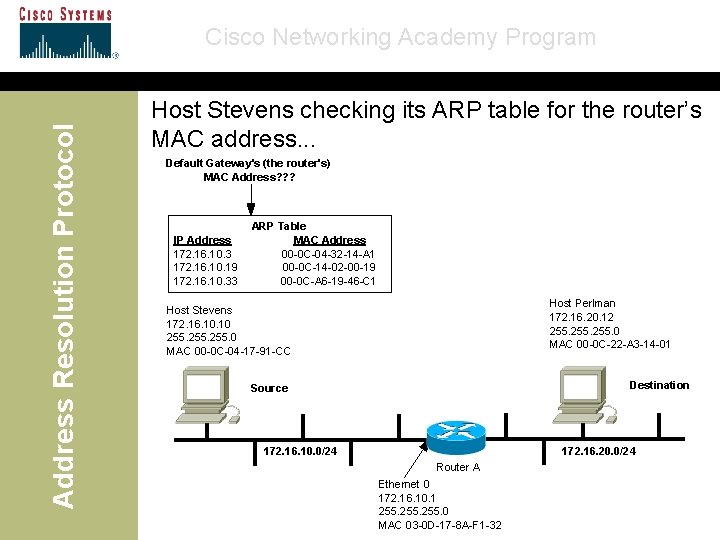
Address Resolution Protocol Cisco Networking Academy Program Host Stevens checking its ARP table for the router’s MAC address. . . Default Gateway's (the router's) MAC Address? ? ? IP Address 172. 16. 10. 3 172. 16. 10. 19 172. 16. 10. 33 ARP Table MAC Address 00 -0 C-04 -32 -14 -A 1 00 -0 C-14 -02 -00 -19 00 -0 C-A 6 -19 -46 -C 1 Host Perlman 172. 16. 20. 12 255. 0 MAC 00 -0 C-22 -A 3 -14 -01 Host Stevens 172. 16. 10 255. 0 MAC 00 -0 C-04 -17 -91 -CC Destination Source 172. 16. 10. 0/24 172. 16. 20. 0/24 Router A Ethernet 0 172. 16. 10. 1 255. 0 MAC 03 -0 D-17 -8 A-F 1 -32
Address Resolution Protocol Cisco Networking Academy Program • In the example above, Host Perlman’s IP Address does not appear in Host Stevens’ ARP Table. • Host Stevens must send out an ARP Request for the IP address 172. 16. 10. 1, Router A’s IP address. • Host Stevens can not do an ARP request directly for Host Perlman, because it had determined they are on different subnets.
Address Resolution Protocol Cisco Networking Academy Program Let’s do the ARP Request So, what does an ARP packet look like? Note: You may wish to skip this part if you do not need the review.
Address Resolution Protocol Cisco Networking Academy Program ARP Request from Host Stevens at 172. 16. 10 “Hey everyone! I have this IP Address, 172. 16. 10. 1, and I need the device this belongs to, to send me their MAC address. ” op field – ARP request = 1 ARP reply = 2 RARP request = 3 RARP reply = 4
Address Resolution Protocol Cisco Networking Academy Program ARP Reply from Router A at 172. 16. 10. 1 “Hey sender of ARP Request! Here is my MAC address that you wanted for that IP address. ” Here it is!
Address Resolution Protocol Cisco Networking Academy Program • Host Stevens receives the ARP Reply and enters Router A’s IP address and MAC address into its ARP Table. • Host Stevens now has all it needs to encapsulate the IP packet into the Ethernet frame and send that packet to Router A.
Address Resolution Protocol Cisco Networking Academy Program • It is now up to Router A to forward the packet onward.
Address Resolution Protocol Cisco Networking Academy Program