
Address Resolution Protocol ARP n RFC 826 n
- Slides: 78
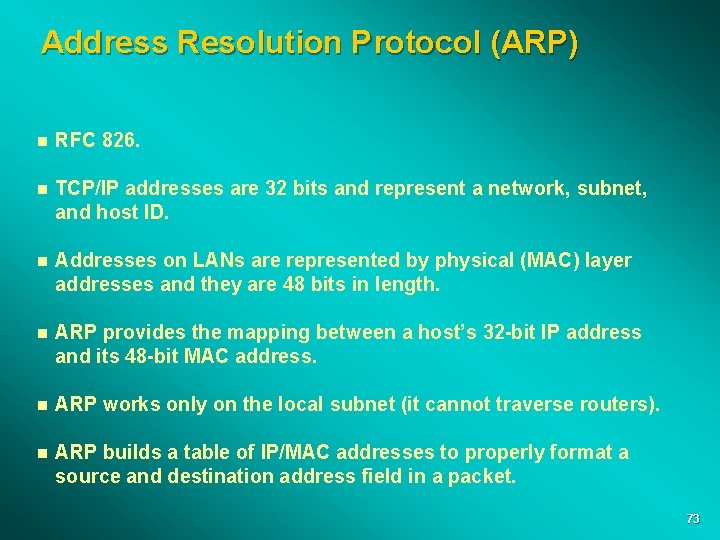
Address Resolution Protocol (ARP) n RFC 826. n TCP/IP addresses are 32 bits and represent a network, subnet, and host ID. n Addresses on LANs are represented by physical (MAC) layer addresses and they are 48 bits in length. n ARP provides the mapping between a host’s 32 -bit IP address and its 48 -bit MAC address. n ARP works only on the local subnet (it cannot traverse routers). n ARP builds a table of IP/MAC addresses to properly format a source and destination address field in a packet. 73
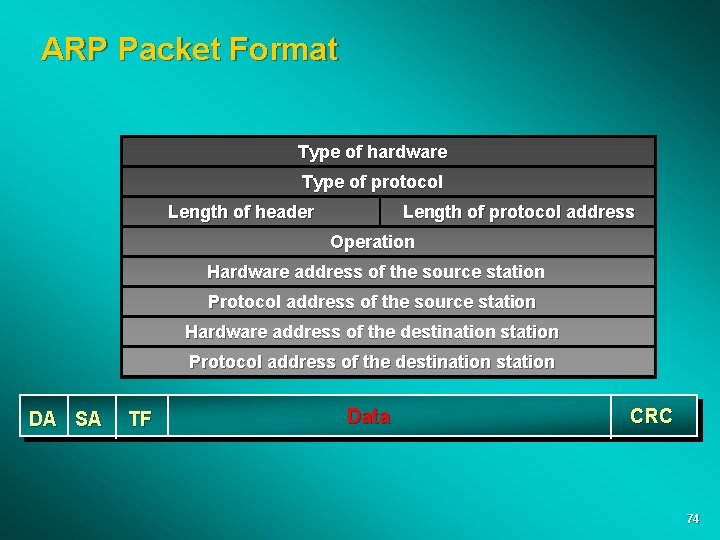
ARP Packet Format Type of hardware Type of protocol Length of header Length of protocol address Operation Hardware address of the source station Protocol address of the source station Hardware address of the destination station Protocol address of the destination station DA SA TF Data CRC 74
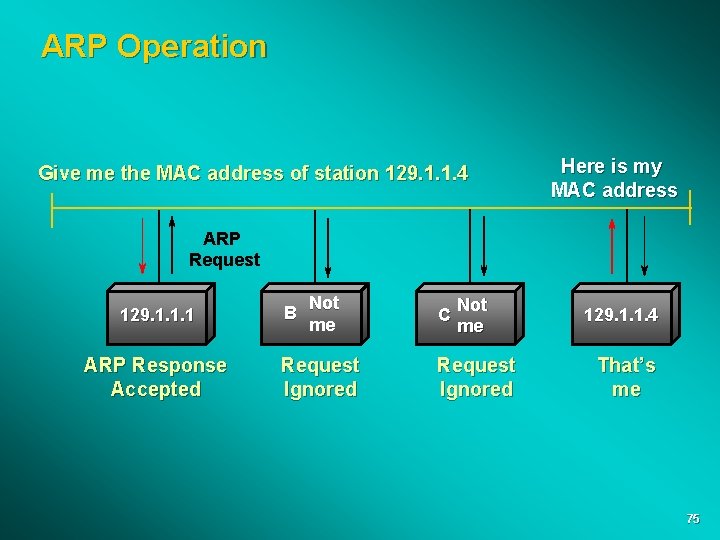
ARP Operation Give me the MAC address of station 129. 1. 1. 4 Here is my MAC address ARP Request 129. 1. 1. 1 ARP Response Accepted B Not me Request Ignored C Not me Request Ignored 129. 1. 1. 4 That’s me 75
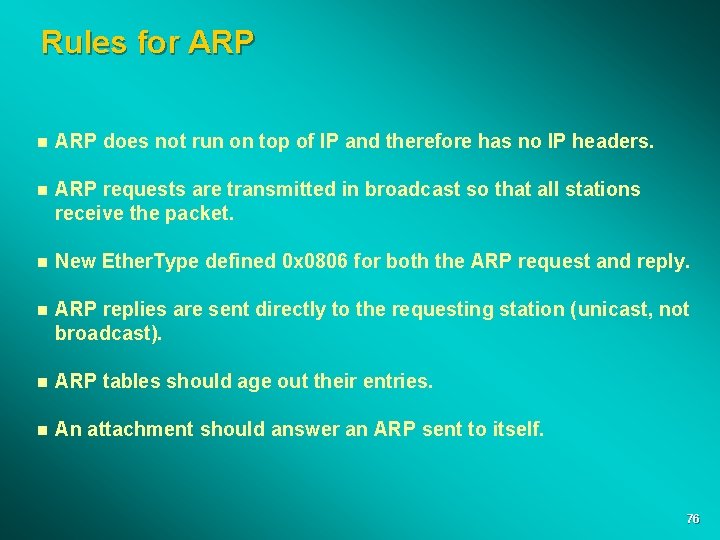
Rules for ARP n ARP does not run on top of IP and therefore has no IP headers. n ARP requests are transmitted in broadcast so that all stations receive the packet. n New Ether. Type defined 0 x 0806 for both the ARP request and reply. n ARP replies are sent directly to the requesting station (unicast, not broadcast). n ARP tables should age out their entries. n An attachment should answer an ARP sent to itself. 76
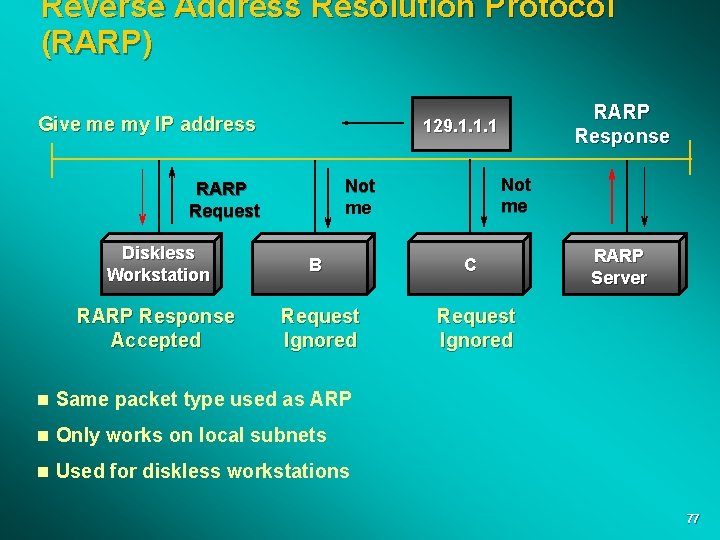
Reverse Address Resolution Protocol (RARP) Give me my IP address RARP Response 129. 1. 1. 1 Not me RARP Request Diskless Workstation B RARP Response Accepted Request Ignored C RARP Server Request Ignored n Same packet type used as ARP n Only works on local subnets n Used for diskless workstations 77
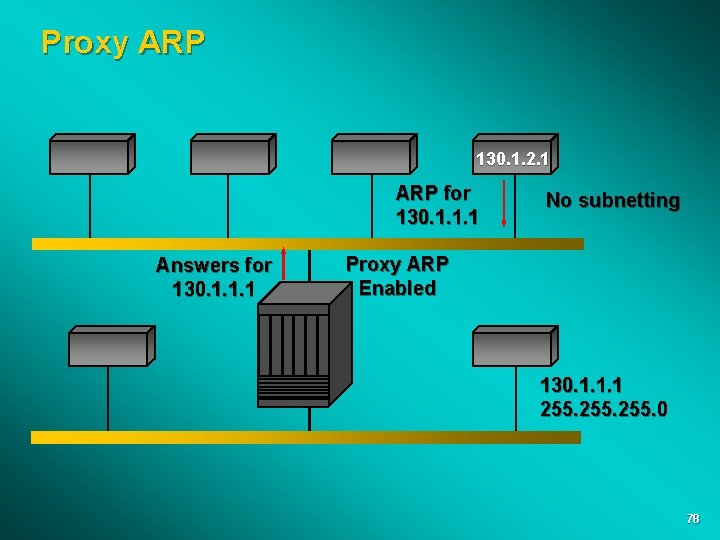
Proxy ARP 130. 1. 2. 1 ARP for 130. 1. 1. 1 Answers for 130. 1. 1. 1 No subnetting Proxy ARP Enabled 130. 1. 1. 1 255. 0 78
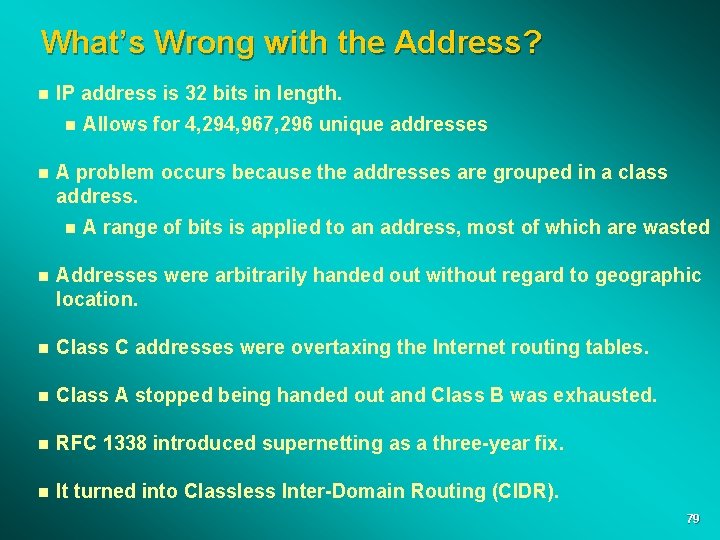
What’s Wrong with the Address? n IP address is 32 bits in length. n n Allows for 4, 294, 967, 296 unique addresses A problem occurs because the addresses are grouped in a class address. n A range of bits is applied to an address, most of which are wasted n Addresses were arbitrarily handed out without regard to geographic location. n Class C addresses were overtaxing the Internet routing tables. n Class A stopped being handed out and Class B was exhausted. n RFC 1338 introduced supernetting as a three-year fix. n It turned into Classless Inter-Domain Routing (CIDR). 79
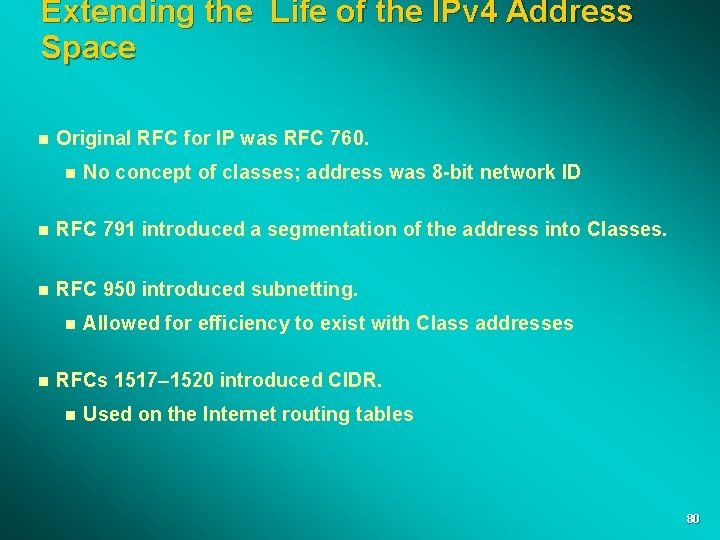
Extending the Life of the IPv 4 Address Space n Original RFC for IP was RFC 760. n No concept of classes; address was 8 -bit network ID n RFC 791 introduced a segmentation of the address into Classes. n RFC 950 introduced subnetting. n n Allowed for efficiency to exist with Class addresses RFCs 1517– 1520 introduced CIDR. n Used on the Internet routing tables 80
IP Address Assignment (The Old Method) n Three methods of assigning addresses in the old days: n Acquire a distinct network number for each cable segment separated by a router n Use a single network number for the entire operation, but assign host number in coordination with their communication requirements n Use a single network number and partition the host address space by assigning subnet number to the LANs (“explicit subnets”) 81
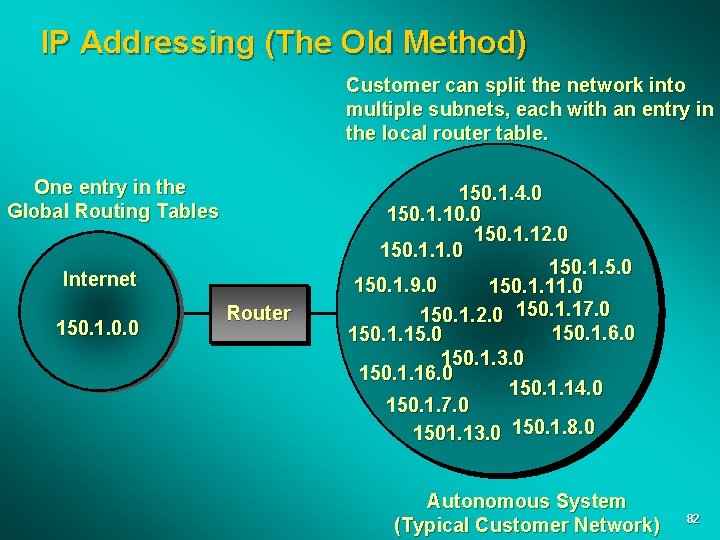
IP Addressing (The Old Method) Customer can split the network into multiple subnets, each with an entry in the local router table. One entry in the Global Routing Tables Internet 150. 1. 0. 0 Router 150. 1. 4. 0 150. 1. 10. 0 150. 1. 12. 0 150. 1. 1. 0 150. 1. 5. 0 150. 1. 9. 0 150. 1. 11. 0 150. 1. 2. 0 150. 1. 17. 0 150. 1. 6. 0 150. 1. 15. 0 150. 1. 3. 0 150. 1. 16. 0 150. 1. 14. 0 150. 1. 7. 0 1501. 13. 0 150. 1. 8. 0 Autonomous System (Typical Customer Network) 82
Address Terms and Definitions n Varible Length Subnet Masks (VLSM)—The ability to place a variablelength subnet mask on a single IP network number. n Supernetting—The ability to apply a mask to an IP address that is shorter than its natural mask. n Classless Inter-Domain Routing (CIDR)—An advertisement mechanism that allows for advertising routes without regard to Class assignment. The route could be identified by a supernet or by an extended subnet mask. n Address aggregation—The ability to summarize contiguous blocks of IP addresses as one advertisement. 83
Making the Address Efficient n All methods provide for extending the life of IPv 4. n CIDR is very similar to VLSM. n Address allocated in blocks. n Example: 205. 24. 0. 0/16 means that the address range of 205. 24. 0. 0 through 205. 24. 255. 0 (256 Class Cs) is assigned to one ISP or consumer, etc. n Block assignment allows for one route to be placed in the Internet routing tables. n It allows the ISP to break up the addresses and efficiently hand them out to its customers. n Consumers must detail their addressing requirements to the ISP. n Address assignments are still conservative. 84
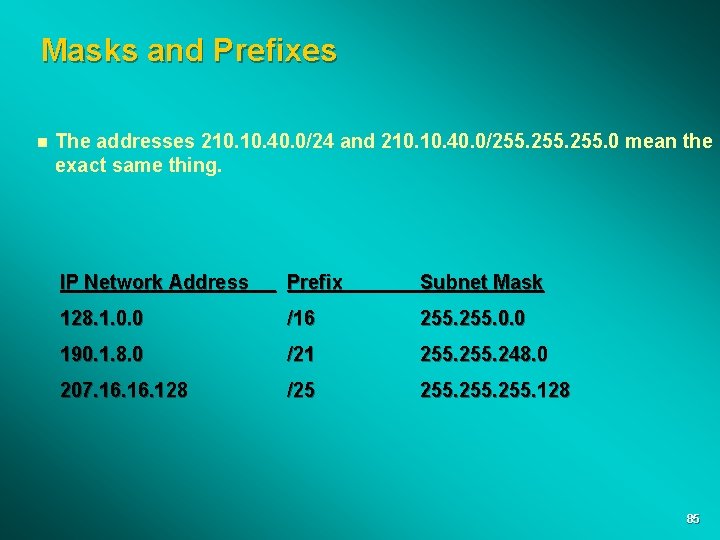
Masks and Prefixes n The addresses 210. 40. 0/24 and 210. 40. 0/255. 0 mean the exact same thing. IP Network Address Prefix Subnet Mask 128. 1. 0. 0 /16 255. 0. 0 190. 1. 8. 0 /21 255. 248. 0 207. 16. 128 /25 255. 128 85
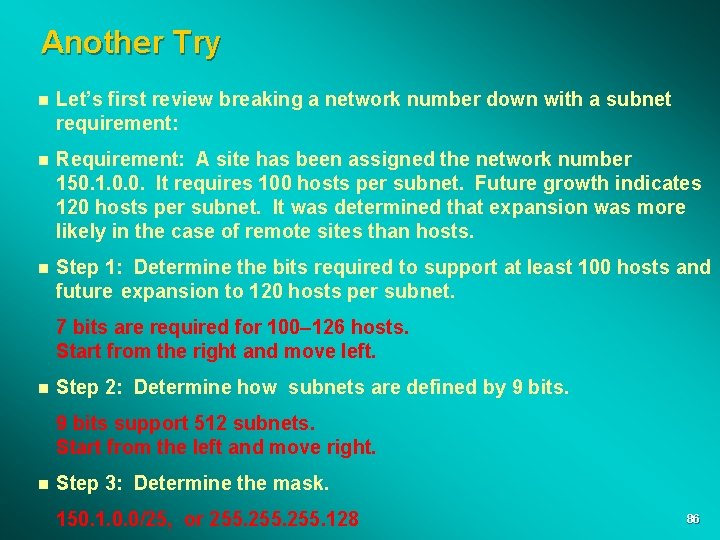
Another Try n Let’s first review breaking a network number down with a subnet requirement: n Requirement: A site has been assigned the network number 150. 1. 0. 0. It requires 100 hosts per subnet. Future growth indicates 120 hosts per subnet. It was determined that expansion was more likely in the case of remote sites than hosts. n Step 1: Determine the bits required to support at least 100 hosts and future expansion to 120 hosts per subnet. 7 bits are required for 100– 126 hosts. Start from the right and move left. n Step 2: Determine how subnets are defined by 9 bits support 512 subnets. Start from the left and move right. n Step 3: Determine the mask. 150. 1. 0. 0/25, or 255. 128 86
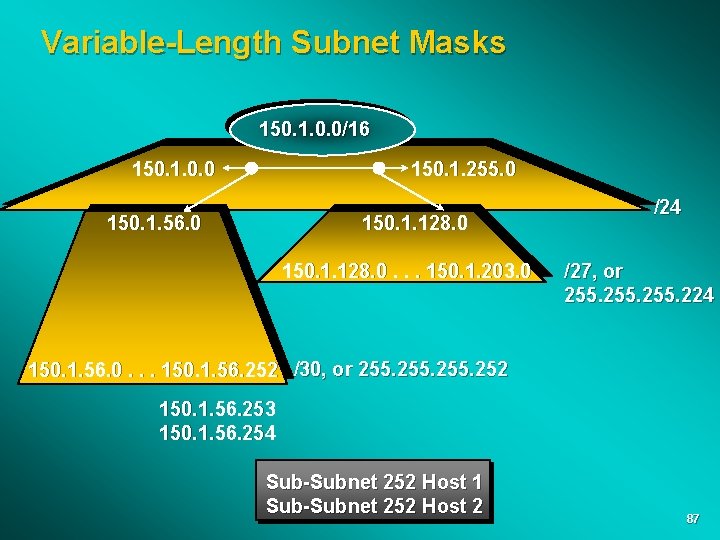
Variable-Length Subnet Masks 150. 1. 0. 0/16 150. 1. 0. 0 150. 1. 255. 0 150. 1. 56. 0 150. 1. 128. 0. . . 150. 1. 203. 0 /24 /27, or 255. 224 150. 1. 56. 0. . . 150. 1. 56. 252 /30, or 255. 252 150. 1. 56. 253 150. 1. 56. 254 Sub-Subnet 252 Host 1 Sub-Subnet 252 Host 2 87
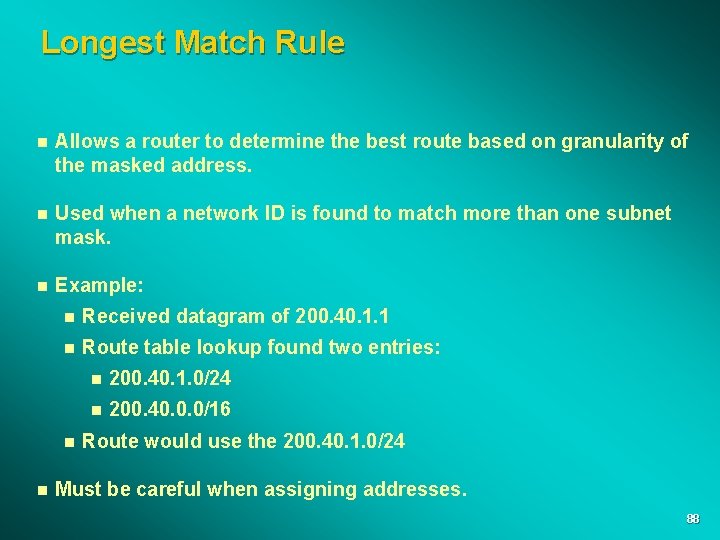
Longest Match Rule n Allows a router to determine the best route based on granularity of the masked address. n Used when a network ID is found to match more than one subnet mask. n Example: n Received datagram of 200. 40. 1. 1 n Route table lookup found two entries: n n n 200. 40. 1. 0/24 n 200. 40. 0. 0/16 Route would use the 200. 40. 1. 0/24 Must be careful when assigning addresses. 88
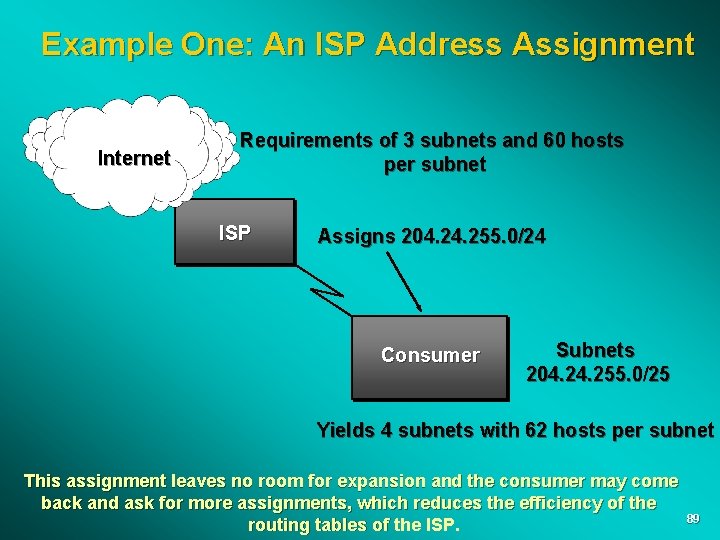
Example One: An ISP Address Assignment Internet Requirements of 3 subnets and 60 hosts per subnet ISP Assigns 204. 255. 0/24 Consumer Subnets 204. 255. 0/25 Yields 4 subnets with 62 hosts per subnet This assignment leaves no room for expansion and the consumer may come back and ask for more assignments, which reduces the efficiency of the routing tables of the ISP. 89
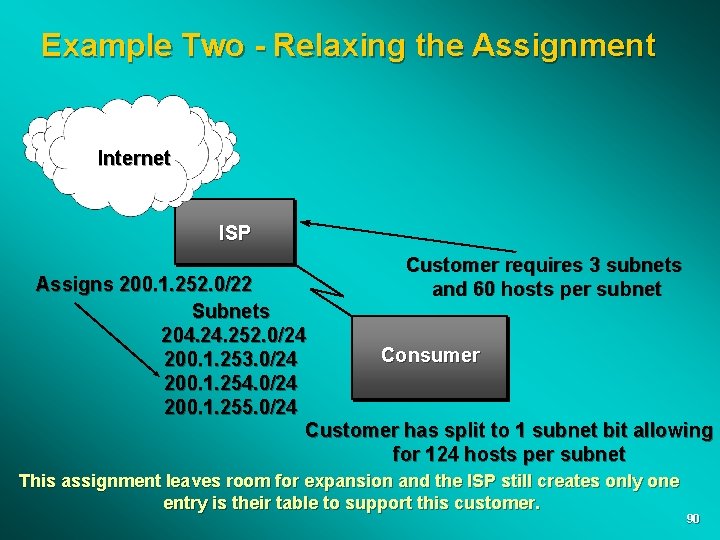
Example Two - Relaxing the Assignment Internet ISP Customer requires 3 subnets and 60 hosts per subnet Assigns 200. 1. 252. 0/22 Subnets 204. 252. 0/24 Consumer 200. 1. 253. 0/24 200. 1. 254. 0/24 200. 1. 255. 0/24 Customer has split to 1 subnet bit allowing for 124 hosts per subnet This assignment leaves room for expansion and the ISP still creates only one entry is their table to support this customer. 90
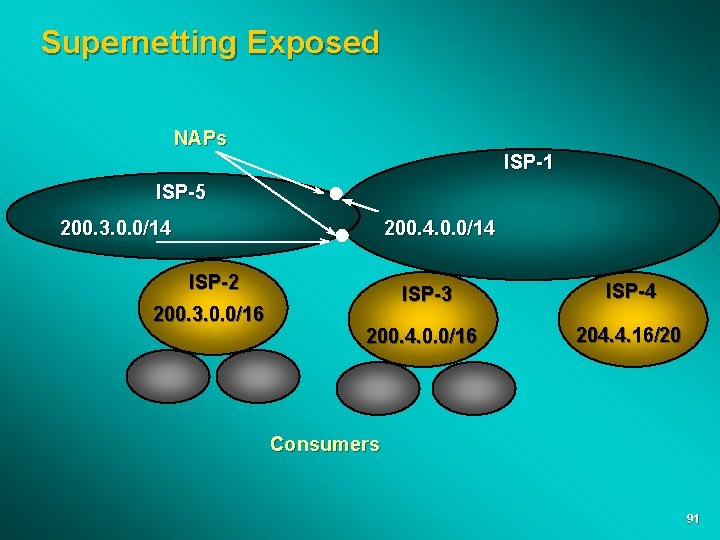
Supernetting Exposed NAPs ISP-1 ISP-5 200. 3. 0. 0/14 200. 4. 0. 0/14 ISP-2 200. 3. 0. 0/16 ISP-3 ISP-4 200. 4. 0. 0/16 204. 4. 16/20 Consumers 91
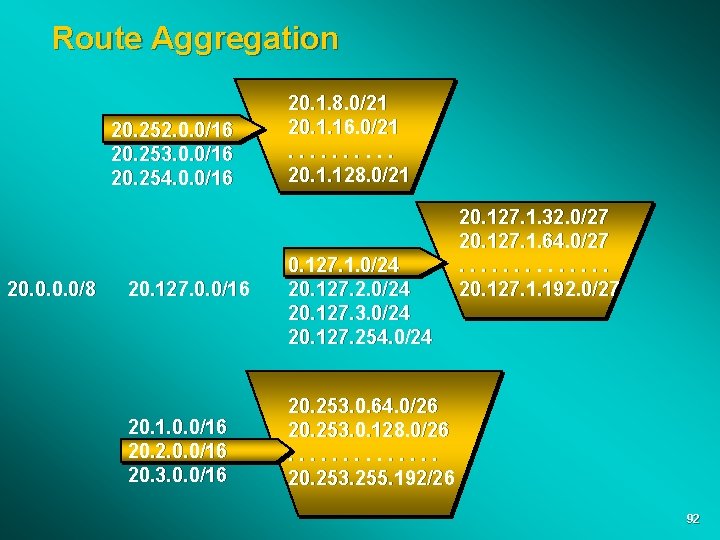
Route Aggregation 20. 252. 0. 0/16 20. 253. 0. 0/16 20. 254. 0. 0/16 20. 0/8 20. 127. 0. 0/16 20. 1. 0. 0/16 20. 2. 0. 0/16 20. 3. 0. 0/16 20. 1. 8. 0/21 20. 1. 16. 0/21. . 20. 1. 128. 0/21 0. 127. 1. 0/24 20. 127. 2. 0/24 20. 127. 3. 0/24 20. 127. 254. 0/24 20. 127. 1. 32. 0/27 20. 127. 1. 64. 0/27. . . 20. 127. 1. 192. 0/27 20. 253. 0. 64. 0/26 20. 253. 0. 128. 0/26. . . 20. 253. 255. 192/26 92
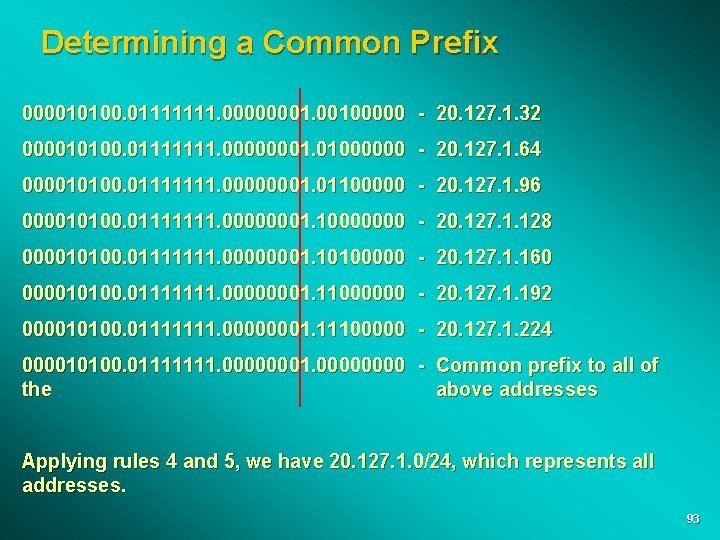
Determining a Common Prefix 000010100. 01111111. 00000001. 00100000 - 20. 127. 1. 32 000010100. 01111111. 00000001. 01000000 - 20. 127. 1. 64 000010100. 01111111. 00000001. 01100000 - 20. 127. 1. 96 000010100. 01111111. 00000001. 10000000 - 20. 127. 1. 128 000010100. 01111111. 00000001. 10100000 - 20. 127. 1. 160 000010100. 01111111. 00000001. 11000000 - 20. 127. 1. 192 000010100. 01111111. 00000001. 11100000 - 20. 127. 1. 224 000010100. 01111111. 00000000 - Common prefix to all of the above addresses Applying rules 4 and 5, we have 20. 127. 1. 0/24, which represents all addresses. 93
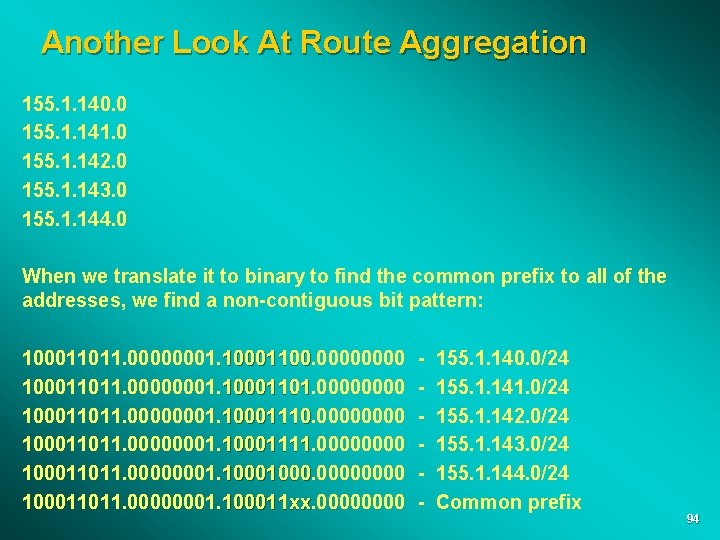
Another Look At Route Aggregation 155. 1. 140. 0 155. 1. 141. 0 155. 1. 142. 0 155. 1. 143. 0 155. 1. 144. 0 When we translate it to binary to find the common prefix to all of the addresses, we find a non-contiguous bit pattern: 100011011. 00000001. 10001100. 0000 10001100 100011011. 00000001. 10001101. 0000 100011011. 00000001. 10001110. 0000 10001110 100011011. 00000001. 10001111. 0000 10001111 100011011. 00000001. 1000. 0000 100011011. 00000001. 100011 xx. 0000 100011 xx - 155. 1. 140. 0/24 155. 1. 141. 0/24 155. 1. 142. 0/24 155. 1. 143. 0/24 155. 1. 144. 0/24 Common prefix 94
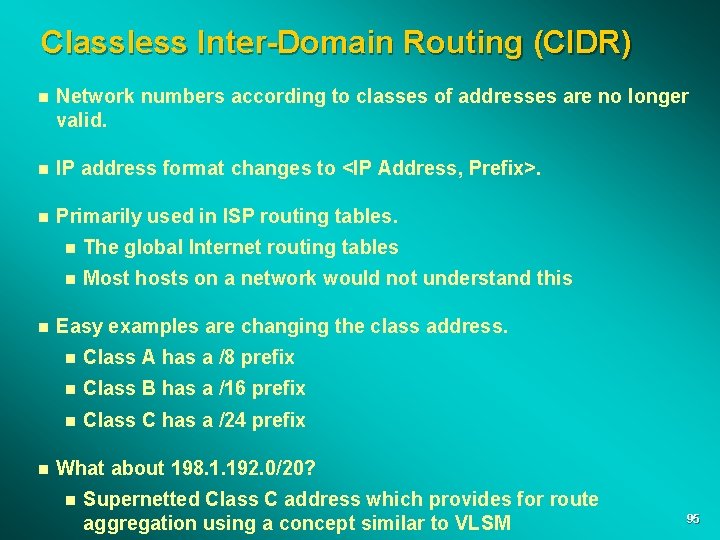
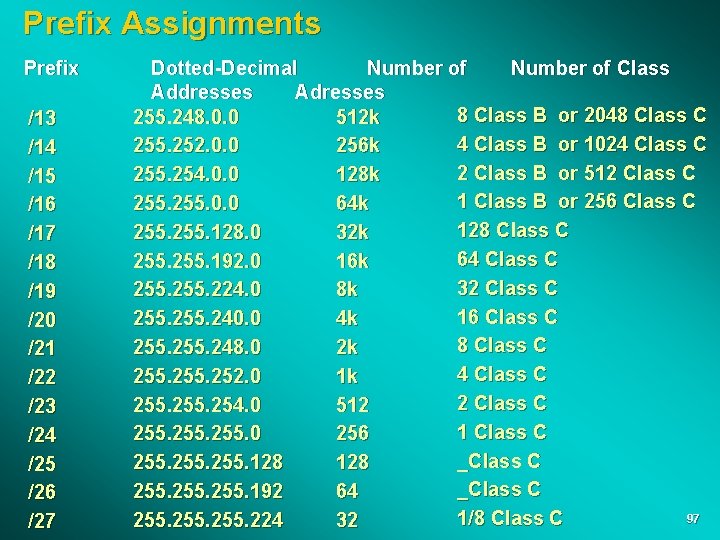
Classless Inter-Domain Routing (CIDR) n Network numbers according to classes of addresses are no longer valid. n IP address format changes to <IP Address, Prefix>. n Primarily used in ISP routing tables. n n n The global Internet routing tables n Most hosts on a network would not understand this Easy examples are changing the class address. n Class A has a /8 prefix n Class B has a /16 prefix n Class C has a /24 prefix What about 198. 1. 192. 0/20? n Supernetted Class C address which provides for route aggregation using a concept similar to VLSM 95
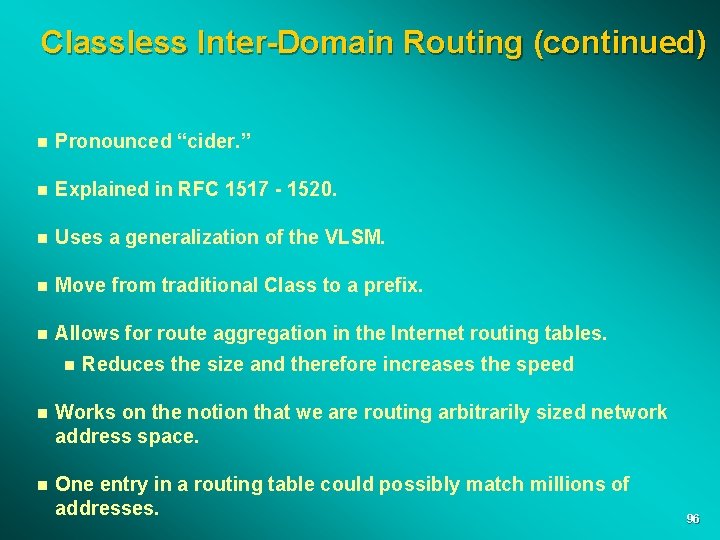
Classless Inter-Domain Routing (continued) n Pronounced “cider. ” n Explained in RFC 1517 - 1520. n Uses a generalization of the VLSM. n Move from traditional Class to a prefix. n Allows for route aggregation in the Internet routing tables. n Reduces the size and therefore increases the speed n Works on the notion that we are routing arbitrarily sized network address space. n One entry in a routing table could possibly match millions of addresses. 96
Prefix Assignments Prefix /13 /14 /15 /16 /17 /18 /19 /20 /21 /22 /23 /24 /25 /26 /27 Dotted-Decimal Number of Class Addresses Adresses 8 Class B or 2048 Class C 255. 248. 0. 0 512 k 4 Class B or 1024 Class C 255. 252. 0. 0 256 k 2 Class B or 512 Class C 255. 254. 0. 0 128 k 1 Class B or 256 Class C 255. 0. 0 64 k 128 Class C 255. 128. 0 32 k 64 Class C 255. 192. 0 16 k 32 Class C 255. 224. 0 8 k 16 Class C 255. 240. 0 4 k 8 Class C 255. 248. 0 2 k 4 Class C 255. 252. 0 1 k 2 Class C 255. 254. 0 512 1 Class C 255. 0 256 _Class C 255. 128 _Class C 255. 192 64 97 1/8 Class C 255. 224 32
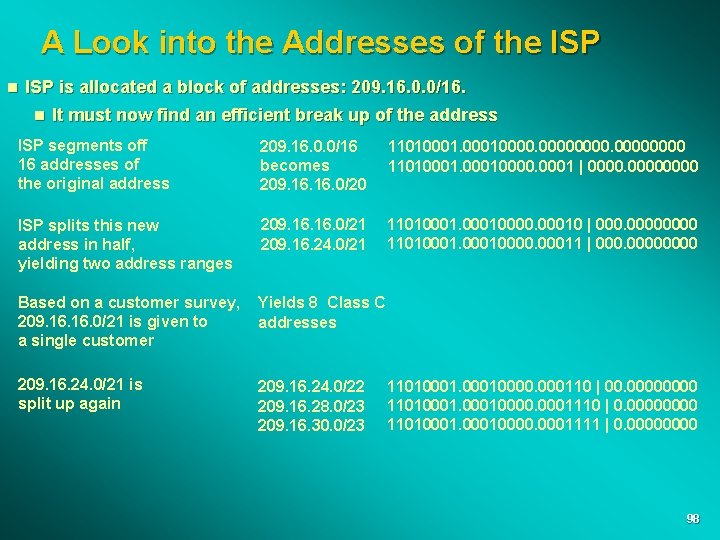
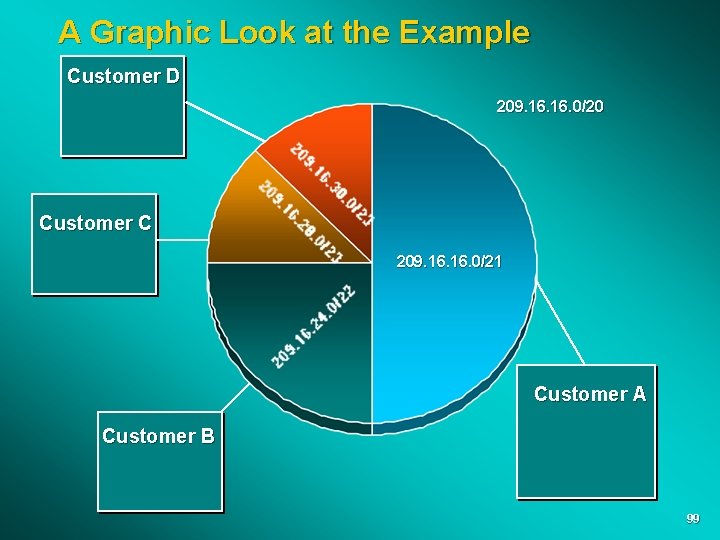
A Look into the Addresses of the ISP n ISP is allocated a block of addresses: 209. 16. 0. 0/16. n It must now find an efficient break up of the address ISP segments off 16 addresses of the original address 209. 16. 0. 0/16 becomes 209. 16. 0/20 1101000100000000 110100010000. 0001 | 0000 ISP splits this new address in half, yielding two address ranges 209. 16. 0/21 209. 16. 24. 0/21 110100010000. 00010 | 0000 110100010000. 00011 | 0000 Based on a customer survey, 209. 16. 0/21 is given to a single customer Yields 8 Class C addresses 209. 16. 24. 0/21 is split up again 209. 16. 24. 0/22 209. 16. 28. 0/23 209. 16. 30. 0/23 110100010000. 000110 | 00. 0000 110100010000. 0001110 | 0. 0000 110100010000. 0001111 | 0. 0000 98
A Graphic Look at the Example Customer D 209. 16. 0/20 Customer C 209. 16. 0/21 Customer A Customer B 99
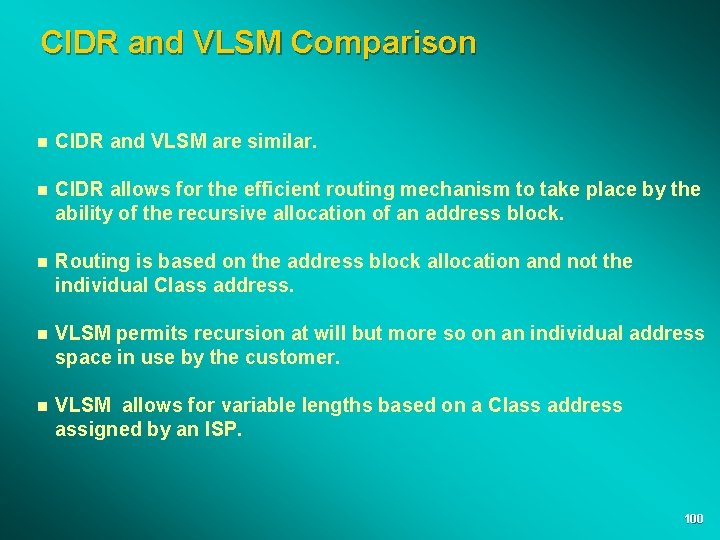
CIDR and VLSM Comparison n CIDR and VLSM are similar. n CIDR allows for the efficient routing mechanism to take place by the ability of the recursive allocation of an address block. n Routing is based on the address block allocation and not the individual Class address. n VLSM permits recursion at will but more so on an individual address space in use by the customer. n VLSM allows for variable lengths based on a Class address assigned by an ISP. 100
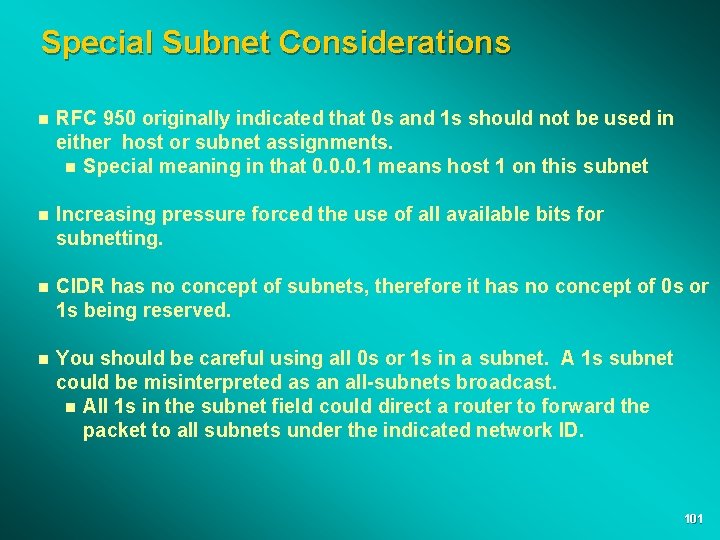
Special Subnet Considerations n RFC 950 originally indicated that 0 s and 1 s should not be used in either host or subnet assignments. n Special meaning in that 0. 0. 0. 1 means host 1 on this subnet n Increasing pressure forced the use of all available bits for subnetting. n CIDR has no concept of subnets, therefore it has no concept of 0 s or 1 s being reserved. n You should be careful using all 0 s or 1 s in a subnet. A 1 s subnet could be misinterpreted as an all-subnets broadcast. n All 1 s in the subnet field could direct a router to forward the packet to all subnets under the indicated network ID. 101
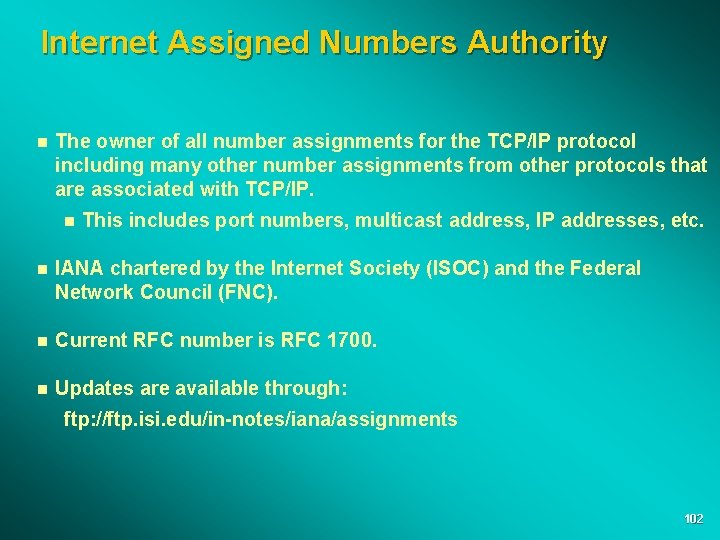
Internet Assigned Numbers Authority n The owner of all number assignments for the TCP/IP protocol including many other number assignments from other protocols that are associated with TCP/IP. n This includes port numbers, multicast address, IP addresses, etc. n IANA chartered by the Internet Society (ISOC) and the Federal Network Council (FNC). n Current RFC number is RFC 1700. n Updates are available through: ftp: //ftp. isi. edu/in-notes/iana/assignments 102
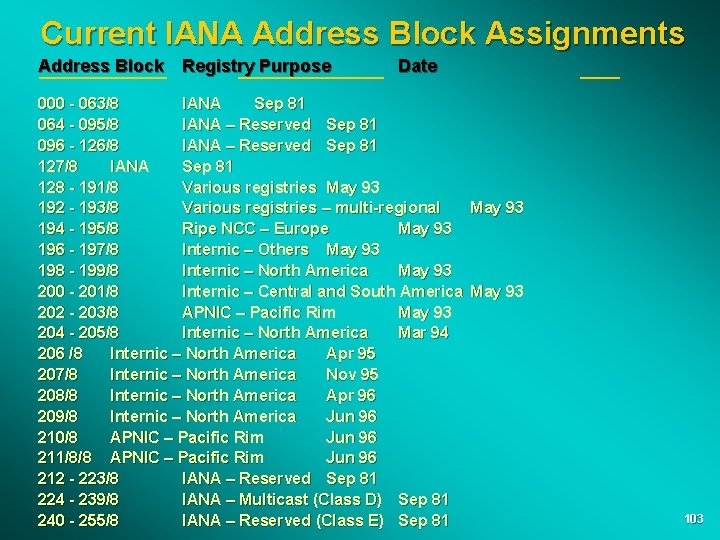
Current IANA Address Block Assignments Address Block Registry Purpose Date 000 - 063/8 IANA Sep 81 064 - 095/8 IANA – Reserved Sep 81 096 - 126/8 IANA – Reserved Sep 81 127/8 IANA Sep 81 128 - 191/8 Various registries May 93 192 - 193/8 Various registries – multi-regional May 93 194 - 195/8 Ripe NCC – Europe May 93 196 - 197/8 Internic – Others May 93 198 - 199/8 Internic – North America May 93 200 - 201/8 Internic – Central and South America May 93 202 - 203/8 APNIC – Pacific Rim May 93 204 - 205/8 Internic – North America Mar 94 206 /8 Internic – North America Apr 95 207/8 Internic – North America Nov 95 208/8 Internic – North America Apr 96 209/8 Internic – North America Jun 96 210/8 APNIC – Pacific Rim Jun 96 211/8/8 APNIC – Pacific Rim Jun 96 212 - 223/8 IANA – Reserved Sep 81 224 - 239/8 IANA – Multicast (Class D) Sep 81 240 - 255/8 IANA – Reserved (Class E) Sep 81 103
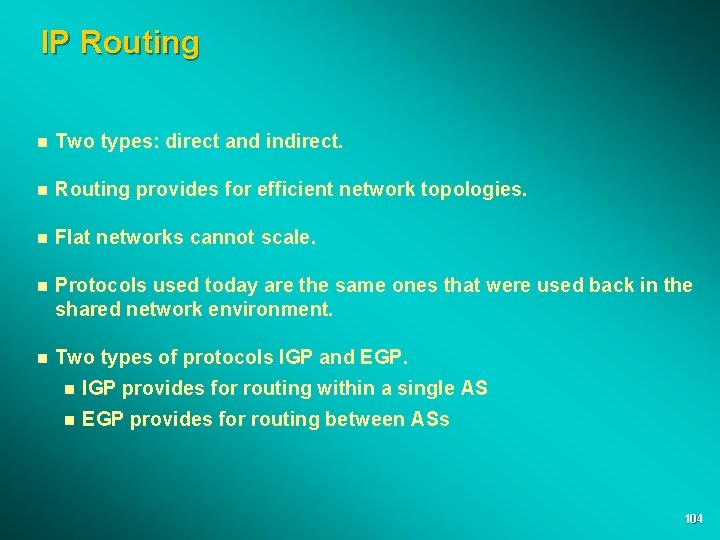
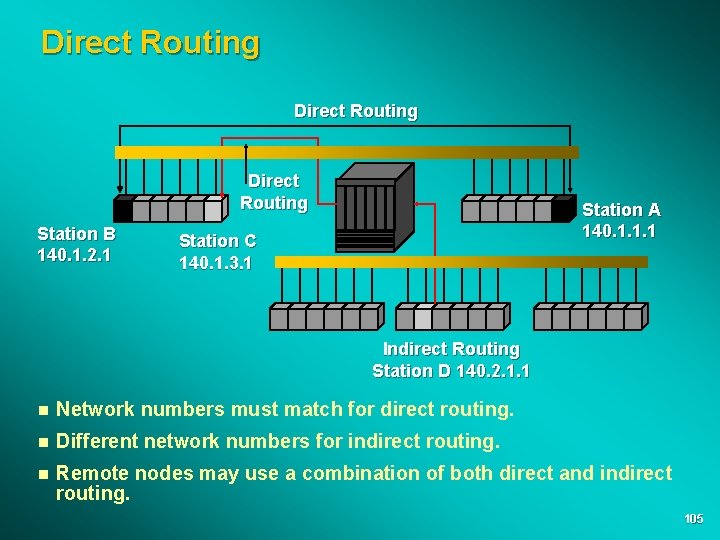
IP Routing n Two types: direct and indirect. n Routing provides for efficient network topologies. n Flat networks cannot scale. n Protocols used today are the same ones that were used back in the shared network environment. n Two types of protocols IGP and EGP. n IGP provides for routing within a single AS n EGP provides for routing between ASs 104
Direct Routing Station B 140. 1. 2. 1 Station A 140. 1. 1. 1 Station C 140. 1. 3. 1 Indirect Routing Station D 140. 2. 1. 1 n Network numbers must match for direct routing. n Different network numbers for indirect routing. n Remote nodes may use a combination of both direct and indirect routing. 105
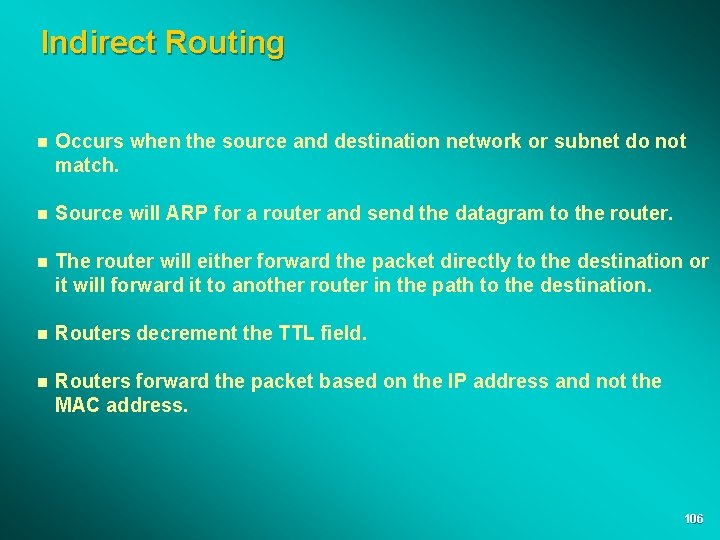
Indirect Routing n Occurs when the source and destination network or subnet do not match. n Source will ARP for a router and send the datagram to the router. n The router will either forward the packet directly to the destination or it will forward it to another router in the path to the destination. n Routers decrement the TTL field. n Routers forward the packet based on the IP address and not the MAC address. 106
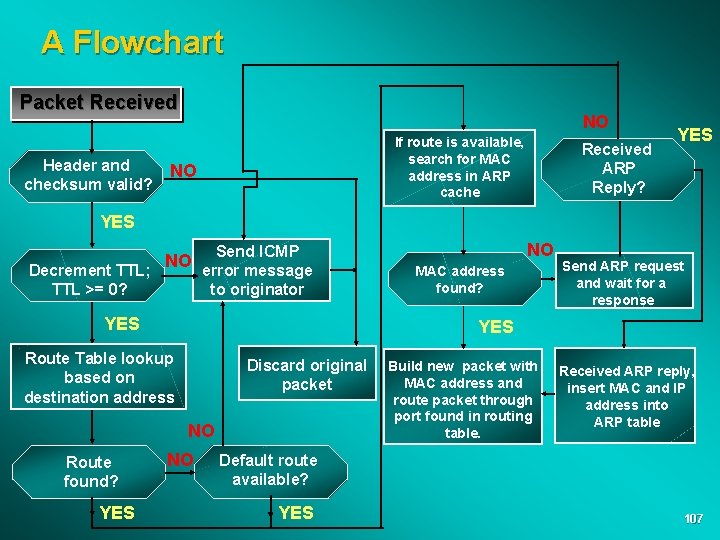
A Flowchart Packet Received Header and checksum valid? NO If route is available, search for MAC address in ARP cache NO Received ARP Reply? YES Decrement TTL; TTL >= 0? NO Send ICMP error message to originator YES Discard original packet NO YES MAC address found? Send ARP request and wait for a response YES Route Table lookup based on destination address Route found? NO NO Build new packet with MAC address and route packet through port found in routing table. Received ARP reply, insert MAC and IP address into ARP table Default route available? YES 107
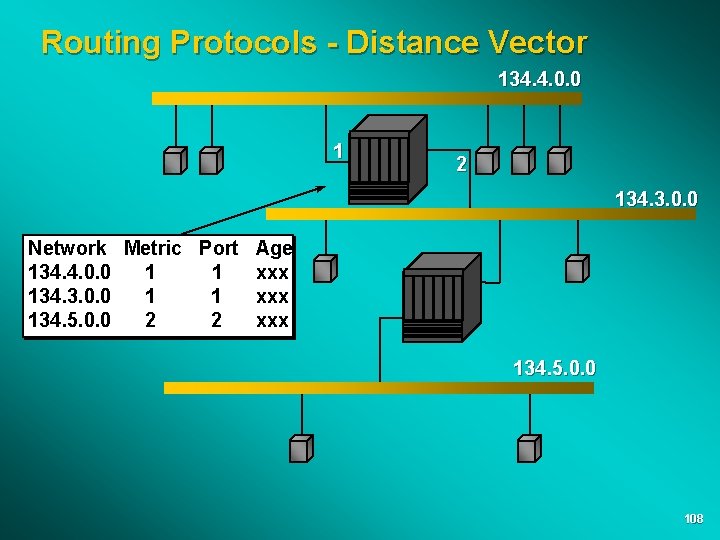
Routing Protocols - Distance Vector 134. 4. 0. 0 1 2 134. 3. 0. 0 Network Metric Port Age 134. 4. 0. 0 1 1 xxx 134. 3. 0. 0 1 1 xxx 134. 5. 0. 0 2 2 xxx 134. 5. 0. 0 108
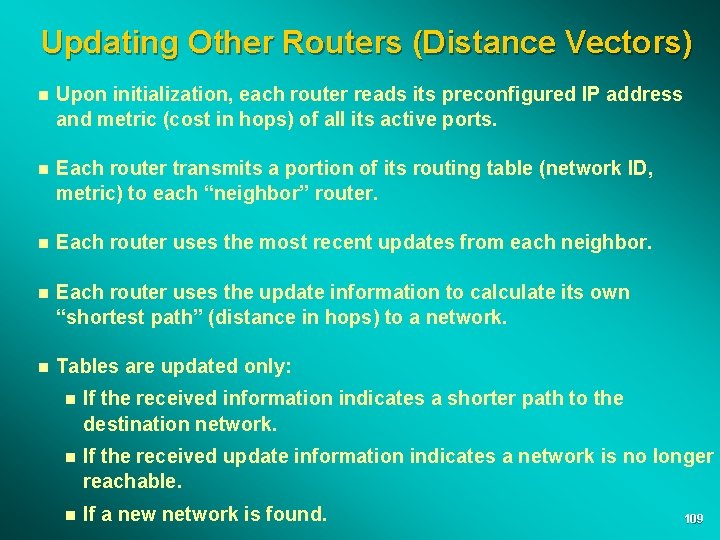
Updating Other Routers (Distance Vectors) n Upon initialization, each router reads its preconfigured IP address and metric (cost in hops) of all its active ports. n Each router transmits a portion of its routing table (network ID, metric) to each “neighbor” router. n Each router uses the most recent updates from each neighbor. n Each router uses the update information to calculate its own “shortest path” (distance in hops) to a network. n Tables are updated only: n If the received information indicates a shorter path to the destination network. n If the received update information indicates a network is no longer reachable. n If a new network is found. 109
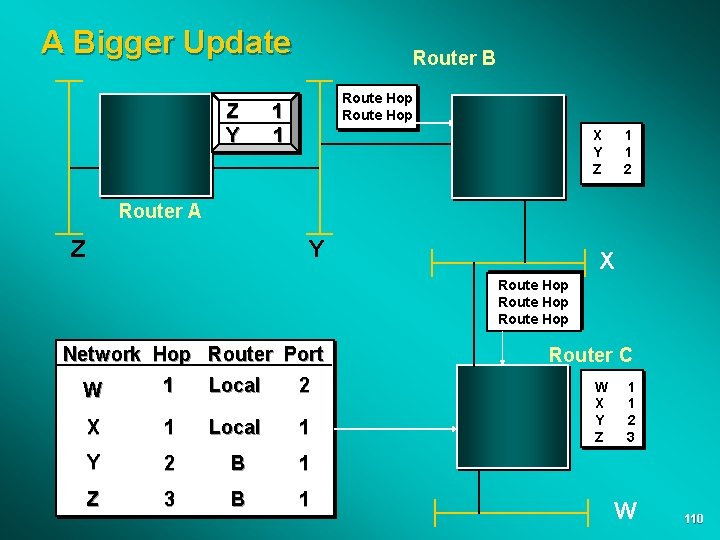
A Bigger Update Z Y Router B Route Hop 1 1 X Y Z 1 1 2 Router A Z Y X Route Hop Network Hop Router Port W 1 Local 2 X 1 Local 1 Y 2 B 1 Z 3 B 1 Router C W X Y Z 1 1 2 3 W 110
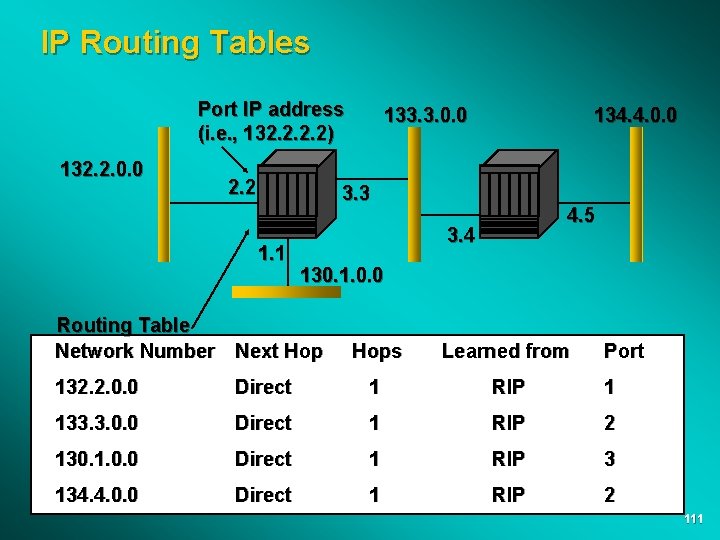
IP Routing Tables Port IP address (i. e. , 132. 2) 132. 2. 0. 0 2. 2 133. 3. 0. 0 134. 4. 0. 0 3. 3 1. 1 4. 5 3. 4 130. 1. 0. 0 Routing Table Network Number Next Hops Learned from Port 132. 2. 0. 0 Direct 1 RIP 1 133. 3. 0. 0 Direct 1 RIP 2 130. 1. 0. 0 Direct 1 RIP 3 134. 4. 0. 0 Direct 1 RIP 2 111
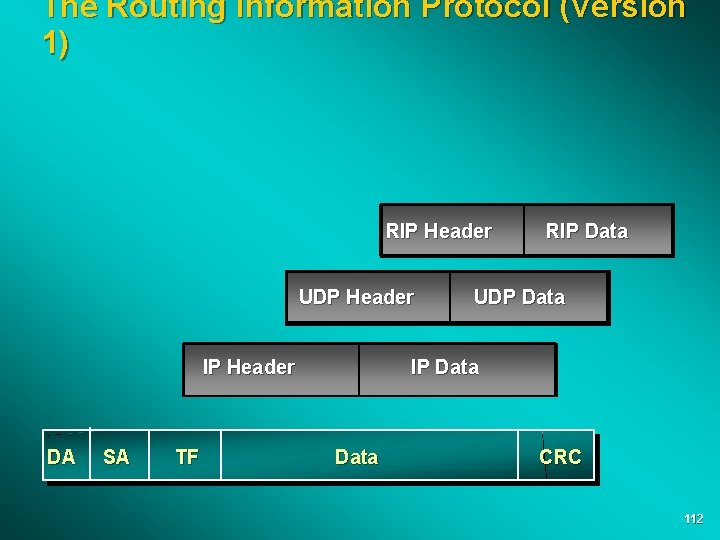
The Routing Information Protocol (Version 1) RIP Header UDP Header IP Header DA SA TF RIP Data UDP Data IP Data CRC 112
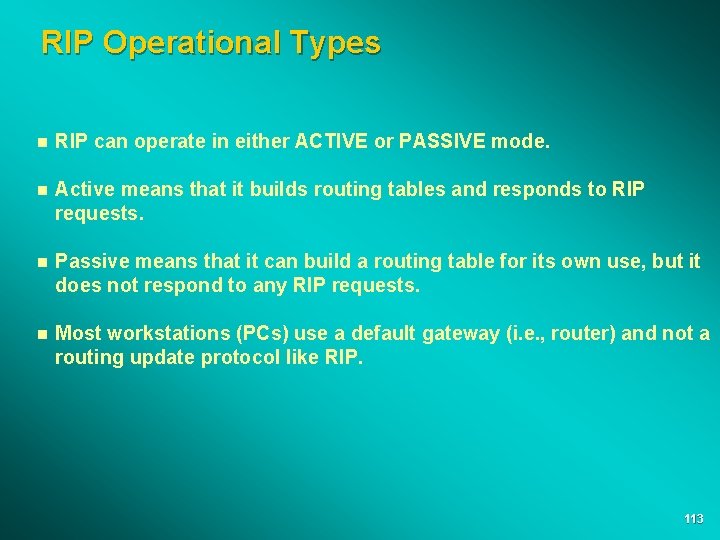
RIP Operational Types n RIP can operate in either ACTIVE or PASSIVE mode. n Active means that it builds routing tables and responds to RIP requests. n Passive means that it can build a routing table for its own use, but it does not respond to any RIP requests. n Most workstations (PCs) use a default gateway (i. e. , router) and not a routing update protocol like RIP. 113
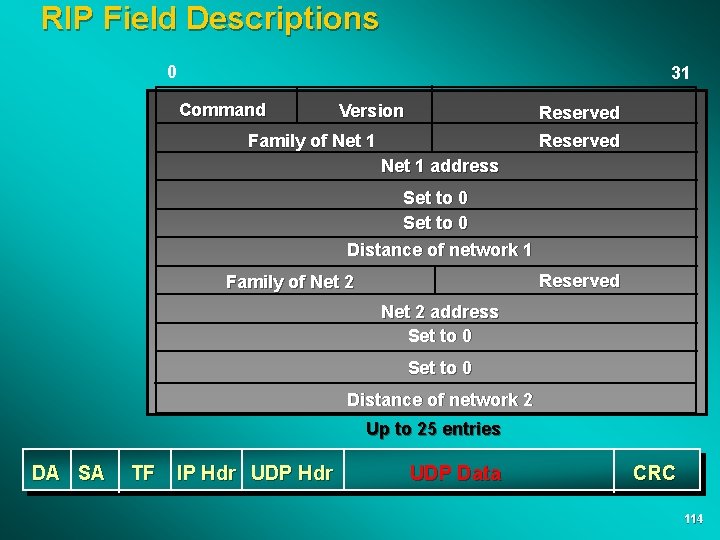
RIP Field Descriptions 0 31 Command Version Reserved Family of Net 1 Reserved Net 1 address Set to 0 Distance of network 1 Reserved Family of Net 2 address Set to 0 Distance of network 2 Up to 25 entries DA SA TF IP Hdr UDP Data CRC 114
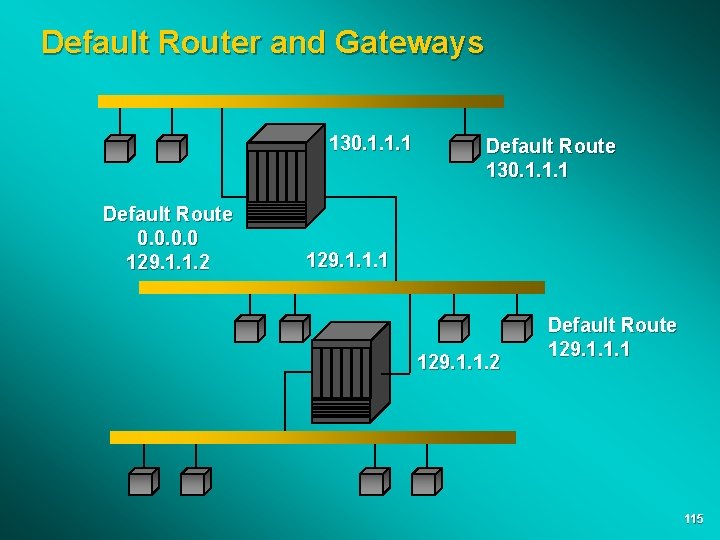
Default Router and Gateways 130. 1. 1. 1 Default Route 0. 0 129. 1. 1. 2 Default Route 130. 1. 1. 1 129. 1. 1. 2 Default Route 129. 1. 1. 1 115
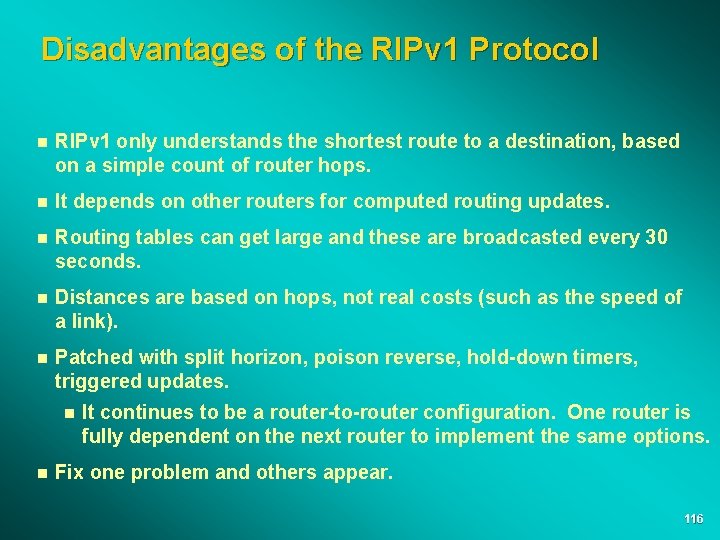
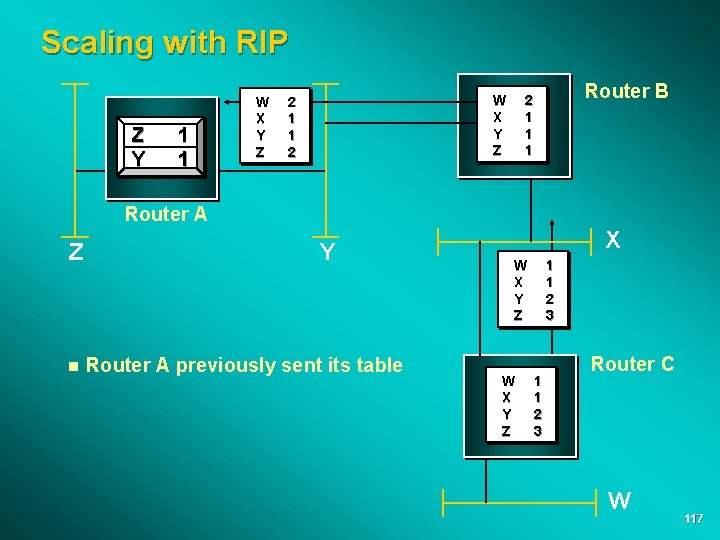
Disadvantages of the RIPv 1 Protocol n RIPv 1 only understands the shortest route to a destination, based on a simple count of router hops. n It depends on other routers for computed routing updates. n Routing tables can get large and these are broadcasted every 30 seconds. n Distances are based on hops, not real costs (such as the speed of a link). n Patched with split horizon, poison reverse, hold-down timers, triggered updates. n n It continues to be a router-to-router configuration. One router is fully dependent on the next router to implement the same options. Fix one problem and others appear. 116
Scaling with RIP Z Y 1 1 W X Y Z 2 1 1 2 Router B 2 1 1 1 Router A Z n Y Router A previously sent its table X W X Y Z 1 1 2 3 Router C W 117
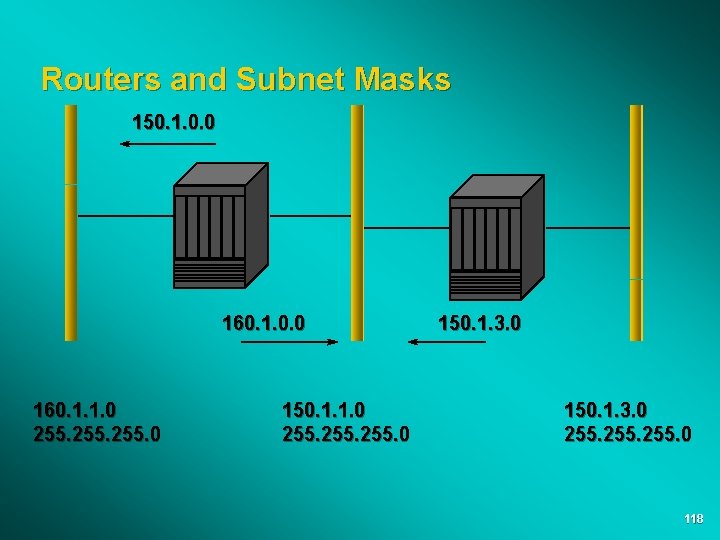
Routers and Subnet Masks 150. 1. 0. 0 160. 1. 1. 0 255. 0 150. 1. 3. 0 255. 0 118
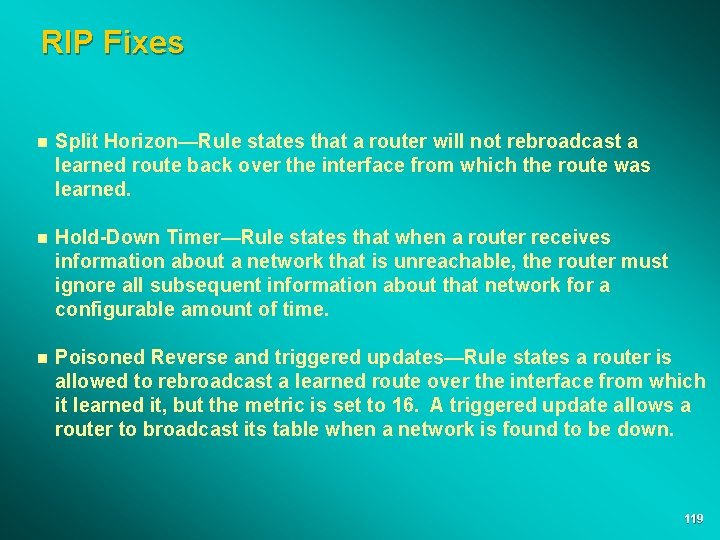
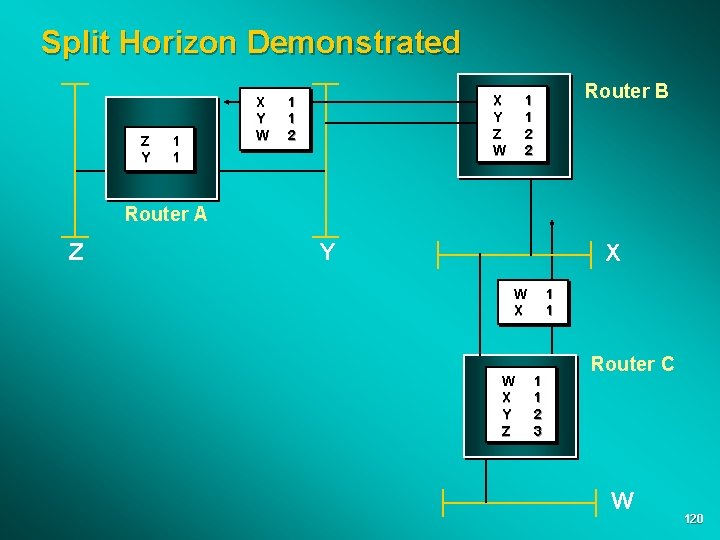
RIP Fixes n Split Horizon—Rule states that a router will not rebroadcast a learned route back over the interface from which the route was learned. n Hold-Down Timer—Rule states that when a router receives information about a network that is unreachable, the router must ignore all subsequent information about that network for a configurable amount of time. n Poisoned Reverse and triggered updates—Rule states a router is allowed to rebroadcast a learned route over the interface from which it learned it, but the metric is set to 16. A triggered update allows a router to broadcast its table when a network is found to be down. 119
Split Horizon Demonstrated Z Y 1 1 X Y W X Y Z W 1 1 2 Router B 1 1 2 2 Router A Z Y X W X Y Z 1 1 2 3 Router C W 120
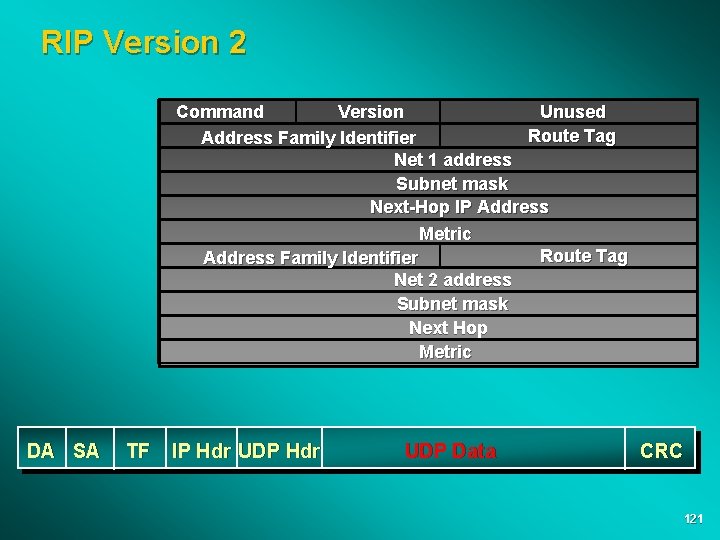
RIP Version 2 Command Version Unused Route Tag Address Family Identifier Net 1 address Subnet mask Next-Hop IP Address Metric Route Tag Address Family Identifier Net 2 address Subnet mask Next Hop Metric DA SA TF IP Hdr UDP Data CRC 121
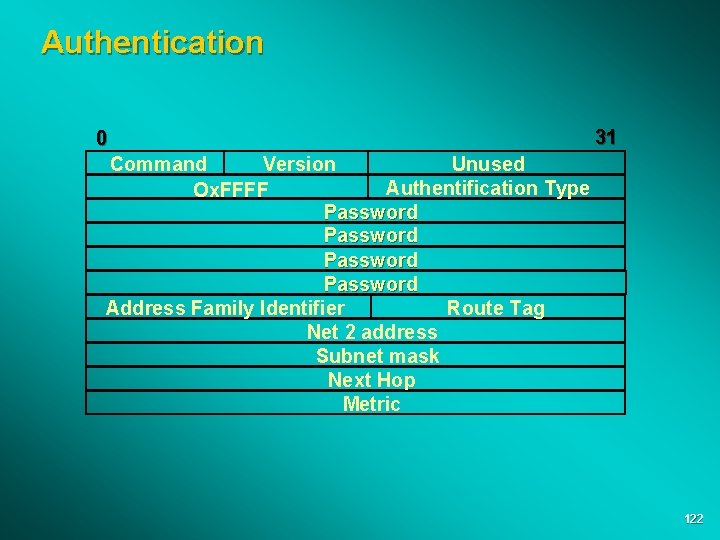
Authentication 0 31 Command Version Unused Authentification Type Ox. FFFF Password Address Family Identifier Route Tag Net 2 address Subnet mask Next Hop Metric 122
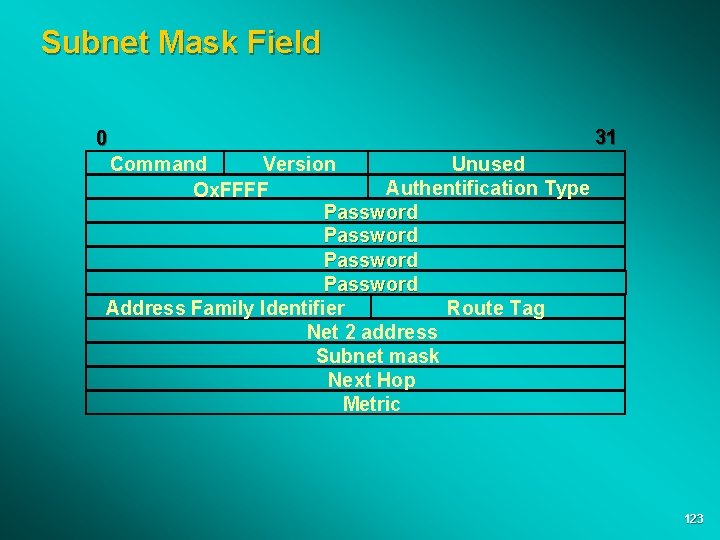
Subnet Mask Field 0 31 Command Version Unused Authentification Type Ox. FFFF Password Address Family Identifier Route Tag Net 2 address Subnet mask Next Hop Metric 123
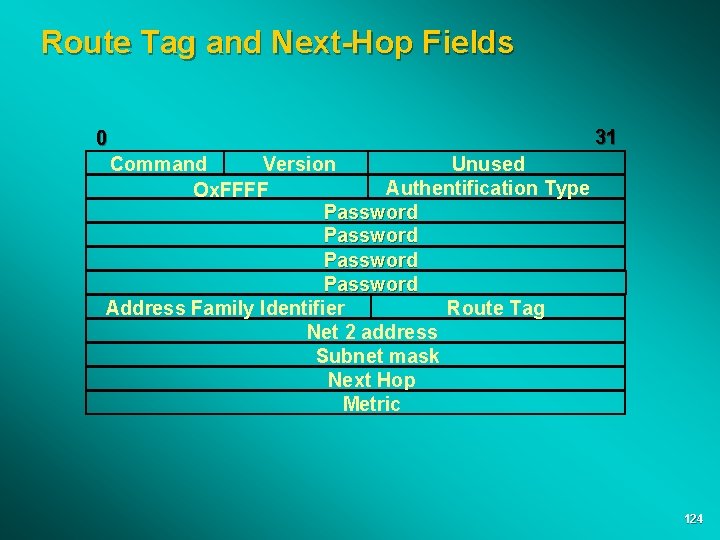
Route Tag and Next-Hop Fields 0 31 Command Version Unused Authentification Type Ox. FFFF Password Address Family Identifier Route Tag Net 2 address Subnet mask Next Hop Metric 124
Multicast Support n RIPv 2 uses the multicast address of 224. 0. 0. 9 to multicast, does not broadcast its table. n MAC address of 01 -00 -5 E-00 -00 -09. n Details of this conversion are covered in RFC 1700 and the multicast section of this book n RIPv 1 uses a broadcast address in both the IP header and the MAC header. n IGMP is not used for this multicast support. 125
RIPv 2 Compatibility with RIPv 1 n Configuration parameters on the router for: n RIPv 1 only – version 1 messages will be sent n RIPv 1 compatibility – RIP 2 messages as broadcast n RIPv 2 – Messages are multicast n None – No RIP messages are sent 126
Open Shortest Path First (OSPF, RFC 2178) n Shortest-path routes based on true metrics, not just a hop count. n Computes the routes only when triggered to or every 30 minutes (whichever is less). n Pairs a network address entry with a subnet mask. n Allows for routing across equal paths. n Supports To. S. n Permits the injection of external routes (other ASs). n Authenticates route exchanges. n Quick convergence. n Direct support for multicast in both the IP header and the MAC header. 127
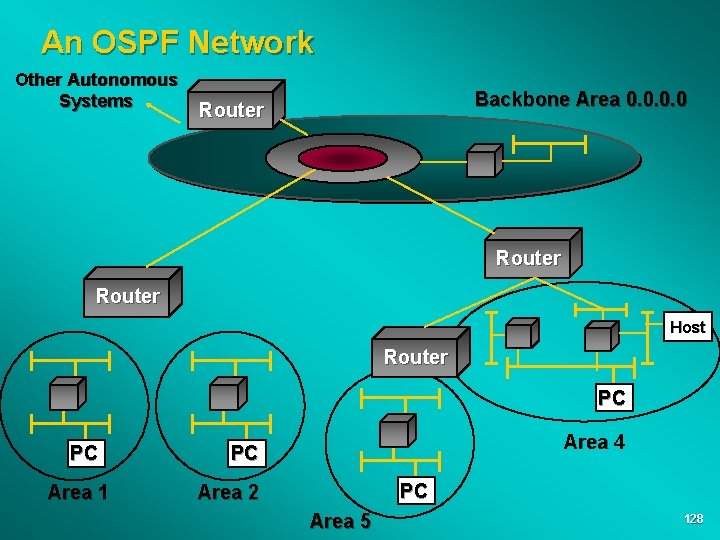
An OSPF Network Other Autonomous Systems Backbone Area 0. 0 Router Host Router PC PC Area 1 Area 4 PC PC Area 2 Area 5 128
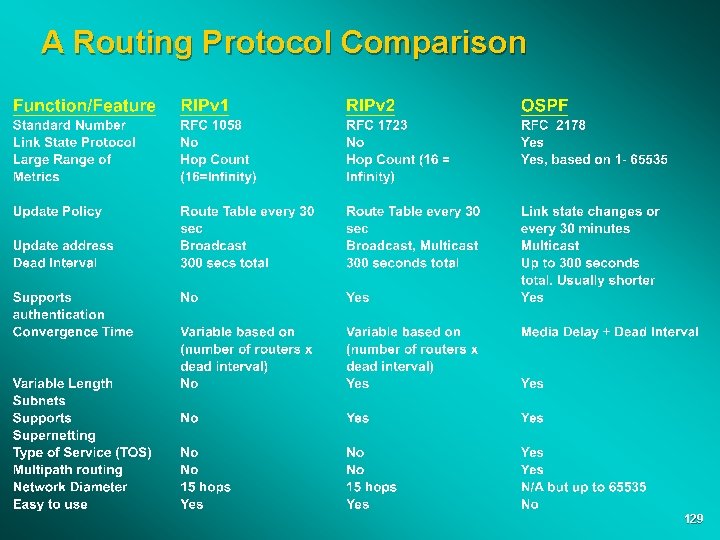
A Routing Protocol Comparison 129
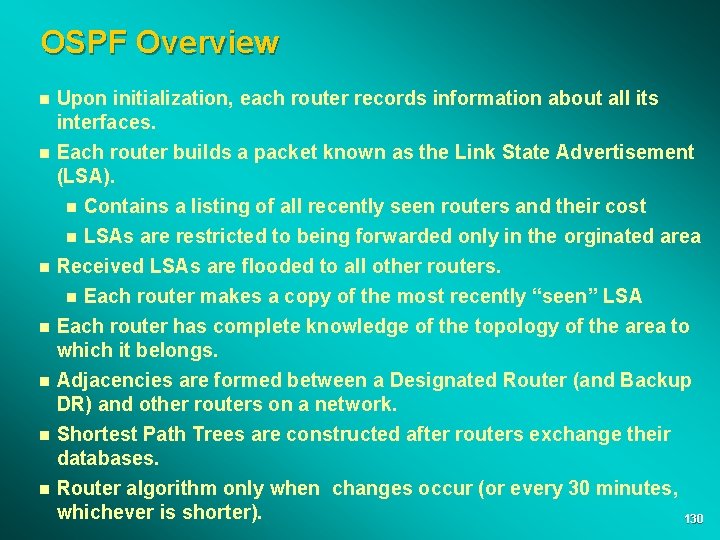
OSPF Overview n Upon initialization, each router records information about all its interfaces. Each router builds a packet known as the Link State Advertisement (LSA). n Contains a listing of all recently seen routers and their cost n LSAs are restricted to being forwarded only in the orginated area n Received LSAs are flooded to all other routers. n Each router makes a copy of the most recently “seen” LSA n Each router has complete knowledge of the topology of the area to which it belongs. n Adjacencies are formed between a Designated Router (and Backup DR) and other routers on a network. n Shortest Path Trees are constructed after routers exchange their databases. n Router algorithm only when changes occur (or every 30 minutes, whichever is shorter). 130 n
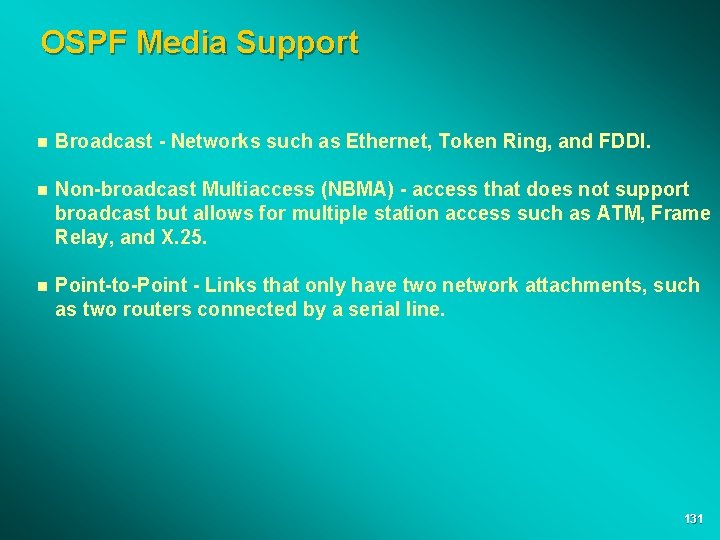
OSPF Media Support n Broadcast - Networks such as Ethernet, Token Ring, and FDDI. n Non-broadcast Multiaccess (NBMA) - access that does not support broadcast but allows for multiple station access such as ATM, Frame Relay, and X. 25. n Point-to-Point - Links that only have two network attachments, such as two routers connected by a serial line. 131
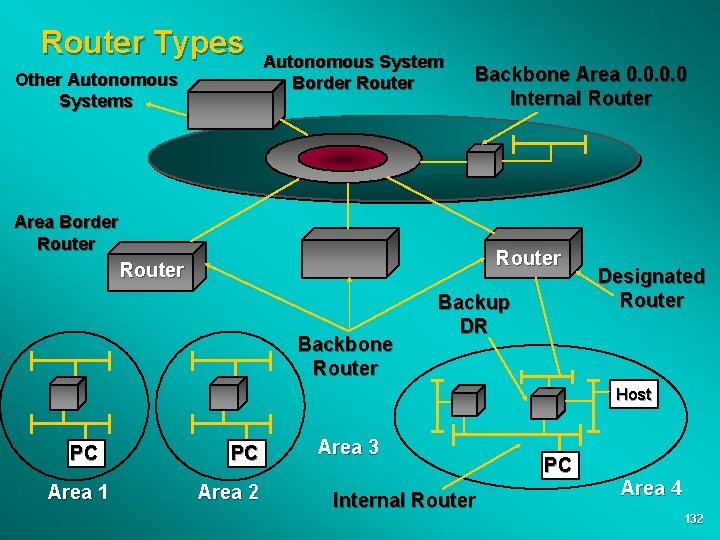
Router Types Other Autonomous Systems Autonomous System Border Router Backbone Area 0. 0 Internal Router Area Border Router Backbone Router Backup DR Designated Router Host PC Area 1 PC Area 2 Area 3 Internal Router PC Area 4 132
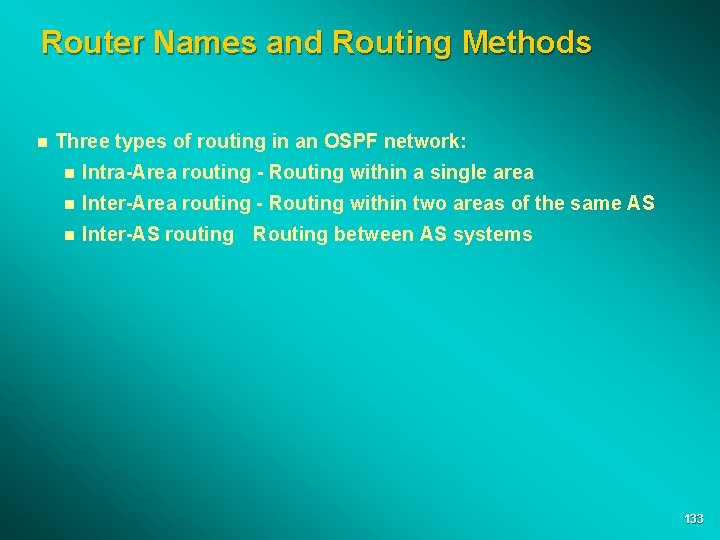
Router Names and Routing Methods n Three types of routing in an OSPF network: n Intra-Area routing - Routing within a single area n Inter-Area routing - Routing within two areas of the same AS n Inter-AS routing Routing between AS systems 133
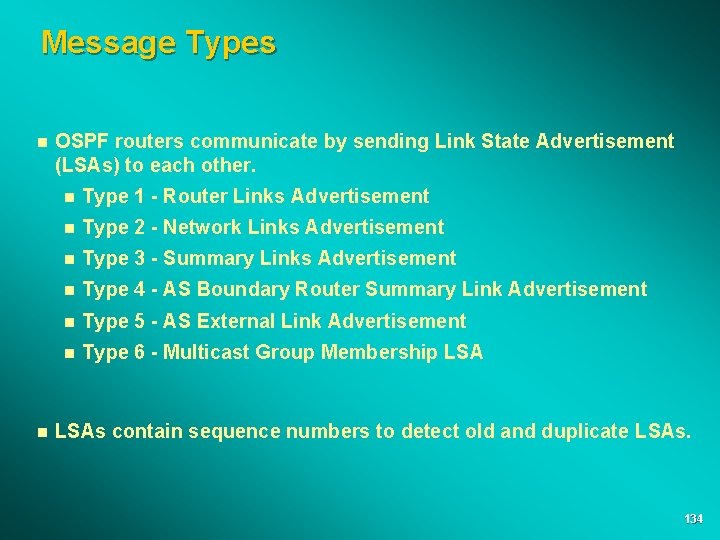
Message Types n n OSPF routers communicate by sending Link State Advertisement (LSAs) to each other. n Type 1 - Router Links Advertisement n Type 2 - Network Links Advertisement n Type 3 - Summary Links Advertisement n Type 4 - AS Boundary Router Summary Link Advertisement n Type 5 - AS External Link Advertisement n Type 6 - Multicast Group Membership LSAs contain sequence numbers to detect old and duplicate LSAs. 134
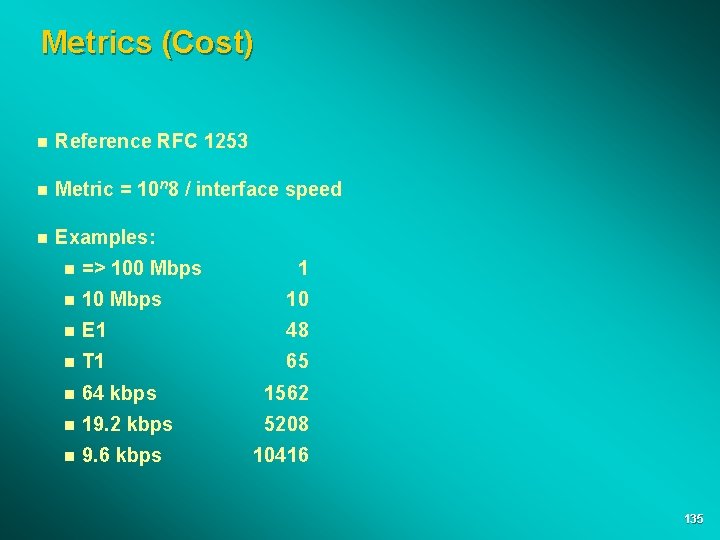
Metrics (Cost) n Reference RFC 1253 n Metric = 10 n 8 / interface speed n Examples: n => 100 Mbps 1 n 10 Mbps 10 n E 1 48 n T 1 65 n 64 kbps 1562 n 19. 2 kbps 5208 n 9. 6 kbps 10416 135
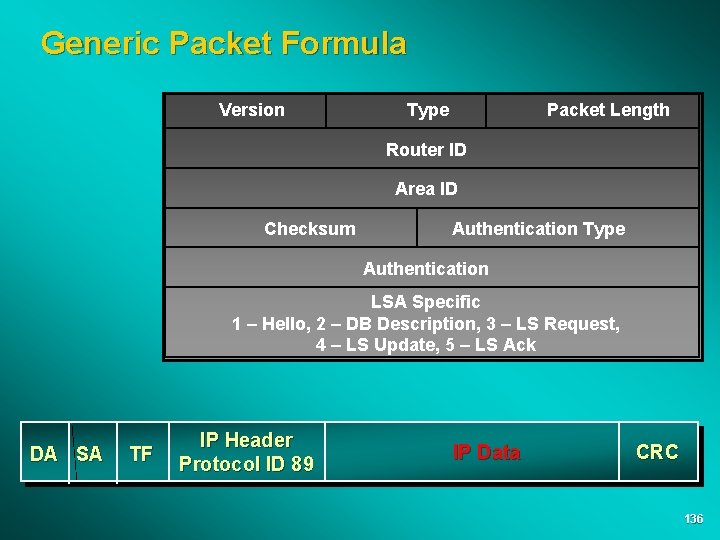
Generic Packet Formula Version Type Packet Length Router ID Area ID Checksum Authentication Type Authentication LSA Specific 1 – Hello, 2 – DB Description, 3 – LS Request, 4 – LS Update, 5 – LS Ack DA SA TF IP Header Protocol ID 89 IP Data CRC 136
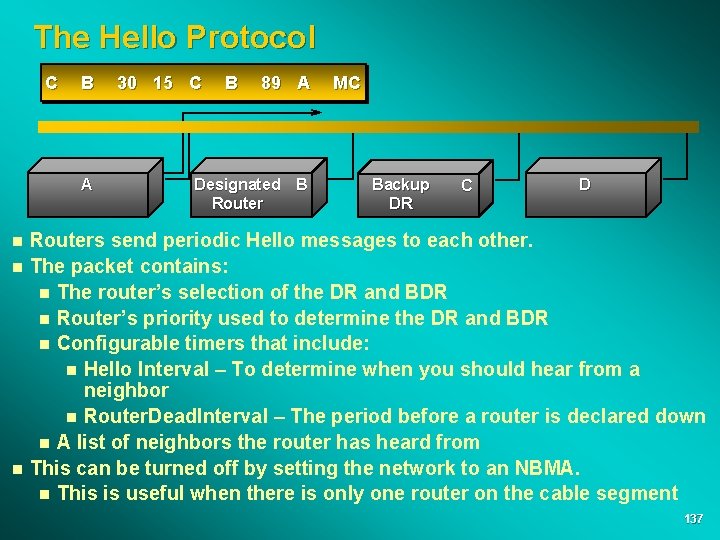
The Hello Protocol C B A 30 15 C B 89 A Designated B Router MC Backup DR C D Routers send periodic Hello messages to each other. n The packet contains: n The router’s selection of the DR and BDR n Router’s priority used to determine the DR and BDR n Configurable timers that include: n Hello Interval – To determine when you should hear from a neighbor n Router. Dead. Interval – The period before a router is declared down n A list of neighbors the router has heard from n This can be turned off by setting the network to an NBMA. n This is useful when there is only one router on the cable segment n 137
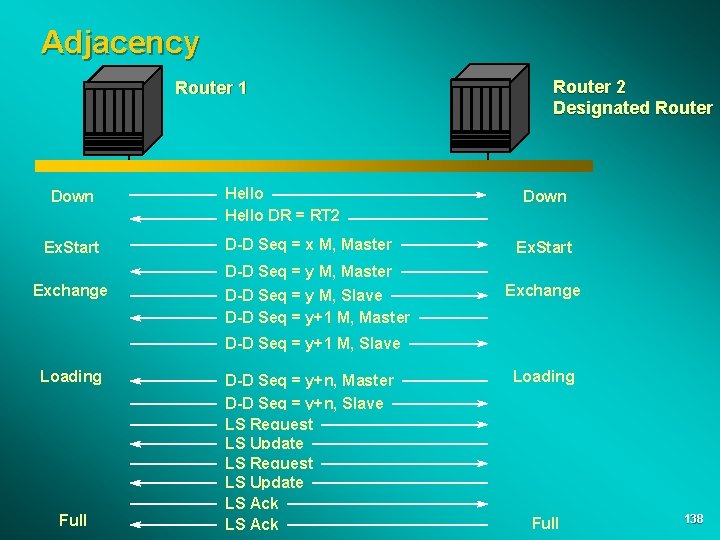
Adjacency Router 1 Down Ex. Start Hello DR = RT 2 D-D Seq = x M, Master Router 2 Designated Router Down Ex. Start D-D Seq = y M, Master Exchange D-D Seq = y M, Slave D-D Seq = y+1 M, Master Exchange D-D Seq = y+1 M, Slave Loading Full D-D Seq = y+n, Master D-D Seq = y+n, Slave LS Request LS Update LS Ack Loading Full 138
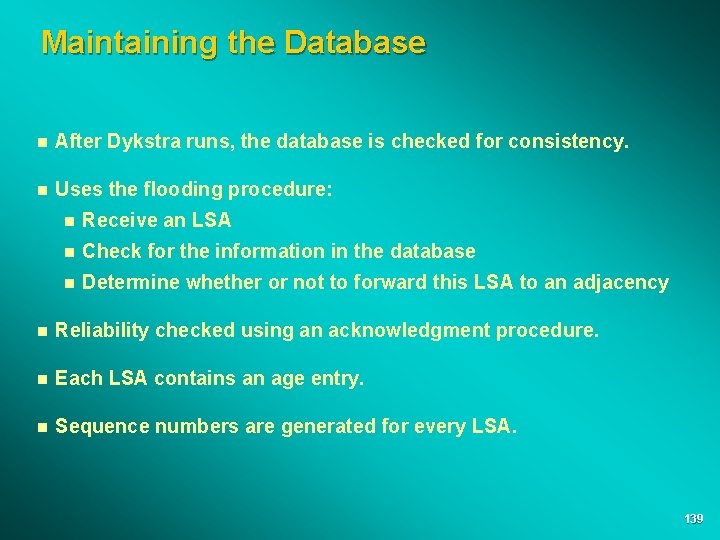
Maintaining the Database n After Dykstra runs, the database is checked for consistency. n Uses the flooding procedure: n Receive an LSA n Check for the information in the database n Determine whether or not to forward this LSA to an adjacency n Reliability checked using an acknowledgment procedure. n Each LSA contains an age entry. n Sequence numbers are generated for every LSA. 139
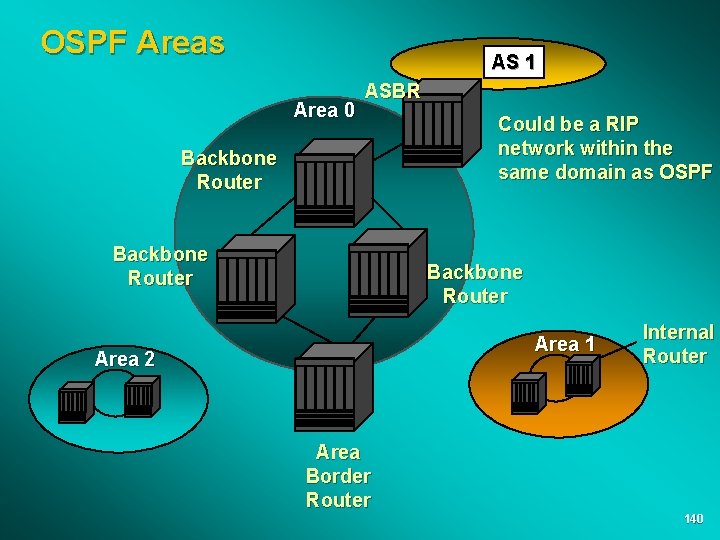
OSPF Areas AS 1 Area 0 ASBR Backbone Router Could be a RIP network within the same domain as OSPF Backbone Router Area 1 Area 2 Area Border Router Internal Router 140
The Backbone Area n There must be at least one area in an OSPF network. n It is called the backbone area. n Designated by area ID of 0. 0. n Primarily responsibility to propagate information between areas. n Has the same attributes as any other area. n Any network topology make up the backbone. n It can be used as a real network with attachments. 141
The Area Border Router (ABR) n Connects an area (or areas) to the backbone. n Summarizes its area topology to the backbone. n Propagates summarized information from the backbone into its area. n Final router that receives an area’s LSA. n ABRs do not flood LSA information into the backbone n Only produces summaries to the backbone for the backbone to propagate to other areas n Uses the network summary LSA. n Summarized information is propagated in an area by the DR and its adjacencies. 142
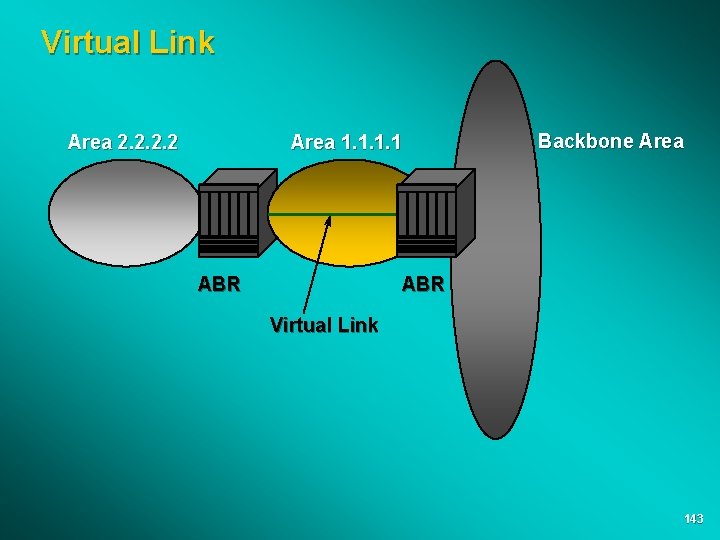
Virtual Link Area 2. 2 Area 1. 1 ABR Backbone Area ABR Virtual Link 143
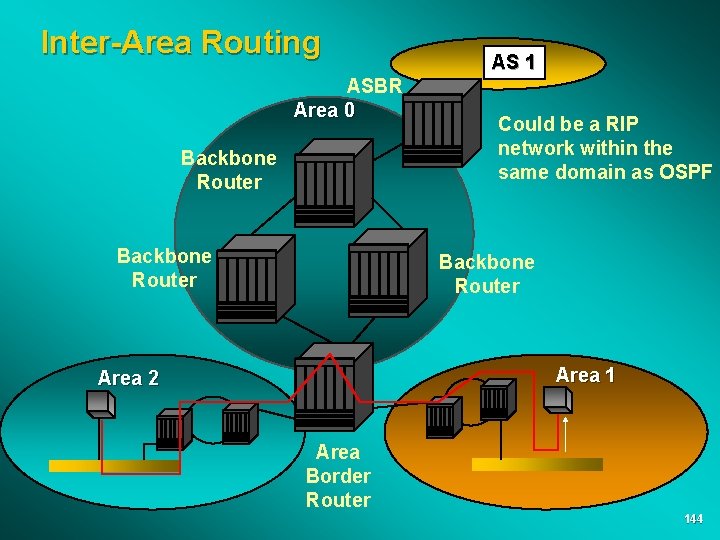
Inter-Area Routing ASBR Area 0 Backbone Router AS 1 Could be a RIP network within the same domain as OSPF Backbone Router Area 1 Area 2 Area Border Router 144
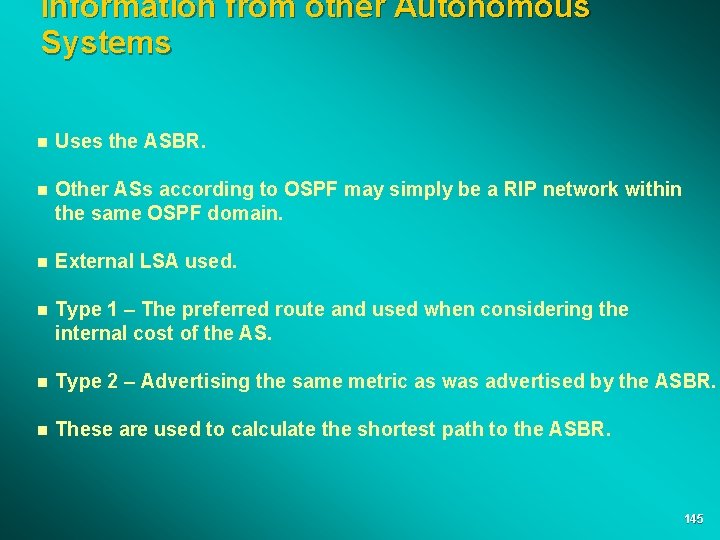
Information from other Autonomous Systems n Uses the ASBR. n Other ASs according to OSPF may simply be a RIP network within the same OSPF domain. n External LSA used. n Type 1 – The preferred route and used when considering the internal cost of the AS. n Type 2 – Advertising the same metric as was advertised by the ASBR. n These are used to calculate the shortest path to the ASBR. 145
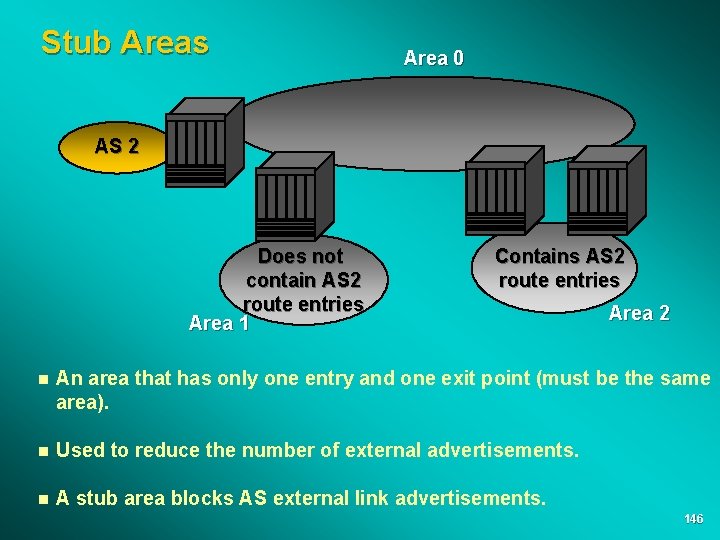
Stub Areas Area 0 AS 2 Does not contain AS 2 route entries Area 1 Contains AS 2 route entries Area 2 n An area that has only one entry and one exit point (must be the same area). n Used to reduce the number of external advertisements. n A stub area blocks AS external link advertisements. 146
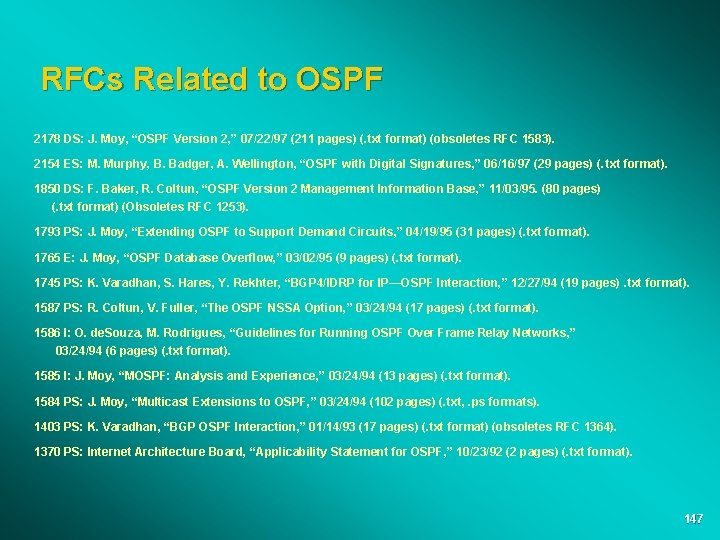
RFCs Related to OSPF 2178 DS: J. Moy, “OSPF Version 2, ” 07/22/97 (211 pages) (. txt format) (obsoletes RFC 1583). 2154 ES: M. Murphy, B. Badger, A. Wellington, “OSPF with Digital Signatures, ” 06/16/97 (29 pages) (. txt format). 1850 DS: F. Baker, R. Coltun, “OSPF Version 2 Management Information Base, ” 11/03/95. (80 pages) (. txt format) (Obsoletes RFC 1253). 1793 PS: J. Moy, “Extending OSPF to Support Demand Circuits, ” 04/19/95 (31 pages) (. txt format). 1765 E: J. Moy, “OSPF Database Overflow, ” 03/02/95 (9 pages) (. txt format). 1745 PS: K. Varadhan, S. Hares, Y. Rekhter, “BGP 4/IDRP for IP—OSPF Interaction, ” 12/27/94 (19 pages). txt format). 1587 PS: R. Coltun, V. Fuller, “The OSPF NSSA Option, ” 03/24/94 (17 pages) (. txt format). 1586 I: O. de. Souza, M. Rodrigues, “Guidelines for Running OSPF Over Frame Relay Networks, ” 03/24/94 (6 pages) (. txt format). 1585 I: J. Moy, “MOSPF: Analysis and Experience, ” 03/24/94 (13 pages) (. txt format). 1584 PS: J. Moy, “Multicast Extensions to OSPF, ” 03/24/94 (102 pages) (. txt, . ps formats). 1403 PS: K. Varadhan, “BGP OSPF Interaction, ” 01/14/93 (17 pages) (. txt format) (obsoletes RFC 1364). 1370 PS: Internet Architecture Board, “Applicability Statement for OSPF, ” 10/23/92 (2 pages) (. txt format). 147
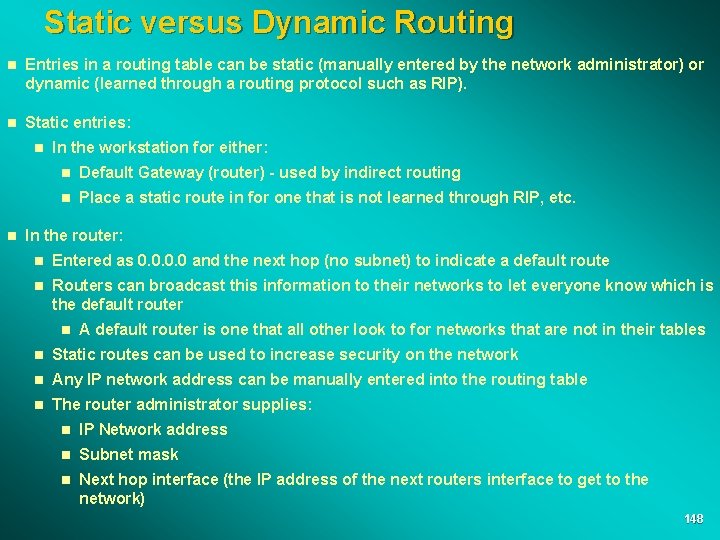
Static versus Dynamic Routing n Entries in a routing table can be static (manually entered by the network administrator) or dynamic (learned through a routing protocol such as RIP). n Static entries: n n In the workstation for either: n Default Gateway (router) - used by indirect routing n Place a static route in for one that is not learned through RIP, etc. In the router: n Entered as 0. 0 and the next hop (no subnet) to indicate a default route n Routers can broadcast this information to their networks to let everyone know which is the default router n A default router is one that all other look to for networks that are not in their tables n Static routes can be used to increase security on the network n Any IP network address can be manually entered into the routing table n The router administrator supplies: n IP Network address n Subnet mask n Next hop interface (the IP address of the next routers interface to get to the network) 148
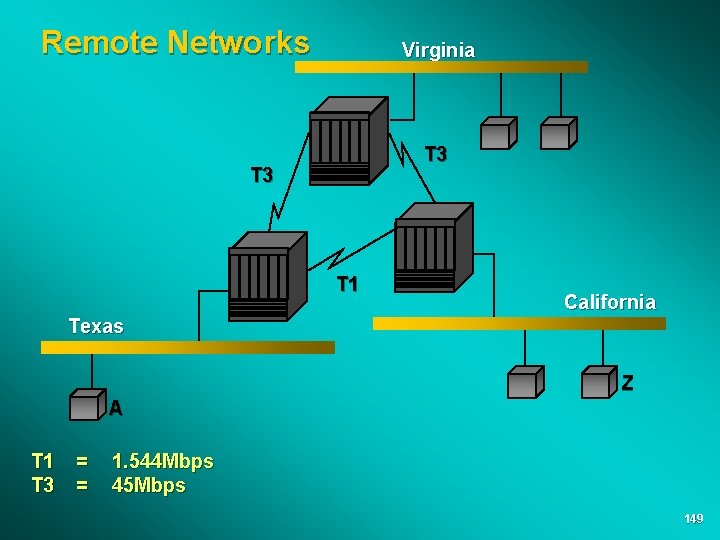
Remote Networks Virginia T 3 T 1 California Texas Z A T 1 T 3 = = 1. 544 Mbps 45 Mbps 149
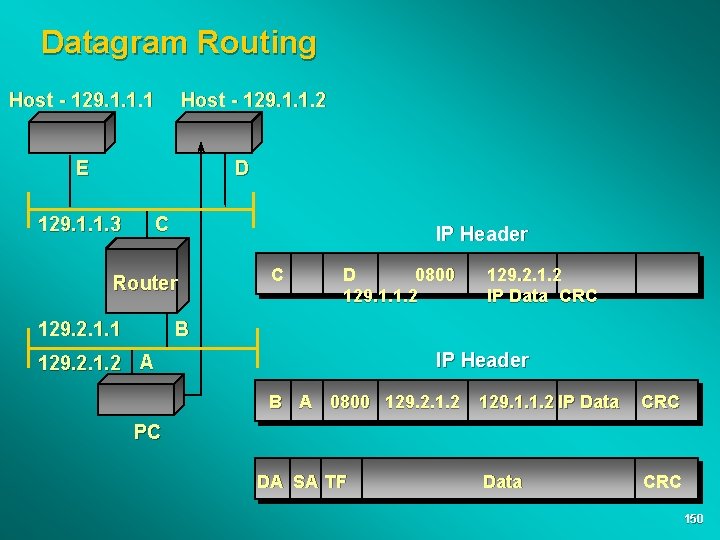
Datagram Routing Host - 129. 1. 1. 1 Host - 129. 1. 1. 2 E D 129. 1. 1. 3 C IP Header Router 129. 2. 1. 1 C D 0800 129. 1. 1. 2 129. 2. 1. 2 IP Data CRC B IP Header 129. 2. 1. 2 A B A 0800 129. 2. 1. 2 129. 1. 1. 2 IP Data CRC PC DA SA TF 150