
Additive Groves of Regression Trees Daria Sorokina Rich

- Slides: 30
Additive Groves of Regression Trees Daria Sorokina Rich Caruana Mirek Riedewald
Groves of Trees o New regression algorithm n o Based on n o Ensemble of regression trees Bagging Additive models Combination of large trees and additive structure Outperforms state-of the-art ensembles n n n Bagged trees Stochastic gradient boosting Most improvement on complex non-linear data Daria Sorokina, Rich Caruana, Mirek Riedewald Additive Groves of Regression Trees
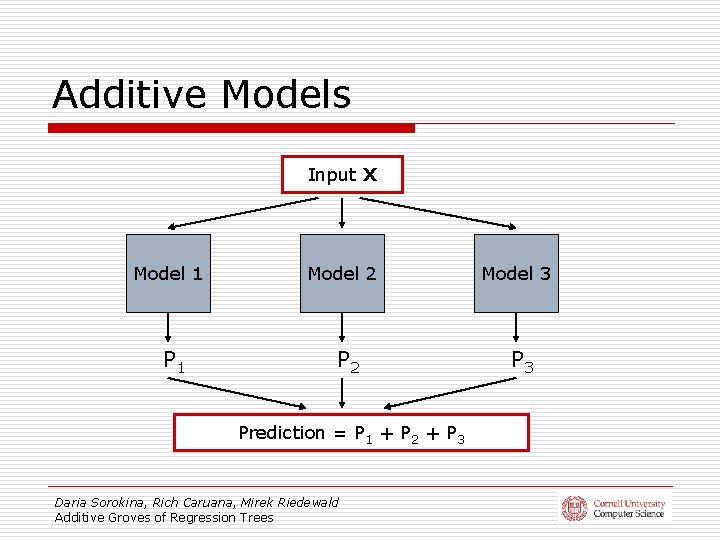
Additive Models Input X Model 1 P 1 Model 2 Prediction = P 1 + P 2 + P 3 Daria Sorokina, Rich Caruana, Mirek Riedewald Additive Groves of Regression Trees Model 3 P 3
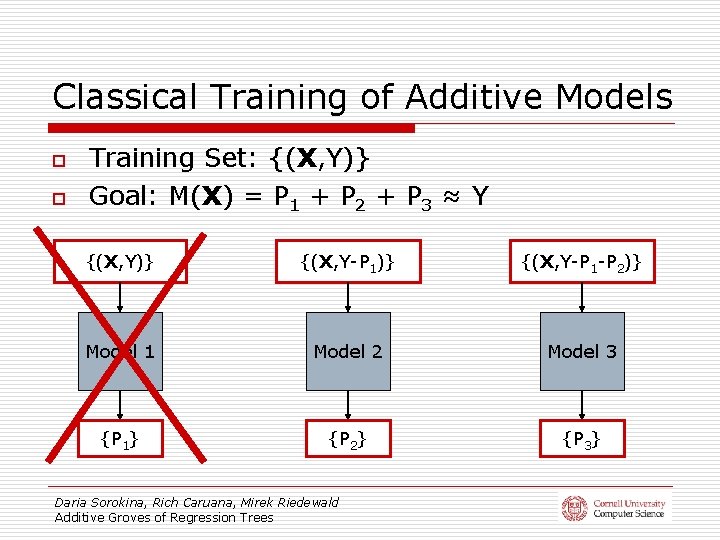
Classical Training of Additive Models o o Training Set: {(X, Y)} Goal: M(X) = P 1 + P 2 + P 3 ≈ Y {(X, Y)} {(X, Y-P 1 -P 2)} Model 1 Model 2 Model 3 {P 1} {P 2} {P 3} Daria Sorokina, Rich Caruana, Mirek Riedewald Additive Groves of Regression Trees
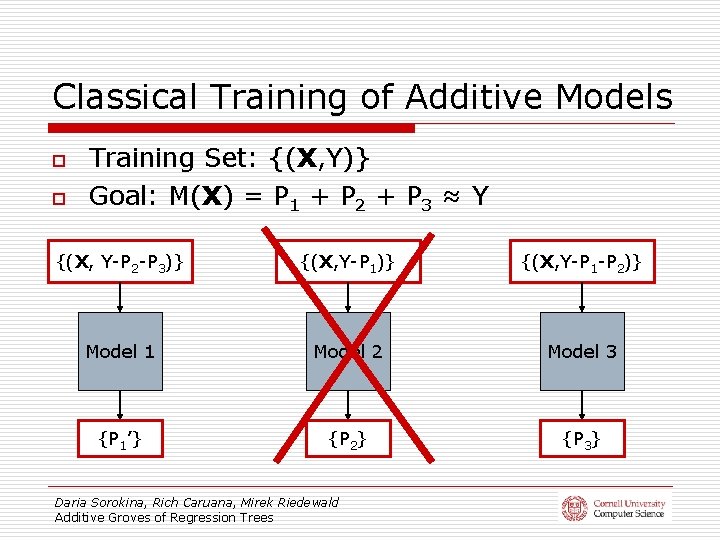
Classical Training of Additive Models o o Training Set: {(X, Y)} Goal: M(X) = P 1 + P 2 + P 3 ≈ Y {(X, Y-P 2 -P 3)} {(X, Y-P 1 -P 2)} Model 1 Model 2 Model 3 {P 1’} {P 2} {P 3} Daria Sorokina, Rich Caruana, Mirek Riedewald Additive Groves of Regression Trees
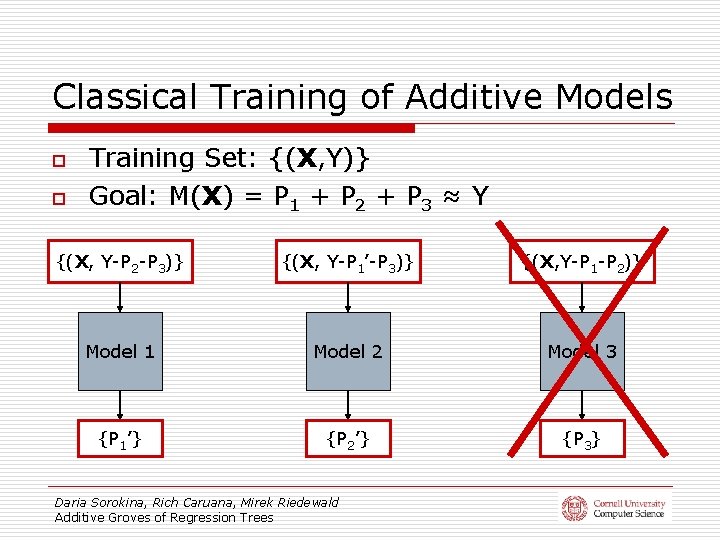
Classical Training of Additive Models o o Training Set: {(X, Y)} Goal: M(X) = P 1 + P 2 + P 3 ≈ Y {(X, Y-P 2 -P 3)} {(X, Y-P 1’-P 3)} {(X, Y-P 1 -P 2)} Model 1 Model 2 Model 3 {P 1’} {P 2’} {P 3} Daria Sorokina, Rich Caruana, Mirek Riedewald Additive Groves of Regression Trees
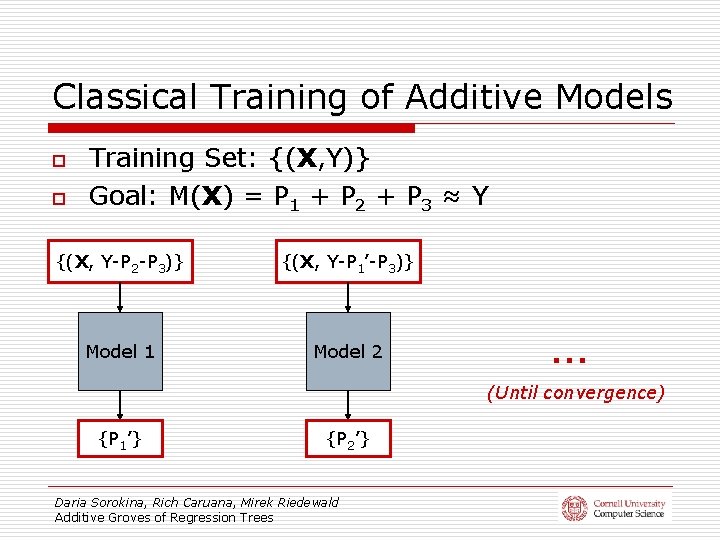
Classical Training of Additive Models o o Training Set: {(X, Y)} Goal: M(X) = P 1 + P 2 + P 3 ≈ Y {(X, Y-P 2 -P 3)} {(X, Y-P 1’-P 3)} Model 1 Model 2 … (Until convergence) {P 1’} {P 2’} Daria Sorokina, Rich Caruana, Mirek Riedewald Additive Groves of Regression Trees
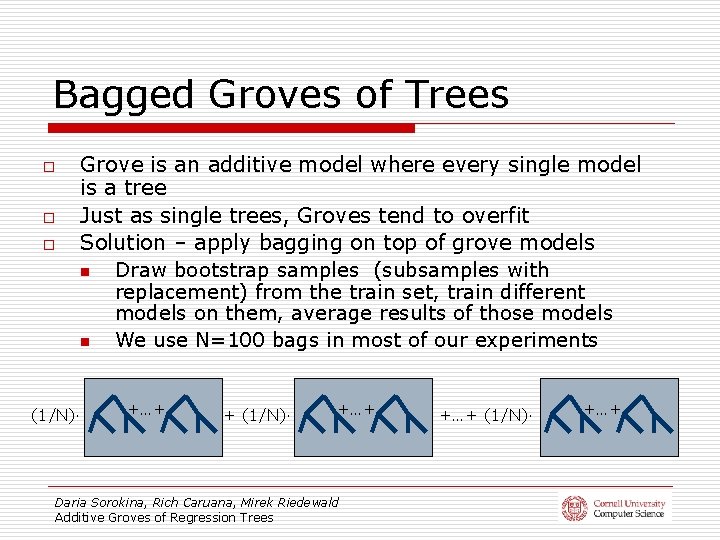
Bagged Groves of Trees o o o Grove is an additive model where every single model is a tree Just as single trees, Groves tend to overfit Solution – apply bagging on top of grove models n Draw bootstrap samples (subsamples with replacement) from the train set, train different models on them, average results of those models n We use N=100 bags in most of our experiments (1/N)· +…+ + (1/N)· +…+ Daria Sorokina, Rich Caruana, Mirek Riedewald Additive Groves of Regression Trees +…+ (1/N)· +…+
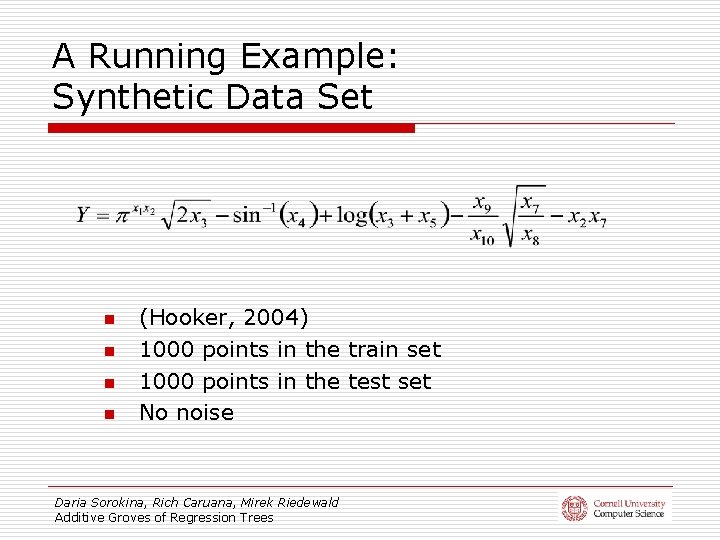
A Running Example: Synthetic Data Set n n (Hooker, 2004) 1000 points in the train set 1000 points in the test set No noise Daria Sorokina, Rich Caruana, Mirek Riedewald Additive Groves of Regression Trees
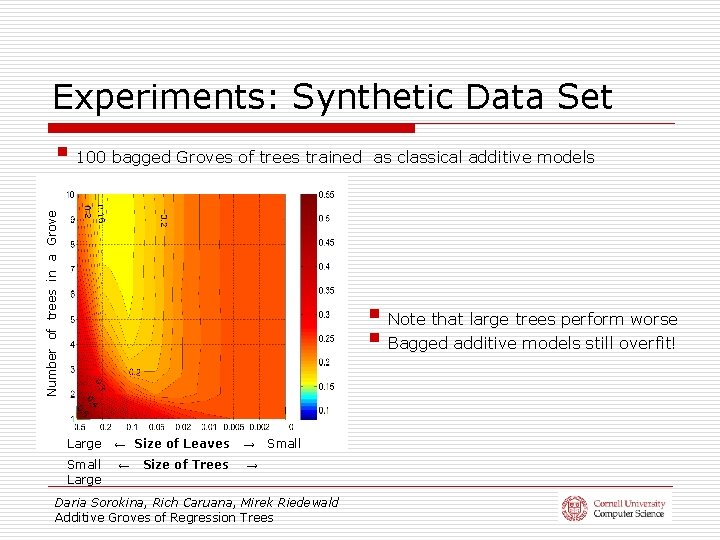
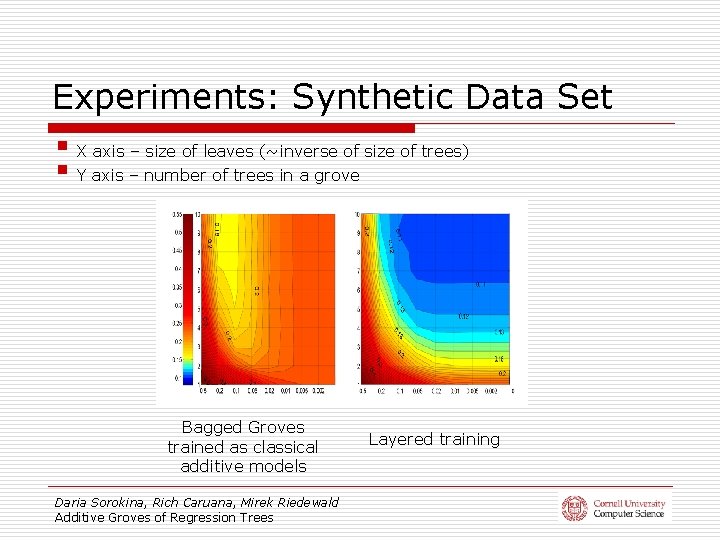
Experiments: Synthetic Data Set Number of trees in a Grove § 100 bagged Groves of trees trained as classical additive models § Note that large trees perform worse § Bagged additive models still overfit! Large Small Large ← Size of Leaves → Size of Trees → ← Small Daria Sorokina, Rich Caruana, Mirek Riedewald Additive Groves of Regression Trees
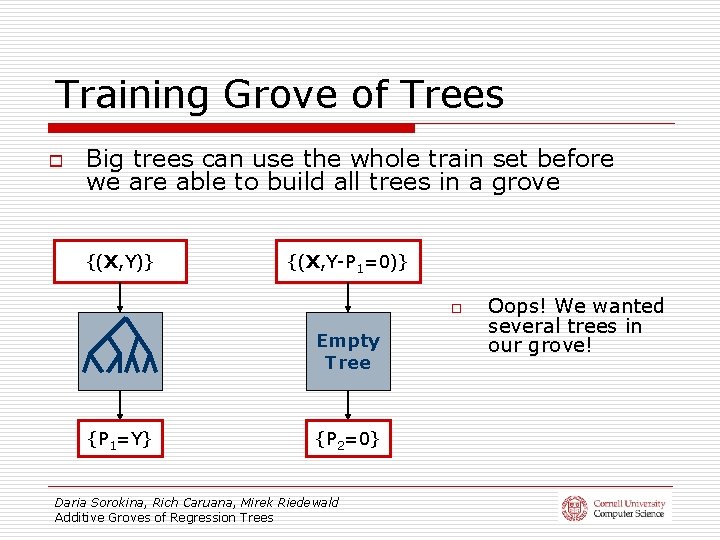
Training Grove of Trees o Big trees can use the whole train set before we are able to build all trees in a grove {(X, Y)} {(X, Y-P 1=0)} o Empty Tree {P 1=Y} {P 2=0} Daria Sorokina, Rich Caruana, Mirek Riedewald Additive Groves of Regression Trees Oops! We wanted several trees in our grove!
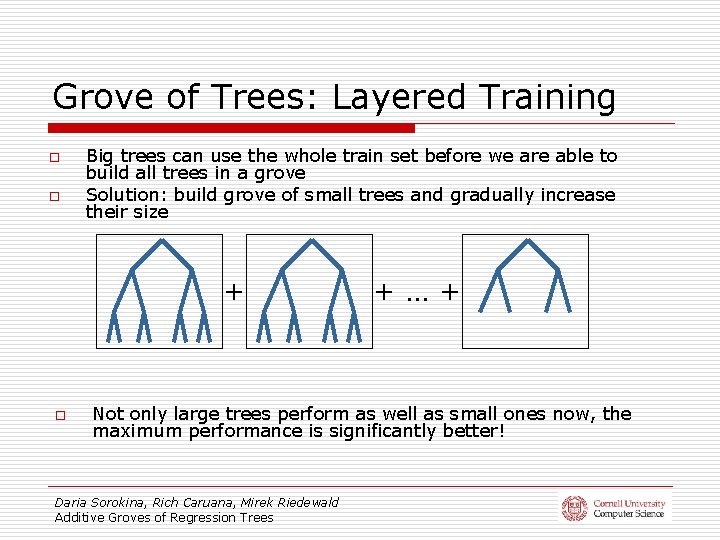
Grove of Trees: Layered Training o o Big trees can use the whole train set before we are able to build all trees in a grove Solution: build grove of small trees and gradually increase their size + o +…+ Not only large trees perform as well as small ones now, the maximum performance is significantly better! Daria Sorokina, Rich Caruana, Mirek Riedewald Additive Groves of Regression Trees
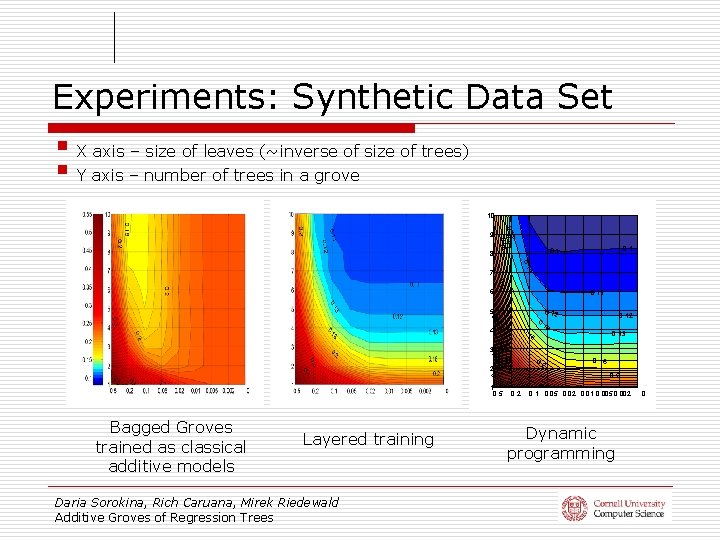
Experiments: Synthetic Data Set § X axis – size of leaves (~inverse of size of trees) § Y axis – number of trees in a grove Bagged Groves trained as classical additive models Daria Sorokina, Rich Caruana, Mirek Riedewald Additive Groves of Regression Trees Layered training
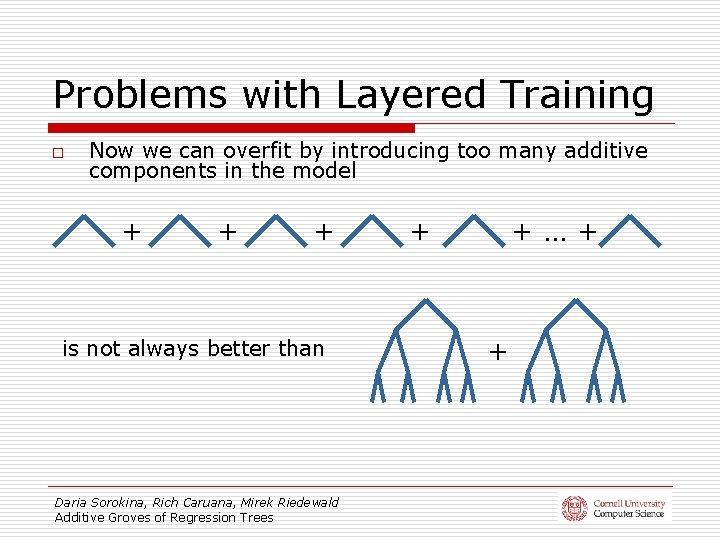
Problems with Layered Training o Now we can overfit by introducing too many additive components in the model + + + is not always better than Daria Sorokina, Rich Caruana, Mirek Riedewald Additive Groves of Regression Trees + +…+ +
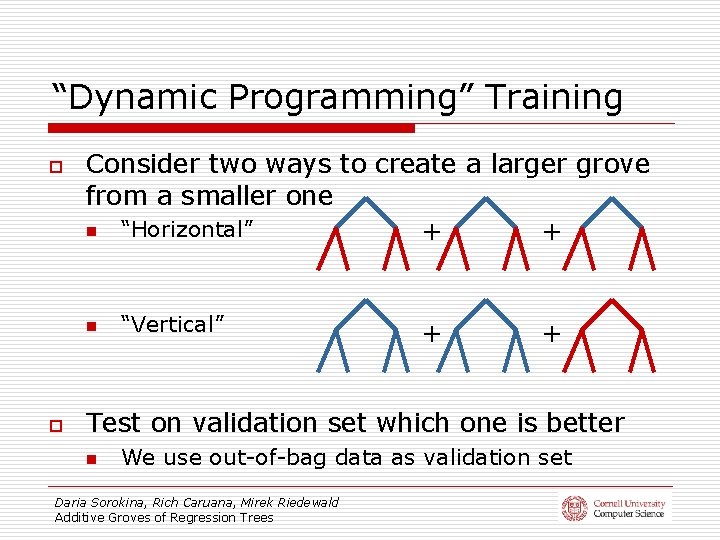
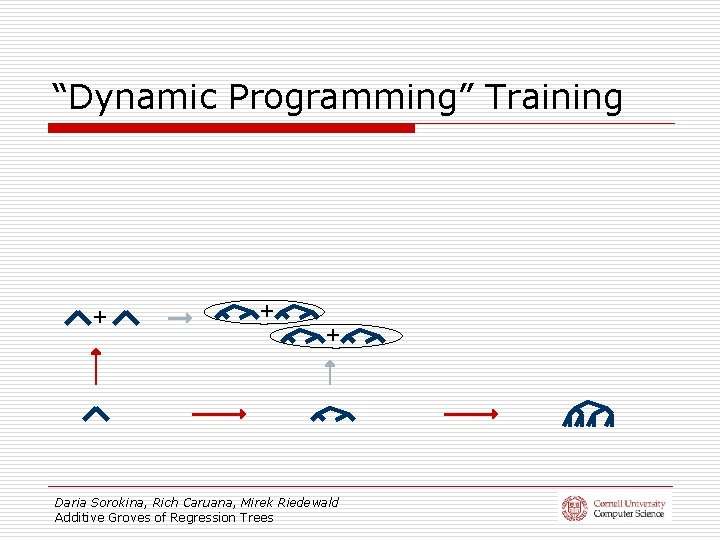
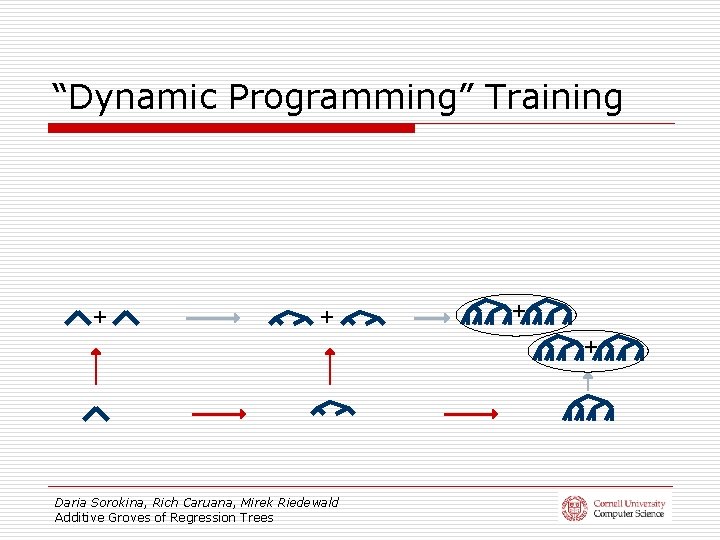
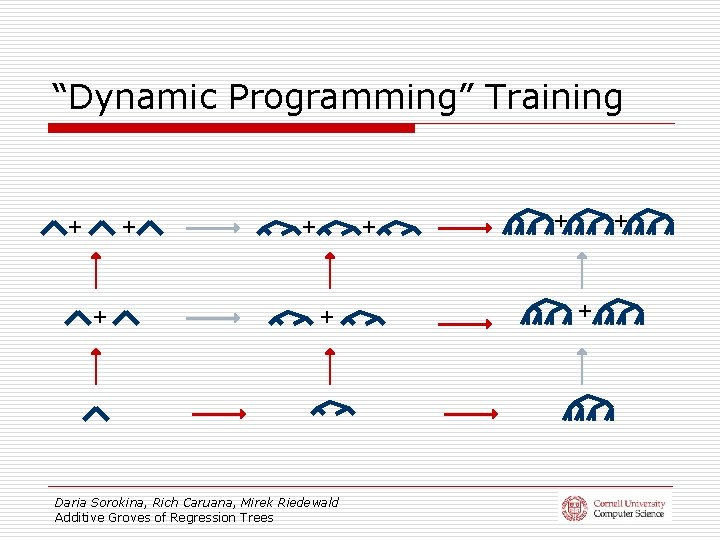
“Dynamic Programming” Training o o Consider two ways to create a larger grove from a smaller one n “Horizontal” + + n “Vertical” + + Test on validation set which one is better n We use out-of-bag data as validation set Daria Sorokina, Rich Caruana, Mirek Riedewald Additive Groves of Regression Trees
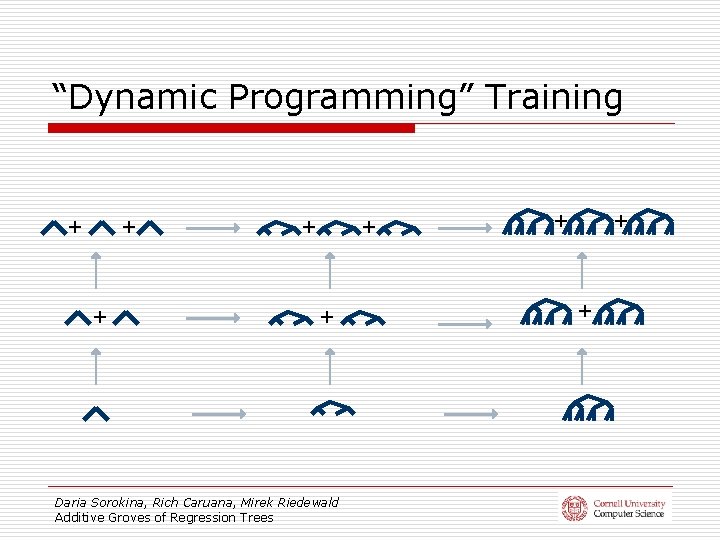
“Dynamic Programming” Training + + + Daria Sorokina, Rich Caruana, Mirek Riedewald Additive Groves of Regression Trees + + +
“Dynamic Programming” Training + + + Daria Sorokina, Rich Caruana, Mirek Riedewald Additive Groves of Regression Trees
“Dynamic Programming” Training + + Daria Sorokina, Rich Caruana, Mirek Riedewald Additive Groves of Regression Trees
“Dynamic Programming” Training + + + Daria Sorokina, Rich Caruana, Mirek Riedewald Additive Groves of Regression Trees + + +
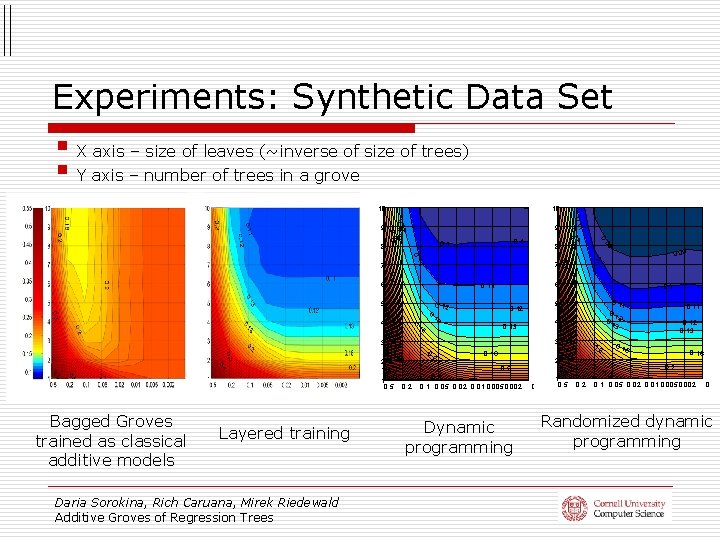
Experiments: Synthetic Data Set § X axis – size of leaves (~inverse of size of trees) § Y axis – number of trees in a grove 10 8 2 0. 13 0. 16 9 0. 1 1 7 0. 2 6 0. 11 5 0. 3 0. 4 0. 12 0. 16 0. 12 13 0. 13 3 0. 4 0. 2 2 0. 3 5 1 0. 5 Bagged Groves trained as classical additive models Layered training Daria Sorokina, Rich Caruana, Mirek Riedewald Additive Groves of Regression Trees 0. 2 0. 16 0. 2 0. 1 0. 05 0. 02 0. 01 0. 0050. 002 Dynamic programming 0
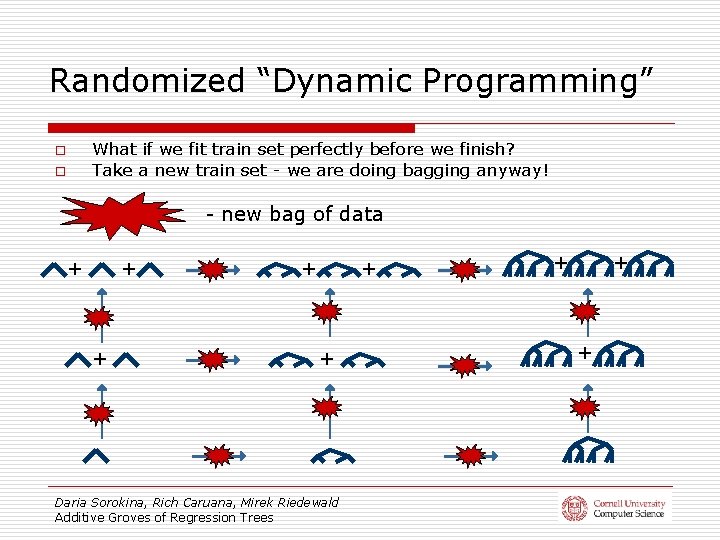
Randomized “Dynamic Programming” What if we fit train set perfectly before we finish? Take a new train set - we are doing bagging anyway! o o - new bag of data + + + Daria Sorokina, Rich Caruana, Mirek Riedewald Additive Groves of Regression Trees + + +
Experiments: Synthetic Data Set § X axis – size of leaves (~inverse of size of trees) § Y axis – number of trees in a grove 10 10 0. 4 0. 1 0. 05 0. 02 0. 01 0. 0050. 002 Dynamic programming 0. 3 5 Daria Sorokina, Rich Caruana, Mirek Riedewald Additive Groves of Regression Trees 0. 2 0 1 0. 5 0. 2 0. 13 0. 16 2 0. 5 Layered training 0. 2 4 0. 3 0. 16 0. 2 Bagged Groves trained as classical additive models 1 3 0. 2 0. 11 0. 1 2 3 4 0. 13 3 1 0. 5 0. 16 5 0. 12 13 0. 11 0. 3 0. 4 0. 12 0. 09 0. 16 6 0. 11 5 0. 2 1 7 09 8 0. 1 0. 2 6 9 0. 1 7 0. 110. 12 0. 13 8 2 0. 13 0. 16 9 0. 16 0. 2 0. 1 0. 05 0. 02 0. 01 0. 0050. 002 0 Randomized dynamic programming
Main competitor – Stochastic Gradient Boosting o o o Introduced by Jerome Friedman in 2001 & 2002 Is a state-of-the-art technique: winner and runner-up on several PAKDD and KDD Cup competitions Also known as MART, Tree. Net, gbm Is an ensemble of additive trees Differs from bagged Groves: n n o Never discards trees Builds trees of the same size Prefers smaller trees Can overfit Parameters to tune: n n Number of trees in the ensemble Size of trees Subsampling parameter Regularization coefficient Daria Sorokina, Rich Caruana, Mirek Riedewald Additive Groves of Regression Trees
Experiments o o o 2 synthetic and 5 real data sets 10 -fold cross validation: 8 folds train set, 1 fold validation set, 1 fold test set Best values of parameters both for Groves and for Gradient boosting are defined on the validation set Max size of the ensemble - 1500 trees (15 additive models X 100 bags for Groves) We also did experiments for 1500 bagged trees for comparison Daria Sorokina, Rich Caruana, Mirek Riedewald Additive Groves of Regression Trees
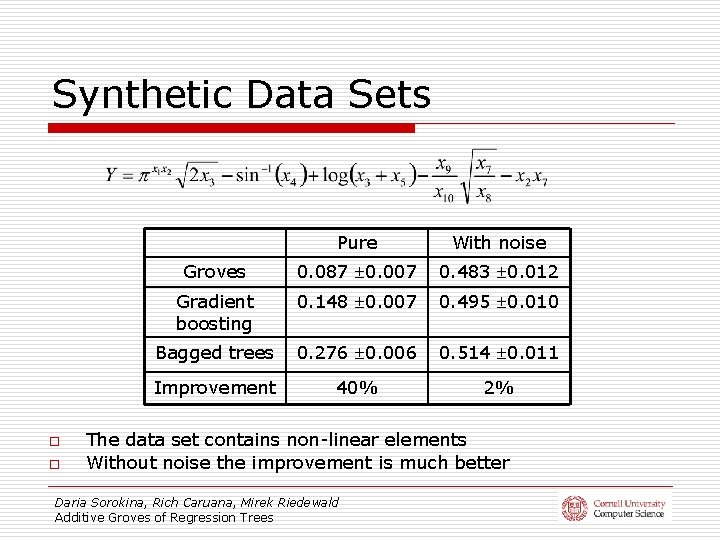
Synthetic Data Sets o o Pure With noise Groves 0. 087 0. 007 0. 483 0. 012 Gradient boosting 0. 148 0. 007 0. 495 0. 010 Bagged trees 0. 276 0. 006 0. 514 0. 011 Improvement 40% 2% The data set contains non-linear elements Without noise the improvement is much better Daria Sorokina, Rich Caruana, Mirek Riedewald Additive Groves of Regression Trees
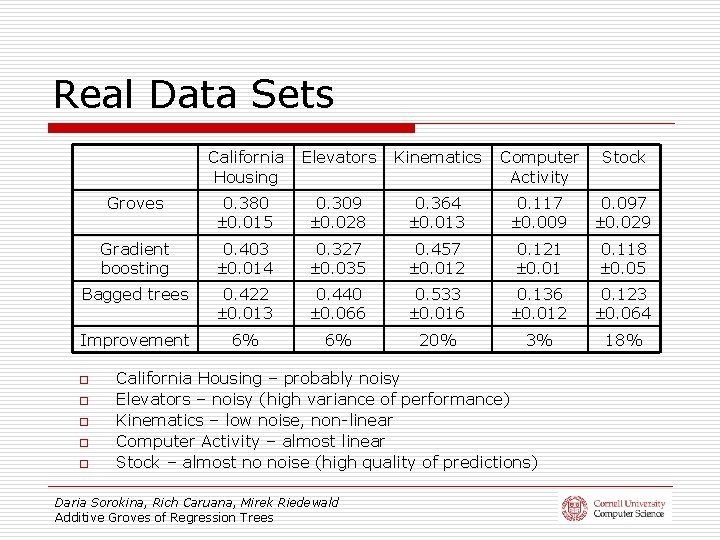
Real Data Sets California Housing Elevators Kinematics Computer Activity Stock Groves 0. 380 0. 015 0. 309 0. 028 0. 364 0. 013 0. 117 0. 009 0. 097 0. 029 Gradient boosting 0. 403 0. 014 0. 327 0. 035 0. 457 0. 012 0. 121 0. 01 0. 118 0. 05 Bagged trees 0. 422 0. 013 0. 440 0. 066 0. 533 0. 016 0. 136 0. 012 0. 123 0. 064 Improvement 6% 6% 20% 3% 18% o o o California Housing – probably noisy Elevators – noisy (high variance of performance) Kinematics – low noise, non-linear Computer Activity – almost linear Stock – almost no noise (high quality of predictions) Daria Sorokina, Rich Caruana, Mirek Riedewald Additive Groves of Regression Trees
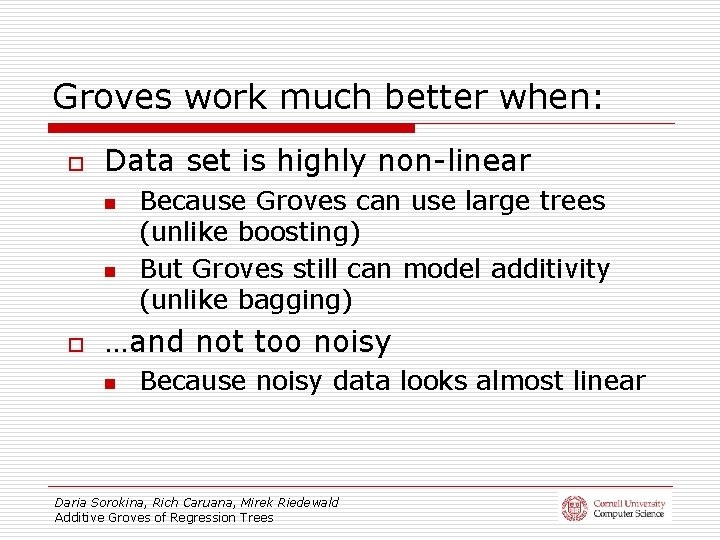
Groves work much better when: o Data set is highly non-linear n n o Because Groves can use large trees (unlike boosting) But Groves still can model additivity (unlike bagging) …and not too noisy n Because noisy data looks almost linear Daria Sorokina, Rich Caruana, Mirek Riedewald Additive Groves of Regression Trees
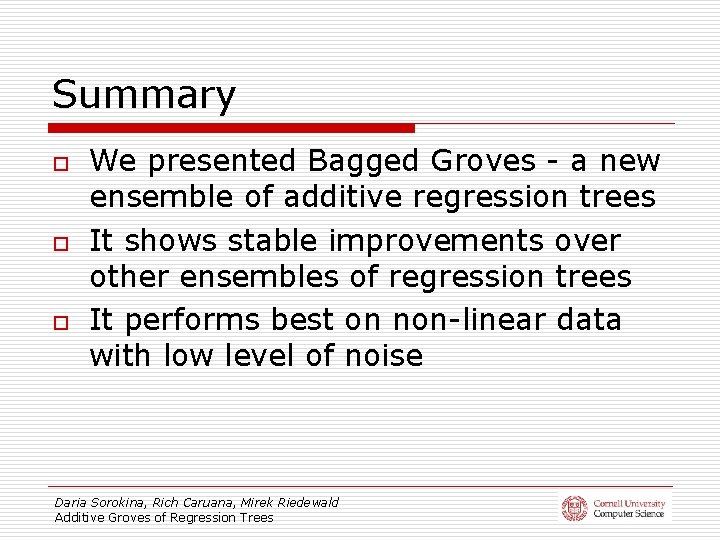
Summary o o o We presented Bagged Groves - a new ensemble of additive regression trees It shows stable improvements over other ensembles of regression trees It performs best on non-linear data with low level of noise Daria Sorokina, Rich Caruana, Mirek Riedewald Additive Groves of Regression Trees
Future Work o Publicly available implementation n o Groves of decision trees n o by the end of the year apply similar ideas to classification Detection of statistical interactions n additive structure and non-linear components of the response function Daria Sorokina, Rich Caruana, Mirek Riedewald Additive Groves of Regression Trees
Acknowledgements o Our collaborators in Computer Science department and Cornell Lab of Ornithology: n n o Daniel Fink Wes Hochachka Steve Kelling Art Munson This work was supported by NSF grants 0427914 and 0612031 Daria Sorokina, Rich Caruana, Mirek Riedewald Additive Groves of Regression Trees