
Additional HS codes used for HFC in the
- Slides: 8
Additional HS codes used for HFC in the European Union CLAUDIA-SORINA DUMITRU MINISTRY OF ENVIRONMENT GENERAL DIRECTORATE FOR WASTE, HAZARDOUS CHEMICALS AND CONTAMINATED SITES
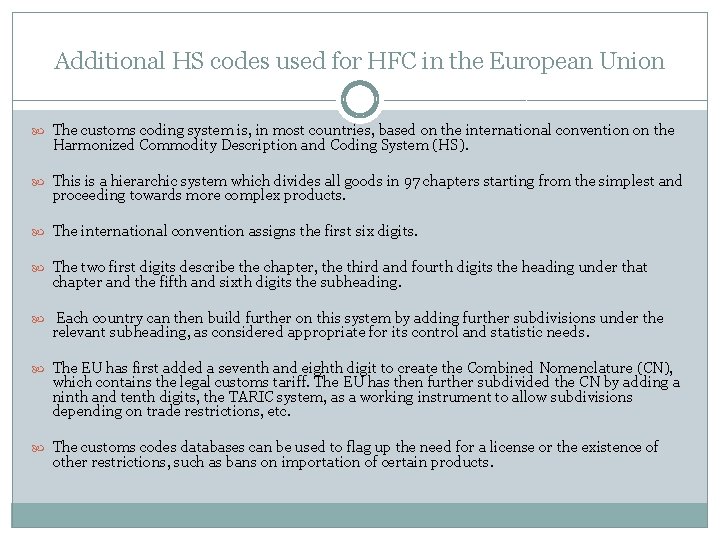
Additional HS codes used for HFC in the European Union The customs coding system is, in most countries, based on the international convention on the Harmonized Commodity Description and Coding System (HS). This is a hierarchic system which divides all goods in 97 chapters starting from the simplest and proceeding towards more complex products. The international convention assigns the first six digits. The two first digits describe the chapter, the third and fourth digits the heading under that chapter and the fifth and sixth digits the subheading. Each country can then build further on this system by adding further subdivisions under the relevant subheading, as considered appropriate for its control and statistic needs. The EU has first added a seventh and eighth digit to create the Combined Nomenclature (CN), which contains the legal customs tariff. The EU has then further subdivided the CN by adding a ninth and tenth digits, the TARIC system, as a working instrument to allow subdivisions depending on trade restrictions, etc. The customs codes databases can be used to flag up the need for a license or the existence of other restrictions, such as bans on importation of certain products.
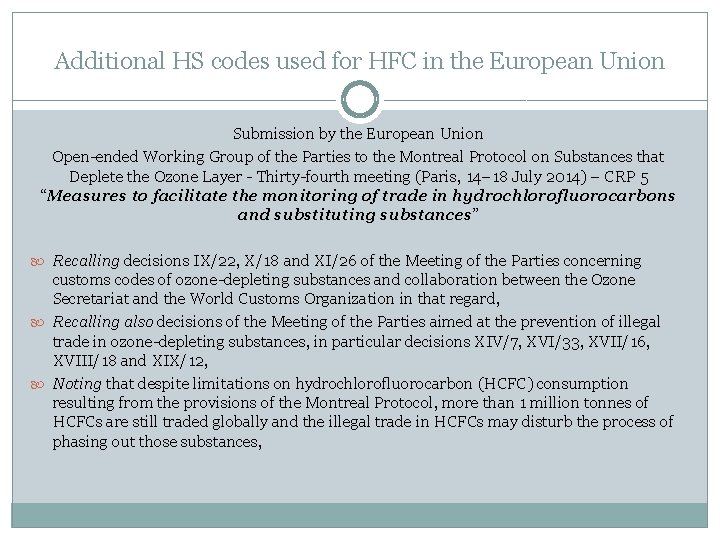
Additional HS codes used for HFC in the European Union Submission by the European Union Open-ended Working Group of the Parties to the Montreal Protocol on Substances that Deplete the Ozone Layer - Thirty-fourth meeting (Paris, 14– 18 July 2014) – CRP 5 “Measures to facilitate the monitoring of trade in hydrochlorofluorocarbons and substituting substances” Recalling decisions IX/22, X/18 and XI/26 of the Meeting of the Parties concerning customs codes of ozone-depleting substances and collaboration between the Ozone Secretariat and the World Customs Organization in that regard, Recalling also decisions of the Meeting of the Parties aimed at the prevention of illegal trade in ozone-depleting substances, in particular decisions XIV/7, XVI/33, XVII/16, XVIII/18 and XIX/12, Noting that despite limitations on hydrochlorofluorocarbon (HCFC) consumption resulting from the provisions of the Montreal Protocol, more than 1 million tonnes of HCFCs are still traded globally and the illegal trade in HCFCs may disturb the process of phasing out those substances,
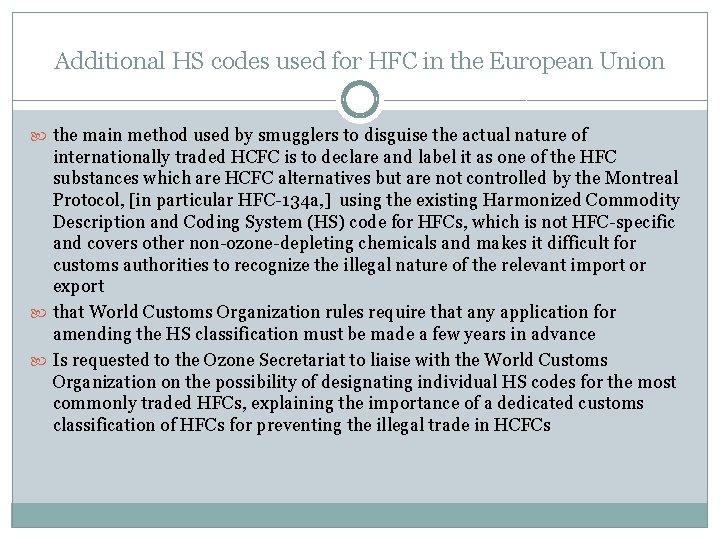
Additional HS codes used for HFC in the European Union the main method used by smugglers to disguise the actual nature of internationally traded HCFC is to declare and label it as one of the HFC substances which are HCFC alternatives but are not controlled by the Montreal Protocol, [in particular HFC-134 a, ] using the existing Harmonized Commodity Description and Coding System (HS) code for HFCs, which is not HFC-specific and covers other non-ozone-depleting chemicals and makes it difficult for customs authorities to recognize the illegal nature of the relevant import or export that World Customs Organization rules require that any application for amending the HS classification must be made a few years in advance Is requested to the Ozone Secretariat to liaise with the World Customs Organization on the possibility of designating individual HS codes for the most commonly traded HFCs, explaining the importance of a dedicated customs classification of HFCs for preventing the illegal trade in HCFCs
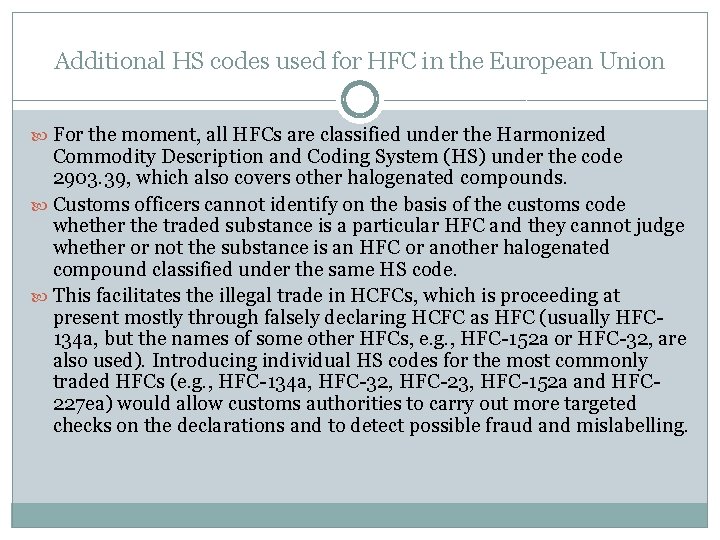
Additional HS codes used for HFC in the European Union For the moment, all HFCs are classified under the Harmonized Commodity Description and Coding System (HS) under the code 2903. 39, which also covers other halogenated compounds. Customs officers cannot identify on the basis of the customs code whether the traded substance is a particular HFC and they cannot judge whether or not the substance is an HFC or another halogenated compound classified under the same HS code. This facilitates the illegal trade in HCFCs, which is proceeding at present mostly through falsely declaring HCFC as HFC (usually HFC 134 a, but the names of some other HFCs, e. g. , HFC-152 a or HFC-32, are also used). Introducing individual HS codes for the most commonly traded HFCs (e. g. , HFC-134 a, HFC-32, HFC-23, HFC-152 a and HFC 227 ea) would allow customs authorities to carry out more targeted checks on the declarations and to detect possible fraud and mislabelling.
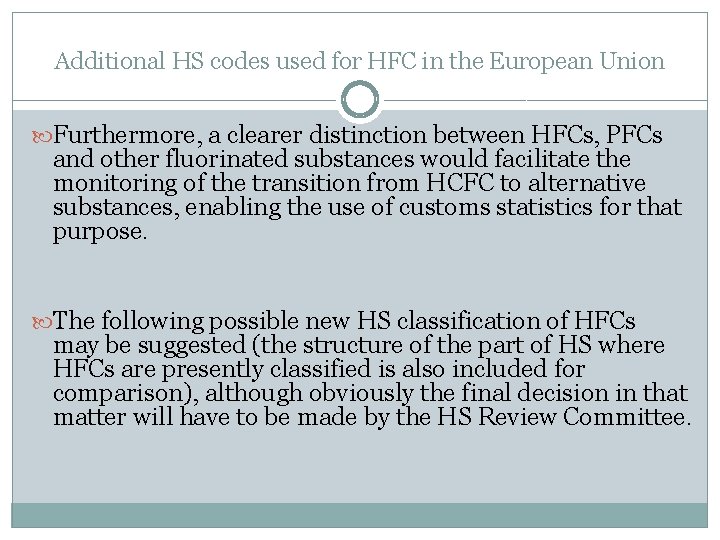
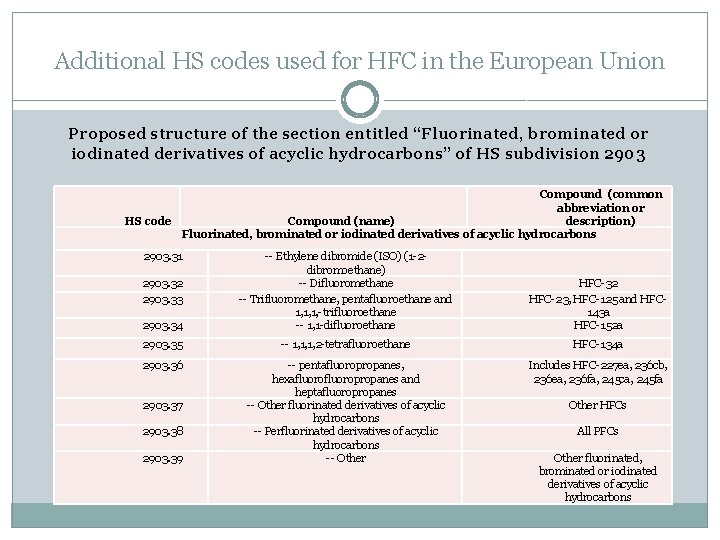
Additional HS codes used for HFC in the European Union Furthermore, a clearer distinction between HFCs, PFCs and other fluorinated substances would facilitate the monitoring of the transition from HCFC to alternative substances, enabling the use of customs statistics for that purpose. The following possible new HS classification of HFCs may be suggested (the structure of the part of HS where HFCs are presently classified is also included for comparison), although obviously the final decision in that matter will have to be made by the HS Review Committee.
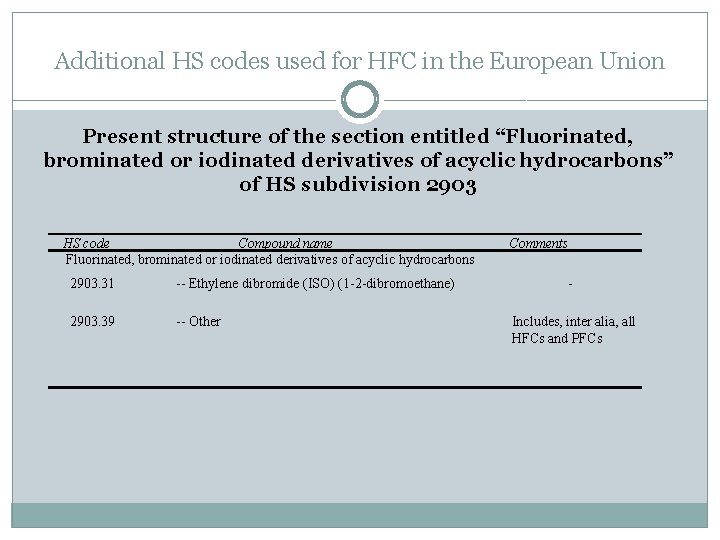
Additional HS codes used for HFC in the European Union Present structure of the section entitled “Fluorinated, brominated or iodinated derivatives of acyclic hydrocarbons” of HS subdivision 2903 HS code Compound name Fluorinated, brominated or iodinated derivatives of acyclic hydrocarbons 2903. 31 -- Ethylene dibromide (ISO) (1 -2 -dibromoethane) 2903. 39 -- Other Comments Includes, inter alia, all HFCs and PFCs
Additional HS codes used for HFC in the European Union Proposed structure of the section entitled “Fluorinated, brominated or iodinated derivatives of acyclic hydrocarbons” of HS subdivision 2903 Compound (common abbreviation or HS code Compound (name) description) Fluorinated, brominated or iodinated derivatives of acyclic hydrocarbons 2903. 31 2903. 34 -- Ethylene dibromide (ISO) (1 -2 dibromoethane) -- Difluoromethane -- Trifluoromethane, pentafluoroethane and 1, 1, 1, -trifluoroethane -- 1, 1 -difluoroethane HFC-32 HFC-23, HFC-125 and HFC 143 a HFC-152 a 2903. 35 -- 1, 1, 1, 2 -tetrafluoroethane HFC-134 a 2903. 36 -- pentafluoropropanes, hexafluoropropanes and heptafluoropropanes -- Other fluorinated derivatives of acyclic hydrocarbons -- Perfluorinated derivatives of acyclic hydrocarbons -- Other Includes HFC-227 ea, 236 cb, 236 ea, 236 fa, 245 ca, 245 fa 2903. 32 2903. 33 2903. 37 2903. 38 2903. 39 Other HFCs All PFCs Other fluorinated, brominated or iodinated derivatives of acyclic hydrocarbons