
Additional Causes of Market Failure Abuse of Monopoly
Additional Causes of Market Failure
Abuse of Monopoly Power �Market failure can also be the consequence of monopoly power. �In a market system, producers strive to increase their market power �Market Power: is the ability to raise revenue by reducing output and increasing price �Monopolies are unlikely to allocate resources in a way that maximizes welfare and consequently they achieves a level of output that is allocative inefficient �Governments usually has anti-trust laws to reduce the concentration of power in such markets �Courts exist to prosecute firms that use these practices against the interest of the public
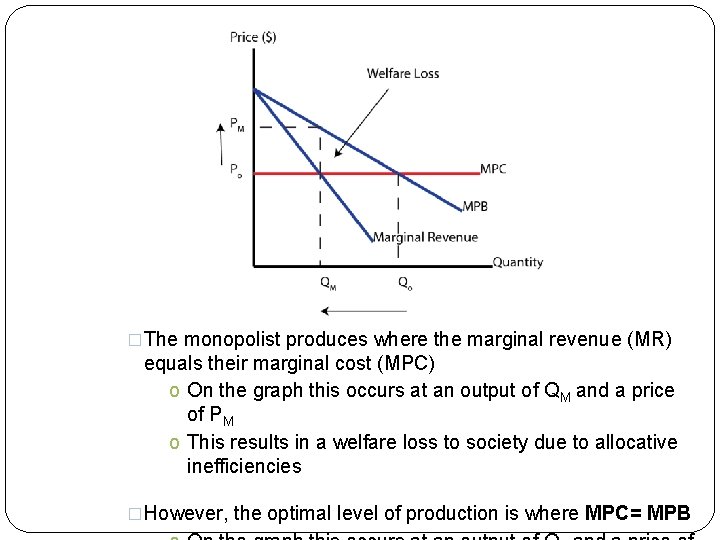
�The monopolist produces where the marginal revenue (MR) equals their marginal cost (MPC) o On the graph this occurs at an output of QM and a price of PM o This results in a welfare loss to society due to allocative inefficiencies �However, the optimal level of production is where MPC= MPB
Government Intervention & Monopolies �There are two key methods the government can use to correct for market failure � 1) Government Regulation: often governments regulate monopolies, particularly those that offer utilities like telephone service or electricity or water. �As a regulated monopoly, the government sets the price that can be charged (usually after discussions with the monopolist). �Now, instead of facing downward sloping demand marginal revenue curves, the monopolist now only has horizontal marginal revenue curve. �Assuming as we did previously that the supply curve is also perfectly elastic, the monopolist now has no incentive to
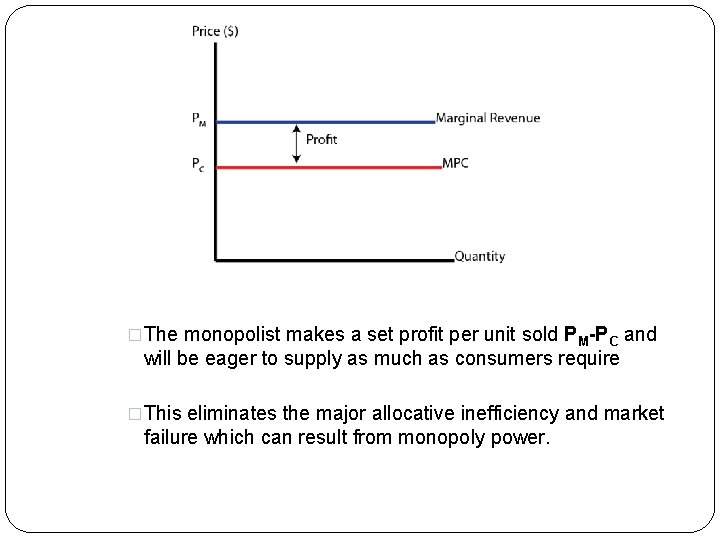
�The monopolist makes a set profit per unit sold PM-PC and will be eager to supply as much as consumers require �This eliminates the major allocative inefficiency and market failure which can result from monopoly power.
� 2) Trade Liberalization: involves eliminating or reducing barriers to trade such as tariffs and quotas in order to increase competition in the market �If there is a local or national monopoly, trade liberalization can often cause the monopolist to behave more competitively and offer their goods at a constant market price �This mimicking the behavior of government intervention
Tragedy of the Commons �Tragedy of the Commons: is a dilemma arising from the situation in which multiple individuals, acting independently and rationally consulting their own self-interest, will deplete a shared limited resource, even when it is clear that it is not in anyone's long-term interest for this to happen. �The solution to the tragedy of the commons is to make the commonly held resource private property. �Economies depend on resources and we must be careful how we manage them. �Ensuring today's economic activity does not jeopardize the resources of future generations is known as sustainable development.
�Example; Tragedy of the Commons- Overfishing �Oceanic fish stocks are an example of a resource that has been used unsustainably due to its commonly held nature. �No one owns the fish in the ocean, and therefore individual fishing nations have every incentive to take as many as they can before other nations do the same. �The result has been widespread overfishing and the collapse of fish stocks worldwide.

Question �Question: As certain species of fish become ever more overfished and hence more scarce, their value on world markets rises. Explain how this might this make sustainable fishing almost impossible to practice.
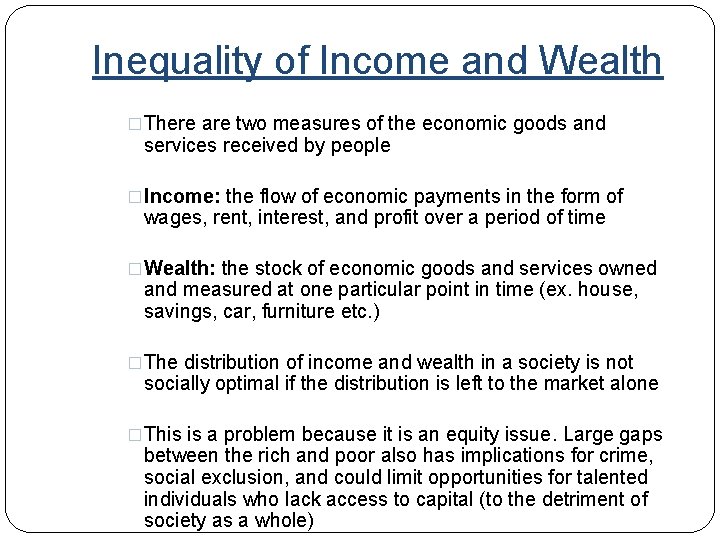
Inequality of Income and Wealth �There are two measures of the economic goods and services received by people �Income: the flow of economic payments in the form of wages, rent, interest, and profit over a period of time �Wealth: the stock of economic goods and services owned and measured at one particular point in time (ex. house, savings, car, furniture etc. ) �The distribution of income and wealth in a society is not socially optimal if the distribution is left to the market alone �This is a problem because it is an equity issue. Large gaps between the rich and poor also has implications for crime, social exclusion, and could limit opportunities for talented individuals who lack access to capital (to the detriment of society as a whole)
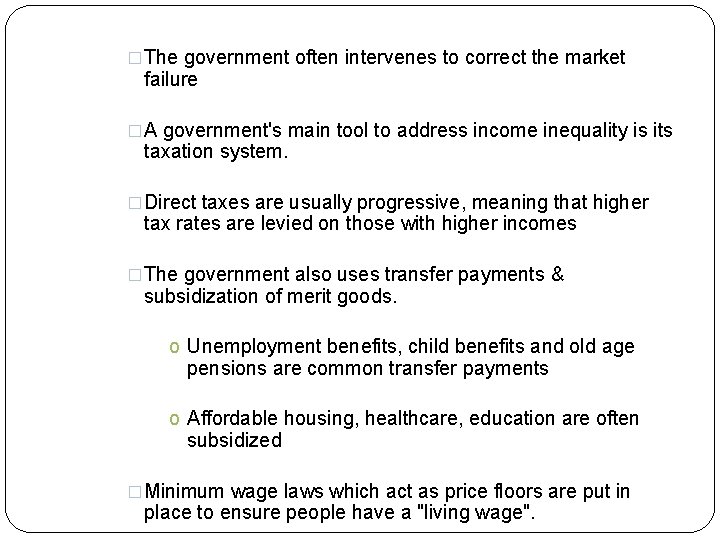
�The government often intervenes to correct the market failure �A government's main tool to address income inequality is its taxation system. �Direct taxes are usually progressive, meaning that higher tax rates are levied on those with higher incomes �The government also uses transfer payments & subsidization of merit goods. o Unemployment benefits, child benefits and old age pensions are common transfer payments o Affordable housing, healthcare, education are often subsidized �Minimum wage laws which act as price floors are put in place to ensure people have a "living wage".
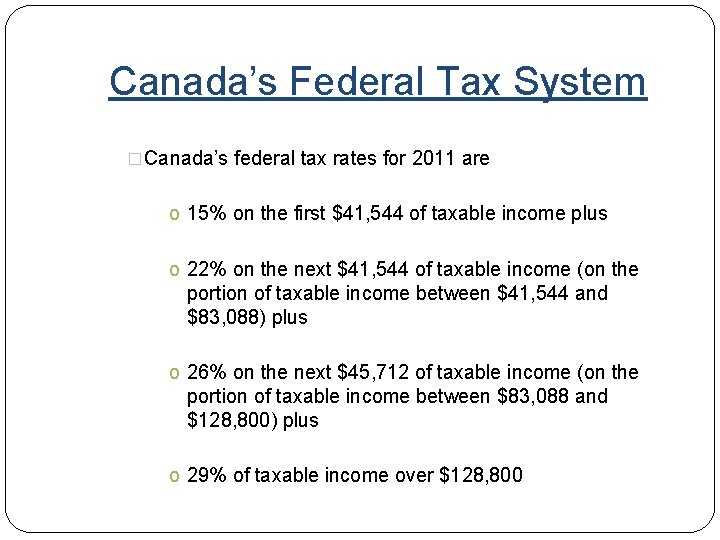
Canada’s Federal Tax System �Canada’s federal tax rates for 2011 are o 15% on the first $41, 544 of taxable income plus o 22% on the next $41, 544 of taxable income (on the portion of taxable income between $41, 544 and $83, 088) plus o 26% on the next $45, 712 of taxable income (on the portion of taxable income between $83, 088 and $128, 800) plus o 29% of taxable income over $128, 800
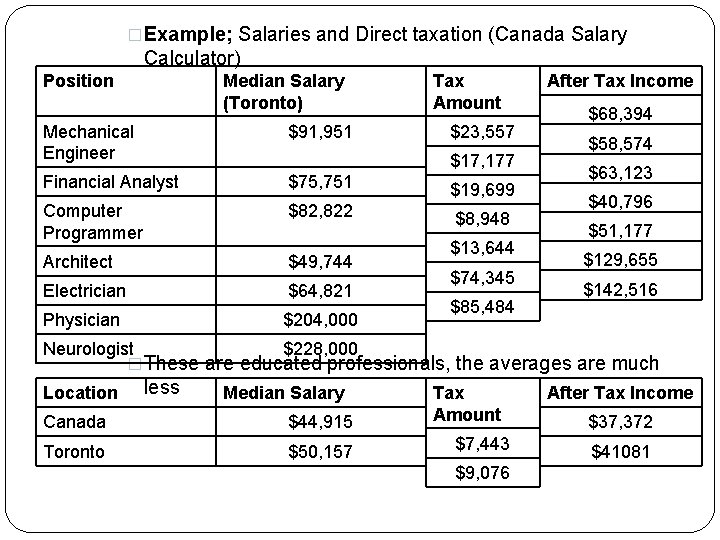
�Example; Salaries and Direct taxation (Canada Salary Calculator) Position Median Salary (Toronto) Tax Amount $23, 557 Mechanical Engineer $91, 951 Financial Analyst $75, 751 $19, 699 Computer Programmer $82, 822 $8, 948 Architect $49, 744 Electrician $64, 821 Physician $204, 000 $17, 177 $13, 644 $74, 345 $85, 484 After Tax Income $68, 394 $58, 574 $63, 123 $40, 796 $51, 177 $129, 655 $142, 516 Neurologist $228, 000 �These are educated professionals, the averages are much Location less Median Salary Canada $44, 915 Toronto $50, 157 Tax Amount $7, 443 $9, 076 After Tax Income $37, 372 $41081
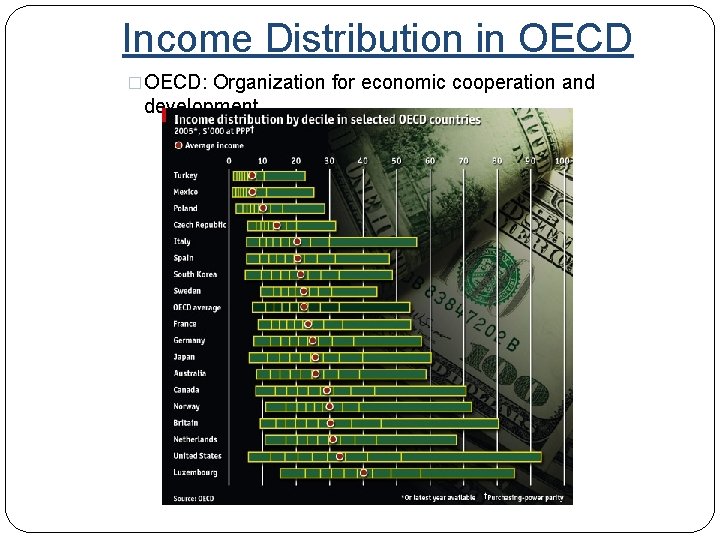
Income Distribution in OECD �OECD: Organization for economic cooperation and development
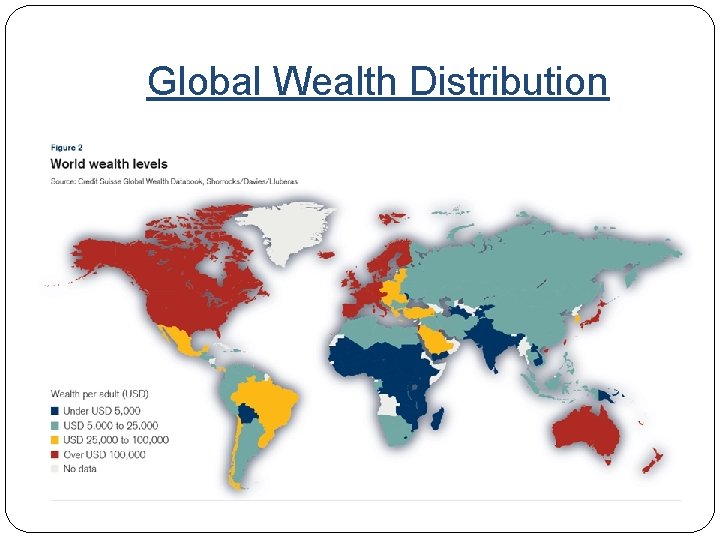
Global Wealth Distribution
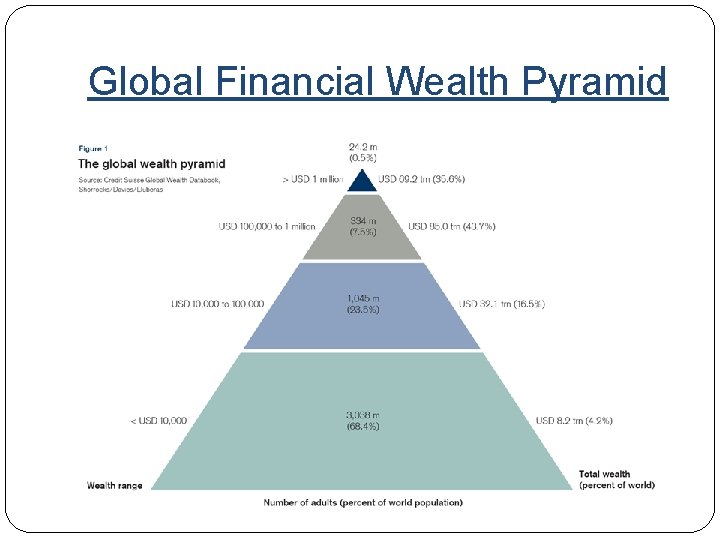
Global Financial Wealth Pyramid
- Slides: 16