
Addis Ababa University Addis Ababa Institute of Technology

Addis Ababa University Addis Ababa Institute of Technology School of Mechanical and Industrial Engineering CHAPTER-2 ROOTS OF EQUATIONS
Introduction Ø The roots or zeros of equations can be simply defined as the values of x that makes f(x) =0. Ø There are many ways to solve for roots of equations. For some cases, the roots can be found easily by solving the equations directly. Ø However, there also other cases where solving the equations directly or analytically is not so possible, there will be approximate solution techniques. Ø There are several techniques of such type and some of them will be discussed in this chapter. Ø Graphical Method Ø Bisection Method Ø False position Method Ø Fixed Point Iteration Method Ø Newton-Raphson Method Ø Secant Method
Graphical method One alternative to obtain an approximate solution is to plot the function and determine where it crosses the x-axis. This point, which represents the x-value for which f(x) =0 is the root. Graphical techniques are of limited practical value because they are not precise. However, graphical methods can be utilized to obtain rough estimates of the roots. These estimates can be employed as starting guesses for numerical methods which will be discussed in the next sections.
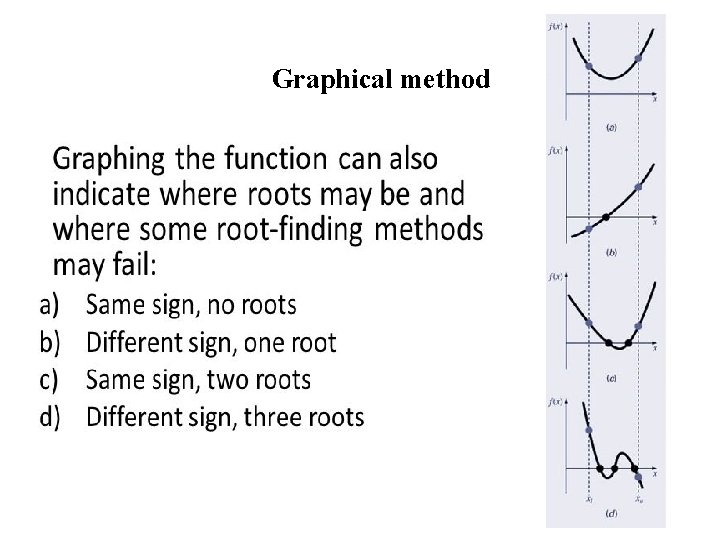
Graphical method
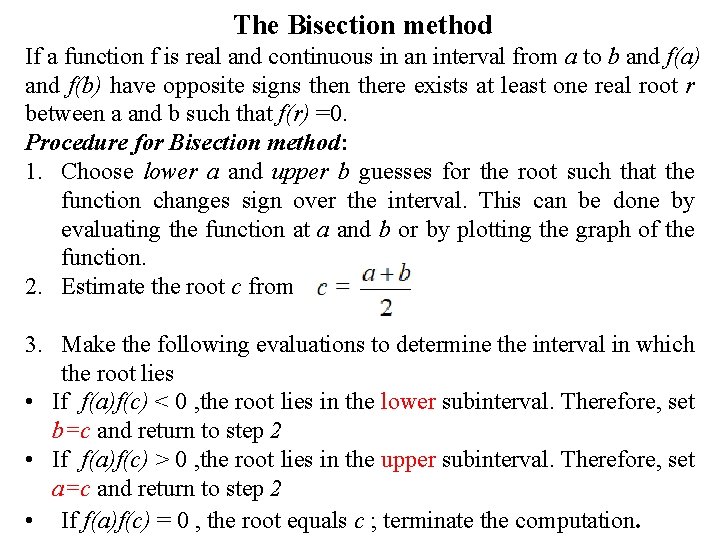
The Bisection method If a function f is real and continuous in an interval from a to b and f(a) and f(b) have opposite signs then there exists at least one real root r between a and b such that f(r) =0. Procedure for Bisection method: 1. Choose lower a and upper b guesses for the root such that the function changes sign over the interval. This can be done by evaluating the function at a and b or by plotting the graph of the function. 2. Estimate the root c from 3. Make the following evaluations to determine the interval in which the root lies • If f(a)f(c) < 0 , the root lies in the lower subinterval. Therefore, set b=c and return to step 2 • If f(a)f(c) > 0 , the root lies in the upper subinterval. Therefore, set a=c and return to step 2 • If f(a)f(c) = 0 , the root equals c ; terminate the computation.
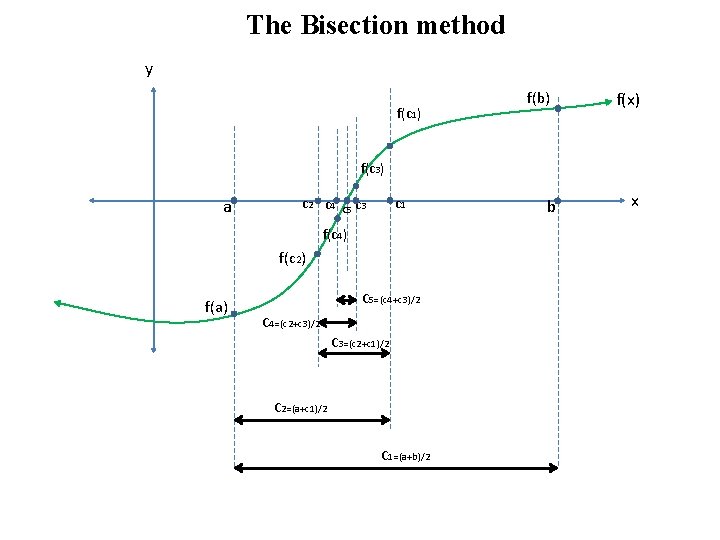
The Bisection method y f(c 1) f(b) f(x) f(c 3) a c 2 c 4 c 5 c 3 c 1 f(c 4) f(c 2) f(a) C 5=(c 4+c 3)/2 C 4=(c 2+c 3)/2 C 3=(c 2+c 1)/2 C 2=(a+c 1)/2 C 1=(a+b)/2 b x
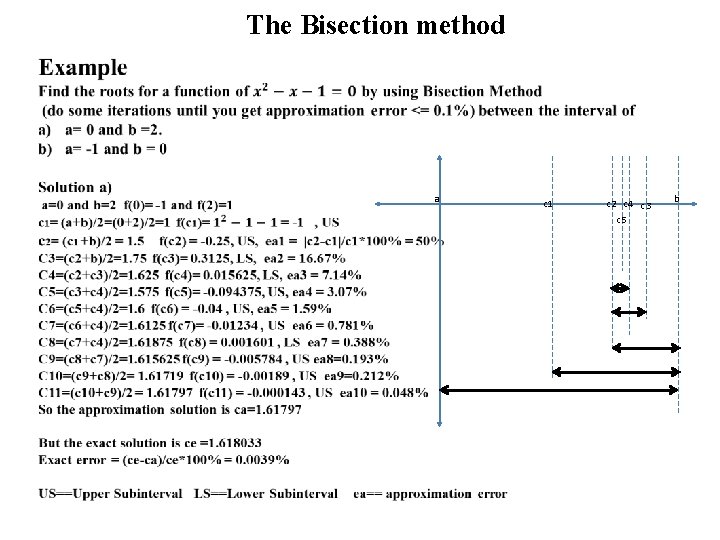
The Bisection method a c 1 c 2 c 4 c 3 c 5 b
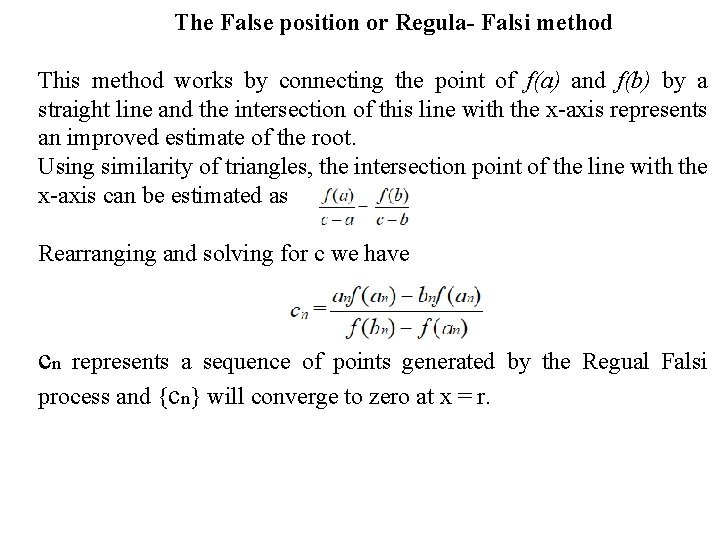
The False position or Regula- Falsi method This method works by connecting the point of f(a) and f(b) by a straight line and the intersection of this line with the x-axis represents an improved estimate of the root. Using similarity of triangles, the intersection point of the line with the x-axis can be estimated as Rearranging and solving for c we have cn represents a sequence of points generated by the Regual Falsi process and {cn} will converge to zero at x = r.
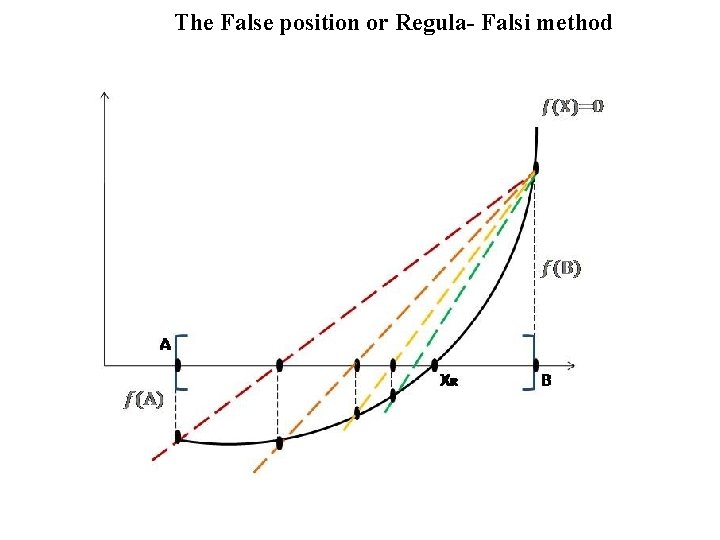
The False position or Regula- Falsi method
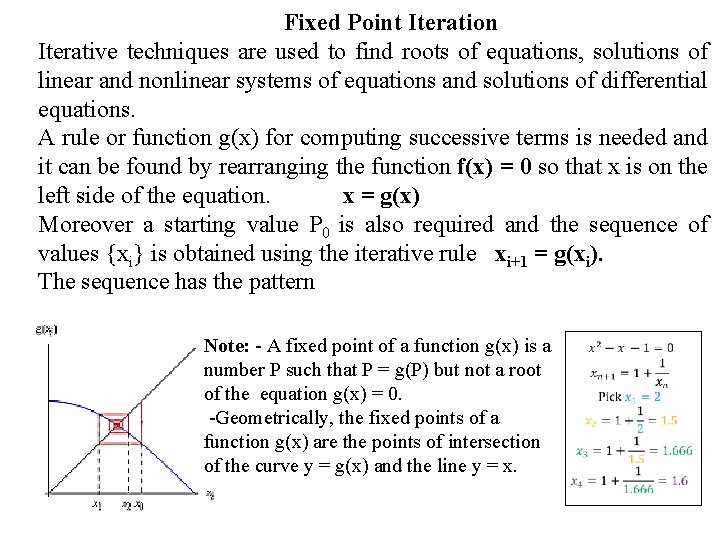
Fixed Point Iteration Iterative techniques are used to find roots of equations, solutions of linear and nonlinear systems of equations and solutions of differential equations. A rule or function g(x) for computing successive terms is needed and it can be found by rearranging the function f(x) = 0 so that x is on the left side of the equation. x = g(x) Moreover a starting value P 0 is also required and the sequence of values {xi} is obtained using the iterative rule xi+1 = g(xi). The sequence has the pattern Note: - A fixed point of a function g(x) is a number P such that P = g(P) but not a root of the equation g(x) = 0. -Geometrically, the fixed points of a function g(x) are the points of intersection of the curve y = g(x) and the line y = x.
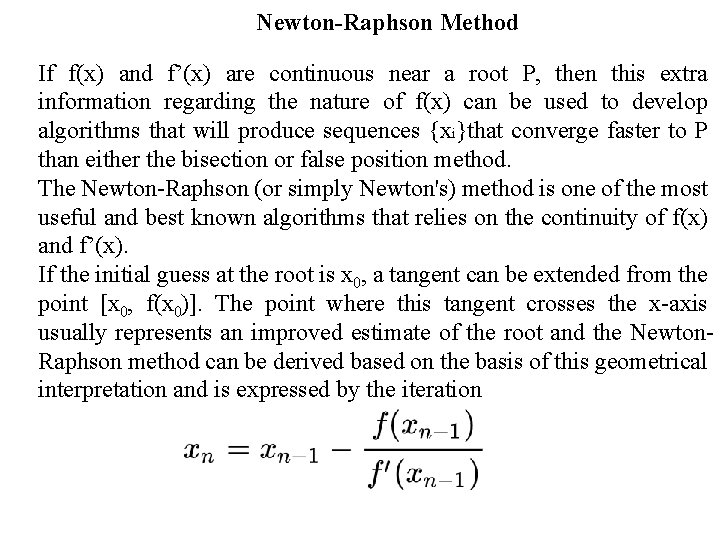
Newton-Raphson Method If f(x) and f’(x) are continuous near a root P, then this extra information regarding the nature of f(x) can be used to develop algorithms that will produce sequences {xi}that converge faster to P than either the bisection or false position method. The Newton-Raphson (or simply Newton's) method is one of the most useful and best known algorithms that relies on the continuity of f(x) and f’(x). If the initial guess at the root is x 0, a tangent can be extended from the point [x 0, f(x 0)]. The point where this tangent crosses the x-axis usually represents an improved estimate of the root and the Newton. Raphson method can be derived based on the basis of this geometrical interpretation and is expressed by the iteration
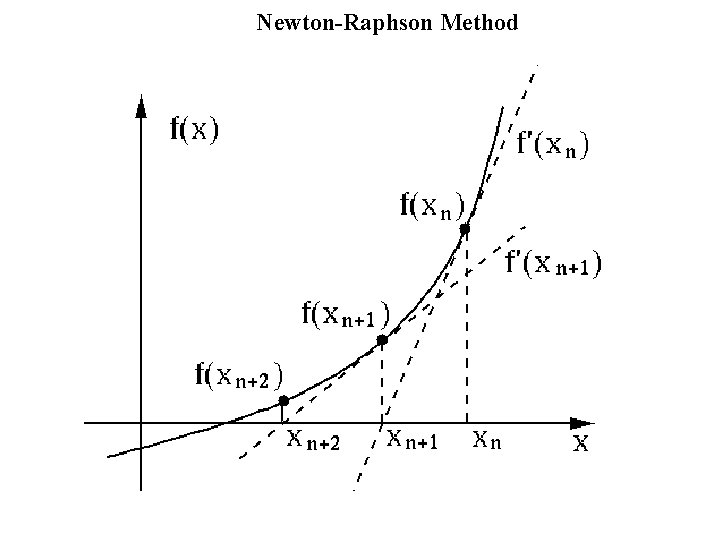
Newton-Raphson Method
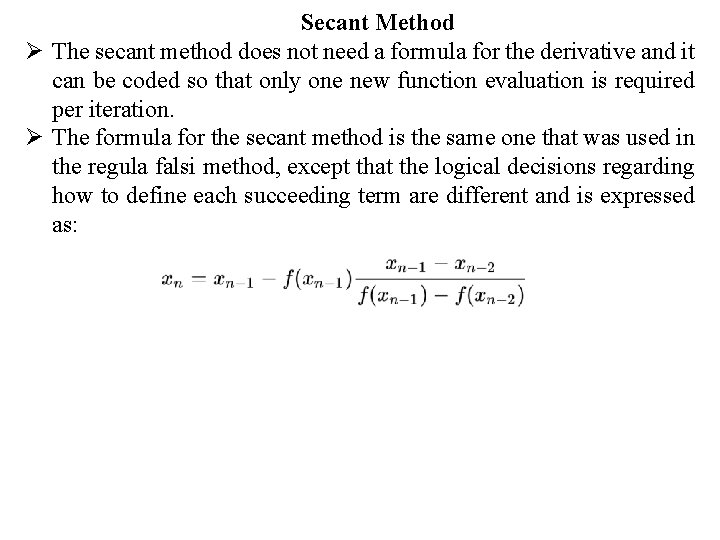
Secant Method Ø The secant method does not need a formula for the derivative and it can be coded so that only one new function evaluation is required per iteration. Ø The formula for the secant method is the same one that was used in the regula falsi method, except that the logical decisions regarding how to define each succeeding term are different and is expressed as:
- Slides: 13