
Adding Value to the Advanced Lab Rudi Michalak
Adding Value to the Advanced Lab Rudi Michalak, University of Wyoming AAPT Regional Meeting CO/WY, April 2018
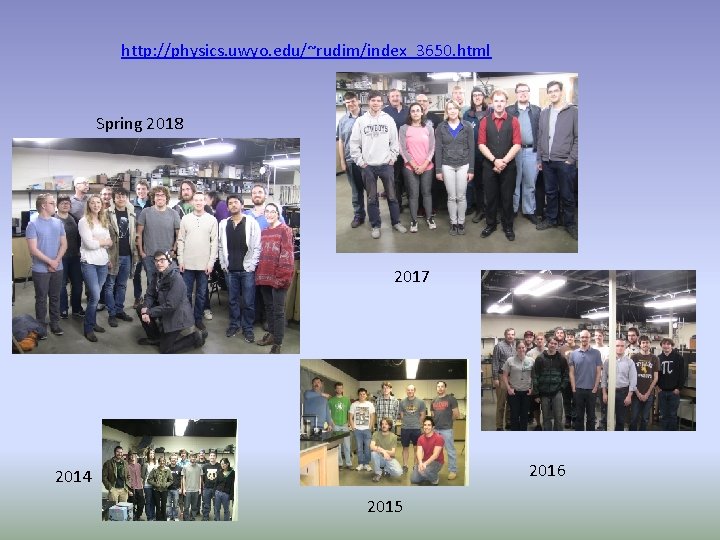
http: //physics. uwyo. edu/~rudim/index_3650. html Spring 2018 2017 2016 2014 2015
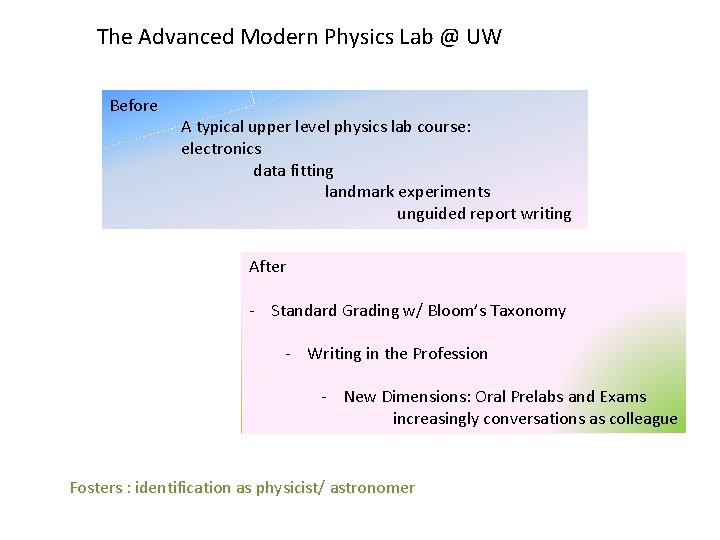
The Advanced Modern Physics Lab @ UW Before A typical upper level physics lab course: electronics data fitting landmark experiments unguided report writing After - Standard Grading w/ Bloom’s Taxonomy - Writing in the Profession - New Dimensions: Oral Prelabs and Exams increasingly conversations as colleague Fosters : identification as physicist/ astronomer
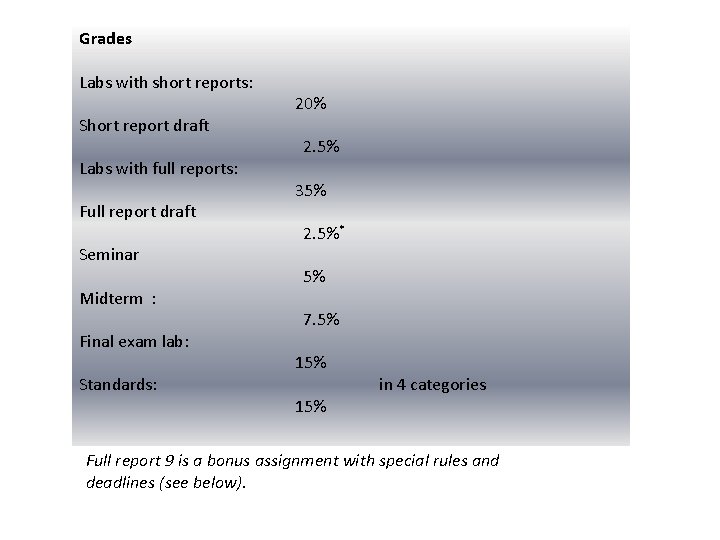
Grades Labs with short reports: Short report draft Labs with full reports: Full report draft Seminar Midterm : Final exam lab: Standards: 20% 2. 5% 35% 2. 5%* 5% 7. 5% 15% in 4 categories Full report 9 is a bonus assignment with special rules and deadlines (see below).
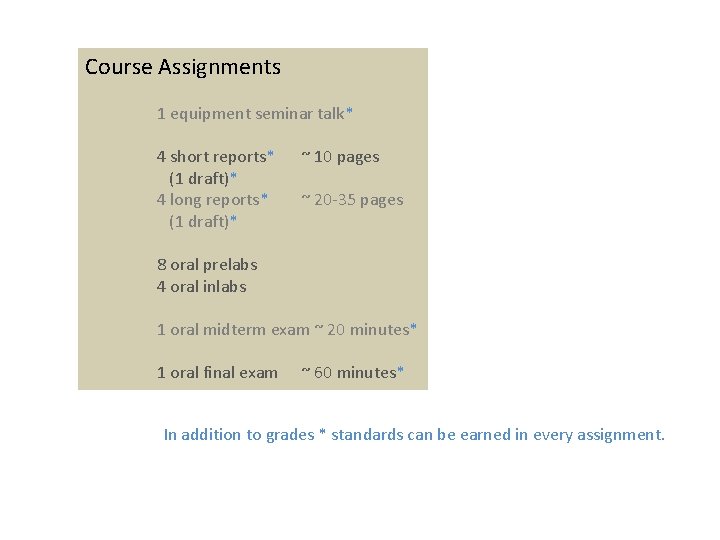
Course Assignments 1 equipment seminar talk* 4 short reports* (1 draft)* 4 long reports* (1 draft)* ~ 10 pages ~ 20 -35 pages 8 oral prelabs 4 oral inlabs 1 oral midterm exam ~ 20 minutes* 1 oral final exam ~ 60 minutes* In addition to grades * standards can be earned in every assignment.
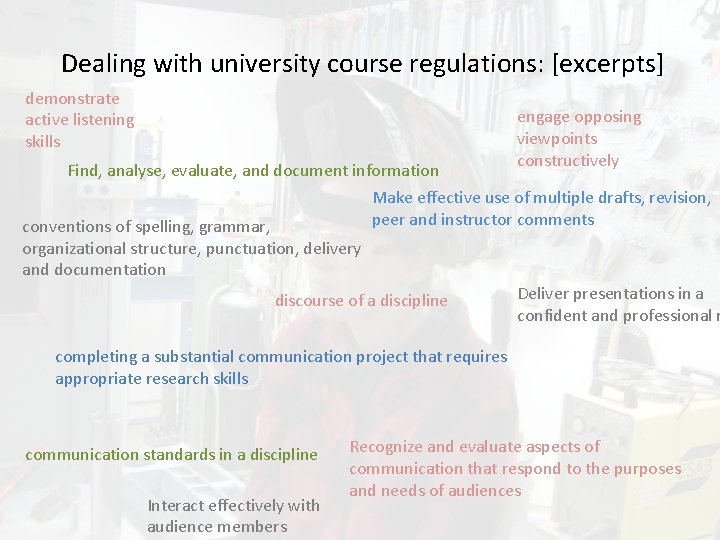
Dealing with university course regulations: [excerpts] demonstrate active listening skills engage opposing viewpoints constructively Find, analyse, evaluate, and document information Make effective use of multiple drafts, revision, peer and instructor comments conventions of spelling, grammar, organizational structure, punctuation, delivery and documentation discourse of a discipline Deliver presentations in a confident and professional m completing a substantial communication project that requires appropriate research skills communication standards in a discipline Interact effectively with audience members Recognize and evaluate aspects of communication that respond to the purposes and needs of audiences
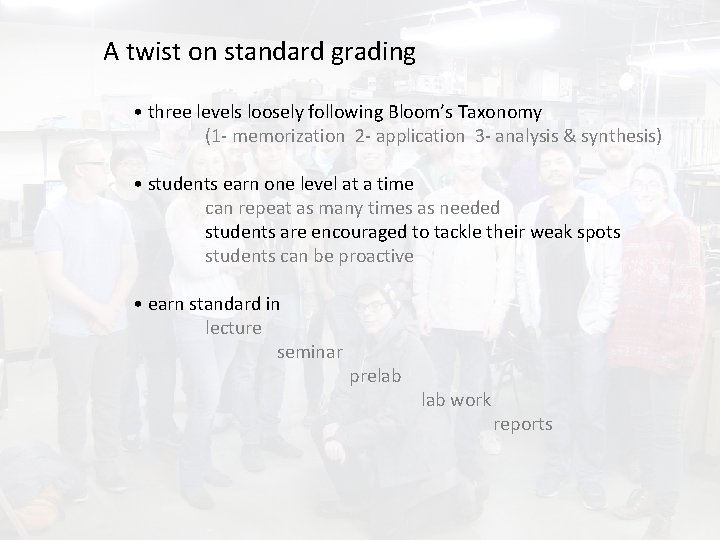
A twist on standard grading • three levels loosely following Bloom’s Taxonomy (1 - memorization 2 - application 3 - analysis & synthesis) • students earn one level at a time can repeat as many times as needed students are encouraged to tackle their weak spots students can be proactive • earn standard in lecture seminar prelab work reports
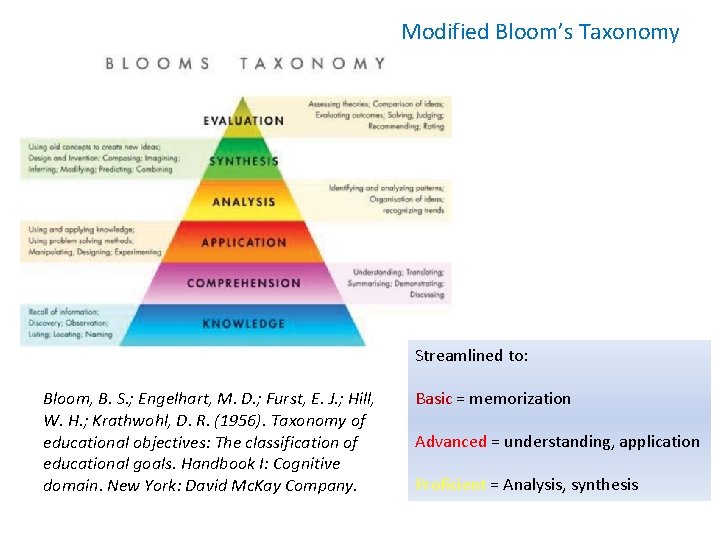
Modified Bloom’s Taxonomy Streamlined to: Bloom, B. S. ; Engelhart, M. D. ; Furst, E. J. ; Hill, W. H. ; Krathwohl, D. R. (1956). Taxonomy of educational objectives: The classification of educational goals. Handbook I: Cognitive domain. New York: David Mc. Kay Company. Basic = memorization Advanced = understanding, application Proficient = Analysis, synthesis
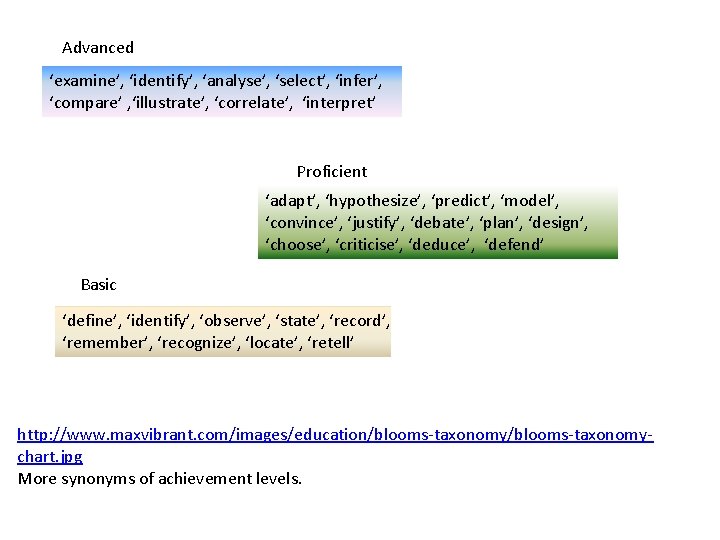
Advanced ‘examine’, ‘identify’, ‘analyse’, ‘select’, ‘infer’, ‘compare’ , ‘illustrate’, ‘correlate’, ‘interpret’ Proficient ‘adapt’, ‘hypothesize’, ‘predict’, ‘model’, ‘convince’, ‘justify’, ‘debate’, ‘plan’, ‘design’, ‘choose’, ‘criticise’, ‘deduce’, ‘defend’ Basic ‘define’, ‘identify’, ‘observe’, ‘state’, ‘record’, ‘remember’, ‘recognize’, ‘locate’, ‘retell’ http: //www. maxvibrant. com/images/education/blooms-taxonomychart. jpg More synonyms of achievement levels.
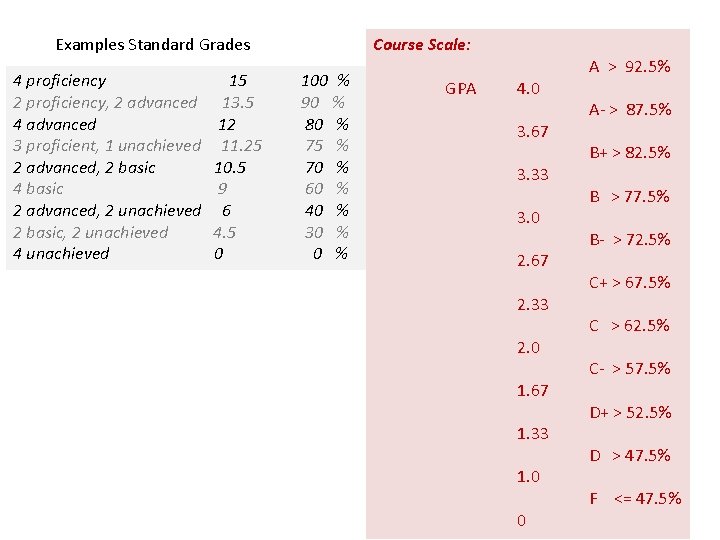
Examples Standard Grades 4 proficiency 2 proficiency, 2 advanced 4 advanced 3 proficient, 1 unachieved 2 advanced, 2 basic 4 basic 2 advanced, 2 unachieved 2 basic, 2 unachieved 4 unachieved 15 13. 5 12 11. 25 10. 5 9 6 4. 5 0 Course Scale: 100 % 90 % 80 % 75 % 70 % 60 % 40 % 30 % A AB BC+ CF F F GPA 4. 0 3. 67 3. 33 3. 0 2. 67 2. 33 2. 0 1. 67 1. 33 1. 0 0 A > 92. 5% A- > 87. 5% B+ > 82. 5% B > 77. 5% B- > 72. 5% C+ > 67. 5% C > 62. 5% C- > 57. 5% D+ > 52. 5% D > 47. 5% F <= 47. 5%
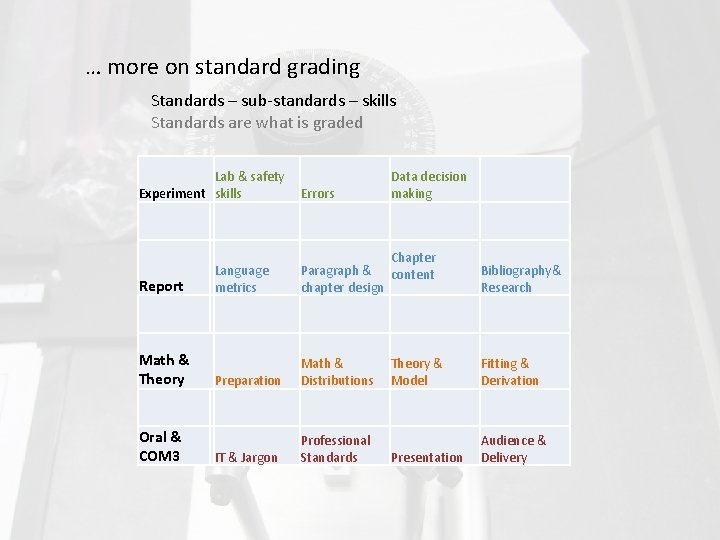
… more on standard grading Standards – sub-standards – skills Standards are what is graded Lab & safety Experiment skills Report Math & Theory Oral & COM 3 Errors Data decision making Language metrics Chapter Paragraph & content chapter design Bibliography& Research Preparation Math & Distributions Theory & Model Fitting & Derivation IT & Jargon Professional Standards Presentation Audience & Delivery
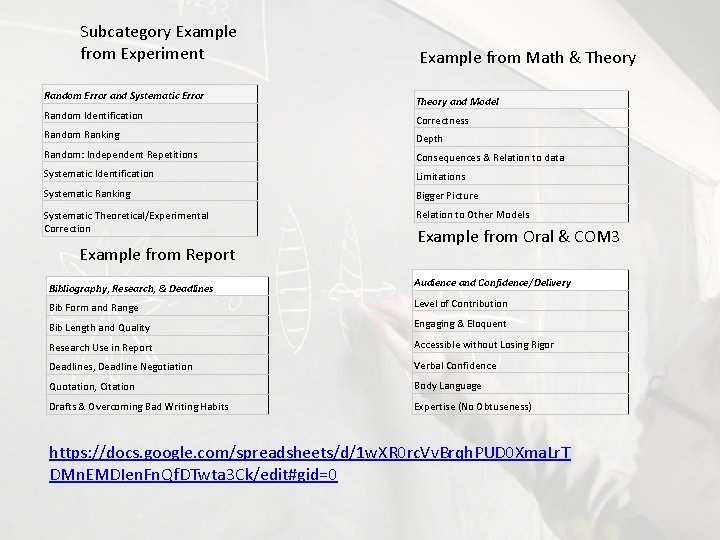
Subcategory Example from Experiment Example from Math & Theory Random Error and Systematic Error Theory and Model Random Identification Correctness Random Ranking Depth Random: Independent Repetitions Consequences & Relation to data Systematic Identification Limitations Systematic Ranking Bigger Picture Systematic Theoretical/Experimental Correction Relation to Other Models Example from Report Bibliography, Research, & Deadlines Example from Oral & COM 3 Audience and Confidence/Delivery Bib Form and Range Level of Contribution Bib Length and Quality Engaging & Eloquent Research Use in Report Accessible without Losing Rigor Deadlines, Deadline Negotiation Verbal Confidence Quotation, Citation Body Language Drafts & Overcoming Bad Writing Habits Expertise (No Obtuseness) https: //docs. google. com/spreadsheets/d/1 w. XR 0 rc. Vv. Brqh. PUD 0 Xma. Lr. T DMn. EMDIen. Fn. Qf. DTwta 3 Ck/edit#gid=0
Focus on professional discussions: Prelabs are professional conversations between instructor and student about topics that relate to a particular experiment. The student can start freely and should choose a topic that she is strong at and/or a topic that will satisfy a needed standard. Inlabs are discussions in a hands-on situation: How did you decide how many data points you need, how many repetitions, which errors dominate, how did you make sure you do not skew your data distributions? This mimics the interactions between a graduate adviser and her graduate student. The exams are essentially professional discussions among colleagues. Unlike with prelabs this expects a different level of competence in your answers. Emphasis is also put toward professional conduct, which includes behaviour, preparedness, and a number of COM 3 categories. One can compare the experience somewhat to presenting a poster at a scientific conference
Having our lab approved as a COM 3 course in USP 2015 brought the following advantages: • the majors learn discipline oriented professional conduct, oral skills, and writing skills • students learn to be goal oriented and proactive • the majors are less resentful of the large writing load • fewer students will fail the course (report deadline issue) • opportunities for internal funding of lab equipment
- Slides: 14