
Adding Subtracting and Multiplying Decimals 3 13 2
* Adding, Subtracting, and Multiplying Decimals 3 -1/3 -2
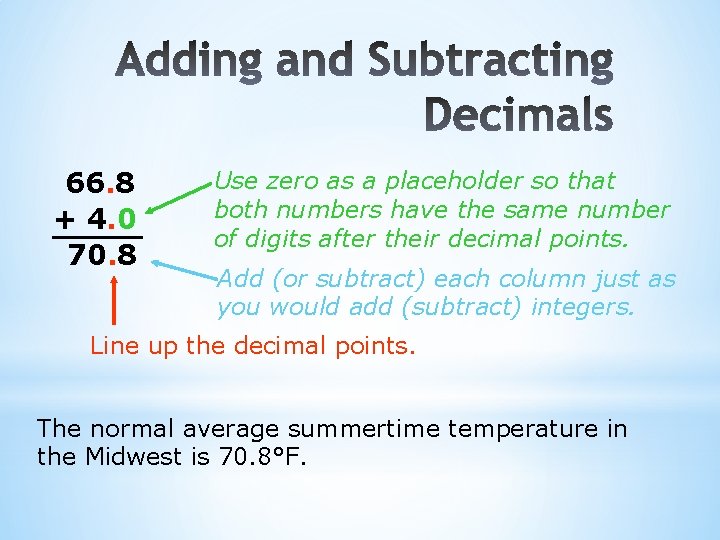
66. 8 + 4. 0 70. 8 Use zero as a placeholder so that both numbers have the same number of digits after their decimal points. Add (or subtract) each column just as you would add (subtract) integers. Line up the decimal points. The normal average summertime temperature in the Midwest is 70. 8°F.
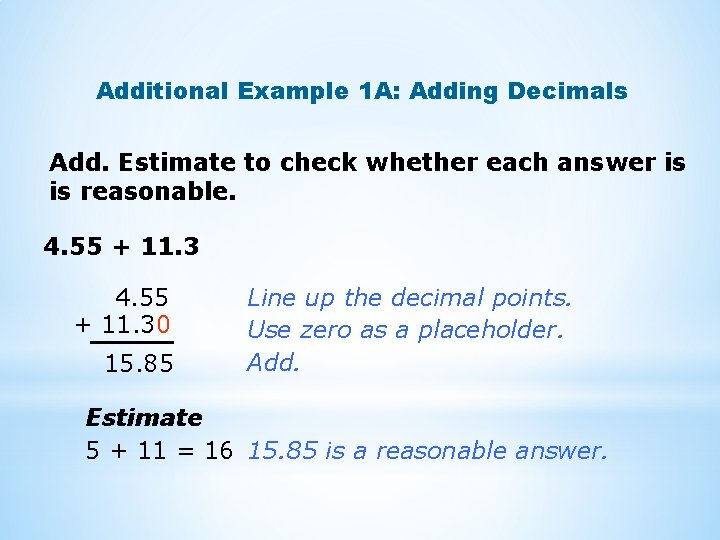
Additional Example 1 A: Adding Decimals Add. Estimate to check whether each answer is is reasonable. 4. 55 + 11. 30 15. 85 Line up the decimal points. Use zero as a placeholder. Add. Estimate 5 + 11 = 16 15. 85 is a reasonable answer.
Remember! When adding numbers with the same sign, find the sum of their absolute values. Then use the sign of the numbers.

Additional Example 1 C: Adding Decimals Add. Estimate to check whether each answer is reasonable. – 8. 33 + (– 10. 972) 8. 330 +10. 972 19. 302 – 8. 33 + (– 10. 972) = – 19. 302 Think: 8. 33 + 10. 972. Line up the decimal points. Use zero as a placeholder. Add. Use the sign of the two numbers. Estimate – 8 + (– 11) = – 19. 302 is a reasonable answer.
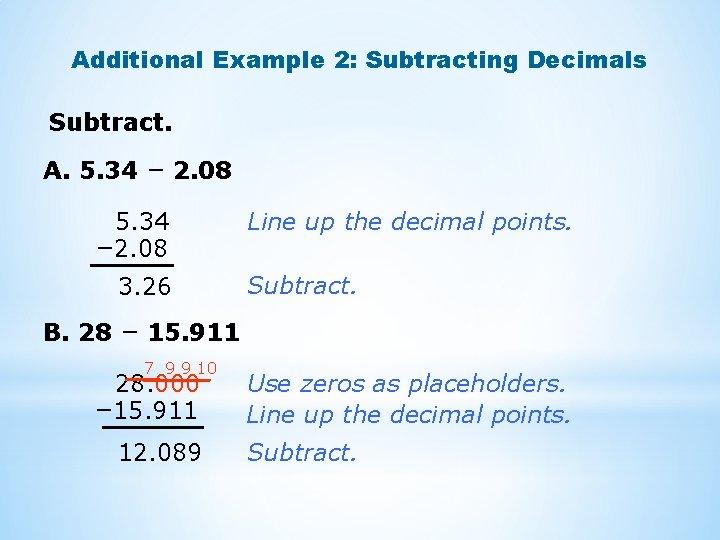
Additional Example 2: Subtracting Decimals Subtract. A. 5. 34 – 2. 08 3. 26 Line up the decimal points. Subtract. B. 28 – 15. 911 7 9 9 10 28. 000 – 15. 911 12. 089 Use zeros as placeholders. Line up the decimal points. Subtract.
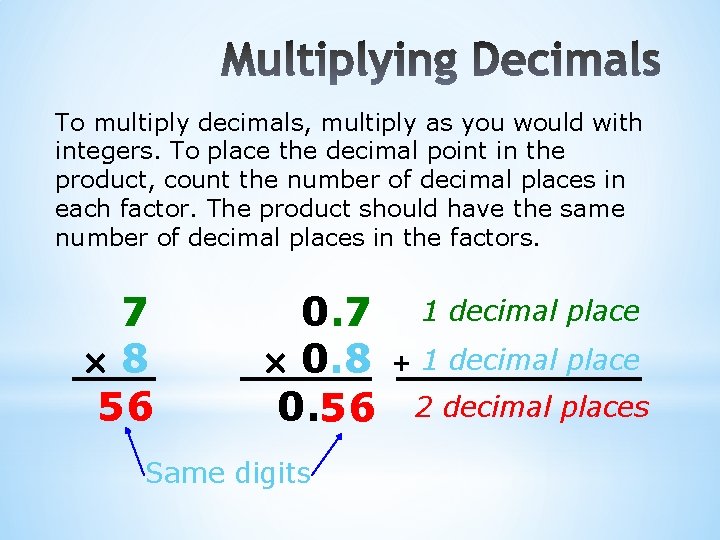
To multiply decimals, multiply as you would with integers. To place the decimal point in the product, count the number of decimal places in each factor. The product should have the same number of decimal places in the factors. 7 8 56 0. 7 0. 8 0. 56 Same digits 1 decimal place + 1 decimal place 2 decimal places
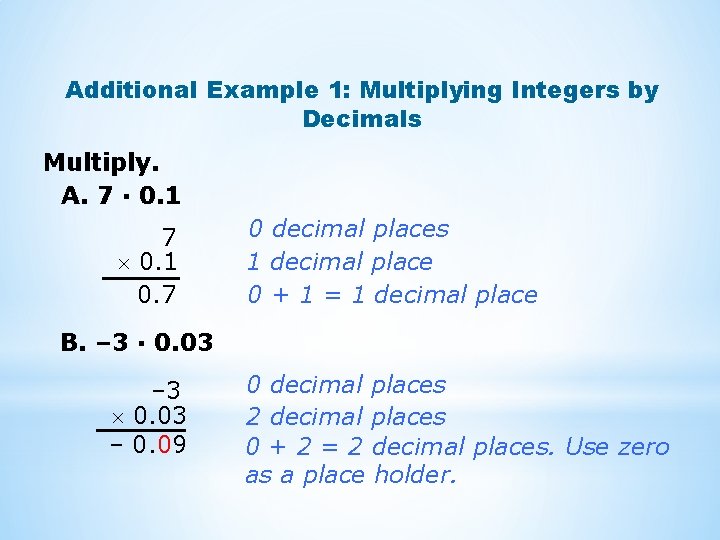
Additional Example 1: Multiplying Integers by Decimals Multiply. A. 7 · 0. 1 7 0. 1 0. 7 0 decimal places 1 decimal place 0 + 1 = 1 decimal place B. – 3 · 0. 03 – 3 0. 03 – 0. 09 0 decimal places 2 decimal places 0 + 2 = 2 decimal places. Use zero as a place holder.
- Slides: 8