
Adding and Subtracting Integers Definition Algorithm a plan
Adding and Subtracting Integers
Definition Algorithm – a plan, or a series of steps, for doing a computation

Additive Identity The additive identity property says that any number plus zero is that number. Example: 1 + 0 = 1 15 + 0 = 15
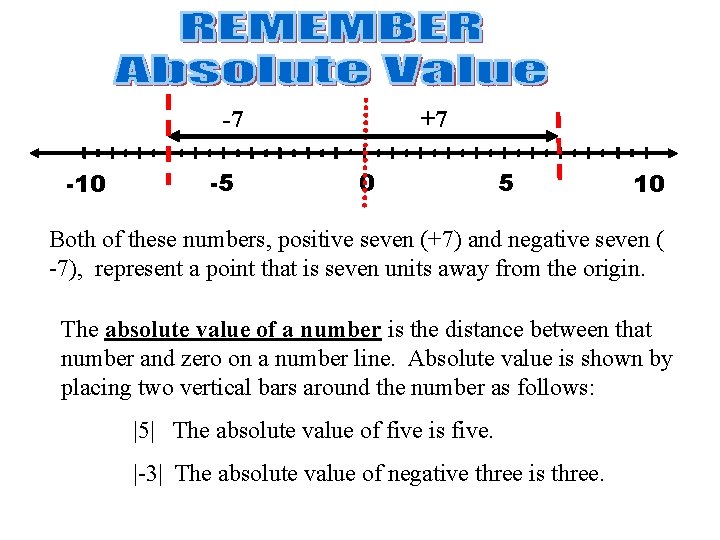
-7 -10 -5 +7 0 5 10 Both of these numbers, positive seven (+7) and negative seven ( -7), represent a point that is seven units away from the origin. The absolute value of a number is the distance between that number and zero on a number line. Absolute value is shown by placing two vertical bars around the number as follows: |5| The absolute value of five is five. |-3| The absolute value of negative three is three.
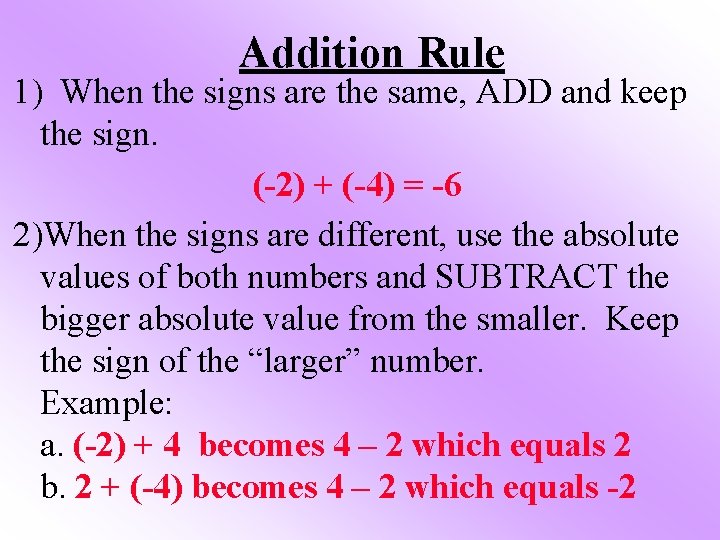
Addition Rule 1) When the signs are the same, ADD and keep the sign. (-2) + (-4) = -6 2)When the signs are different, use the absolute values of both numbers and SUBTRACT the bigger absolute value from the smaller. Keep the sign of the “larger” number. Example: a. (-2) + 4 becomes 4 – 2 which equals 2 b. 2 + (-4) becomes 4 – 2 which equals -2

Addition Rule Continued 2) When the signs are different, use the absolute values of both numbers and SUBTRACT the bigger absolute value from the smaller. Keep the sign of the “larger” number. Example: a. (-2) + 4 = ? Take the absolute value of each |-2 | = 2 and | 4 | = 4 Now subtract the bigger absolute value from the smaller 4 -2=2 Since the “larger” number (4) is positive in the original problem, the answer stays positive.
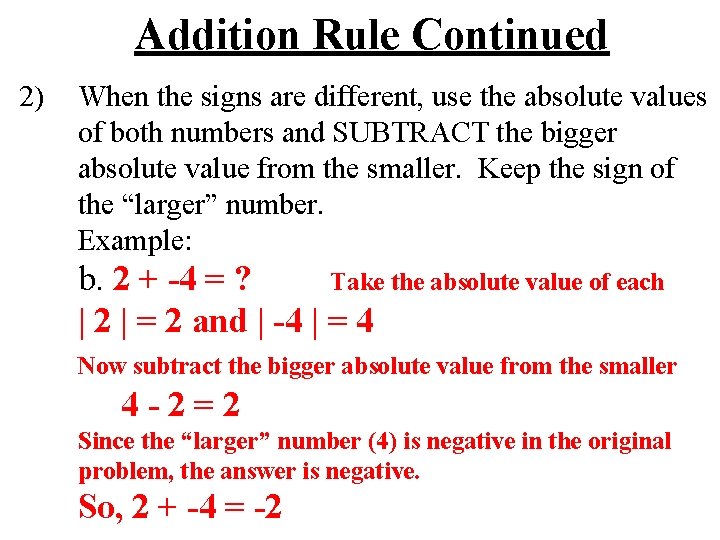
Addition Rule Continued 2) When the signs are different, use the absolute values of both numbers and SUBTRACT the bigger absolute value from the smaller. Keep the sign of the “larger” number. Example: b. 2 + -4 = ? Take the absolute value of each | 2 | = 2 and | -4 | = 4 Now subtract the bigger absolute value from the smaller 4 -2=2 Since the “larger” number (4) is negative in the original problem, the answer is negative. So, 2 + -4 = -2
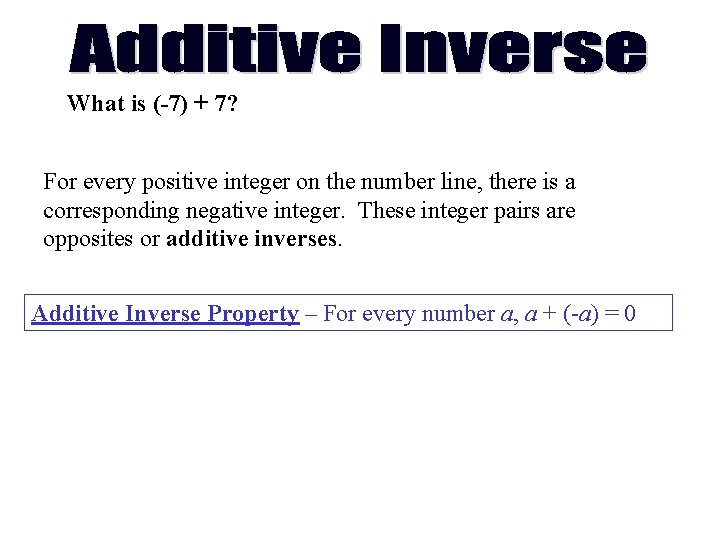
What is (-7) + 7? For every positive integer on the number line, there is a corresponding negative integer. These integer pairs are opposites or additive inverses. Additive Inverse Property – For every number a, a + (-a) = 0
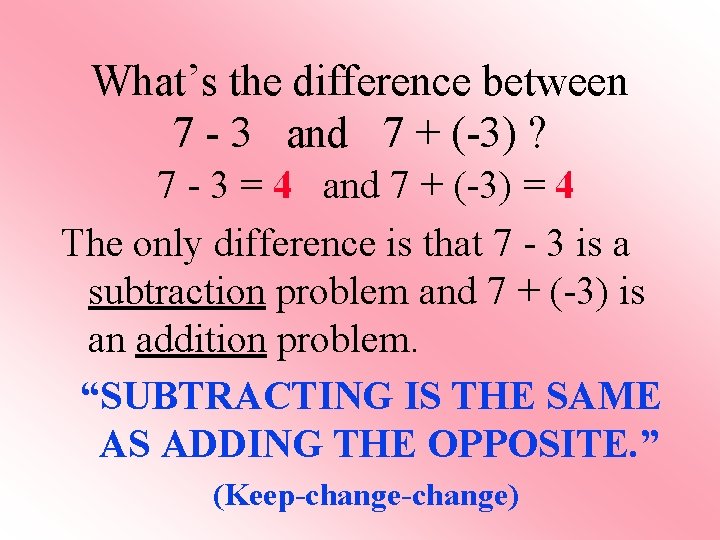
What’s the difference between 7 - 3 and 7 + (-3) ? 7 - 3 = 4 and 7 + (-3) = 4 The only difference is that 7 - 3 is a subtraction problem and 7 + (-3) is an addition problem. “SUBTRACTING IS THE SAME AS ADDING THE OPPOSITE. ” (Keep-change)
Repeat after me (three times) • Adding a negative is the same thing as subtracting a positive • Subtracting a positive is the same thing as adding a negative
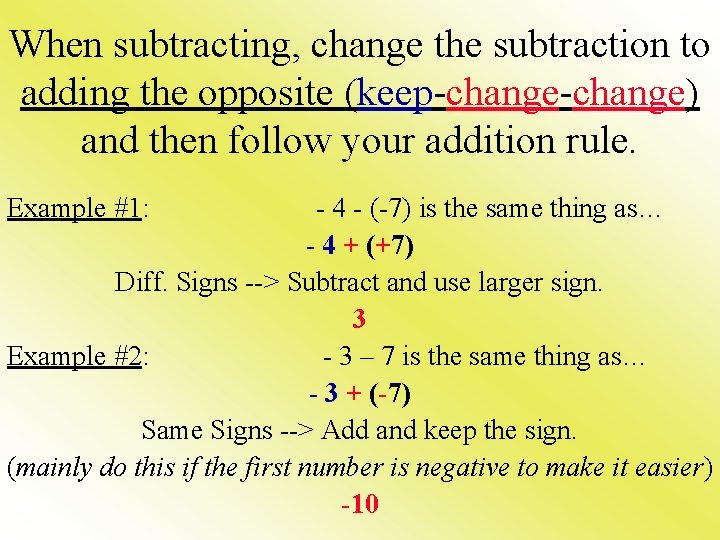
When subtracting, change the subtraction to adding the opposite (keep-change) and then follow your addition rule. Example #1: - 4 - (-7) is the same thing as… - 4 + (+7) Diff. Signs --> Subtract and use larger sign. 3 Example #2: - 3 – 7 is the same thing as… - 3 + (-7) Same Signs --> Add and keep the sign. (mainly do this if the first number is negative to make it easier) -10
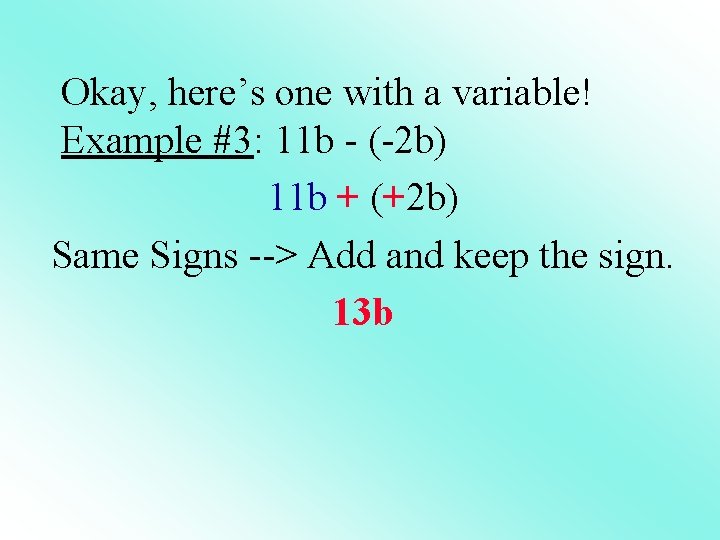
Okay, here’s one with a variable! Example #3: 11 b - (-2 b) 11 b + (+2 b) Same Signs --> Add and keep the sign. 13 b
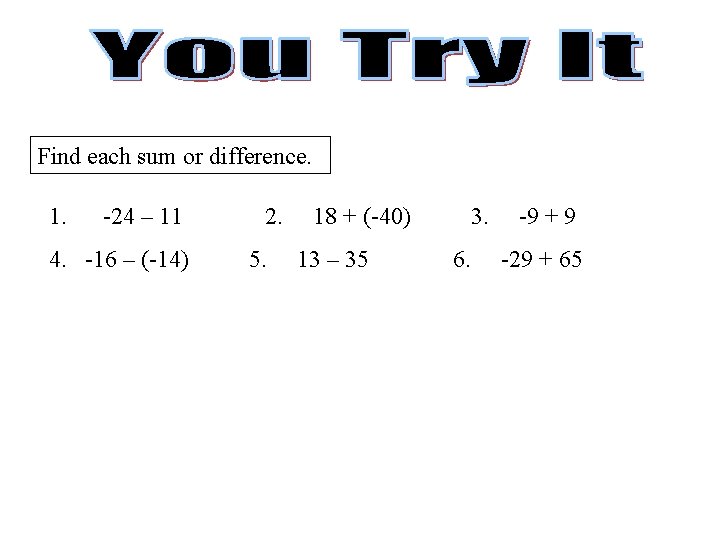
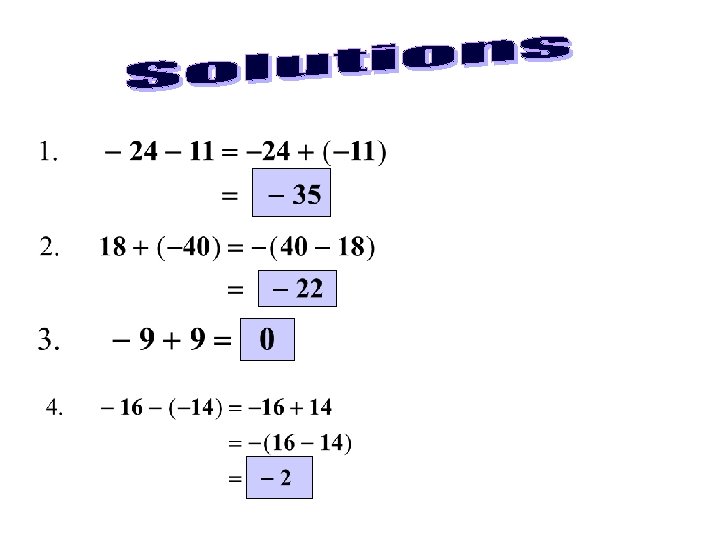
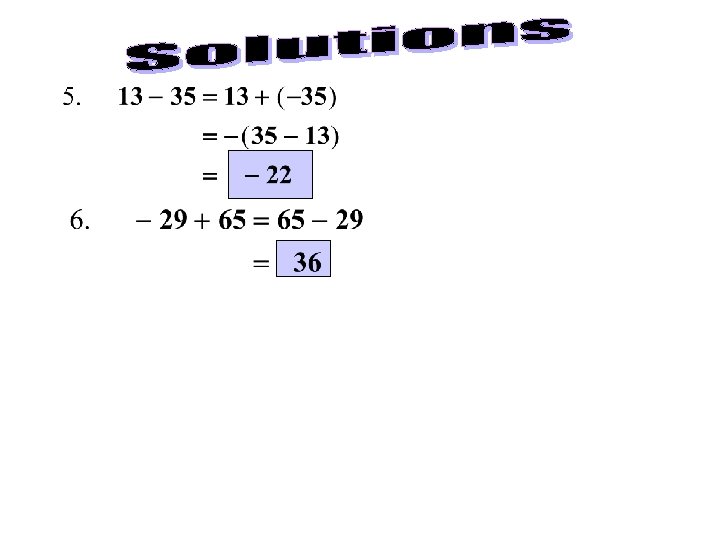
Find each sum or difference. 1. -24 – 11 4. -16 – (-14) 2. 5. 18 + (-40) 13 – 35 3. 6. -9 + 9 -29 + 65
Homework Page 44, #’s 2 -14 every other even Page 45, #’s 18 -30 even Page 49 -50, #’s 61 -63 odd, 65 (a-c), 66(a-c), 67 QUIZ NEXT CLASS
- Slides: 16