
Adding and Subtracting Decimals Lesson 1 5 The
Adding and Subtracting Decimals Lesson 1 -5
The Basic Steps: • Line up the numbers by the decimal point. • Fill in missing places with zeroes. • Add or subtract.
Addition Properties Commutative Property of Addition: Numbers can be added in any order. Example: 5+3=3+5 Associative Property of Addition: Numbers can be grouped in any way. Example: (7+3) + 5 = 7 + (3+5) Identity Property of Addition: The sum of any number and zero is that number. Example: 18 + 0 = 18
Mental Math • Addition properties can be used to quickly find sums. • Example: What is 52 + 12. 4 + 48? • We can use an addition property to quickly add this. • First, change the order: 52 + 48 + 12. 4 ________ property. commutative • Then, group the first two addends together: (52 + 48) + 12. 4 ________ property associative • 100 + 12. 4 = 112. 4
Why Estimate? • Before adding your numbers, use one of the estimating strategies you learned to see what the answer should be close to. • When you add, you can see if your answer is reasonable.
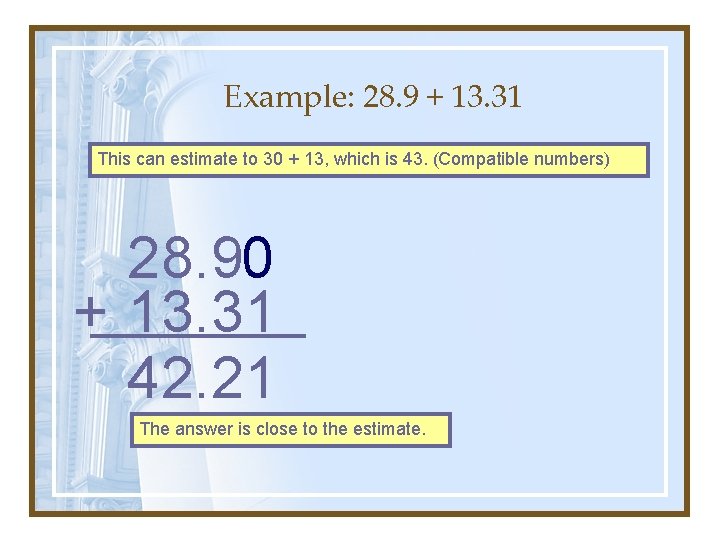
Example: 28. 9 + 13. 31 This can estimate to 30 + 13, which is 43. (Compatible numbers) 28. 90 + 13. 31 42. 21 The answer is close to the estimate.
Subtracting • The addition properties do not work for subtraction. • Estimate and subtract to find what the answer is close to. • Subtract to find the real answer.
Subtracting Across Zeroes • If you have several zeroes in a row, and you need to borrow, go to the first digit that is not zero, and borrow. • All middle zeroes become 9’s. • The final zero becomes 10.
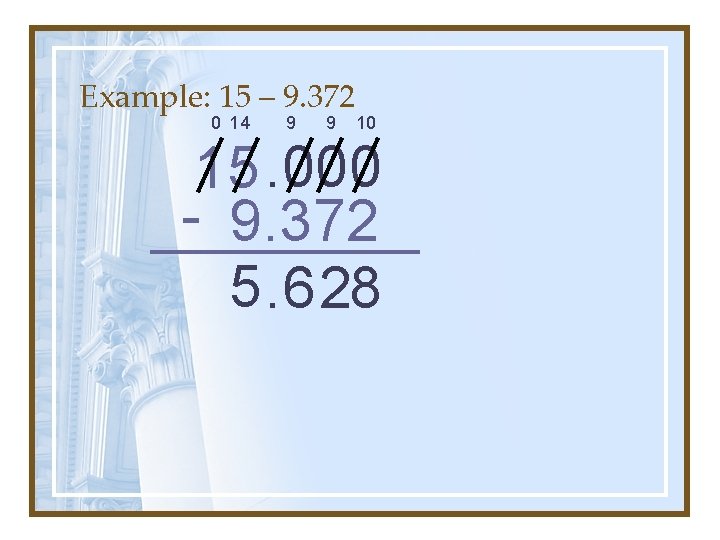
Example: 15 – 9. 372 0 14 9 9 10 15. 000 - 9. 372 5. 6 28

Homework Time The above image is a royalty free picture provided by http: //www. bigfoto. com
- Slides: 10