
Addiction is everybodys business Anna Nelson www matuaraki
Addiction is everybody’s business Anna Nelson www. matuaraki. org. nz www. tepou. co. nz
Matua Raki The National Addiction Workforce Development Programme Purpose: To minimise addiction-related harm by developing a highly skilled, competent and confident workforce which, supported by sound infrastructure, will provide accessible and effective services
Addiction is everybody’s business • 3. 5% of the population will have serious AOD problems=157, 000 • Approx. 45, 000 seen at specialist services • Many more experience harmful use
Learning outcomes • Explore attitudes, values and assumptions about people who use substances (possible stigma and discrimination). • Understand some basic alcohol and other drug classifications • Understand specialist addiction treatment options in the context of our addiction sector • Understand how you might offer a brief intervention • Understand the concept of ‘harm reduction’
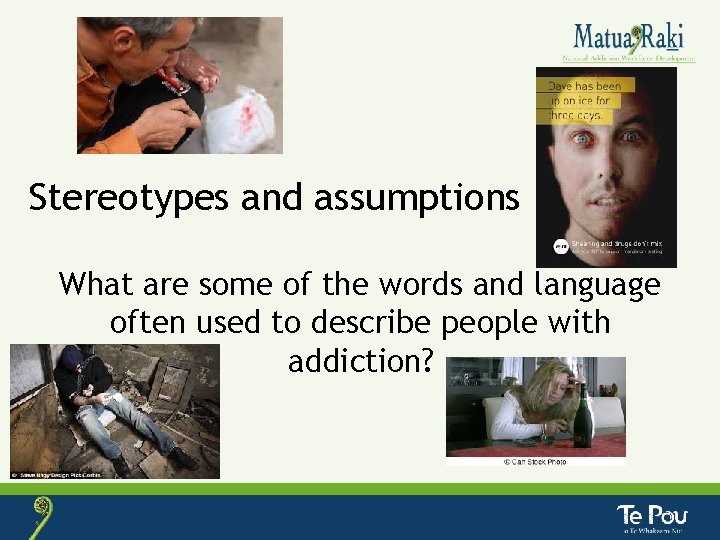
Stereotypes and assumptions What are some of the words and language often used to describe people with addiction?
Addiction does not discriminate

“I might want to work but who would give someone like me a job? ” People who experience problematic substance use, once unemployed, face multiple barriers to returning to work. As a result, their employment rate is well below that of the general population.
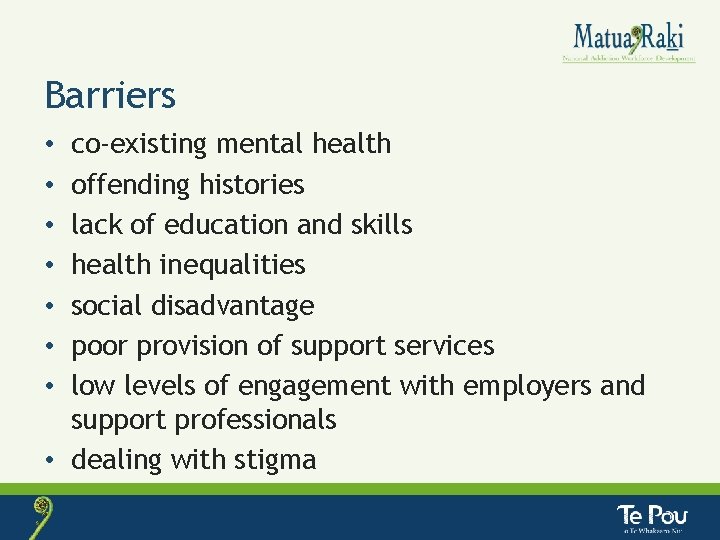
Barriers co-existing mental health offending histories lack of education and skills health inequalities social disadvantage poor provision of support services low levels of engagement with employers and support professionals • dealing with stigma • •
Recovery is not just about tackling the symptoms and causes of dependence, but about enabling people to successfully reintegrate into their communities (HM Government, 2010).

Employment • Individuals who currently have problematic substance use often reduce their use or become motivated to try to abstain when they have a job • Most studies have found that employment can moderate relapse and assist treatment retention
Power of language • Language has more impact than is often acknowledged and language and power are inextricably linked. • “Common language in use reflects a worldview and in itself can reproduce relations of dominance and subordination”. Language is a key medium through which dominating groups reinforce their superiority and prescribe the inferior status of minority groups. Reference: (Thompson, N. (2003) Language and Communication: A Handbook of Theory and Practice. Basingstoke: Palgrave Mac. Millian
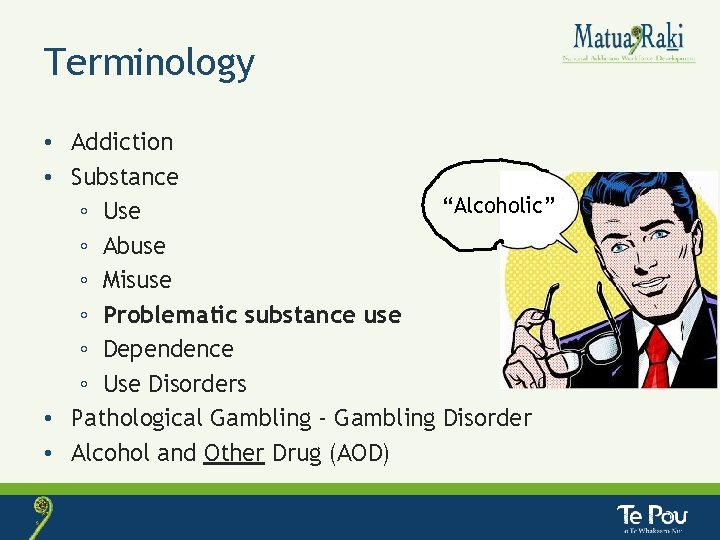
Terminology • Addiction • Substance “Alcoholic” ◦ Use ◦ Abuse ◦ Misuse ◦ Problematic substance use ◦ Dependence ◦ Use Disorders • Pathological Gambling - Gambling Disorder • Alcohol and Other Drug (AOD)
AOD Classification ◦ Depressants-are drugs that slow down the central nervous system (CNS) and because of this they are sometimes called downers. They make people feel sleepy, relaxed and calm ◦ Stimulants-these substances increase activity in the CNS. They speed users up, makes users feel more energised and alert and give users a sense of wellbeing. They may also cause anxiety, restlessness and insomnia. ◦ Hallucinogens-produce a sensory experience of something that does not exist outside the mind (a hallucination).
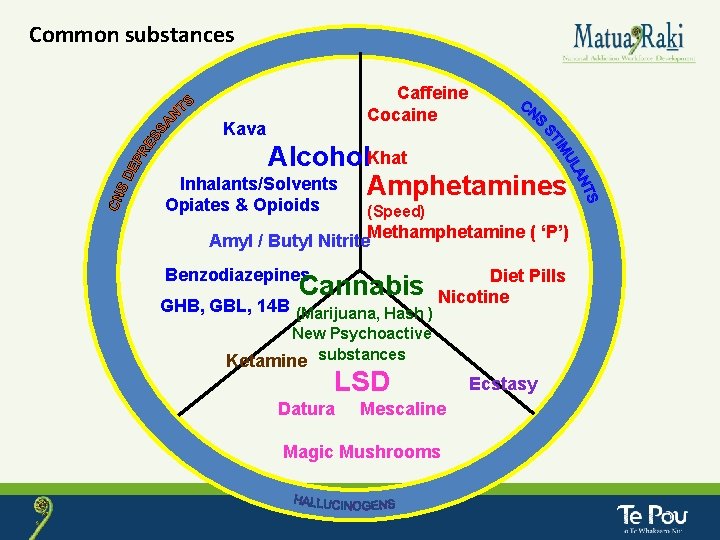
Common substances Caffeine Cocaine Kava Alcohol. Khat Inhalants/Solvents Amphetamines Opiates & Opioids (Speed) Methamphetamine ( ‘P’) Amyl / Butyl Nitrite Benzodiazepines Cannabis GHB, GBL, 14 B (Marijuana, Hash ) Diet Pills Nicotine New Psychoactive Ketamine substances LSD Datura Mescaline Magic Mushrooms Ecstasy
Dependence • Psychological habituation – a compulsion to take the substances periodically or continuously to have a good time or to avoid reality and manage emotional pain. • Physical dependence-user’s body has become dependent, without the substance the person will experience symptoms of withdrawal.
Tolerance • Depends on the substance • Person requires more and more of the substance to get the same effect • Usually also physically dependent
Reality check… The evidence suggests that a majority of people who use drugs are able to use them without harming themselves or others. They are able, in that sense, to manage their drug use…The harmless use of illegal drug use is possible, indeed common. (RSA, 2007: 11)
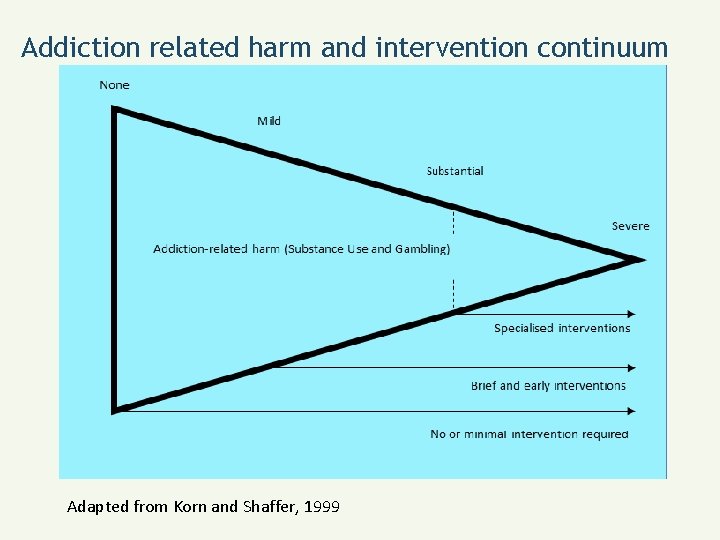
Addiction related harm and intervention continuum Adapted from Korn and Shaffer, 1999
Brief Intervention ‘Brief interventions are time limited, self help and preventative strategies to promote reductions in substance use in non -dependent clients and, in the case of dependent clients, to facilitate their referral to specialised treatment programmes’ (Zweben and Fleming, 1999: 253)
Standard drinks (adults) The standard drinks measure is a simple way to work out how much alcohol you are drinking. It measures the amount of pure alcohol in a drink. One standard drink equals 10 grams of pure alcohol. • Amount of drink in litres (Vol) x Percent by volume of alcohol (%) x Density of ethanol at room temperature (0. 789) • Example: • 500 ml of beer which is 5 percent alcohol by volume. • 0. 5 x 0. 789 = 1. 97 (approx 2 standard drinks) • Making people aware of this is a ‘brief intervention’.
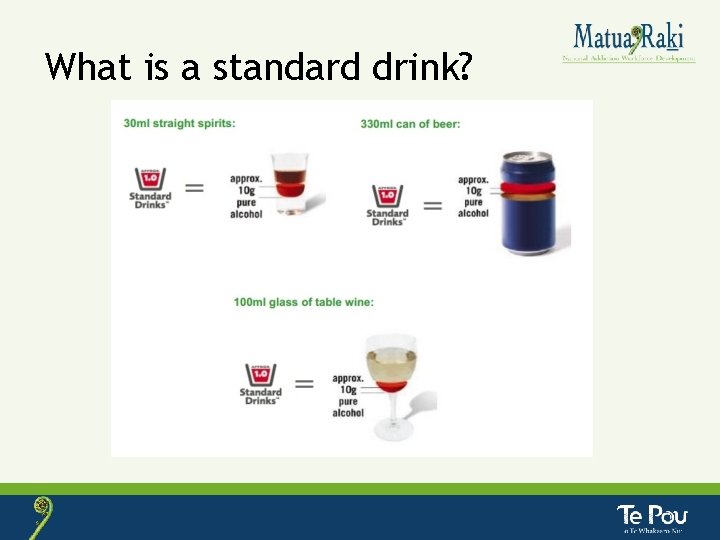
What is a standard drink?
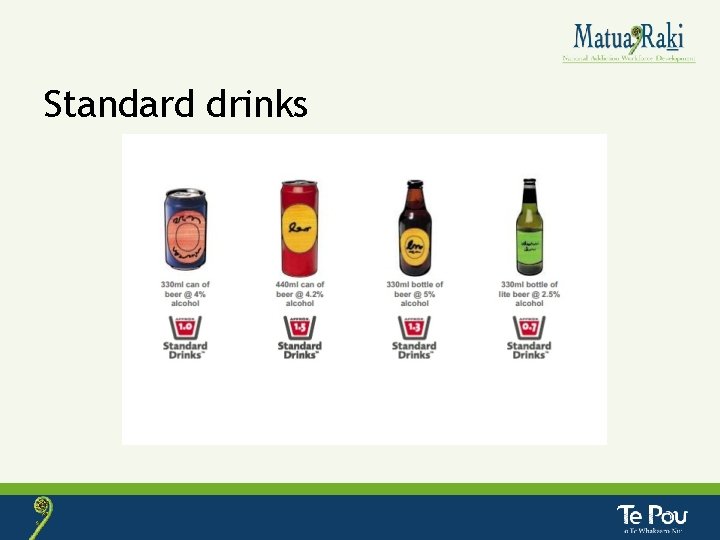
Standard drinks
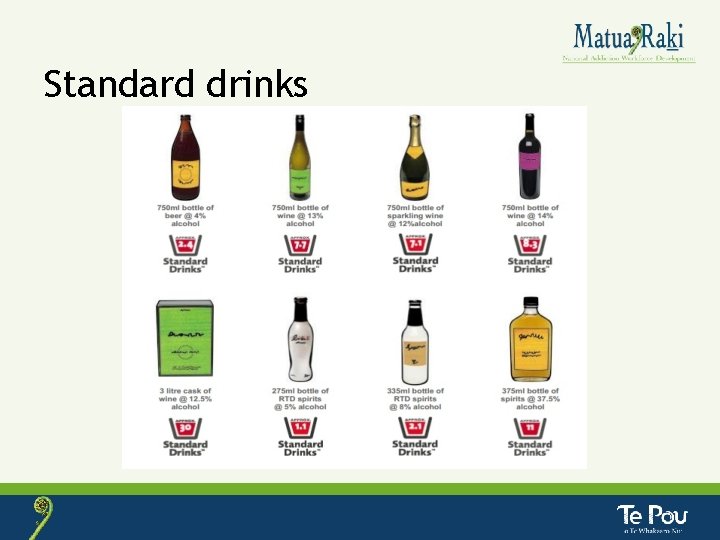
Standard drinks
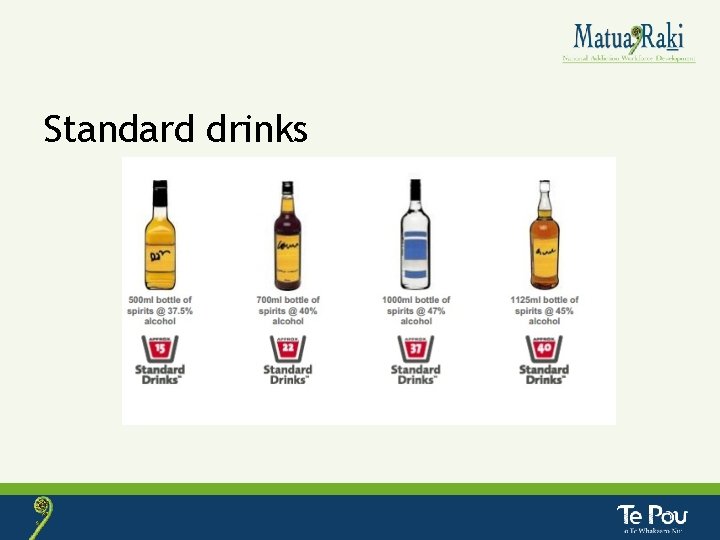
Standard drinks
Low risk drinking (adults) How much? • Reduce your long-term health risks by drinking no more than: • 2 standard drinks a day for women and no more than 10 standard drinks a week • 3 standard drinks a day for men and no more than 15 standard drinks a week • AND at least two alcohol-free days every week. • Reduce your risk of injury on a single occasion of drinking by drinking no more than: • 4 standard drinks for women on any single occasion • 5 standard drinks for men on any single occasion
Low risk drinking (adults) • • • Advice for pregnant women or those planning to get pregnant no alcohol There is no known safe level of alcohol use at any stage of pregnancy. • • �dvice for parents of children and young people under 18 years A For children and young people under 18 years, not drinking alcohol is the safest option. Those under 15 years of age are at the greatest risk of harm from drinking alcohol and not drinking in this age group is especially important. For young people aged 15 to 17 years, the safest option is to delay drinking for as long as possible. If 15 to 17 year olds do drink alcohol, they should be supervised, drink infrequently and at levels usually below and never exceeding the adult daily limits • • •
What we want to know is… • • What people are using? How much they are using? How often they use? How do they use (smoke, swallow, inject)? What the effects for them (positive and negative)? How often they feel guilt or remorse after using? What happens if they stop using?
Harm reduction (harmreduction. org) • Harm reduction is a set of practical strategies and ideas aimed at reducing negative consequences associated with substances use. Harm Reduction is also a movement for social justice built on a belief in, and respect for, the rights of people who use substances.
• Harm reduction incorporates a spectrum of strategies from safer use, to managed use to abstinence to meet substance users “where they’re at, ” addressing conditions of use along with the use itself. Because harm reduction demands that interventions and policies designed to serve drug users reflect specific individual and community needs, there is no universal definition of or formula for implementing harm reduction.
Harm reduction • Are you aware of any harm reduction strategies?
Harm reduction • Reducing levels of use-take less alcohol, drink less often, have a glass of water in between each drink • Eat before drinking • Changing to safer mode of use-smoke instead of inject • Needle exchange programme • Opiod substitution treatment • Planning ahead= driving, safe sex • Legal information about rights • Information about potential exacerbation of psychiatric problems • Overdose potential • Information about risks to personal reputation, realtionships, career
Support options Withdrawal management-medical, social, home 12 step groups in community e. g. AA, NA, Al-Anon Community outpatients e. g. CADS Day Programmes e. g. CADS Residential e. g. Salvation Army Bridge Programme • Therapeutic Communities e. g. Higher Ground, Odyssey House • Alcohol Drug Helpline 0800 787 797 • Local options? • • •
Resources and help services • Alcohol Drug Helpline 0800 787 797 http: //alcoholdrughelp. org. nz • HPA http: //www. hpa. org. nz • Drug. Help www. drughelp. org. nz • Kina Trust www. kina. org. nz (for families and whānau • AA www. aa. org. nz • NA www. nzna. org • Living sober http: //www. livingsober. org. nz/
“Work gave me the motivation to begin to address my addiction, without I wouldn’t have had a reason to change”.

Anna Nelson anna. nelson@matuaraki. org. nz www. matuaraki. org. nz
- Slides: 38