
Addendum For the simple cases in 2 dimensions
- Slides: 5
Addendum For the simple cases in 2 -dimensions we have not distinguished between homotopy and homology. The distinction however does exist even in 2 -d. See our more recent [AURO 2012] paper or [RSS 2011] paper for a comprehensive discussion on the distinction between homotopy and homology, examples illustrating the distinction, and its implications in robot planning problems. [AURO 2012] Subhrajit Bhattacharya, Maxim Likhachev and Vijay Kumar (2012) "Topological Constraints in Search-based Robot Path Planning". Autonomous Robots, 33(3): 273 -290, October, Springer Netherlands. DOI: 10. 1007/s 10514 -012 -9304 -1. [RSS 2011] Subhrajit Bhattacharya, Maxim Likhachev and Vijay Kumar (2011) "Identification and Representation of Homotopy Classes of Trajectories for Search-based Path Planning in 3 D". [Original title: "Identifying Homotopy Classes of Trajectories for Robot Exploration and Path Planning"]. In Proceedings of Robotics: Science and Systems. 27 -30 June.
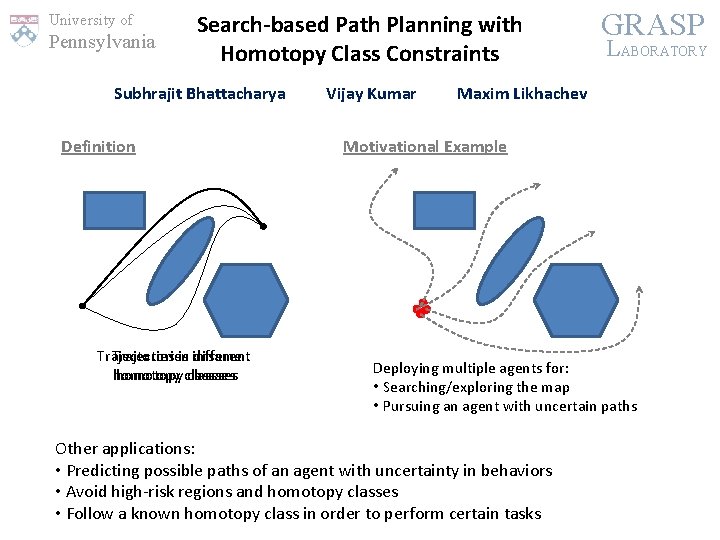
University of Pennsylvania Search-based Path Planning with Homotopy Class Constraints Subhrajit Bhattacharya Definition Trajectories in in different same homotopy classses Vijay Kumar GRASP LABORATORY Maxim Likhachev Motivational Example Deploying multiple agents for: • Searching/exploring the map • Pursuing an agent with uncertain paths Other applications: • Predicting possible paths of an agent with uncertainty in behaviors • Avoid high-risk regions and homotopy classes • Follow a known homotopy class in order to perform certain tasks
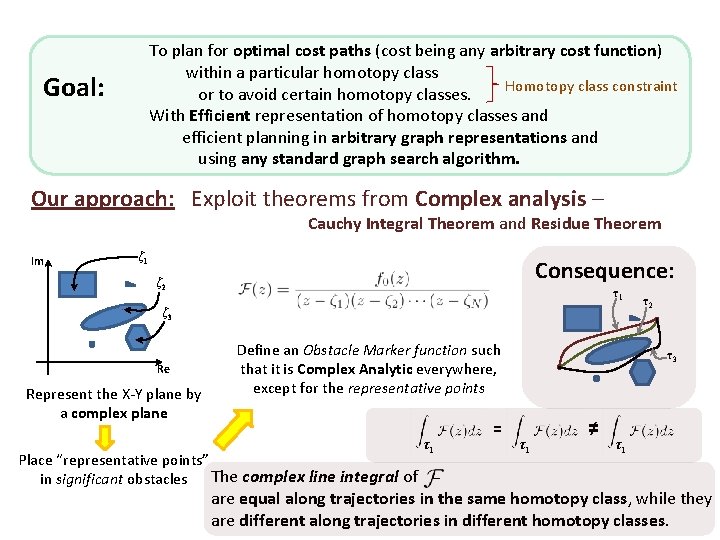
To plan for optimal cost paths (cost being any arbitrary cost function) within a particular homotopy class Homotopy class constraint or to avoid certain homotopy classes. With Efficient representation of homotopy classes and efficient planning in arbitrary graph representations and using any standard graph search algorithm. Goal: Our approach: Exploit theorems from Complex analysis – Cauchy Integral Theorem and Residue Theorem Im ζ 1 Consequence: ζ 2 τ1 ζ 3 Re Represent the X-Y plane by a complex plane Define an Obstacle Marker function such that it is Complex Analytic everywhere, except for the representative points Place “representative points” in significant obstacles The complex line integral of τ1 = τ2 τ3 τ1 ≠ τ1 are equal along trajectories in the same homotopy class, while they are different along trajectories in different homotopy classes.
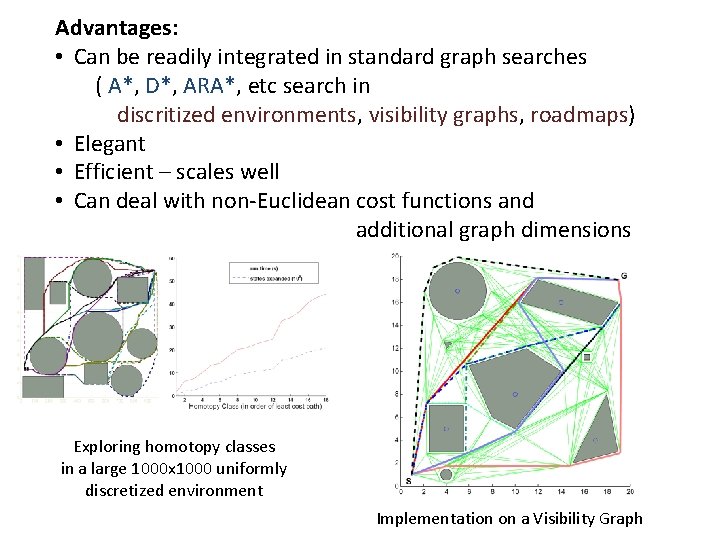
Advantages: • Can be readily integrated in standard graph searches ( A*, D*, ARA*, etc search in discritized environments, visibility graphs, roadmaps) • Elegant • Efficient – scales well • Can deal with non-Euclidean cost functions and additional graph dimensions Exploring homotopy classes in a large 1000 x 1000 uniformly discretized environment Implementation on a Visibility Graph
More at the poster: • Details on theory • Graph construction • Algorithmic details • Insight into graph topology • Interesting results and applications Please stop by!! Thank you.