
ADD INFO ONTO PAGE 13 Feminism Lesson Objectives

ADD INFO ONTO PAGE 13
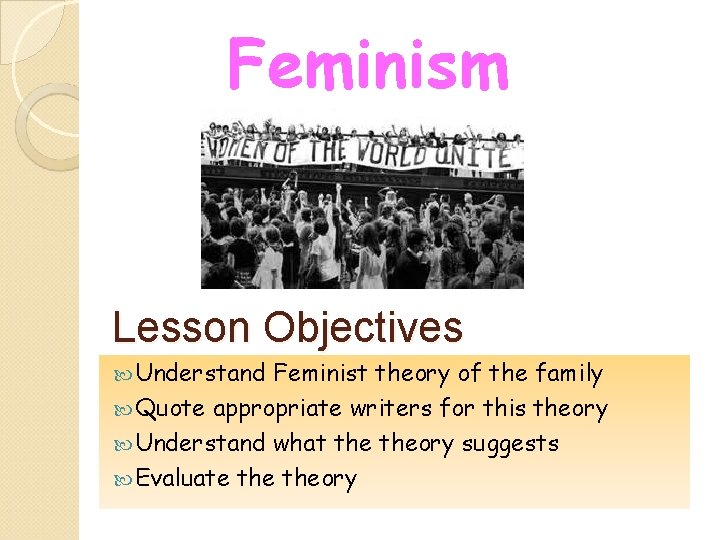
Feminism Lesson Objectives Understand Feminist theory of the family Quote appropriate writers for this theory Understand what theory suggests Evaluate theory
Starter: Card sort Sort the cards out into a timeline of events to do with feminism/women’s rights.
Timeline… Emmeline Pankhurst founds the Women's Social and Political Union (WSPU). The word "suffragette" was first used to describe women campaigning for the right to vote. Emily Wilding Davison throws herself under the King's horse at the Epsom
Timeline… Representation of the People bill, doubles the electorate, giving the parliamentary vote to about six million women. Nancy Astor becomes the first woman to take her seat in the House of Commons. Women given the vote at the age of 21 - the same as men. By the end of the war there were 460, 000 women in the military and over 6. 5 million in civilian war work.
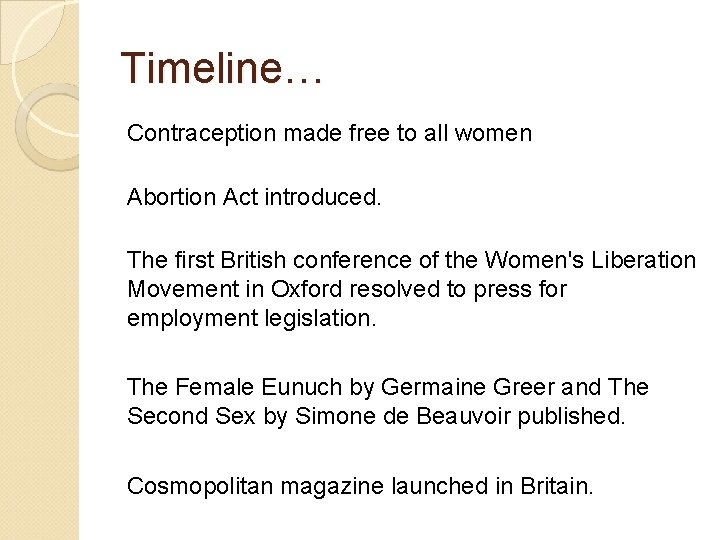
Timeline… Contraception made free to all women Abortion Act introduced. The first British conference of the Women's Liberation Movement in Oxford resolved to press for employment legislation. The Female Eunuch by Germaine Greer and The Second Sex by Simone de Beauvoir published. Cosmopolitan magazine launched in Britain.
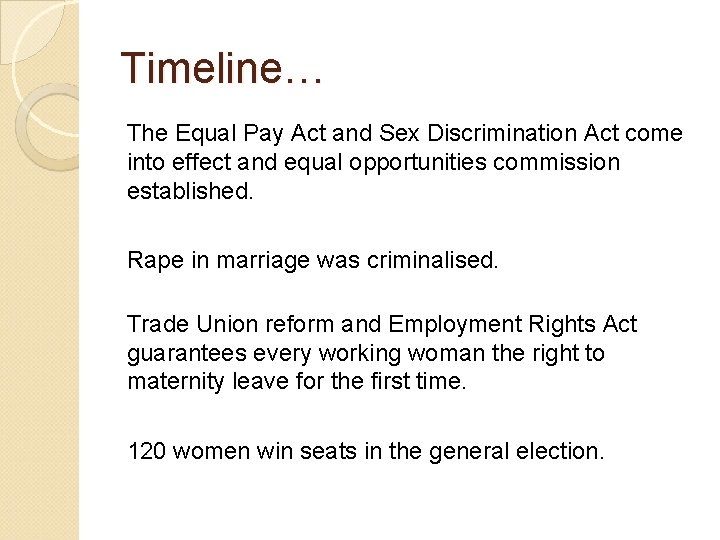
Timeline… The Equal Pay Act and Sex Discrimination Act come into effect and equal opportunities commission established. Rape in marriage was criminalised. Trade Union reform and Employment Rights Act guarantees every working woman the right to maternity leave for the first time. 120 women win seats in the general election.
Can women get into the top jobs? If so, are there any job sectors that women are more likely to succeed in?
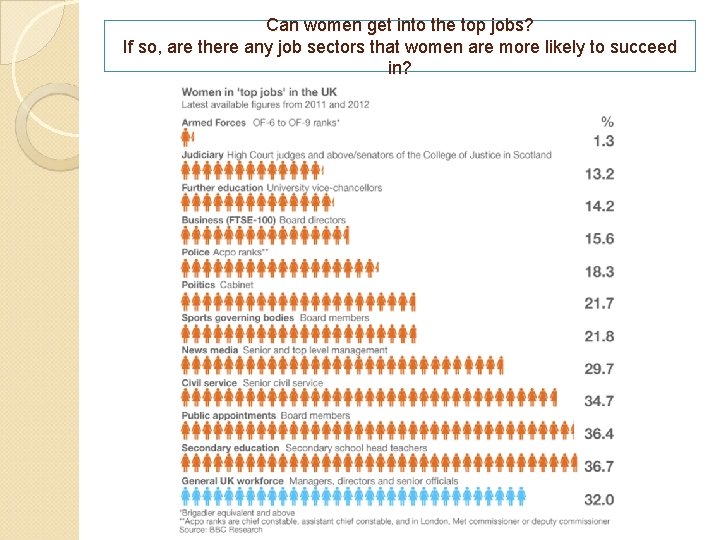
Can women get into the top jobs? If so, are there any job sectors that women are more likely to succeed in?
Feminism Watch the background on feminism. What are your thoughts? In what ways have women been oppressed. http: //www. youtube. com/watch? v=6 Xg. PD 8 d 3 h. T 0 What are the miss conceptions of feminism? How is femininity perceived in western society? How are women defined?
Feminist Perspectives Conflict theory – between males and females They are interested in the structure of patriarchy (male domination, female subordination and therefore gender inequality) that characterizes the organisation of modern societies. Focus on gender inequality in education, employment, social mobility, political power and family relationships.
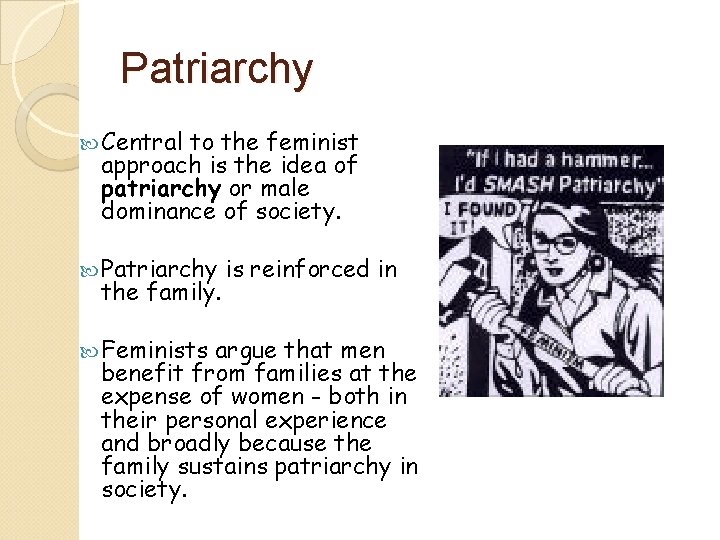
Patriarchy Central to the feminist approach is the idea of patriarchy or male dominance of society. Patriarchy the family. Feminists is reinforced in argue that men benefit from families at the expense of women - both in their personal experience and broadly because the family sustains patriarchy in society.
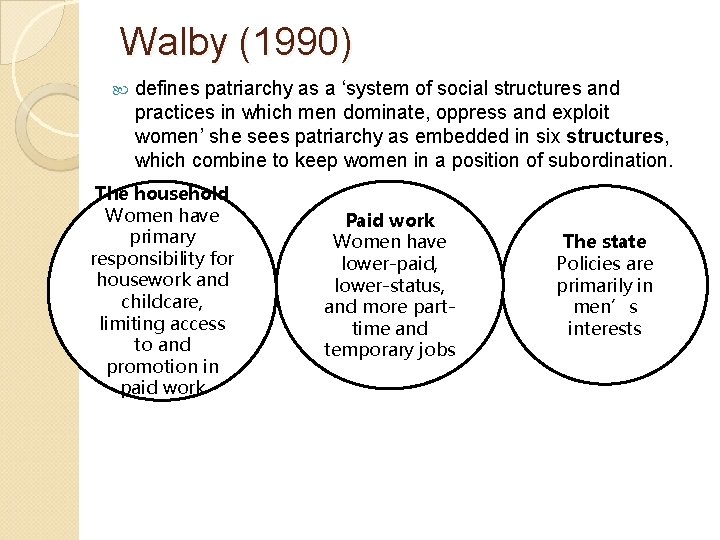
Walby (1990) defines patriarchy as a ‘system of social structures and practices in which men dominate, oppress and exploit women’ she sees patriarchy as embedded in six structures, which combine to keep women in a position of subordination. The household Women have primary responsibility for housework and childcare, limiting access to and promotion in paid work Paid work Women have lower-paid, lower-status, and more parttime and temporary jobs The state Policies are primarily in men’s interests
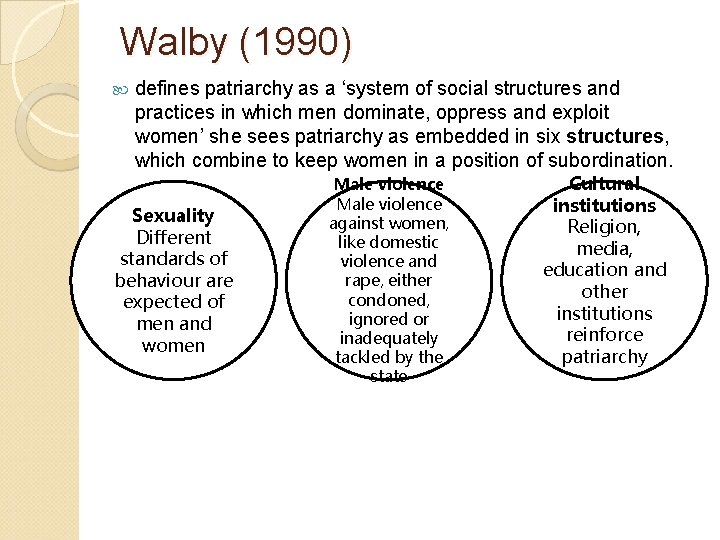
Walby (1990) defines patriarchy as a ‘system of social structures and practices in which men dominate, oppress and exploit women’ she sees patriarchy as embedded in six structures, which combine to keep women in a position of subordination. Sexuality Different standards of behaviour are expected of men and women Male violence against women, like domestic violence and rape, either condoned, ignored or inadequately tackled by the state Cultural institutions Religion, media, education and other institutions reinforce patriarchy
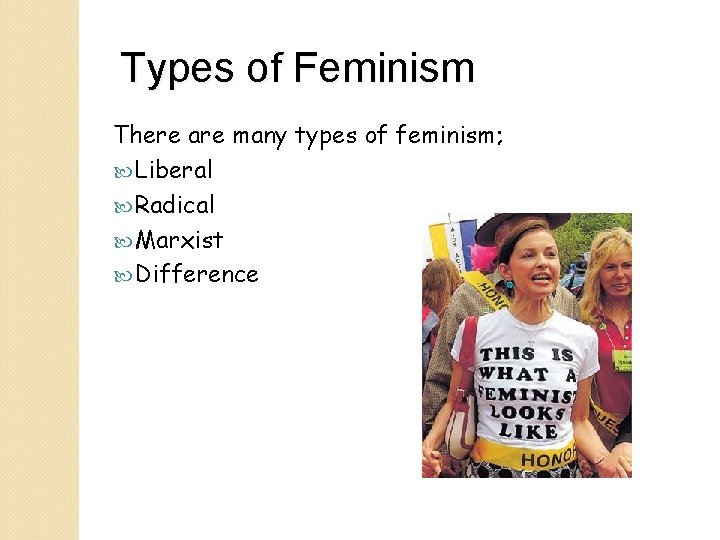
Types of Feminism There are many types of feminism; Liberal Radical Marxist Difference
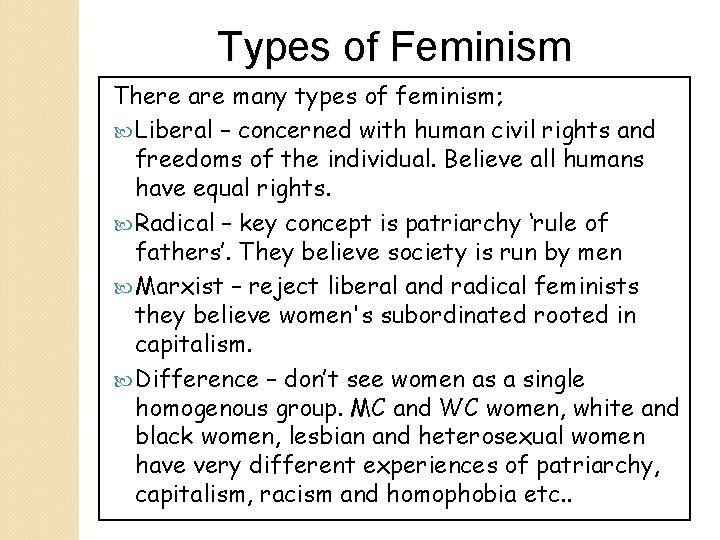
Types of Feminism There are many types of feminism; Liberal – concerned with human civil rights and freedoms of the individual. Believe all humans have equal rights. Radical – key concept is patriarchy ‘rule of fathers’. They believe society is run by men Marxist – reject liberal and radical feminists they believe women's subordinated rooted in capitalism. Difference – don’t see women as a single homogenous group. MC and WC women, white and black women, lesbian and heterosexual women have very different experiences of patriarchy, capitalism, racism and homophobia etc. .
Task In groups you will each be assigned a different feminist approach You will each become an expert on this type of feminism. You are going to make a story board/presentation this lesson – we will present it on Friday You must be able to explain it without reading it off your sheet.
Preparation for Learning Pictionary
Lesson Objective To be able to evaluate feminist perspectives of society.
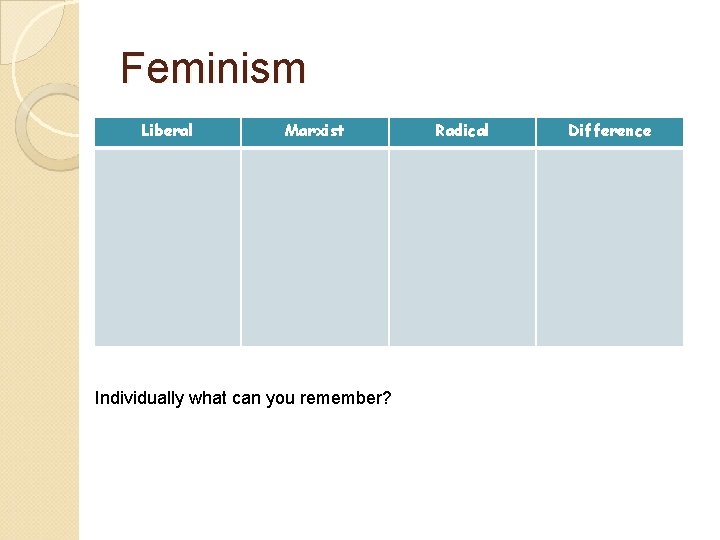
Feminism Liberal Marxist Individually what can you remember? Radical Difference
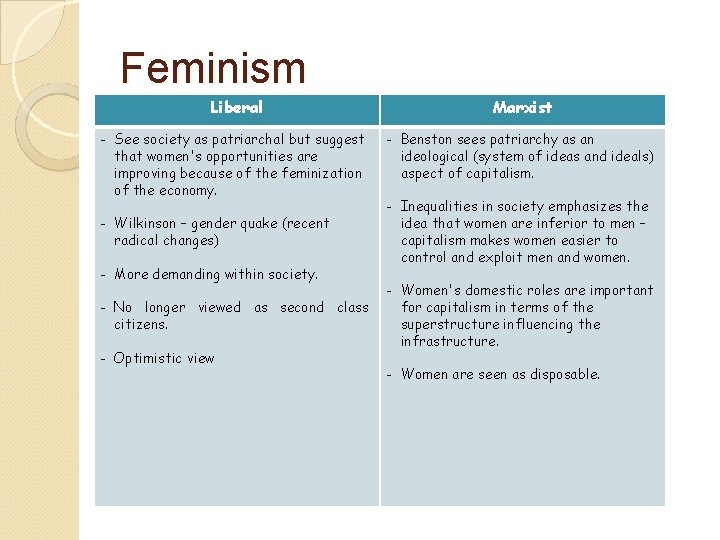
Feminism Liberal Marxist - See society as patriarchal but suggest that women's opportunities are improving because of the feminization of the economy. - Benston sees patriarchy as an ideological (system of ideas and ideals) aspect of capitalism. - Wilkinson – gender quake (recent radical changes) - More demanding within society. - No longer viewed as second class citizens. - Optimistic view - Inequalities in society emphasizes the idea that women are inferior to men – capitalism makes women easier to control and exploit men and women. - Women's domestic roles are important for capitalism in terms of the superstructure influencing the infrastructure. - Women are seen as disposable.
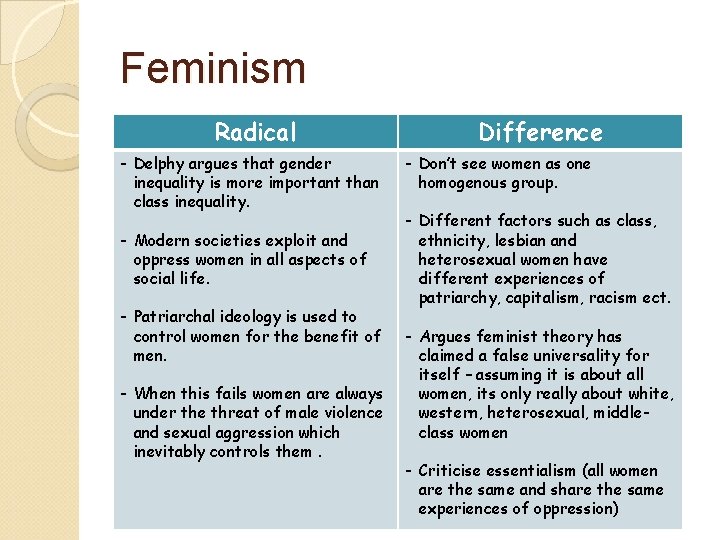
Feminism Radical - Delphy argues that gender inequality is more important than class inequality. - Modern societies exploit and oppress women in all aspects of social life. - Patriarchal ideology is used to control women for the benefit of men. - When this fails women are always under the threat of male violence and sexual aggression which inevitably controls them. Difference - Don’t see women as one homogenous group. - Different factors such as class, ethnicity, lesbian and heterosexual women have different experiences of patriarchy, capitalism, racism ect. - Argues feminist theory has claimed a false universality for itself – assuming it is about all women, its only really about white, western, heterosexual, middleclass women - Criticise essentialism (all women are the same and share the same experiences of oppression)
Construct Judge whether the you think the following evaluation points are strengths or weaknesses of each feminist perspective – explain why.
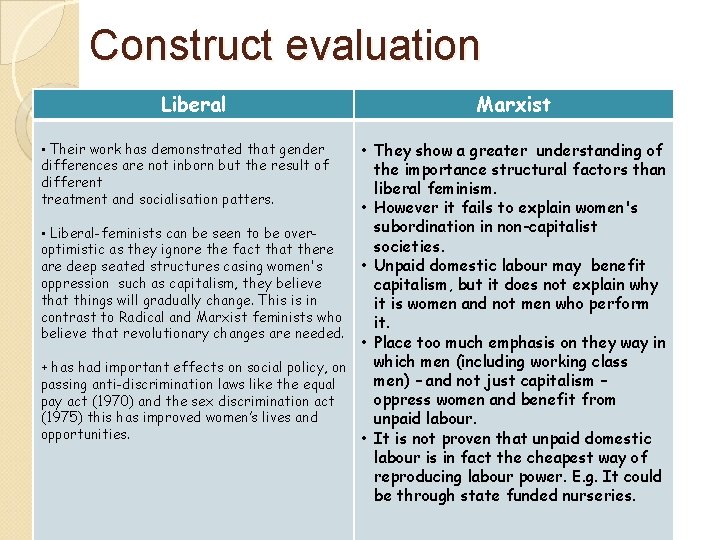
Construct evaluation Liberal Marxist • They show a greater understanding of the importance structural factors than liberal feminism. • However it fails to explain women's subordination in non-capitalist • Liberal-feminists can be seen to be oversocieties. optimistic as they ignore the fact that there • Unpaid domestic labour may benefit are deep seated structures casing women's oppression such as capitalism, they believe capitalism, but it does not explain why that things will gradually change. This is in it is women and not men who perform contrast to Radical and Marxist feminists who it. believe that revolutionary changes are needed. • Place too much emphasis on they way in which men (including working class + has had important effects on social policy, on men) – and not just capitalism – passing anti-discrimination laws like the equal oppress women and benefit from pay act (1970) and the sex discrimination act (1975) this has improved women’s lives and unpaid labour. opportunities. • It is not proven that unpaid domestic labour is in fact the cheapest way of reproducing labour power. E. g. It could be through state funded nurseries. • Their work has demonstrated that gender differences are not inborn but the result of different treatment and socialisation patters.
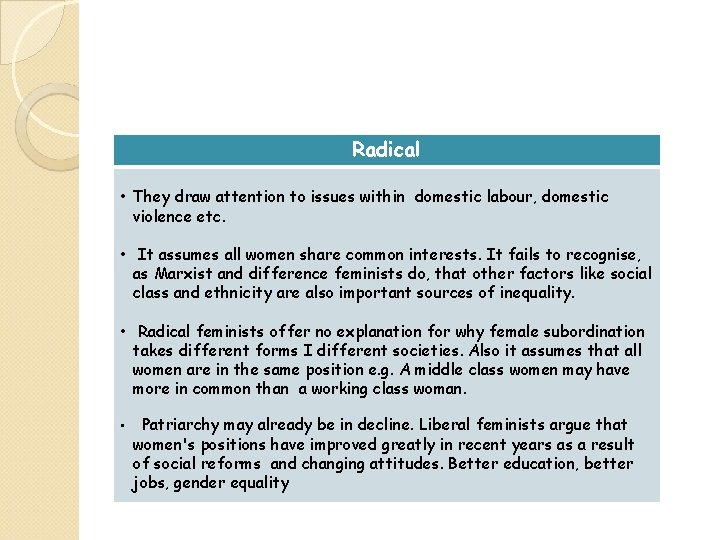
Radical • They draw attention to issues within domestic labour, domestic violence etc. • It assumes all women share common interests. It fails to recognise, as Marxist and difference feminists do, that other factors like social class and ethnicity are also important sources of inequality. • Radical feminists offer no explanation for why female subordination takes different forms I different societies. Also it assumes that all women are in the same position e. g. A middle class women may have more in common than a working class woman. • Patriarchy may already be in decline. Liberal feminists argue that women's positions have improved greatly in recent years as a result of social reforms and changing attitudes. Better education, better jobs, gender equality
Evaluation Difference J Recognises that general ‘broad brush’ feminist theories don’t take into account this diversity in nature and experience of women’s subordination, it is necessary to explore the patriarchy and women’s subordination in society J Liberal and radical feminists criticise difference feminists because by emphasising the differences between women, it deflects attention away from the problems shared by all women.
Apply What do we know about each type of feminism in relation to education? You are going to use this information including the evaluation to create a newspaper article on A 3 paper – you must cover all types of feminism but your stories can relate to education. You can make things up e. g. Crosswords/interviews/stories as long as it has a feminist focus.
Feminism Assess the usefulness of feminist contribution to our understanding of society today (20 marks) What information would you use?
- Slides: 28