
Adaptive Wireless Solutions Ltd Company Overview Copyright 2013






- Slides: 27
Adaptive Wireless Solutions Ltd Company Overview Copyright© 2013 Adaptive Wireless Solutions Ltd
Adaptive Wireless Solutions • • • Specialists in monitoring and control solutions using wireless mesh sensor networks for over 8 years Offer systems integration and equipment supply for numerous wireless and wired technologies driven by customer requirements Distributor for ECOMM and Wireless Sensors in UK and Europe Certified System Partner for HMS Industrial Networks (Netbiter) in UK Can help you integrate and manage your data gathering, monitoring and control activities – – – – Complete solution design, supply and support Wireless technology consulting and advice Programme and project management Technical and wireless architecture design Equipment and software supply from multiple vendors Integration with other systems Installation and commissioning Maintenance and Support Copyright© 2013 Adaptive Wireless Solutions Ltd
Customers and Projects • • We have had enquiries and projects in BMS extension, energy management, industrial plants, IT environments, and related monitoring and control applications in a wide cross-section of industries from commercial offices, universities and colleges, hotels and apartment complexes to warehousing, recycling plants, food companies and national utilities. Customers in UK, Ireland, Italy, Netherlands, Belgium, Hungary, Israel, Saudi Arabia BOMBARDIER Copyright© 2013 Adaptive Wireless Solutions Ltd
Business Advantages of Mesh Radio Economic and operational advantages vs. wired sensors • • Up to 90% lower installed costs – Lower cost of required equipment and supplies – Much quicker installation = less on-site time and less disruption Monitor and control in: – harsh environments (lots of metal and interference) – “wire unfriendly” situations where wires are difficult or undesirable Low cost and speedy retrofit to existing buildings, equipment and processes Monitors mobile or rotating equipment Easy optimisation of sensor position in process for a better result Cost-effective diagnostics in uncertain or temporary situations Multiple sensor types with standard wireless nodes on a single network Remote, ‘PC-less’, monitoring from anywhere on the internet Copyright© 2013 Adaptive Wireless Solutions Ltd
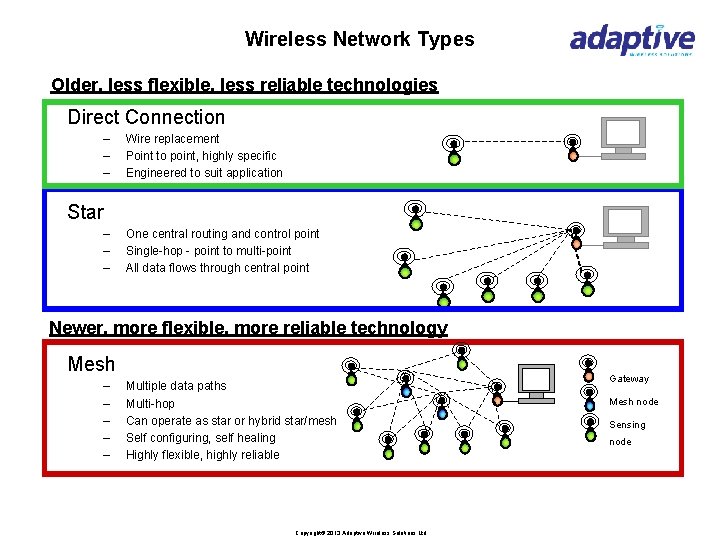
Wireless Network Types Older, less flexible, less reliable technologies Direct Connection – – – Wire replacement Point to point, highly specific Engineered to suit application Star – – – One central routing and control point Single-hop - point to multi-point All data flows through central point Newer, more flexible, more reliable technology Mesh – – – Multiple data paths Multi-hop Can operate as star or hybrid star/mesh Self configuring, self healing Highly flexible, highly reliable Copyright© 2013 Adaptive Wireless Solutions Ltd Gateway Mesh node Sensing node
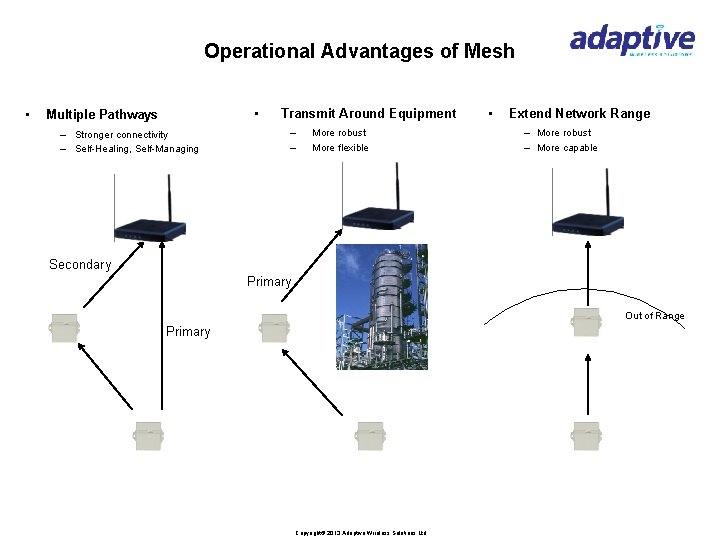
Operational Advantages of Mesh • • Multiple Pathways – Stronger connectivity – Self-Healing, Self-Managing Transmit Around Equipment – – More robust More flexible • Extend Network Range – More robust – More capable Secondary Primary Out of Range Primary Copyright© 2013 Adaptive Wireless Solutions Ltd
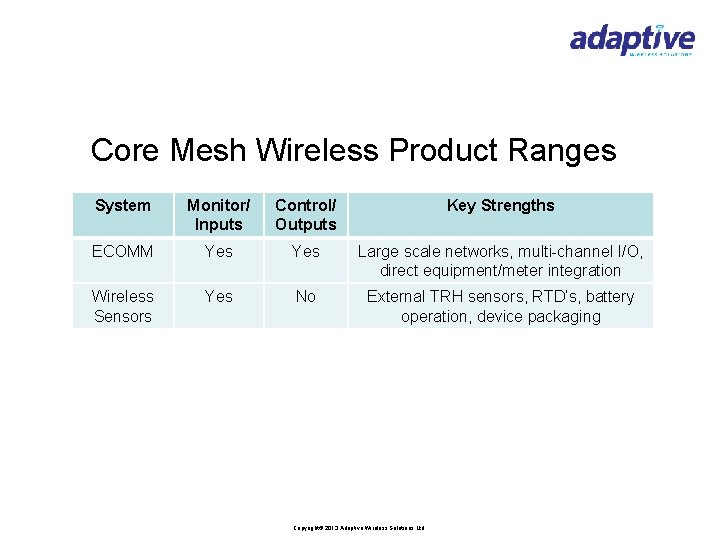
Core Mesh Wireless Product Ranges System Monitor/ Inputs Control/ Outputs Key Strengths ECOMM Yes Large scale networks, multi-channel I/O, direct equipment/meter integration Wireless Sensors Yes No External TRH sensors, RTD’s, battery operation, device packaging Copyright© 2013 Adaptive Wireless Solutions Ltd
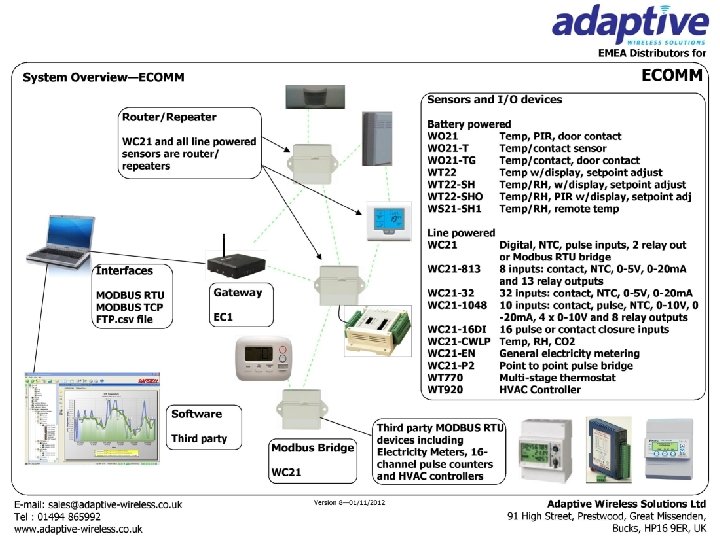
Copyright© 2013 Adaptive Wireless Solutions Ltd
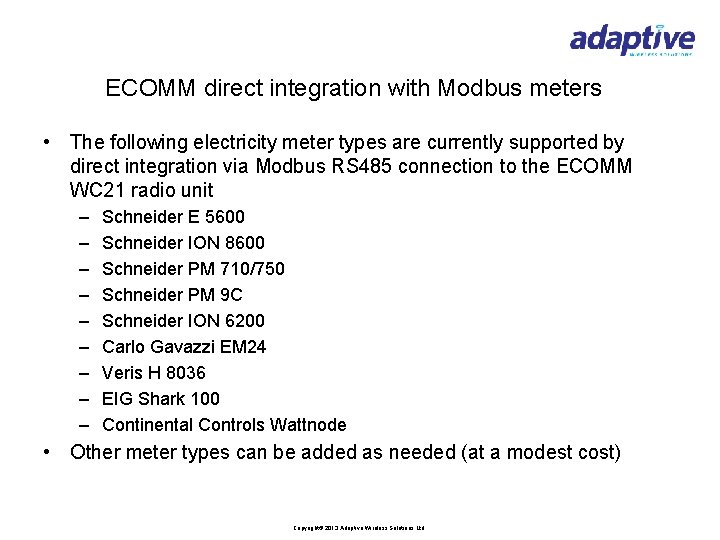
ECOMM direct integration with Modbus meters • The following electricity meter types are currently supported by direct integration via Modbus RS 485 connection to the ECOMM WC 21 radio unit – – – – – Schneider E 5600 Schneider ION 8600 Schneider PM 710/750 Schneider PM 9 C Schneider ION 6200 Carlo Gavazzi EM 24 Veris H 8036 EIG Shark 100 Continental Controls Wattnode • Other meter types can be added as needed (at a modest cost) Copyright© 2013 Adaptive Wireless Solutions Ltd
Copyright© 2013 Adaptive Wireless Solutions Ltd
Remote Monitoring and Control Copyright© 2013 Adaptive Wireless Solutions Ltd
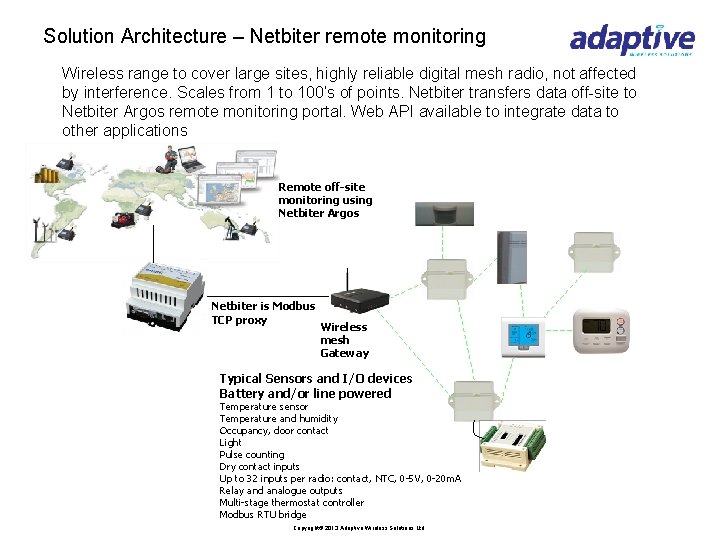
Solution Architecture – Netbiter remote monitoring Wireless range to cover large sites, highly reliable digital mesh radio, not affected by interference. Scales from 1 to 100’s of points. Netbiter transfers data off-site to Netbiter Argos remote monitoring portal. Web API available to integrate data to other applications Remote off-site monitoring using Netbiter Argos Netbiter is Modbus TCP proxy Wireless mesh Gateway Typical Sensors and I/O devices Battery and/or line powered Temperature sensor Temperature and humidity Occupancy, door contact Light Pulse counting Dry contact inputs Up to 32 inputs per radio: contact, NTC, 0 -5 V, 0 -20 m. A Relay and analogue outputs Multi-stage thermostat controller Modbus RTU bridge Copyright© 2013 Adaptive Wireless Solutions Ltd
Although we specialise in mesh radio we also use GSM/GPRS and Narrowband radio systems when needed to meet customer requirements Copyright© 2013 Adaptive Wireless Solutions Ltd
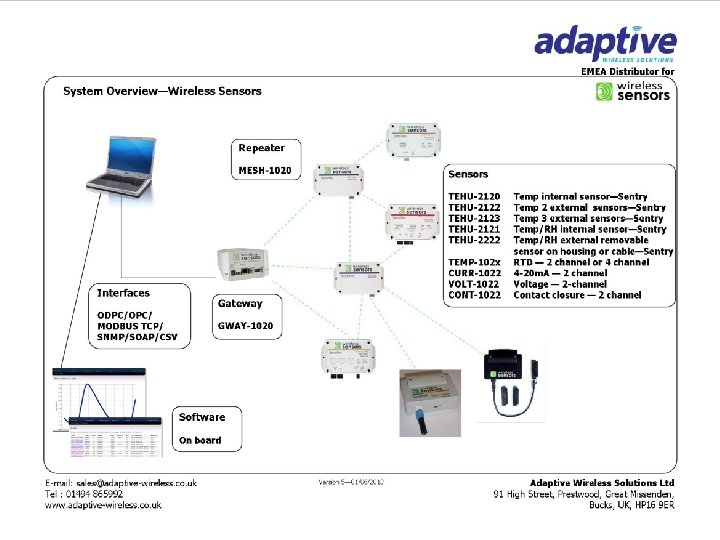
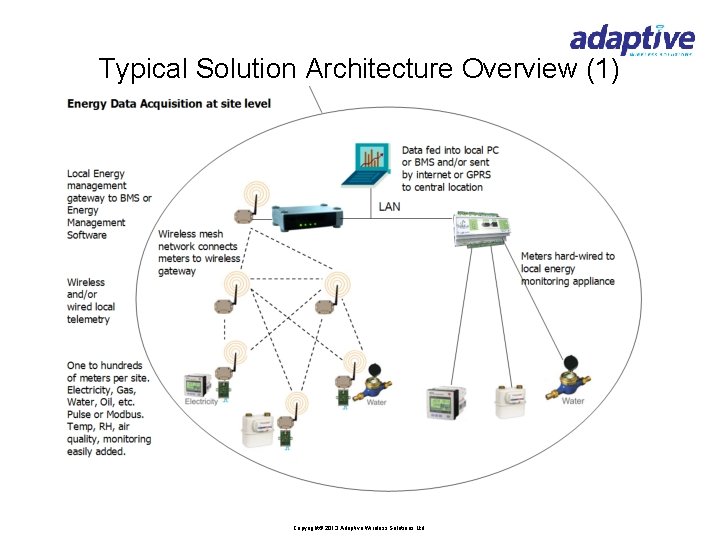
Typical Solution Architecture Overview (1) Copyright© 2013 Adaptive Wireless Solutions Ltd
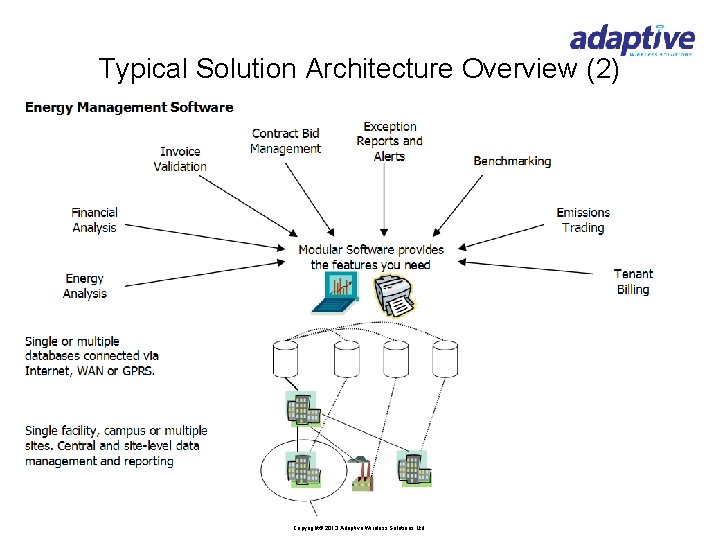
Typical Solution Architecture Overview (2) Copyright© 2013 Adaptive Wireless Solutions Ltd
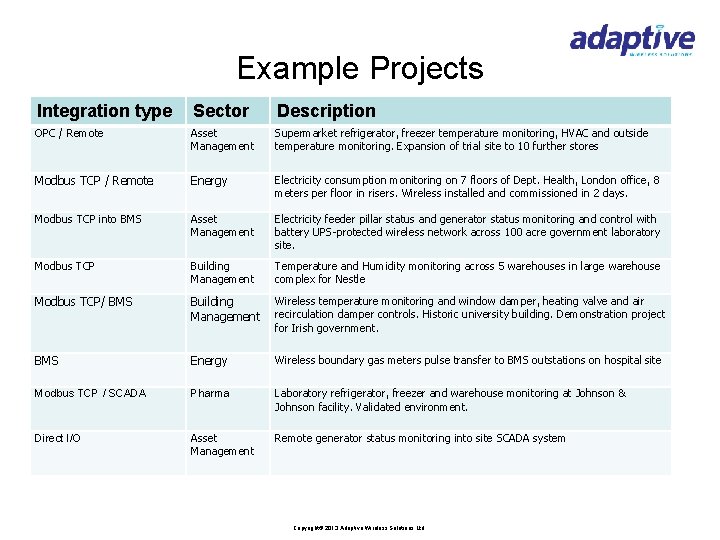
Example Projects Integration type Sector Description OPC / Remote Asset Management Supermarket refrigerator, freezer temperature monitoring, HVAC and outside temperature monitoring. Expansion of trial site to 10 further stores Modbus TCP / Remote Energy Electricity consumption monitoring on 7 floors of Dept. Health, London office, 8 meters per floor in risers. Wireless installed and commissioned in 2 days. Modbus TCP into BMS Asset Management Electricity feeder pillar status and generator status monitoring and control with battery UPS-protected wireless network across 100 acre government laboratory site. Modbus TCP Building Management Temperature and Humidity monitoring across 5 warehouses in large warehouse complex for Nestle Modbus TCP/ BMS Building Management Wireless temperature monitoring and window damper, heating valve and air recirculation damper controls. Historic university building. Demonstration project for Irish government. BMS Energy Wireless boundary gas meters pulse transfer to BMS outstations on hospital site Modbus TCP / SCADA Pharma Laboratory refrigerator, freezer and warehouse monitoring at Johnson & Johnson facility. Validated environment. Direct I/O Asset Management Remote generator status monitoring into site SCADA system Copyright© 2013 Adaptive Wireless Solutions Ltd
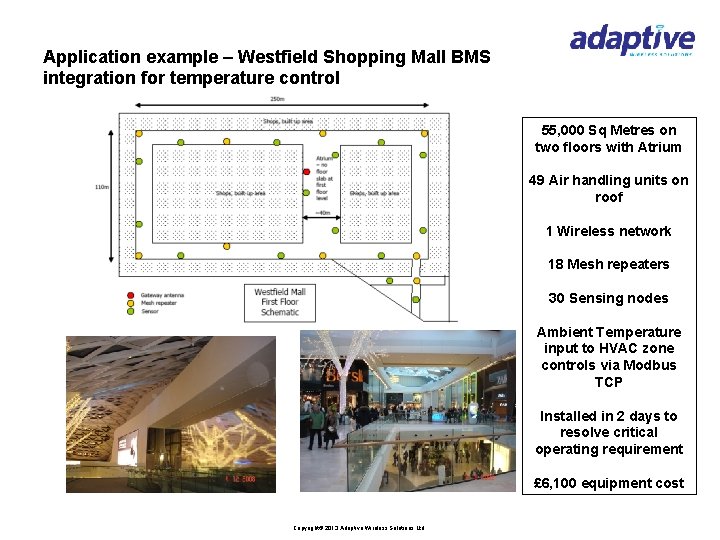
Application example – Westfield Shopping Mall BMS integration for temperature control 55, 000 Sq Metres on two floors with Atrium 49 Air handling units on roof 1 Wireless network 18 Mesh repeaters 30 Sensing nodes Ambient Temperature input to HVAC zone controls via Modbus TCP Installed in 2 days to resolve critical operating requirement £ 6, 100 equipment cost Copyright© 2013 Adaptive Wireless Solutions Ltd
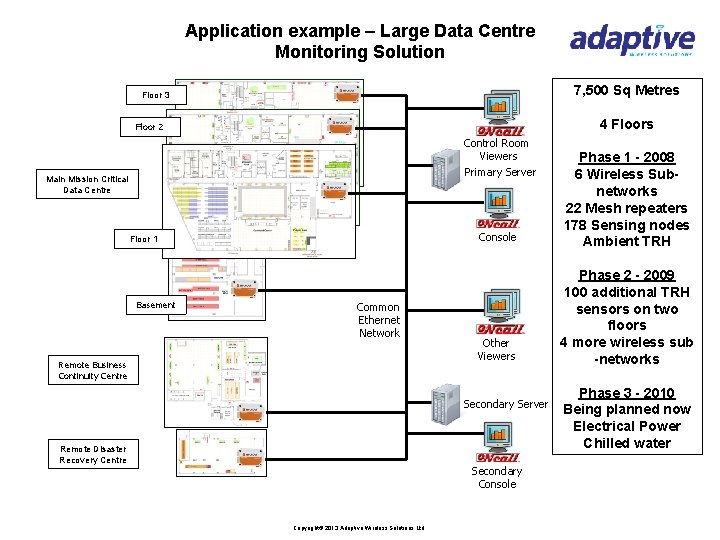
Application example – Large Data Centre Monitoring Solution 7, 500 Sq Metres Floor 3 4 Floors Floor 2 Control Room Viewers Primary Server Main Mission Critical Data Centre Console Floor 1 Basement Common Ethernet Network Remote Business Continuity Centre Other Viewers Secondary Server Remote Disaster Recovery Centre Secondary Console Copyright© 2013 Adaptive Wireless Solutions Ltd Phase 1 - 2008 6 Wireless Subnetworks 22 Mesh repeaters 178 Sensing nodes Ambient TRH Phase 2 - 2009 100 additional TRH sensors on two floors 4 more wireless sub -networks Phase 3 - 2010 Being planned now Electrical Power Chilled water
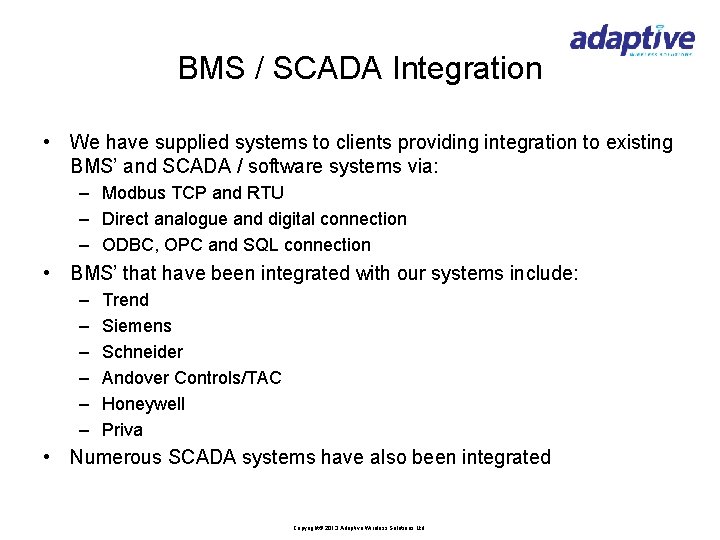
BMS / SCADA Integration • We have supplied systems to clients providing integration to existing BMS’ and SCADA / software systems via: – Modbus TCP and RTU – Direct analogue and digital connection – ODBC, OPC and SQL connection • BMS’ that have been integrated with our systems include: – – – Trend Siemens Schneider Andover Controls/TAC Honeywell Priva • Numerous SCADA systems have also been integrated Copyright© 2013 Adaptive Wireless Solutions Ltd
Network Performance and Reliability Copyright© 2013 Adaptive Wireless Solutions Ltd
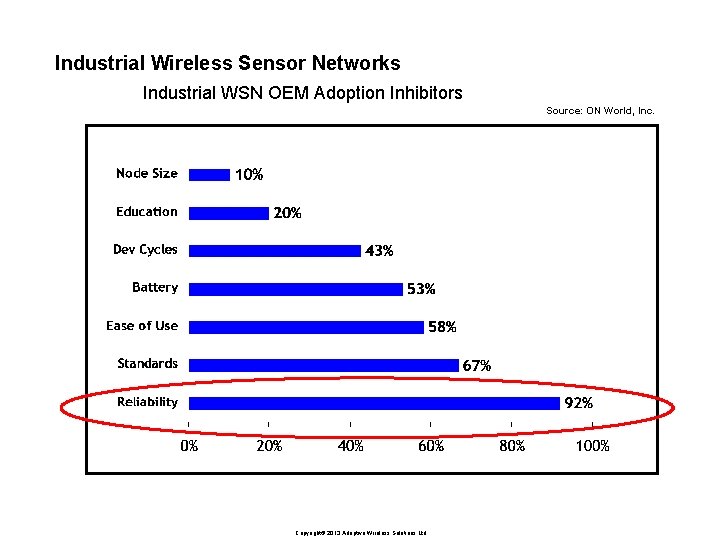
Industrial Wireless Sensor Networks Industrial WSN OEM Adoption Inhibitors Source: ON World, Inc. Copyright© 2013 Adaptive Wireless Solutions Ltd
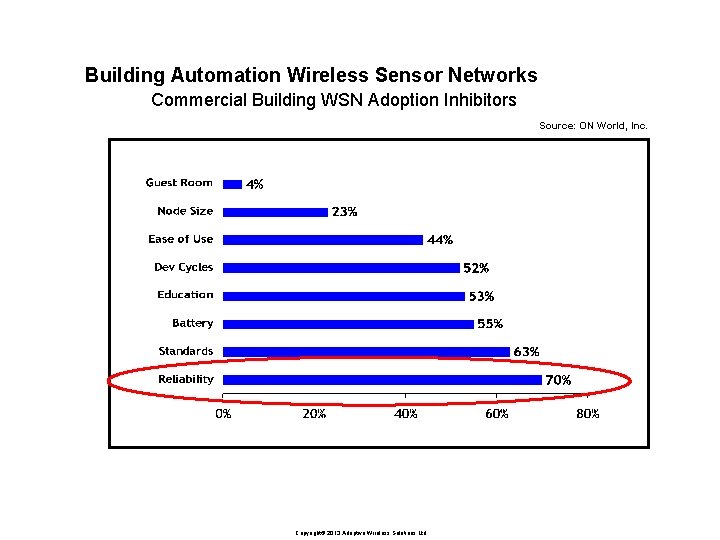
Building Automation Wireless Sensor Networks Commercial Building WSN Adoption Inhibitors Source: ON World, Inc. Copyright© 2013 Adaptive Wireless Solutions Ltd
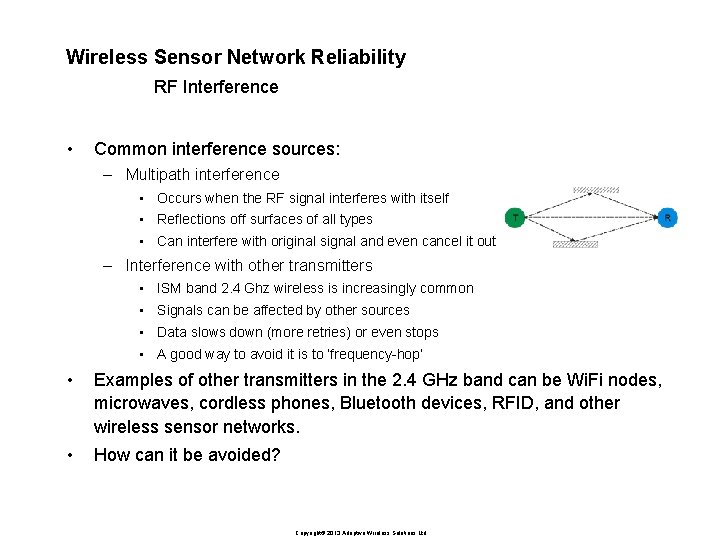
Wireless Sensor Network Reliability RF Interference • Common interference sources: – Multipath interference • Occurs when the RF signal interferes with itself • Reflections off surfaces of all types • Can interfere with original signal and even cancel it out – Interference with other transmitters • ISM band 2. 4 Ghz wireless is increasingly common • Signals can be affected by other sources • Data slows down (more retries) or even stops • A good way to avoid it is to ‘frequency-hop’ • Examples of other transmitters in the 2. 4 GHz band can be Wi. Fi nodes, microwaves, cordless phones, Bluetooth devices, RFID, and other wireless sensor networks. • How can it be avoided? Copyright© 2013 Adaptive Wireless Solutions Ltd
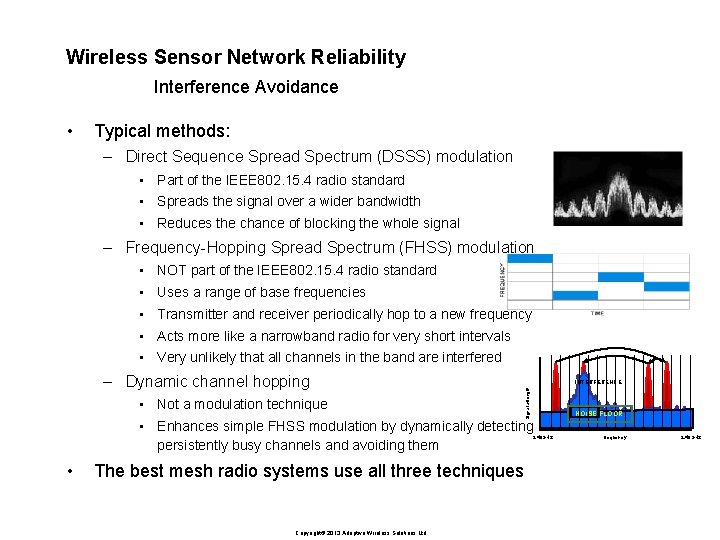
Wireless Sensor Network Reliability Interference Avoidance • Typical methods: – Direct Sequence Spread Spectrum (DSSS) modulation • Part of the IEEE 802. 15. 4 radio standard • Spreads the signal over a wider bandwidth • Reduces the chance of blocking the whole signal – Frequency-Hopping Spread Spectrum (FHSS) modulation • NOT part of the IEEE 802. 15. 4 radio standard • Uses a range of base frequencies • Transmitter and receiver periodically hop to a new frequency • Acts more like a narrowband radio for very short intervals • Very unlikely that all channels in the band are interfered • Not a modulation technique INTERFERENCE Signal strength – Dynamic channel hopping NOISE FLOOR • Enhances simple FHSS modulation by dynamically detecting persistently busy channels and avoiding them 2. 40 GHz • The best mesh radio systems use all three techniques Copyright© 2013 Adaptive Wireless Solutions Ltd frequency 2. 48 GHz
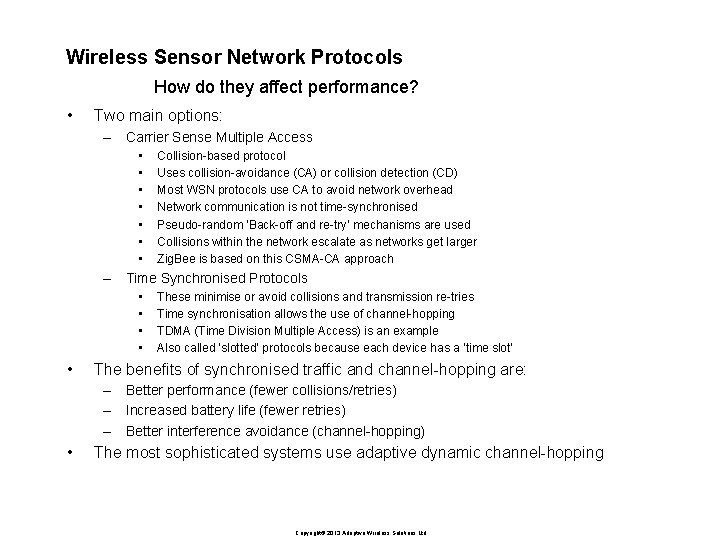
Wireless Sensor Network Protocols How do they affect performance? • Two main options: – Carrier Sense Multiple Access • • Collision-based protocol Uses collision-avoidance (CA) or collision detection (CD) Most WSN protocols use CA to avoid network overhead Network communication is not time-synchronised Pseudo-random ‘Back-off and re-try’ mechanisms are used Collisions within the network escalate as networks get larger Zig. Bee is based on this CSMA-CA approach – Time Synchronised Protocols • • • These minimise or avoid collisions and transmission re-tries Time synchronisation allows the use of channel-hopping TDMA (Time Division Multiple Access) is an example Also called ‘slotted’ protocols because each device has a ‘time slot’ The benefits of synchronised traffic and channel-hopping are: – Better performance (fewer collisions/retries) – Increased battery life (fewer retries) – Better interference avoidance (channel-hopping) • The most sophisticated systems use adaptive dynamic channel-hopping Copyright© 2013 Adaptive Wireless Solutions Ltd
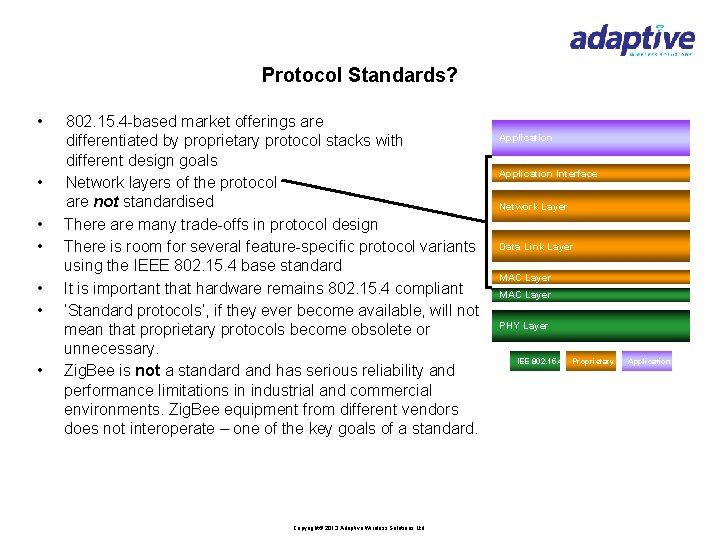
Protocol Standards? • • 802. 15. 4 -based market offerings are differentiated by proprietary protocol stacks with different design goals Network layers of the protocol are not standardised There are many trade-offs in protocol design There is room for several feature-specific protocol variants using the IEEE 802. 15. 4 base standard It is important that hardware remains 802. 15. 4 compliant ‘Standard protocols’, if they ever become available, will not mean that proprietary protocols become obsolete or unnecessary. Zig. Bee is not a standard and has serious reliability and performance limitations in industrial and commercial environments. Zig. Bee equipment from different vendors does not interoperate – one of the key goals of a standard. Copyright© 2013 Adaptive Wireless Solutions Ltd Application Interface Network Layer Data Link Layer MAC Layer PHY Layer IEE 802. 15. 4 Proprietary Application
Contact Details Adaptive Wireless Solutions Ltd 91 High Street Prestwood Great Missenden HP 16 9 ER Tel: +44 (0) 1494 865992 www. adaptive-wireless. co. uk Nick Baker Director Mobile: 07968 352875 nbaker@adaptive-wireless. co. uk Skype: adaptivewireless Copyright© 2013 Adaptive Wireless Solutions Ltd