
Adaptive Weighted Traffic Splitting in Programmable Data planes

Adaptive Weighted Traffic Splitting in Programmable Data planes Kuo-Feng Hsu*, Praveen Tammana+, Ryan Beckett#, Ang Chen*, Jennifer Rexford+, David Walker+ Rice University*, Princeton University+, Microsoft Research# 1
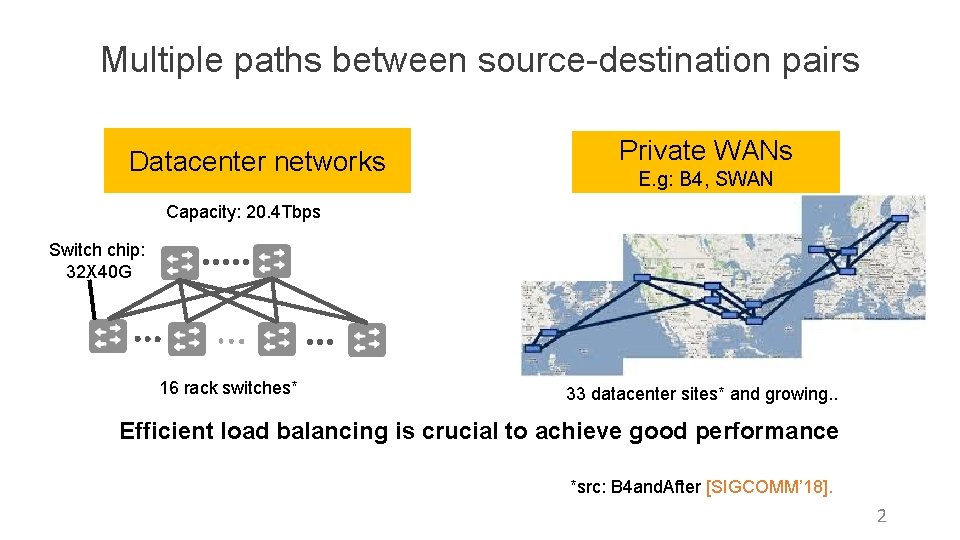
Multiple paths between source-destination pairs Datacenter networks Private WANs E. g: B 4, SWAN Capacity: 20. 4 Tbps Switch chip: 32 X 40 G 16 rack switches* 33 datacenter sites* and growing. . Efficient load balancing is crucial to achieve good performance *src: B 4 and. After [SIGCOMM’ 18]. 2

Motivation: Load-aware traffic splitting Fast adaptation to real-time traffic conditions at RTT timescales Unequal split is desired Equal split is desired Traffic flows src 1 dest src 2 load = 0 dest src 2 load > 0 3
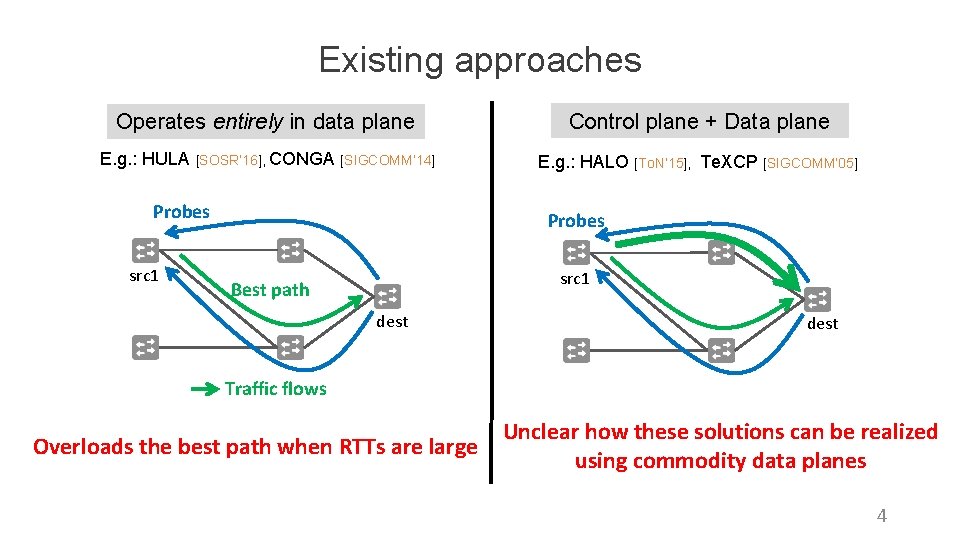
Existing approaches Operates entirely in data plane Control plane + Data plane E. g. : HULA [SOSR’ 16], CONGA [SIGCOMM’ 14] E. g. : HALO [To. N’ 15], Te. XCP [SIGCOMM’ 05] Probes src 1 Best path dest Traffic flows Overloads the best path when RTTs are large Unclear how these solutions can be realized using commodity data planes 4
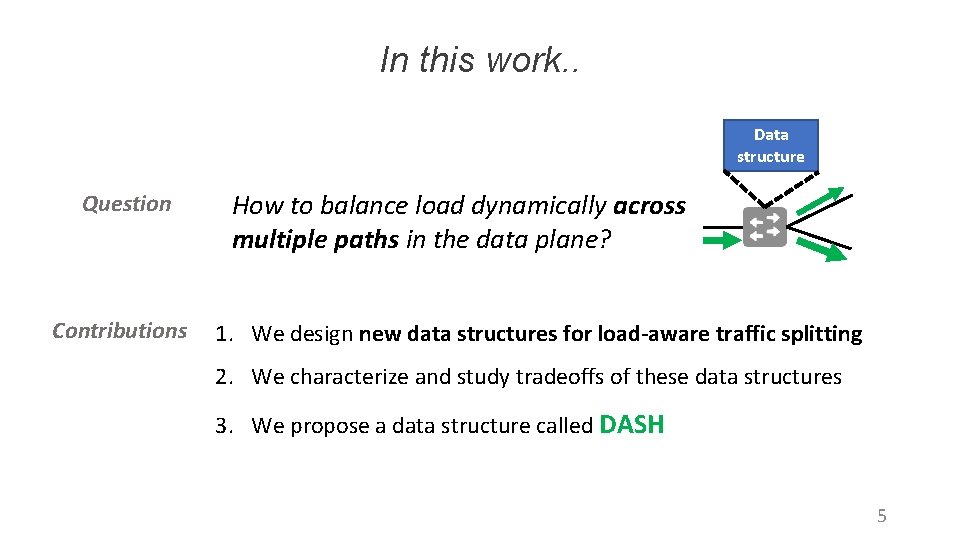
In this work. . Data structure Question Contributions How to balance load dynamically across multiple paths in the data plane? 1. We design new data structures for load-aware traffic splitting 2. We characterize and study tradeoffs of these data structures 3. We propose a data structure called DASH 5
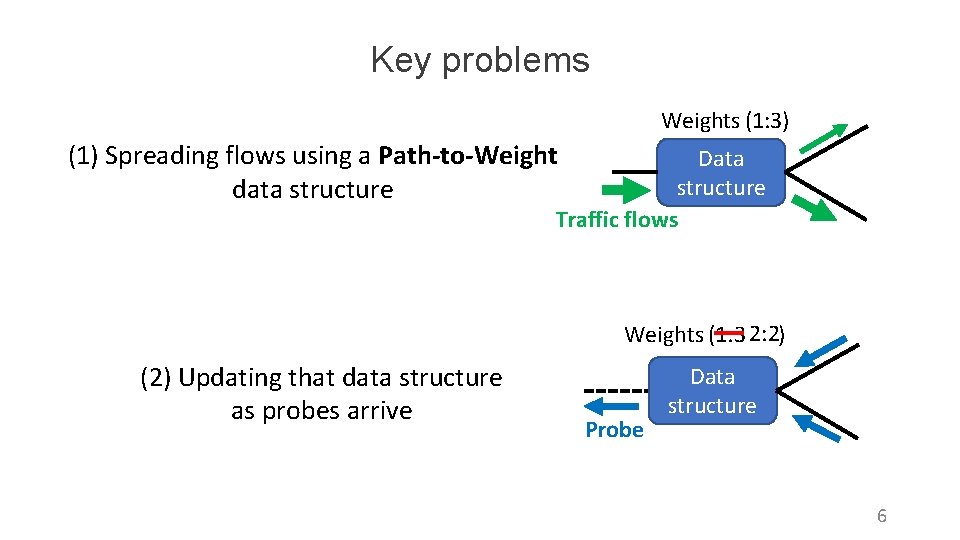
Key problems Weights (1: 3) (1) Spreading flows using a Path-to-Weight data structure Data structure Traffic flows Weights (1: 3 2: 2) (2) Updating that data structure as probes arrive Probe Data structure 6
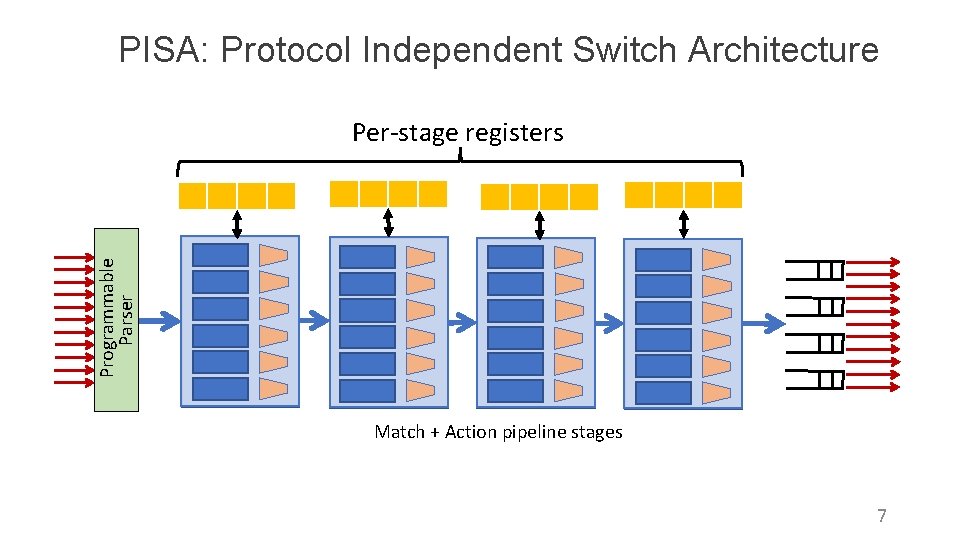
PISA: Protocol Independent Switch Architecture Programmable Parser Per-stage registers Match + Action pipeline stages 7
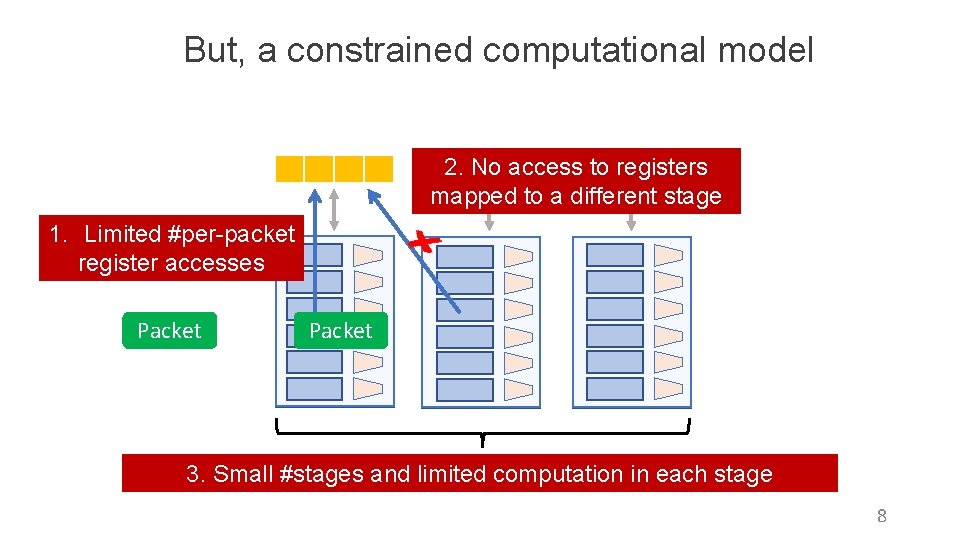
But, a constrained computational model 2. No access to registers mapped to a different stage 1. Limited #per-packet register accesses Packet 3. Small #stages and limited computation in each stage 8
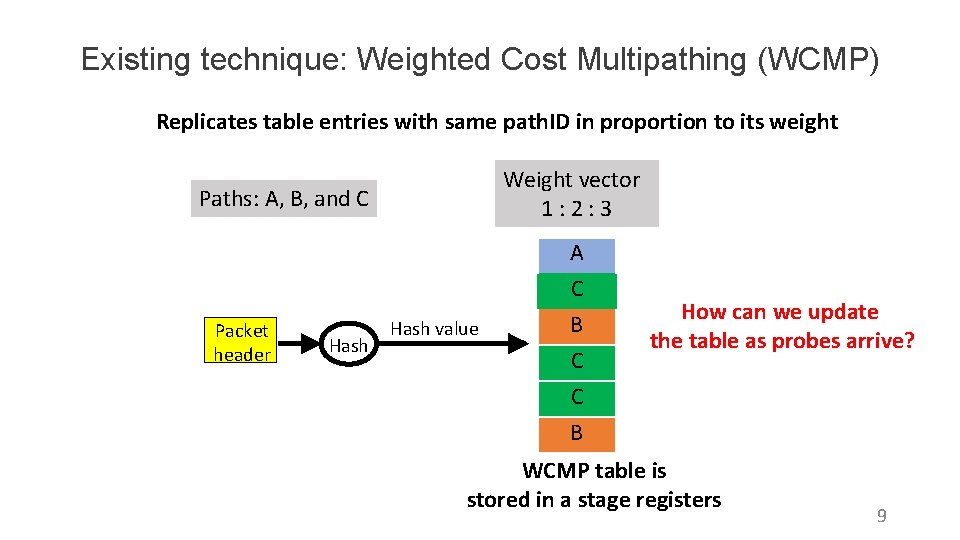
Existing technique: Weighted Cost Multipathing (WCMP) Replicates table entries with same path. ID in proportion to its weight Weight vector 1: 2: 3 Paths: A, B, and C Packet header Hash value A C B C C B How can we update the table as probes arrive? WCMP table is stored in a stage registers 9
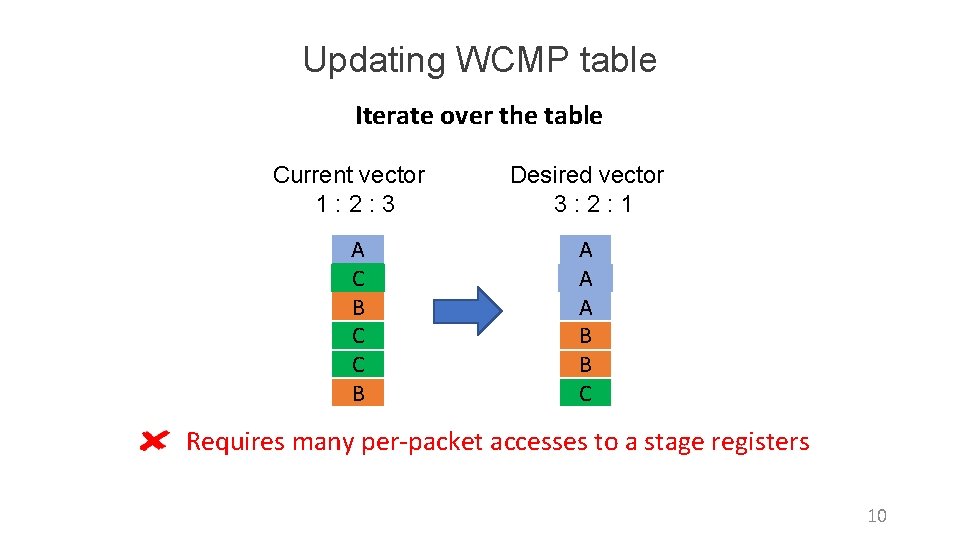
Updating WCMP table Iterate over the table Current vector 1: 2: 3 A C B C C B Desired vector 3: 2: 1 A A A B B C Requires many per-packet accesses to a stage registers 10
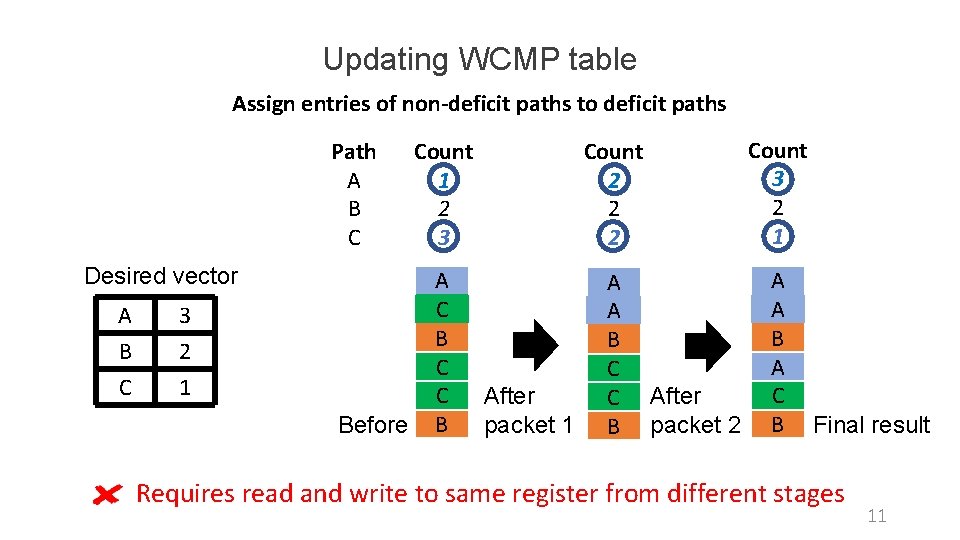
Updating WCMP table Assign entries of non-deficit paths to deficit paths Path A B C Desired vector A B C 3 2 1 Before Count 1 2 3 Count 2 2 2 Count 3 2 1 A C B C C B A A B A C B After packet 1 After packet 2 Final result Requires read and write to same register from different stages 11
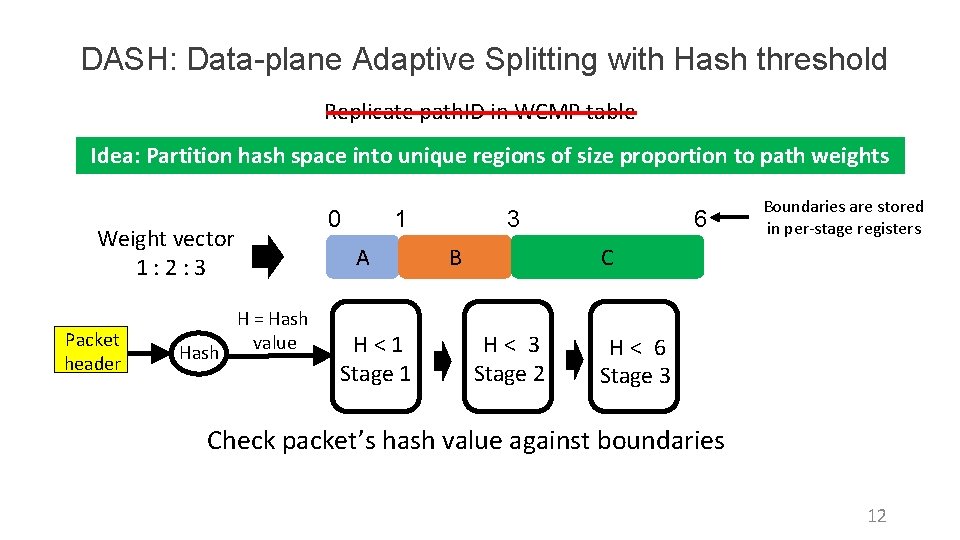
DASH: Data-plane Adaptive Splitting with Hash threshold Replicate path. ID in WCMP table Idea: Partition hash space into unique regions of size proportion to path weights Weight vector 1: 2: 3 Packet header H = Hash value Hash 0 1 A H<1 Stage 1 3 6 Boundaries are stored in per-stage registers C B H< 3 Stage 2 H< 6 Stage 3 Check packet’s hash value against boundaries 12
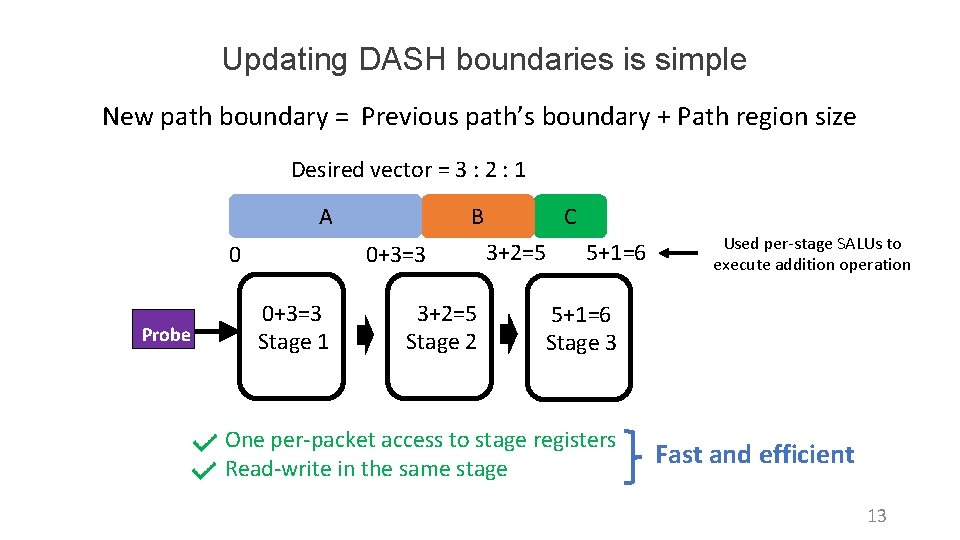
Updating DASH boundaries is simple New path boundary = Previous path’s boundary + Path region size Desired vector = 3 : 2 : 1 A 0 Probe B 0+3=3 Stage 1 3+2=5 Stage 2 C 3+2=5 5+1=6 Used per-stage SALUs to execute addition operation 5+1=6 Stage 3 One per-packet access to stage registers Read-write in the same stage Fast and efficient 13
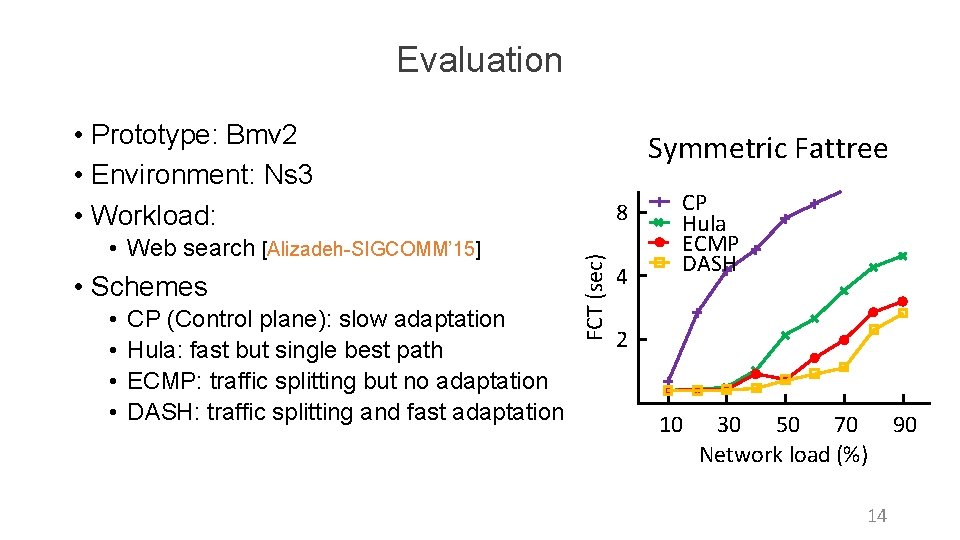
Evaluation • Prototype: Bmv 2 • Environment: Ns 3 • Workload: • Schemes • • CP (Control plane): slow adaptation Hula: fast but single best path ECMP: traffic splitting but no adaptation DASH: traffic splitting and fast adaptation 8 FCT (sec) • Web search [Alizadeh-SIGCOMM’ 15] Symmetric Fattree 4 CP Hula ECMP DASH 2 10 30 50 70 Network load (%) 14 90
Summary and future work • Adaptive weighted traffic splitting in the data plane • DASH is fast and efficient • Future work: • Implementation in commodity switches (e. g. , P 4 -Tofino) • Building a distributed online traffic engineering system 15

Thank you 16
- Slides: 16