
Adaptive Transfer Learning and Its Application on CrossDomain



- Slides: 42
Adaptive Transfer Learning and Its Application on Cross-Domain Recommendation Bin Cao Microsoft Research Asia
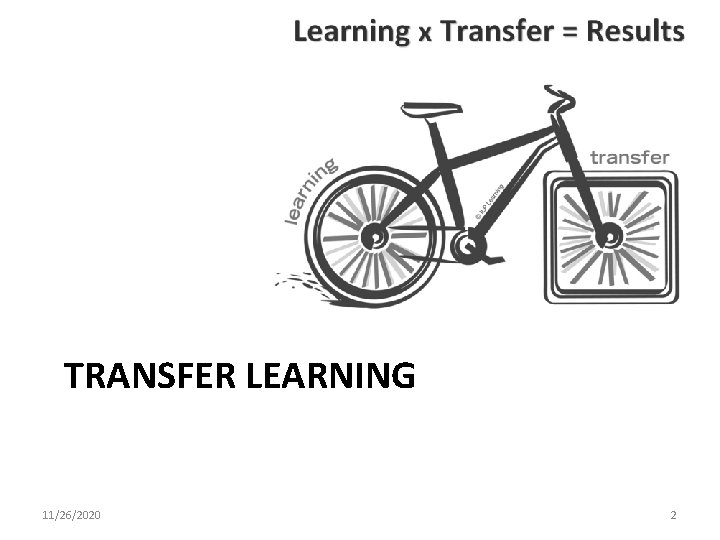
TRANSFER LEARNING 11/26/2020 2
Transfer Learning? (DARPA’ 05) Transfer Learning: The ability of a system to recognize and apply knowledge and skills learned in previous tasks to novel tasks (in new domains) It is motivated by human learning. People can often transfer knowledge learnt previously to novel situations ü Chess Checkers ü Mathematics Computer Science ü Table Tennis 11/26/2020 3
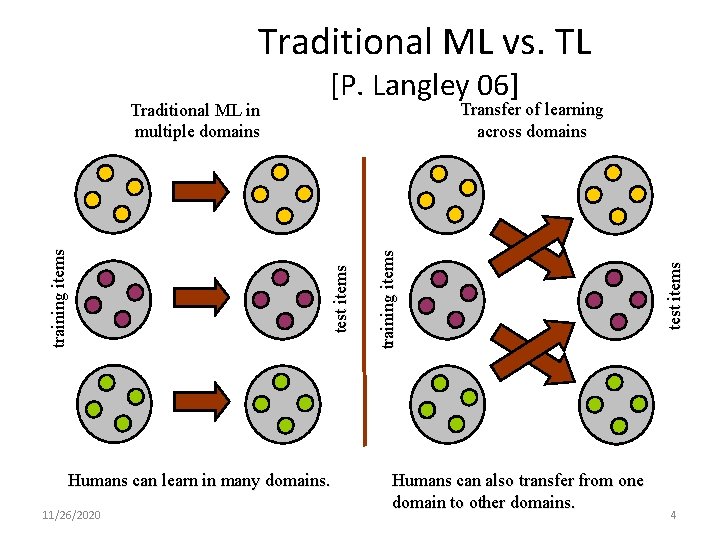
Traditional ML vs. TL Humans can learn in many domains. 11/26/2020 Humans can also transfer from one domain to other domains. test items training items Transfer of learning across domains test items training items Traditional ML in multiple domains [P. Langley 06] 4
Why Transfer Learning? • In some domains, labeled data are in short supply. • In some domains, the calibration effort is very expensive. • In some domains, the learning process is time consuming. ´ How to extract knowledge learnt from related domains to help learning in a target domain with a few labeled data? ´ How to extract knowledge learnt from related domains to speed up learning in a target domain? A Transfer learning techniques may help! 11/26/2020 5
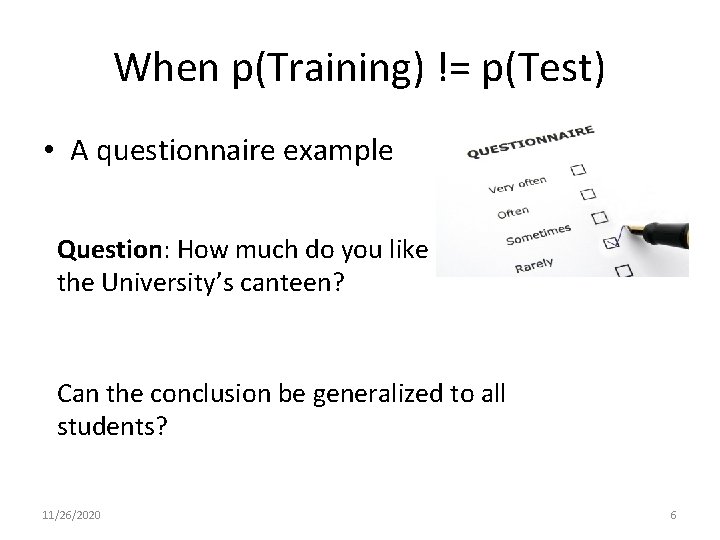
When p(Training) != p(Test) • A questionnaire example Question: How much do you like the University’s canteen? Can the conclusion be generalized to all students? 11/26/2020 6
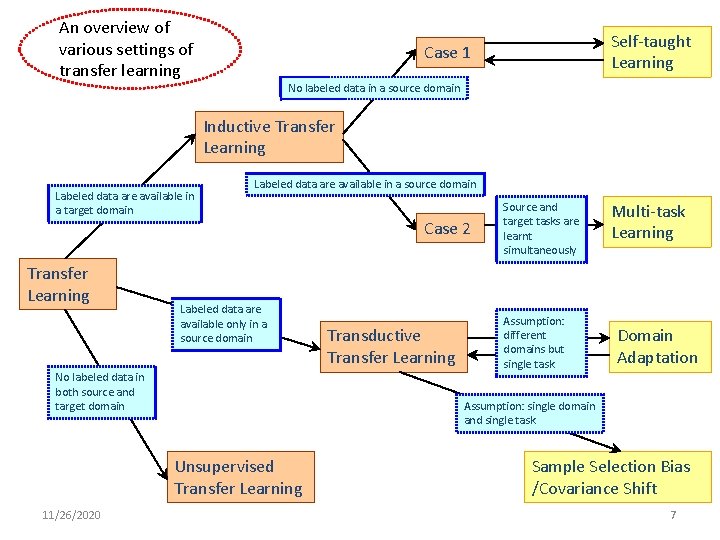
An overview of various settings of transfer learning Self-taught Learning Case 1 No labeled data in a source domain Inductive Transfer Learning Labeled data are available in a target domain Transfer Learning Labeled data are available in a source domain Labeled data are available only in a source domain No labeled data in both source and target domain Transductive Transfer Learning Assumption: different domains but single task Multi-task Learning Domain Adaptation Assumption: single domain and single task Unsupervised Transfer Learning 11/26/2020 Case 2 Source and target tasks are learnt simultaneously Sample Selection Bias /Covariance Shift 7
Transfer Learning: Problem Definition • A source task and a target task – The source task have sufficient labeled data – The target task has limited labeled data • We only cares about the performance on the target task. (different from multi-task) • Examples: – Out-dated labeling data – Learning with auxiliary data 11/26/2020 HKUST 8
Negative Transfer • The Key Assumption in Transfer Learning: – The source task is related to the target task • However, the assumption may not hold – How much related it is? – What if it is not related at all? • Negative Transfer – The use of source task may hurt the performance of the target task. 11/26/2020 HKUST 9
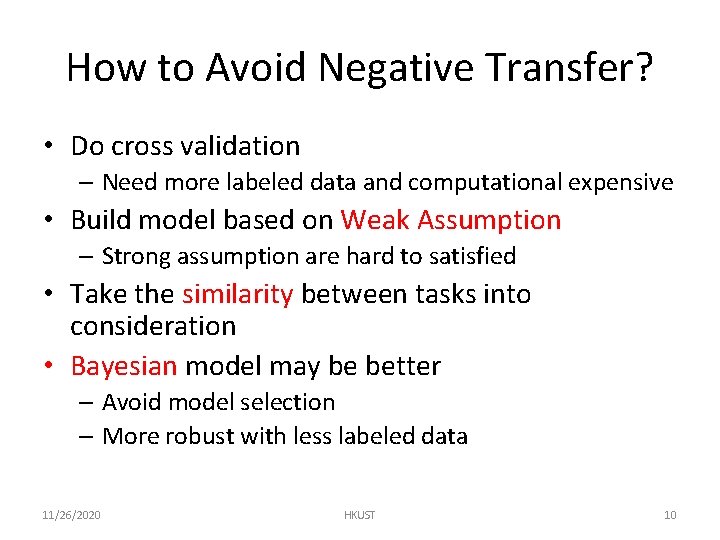
How to Avoid Negative Transfer? • Do cross validation – Need more labeled data and computational expensive • Build model based on Weak Assumption – Strong assumption are hard to satisfied • Take the similarity between tasks into consideration • Bayesian model may be better – Avoid model selection – More robust with less labeled data 11/26/2020 HKUST 10
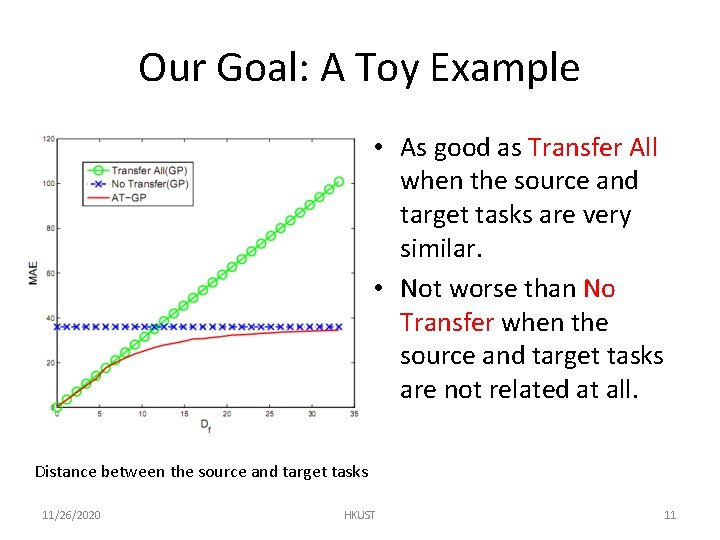
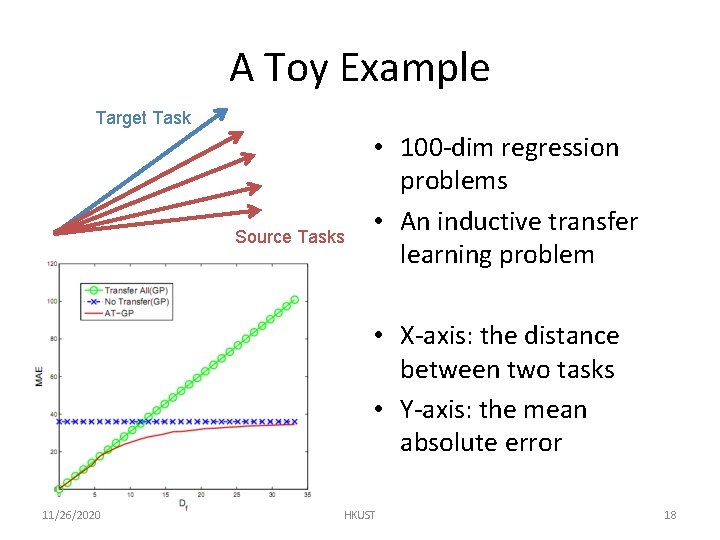
Our Goal: A Toy Example • As good as Transfer All when the source and target tasks are very similar. • Not worse than No Transfer when the source and target tasks are not related at all. Distance between the source and target tasks 11/26/2020 HKUST 11
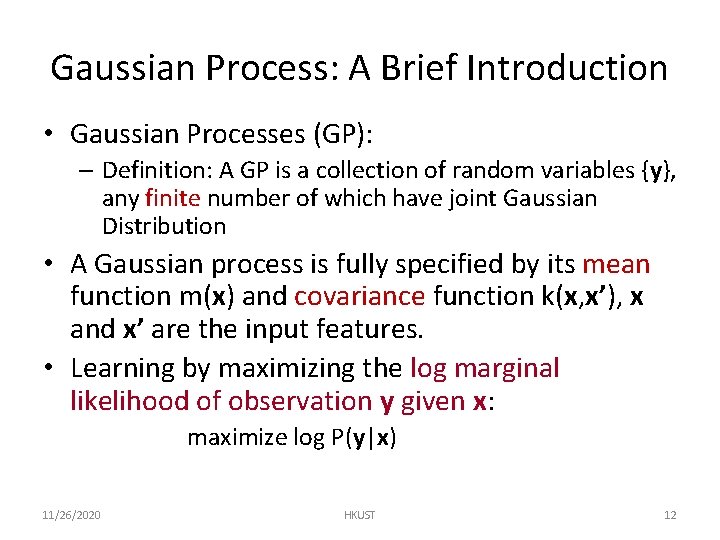
Gaussian Process: A Brief Introduction • Gaussian Processes (GP): – Definition: A GP is a collection of random variables {y}, any finite number of which have joint Gaussian Distribution • A Gaussian process is fully specified by its mean function m(x) and covariance function k(x, x’), x and x’ are the input features. • Learning by maximizing the log marginal likelihood of observation y given x: maximize log P(y|x) 11/26/2020 HKUST 12
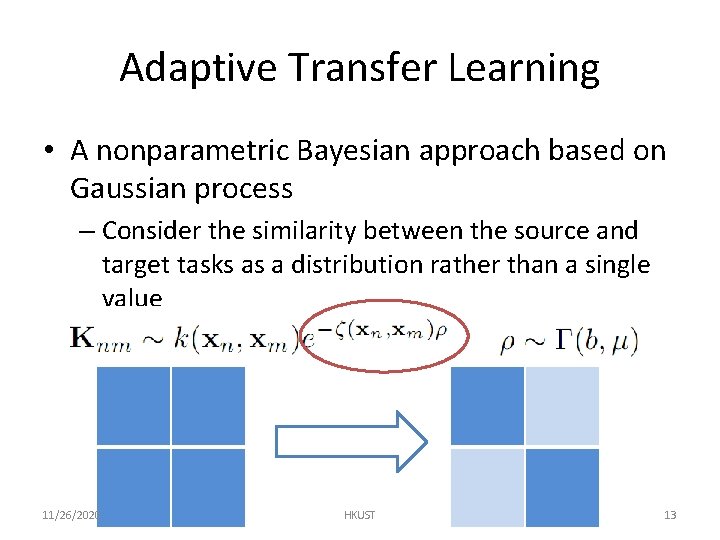
Adaptive Transfer Learning • A nonparametric Bayesian approach based on Gaussian process – Consider the similarity between the source and target tasks as a distribution rather than a single value 11/26/2020 HKUST 13
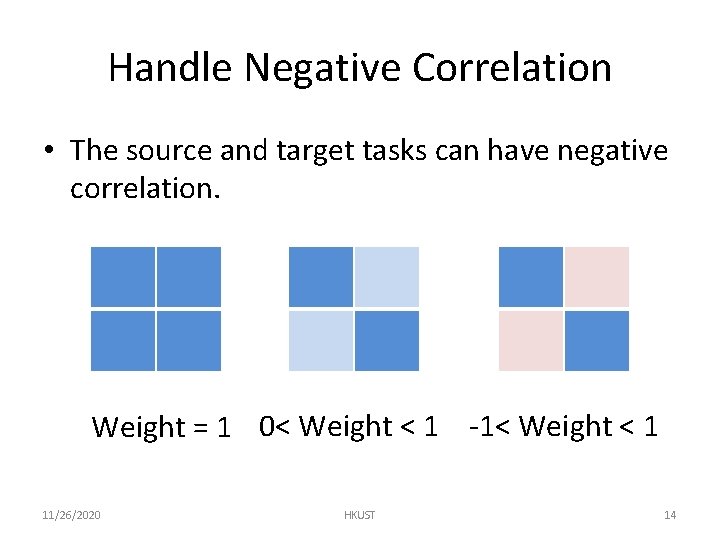
Handle Negative Correlation • The source and target tasks can have negative correlation. Weight = 1 0< Weight < 1 -1< Weight < 1 11/26/2020 HKUST 14
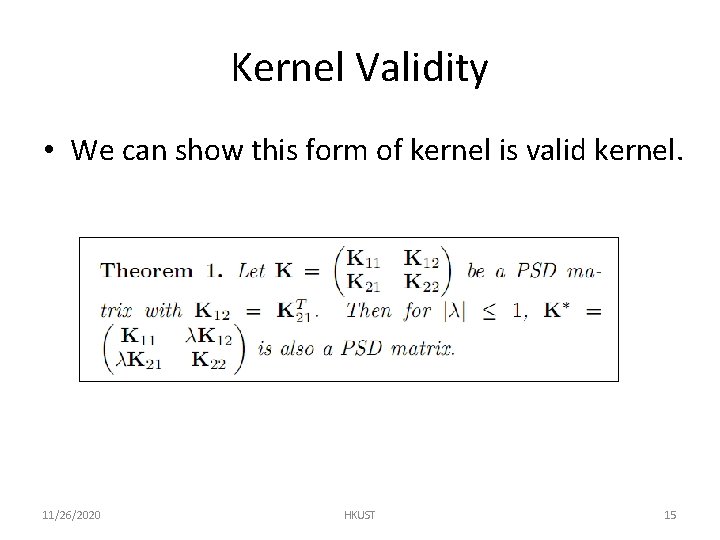
Kernel Validity • We can show this form of kernel is valid kernel. 11/26/2020 HKUST 15
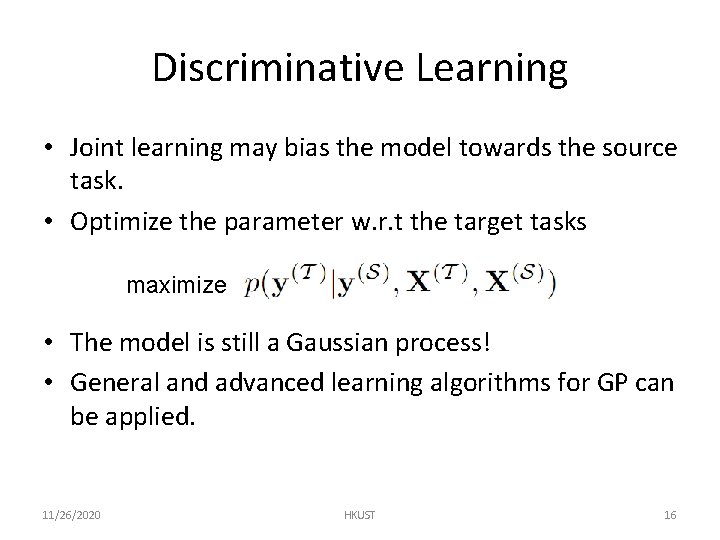
Discriminative Learning • Joint learning may bias the model towards the source task. • Optimize the parameter w. r. t the target tasks maximize • The model is still a Gaussian process! • General and advanced learning algorithms for GP can be applied. 11/26/2020 HKUST 16
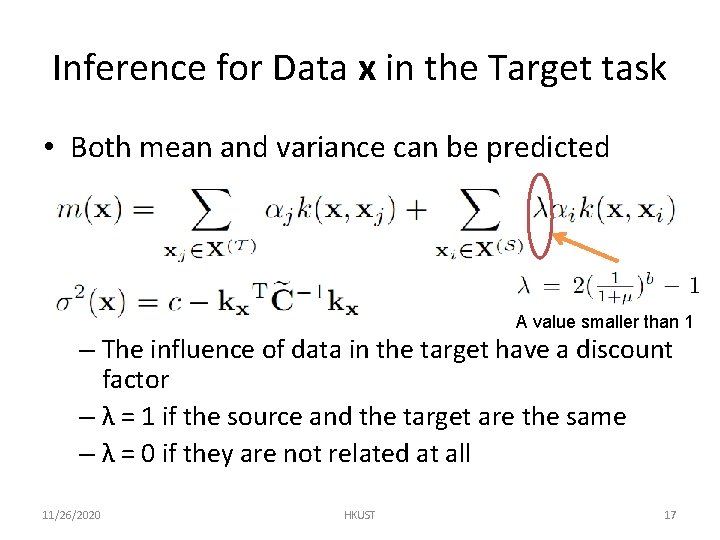
Inference for Data x in the Target task • Both mean and variance can be predicted A value smaller than 1 – The influence of data in the target have a discount factor – λ = 1 if the source and the target are the same – λ = 0 if they are not related at all 11/26/2020 HKUST 17
A Toy Example Target Task Source Tasks • 100 -dim regression problems • An inductive transfer learning problem • X-axis: the distance between two tasks • Y-axis: the mean absolute error 11/26/2020 HKUST 18
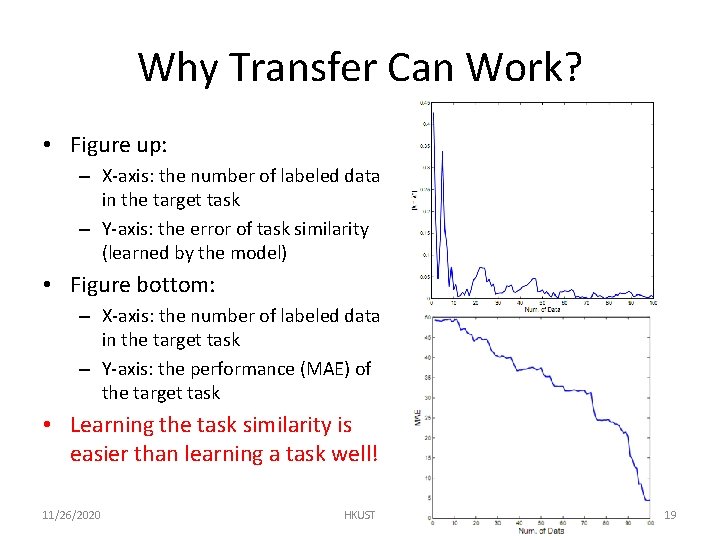
Why Transfer Can Work? • Figure up: – X-axis: the number of labeled data in the target task – Y-axis: the error of task similarity (learned by the model) • Figure bottom: – X-axis: the number of labeled data in the target task – Y-axis: the performance (MAE) of the target task • Learning the task similarity is easier than learning a task well! 11/26/2020 HKUST 19
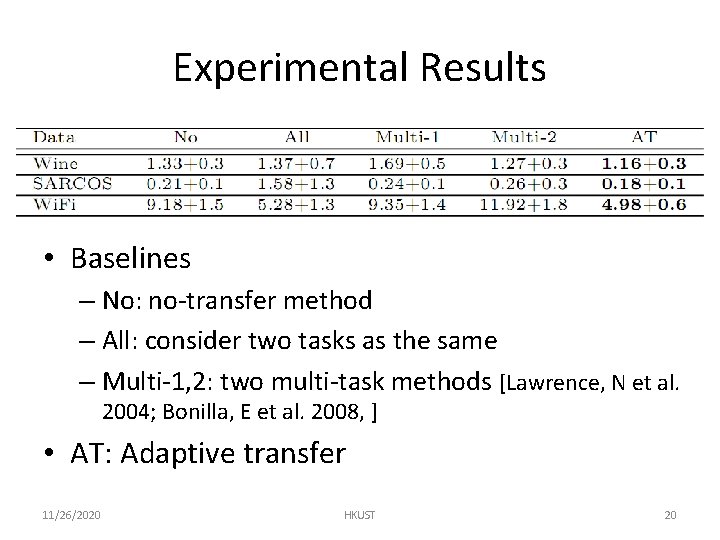
Experimental Results • Baselines – No: no-transfer method – All: consider two tasks as the same – Multi-1, 2: two multi-task methods [Lawrence, N et al. 2004; Bonilla, E et al. 2008, ] • AT: Adaptive transfer 11/26/2020 HKUST 20
CROSS-DOMAIN COLLABORATIVE FILTERING
Recommender Systems 11/26/2020 HKUST 22
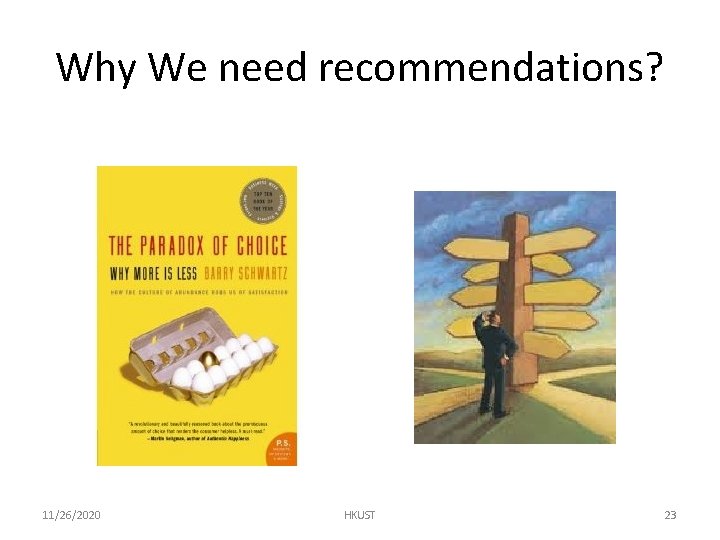
Why We need recommendations? 11/26/2020 HKUST 23
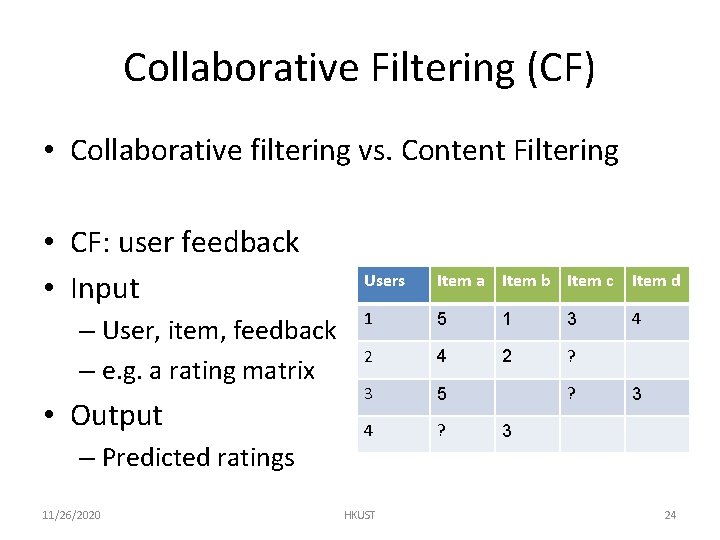
Collaborative Filtering (CF) • Collaborative filtering vs. Content Filtering • CF: user feedback • Input – User, item, feedback – e. g. a rating matrix • Output – Predicted ratings 11/26/2020 Users Item a Item b Item c Item d 1 5 1 3 4 2 ? 3 5 4 ? HKUST ? 3 3 24
Previous Work • Algorithms – Memory based approaches (KNN) – Model based approaches (PLSA, MFs, etc. ) – Hybrid approaches • Benchmarks – Moive. Lens – Eachmovie – Netflix prize [2006 -2009] 11/26/2020 HKUST 25
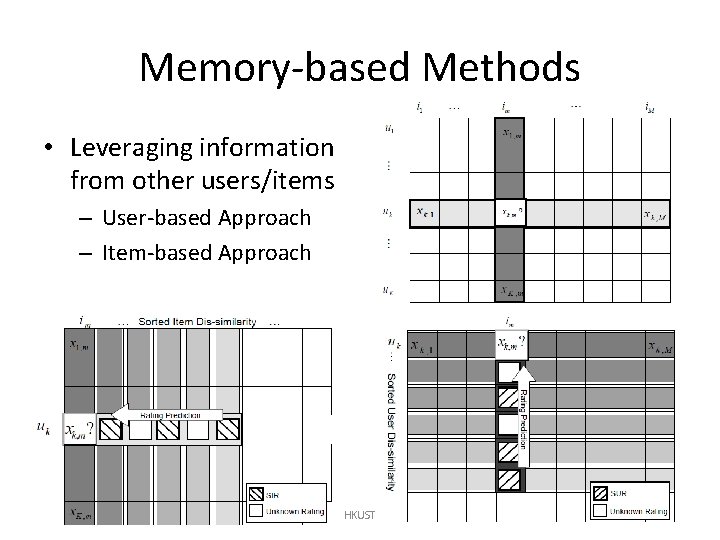
Memory-based Methods • Leveraging information from other users/items – User-based Approach – Item-based Approach 11/26/2020 HKUST 26
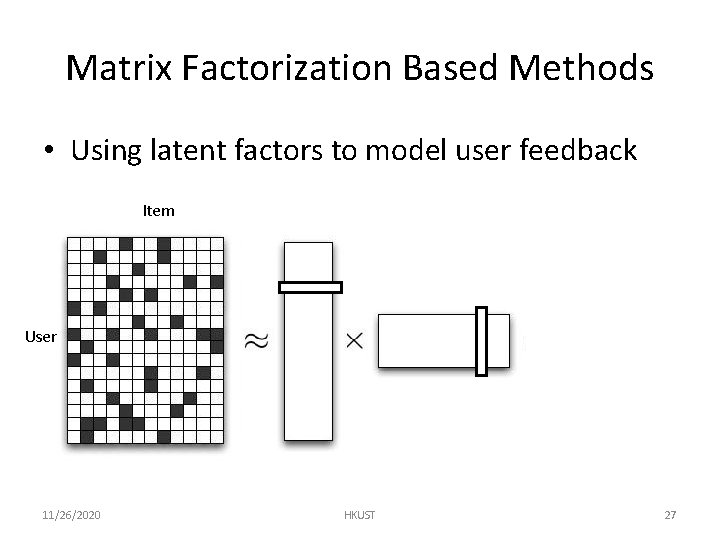
Matrix Factorization Based Methods • Using latent factors to model user feedback Item User 11/26/2020 HKUST 27
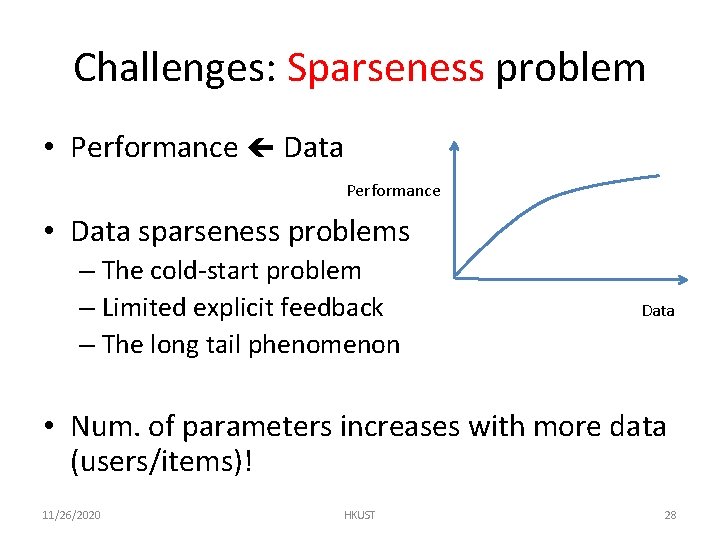
Challenges: Sparseness problem • Performance Data Performance • Data sparseness problems – The cold-start problem – Limited explicit feedback – The long tail phenomenon Data • Num. of parameters increases with more data (users/items)! 11/26/2020 HKUST 28
Auxiliary Data • Types – Content data – Context data – Social data – Data from related tasks • Issues to use auxiliary data – Inconsistent problem: data from different distributions 11/26/2020 HKUST 29
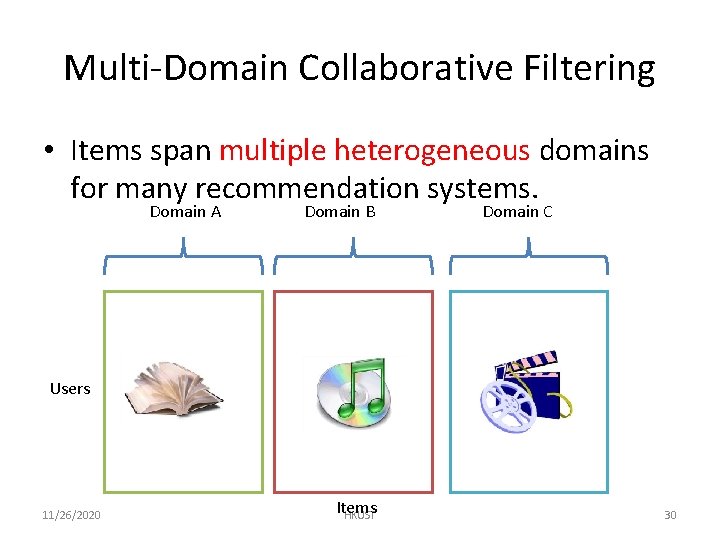
Multi-Domain Collaborative Filtering • Items span multiple heterogeneous domains for many recommendation systems. Domain A Domain B Domain C Users 11/26/2020 Items HKUST 30
Collective Link Prediction • Jointly consider multiple domains together • Learning the similarity of different domains – Idea behind learning: consistency cross domains indicates the similarity. • If the user similarities between two domains are consistent, than the domains are similar. • Consider link functions 11/26/2020 HKUST 31
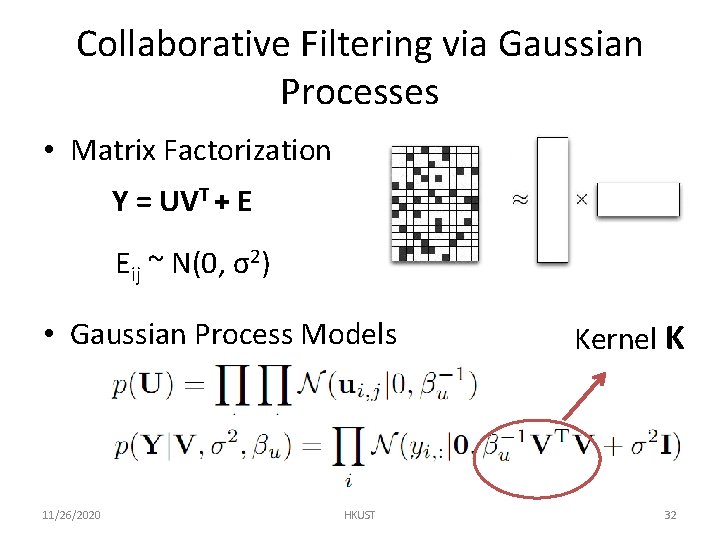
Collaborative Filtering via Gaussian Processes • Matrix Factorization Y = UVT + E Eij ~ N(0, σ2) • Gaussian Process Models 11/26/2020 HKUST Kernel K 32
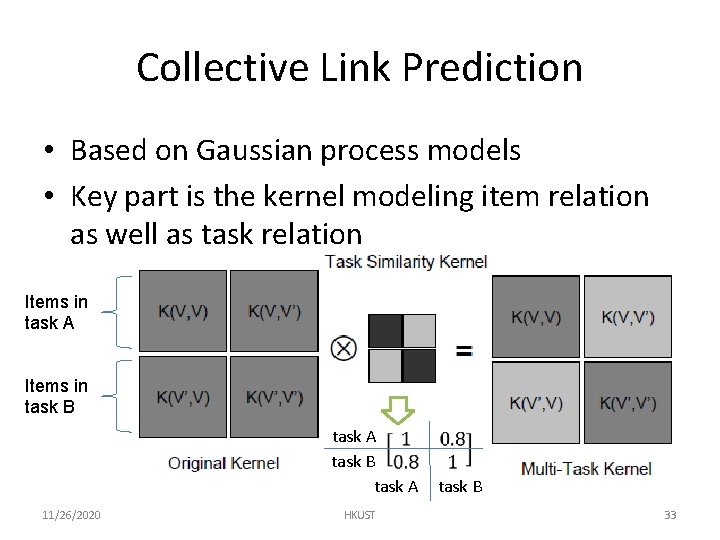
Collective Link Prediction • Based on Gaussian process models • Key part is the kernel modeling item relation as well as task relation Items in task A Items in task B task A 11/26/2020 HKUST task B 33
Rating Bias • Rating bias exists in the data – Users tend to rate more items they like • Assumptions in Gaussian processes – Observations follow Gaussian distributions – Similar assumptions in the models minimizing L 2 loss • Existing of bias breaks the underlying assumption! 11/26/2020 HKUST 34
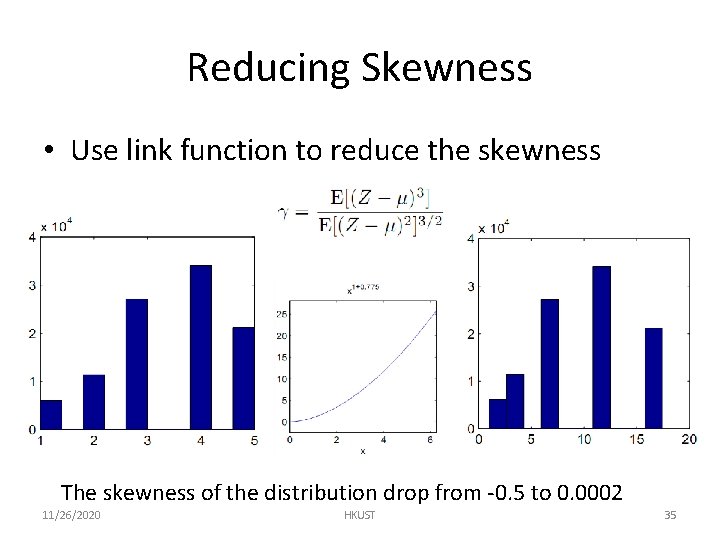
Reducing Skewness • Use link function to reduce the skewness The skewness of the distribution drop from -0. 5 to 0. 0002 11/26/2020 HKUST 35
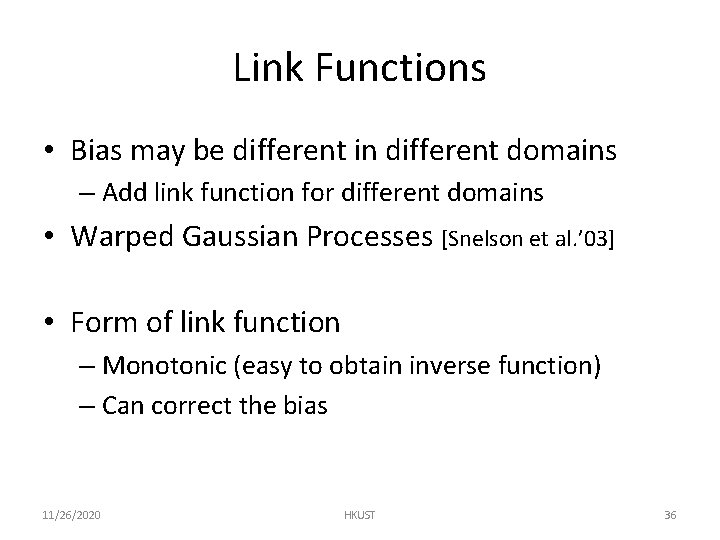
Link Functions • Bias may be different in different domains – Add link function for different domains • Warped Gaussian Processes [Snelson et al. ’ 03] • Form of link function – Monotonic (easy to obtain inverse function) – Can correct the bias 11/26/2020 HKUST 36
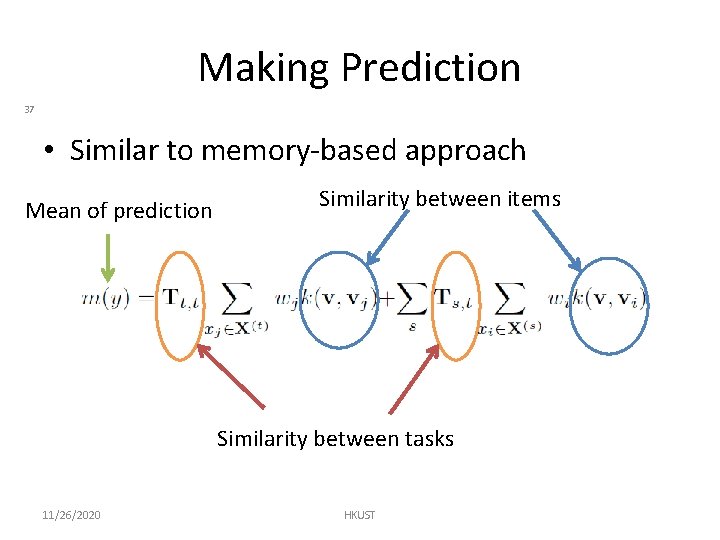
Making Prediction 37 • Similar to memory-based approach Mean of prediction Similarity between items Similarity between tasks 11/26/2020 HKUST
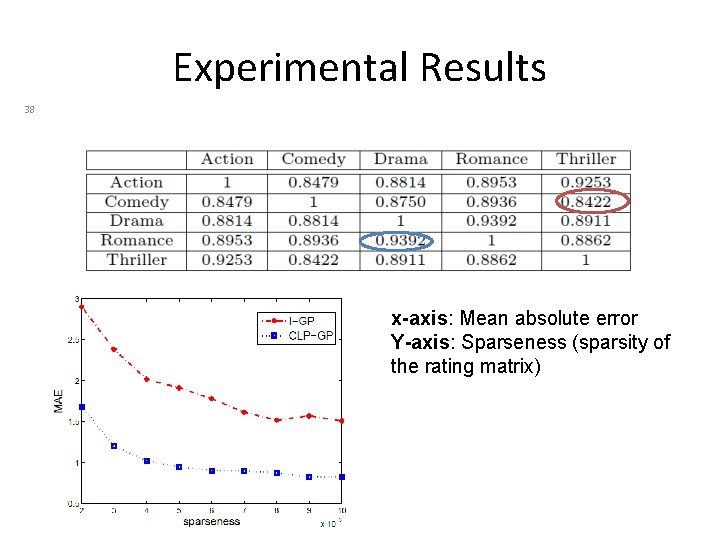
Experimental Results 38 x-axis: Mean absolute error Y-axis: Sparseness (sparsity of the rating matrix)
References • Pan, S. J. , & Yang, Q. (2010). A Survey on Transfer Learning. IEEE Transactions on Knowledge and Data Engineering, 22(10), 1345 -1359. doi: 10. 1109/TKDE. 2009. 191 • Zhang, Y. , Cao, B. , & Yeung, D. Y. (2010). Multi-Domain Collaborative Filtering. Proceedings of the 26 th Conference on Uncertainty in Artificial Intelligence (UAI), Catalina Island, California, USA. • Cao, B. , Liu, N. N. , & Yang, Q. (2010). Transfer learning for collective link prediction in multiple heterogenous domains. Proceedings of the 27 th International Conference on Machine Learning, Haifa, Israel. • Cao, B. , Pan, S. J. , Zhang, Y. , Yeung, D. -Y. , & Yang, Q. (2010). Adaptive Transfer Learning. AAAI. Retrieved from http: //dblp. unitrier. de/db/conf/aaai 2010. html#Cao. PZYY 10 11/26/2020 39
References • Koren, Yehuda. “Collaborative filtering with temporal dynamics. ” Proceedings of the 15 th ACM SIGKDD international conference on Knowledge discovery and data mining - KDD ’ 09 (2009): 447. • Das, A. S. , M. Datar, A. Garg, and S. Rajaram. “Google news personalization: scalable online collaborative filtering. ” In Proceedings of the 16 th international conference on World Wide Web, 271– 280. ACM New York, NY, USA, 2007. • Linden, G. , B. Smith, and J. York. “Amazon. com recommendations: item-to-item collaborative filtering. ” IEEE Internet Computing 7, no. 1 (January 2003): 76 -80. • Davidson, James, Benjamin Liebald, and Taylor Van Vleet. “The You. Tube Video Recommendation System. ” Design (2010): 293 -296.
Reference • Salakhutdinov, R. , & Mnih, A. (2008). Probabilistic matrix factorization. Advances in neural information processing systems, 20, 1257– 1264. • Salakhutdinov, R. , & Mnih, A. (2008). Bayesian probabilistic matrix factorization using Markov chain Monte Carlo. Proceedings of the 25 th international conference on Machine learning (pp. 880– 887). ACM. • Lawrence, N. D. , & Urtasun, R. (2009). Non-Linear Matrix Factorization with Gaussian Processes. In L. Bottou & M. Littman (Eds. ), Proceedings of the 26 th International Conference on Machine Learning (pp. 601 -608). 11/26/2020 41
Reference • http: //www. cse. ust. hk/TL/index. html • http: //www 1. i 2 r. astar. edu. sg/~jspan/Survey. TL. htm • http: //www 1. i 2 r. astar. edu. sg/~jspan/conference. TL. htm 11/26/2020 42