
Adaptive Survey Design PIAAC Experiment and International Implementation

- Slides: 17
Adaptive Survey Design PIAAC Experiment and International Implementation Tom Krenzke, Leyla Mohadjer, Minsun Riddles (Westat) Natalie Shlomo (University of Manchester) ESRA 2019 • Zagreb, Croatia • July 15 -July 19 The views presented in this paper are those of the author(s) and do not represent the views of any Government Agency/Department or Westat
Outline Challenge Approach Experiment Summary International Implementation 2
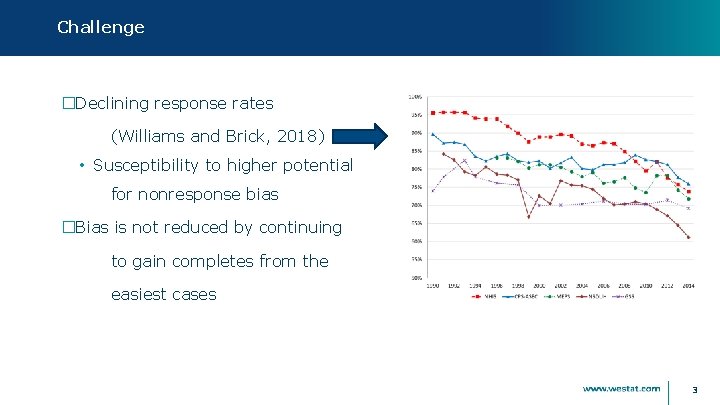
Challenge �Declining response rates (Williams and Brick, 2018) • Susceptibility to higher potential for nonresponse bias �Bias is not reduced by continuing to gain completes from the easiest cases 3
PIAAC US 2017 Round 3 sample �International survey with close to 40 countries participating in Cycle 1 �US 2017 sample -- sponsored by the National Center for Education Statistics • Non-institutionalized U. S. population of 16 to 74 year olds • Data collection instruments - Screener, Background Questionnaire (BQ), Assessment • Conducted in person within households • Nationally representative four-stage area probability sample - 80 Primary Sampling Units, about 700 Secondary Sampling Units - Over 8, 500 dwelling units initially selected, which resulted in about 5, 000 individuals initially selected using the Screener - Over 3, 500 completed cases 4
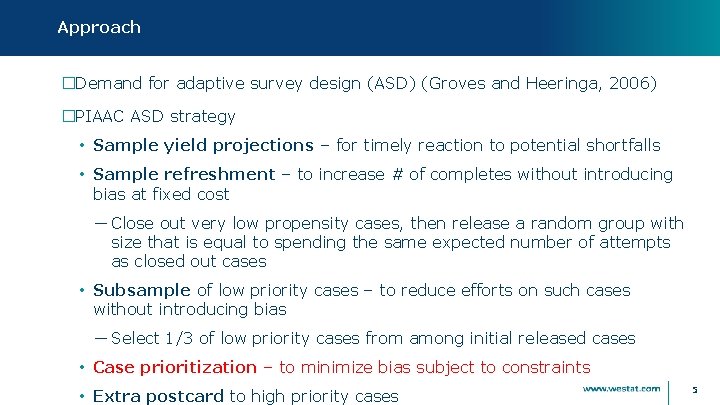
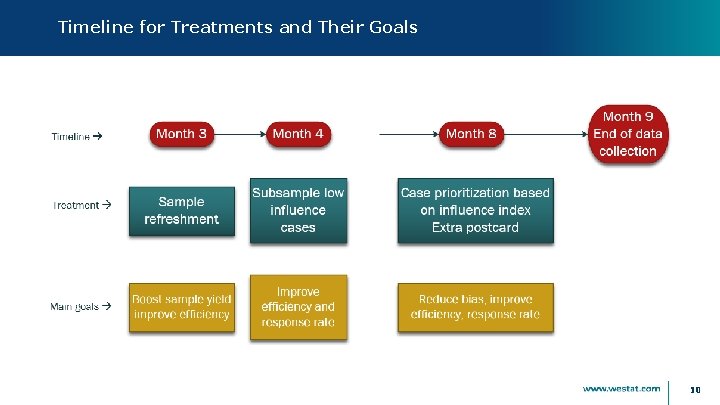
Approach �Demand for adaptive survey design (ASD) (Groves and Heeringa, 2006) �PIAAC ASD strategy • Sample yield projections – for timely reaction to potential shortfalls • Sample refreshment – to increase # of completes without introducing bias at fixed cost - Close out very low propensity cases, then release a random group with size that is equal to spending the same expected number of attempts as closed out cases • Subsample of low priority cases – to reduce efforts on such cases without introducing bias - Select 1/3 of low priority cases from among initial released cases • Case prioritization – to minimize bias subject to constraints • Extra postcard to high priority cases 5
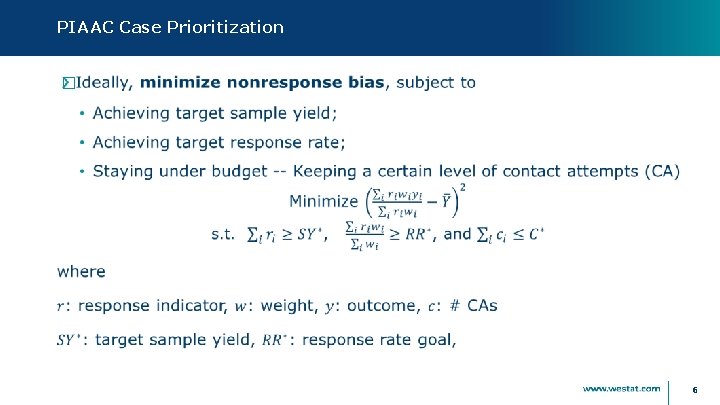
PIAAC Case Prioritization � 6
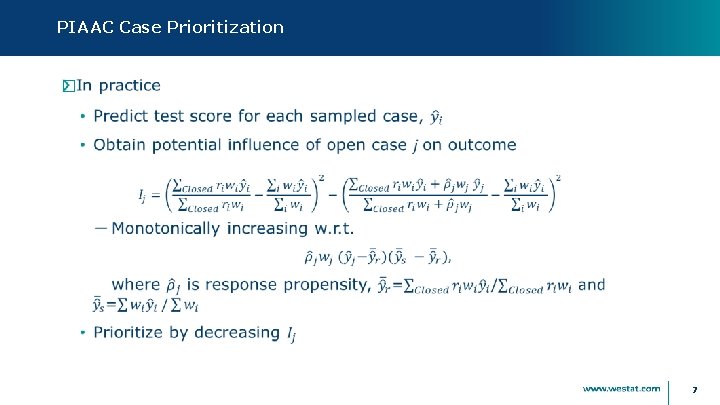
PIAAC Case Prioritization � 7
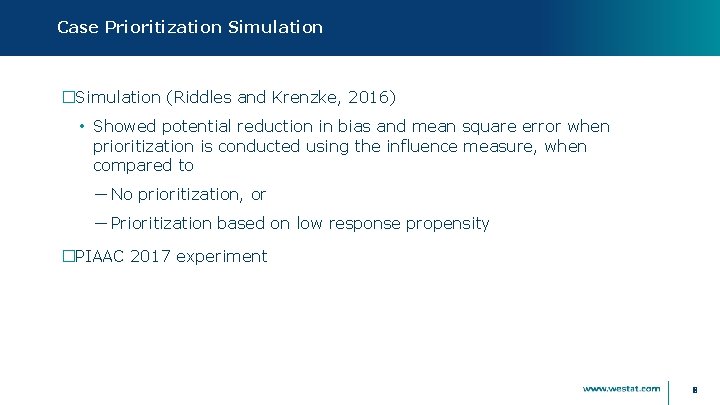
Case Prioritization Simulation �Simulation (Riddles and Krenzke, 2016) • Showed potential reduction in bias and mean square error when prioritization is conducted using the influence measure, when compared to - No prioritization, or - Prioritization based on low response propensity �PIAAC 2017 experiment 8
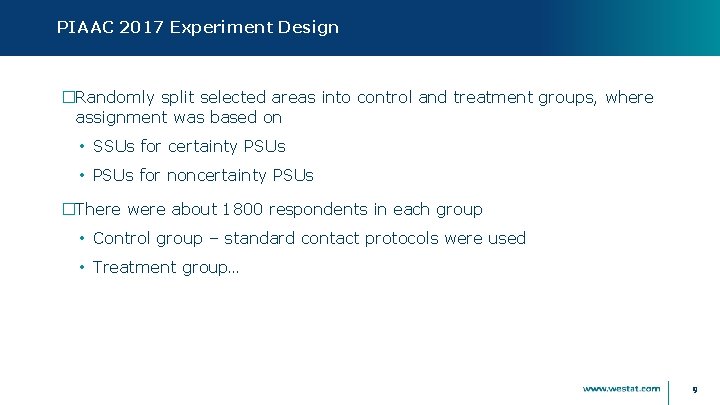
PIAAC 2017 Experiment Design �Randomly split selected areas into control and treatment groups, where assignment was based on • SSUs for certainty PSUs • PSUs for noncertainty PSUs �There were about 1800 respondents in each group • Control group – standard contact protocols were used • Treatment group… 9
Timeline for Treatments and Their Goals 10
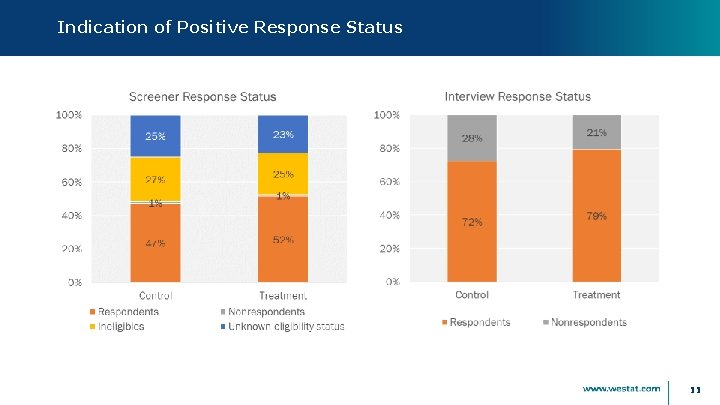
Indication of Positive Response Status 11
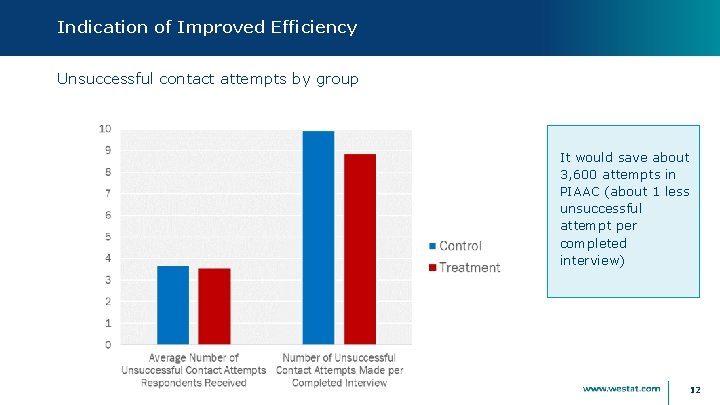
Indication of Improved Efficiency Unsuccessful contact attempts by group It would save about 3, 600 attempts in PIAAC (about 1 less unsuccessful attempt per completed interview) 12
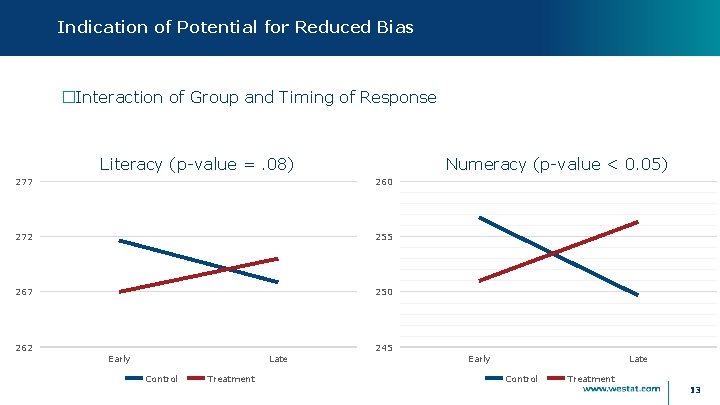
Indication of Potential for Reduced Bias �Interaction of Group and Timing of Response Literacy (p-value =. 08) Numeracy (p-value < 0. 05) 277 260 272 255 267 250 262 Early Late Control Treatment 245 Early Late Control Treatment 13
Summary �ASD experiment results • Indications of higher response rates due to treatments, likely due to subsampling low influence cases and extra postcard • Indications of being slightly more cost effective due to a combination of treatments • Indications of potential reduction in bias, most likely due to the case prioritizations - Influence measure was derived from optimization framework for case prioritization - Good results in both simulation and experiment 14
International Implementation �Case prioritization system • Objective: Reduce nonresponse bias • Influenced by experiment; approach was generalized for the system • Provides guidance to the field management staff to help interviewers focus on completing higher priority cases • Two phases - Phase 1: Contact attempt ordering. The first few priority groups are derived from whether or not cases are meeting standard contact attempt protocols - Phase 2: Statistical ordering. For cases meeting the contact protocols, a statistical-based ordering is derived for each case using collected paradata. Option to import the priorities from country. 15
References �Groves, R. M. and Heeringa, S. G. (2006). Responsive design for household surveys: tools for actively controlling survey errors and costs. Journal of the Royal Statistical Society: Series A (Statistics in Society), 169, 439– 457. �Riddles, M. and Krenzke, T. (2016). Adapting responsive design strategies in a recurring adult literacy assessment. Presentation at the Joint Statistical Meetings, Chicago, IL. �Williams, D. and Brick, M. (2018). Trends in U. S. Face-To-Face Household Survey Nonresponse and Level of Effort. Journal of Survey Statistics and Methodology. 6, 186 -211 16
Thank You 17