
Adaptive Submodularity A New Approach to Active Learning
Adaptive Submodularity: A New Approach to Active Learning and Stochastic Optimization Daniel Golovin Joint work with Andreas Krause California Technology California Institute ofof. Technology Center for the Mathematics of Information 1
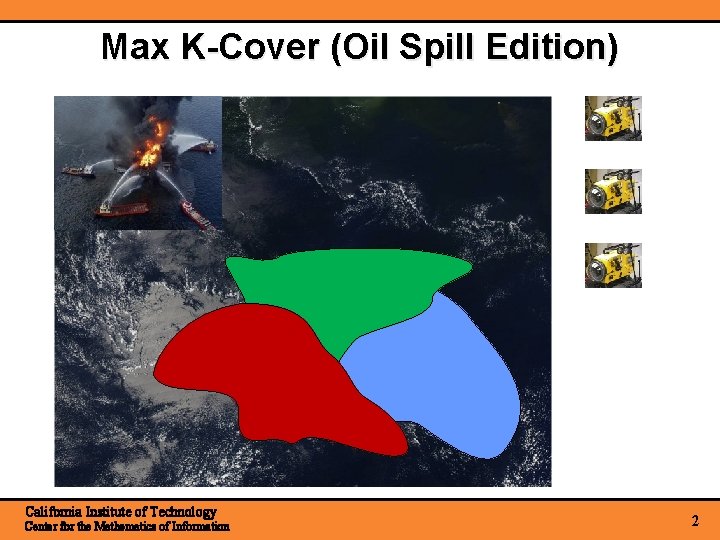
Max K-Cover (Oil Spill Edition) California Institute of Technology Center for the Mathematics of Information 2

Submodularity Time Discrete diminishing returns property for set functions. ``Playing an action at an earlier stage only increases its marginal benefit'' California Institute of Technology Center for the Mathematics of Information 3
![The Greedy Algorithm Theorem [Nemhauser et al ‘ 78] California Institute of Technology Center](http://slidetodoc.com/presentation_image/127ac45ebb82021f691ac5b4a4c64b1c/image-4.jpg "The Greedy Algorithm Theorem [Nemhauser et al ‘ 78] California Institute of Technology Center")
The Greedy Algorithm Theorem [Nemhauser et al ‘ 78] California Institute of Technology Center for the Mathematics of Information 4
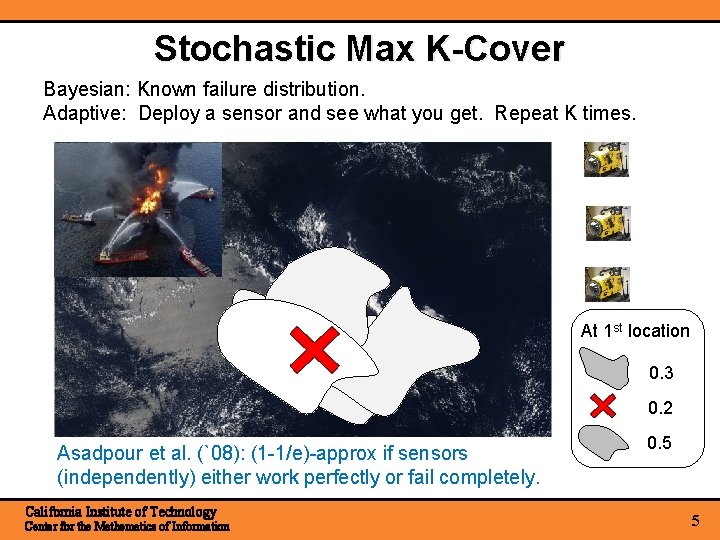
Stochastic Max K-Cover Bayesian: Known failure distribution. Adaptive: Deploy a sensor and see what you get. Repeat K times. At 1 st location 0. 3 0. 2 Asadpour et al. (`08): (1 -1/e)-approx if sensors (independently) either work perfectly or fail completely. California Institute of Technology Center for the Mathematics of Information 0. 5 5
![Adaptive Submodularity [G & Krause, 2010] Select Item Time Stochastic Outcome Gain less Gain](http://slidetodoc.com/presentation_image/127ac45ebb82021f691ac5b4a4c64b1c/image-6.jpg "Adaptive Submodularity [G & Krause, 2010] Select Item Time Stochastic Outcome Gain less Gain")
Adaptive Submodularity [G & Krause, 2010] Select Item Time Stochastic Outcome Gain less Gain more Playing an action at an earlier stage (i. e. , at an ancestor) only increases its marginal benefit Δ(action | observations) expected (taken over its outcome) California Institute of Technology Center for the Mathematics of Information Adaptive Monotonicity: Δ(a | obs) ≥ 0, always 6
What’s it good for? Allows us to generalize results to the adaptive realm, including: (1 -1/e)-approximation for Max K-Cover, submodular maximization (ln(n)+1)-approximation for Set Cover “Accelerated” implementation Data-Dependent Upper Bounds on OPT California Institute of Technology Center for the Mathematics of Information 7
![Recall the Greedy Algorithm Theorem [Nemhauser et al ‘ 78] California Institute of Technology](http://slidetodoc.com/presentation_image/127ac45ebb82021f691ac5b4a4c64b1c/image-8.jpg "Recall the Greedy Algorithm Theorem [Nemhauser et al ‘ 78] California Institute of Technology")
Recall the Greedy Algorithm Theorem [Nemhauser et al ‘ 78] California Institute of Technology Center for the Mathematics of Information 8
![The Adaptive-Greedy Algorithm Theorem [G & Krause, COLT ‘ 10] California Institute of Technology](http://slidetodoc.com/presentation_image/127ac45ebb82021f691ac5b4a4c64b1c/image-9.jpg "The Adaptive-Greedy Algorithm Theorem [G & Krause, COLT ‘ 10] California Institute of Technology")
The Adaptive-Greedy Algorithm Theorem [G & Krause, COLT ‘ 10] California Institute of Technology Center for the Mathematics of Information 9
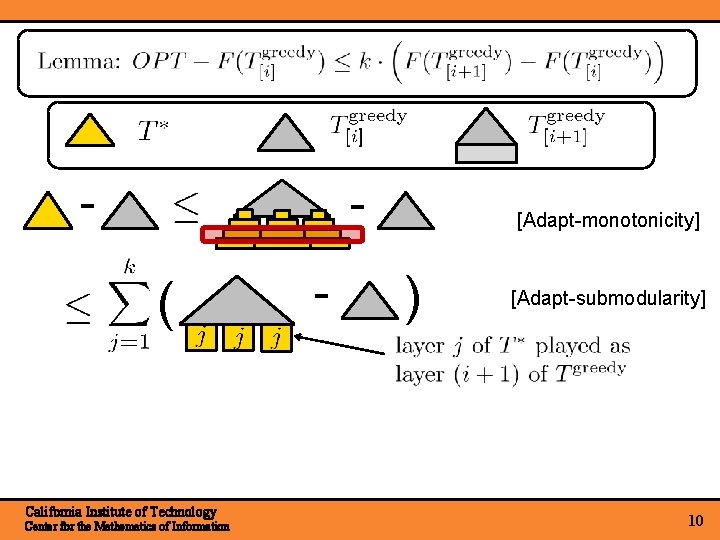
- - ( California Institute of Technology Center for the Mathematics of Information - [Adapt-monotonicity] ) [Adapt-submodularity] 10
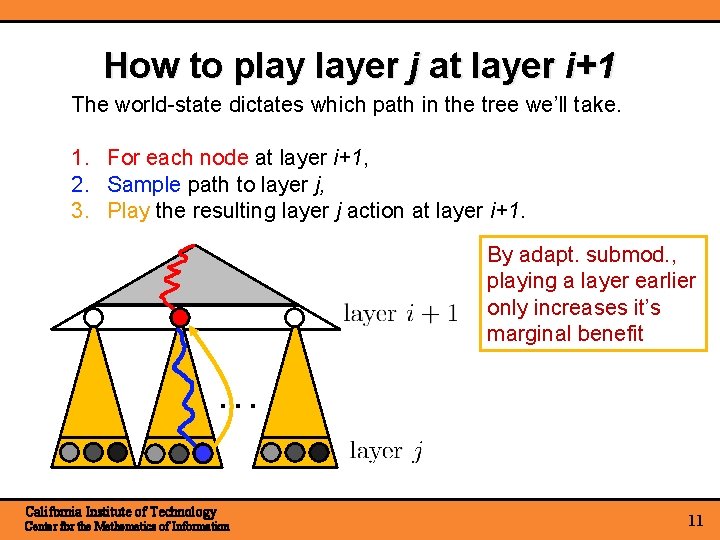
How to play layer j at layer i+1 The world-state dictates which path in the tree we’ll take. 1. For each node at layer i+1, 2. Sample path to layer j, 3. Play the resulting layer j action at layer i+1. By adapt. submod. , playing a layer earlier only increases it’s marginal benefit … California Institute of Technology Center for the Mathematics of Information 11
![- - ( ( [Adapt-monotonicity] - ) ) [Adapt-submodularity] ( - ) [Def. of](http://slidetodoc.com/presentation_image/127ac45ebb82021f691ac5b4a4c64b1c/image-12.jpg "- - ( ( [Adapt-monotonicity] - ) ) [Adapt-submodularity] ( - ) [Def. of")
- - ( ( [Adapt-monotonicity] - ) ) [Adapt-submodularity] ( - ) [Def. of adapt-greedy] California Institute of Technology Center for the Mathematics of Information 12
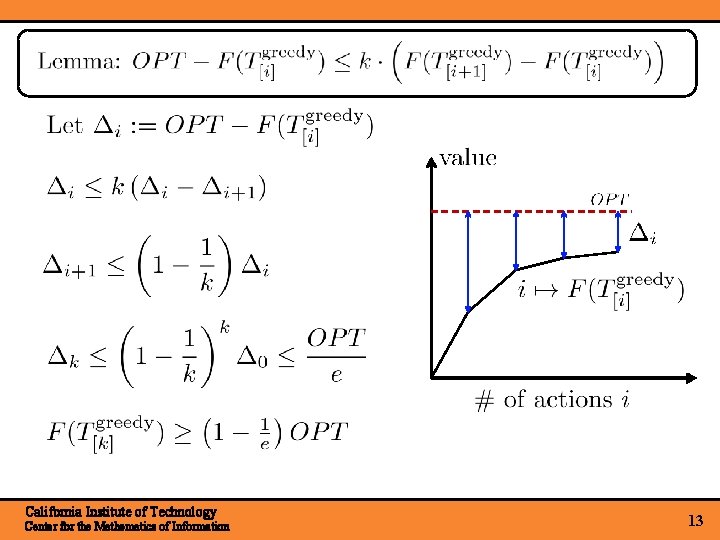
California Institute of Technology Center for the Mathematics of Information 13
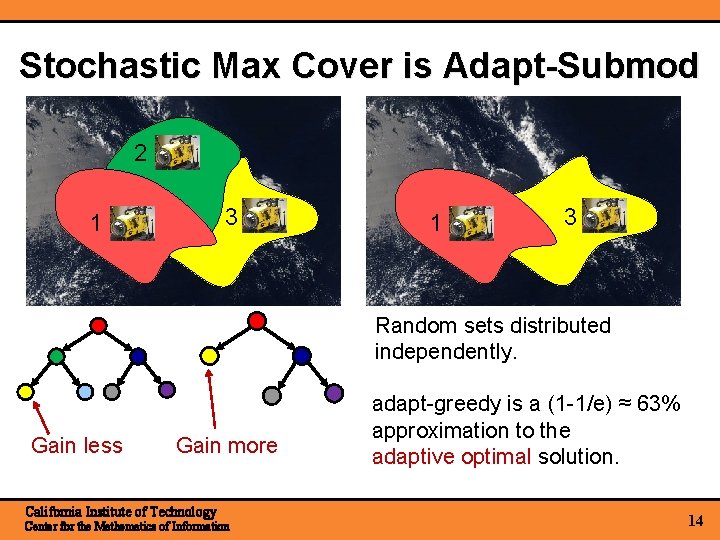
Stochastic Max Cover is Adapt-Submod 2 3 1 1 3 Random sets distributed independently. Gain less Gain more California Institute of Technology Center for the Mathematics of Information adapt-greedy is a (1 -1/e) ≈ 63% approximation to the adaptive optimal solution. 14
![Influence in Social Networks [Kempe, Kleinberg, & Tardos, KDD `03] Daria Alice Eric 0.](http://slidetodoc.com/presentation_image/127ac45ebb82021f691ac5b4a4c64b1c/image-15.jpg "Influence in Social Networks [Kempe, Kleinberg, & Tardos, KDD `03] Daria Alice Eric 0.")
Influence in Social Networks [Kempe, Kleinberg, & Tardos, KDD `03] Daria Alice Eric 0. 2 0. 5 0. 3 0. 4 Prob. of influencing 0. 2 0. 5 Bob 0. 5 Fiona Charlie Who should get free cell phones? V = {Alice, Bob, Charlie, Daria, Eric, Fiona} F(A) = Expected # of people influenced when targeting A California Institute of Technology Center for the Mathematics of Information 15
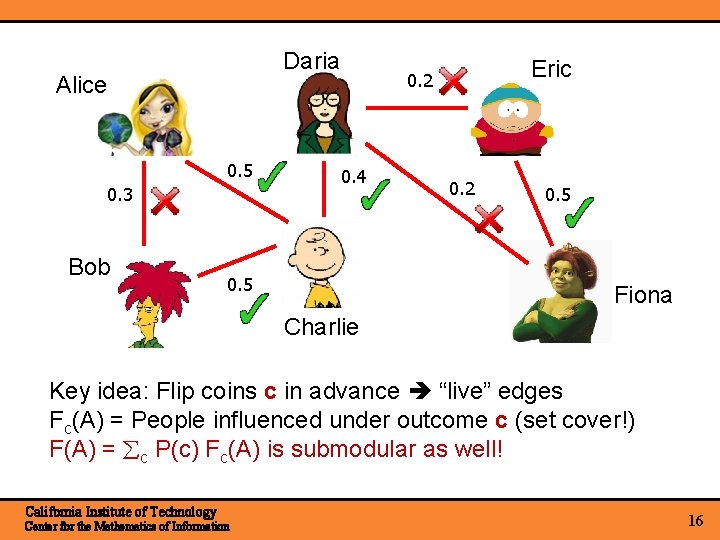
Daria Alice 0. 5 0. 3 Bob Eric 0. 2 0. 4 0. 5 0. 2 0. 5 Fiona Charlie Key idea: Flip coins c in advance “live” edges Fc(A) = People influenced under outcome c (set cover!) F(A) = c P(c) Fc(A) is submodular as well! California Institute of Technology Center for the Mathematics of Information 16
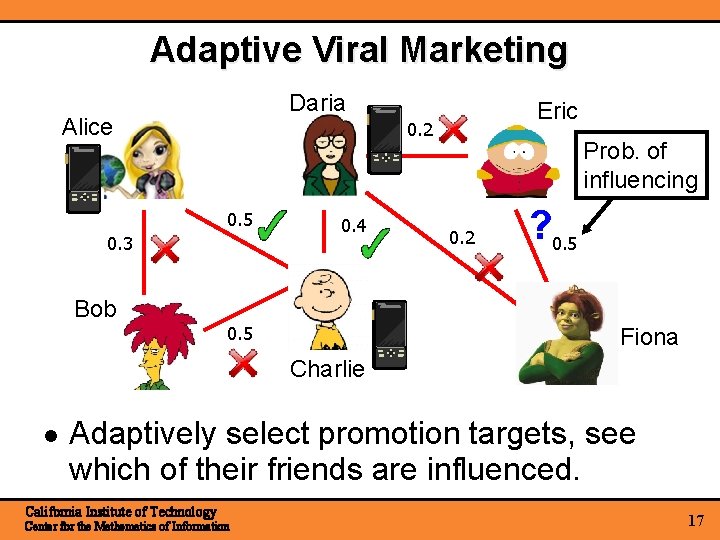
Adaptive Viral Marketing Daria Alice Eric 0. 2 0. 5 0. 3 0. 4 Prob. of influencing 0. 2 ? 0. 5 Bob 0. 5 Fiona Charlie Adaptively select promotion targets, see which of their friends are influenced. California Institute of Technology Center for the Mathematics of Information 17
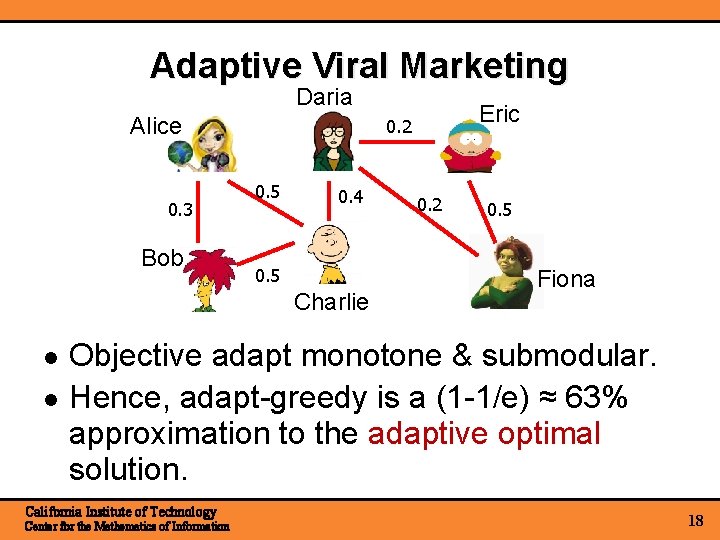
Adaptive Viral Marketing Daria Alice 0. 3 Bob 0. 5 0. 4 0. 5 Charlie Eric 0. 2 0. 5 Fiona Objective adapt monotone & submodular. Hence, adapt-greedy is a (1 -1/e) ≈ 63% approximation to the adaptive optimal solution. California Institute of Technology Center for the Mathematics of Information 18
Stochastic Min Cost Cover Adaptively get a threshold amount of value. Minimize expected number of actions. If objective is adapt-submod and monotone, we get a logarithmic approximation. [Goemans & Vondrak, LATIN ‘ 06] [Liu et al. , SIGMOD ‘ 08] [Feige, JACM ‘ 98] c. f. , Interactive Submodular Set Cover [Guillory & Bilmes, ICML ‘ 10] California Institute of Technology Center for the Mathematics of Information 19
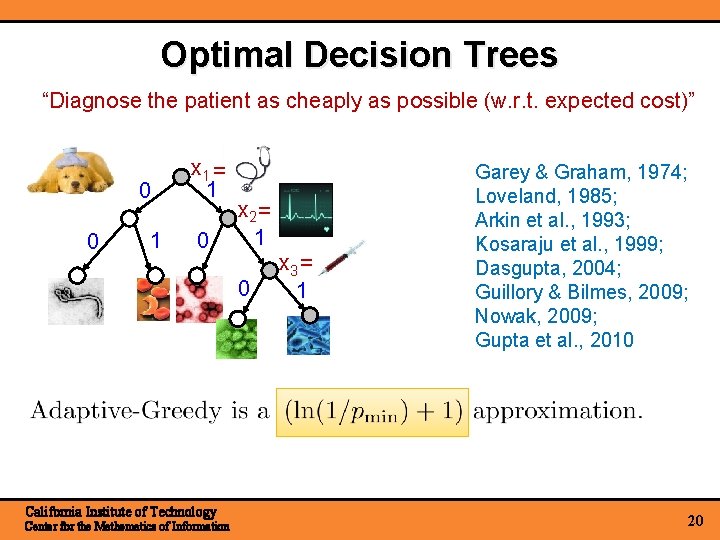
Optimal Decision Trees “Diagnose the patient as cheaply as possible (w. r. t. expected cost)” 0 0 1 x 1 = 1 0 x 2 = 1 0 California Institute of Technology Center for the Mathematics of Information x 3 = 1 Garey & Graham, 1974; Loveland, 1985; Arkin et al. , 1993; Kosaraju et al. , 1999; Dasgupta, 2004; Guillory & Bilmes, 2009; Nowak, 2009; Gupta et al. , 2010 20
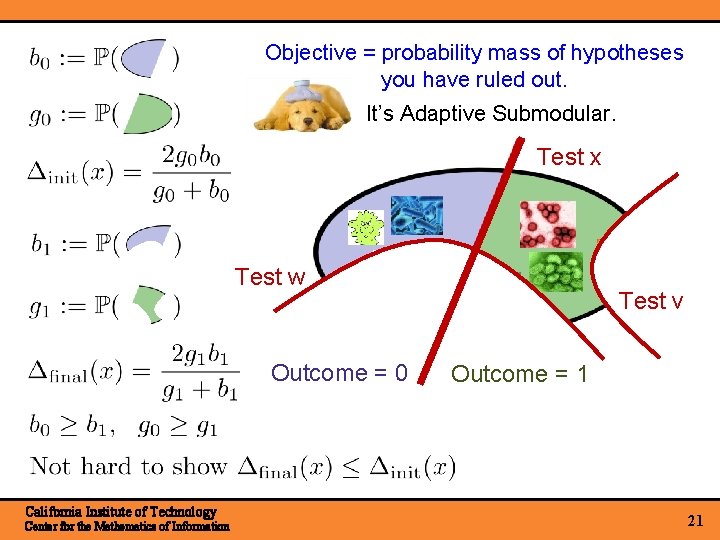
Objective = probability mass of hypotheses you have ruled out. It’s Adaptive Submodular. Test x Test w Outcome = 0 California Institute of Technology Center for the Mathematics of Information Test v Outcome = 1 21
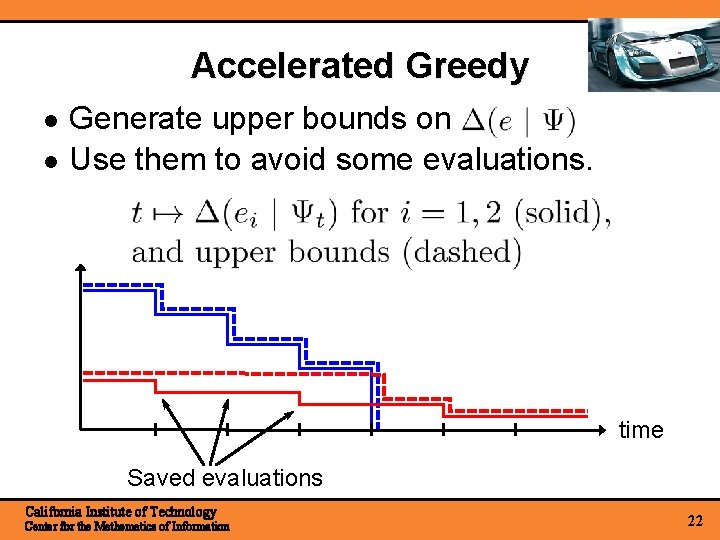
Accelerated Greedy Generate upper bounds on Use them to avoid some evaluations. time Saved evaluations California Institute of Technology Center for the Mathematics of Information 22
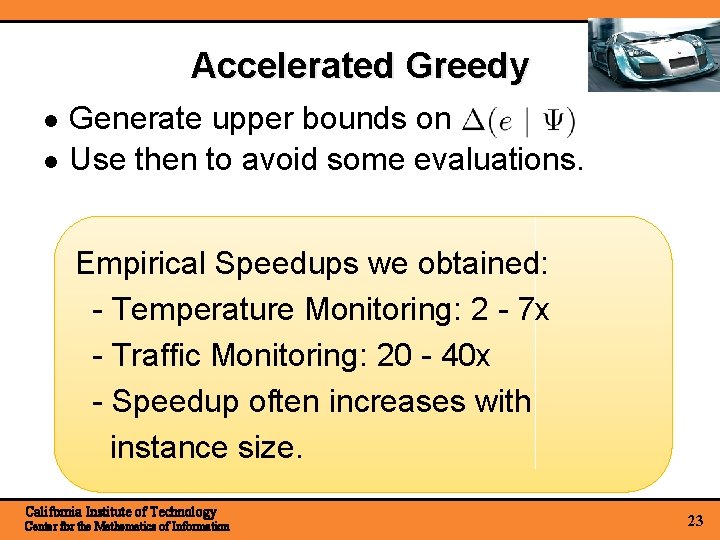
Accelerated Greedy Generate upper bounds on Use then to avoid some evaluations. Empirical Speedups we obtained: - Temperature Monitoring: 2 - 7 x - Traffic Monitoring: 20 - 40 x - Speedup often increases with instance size. California Institute of Technology Center for the Mathematics of Information 23
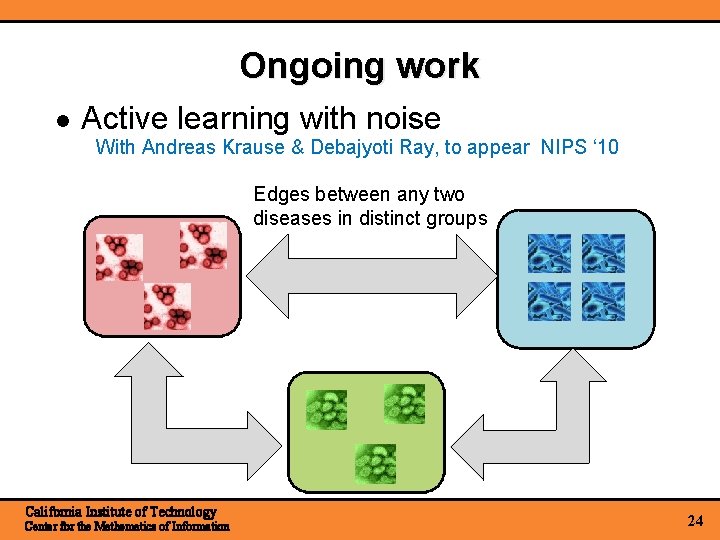
Ongoing work Active learning with noise With Andreas Krause & Debajyoti Ray, to appear NIPS ‘ 10 Edges between any two diseases in distinct groups California Institute of Technology Center for the Mathematics of Information 24
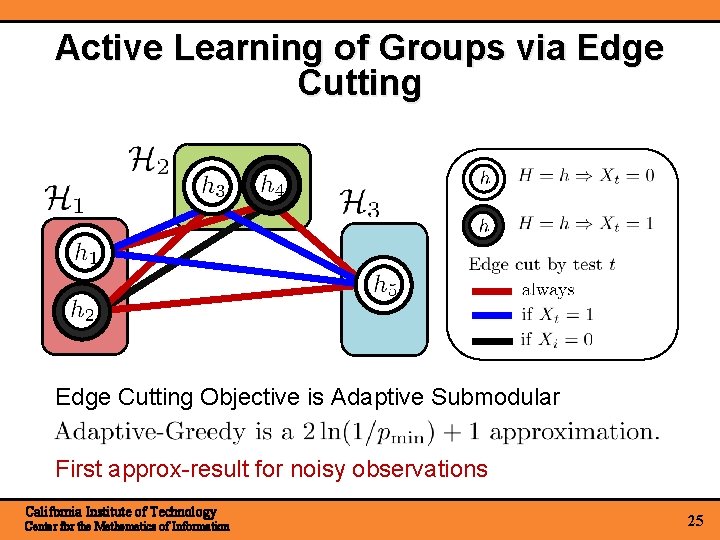
Active Learning of Groups via Edge Cutting Objective is Adaptive Submodular First approx-result for noisy observations California Institute of Technology Center for the Mathematics of Information 25
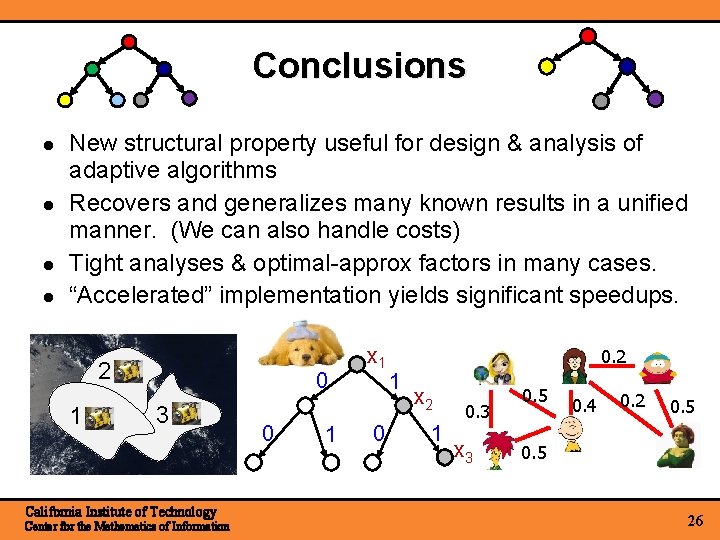
Conclusions New structural property useful for design & analysis of adaptive algorithms Recovers and generalizes many known results in a unified manner. (We can also handle costs) Tight analyses & optimal-approx factors in many cases. “Accelerated” implementation yields significant speedups. 2 1 0 3 California Institute of Technology Center for the Mathematics of Information 0 1 x 1 0 0. 2 1 x 2 1 0. 3 x 3 0. 5 0. 4 0. 2 0. 5 26
2 1 0 3 California Institute of Technology Center for the Mathematics of Information 0 1 x 1 0 0. 2 1 x 2 1 0. 3 x 3 0. 5 0. 4 0. 2 0. 5 27
- Slides: 27