
Adaptive RED An Algorithm for Increasing the Robustness
Adaptive RED: An Algorithm for Increasing the Robustness of RED’s Active Queue Management or How I learned to stop worrying and love RED l Presented 10/20/2021 by: l Frank Posluszny l Vishal Phirke 1
§Introduction §Background and Related Work §Metrics and Scenarios §Pre-results §Adaptive RED Algorithm. §Parameters and their values §Simulations. §Delay-Throughput Tradeoff. §Conclusions. 10/20/2021 2
Introduction - 1 l Who are they authors? – Sally Floyd (original RED author) – Ramakrishna Gummadi (CS grad - intern) – Scott Shenker (works with Sally Floyd) 10/20/2021 3
Introduction - 2 l Goals: – People want a guaranteed delay, which RED can’t do without constantly adjusting the parameters – “Our goal… is to solve this problem with minimal changes to the overall RED algorithm. ” 10/20/2021 4
§Introduction §Background and Related Work §Metrics and Scenarios §Pre-results §Adaptive RED Algorithm. §Parameters and their values §Simulations. §Delay-Throughput Tradeoff. §Conclusions. 10/20/2021 5
Background & Related Work - 1 l Quick review of RED – Try to maintain queue size under a threshold, assuming that as we get closer to that threshold then congestion will start to occur – Once we “foresee” congestion, drop with an increasing probability 10/20/2021 6
Background & Related Work - 2 l Problems, problems everywhere… – Tuning RED for Web Traffic – A number of papers point out problems with oscillations in the instantaneous queue size (Misra et at. , Hollot et al. , Firoiu et al. ) – Average queuing delay – Throughput 10/20/2021 7
Background & Related Work - 3 l Suggested fixes… – – Jacobson (how to set wq) Ziegler (tighter bound for aveq) Feng (adapt maxp) AVG (keep queue size small, token bucket) – SRED (estimate #of active flows) – DRED (keep queue size near a threshold) 10/20/2021 8
§Introduction §Background and Related Work §Metrics and Scenarios §Pre-results §Adaptive RED Algorithm. §Parameters and their values §Simulations. §Delay-Throughput Tradeoff. §Conclusions. 10/20/2021 9
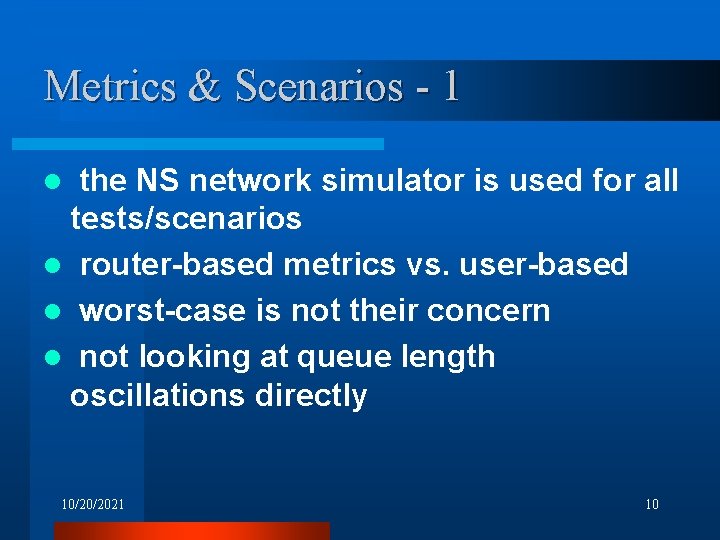
Metrics & Scenarios - 1 the NS network simulator is used for all tests/scenarios l router-based metrics vs. user-based l worst-case is not their concern l not looking at queue length oscillations directly l 10/20/2021 10
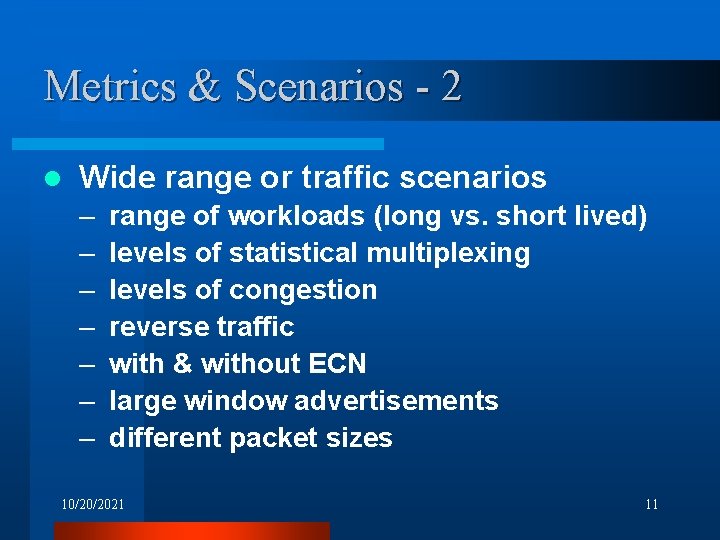
Metrics & Scenarios - 2 l Wide range or traffic scenarios – – – – range of workloads (long vs. short lived) levels of statistical multiplexing levels of congestion reverse traffic with & without ECN large window advertisements different packet sizes 10/20/2021 11
§Introduction §Background and Related Work §Metrics and Scenarios §Pre-results §Adaptive RED Algorithm. §Parameters and their values §Simulations. §Delay-Throughput Tradeoff. §Conclusions. 10/20/2021 12
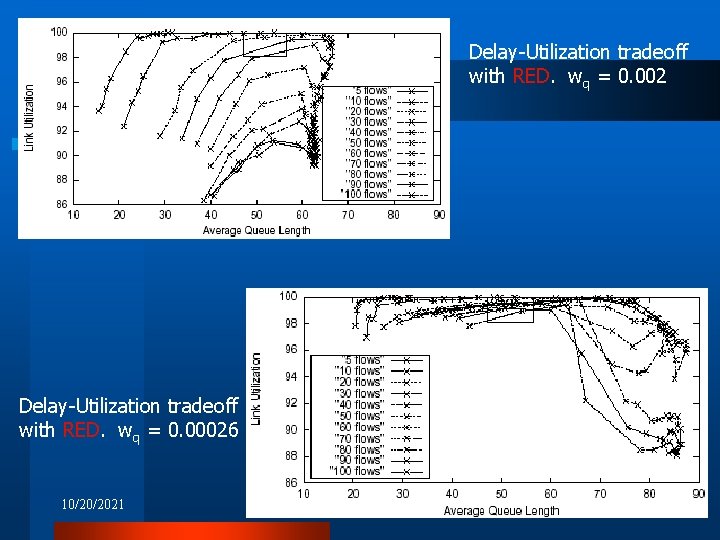
Delay-Utilization tradeoff with RED. wq = 0. 002 Delay-Utilization tradeoff with RED. wq = 0. 00026 10/20/2021 13
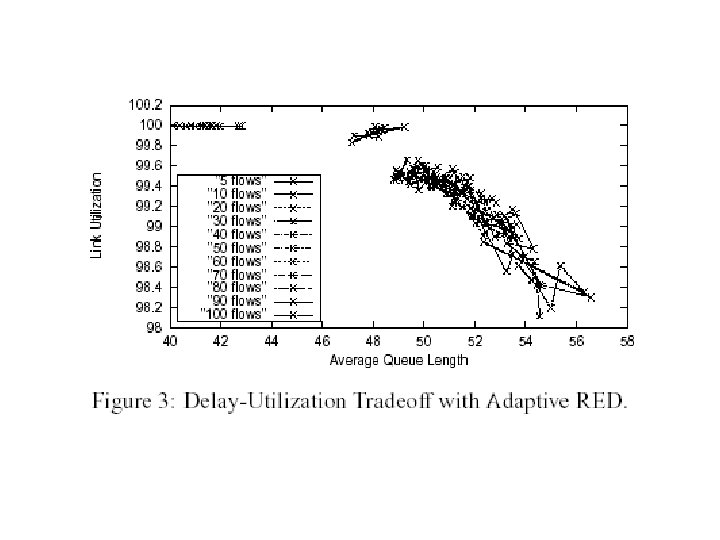
10/20/2021 14
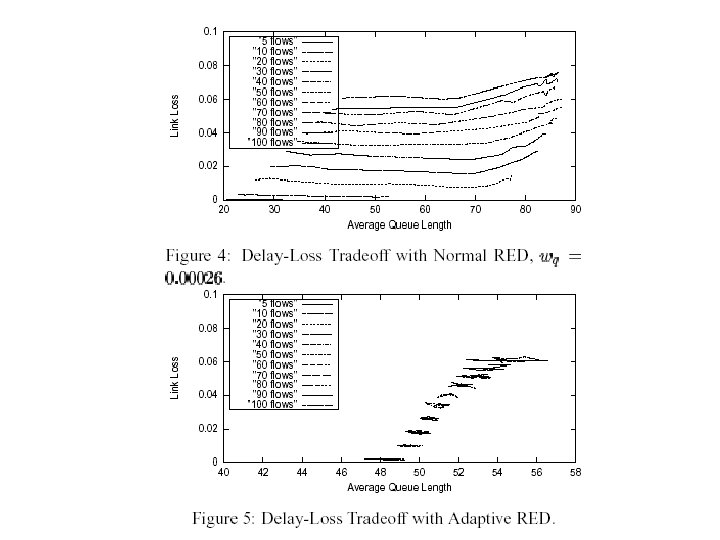
10/20/2021 15
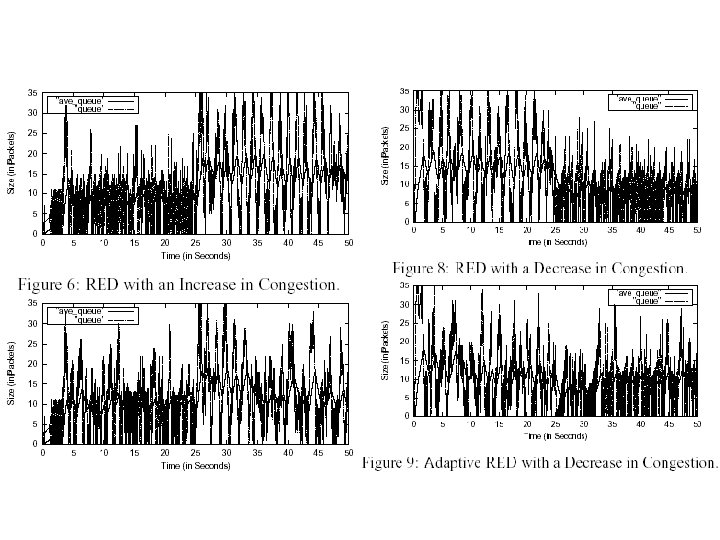
10/20/2021 16
§Introduction §Background and Related Work §Metrics and Scenarios §Pre-results §Adaptive RED Algorithm. §Parameters and their values §Simulations. §Delay-Throughput Tradeoff. §Conclusions. 10/20/2021 17
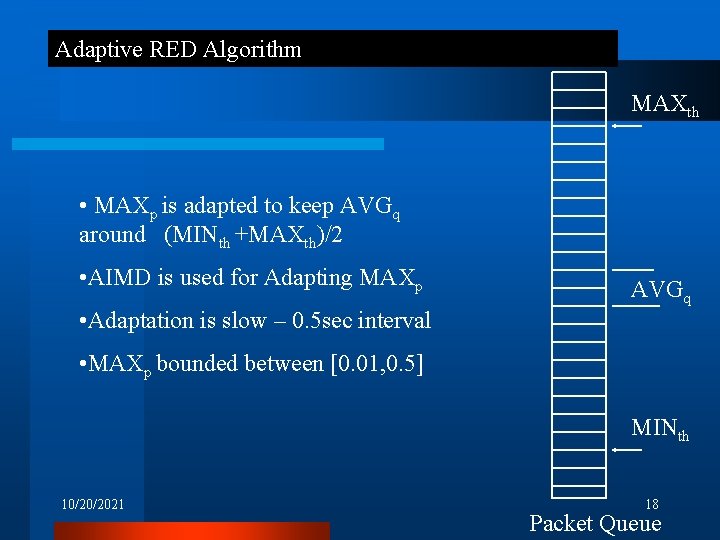
Adaptive RED Algorithm MAXth • MAXp is adapted to keep AVGq around (MINth +MAXth)/2 • AIMD is used for Adapting MAXp • Adaptation is slow – 0. 5 sec interval AVGq • MAXp bounded between [0. 01, 0. 5] MINth 10/20/2021 18 Packet Queue
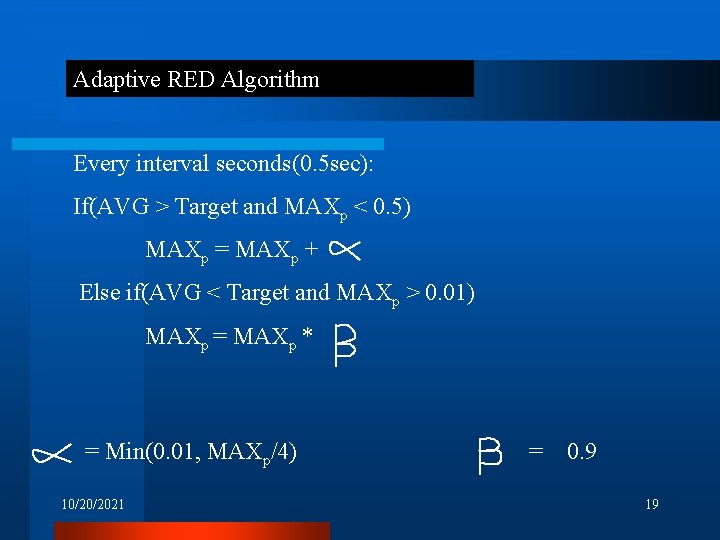
Adaptive RED Algorithm Every interval seconds(0. 5 sec): If(AVG > Target and MAXp < 0. 5) MAXp = MAXp + Else if(AVG < Target and MAXp > 0. 01) MAXp = MAXp * = Min(0. 01, MAXp/4) 10/20/2021 = 0. 9 19
§Introduction §Background and Related Work §Metrics and Scenarios §Pre-results §Adaptive RED Algorithm. §Parameters and their values §Simulations. §Delay-Throughput Tradeoff. §Conclusions. 10/20/2021 20
![MAXp Range [0. 01, 0. 5] Upper bound 0. 5 §Not trying to optimize](http://slidetodoc.com/presentation_image_h2/d72050e6e1a9c8e2844092c80d252e9a/image-21.jpg "MAXp Range [0. 01, 0. 5] Upper bound 0. 5 §Not trying to optimize")
MAXp Range [0. 01, 0. 5] Upper bound 0. 5 §Not trying to optimize for packet drop rates more than 50%. §Gentle RED 1 MAXp Lower bound 0. 01 §No one will object lower delays MINth MAXth 2 MAXth §Limits the MAXp Range – Important as Adaptation is slow (0. 5 sec interval) 10/20/2021 21
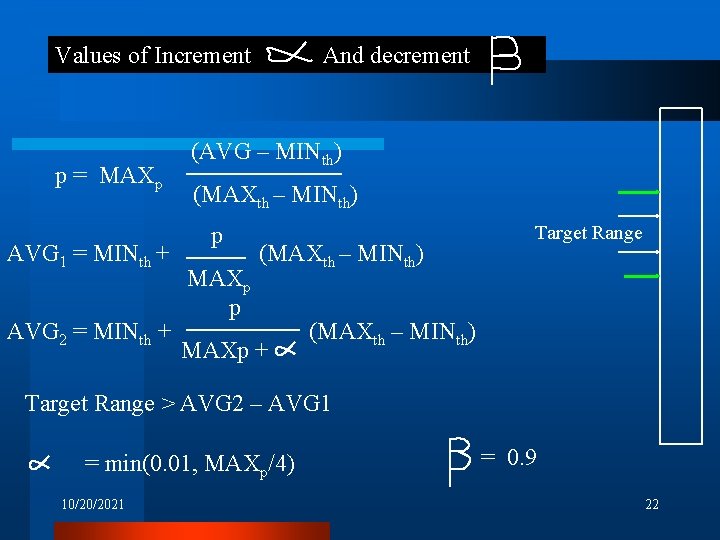
Values of Increment p = MAXp AVG 1 = MINth + AVG 2 = MINth + And decrement (AVG – MINth) (MAXth – MINth) p MAXp p (MAXth – MINth) MAXp + Target Range (MAXth – MINth) Target Range > AVG 2 – AVG 1 = min(0. 01, MAXp/4) 10/20/2021 = 0. 9 22
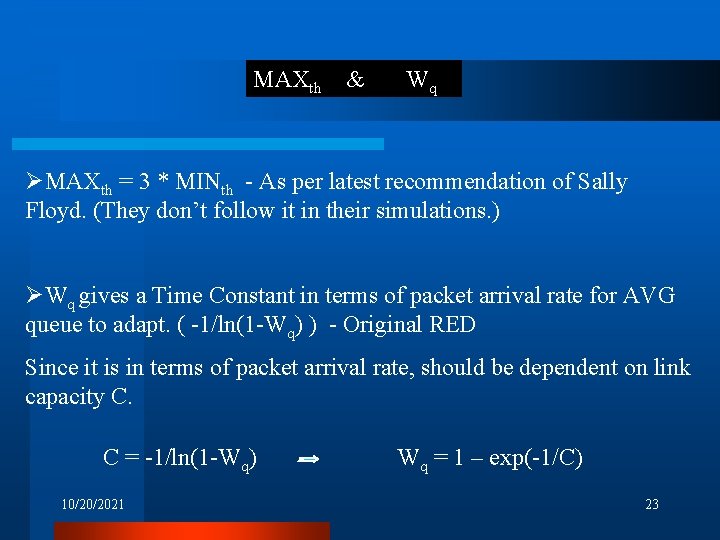
MAXth & Wq ØMAXth = 3 * MINth - As per latest recommendation of Sally Floyd. (They don’t follow it in their simulations. ) ØWq gives a Time Constant in terms of packet arrival rate for AVG queue to adapt. ( -1/ln(1 -Wq) ) - Original RED Since it is in terms of packet arrival rate, should be dependent on link capacity C. C = -1/ln(1 -Wq) 10/20/2021 Wq = 1 – exp(-1/C) 23
§Introduction §Background and Related Work §Metrics and Scenarios §Pre-results §Adaptive RED Algorithm. §Parameters and their values §Simulations. §Delay-Throughput Tradeoff. §Conclusions. 10/20/2021 24
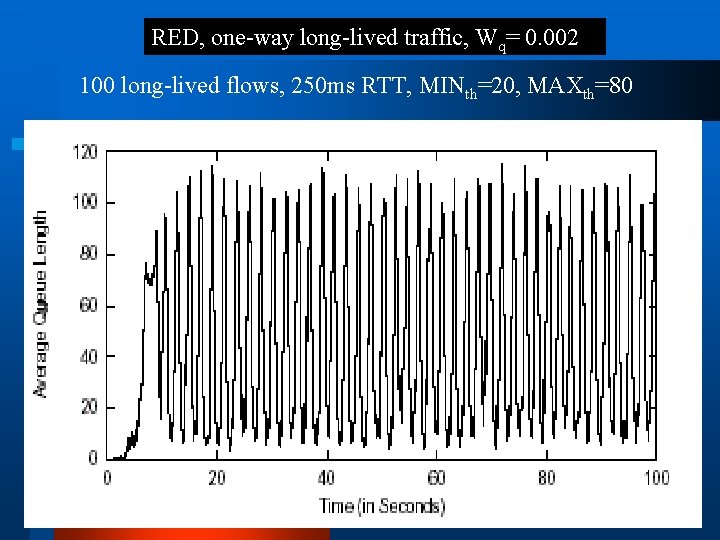
RED, one-way long-lived traffic, Wq= 0. 002 100 long-lived flows, 250 ms RTT, MINth=20, MAXth=80 10/20/2021 25
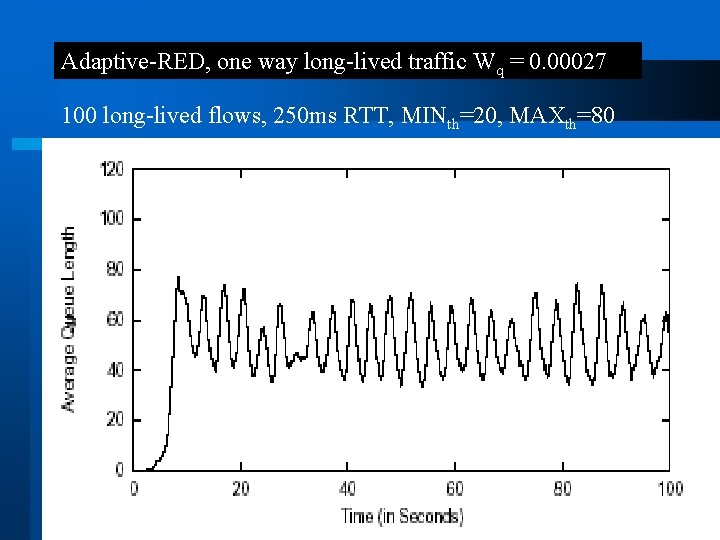
Adaptive-RED, one way long-lived traffic Wq = 0. 00027 100 long-lived flows, 250 ms RTT, MINth=20, MAXth=80 10/20/2021 26
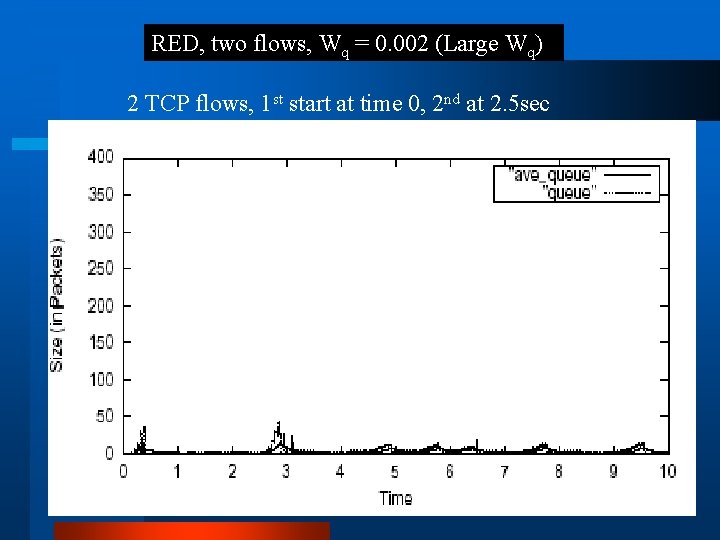
RED, two flows, Wq = 0. 002 (Large Wq) 2 TCP flows, 1 st start at time 0, 2 nd at 2. 5 sec 10/20/2021 27
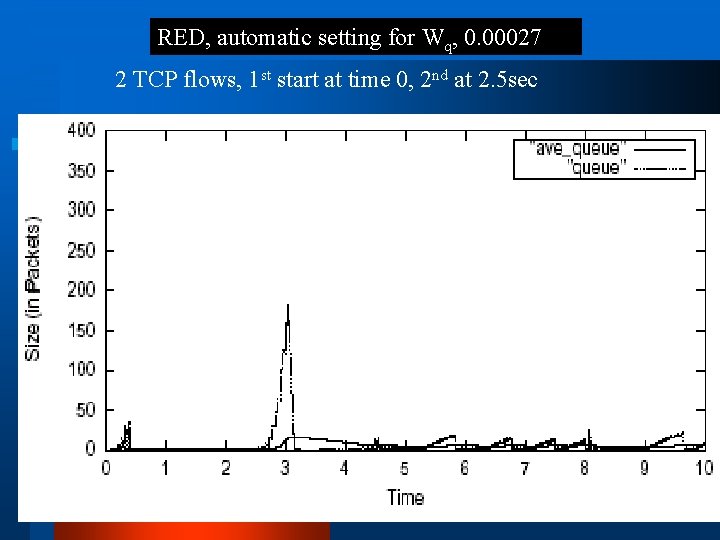
RED, automatic setting for Wq, 0. 00027 2 TCP flows, 1 st start at time 0, 2 nd at 2. 5 sec 10/20/2021 28
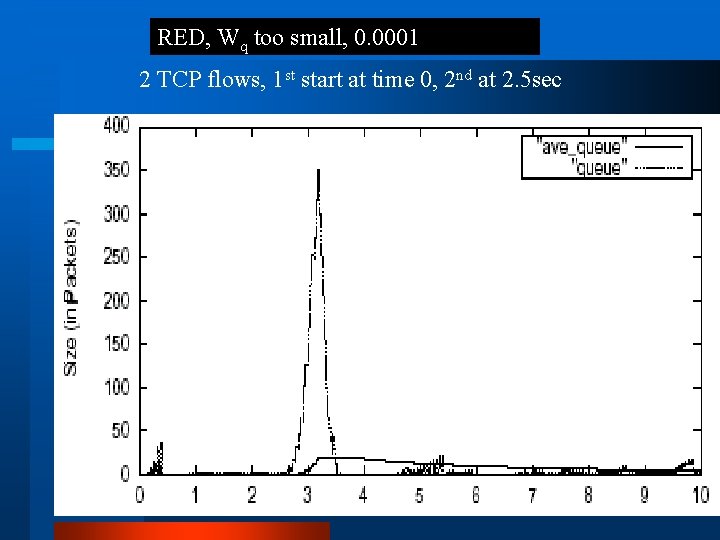
RED, Wq too small, 0. 0001 2 TCP flows, 1 st start at time 0, 2 nd at 2. 5 sec 10/20/2021 29
§Introduction §Background and Related Work §Metrics and Scenarios §Pre-results §Adaptive RED Algorithm. §Parameters and their values §Simulations. §Delay-Throughput Tradeoff. §Conclusions. 10/20/2021 30
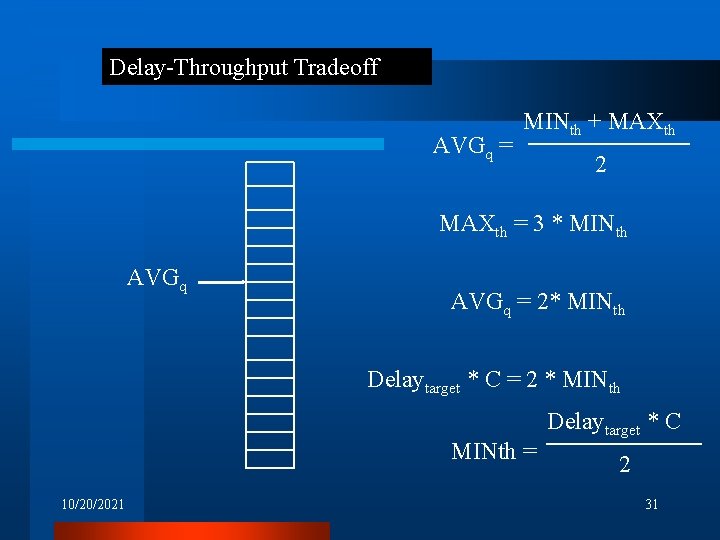
Delay-Throughput Tradeoff AVGq = MINth + MAXth 2 MAXth = 3 * MINth AVGq = 2* MINth Delaytarget * C = 2 * MINth = 10/20/2021 Delaytarget * C 2 31
§Introduction §Background and Related Work §Metrics and Scenarios §Pre-results §Adaptive RED Algorithm. §Parameters and their values §Simulations. §Delay-Throughput Tradeoff. §Conclusions. 10/20/2021 32
Conclusions § Reduces RED’s parameter sensitivity. §Network operators can configure delay by using proper value for MINth. 10/20/2021 33

10/20/2021 34
- Slides: 34