
Adaptive Random Testing W Eric Wong Department of

- Slides: 20
Adaptive Random Testing W. Eric Wong Department of Computer Science The University of Texas at Dallas ewong@utdallas. edu http: //www. utdallas. edu/~ewong Adaptive Random Testing (© 2012 Professor W. Eric Wong, The University of Texas at Dallas) 1
Speaker Biographical Sketch Professor & Director of International Outreach Department of Computer Science University of Texas at Dallas Guest Researcher Computer Security Division National Institute of Standards and Technology (NIST) Vice President, IEEE Reliability Society Secretary, ACM SIGAPP (Special Interest Group on Applied Computing) Principal Investigator, NSF TUES (Transforming Undergraduate Education in Science, Technology, Engineering and Mathematics) Project – Incorporating Software Testing into Multiple Computer Science and Software Engineering Undergraduate Courses Founder & Steering Committee co-Chair for the SERE conference (IEEE International Conference on Software Security and Reliability) (http: //paris. utdallas. edu/sere 13) Adaptive Random Testing (© 2012 Professor W. Eric Wong, The University of Texas at Dallas) 2
Basic Concepts Input domain: Set of all possible inputs Exhaustive testing: – Test the program with the entire input domain – Practically infeasible Failure-causing inputs: Inputs that exhibit failures Adaptive Random Testing (© 2012 Professor W. Eric Wong, The University of Texas at Dallas) 3
Random Testing (1) Random Testing – Selects test cases from the entire input domain randomly and independently Advantages: – Intuitively simple – Allows statistical quantitative estimation of the software’s reliability Adaptive Random Testing (© 2012 Professor W. Eric Wong, The University of Texas at Dallas) 4
Random Testing (2) Two approaches – Uniform distributions – Operational distributions (profiles) Adaptive Random Testing (© 2012 Professor W. Eric Wong, The University of Texas at Dallas) 5
How to Improve Random Testing Any common information or characteristics to all faulty programs? Failure-causing inputs Adaptive Random Testing (© 2012 Professor W. Eric Wong, The University of Texas at Dallas) 6
Patterns of Failure-Causing Inputs Strip Pattern Block Pattern Point Pattern Adaptive Random Testing (© 2012 Professor W. Eric Wong, The University of Texas at Dallas) 7
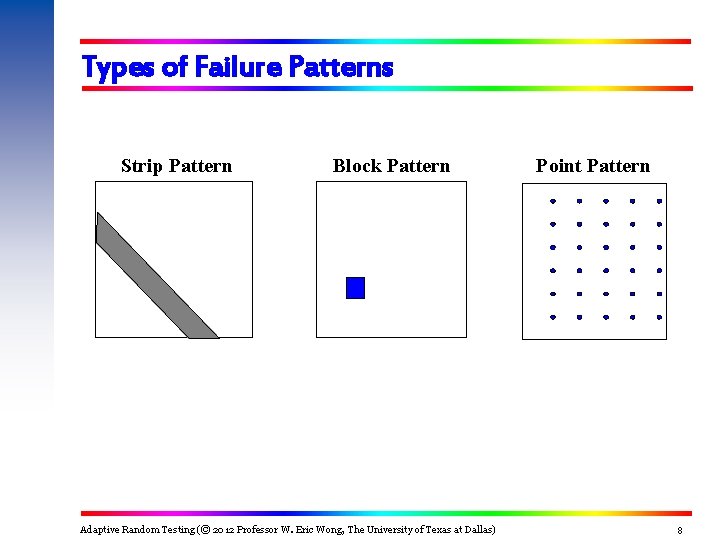
Types of Failure Patterns Strip Pattern Block Pattern Adaptive Random Testing (© 2012 Professor W. Eric Wong, The University of Texas at Dallas) Point Pattern 8
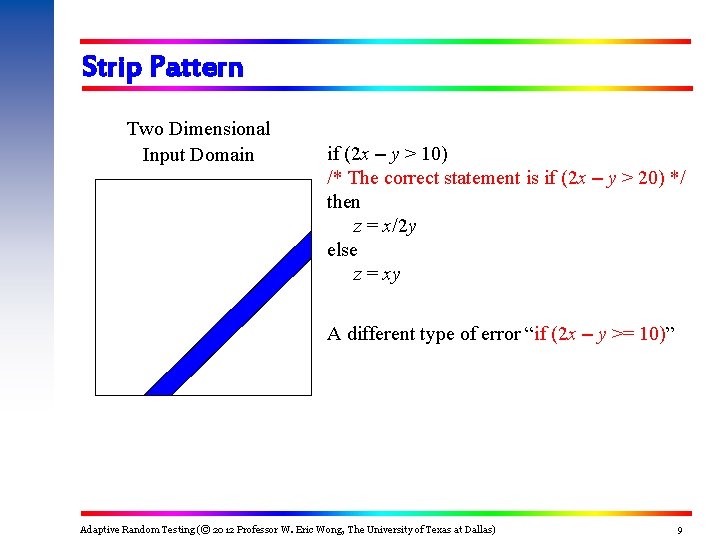
Strip Pattern Two Dimensional Input Domain if (2 x – y > 10) /* The correct statement is if (2 x – y > 20) */ then z = x/2 y else z = xy A different type of error “if (2 x – y >= 10)” Adaptive Random Testing (© 2012 Professor W. Eric Wong, The University of Texas at Dallas) 9
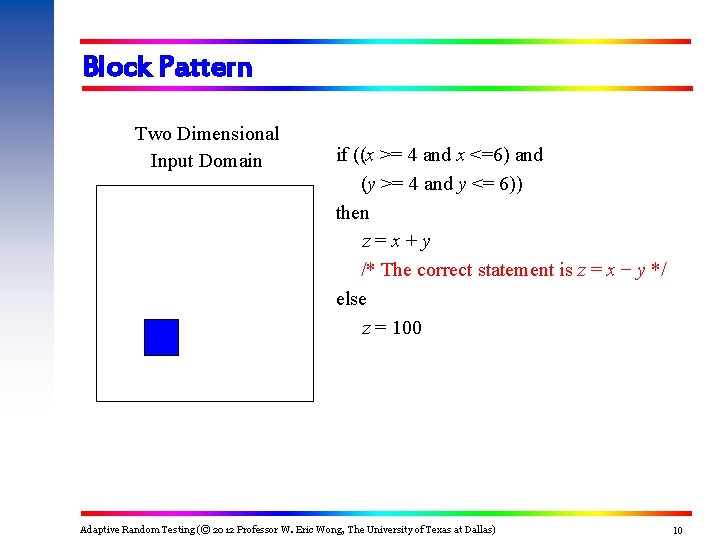
Block Pattern Two Dimensional Input Domain if ((x >= 4 and x <=6) and (y >= 4 and y <= 6)) then z=x+y /* The correct statement is z = x − y */ else z = 100 Adaptive Random Testing (© 2012 Professor W. Eric Wong, The University of Texas at Dallas) 10
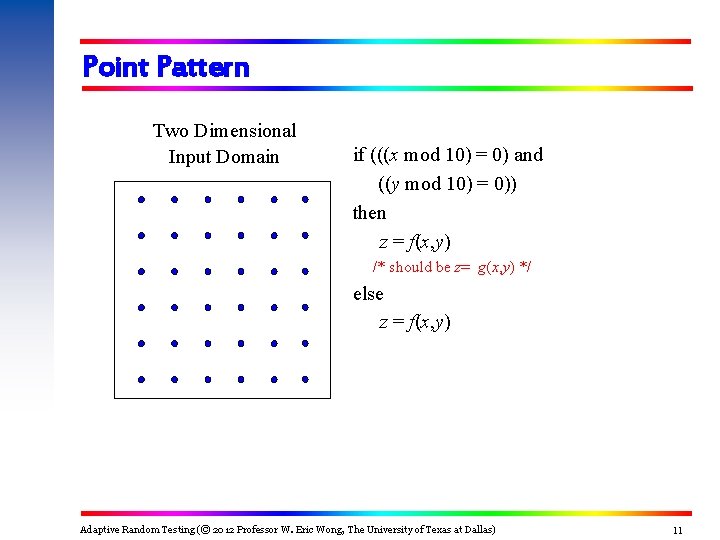
Point Pattern Two Dimensional Input Domain if (((x mod 10) = 0) and ((y mod 10) = 0)) then z = f(x, y) /* should be z= g(x, y) */ else z = f(x, y) Adaptive Random Testing (© 2012 Professor W. Eric Wong, The University of Texas at Dallas) 11
Which Pattern Occurs More Frequently ? Block and strip patterns Adaptive Random Testing (© 2012 Professor W. Eric Wong, The University of Texas at Dallas) 12
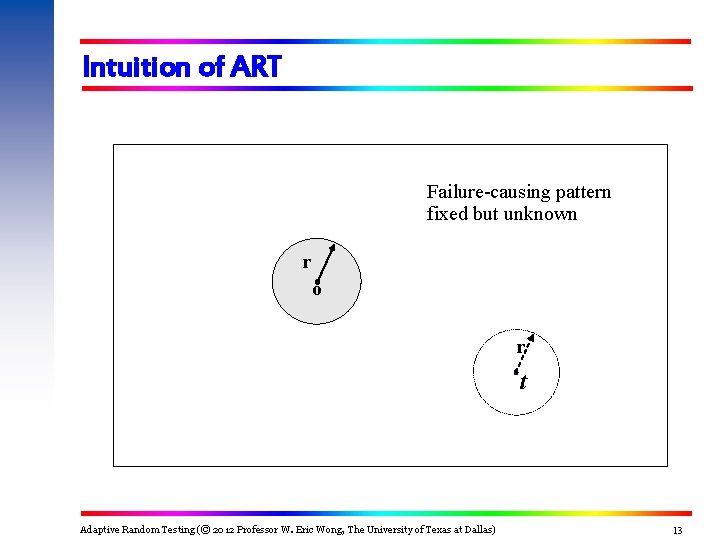
Intuition of ART Failure-causing pattern fixed but unknown r o r t Adaptive Random Testing (© 2012 Professor W. Eric Wong, The University of Texas at Dallas) 13
Adaptive Random Testing (1) For non-point failure patterns – An even spread of random test cases will enhance the fault detection capabilities Adaptive Random Testing (© 2012 Professor W. Eric Wong, The University of Texas at Dallas) 14
Adaptive Random Testing (2) Simulation and empirical results showed that as compared with random testing, fewer test cases required to detect the first failure (smaller F-measure) F-measure of ART 50 -60% of that of RT with replacement Adaptive Random Testing (© 2012 Professor W. Eric Wong, The University of Texas at Dallas) 15
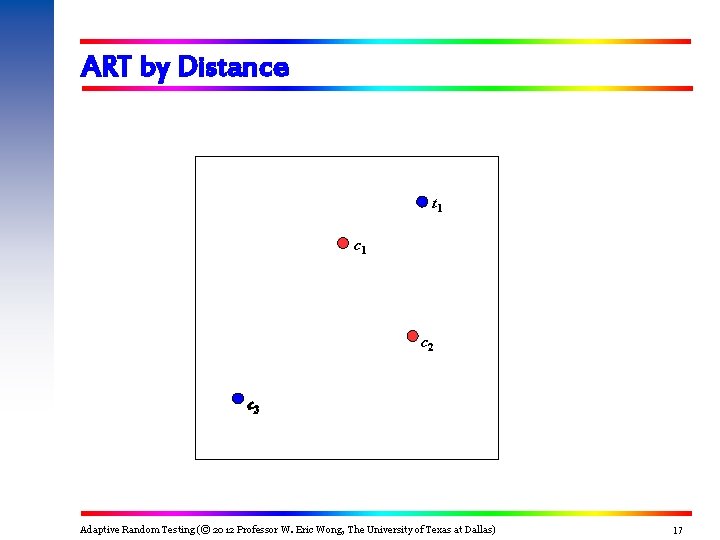
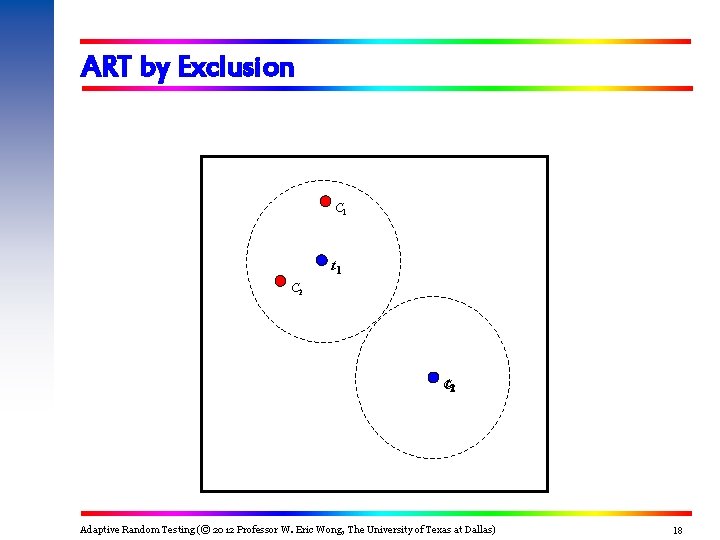
How to Achieve “Even Spread ” ? Notion of distance Notion of exclusion . . . . Adaptive Random Testing (© 2012 Professor W. Eric Wong, The University of Texas at Dallas) 16
ART by Distance t 1 c 2 ct 23 Adaptive Random Testing (© 2012 Professor W. Eric Wong, The University of Texas at Dallas) 17
ART by Exclusion C 1 t 1 C 2 Ct 23 Adaptive Random Testing (© 2012 Professor W. Eric Wong, The University of Texas at Dallas) 18
Even Spread Approaches Distance – Distance measures – Size of candidate set –. . . . Exclusion – Exclusion amount – Shape of exclusion region –. . . Adaptive Random Testing (© 2012 Professor W. Eric Wong, The University of Texas at Dallas) 19
Possible topic for your term paper ART versus RT Adaptive Random Testing (© 2012 Professor W. Eric Wong, The University of Texas at Dallas) 20