
Adaptive Processes Linking Strategy with Execution Contributions of
Adaptive Processes: Linking Strategy with Execution
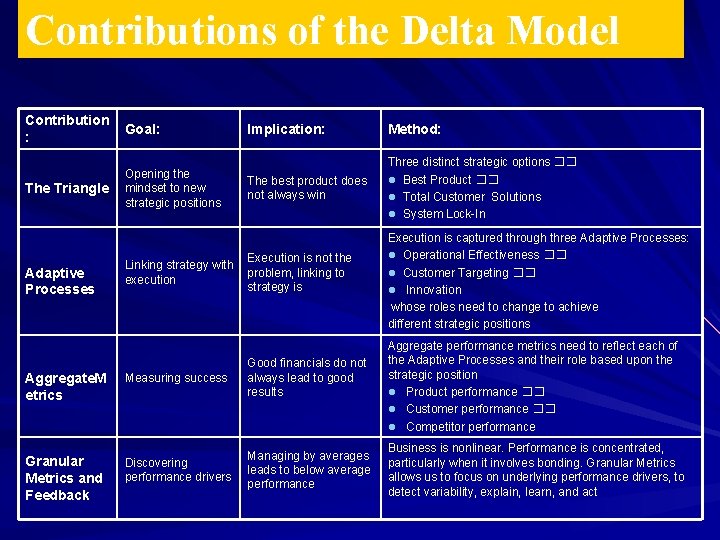
Contributions of the Delta Model Contribution : Goal: The Triangle Opening the mindset to new strategic positions Adaptive Processes Linking strategy with execution Implication: Method: The best product does not always win Three distinct strategic options �� l Best Product �� l Total Customer Solutions l System Lock-In Execution is not the problem, linking to strategy is Aggregate. M etrics Measuring success Good financials do not always lead to good results Granular Metrics and Feedback Discovering performance drivers Managing by averages leads to below average performance Execution is captured through three Adaptive Processes: l Operational Effectiveness �� l Customer Targeting �� l Innovation whose roles need to change to achieve different strategic positions Aggregate performance metrics need to reflect each of the Adaptive Processes and their role based upon the strategic position l Product performance �� l Customer performance �� l Competitor performance Business is nonlinear. Performance is concentrated, particularly when it involves bonding. Granular Metrics allows us to focus on underlying performance drivers, to detect variability, explain, learn, and act

The Adaptive Processes: Linking Strategy with Execution
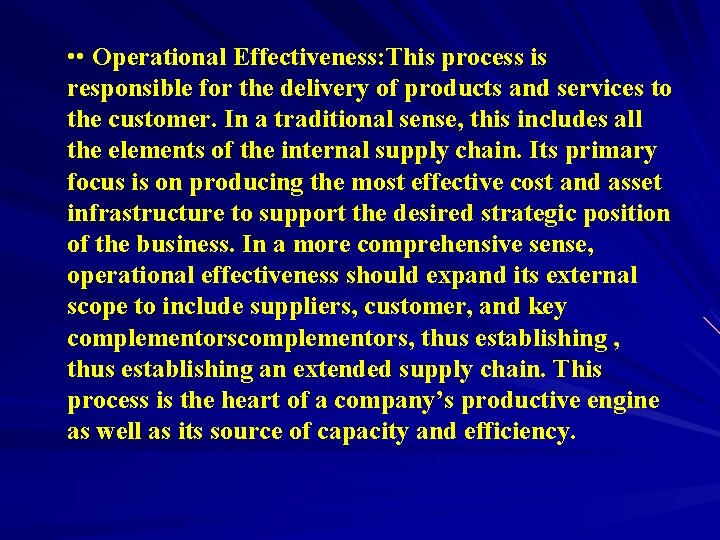
• • Operational Effectiveness: This process is responsible for the delivery of products and services to the customer. In a traditional sense, this includes all the elements of the internal supply chain. Its primary focus is on producing the most effective cost and asset infrastructure to support the desired strategic position of the business. In a more comprehensive sense, operational effectiveness should expand its external scope to include suppliers, customer, and key complementors, thus establishing an extended supply chain. This process is the heart of a company’s productive engine as well as its source of capacity and efficiency.
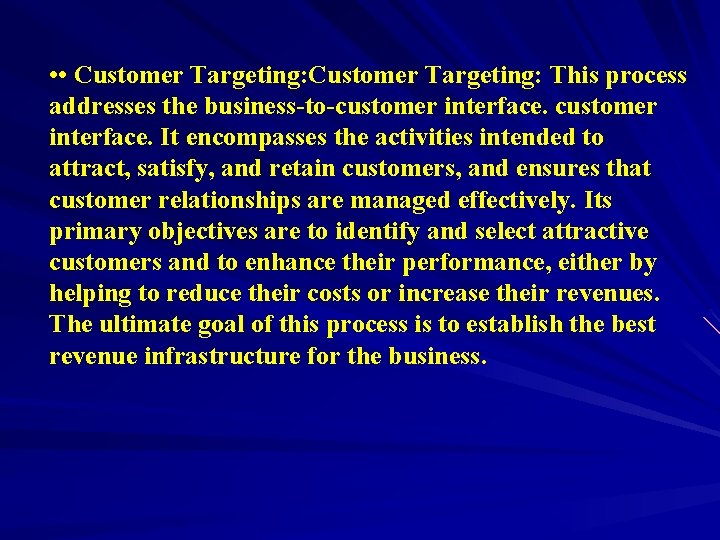
• • Customer Targeting: This process addresses the business-to-customer interface. It encompasses the activities intended to attract, satisfy, and retain customers, and ensures that customer relationships are managed effectively. Its primary objectives are to identify and select attractive customers and to enhance their performance, either by helping to reduce their costs or increase their revenues. The ultimate goal of this process is to establish the best revenue infrastructure for the business.
• • Innovation: This process ensures a continuous stream of new products and services to maintain the future viability of the business. It mobilizes all the creative resources of the firm-including its technical, production, and marketing capabilities--to develop an innovative infrastructure for the business. It Should not limit itself to the pursuit of internal product development, but should extend the sources of Innovation to include suppliers, customers, and key complementors. The heart of this process is the renewal of the business in order to sustain its competitive advantage and its superior financial performance.
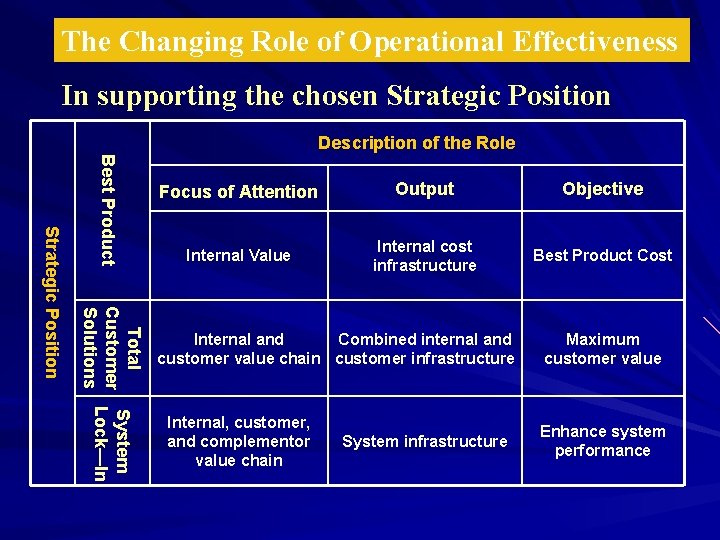
The Changing Role of Operational Effectiveness In supporting the chosen Strategic Position Description of the Role Best P ro d u ct T o ta l S y s te m C u s to m e r Lock—In S o l u ti o n s S tr a te g i c P o s i ti o n Focus of Attention Output Objective Internal Value Internal cost infrastructure Best Product Cost Internal and Combined internal and customer value chain customer infrastructure Internal, customer, and complementor value chain System infrastructure Maximum customer value Enhance system performance
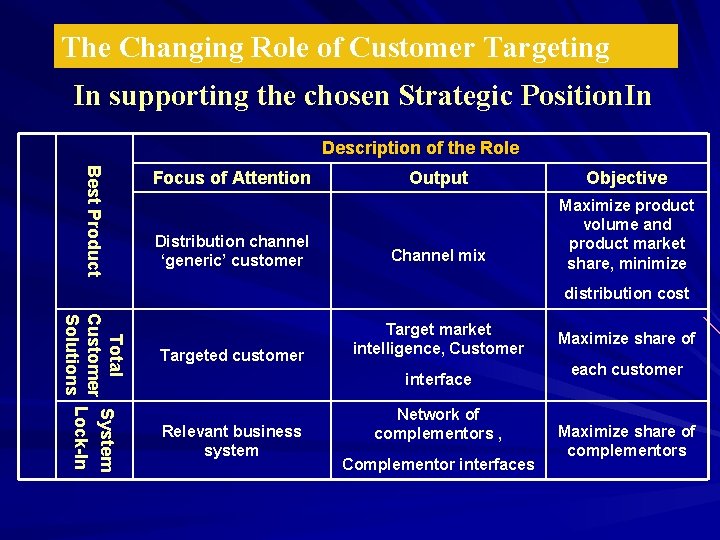
The Changing Role of Customer Targeting In supporting the chosen Strategic Position. In Description of the Role Best P ro d u ct Focus of Attention Distribution channel ‘generic’ customer Output Objective Channel mix Maximize product volume and product market share, minimize distribution cost T o ta l S y s te m C u s to m e r S o l u ti o n s L o c k -I n Targeted customer Target market intelligence, Customer interface Relevant business system Network of complementors , Complementor interfaces Maximize share of each customer Maximize share of complementors
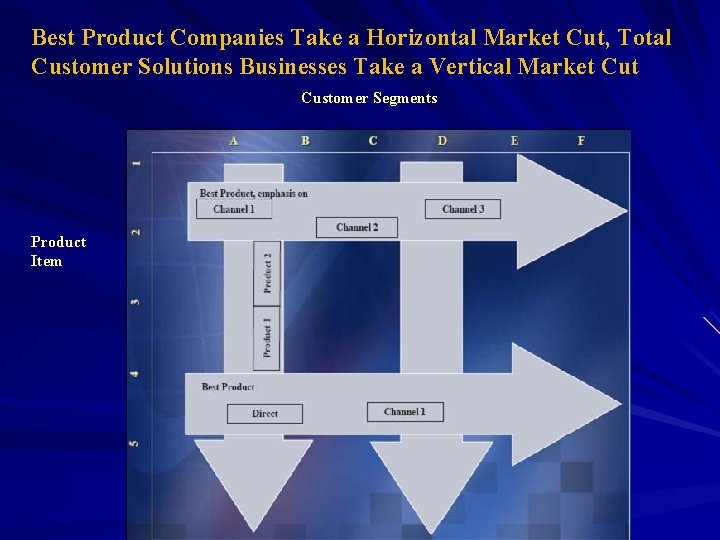
Best Product Companies Take a Horizontal Market Cut, Total Customer Solutions Businesses Take a Vertical Market Customer Segments Product Item
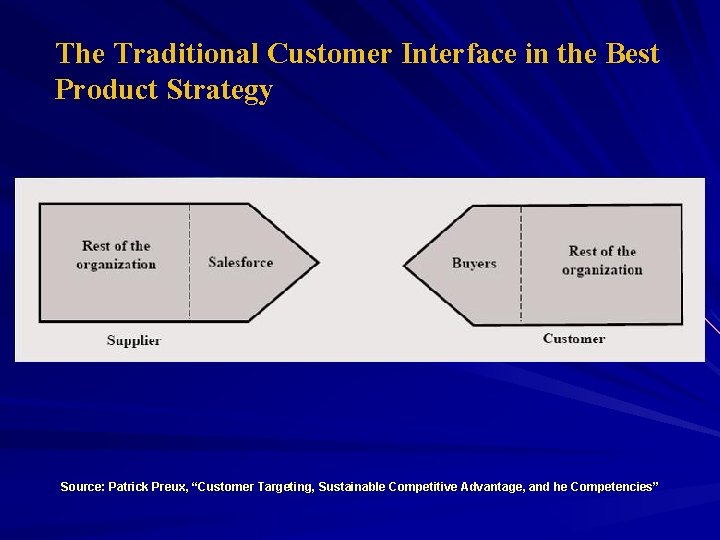
The Traditional Customer Interface in the Best Product Strategy Source: Patrick Preux, “Customer Targeting, Sustainable Competitive Advantage, and he Competencies”
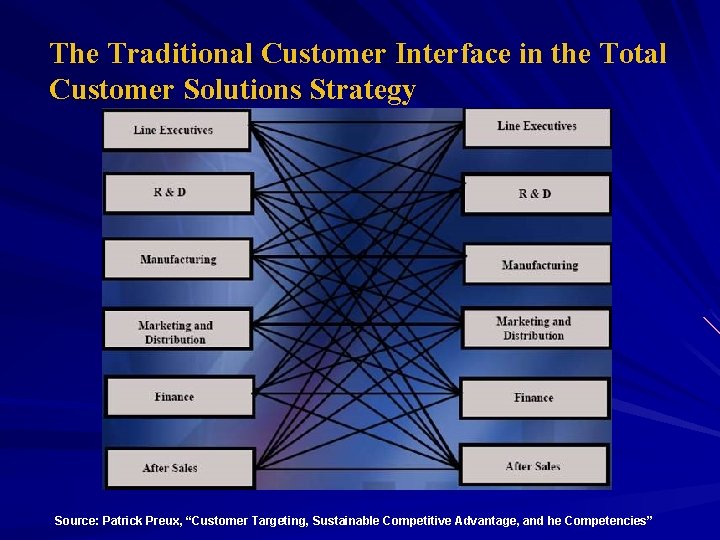
The Traditional Customer Interface in the Total Customer Solutions Strategy Source: Patrick Preux, “Customer Targeting, Sustainable Competitive Advantage, and he Competencies”
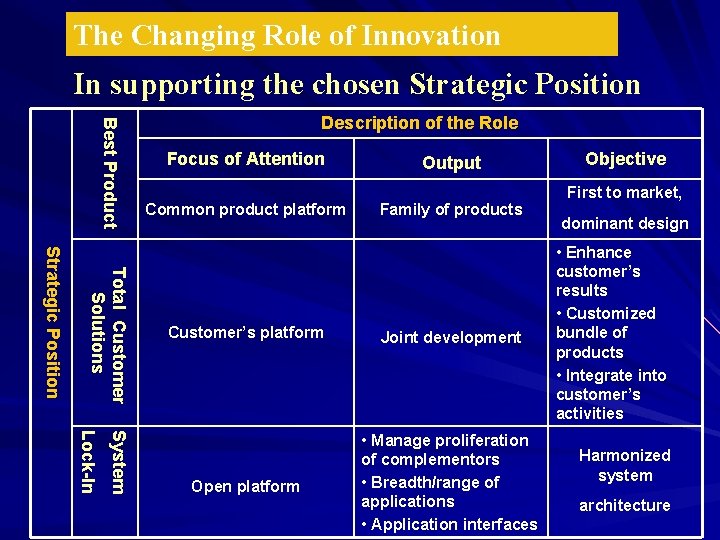
The Changing Role of Innovation In supporting the chosen Strategic Position Best P ro d u ct Description of the Role Focus of Attention Common product platform Output Family of products T o ta l C u s to m e r S o l u ti o n s S tr a te g i c P o s i ti o n S y s te m L o c k -I n Customer’s platform Joint development Open platform • Manage proliferation of complementors • Breadth/range of applications • Application interfaces Objective First to market, dominant design • Enhance customer’s results • Customized bundle of products • Integrate into customer’s activities Harmonized system architecture
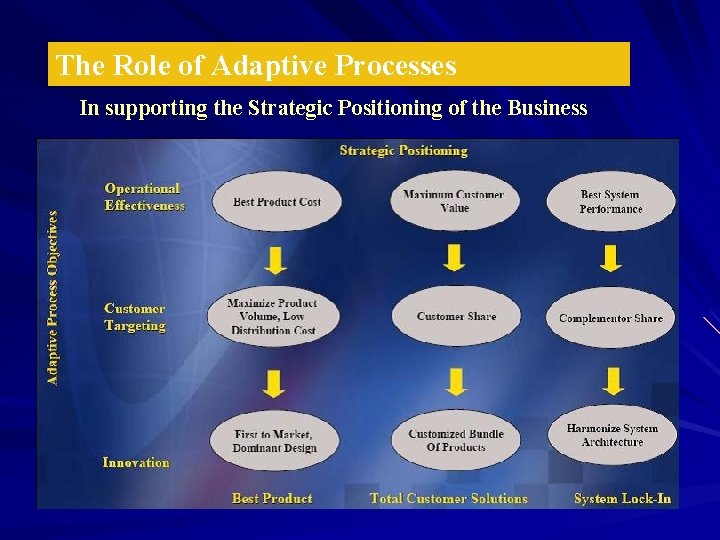
The Role of Adaptive Processes In supporting the Strategic Positioning of the Business
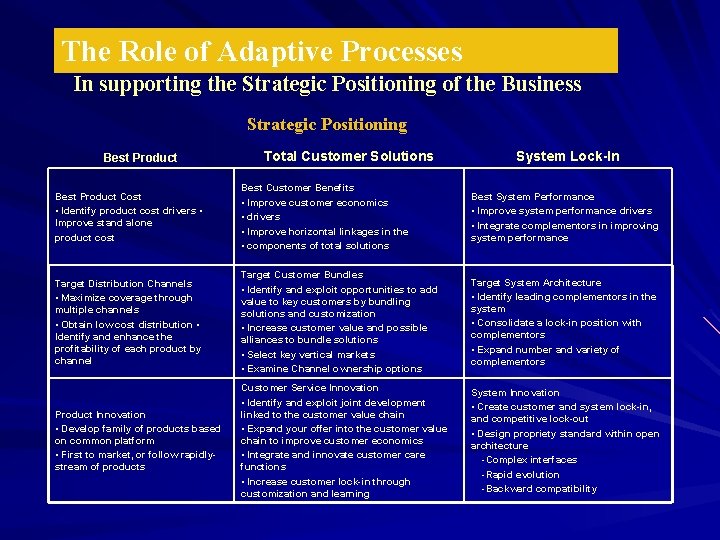
The Role of Adaptive Processes In supporting the Strategic Positioning of the Business Strategic Positioning Best Product Total Customer Solutions System Lock-In Best Product Cost • Identify product cost drivers • Improve stand alone product cost Best Customer Benefits • Improve customer economics • drivers • Improve horizontal linkages in the • components of total solutions Best System Performance • Improve system performance drivers • Integrate complementors in improving system performance Target Distribution Channels • Maximize coverage through multiple channels • Obtain low cost distribution • Identify and enhance the profitability of each product by channel Target Customer Bundles • Identify and exploit opportunities to add value to key customers by bundling solutions and customization • Increase customer value and possible alliances to bundle solutions • Select key vertical markets • Examine Channel ownership options Target System Architecture • Identify leading complementors in the system • Consolidate a lock-in position with complementors • Expand number and variety of complementors Product Innovation • Develop family of products based on common platform • First to market, or follow rapidlystream of products Customer Service Innovation • Identify and exploit joint development linked to the customer value chain • Expand your offer into the customer value chain to improve customer economics • Integrate and innovate customer care functions • Increase customer lock-in through customization and learning System Innovation • Create customer and system lock-in, and competitive lock-out • Design propriety standard within open architecture -Complex interfaces -Rapid evolution -Backward compatibility
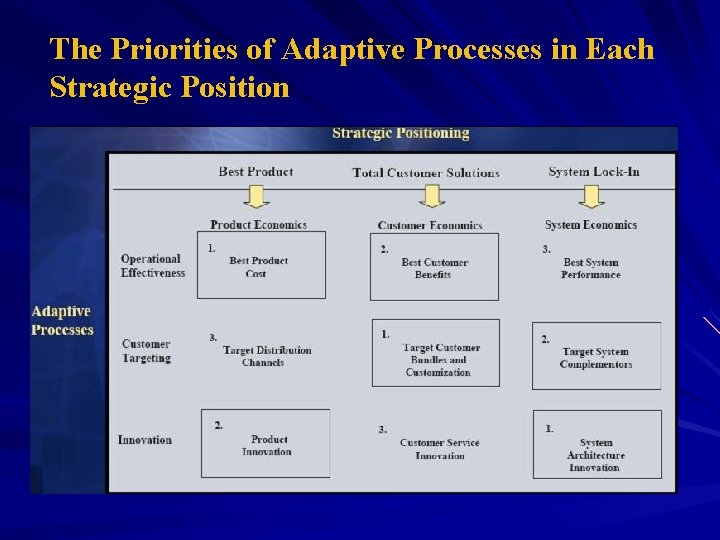
The Priorities of Adaptive Processes in Each Strategic Position
- Slides: 15