
Adaptive ProblemSolving for LargeScale Scheduling Problems A Case
Adaptive Problem-Solving for Large-Scale Scheduling Problems: A Case Study by Jonathan Gratch and Steve Chien Published in JAIR, 1996 EARG presentation Oct 3, 2008 by Frank Hutter 1
Overview Problem domain n Cool: scheduling for the deep space network Scheduling algorithm n Branch & Bound with a Lagrangian relaxation at each search node Adaptive Problem Solving n n Automatic Parameter Tuning by Local Search Already contains many good ideas, 12 years ago! 2
Domain: Scheduling for the Deep Space Network Collection of ground-based radio antennas n Maintain communication with research satellites and deep space probes NASA’s Jet Propulsion Laboratory (JPL): automate scheduling of 26 -meter subnet n n Three 26 -meter antennas Goldstone, CA, USA Canberra, Australia Madrid, Spain 3
Scheduling problem “When should which antenna talk to which satellite? ” Project requirements n n n Number of communication events period Duration of communication events Allowable gap between communication events E. g. Nimbus-7 (meteorogical satellite): needs at least four 15 -minute slots per day, not more than 5 hours apart Antenna constraints n n n Only one communication at once Antenna can only communicate with satellites in view Routine maintenance antenna offline 4
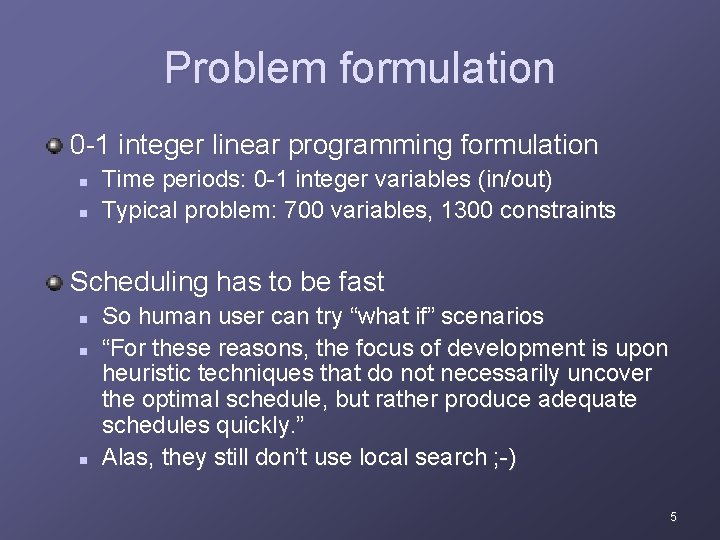
Problem formulation 0 -1 integer linear programming formulation n n Time periods: 0 -1 integer variables (in/out) Typical problem: 700 variables, 1300 constraints Scheduling has to be fast n n n So human user can try “what if” scenarios “For these reasons, the focus of development is upon heuristic techniques that do not necessarily uncover the optimal schedule, but rather produce adequate schedules quickly. ” Alas, they still don’t use local search ; -) 5
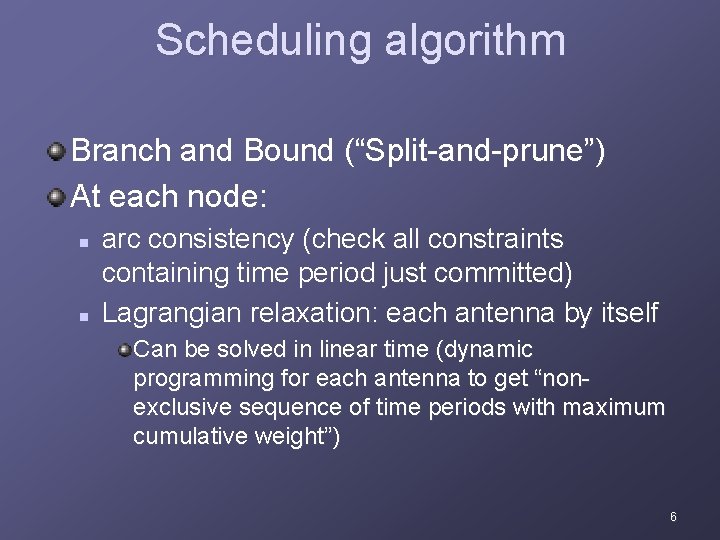
Scheduling algorithm Branch and Bound (“Split-and-prune”) At each node: n n arc consistency (check all constraints containing time period just committed) Lagrangian relaxation: each antenna by itself Can be solved in linear time (dynamic programming for each antenna to get “nonexclusive sequence of time periods with maximum cumulative weight”) 6
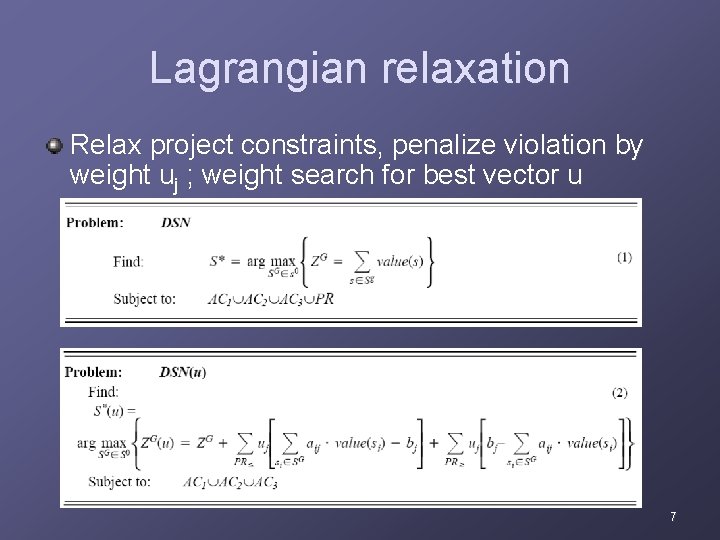
Lagrangian relaxation Relax project constraints, penalize violation by weight uj ; weight search for best vector u 7

The LR-26 scheduler 8
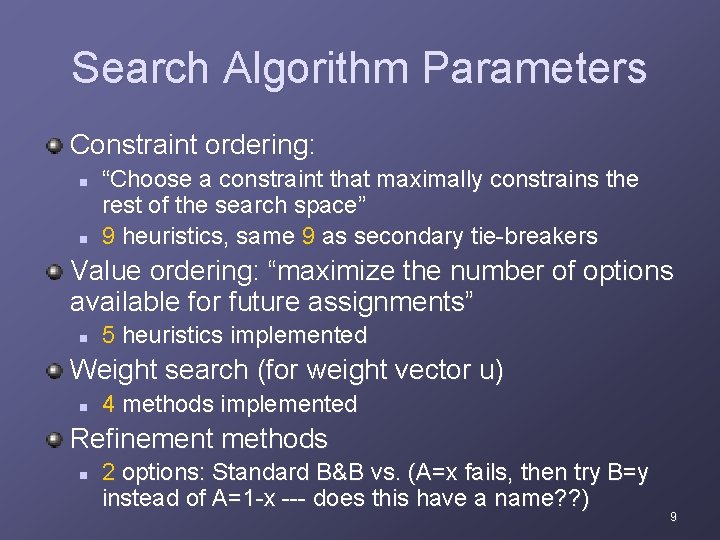
Search Algorithm Parameters Constraint ordering: n n “Choose a constraint that maximally constrains the rest of the search space” 9 heuristics, same 9 as secondary tie-breakers Value ordering: “maximize the number of options available for future assignments” n 5 heuristics implemented Weight search (for weight vector u) n 4 methods implemented Refinement methods n 2 options: Standard B&B vs. (A=x fails, then try B=y instead of A=1 -x --- does this have a name? ? ) 9
Problem distribution Not many problem instances available n n Syntactic manipulation of set of real problems Yields 6, 600 problem instances Only use subset of these 6, 600 instances n n Some generated instances seemed much harder than original instances Discard “intractable” instances (original or generated) Intractable: instances taking longer than 5 minutes 10
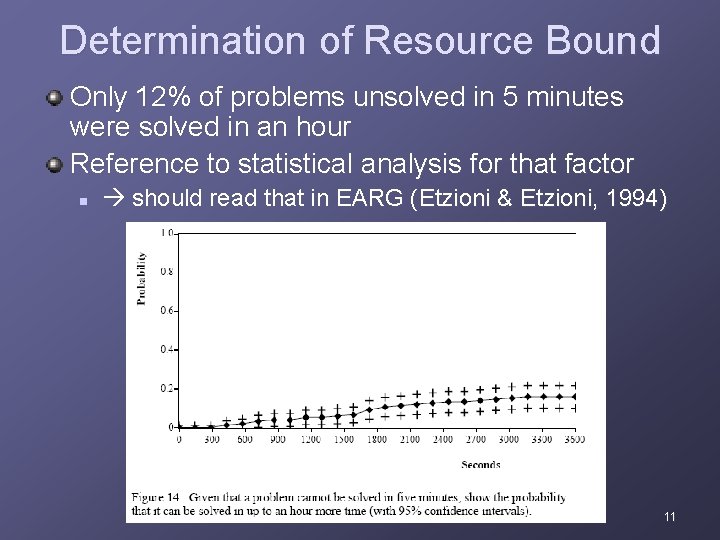
Determination of Resource Bound Only 12% of problems unsolved in 5 minutes were solved in an hour Reference to statistical analysis for that factor n should read that in EARG (Etzioni & Etzioni, 1994) 11

Adaptive Problem Solving: Approaches Syntactic approach n n Transform into more efficient form, using only syntactic structure Recognize structural properties that influence effectiveness of different heuristic methods Big lookup table, specifying heuristic to use Somewhat similar to SATzilla Lin should look into it n (I think: includes newer research on symmetry breaking, etc) Generative approach n n Generate new heuristics based on partial runs of solver focus on inefficiencies in previous runs “Often learning is within an instance and does not generalize to distributions of problems” Statistical approach n n Explicitly reason about performance of different heuristics across distribution of problems Often: statistical generate-and-test approaches Widely applicable (domains, utility functions) Computationally expensive; local optima ( Param. ILS) 12
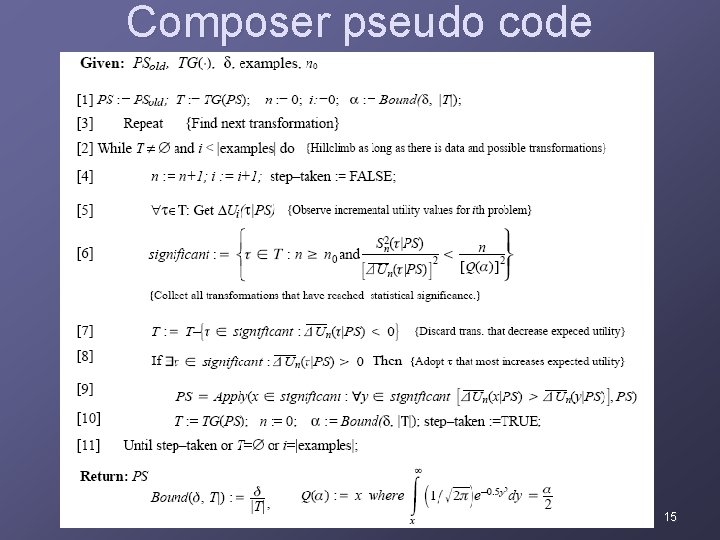
Adaptive Problem Solving: Composer Statistical approach n n Generate-and-test hillclimbing When evaluating a move: Perform runs with neighbour Collect differences in performance Perform test to see if mean(differences) < 0 or >0 Test assumes Normal distribution of differences n n Terminate in first local optimum Evaluation: On large set of test instances (1000) 13
Meta-Control Knowledge in Composer: Layered Search Order parameters by their importance n n First only allow move in the first level, then allow move in the second level, etc Not sure whether they iterate Levels n n Level 0: weight search method Level 1: Refinement method Level 2: Secondary refinement, value ordering Level 3: Primary constraint ordering (this comes last since they strongly believed their manual one was best – it was indeed chosen) 14
Composer pseudo code 15
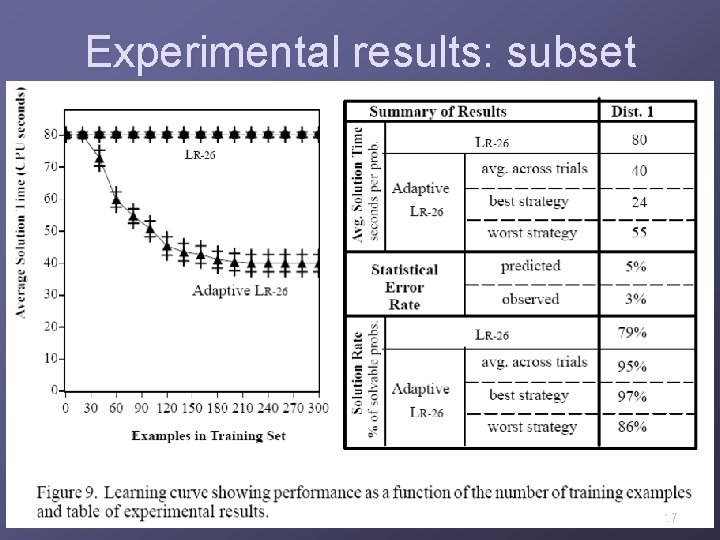
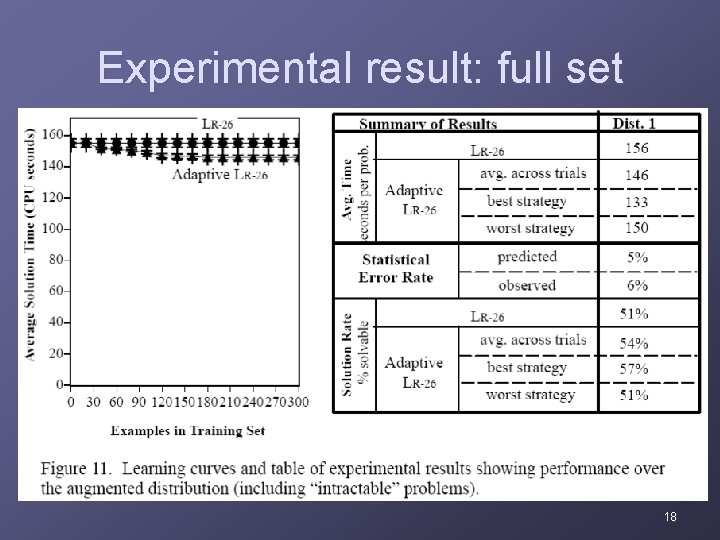
Empirical evaluation Setting of Composer parameters n = 0. 05, n 0 = 15 (empirically determined) Training set: 300 problem instances Test set: 1000 problem instances n They say “independent”, but I don’t think disjoint Stochasticity from drawing instances at random n n Estimate expected performance as average over multiple experimental trials But don’t tell us how many trials they did Measure performance every 20 samples 16
Experimental results: subset 17
Experimental result: full set 18
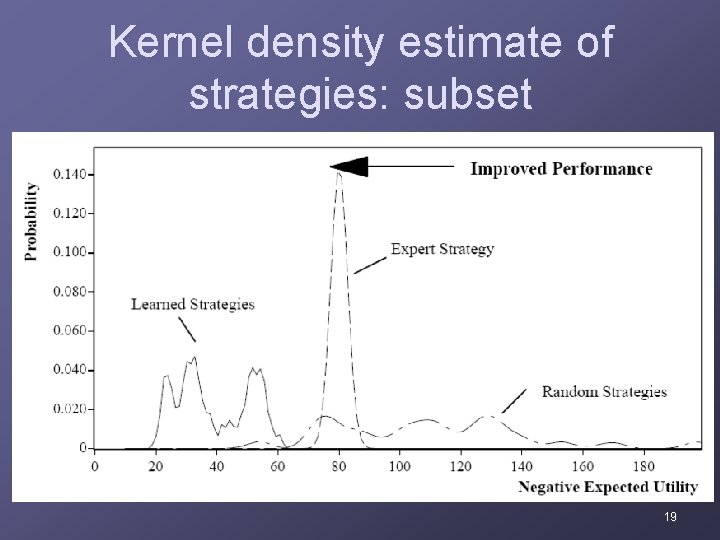
Kernel density estimate of strategies: subset 19
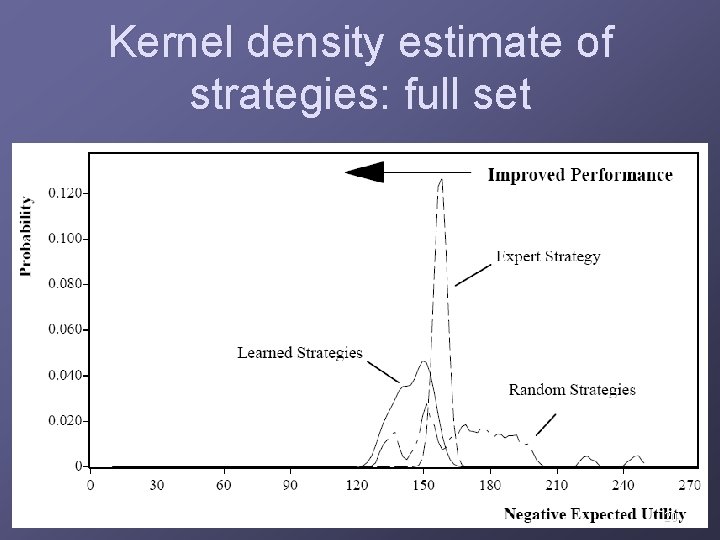
Kernel density estimate of strategies: full set 20
My view of their approach Some very good ideas, already 12 years ago n n Proper use of training/test set Statistical test for move is interesting Problems I see n If a move neither decreases nor increases expected utility, the statistical test can force “an infinite number” of evaluations Even if this just decides between two poor configurations n n Stuck in local minima Never re-using instances? Once they’re out of instances, they stop (also still a little unclear) 21
- Slides: 21