
Adaptive Optics in the VLT and ELT era
![Generalized Fitting (Finite number of DMs) Error [rd 2] (. h)5/3 Design Criteria e.](https://slidetodoc.com/presentation_image_h/01302cb2d4357ac9f3f8a4cda7cfb7b7/image-38.jpg "Generalized Fitting (Finite number of DMs) Error [rd 2] (. h)5/3 Design Criteria e.")

- Slides: 60
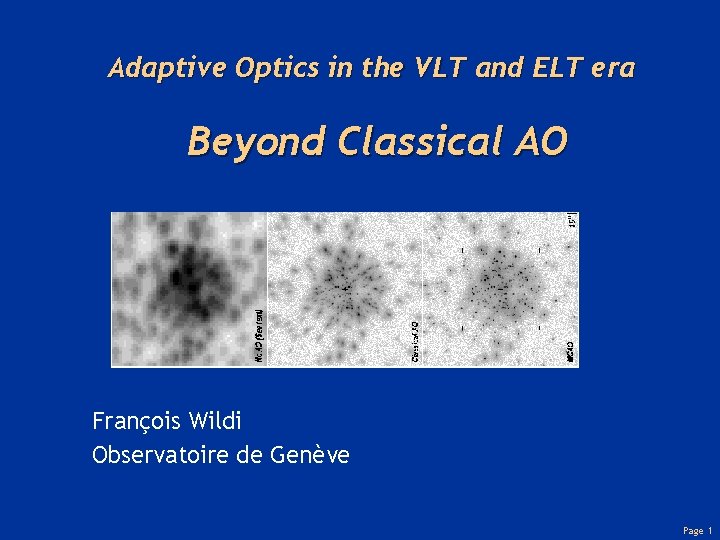
Adaptive Optics in the VLT and ELT era Beyond Classical AO François Wildi Observatoire de Genève Page 1
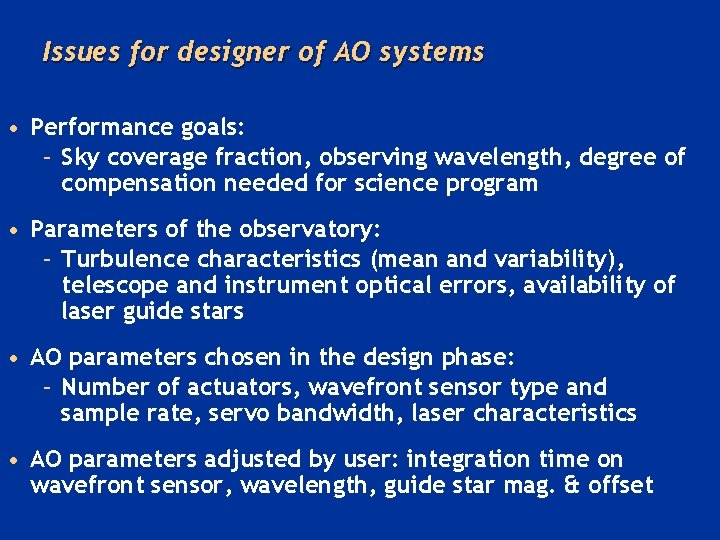
Issues for designer of AO systems • Performance goals: – Sky coverage fraction, observing wavelength, degree of compensation needed for science program • Parameters of the observatory: – Turbulence characteristics (mean and variability), telescope and instrument optical errors, availability of laser guide stars • AO parameters chosen in the design phase: – Number of actuators, wavefront sensor type and sample rate, servo bandwidth, laser characteristics • AO parameters adjusted by user: integration time on wavefront sensor, wavelength, guide star mag. & offset
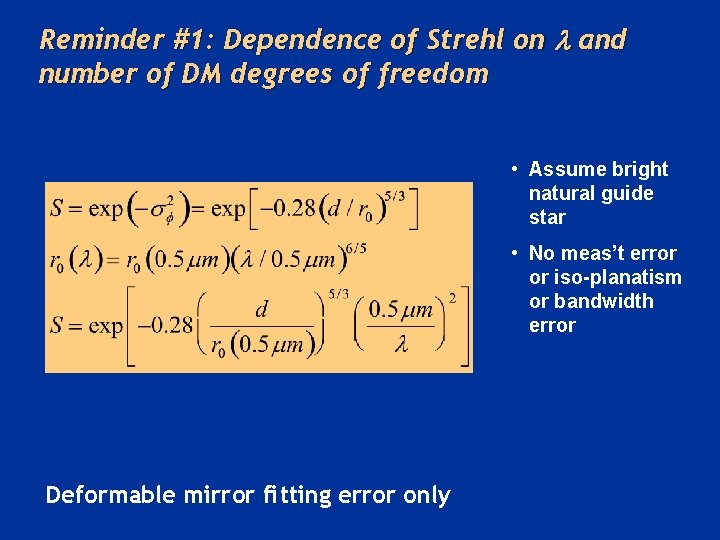
Reminder #1: Dependence of Strehl on l and number of DM degrees of freedom • Assume bright natural guide star • No meas’t error or iso-planatism or bandwidth error Deformable mirror fitting error only
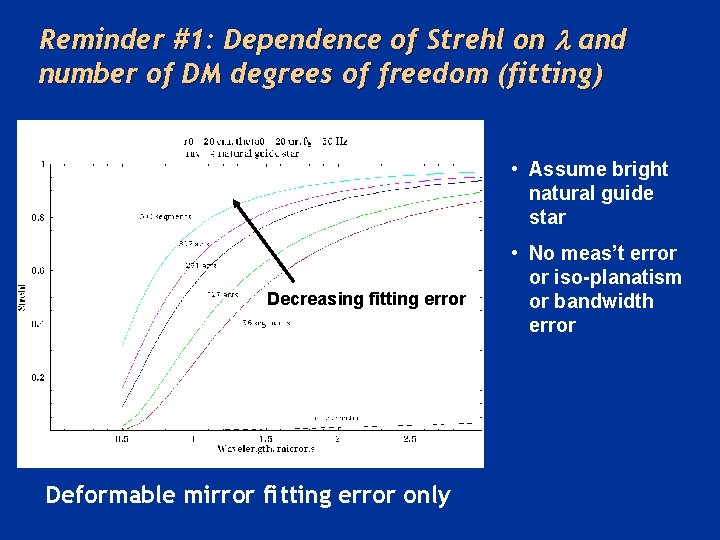
Reminder #1: Dependence of Strehl on l and number of DM degrees of freedom (fitting) • Assume bright natural guide star Decreasing fitting error Deformable mirror fitting error only • No meas’t error or iso-planatism or bandwidth error
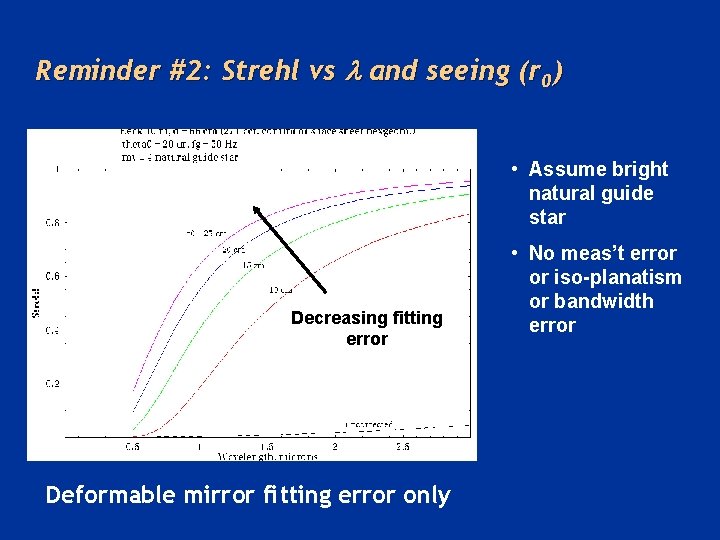
Reminder #2: Strehl vs l and seeing (r 0) • Assume bright natural guide star Decreasing fitting error Deformable mirror fitting error only • No meas’t error or iso-planatism or bandwidth error
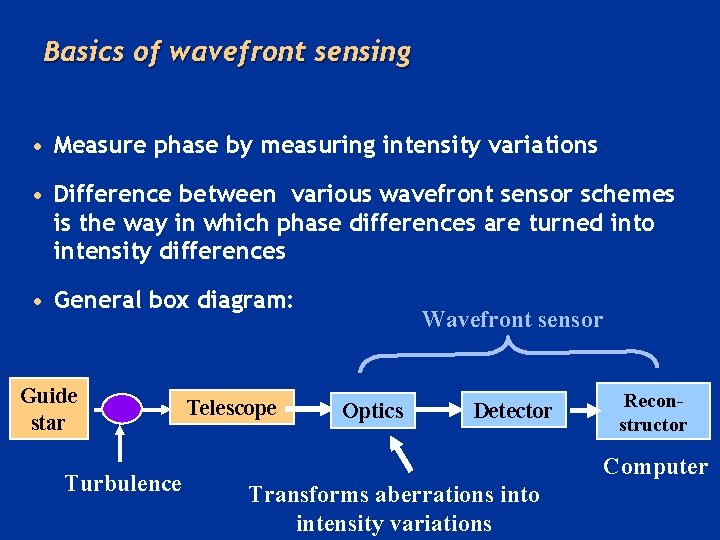
Basics of wavefront sensing • Measure phase by measuring intensity variations • Difference between various wavefront sensor schemes is the way in which phase differences are turned into intensity differences • General box diagram: Guide star Turbulence Telescope Wavefront sensor Optics Detector Reconstructor Computer Transforms aberrations into intensity variations
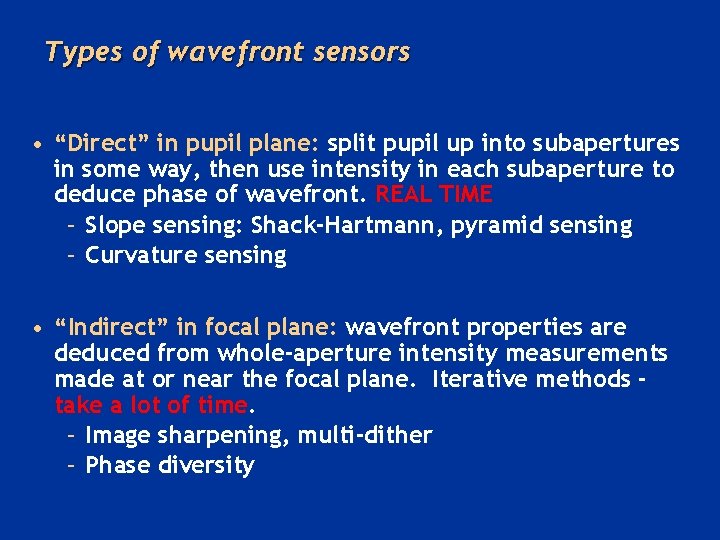
Types of wavefront sensors • “Direct” in pupil plane: split pupil up into subapertures in some way, then use intensity in each subaperture to deduce phase of wavefront. REAL TIME – Slope sensing: Shack-Hartmann, pyramid sensing – Curvature sensing • “Indirect” in focal plane: wavefront properties are deduced from whole-aperture intensity measurements made at or near the focal plane. Iterative methods take a lot of time. – Image sharpening, multi-dither – Phase diversity
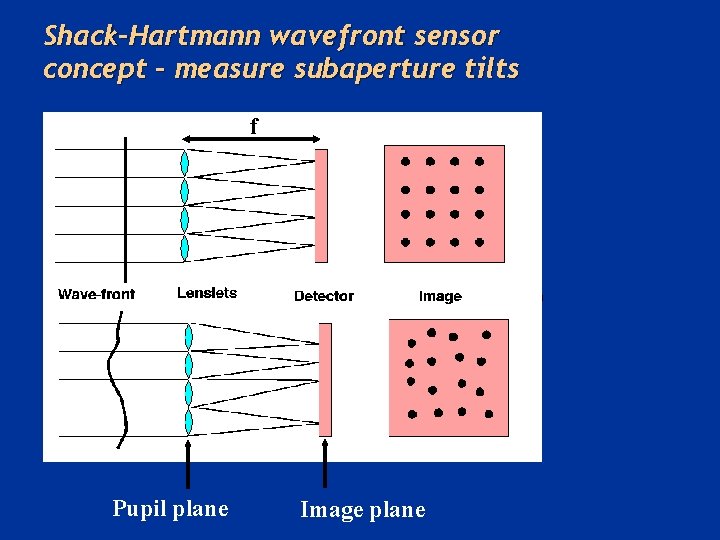
Shack-Hartmann wavefront sensor concept - measure subaperture tilts f CCD Pupil plane Image plane CCD
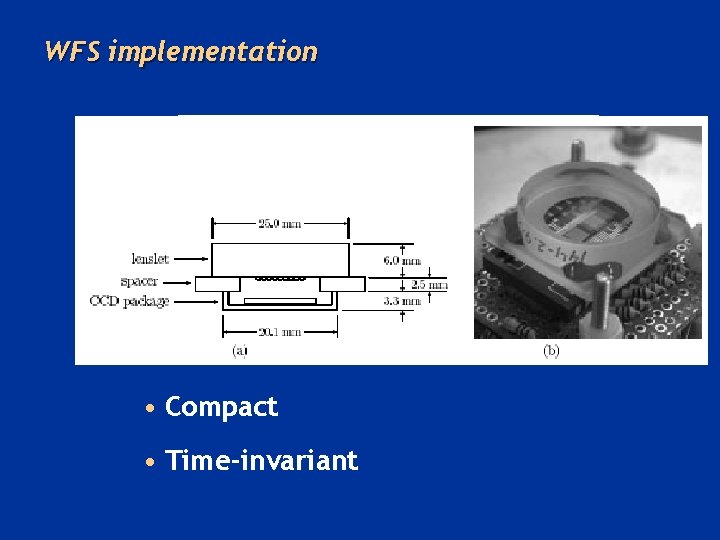
WFS implementation • Compact • Time-invariant
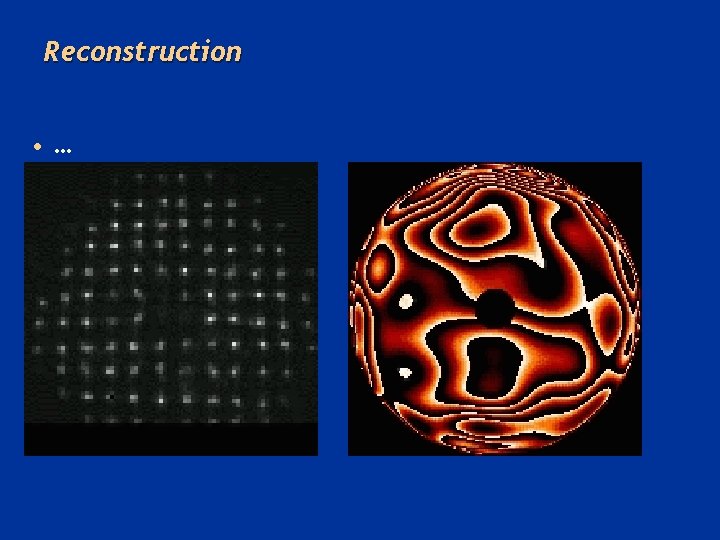
Reconstruction • …
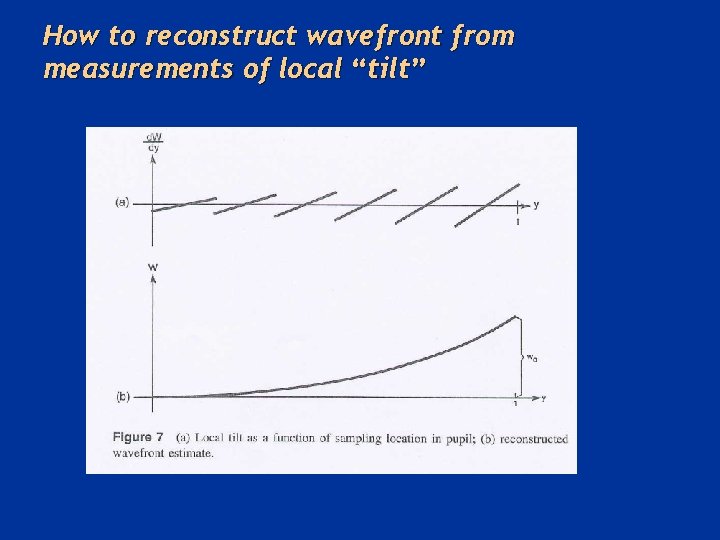
How to reconstruct wavefront from measurements of local “tilt”
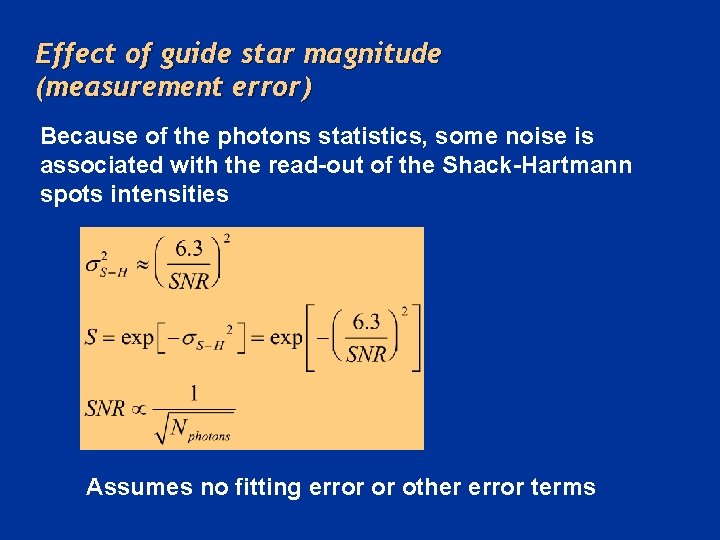
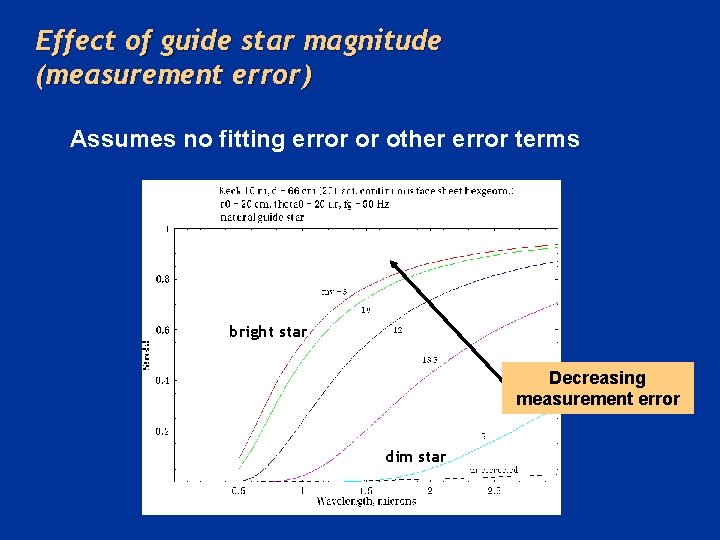
Effect of guide star magnitude (measurement error) Because of the photons statistics, some noise is associated with the read-out of the Shack-Hartmann spots intensities Assumes no fitting error or other error terms
Effect of guide star magnitude (measurement error) Assumes no fitting error or other error terms bright star Decreasing measurement error dim star
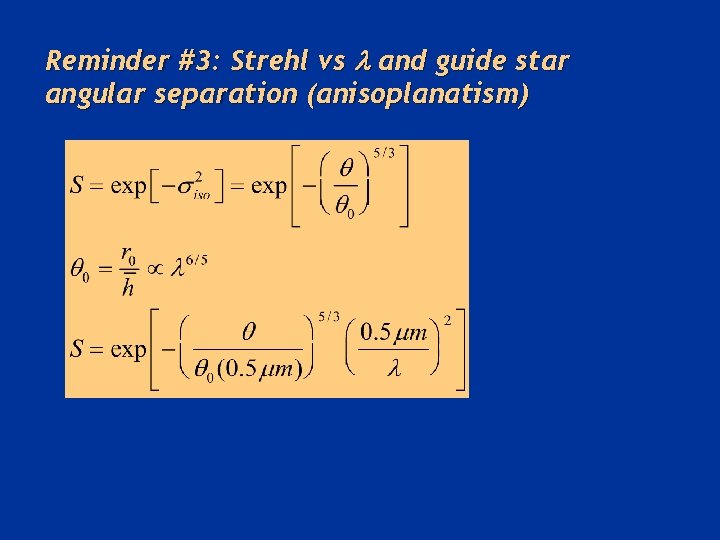
Reminder #3: Strehl vs l and guide star angular separation (anisoplanatism)
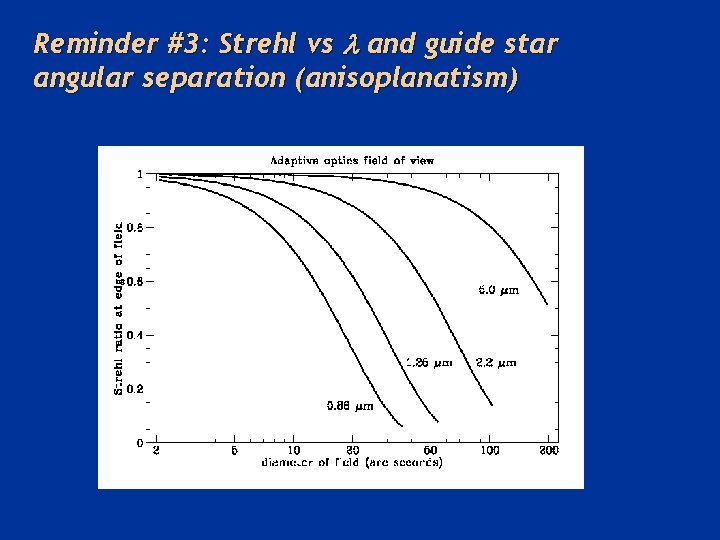
Reminder #3: Strehl vs l and guide star angular separation (anisoplanatism)
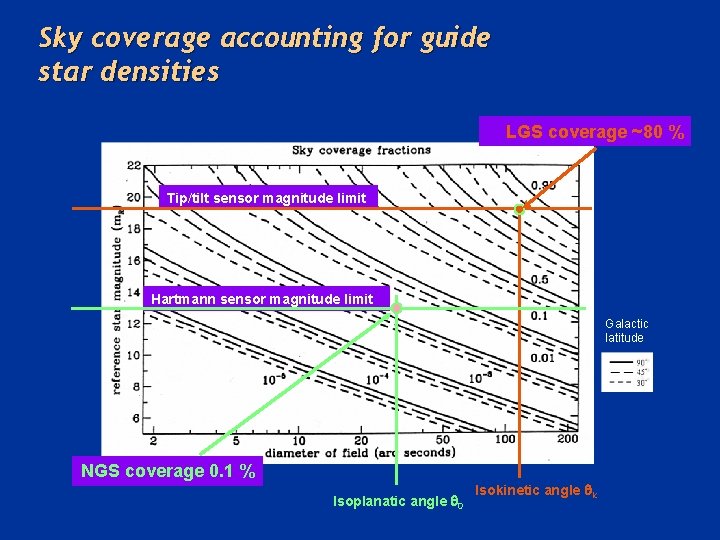
Sky coverage accounting for guide star densities LGS coverage ~80 % Tip/tilt sensor magnitude limit Hartmann sensor magnitude limit Galactic latitude NGS coverage 0. 1 % Isoplanatic angle 0 Isokinetic angle k
(Temporary) conclusion: • With 0. 1% sky coverage, classical AO is of limited use for general astronomy. • This is perticularly true for extra-galactic astronomy, where the science object is diffuse, often faint and cannot be used for wavefront sensing.
The way out: • To circumvent the sky coverage problem, several ways have been devised and are actively pursued: 1. Multi-Conjugate Adaptive Optics (MCAO) 2. Multi Object Adaptive Optics (MOAO) 3. Ground Layer Adaptive Optics (GLAO) 4. Laser Tomography Adaptive Optics (LTAO)
MULTI CONJUGATE ADAPTIVE OPTICS
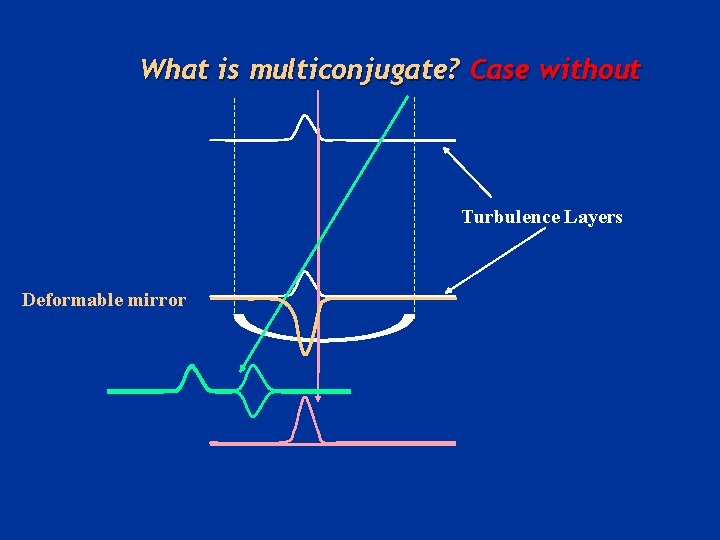
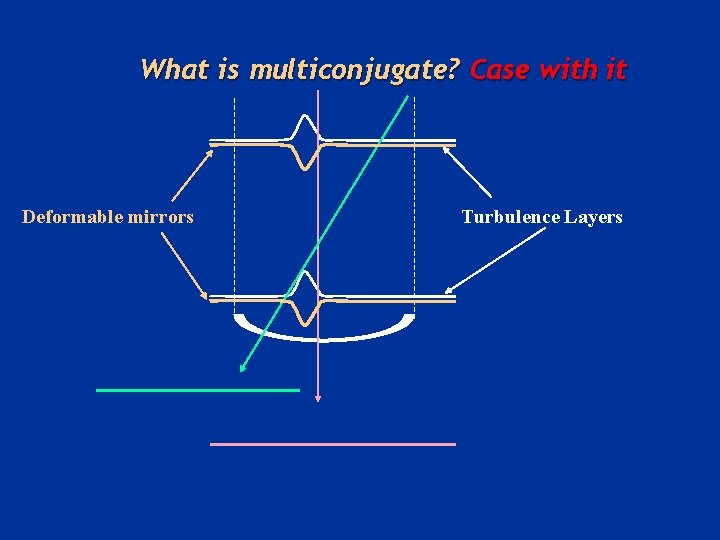
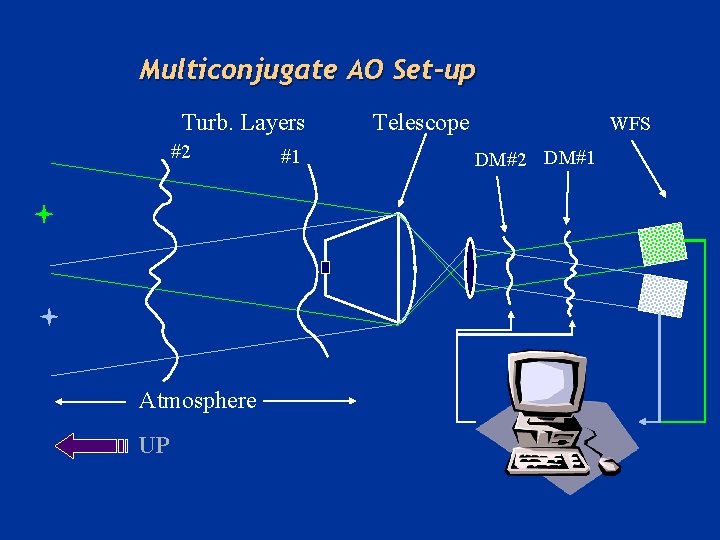
MCAO definition • To increase the isoplanatic patch, the idea is to design an adaptive optical system with several deformable mirrors (DM), each correcting for one of the turbulent layer Each DM is located at an image of the corresponding layer in the optical system. (By definition, the layer and the DM are called conjugated by the optical system.
What is multiconjugate? Case without Turbulence Layers Deformable mirror
What is multiconjugate? Case with it Deformable mirrors Turbulence Layers
Multiconjugate AO Set-up Turb. Layers #2 Atmosphere UP #1 Telescope WFS DM#2 DM#1
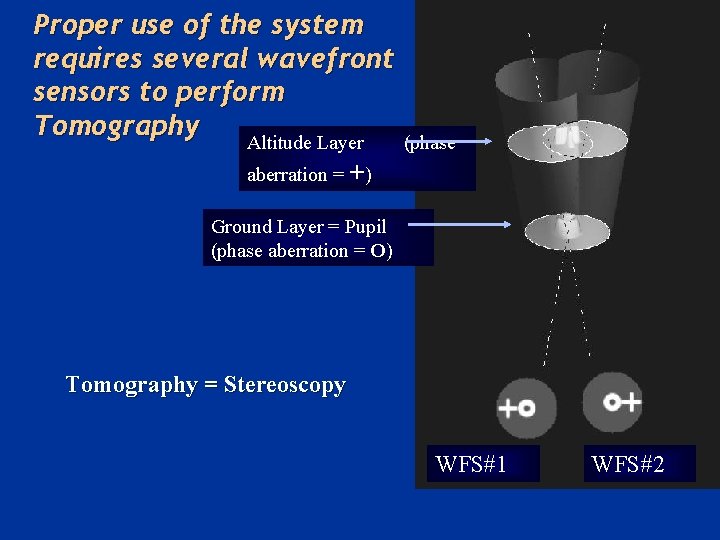
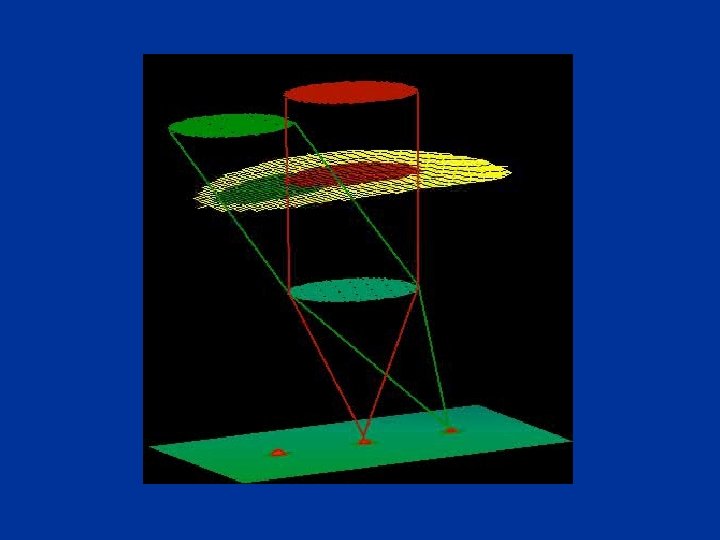
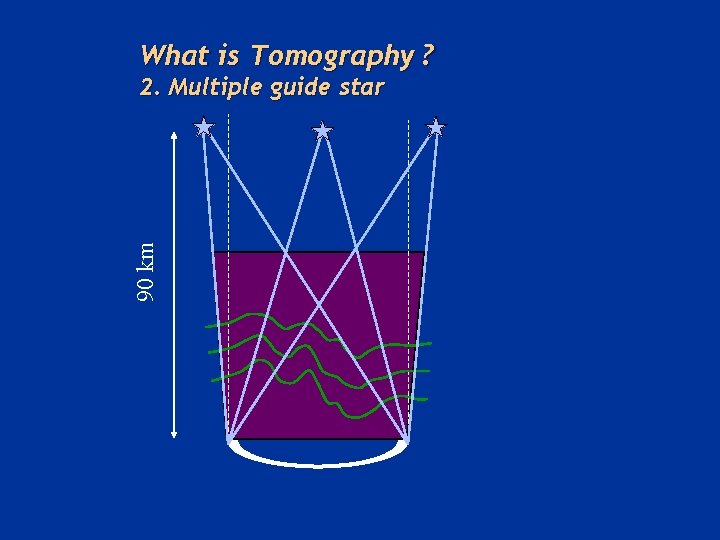
Proper use of the system requires several wavefront sensors to perform Tomography Altitude Layer (phase aberration = +) Ground Layer = Pupil (phase aberration = O) Tomography = Stereoscopy WFS#1 WFS#2
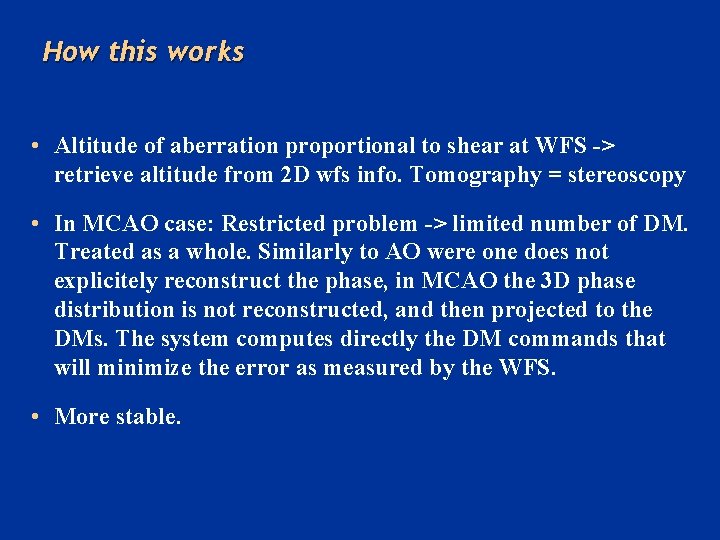
How this works • Altitude of aberration proportional to shear at WFS -> retrieve altitude from 2 D wfs info. Tomography = stereoscopy • In MCAO case: Restricted problem -> limited number of DM. Treated as a whole. Similarly to AO were one does not explicitely reconstruct the phase, in MCAO the 3 D phase distribution is not reconstructed, and then projected to the DMs. The system computes directly the DM commands that will minimize the error as measured by the WFS. • More stable.
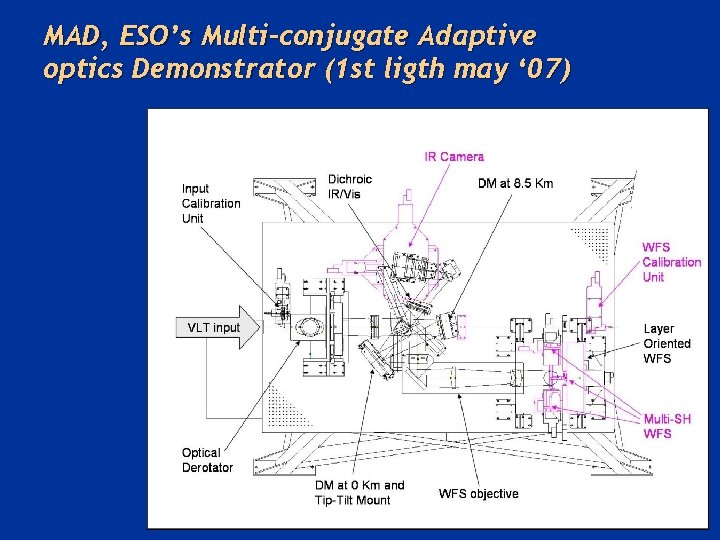
MAD, ESO’s Multi-conjugate Adaptive optics Demonstrator (1 st ligth may ‘ 07)
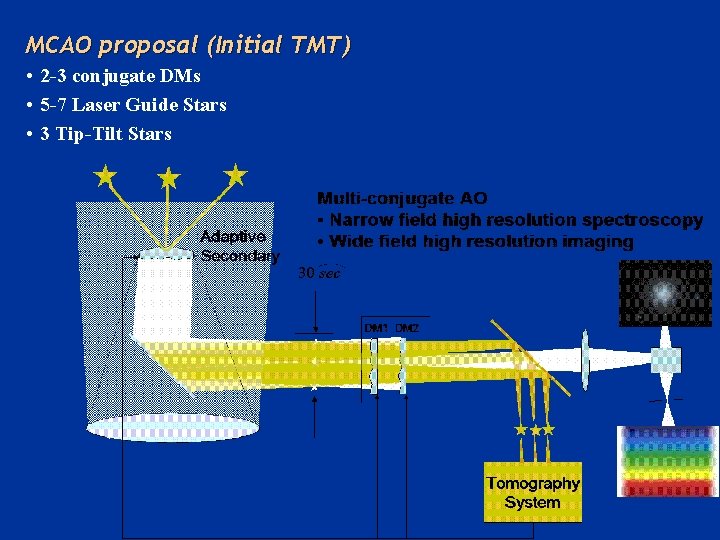
MCAO proposal (Initial TMT) • 2 -3 conjugate DMs • 5 -7 Laser Guide Stars • 3 Tip-Tilt Stars
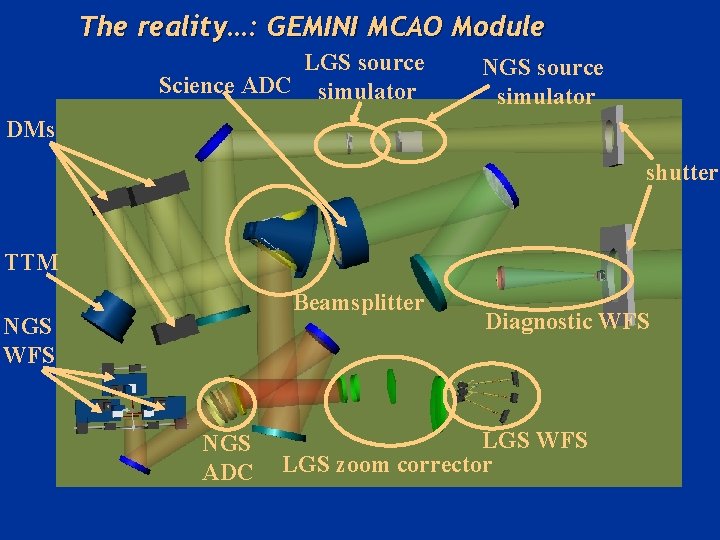
The reality…: GEMINI MCAO Module LGS source Science ADC simulator NGS source simulator DMs shutters TTM Beamsplitter NGS WFS NGS ADC Diagnostic WFS LGS zoom corrector
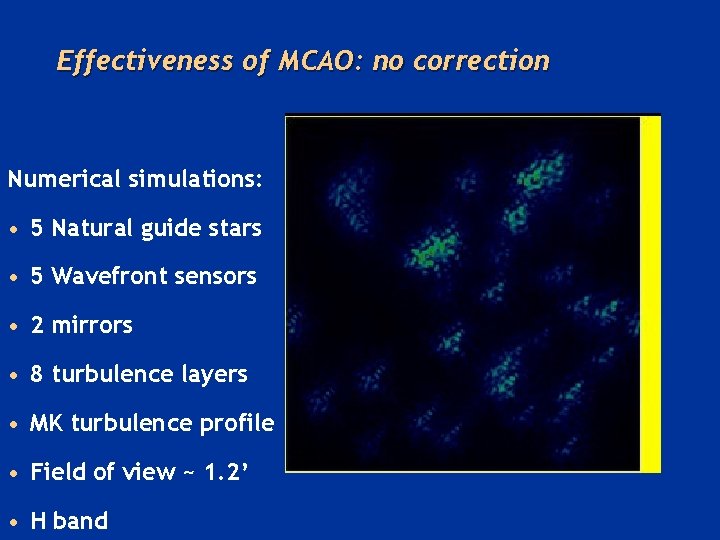
Effectiveness of MCAO: no correction Numerical simulations: • 5 Natural guide stars • 5 Wavefront sensors • 2 mirrors • 8 turbulence layers • MK turbulence profile • Field of view ~ 1. 2’ • H band
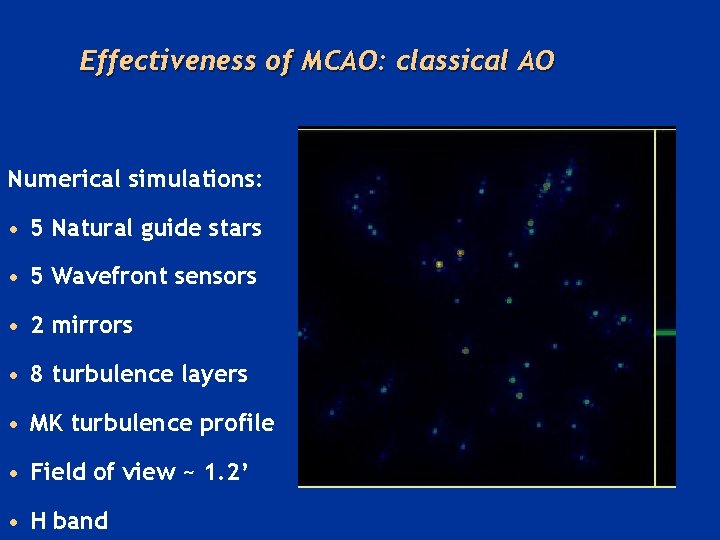
Effectiveness of MCAO: classical AO Numerical simulations: • 5 Natural guide stars • 5 Wavefront sensors • 2 mirrors • 8 turbulence layers • MK turbulence profile • Field of view ~ 1. 2’ • H band
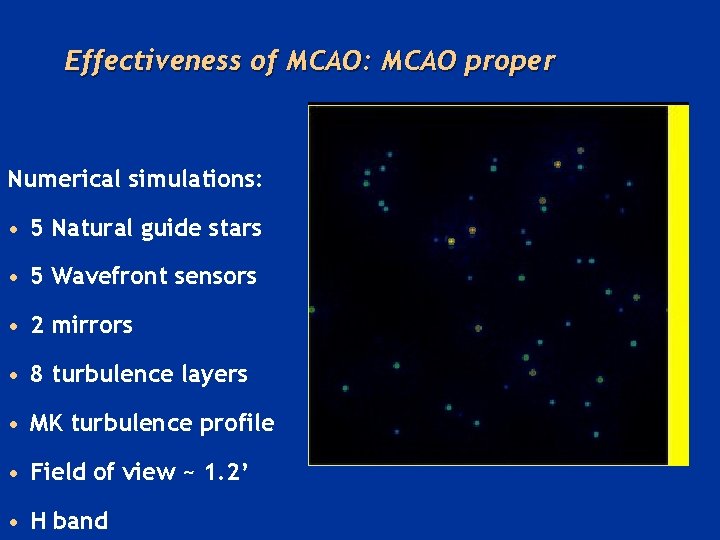
Effectiveness of MCAO: MCAO proper Numerical simulations: • 5 Natural guide stars • 5 Wavefront sensors • 2 mirrors • 8 turbulence layers • MK turbulence profile • Field of view ~ 1. 2’ • H band
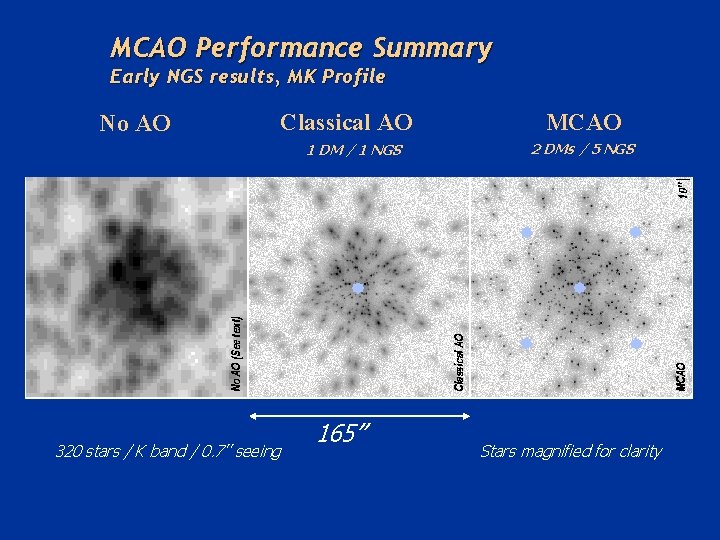
MCAO Performance Summary Early NGS results, MK Profile No AO Classical AO 1 DM / 1 NGS 320 stars / K band / 0. 7’’ seeing 165’’ MCAO 2 DMs / 5 NGS Stars magnified for clarity
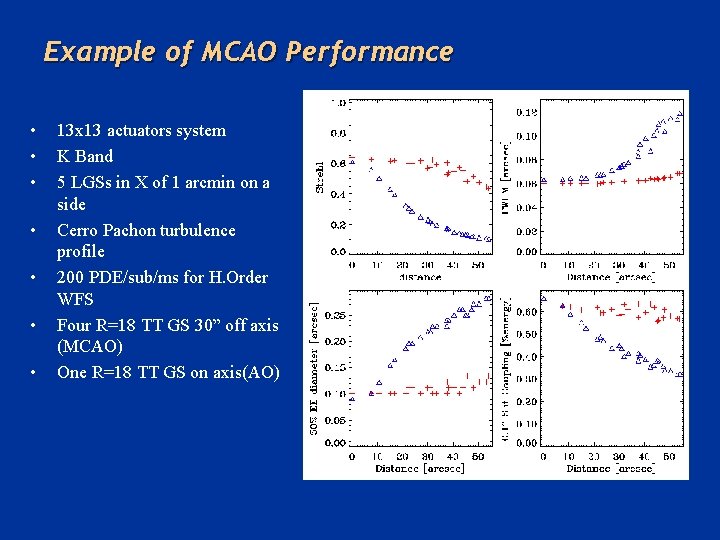
Example of MCAO Performance • • 13 x 13 actuators system K Band 5 LGSs in X of 1 arcmin on a side Cerro Pachon turbulence profile 200 PDE/sub/ms for H. Order WFS Four R=18 TT GS 30” off axis (MCAO) One R=18 TT GS on axis(AO)
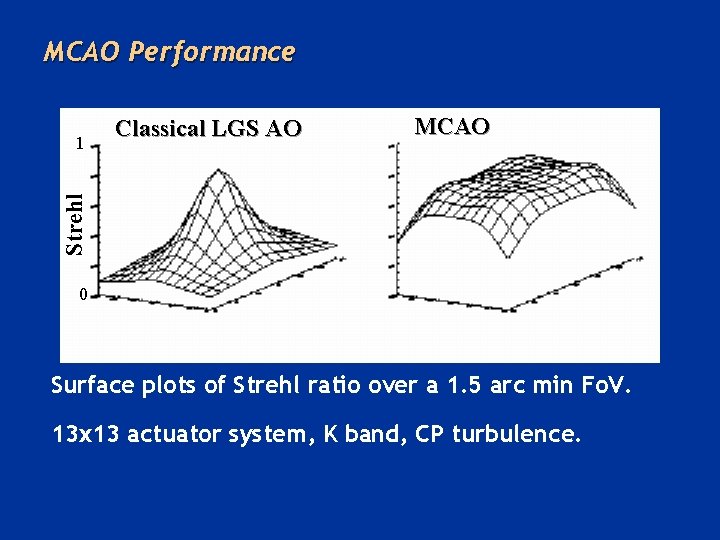
MCAO Performance 1 Classical LGS AO MCAO Strehl 1 0 Surface plots of Strehl ratio over a 1. 5 arc min Fo. V. 13 x 13 actuator system, K band, CP turbulence.
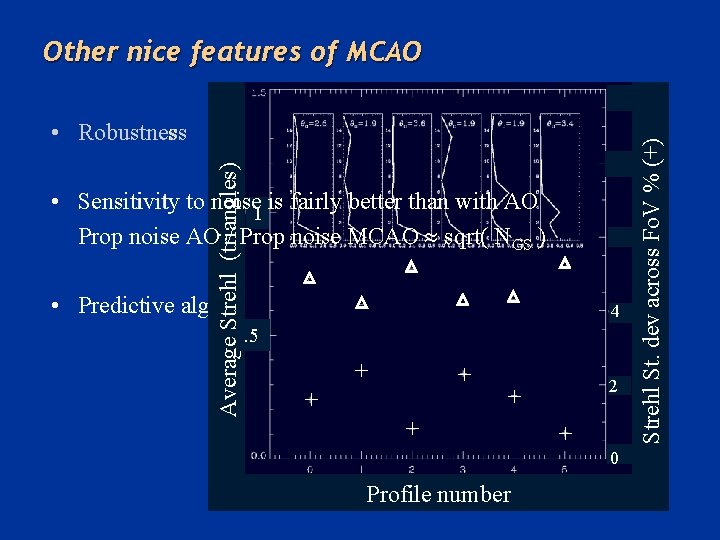
Average Strehl (triangles) • Robustness • Sensitivity to noise 1 is fairly better than with AO Prop noise AO / Prop noise MCAO sqrt( NGS ) • Predictive algorithms possible ? 4 . 5 + + + 2 + + + 0 Profile number Strehl St. dev across Fo. V % (+) Other nice features of MCAO
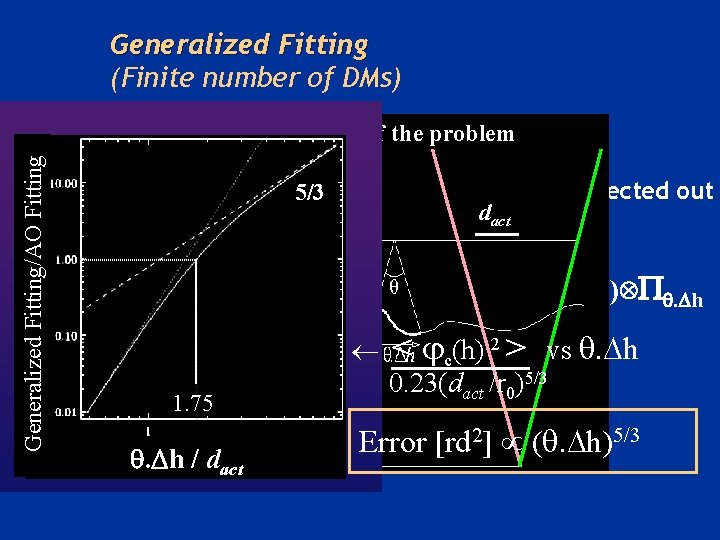
Average. Fitting/AO Strehl in Fov Generalized Fitting (Finite number of DMs) Geometry of the problem Highest spatial frequencies projected out 5/3 d of thedact command Simulations 00 44 Model 1. 75 13 13 . h / dact Altitude [km] c(h) = (h)- (h) . h < c(h) 2 > vs . h 0. 23(dact /r 0)5/3 Error [rd 2] (. h)5/3
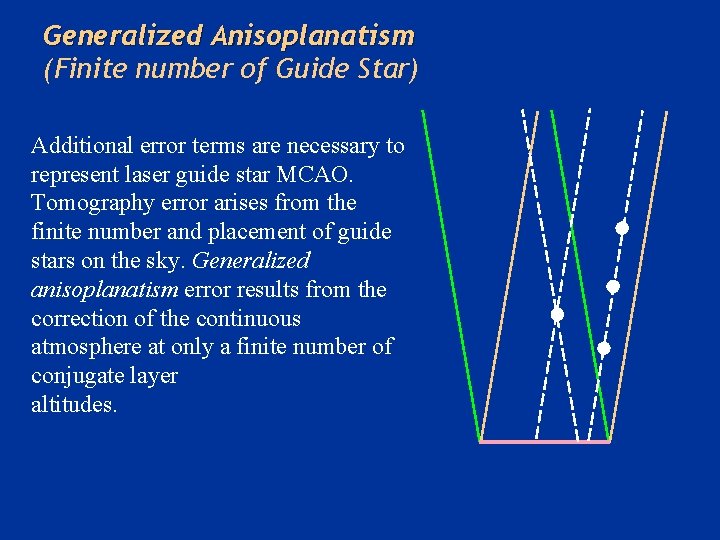
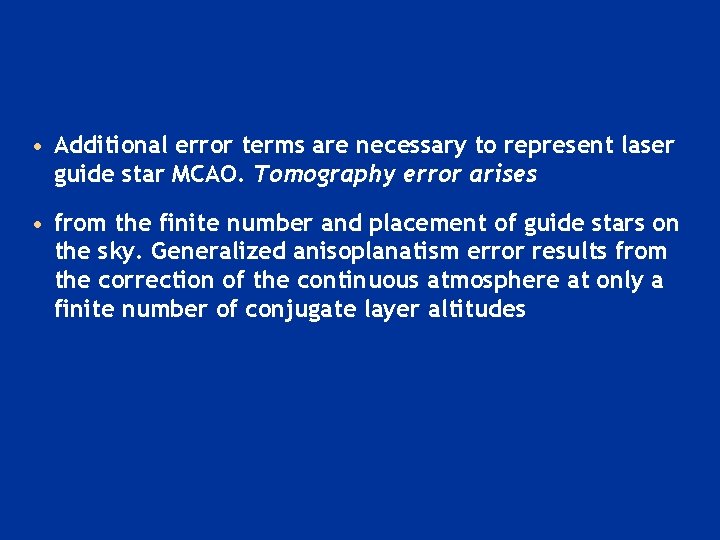
Generalized Anisoplanatism (Finite number of Guide Star) Additional error terms are necessary to represent laser guide star MCAO. Tomography error arises from the finite number and placement of guide stars on the sky. Generalized anisoplanatism error results from the correction of the continuous atmosphere at only a finite number of conjugate layer altitudes.
Generalized Fitting (Finite number of DMs) Error [rd 2] (. h)5/3 Design Criteria e. g. Error balanced hmax( , dact) DM Spacing = 2 x hmax
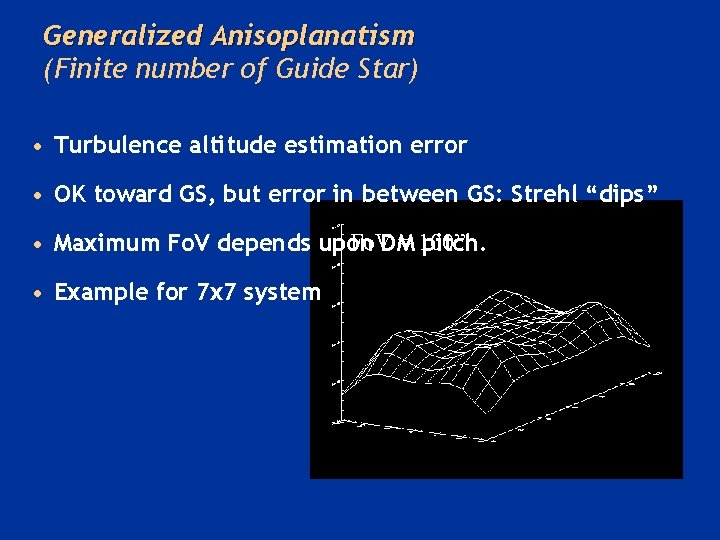
Generalized Anisoplanatism (Finite number of Guide Star) • Turbulence altitude estimation error • OK toward GS, but error in between GS: Strehl “dips” 100” Fo. VDM = 70” • Maximum Fo. V depends upon pitch. • Example for 7 x 7 system
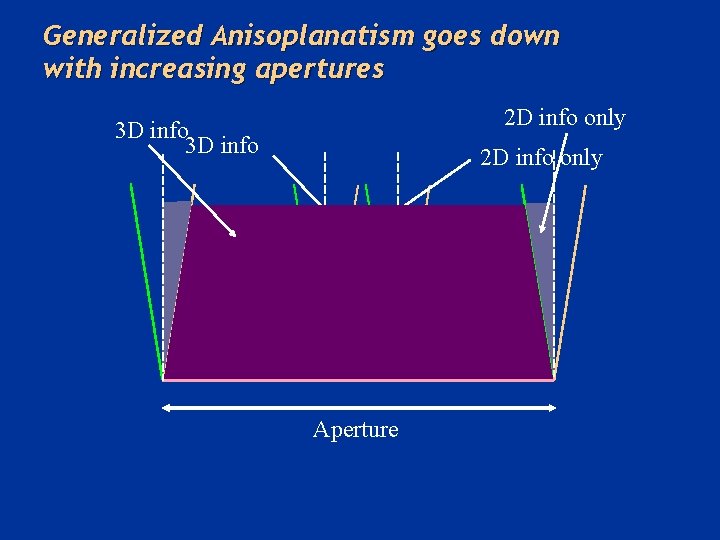
Generalized Anisoplanatism goes down with increasing apertures 2 D info only 3 D info 2 D info only Aperture
On MCAO for ELTs • Generalized Fitting Fo. V 5/3 for a fixed DM configuration, regardless of D NGSs or LGSs ? • NGSs -> Fo. V of 15 -20 arcmin to get S. C > 50% with 4 stars • Gen. Fitting error blows up the error budget, unless many DMs are used • Many DMs mean many GS -> 20 arcmin not enough -> NGS do not work for ELTs. Need LGS.
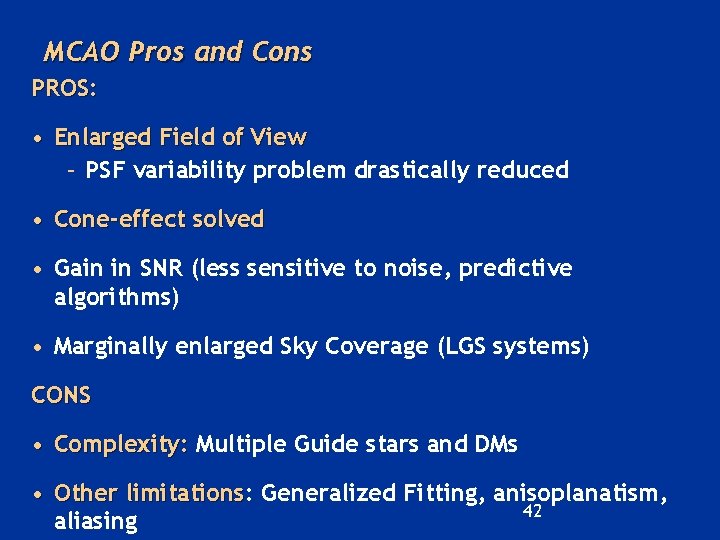
MCAO Pros and Cons PROS: • Enlarged Field of View – PSF variability problem drastically reduced • Cone-effect solved • Gain in SNR (less sensitive to noise, predictive algorithms) • Marginally enlarged Sky Coverage (LGS systems) CONS • Complexity: Multiple Guide stars and DMs • Other limitations: limitations Generalized Fitting, anisoplanatism, 42 aliasing
MULTI OBJECTS ADAPTIVE OPTICS
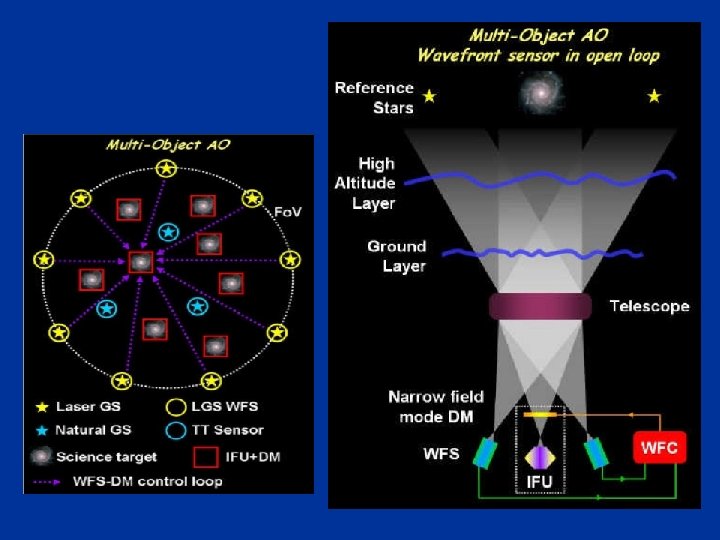
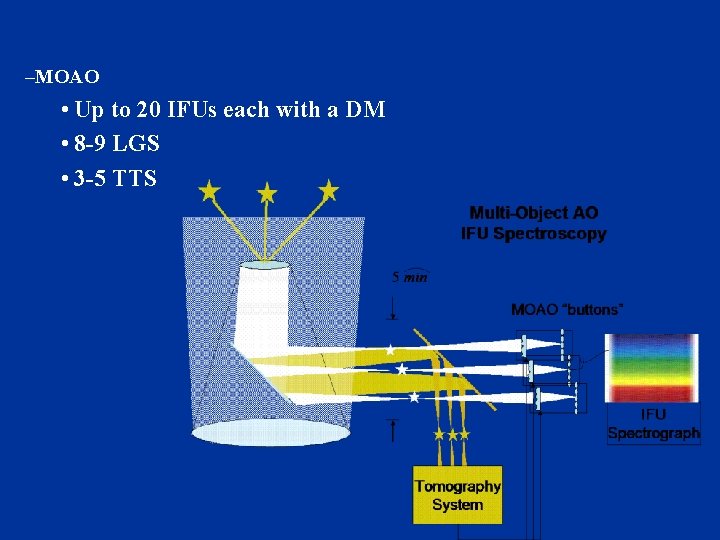
• In certain case, the user does not want to (or need to) have a fully corrected image. He/she might be satisfied with having only specific locations (i. e. ) objects corrected in the field. • An AO system designed to provide this kind of correction is called a Multi Objects Adaptive Optics system • MOAO are the systems of choice to feed spectrographs and Integral Field Units in the ELT era.
–MOAO • Up to 20 IFUs each with a DM • 8 -9 LGS • 3 -5 TTS
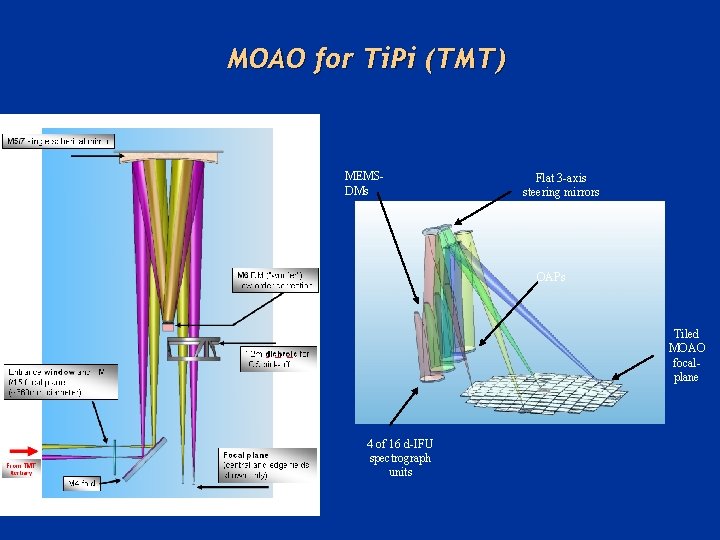
MOAO for Ti. Pi (TMT) MEMSDMs Flat 3 -axis steering mirrors OAPs Tiled MOAO focalplane 4 of 16 d-IFU spectrograph units
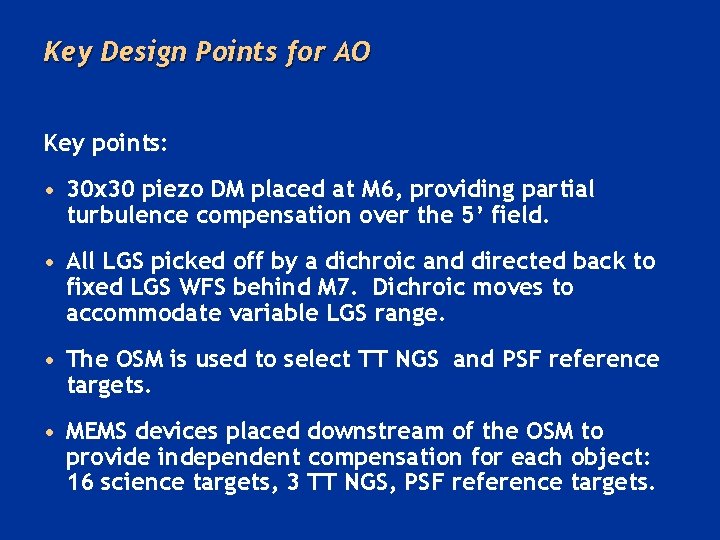
Key Design Points for AO Key points: • 30 x 30 piezo DM placed at M 6, providing partial turbulence compensation over the 5’ field. • All LGS picked off by a dichroic and directed back to fixed LGS WFS behind M 7. Dichroic moves to accommodate variable LGS range. • The OSM is used to select TT NGS and PSF reference targets. • MEMS devices placed downstream of the OSM to provide independent compensation for each object: 16 science targets, 3 TT NGS, PSF reference targets.
LASER GUIDE STARS
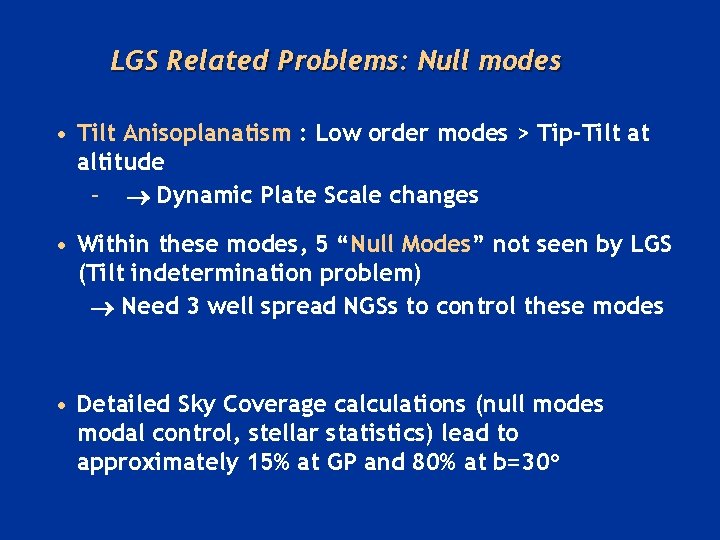
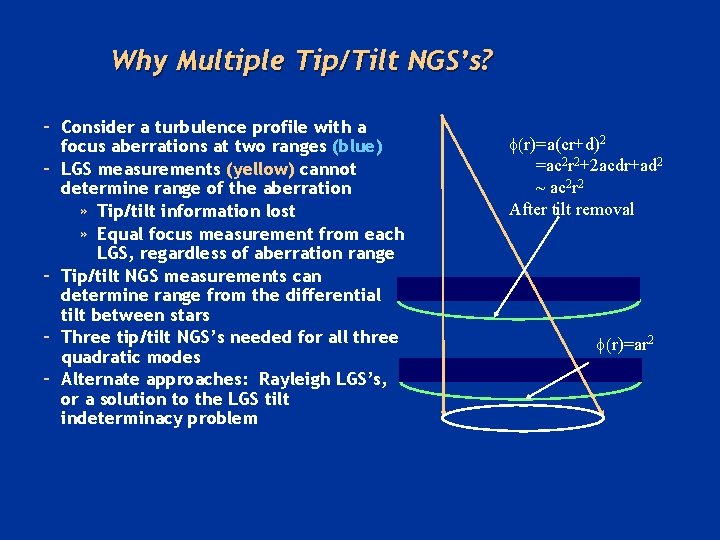
LGS Related Problems: Null modes • Tilt Anisoplanatism : Low order modes > Tip-Tilt at altitude – Dynamic Plate Scale changes • Within these modes, 5 “Null Modes” not seen by LGS (Tilt indetermination problem) Need 3 well spread NGSs to control these modes • Detailed Sky Coverage calculations (null modes modal control, stellar statistics) lead to approximately 15% at GP and 80% at b=30 o
• Additional error terms are necessary to represent laser guide star MCAO. Tomography error arises • from the finite number and placement of guide stars on the sky. Generalized anisoplanatism error results from the correction of the continuous atmosphere at only a finite number of conjugate layer altitudes
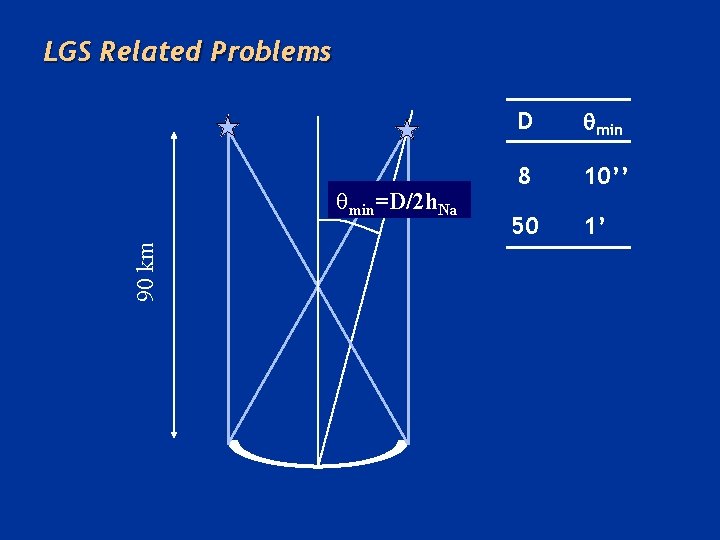
LGS Related Problems 90 km min=D/2 h. Na D min 8 10’’ 50 1’
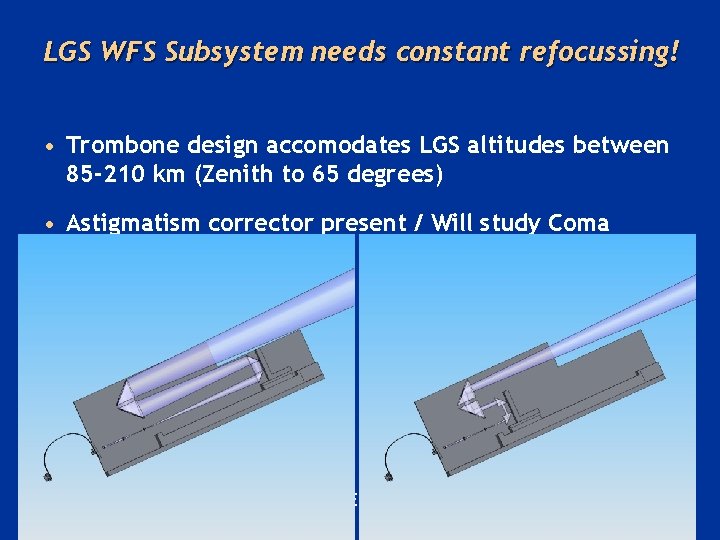
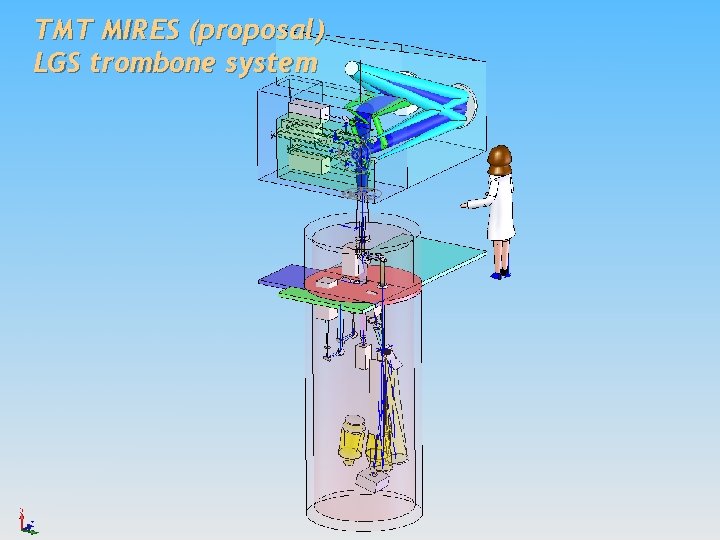
LGS WFS Subsystem needs constant refocussing! • Trombone design accomodates LGS altitudes between 85 -210 km (Zenith to 65 degrees) • Astigmatism corrector present / Will study Coma corrector TMT. IAO. PRE. 06. 030. REL 0 2 54
TMT MIRES (proposal) Concept Overview LGS trombone system TMT. INS. PRE. 06. 029. DRF 0 1 55
Why Multiple Tip/Tilt NGS’s? – Consider a turbulence profile with a focus aberrations at two ranges (blue) – LGS measurements (yellow) cannot determine range of the aberration » Tip/tilt information lost » Equal focus measurement from each LGS, regardless of aberration range – Tip/tilt NGS measurements can determine range from the differential tilt between stars – Three tip/tilt NGS’s needed for all three quadratic modes – Alternate approaches: Rayleigh LGS’s, or a solution to the LGS tilt indeterminacy problem f(r)=a(cr+d)2 =ac 2 r 2+2 acdr+ad 2 ~ ac 2 r 2 After tilt removal f(r)=ar 2
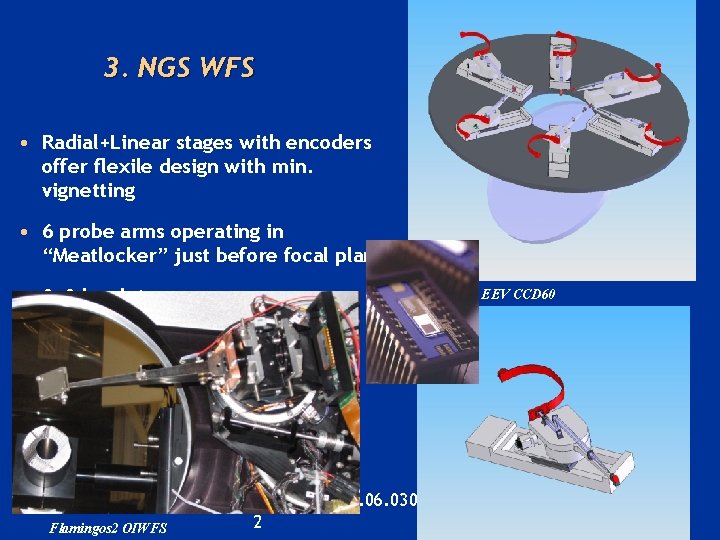
3. NGS WFS • Radial+Linear stages with encoders offer flexile design with min. vignetting • 6 probe arms operating in “Meatlocker” just before focal plane • 2 x 2 lenslets EEV CCD 60 • 6” FOV - 60 x 60 0. 1” pix Flamingos 2 OIWFS TMT. IAO. PRE. 06. 030. REL 0 2 57
What is Tomography ? 90 km 2. Multiple guide star
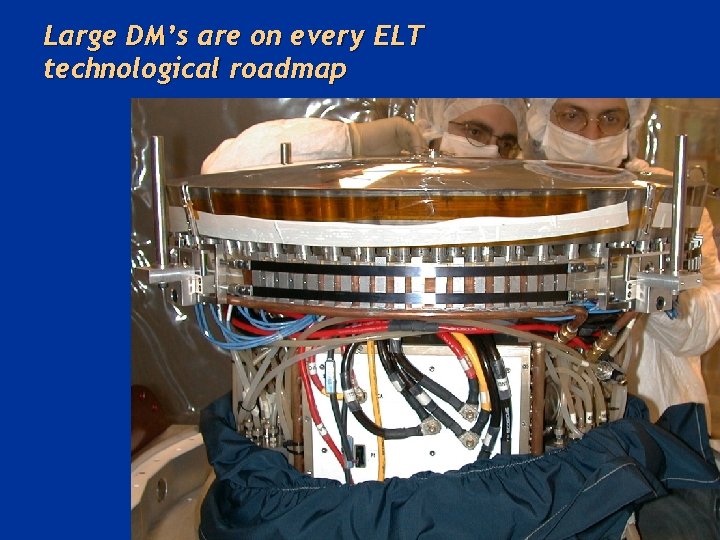
Large DM’s are on every ELT technological roadmap
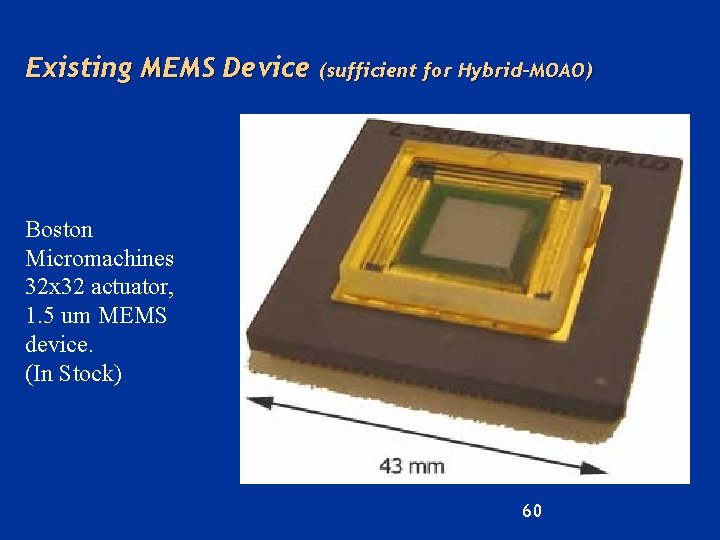
Existing MEMS Device (sufficient for Hybrid-MOAO) Boston Micromachines 32 x 32 actuator, 1. 5 um MEMS device. (In Stock) 60