
Adaptive Optics and its Applications Lecture 1 Neptune

- Slides: 56
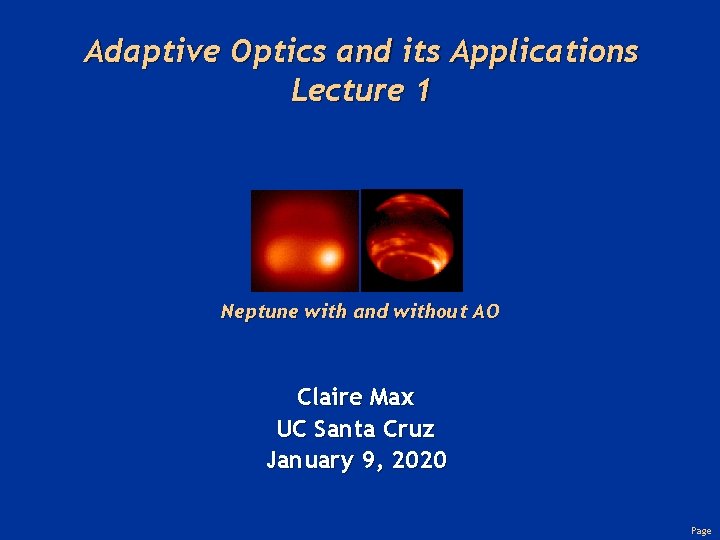
Adaptive Optics and its Applications Lecture 1 Neptune with and without AO Claire Max UC Santa Cruz January 9, 2020 Page
Outline of lecture • Introductions, goals of this course • How the course will work • Overview of adaptive optics and its applications Please remind me to stop for a break at 10: 35 am ! ASTR 289 Page 2
Zoom techniques • Please identify yourself when you speak – “This is Mary Smith from Santa Cruz” • Report technical problems to Graseilah Coolidge at 831459 -2991. If that doesn’t work, please text me at 510717 -1930 (my cell) • Microphones are quite sensitive, even on laptops – Do not to rustle papers in front of them – Mute your microphone if you are making side-comments, sneezes, eating lunch, whatever – In fact, it’s probably best if you keep microphone muted until you want to ask a question or make a comment ASTR 289 Page 3
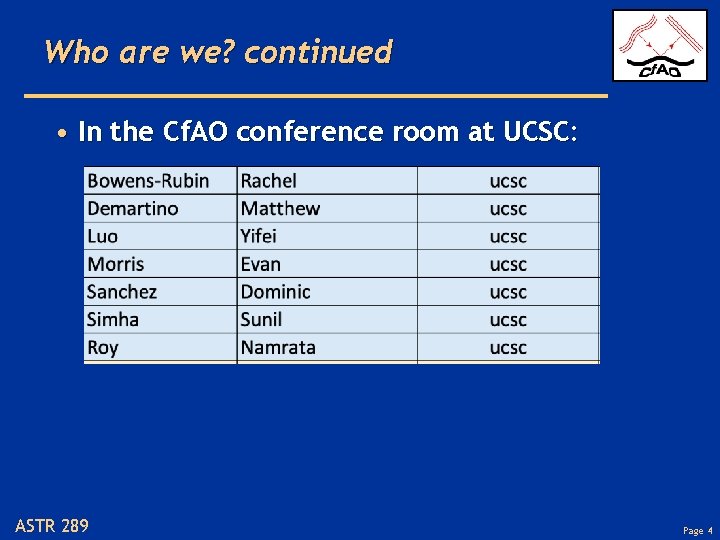
Who are we? continued • In the Cf. AO conference room at UCSC: ASTR 289 Page 4
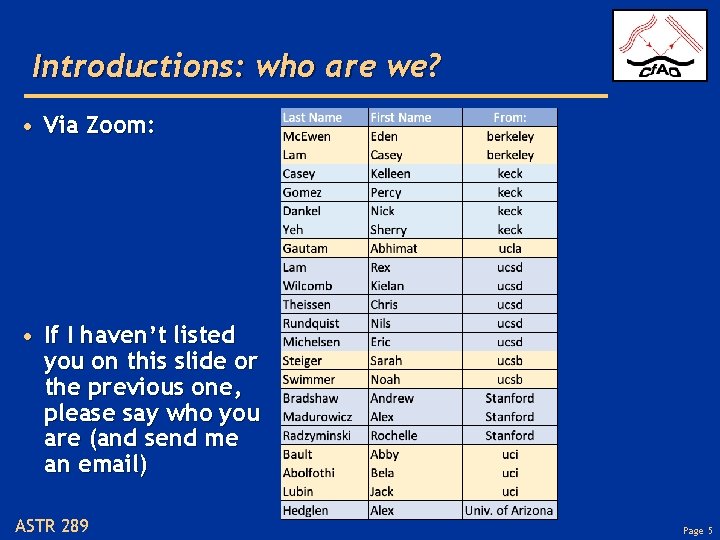
Introductions: who are we? • Via Zoom: • If I haven’t listed you on this slide or the previous one, please say who you are (and send me an email) ASTR 289 Page 5
Goals of this course • To understand the main concepts and components behind adaptive optics systems • To understand how to do astronomical observations with AO (what is AO good for, what is it not good for? ) • To get acquainted with AO components in the Lab • Brief introduction to non-astronomical applications • I hope to interest a few of you in learning more AO, and doing research in the field ASTR 289 Page 6
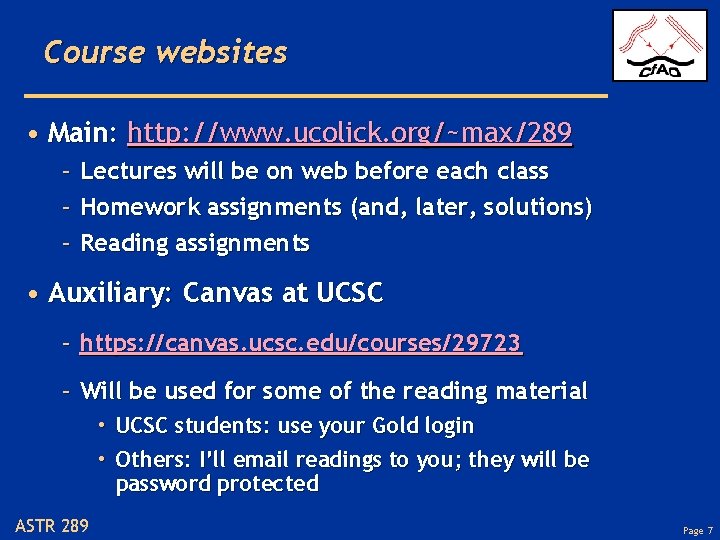
Course websites • Main: http: //www. ucolick. org/~max/289 – Lectures will be on web before each class – Homework assignments (and, later, solutions) – Reading assignments • Auxiliary: Canvas at UCSC – https: //canvas. ucsc. edu/courses/29723 – Will be used for some of the reading material • UCSC students: use your Gold login • Others: I’ll email readings to you; they will be password protected ASTR 289 Page 7
Required Textbook • Field Guide to Astronomical Instrumentation by Keller, Navarro, and Brandl – Available from SPIE – I found this small spiral book very useful for lots of things • Readings from the academic literature available from Canvas or via email from me, password protected ASTR 289 Page 8
Outline of lecture • Introductions, goals of this course • How the course will work • Overview of adaptive optics ASTR 289 Page 9
Course components • Lectures • Reading assignments • Homework problems • Project • Laboratory exercises • Final exam (take-home) ASTR 289 Page 10
How People Learn • Research shows that the traditional passive lecture is far from the most effective teaching tool. • It is not possible for an instructor to pour knowledge into the minds of students. • It is the students who must actively engage in the subject matter in a manner that is meaningful to them. • Hence this course will use several departures from the traditional lecture format, to encourage active learning and understanding of concepts. ASTR 289 Page 11
I will post lectures prior to each class; you can download them • http: //www. ucolick. org/~max/289/ • I strongly suggest that those of you who are attending via video download the lectures prior to class, and project them locally • I’ll also project them via Zoom ASTR 289 Page 12
Concept Questions • Lectures will discuss the underlying concepts and key points, elaborate on reading, and address difficulties. – I will assume you have already done a first pass through the reading • As feedback to me, lectures will include Concept Questions • You will be asked to first formulate your own answer, then to discuss your answer with each other, and finally to report each group’s answers to the class as a whole. ASTR 289 Page 13
Reading Assignments • I will expect you to do the reading BEFORE class • Then if you want, go back and read more deeply after the lecture, to resolve areas which seem confusing • From time to time I will give quick “Reading Quizzes” at the start of a class, where I ask few questions that you’ll be able to answer easily if you’ve spent even 20 minutes looking at the reading assignment ASTR 289 Page 14
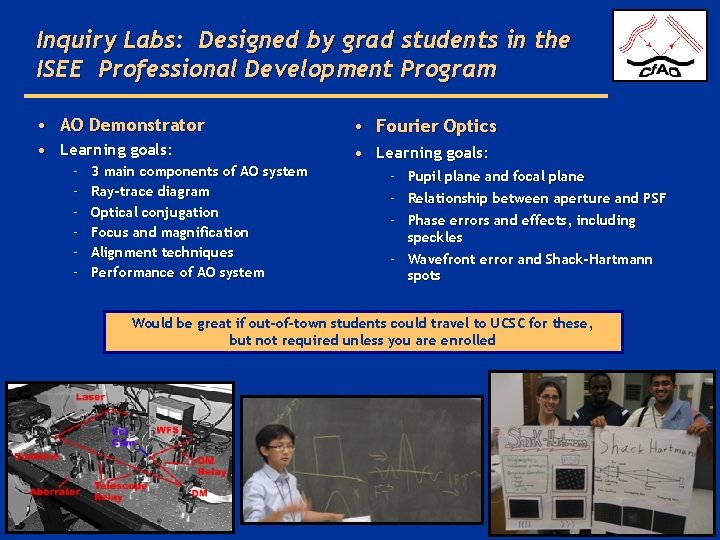
Inquiry Labs: Designed by grad students in the ISEE Professional Development Program • AO Demonstrator • Fourier Optics • Learning goals: – – – 3 main components of AO system Ray-trace diagram Optical conjugation Focus and magnification Alignment techniques Performance of AO system – Pupil plane and focal plane – Relationship between aperture and PSF – Phase errors and effects, including speckles – Wavefront error and Shack-Hartmann spots Would be great if out-of-town students could travel to UCSC for these, but not required unless you are enrolled Page 15
Class Project: Design an AO system to meet your chosen scientific goals • Group activity • Learning goals: – – Systems thinking Requirements-driven design Optimization and tradeoffs Wavefront error terms and error budget • Activity outline: – Choose a science goal – Sketch out the design of an AO system that best meets your science goal – Justify design decisions with an error budget – Present your design to the class ASTR 289 Page 16
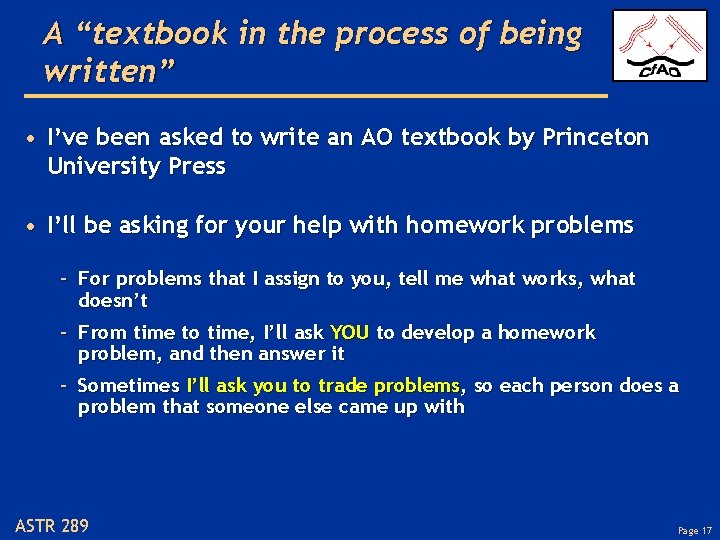
A “textbook in the process of being written” • I’ve been asked to write an AO textbook by Princeton University Press • I’ll be asking for your help with homework problems – For problems that I assign to you, tell me what works, what doesn’t – From time to time, I’ll ask YOU to develop a homework problem, and then answer it – Sometimes I’ll ask you to trade problems, so each person does a problem that someone else came up with ASTR 289 Page 17
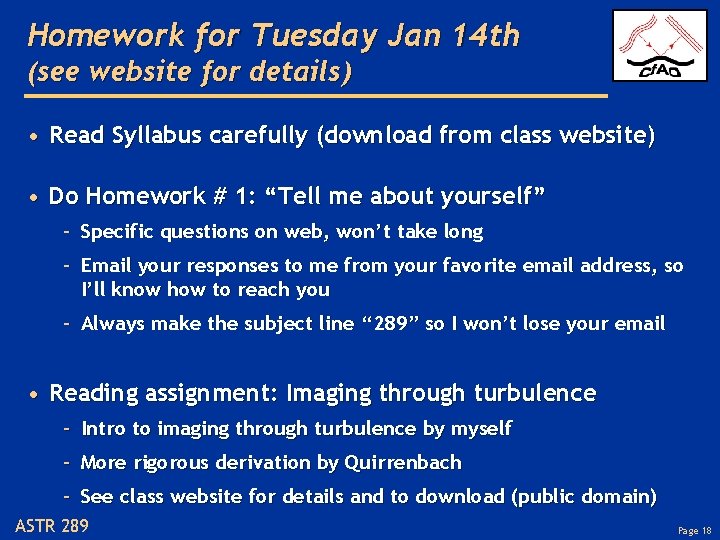
Homework for Tuesday Jan 14 th (see website for details) • Read Syllabus carefully (download from class website) • Do Homework # 1: “Tell me about yourself” – Specific questions on web, won’t take long – Email your responses to me from your favorite email address, so I’ll know how to reach you – Always make the subject line “ 289” so I won’t lose your email • Reading assignment: Imaging through turbulence – Intro to imaging through turbulence by myself – More rigorous derivation by Quirrenbach – See class website for details and to download (public domain) ASTR 289 Page 18
Outline of lecture • Introductions, goals of this course • How the course will work • Overview of adaptive optics ASTR 289 Page 19
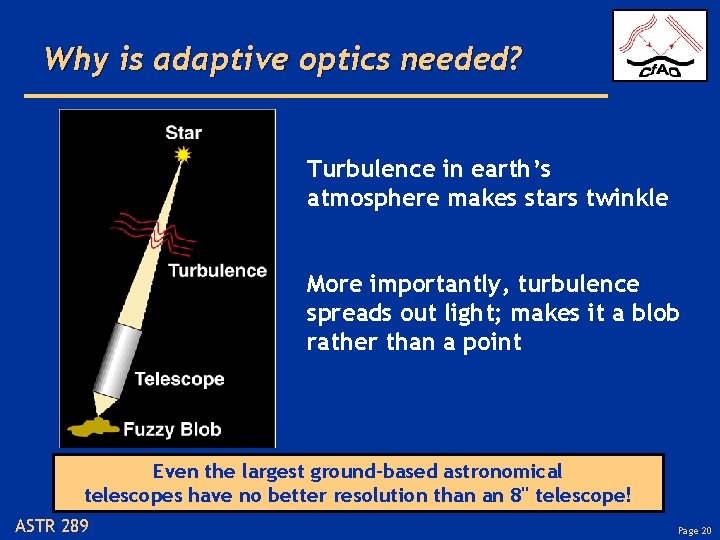
Why is adaptive optics needed? Turbulence in earth’s atmosphere makes stars twinkle More importantly, turbulence spreads out light; makes it a blob rather than a point Even the largest ground-based astronomical telescopes have no better resolution than an 8" telescope! ASTR 289 Page 20
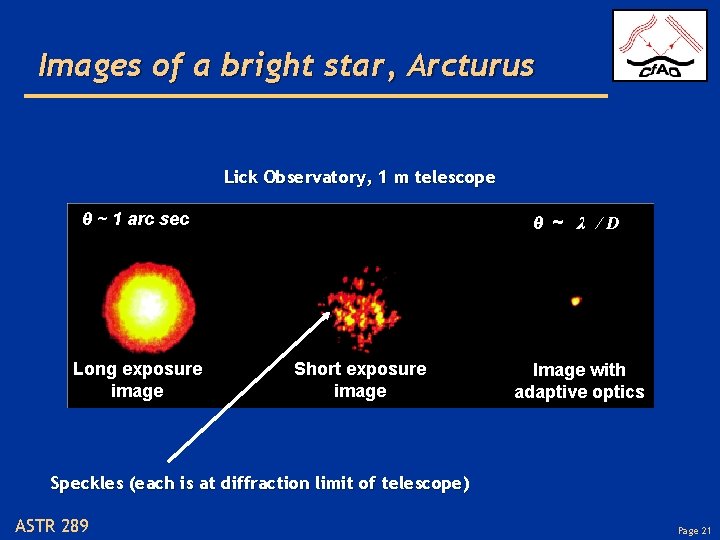
Images of a bright star, Arcturus Lick Observatory, 1 m telescope θ ~ 1 arc sec Long exposure image θ ~ λ /D Short exposure image Image with adaptive optics Speckles (each is at diffraction limit of telescope) ASTR 289 Page 21
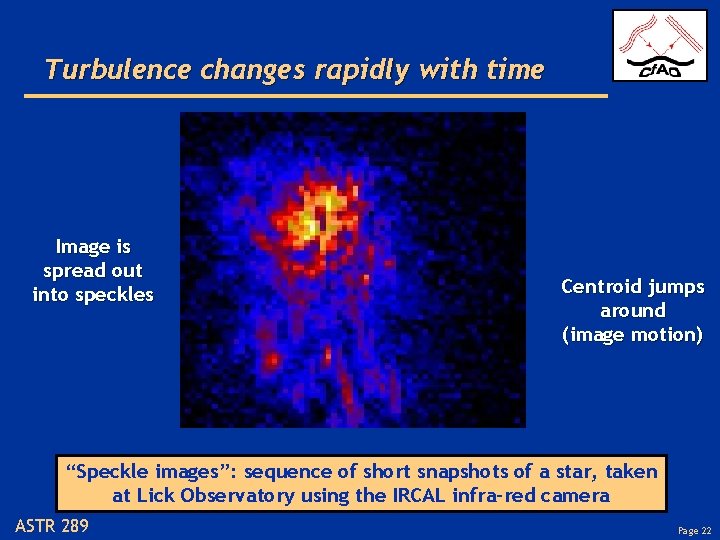
Turbulence changes rapidly with time Image is spread out into speckles Centroid jumps around (image motion) “Speckle images”: sequence of short snapshots of a star, taken at Lick Observatory using the IRCAL infra-red camera ASTR 289 Page 22
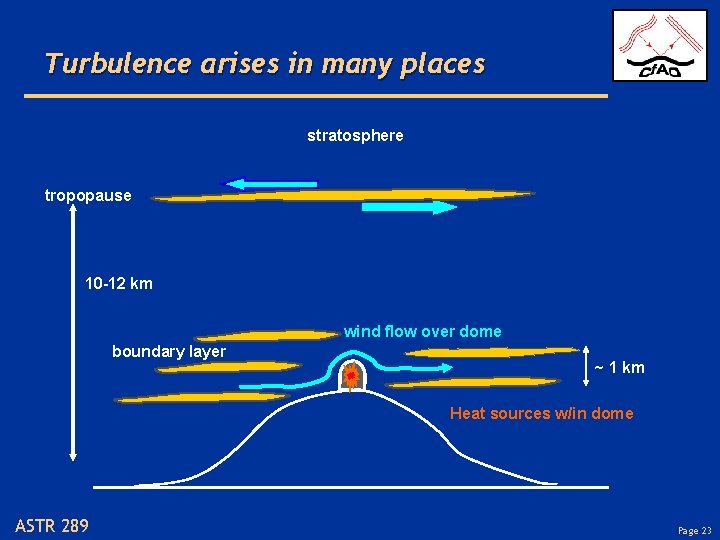
Turbulence arises in many places stratosphere tropopause 10 -12 km wind flow over dome boundary layer ~ 1 km Heat sources w/in dome ASTR 289 Page 23
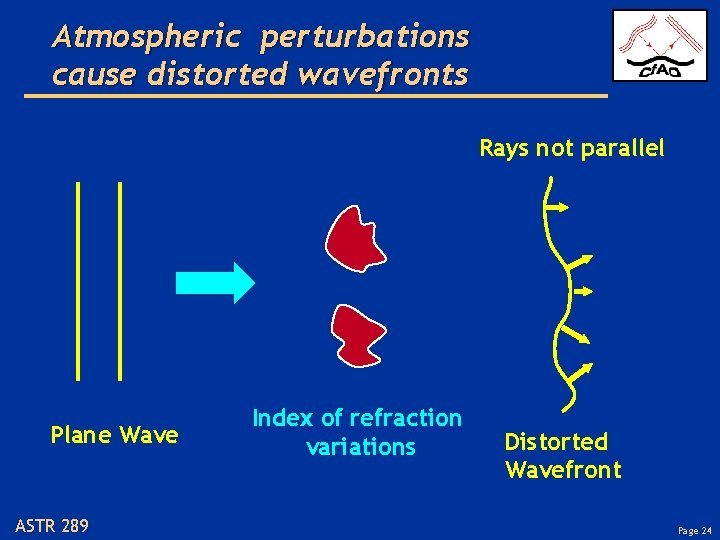
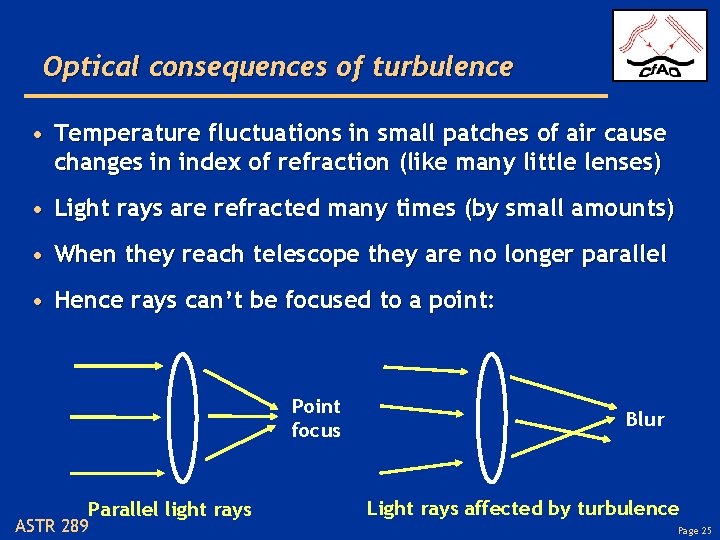
Atmospheric perturbations cause distorted wavefronts Rays not parallel Plane Wave ASTR 289 Index of refraction variations Distorted Wavefront Page 24
Optical consequences of turbulence • Temperature fluctuations in small patches of air cause changes in index of refraction (like many little lenses) • Light rays are refracted many times (by small amounts) • When they reach telescope they are no longer parallel • Hence rays can’t be focused to a point: Point focus Parallel light rays ASTR 289 Blur Light rays affected by turbulence Page 25
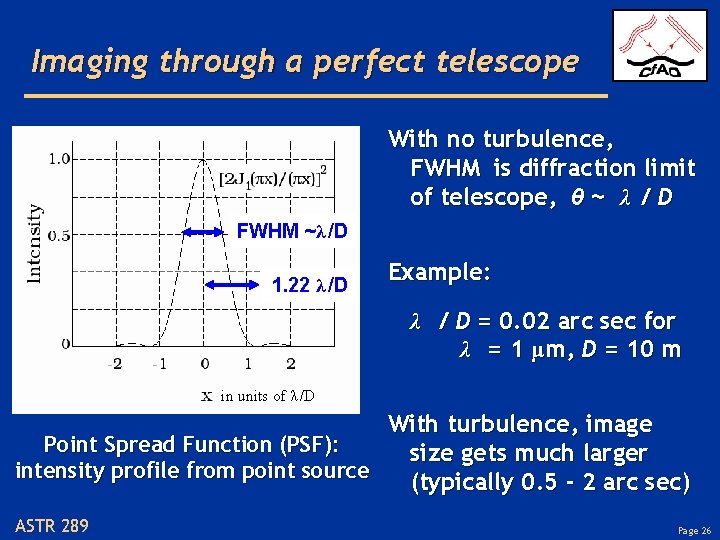
Imaging through a perfect telescope With no turbulence, FWHM is diffraction limit of telescope, θ ~ λ / D FWHM ~λ /D 1. 22 λ /D Example: λ / D = 0. 02 arc sec for λ = 1 μ m, D = 10 m in units of λ /D With turbulence, image Point Spread Function (PSF): size gets much larger intensity profile from point source (typically 0. 5 - 2 arc sec) ASTR 289 Page 26
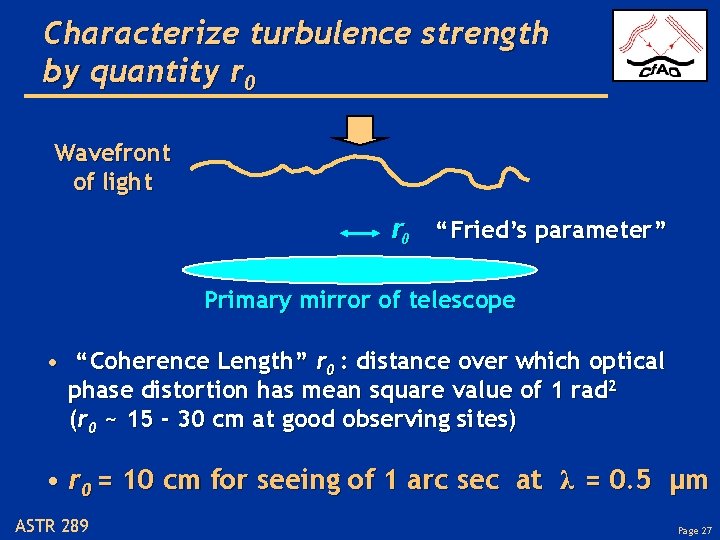
Characterize turbulence strength by quantity r 0 Wavefront of light r 0 “Fried’s parameter” Primary mirror of telescope • “Coherence Length” r 0 : distance over which optical phase distortion has mean square value of 1 rad 2 (r 0 ~ 15 - 30 cm at good observing sites) • r 0 = 10 cm for seeing of 1 arc sec at λ = 0. 5 μm ASTR 289 Page 27
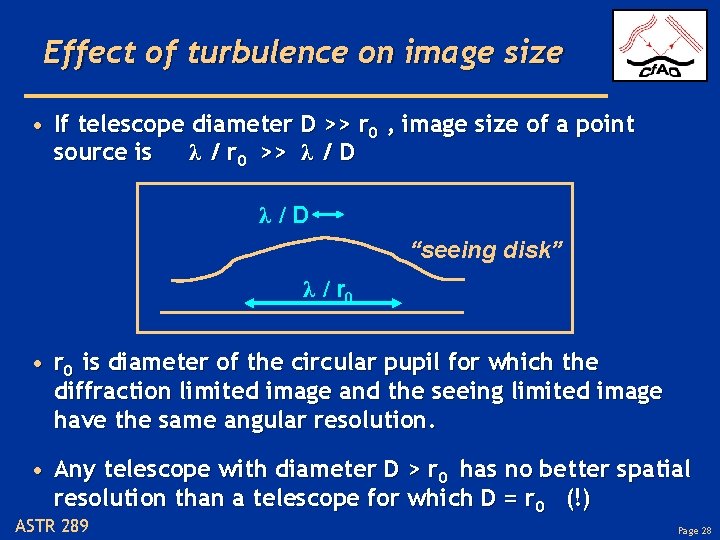
Effect of turbulence on image size • If telescope diameter D >> r 0 , image size of a point source is λ / r 0 >> λ / D λ /D “seeing disk” λ / r 0 • r 0 is diameter of the circular pupil for which the diffraction limited image and the seeing limited image have the same angular resolution. • Any telescope with diameter D > r 0 has no better spatial resolution than a telescope for which D = r 0 (!) ASTR 289 Page 28
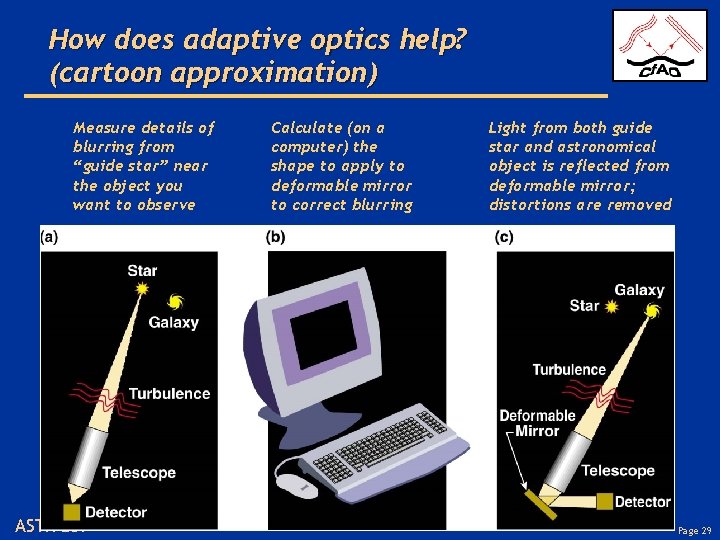
How does adaptive optics help? (cartoon approximation) Measure details of blurring from “guide star” near the object you want to observe ASTR 289 Calculate (on a computer) the shape to apply to deformable mirror to correct blurring Light from both guide star and astronomical object is reflected from deformable mirror; distortions are removed Page 29
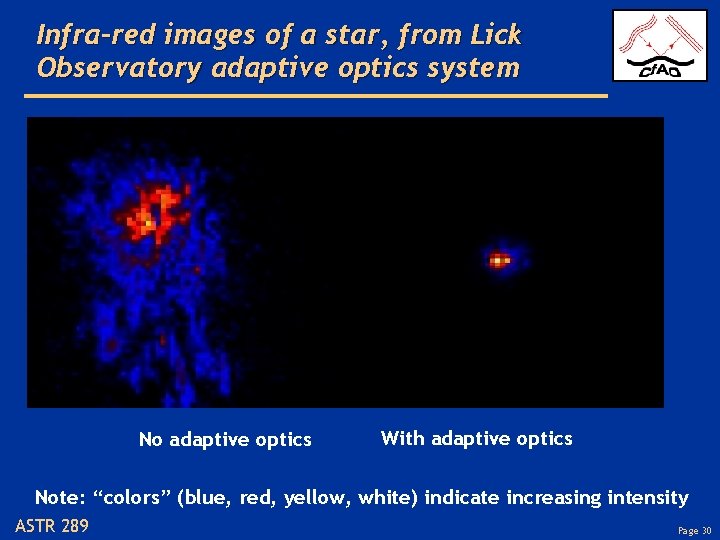
Infra-red images of a star, from Lick Observatory adaptive optics system No adaptive optics With adaptive optics Note: “colors” (blue, red, yellow, white) indicate increasing intensity ASTR 289 Page 30
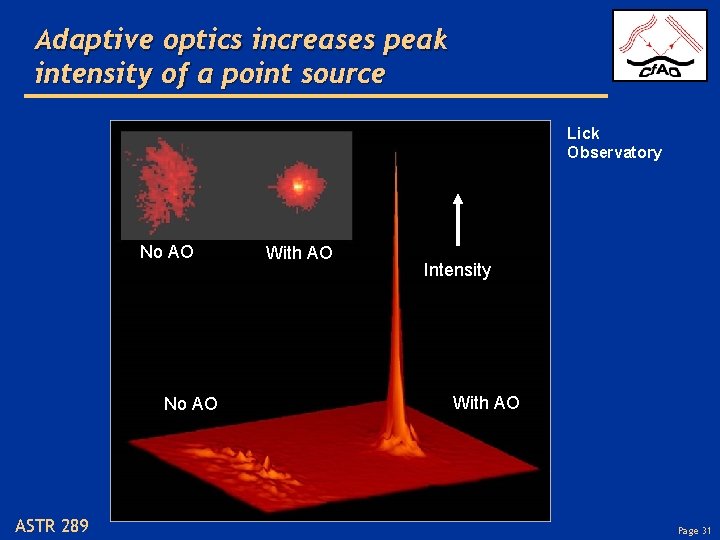
Adaptive optics increases peak intensity of a point source Lick Observatory No AO ASTR 289 With AO Intensity With AO Page 31
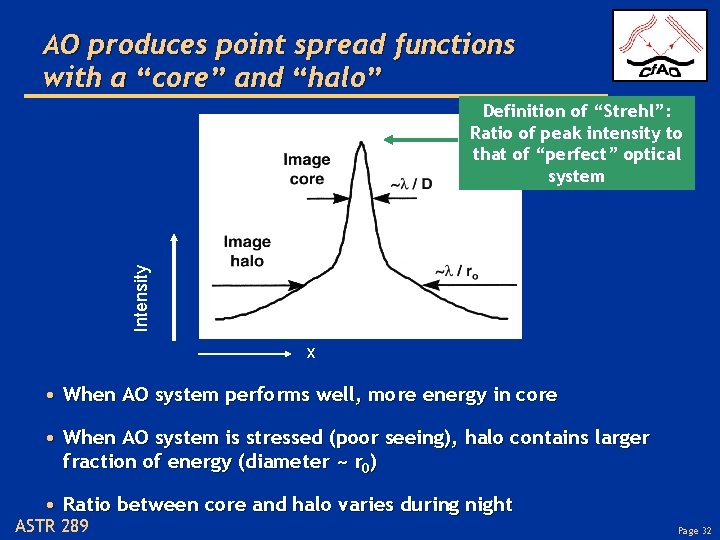
AO produces point spread functions with a “core” and “halo” Intensity Definition of “Strehl”: Ratio of peak intensity to that of “perfect” optical system x • When AO system performs well, more energy in core • When AO system is stressed (poor seeing), halo contains larger fraction of energy (diameter ~ r 0) • Ratio between core and halo varies during night ASTR 289 Page 32
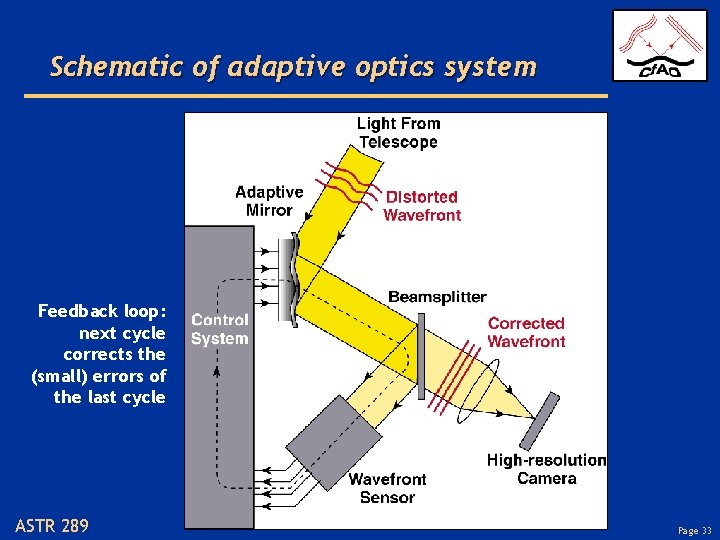
Schematic of adaptive optics system Feedback loop: next cycle corrects the (small) errors of the last cycle ASTR 289 Page 33
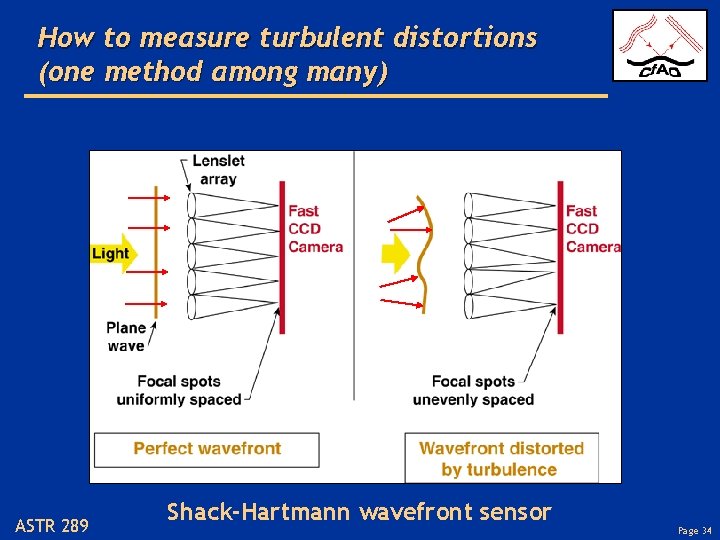
How to measure turbulent distortions (one method among many) ASTR 289 Shack-Hartmann wavefront sensor Page 34
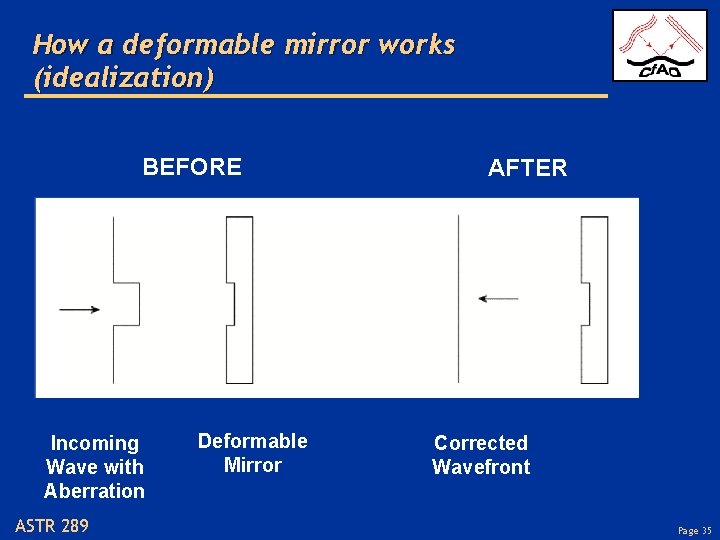
How a deformable mirror works (idealization) BEFORE Incoming Wave with Aberration ASTR 289 Deformable Mirror AFTER Corrected Wavefront Page 35
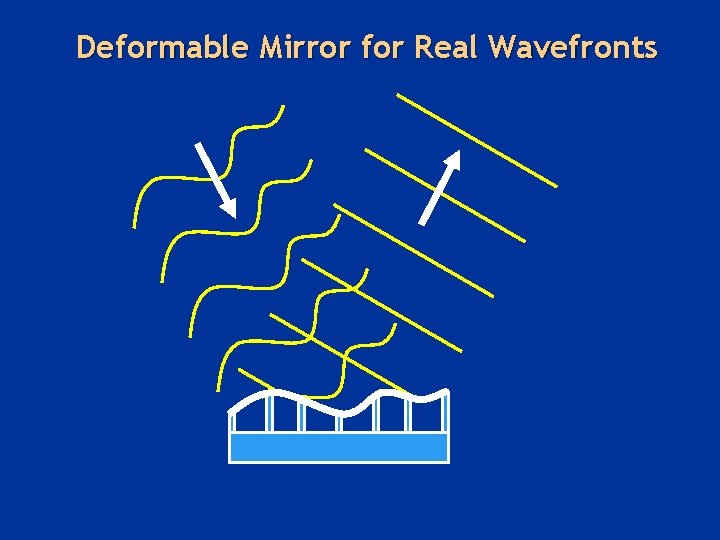
Deformable Mirror for Real Wavefronts
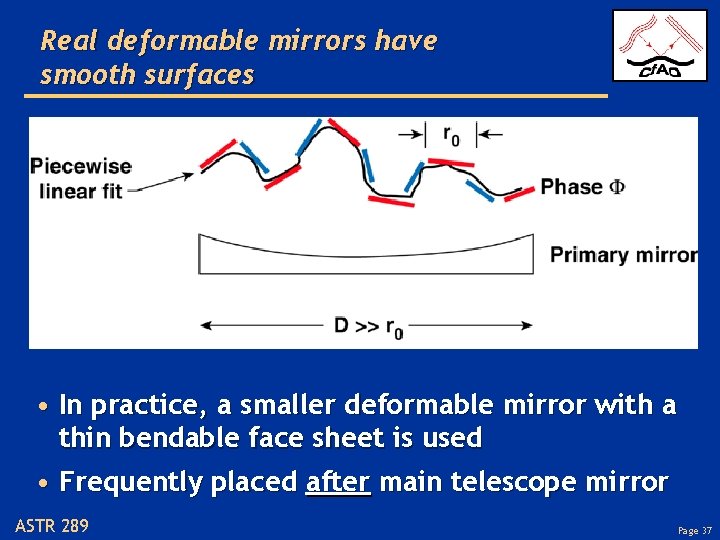
Real deformable mirrors have smooth surfaces • In practice, a smaller deformable mirror with a thin bendable face sheet is used • Frequently placed after main telescope mirror ASTR 289 Page 37
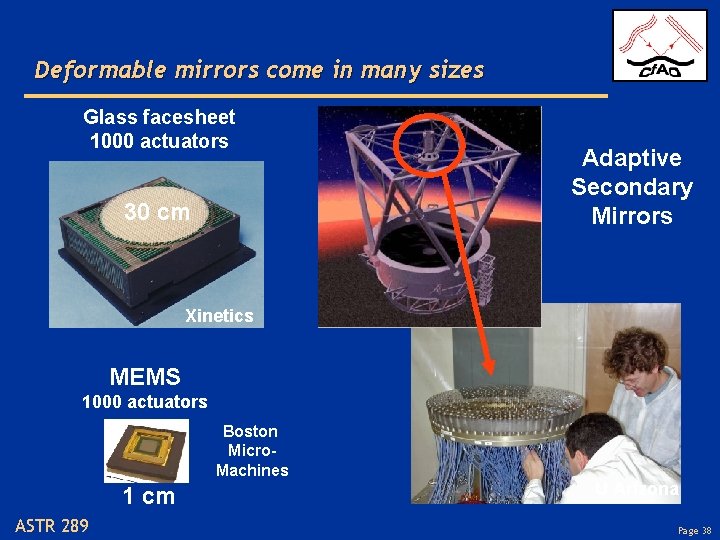
Deformable mirrors come in many sizes Glass facesheet 1000 actuators 30 cm Adaptive Secondary Mirrors Xinetics MEMS 1000 actuators Boston Micro. Machines 1 cm ASTR 289 U Arizona Page 38
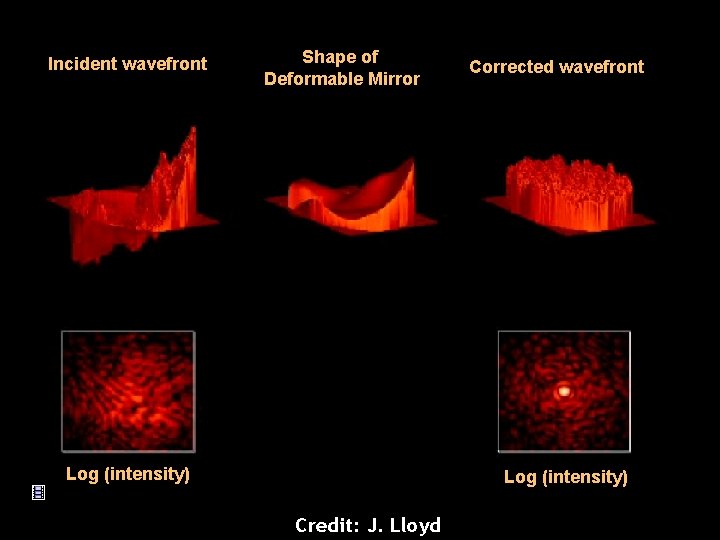
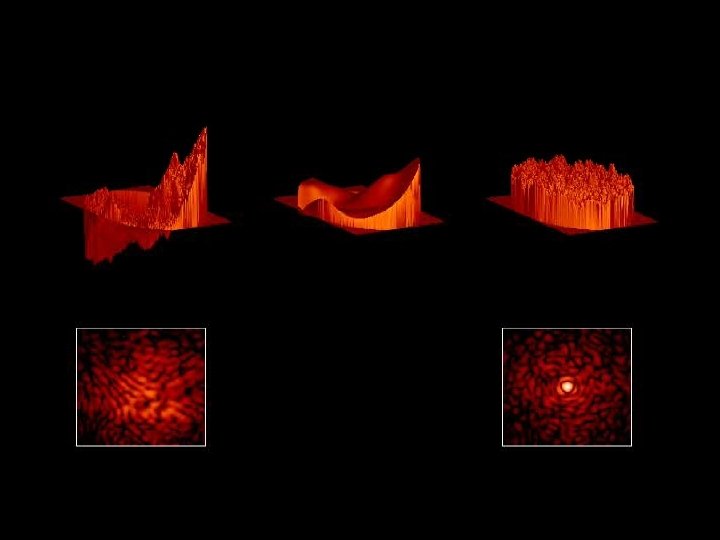
Incident wavefront Shape of Deformable Mirror Log (intensity) Corrected wavefront Log (intensity) Credit: J. Lloyd
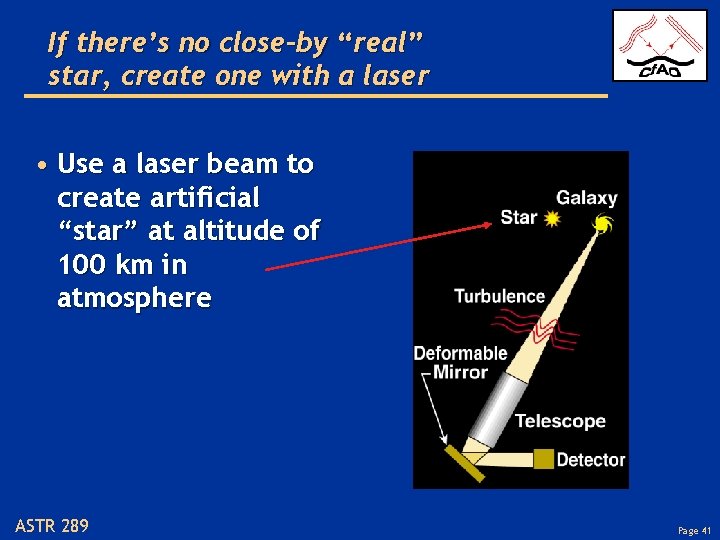
If there’s no close-by “real” star, create one with a laser • Use a laser beam to create artificial “star” at altitude of 100 km in atmosphere ASTR 289 Page 41
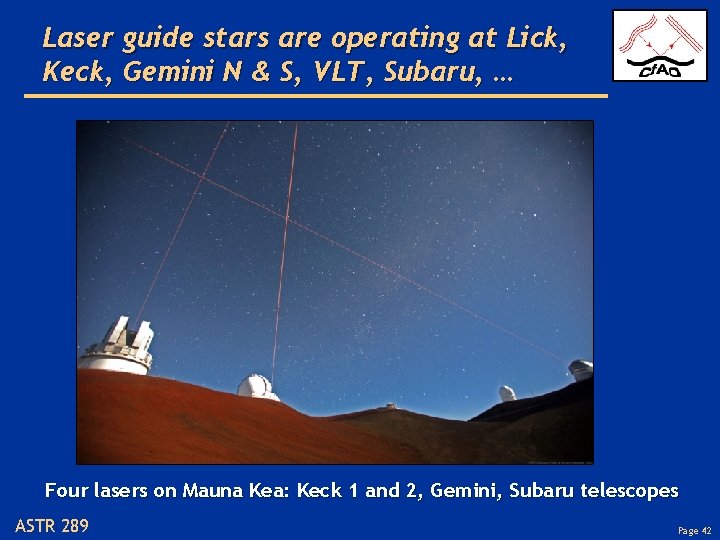
Laser guide stars are operating at Lick, Keck, Gemini N & S, VLT, Subaru, … Four lasers on Mauna Kea: Keck 1 and 2, Gemini, Subaru telescopes ASTR 289 Page 42
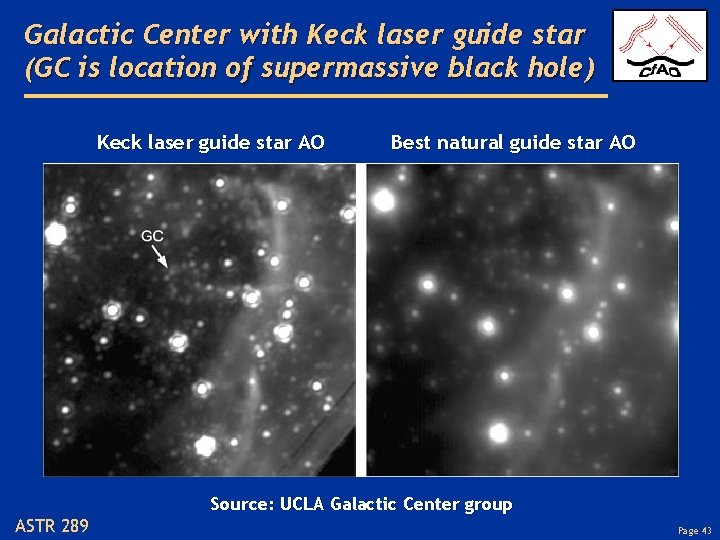
Galactic Center with Keck laser guide star (GC is location of supermassive black hole) Keck laser guide star AO Best natural guide star AO Source: UCLA Galactic Center group ASTR 289 Page 43
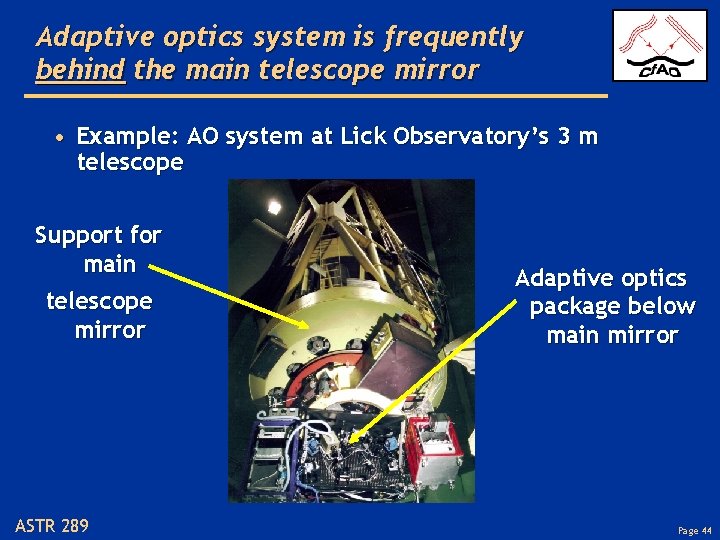
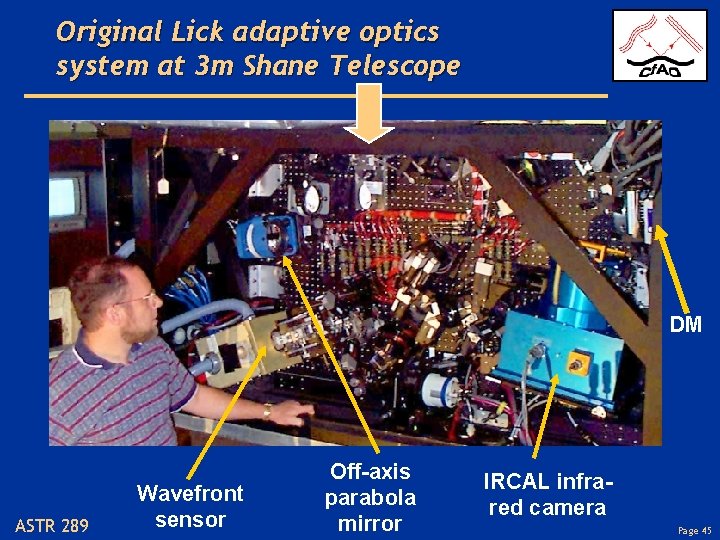
Adaptive optics system is frequently behind the main telescope mirror • Example: AO system at Lick Observatory’s 3 m telescope Support for main telescope mirror ASTR 289 Adaptive optics package below main mirror Page 44
Original Lick adaptive optics system at 3 m Shane Telescope DM ASTR 289 Wavefront sensor Off-axis parabola mirror IRCAL infrared camera Page 45
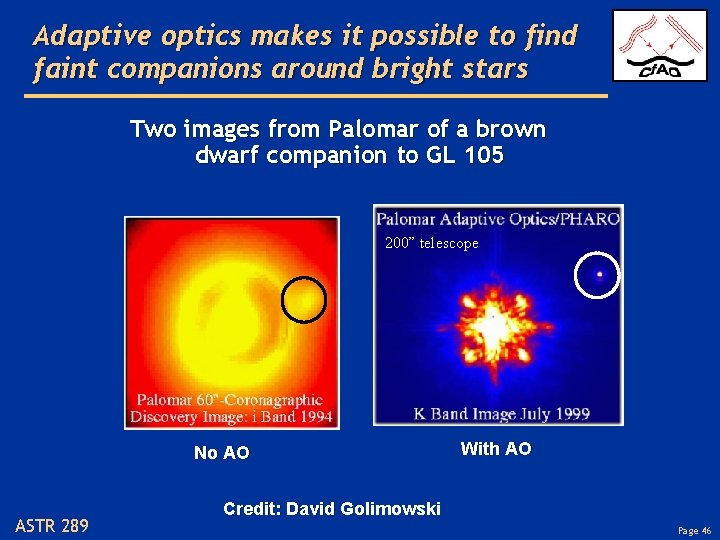
Adaptive optics makes it possible to find faint companions around bright stars Two images from Palomar of a brown dwarf companion to GL 105 200” telescope No AO ASTR 289 With AO Credit: David Golimowski Page 46
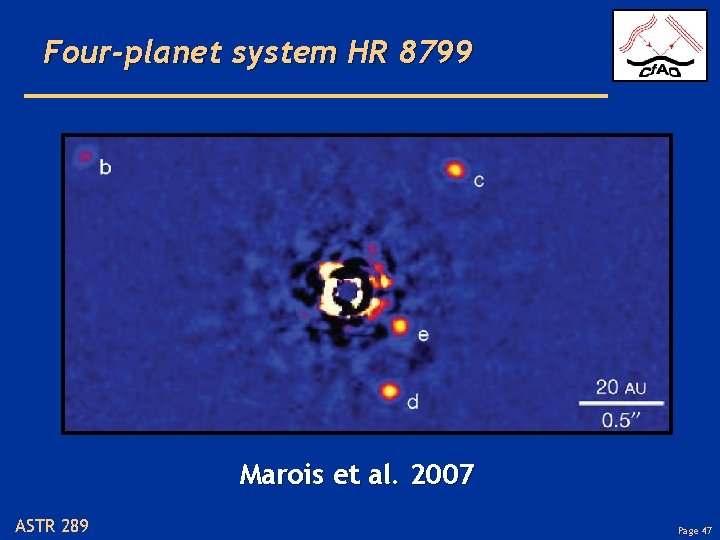
Four-planet system HR 8799 Marois et al. 2007 ASTR 289 Page 47
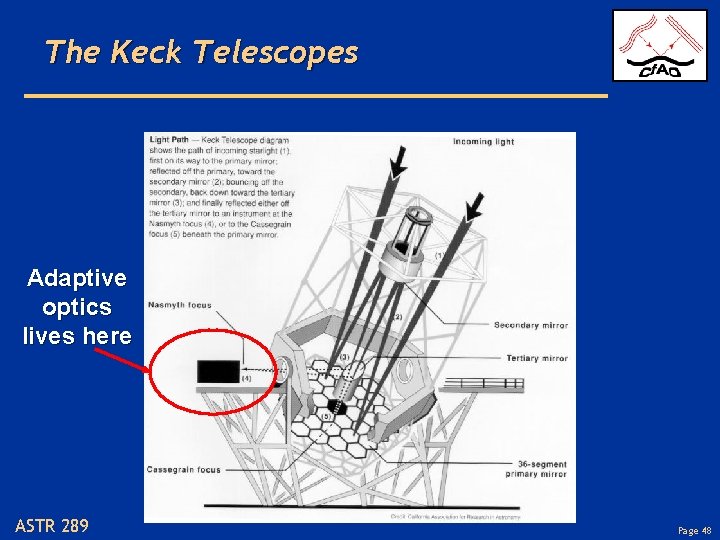
The Keck Telescopes Adaptive optics lives here ASTR 289 Page 48
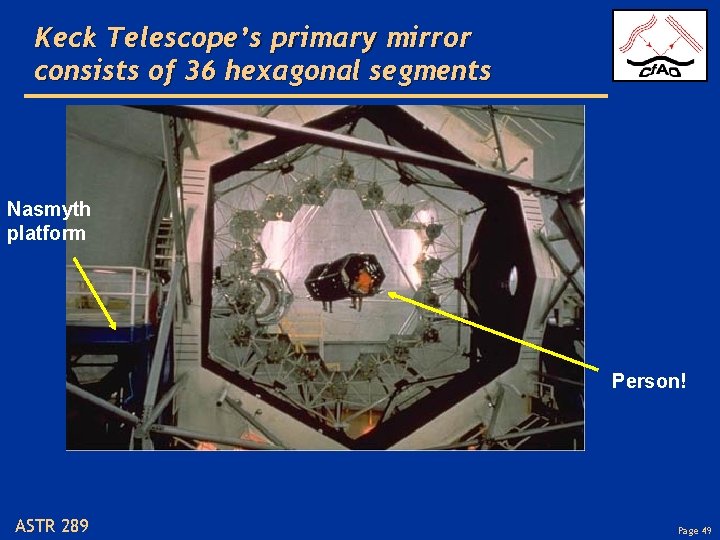
Keck Telescope’s primary mirror consists of 36 hexagonal segments Nasmyth platform Person! ASTR 289 Page 49
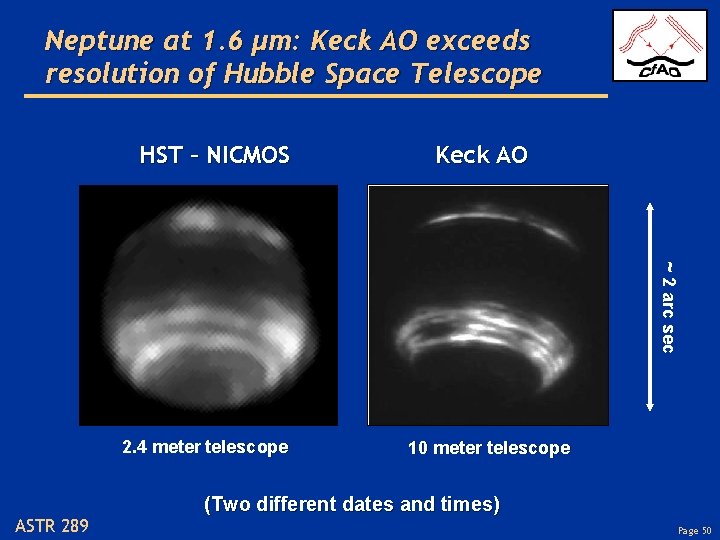
Neptune at 1. 6 μm: Keck AO exceeds resolution of Hubble Space Telescope HST – NICMOS Keck AO ~ 2 arc sec 2. 4 meter telescope ASTR 289 10 meter telescope (Two different dates and times) Page 50
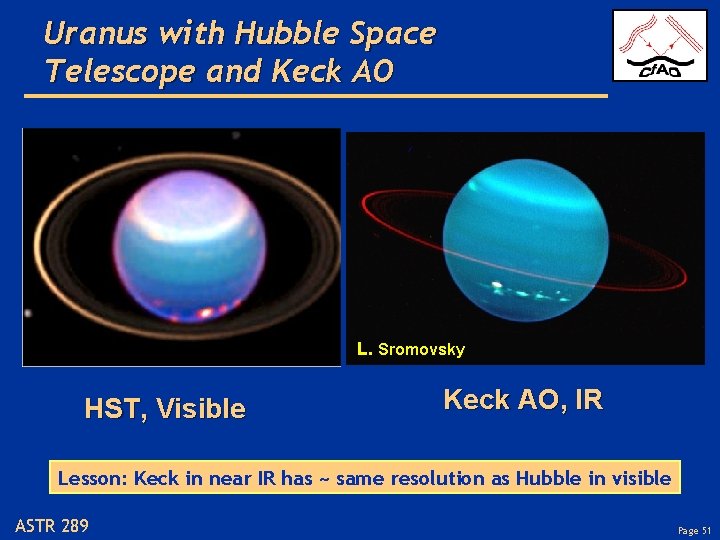
Uranus with Hubble Space Telescope and Keck AO L. Sromovsky HST, Visible Keck AO, IR Lesson: Keck in near IR has ~ same resolution as Hubble in visible ASTR 289 Page 51
Some frontiers of astronomical adaptive optics • Current systems (natural and laser guide stars): – How can we measure the Point Spread Function while we observe? – How accurate can we make our photometry? astrometry? • Future systems: – How far can we push new AO systems to achieve very high contrast ratios, to detect planets around nearby stars? – How can we best achieve a wider AO field of view? – How can we do AO for visible light (replace Hubble on the ground)? – How can we do laser guide star AO on future 30 -m telescopes? ASTR 289 Page 52
Frontiers in AO technology • New kinds of deformable mirrors with > 5000 degrees of freedom • Wavefront sensors that can deal with this many degrees of freedom • Innovative control algorithms • “Tomographic wavefront reconstuction” using multiple laser guide stars • New approaches to doing visible-light AO ASTR 289 Page 53
Other AO applications • Biology – Imaging the living human retina – Improving performance of microscopy (e. g. of cells) • Free-space laser communications (thru air) • Imaging and remote sensing (thru air) • Correcting beam quality of high power lasers ASTR 289 Page 54
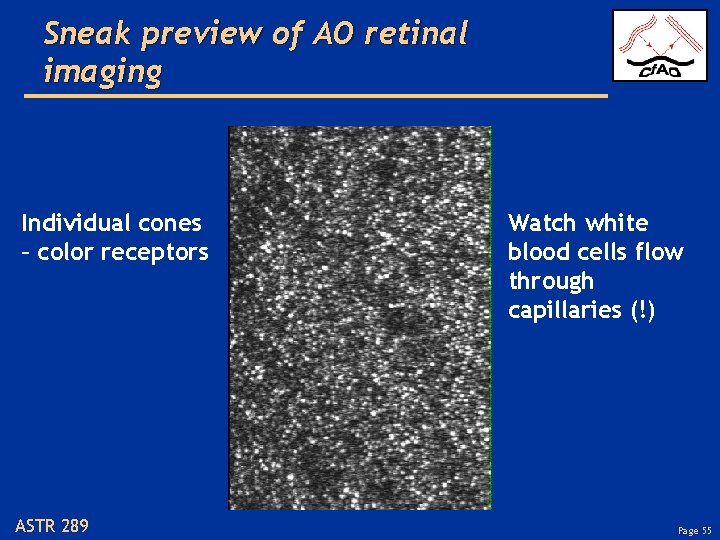
Sneak preview of AO retinal imaging Individual cones – color receptors ASTR 289 Watch white blood cells flow through capillaries (!) Page 55
• Enjoy! ASTR 289 Page 56