
Adaptive Learning Charting Nonlinear Pathways Toward Learning Matthew
- Slides: 1
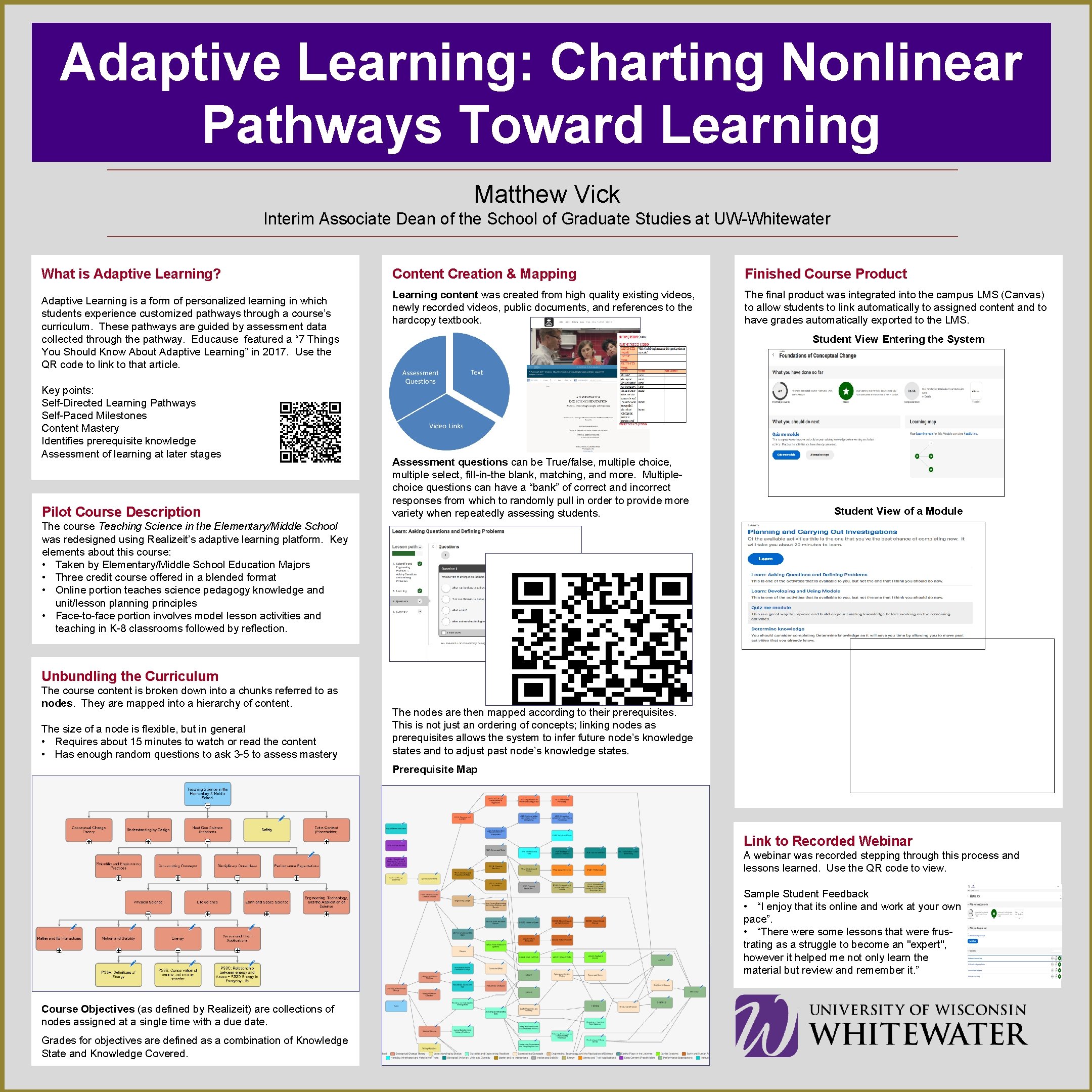
Adaptive Learning: Charting Nonlinear Pathways Toward Learning Matthew Vick Interim Associate Dean of the School of Graduate Studies at UW-Whitewater What is Adaptive Learning? Adaptive Learning is a form of personalized learning in which students experience customized pathways through a course’s curriculum. These pathways are guided by assessment data collected through the pathway. Educause featured a “ 7 Things You Should Know About Adaptive Learning” in 2017. Use the QR code to link to that article. Key points: Self-Directed Learning Pathways Self-Paced Milestones Content Mastery Identifies prerequisite knowledge Assessment of learning at later stages Pilot Course Description The course Teaching Science in the Elementary/Middle School was redesigned using Realizeit’s adaptive learning platform. Key elements about this course: • Taken by Elementary/Middle School Education Majors • Three credit course offered in a blended format • Online portion teaches science pedagogy knowledge and unit/lesson planning principles • Face-to-face portion involves model lesson activities and teaching in K-8 classrooms followed by reflection. Content Creation & Mapping Finished Course Product Learning content was created from high quality existing videos, newly recorded videos, public documents, and references to the hardcopy textbook. The final product was integrated into the campus LMS (Canvas) to allow students to link automatically to assigned content and to have grades automatically exported to the LMS. Student View Entering the System Assessment questions can be True/false, multiple choice, multiple select, fill-in-the blank, matching, and more. Multiplechoice questions can have a “bank” of correct and incorrect responses from which to randomly pull in order to provide more variety when repeatedly assessing students. Student View of a Module Mapping the Curriculum Unbundling the Curriculum The course content is broken down into a chunks referred to as nodes. They are mapped into a hierarchy of content. The size of a node is flexible, but in general • Requires about 15 minutes to watch or read the content • Has enough random questions to ask 3 -5 to assess mastery The nodes are then mapped according to their prerequisites. This is not just an ordering of concepts; linking nodes as prerequisites allows the system to infer future node’s knowledge states and to adjust past node’s knowledge states. Prerequisite Map Link to Recorded Webinar A webinar was recorded stepping through this process and lessons learned. Use the QR code to view. Sample Student Feedback • “I enjoy that its online and work at your own pace”. • “There were some lessons that were frustrating as a struggle to become an "expert", however it helped me not only learn the material but review and remember it. ” Course Objectives (as defined by Realizeit) are collections of nodes assigned at a single time with a due date. Grades for objectives are defined as a combination of Knowledge State and Knowledge Covered.