
Adaptive Grids in Climate Modeling Dynamical Core Tests
- Slides: 13
Adaptive Grids in Climate Modeling: Dynamical Core Tests Christiane Jablonowski, M. Herzog, R. Oehmke, J. E. Penner, Q. Stout, B. van Leer University of Michigan, Ann Arbor, MI in collaboration with NASA/GSFC and NCAR AGU Dec 2003
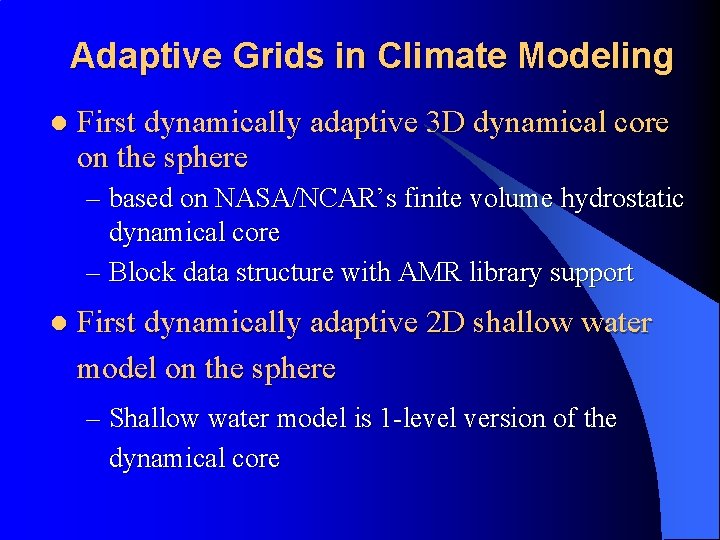
Adaptive Grids in Climate Modeling l First dynamically adaptive 3 D dynamical core on the sphere – based on NASA/NCAR’s finite volume hydrostatic dynamical core – Block data structure with AMR library support l First dynamically adaptive 2 D shallow water model on the sphere – Shallow water model is 1 -level version of the dynamical core
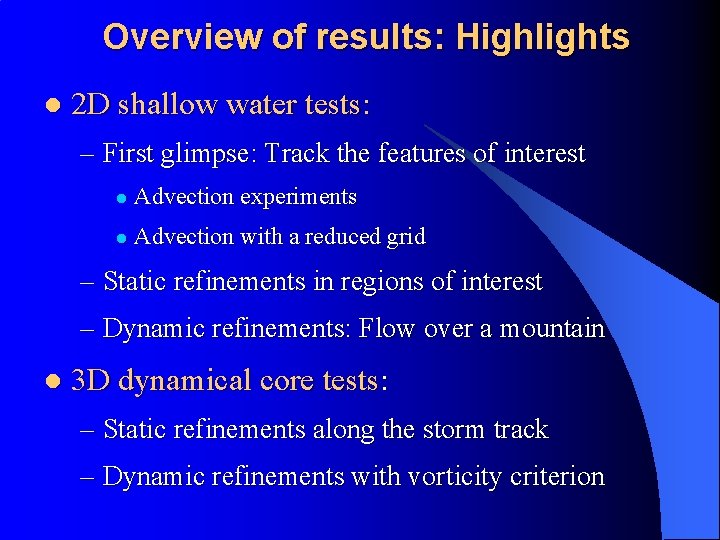
Overview of results: Highlights l 2 D shallow water tests: – First glimpse: Track the features of interest l Advection experiments l Advection with a reduced grid – Static refinements in regions of interest – Dynamic refinements: Flow over a mountain l 3 D dynamical core tests: – Static refinements along the storm track – Dynamic refinements with vorticity criterion
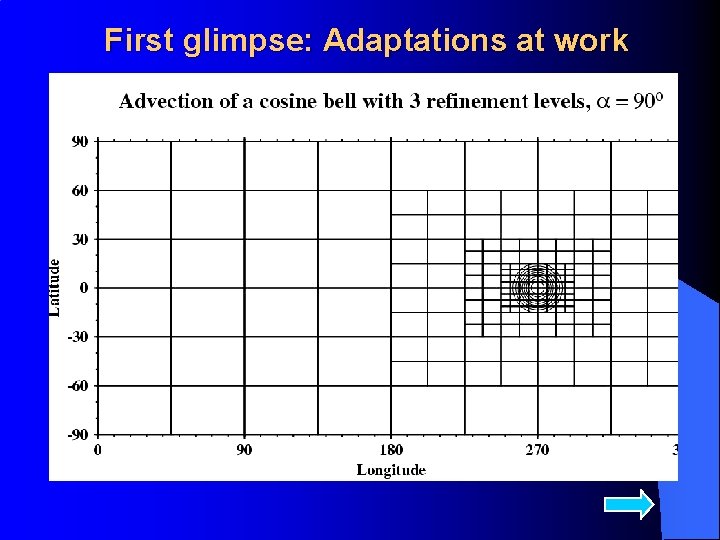
First glimpse: Adaptations at work
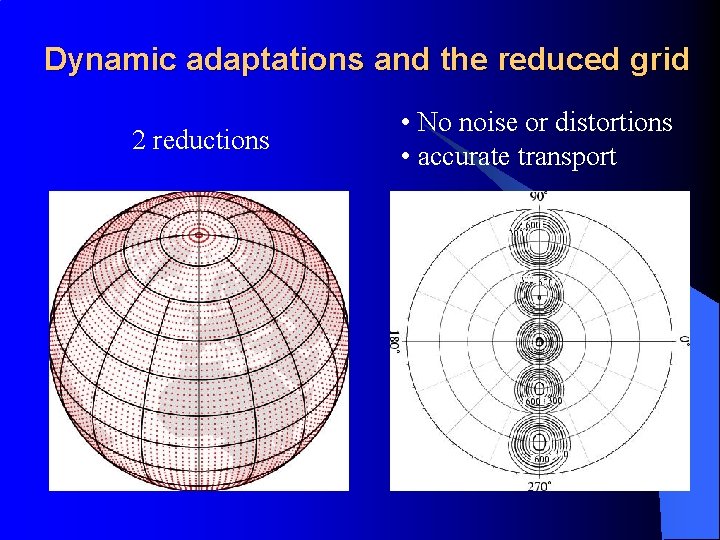
Dynamic adaptations and the reduced grid 2 reductions • No noise or distortions • accurate transport
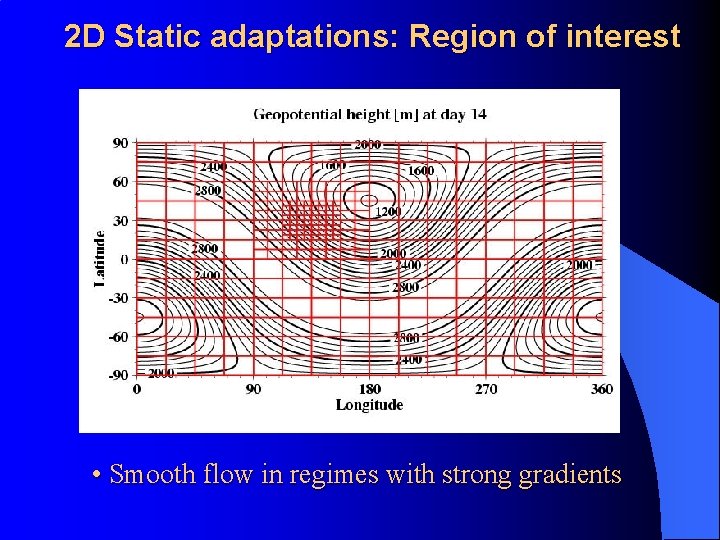
2 D Static adaptations: Region of interest • Smooth flow in regimes with strong gradients
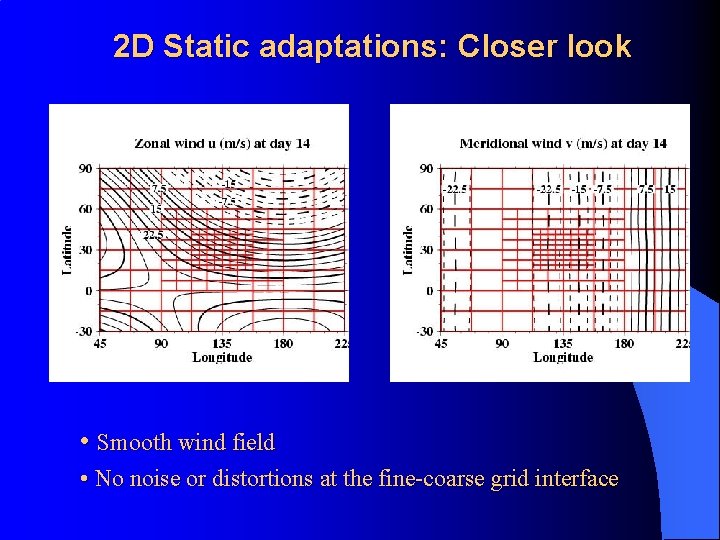
2 D Static adaptations: Closer look • Smooth wind field • No noise or distortions at the fine-coarse grid interface
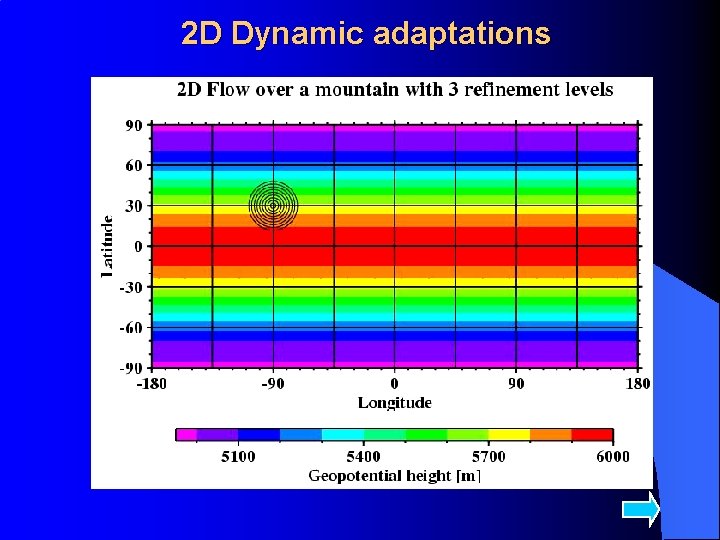
2 D Dynamic adaptations
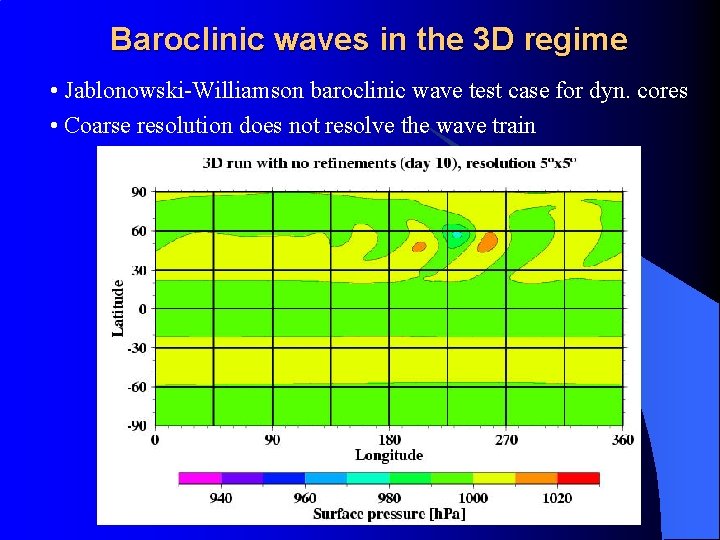
Baroclinic waves in the 3 D regime • Jablonowski-Williamson baroclinic wave test case for dyn. cores • Coarse resolution does not resolve the wave train
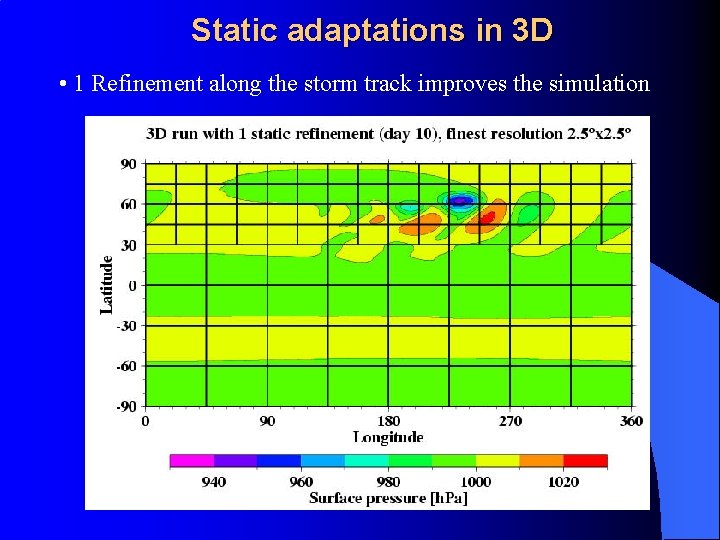
Static adaptations in 3 D • 1 Refinement along the storm track improves the simulation
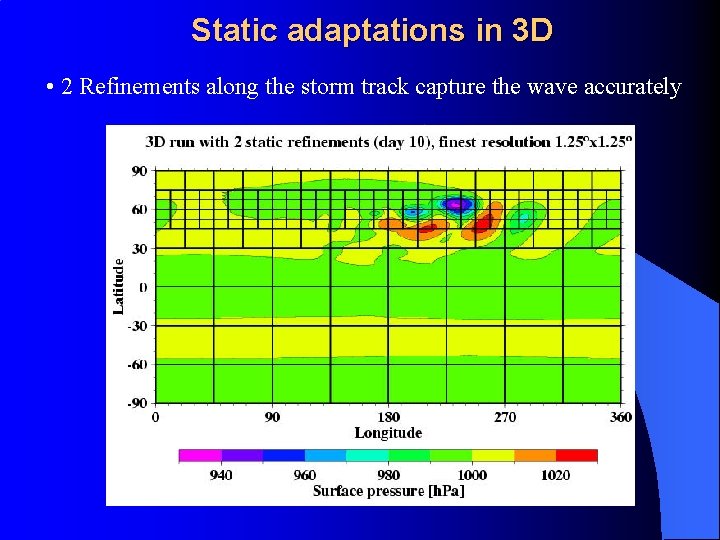
Static adaptations in 3 D • 2 Refinements along the storm track capture the wave accurately
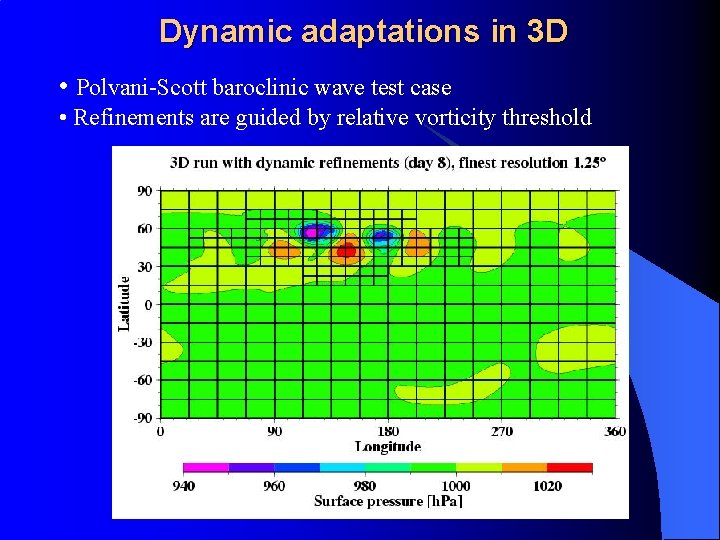
Dynamic adaptations in 3 D • Polvani-Scott baroclinic wave test case • Refinements are guided by relative vorticity threshold
Conclusions Ø Static and dynamic refinements on the sphere work Ø AMR is a current research topic for the atmospheric sciences Ø Future outlook: Ø Static and dynamic adaptations are a viable option for short-term weather predictions ü track storms as they appear ü focus on forecast region of interest: replace nested grids Ø Static adaptations are feasible for long-term climate studies ü refine mountainous terrain, reinitialize orography ÆFuture steps: Add ‘physics’ package, build a full GCM