
Adaptive Extremum Seeking Control of ECCD for NTM

- Slides: 25
Adaptive Extremum Seeking Control of ECCD for NTM Stabilization L. Luo 1, J. Woodby 1, E. Schuster 1 F. D. Halpern 2, G. Bateman 2, A. H. Kritz 2 1 Department of Mechanical Engineering of Physics Lehigh University, Bethlehem, PA 18015 2 Department 48 th Annual Meeting of the Division of Plasma Physics American Physical Society 30 October – 3 November 2006 Philadelphia, Pennsylvania APS DPP 2006 October 31 2006 1
Abstract Neoclassical Tearing Modes (NTMs) drive magnetic islands to grow to their saturated widths, at which they can persist stably in the plasma. The presence of magnetic islands leads to a local flattening of the current density and pressure profiles, which degrade plasma confinement. Since the bootstrap current density is proportional to the pressure gradient, this current is nearly absent within each island. One common method of stabilizing NTMs and therefore shrinking the island widths involves replacing the lost current via Electron Cyclotron Current Drive (ECCD). In order for ECCD to be successful at shrinking the island widths, the current must be driven at the flux surfaces that contain the islands. Moreover, in order to shrink each island with minimal ECCD power, the current must be deposited as close to the center of the island as possible. The difficulty lies in determining the locations of both the island flux surface and the ECCD deposition in real time. The Extremum Seeking feedback method is considered in this work for non-model based optimization of ECCD suppression of NTMs in tokamaks. ECCD steering change will be considered as mechanisms to maximize in real-time the alignment between the island flux surface and the current deposition location, and thus to minimize the ECCD power required for NTM stabilization. Theoretical analysis is done by Woodby [5]. APS DPP 2006 October 31 2006 2
Objectives • Use BALDUR and ISLAND code to simulate NTM • Find a approximation model of the current drive. The shrinking effect is determined by the position, width and strength of the current drive. • Modify BALDUR and ISLAND to incorporate the current drive model • Introduce a feedback control on the current drive using extremum seeking scheme • Numerical simulations APS DPP 2006 October 31 2006 3
References 1. 2. 3. 4. 5. ISLAND module from NTCC module library: http: //w 3. pppl. gov/ntcc Background, finding saturated magnetic island widths, ISLAND: – G. Bateman and R. Morris, Phys. Fluids 29 (3) (1986) – F. Halpern, Physics of Plasmas 13 (2006) 062510 Similar work expressing current drive in Hamada coordinates: – Giruzzi et al. , Nuclear Fusion 39 (1999) 107 -125 – C. Hegna and J. Callen, Physics of Plasmas 4 (1997) 2940 Computing elliptic integrals: www. netlib. org Dependence of NTM Stabilization on Location of Current Drive Relative to Island – J. Woodby, APS 2006 Philadelphia, Poster Session JP 1. 00143 APS DPP 2006 October 31 2006 4
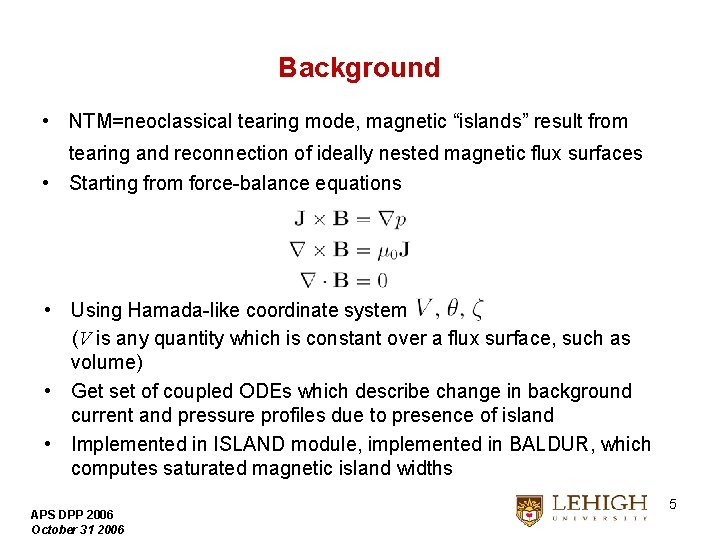
Background • NTM=neoclassical tearing mode, magnetic “islands” result from tearing and reconnection of ideally nested magnetic flux surfaces • Starting from force-balance equations • Using Hamada-like coordinate system (V is any quantity which is constant over a flux surface, such as volume) • Get set of coupled ODEs which describe change in background current and pressure profiles due to presence of island • Implemented in ISLAND module, implemented in BALDUR, which computes saturated magnetic island widths APS DPP 2006 October 31 2006 5
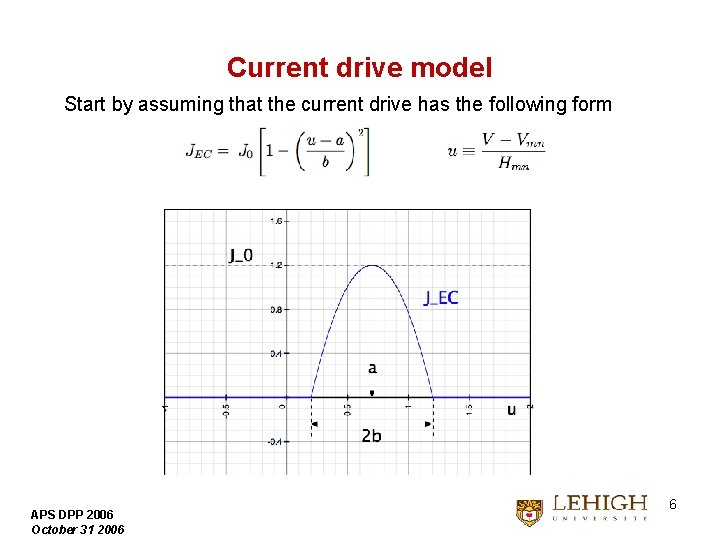
Current drive model Start by assuming that the current drive has the following form APS DPP 2006 October 31 2006 6
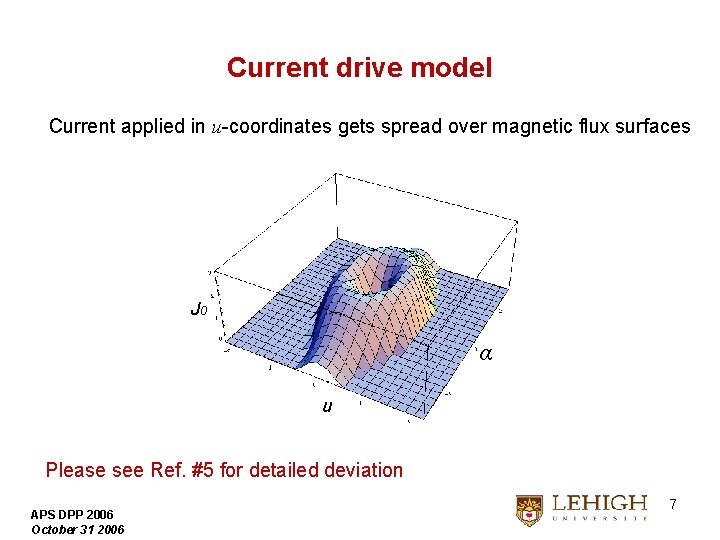
Current drive model Current applied in u-coordinates gets spread over magnetic flux surfaces J 0 α u Please see Ref. #5 for detailed deviation APS DPP 2006 October 31 2006 7
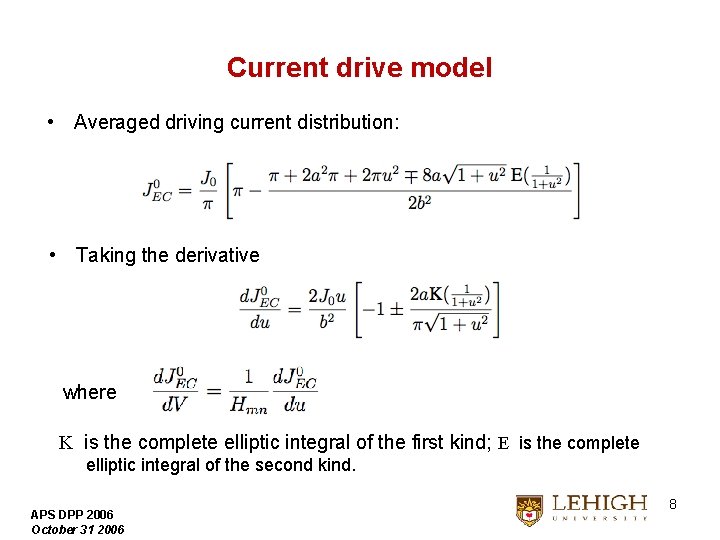
Current drive model • Averaged driving current distribution: • Taking the derivative where K is the complete elliptic integral of the first kind; E is the complete elliptic integral of the second kind. APS DPP 2006 October 31 2006 8
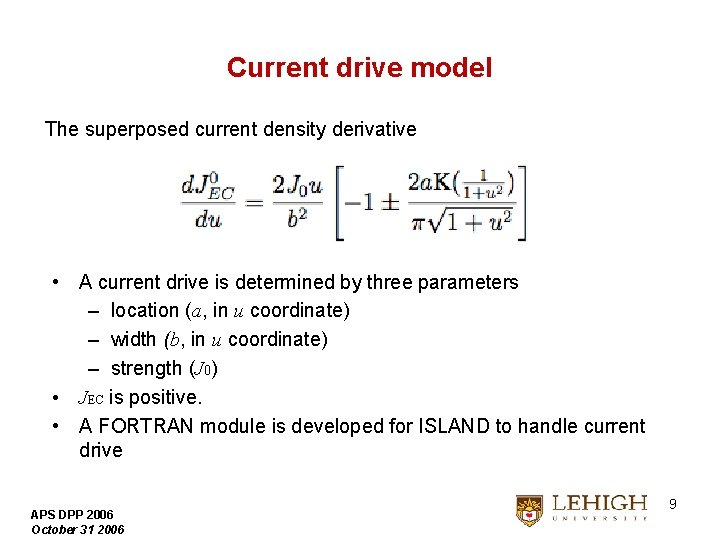
Current drive model The superposed current density derivative • A current drive is determined by three parameters – location (a, in u coordinate) – width (b, in u coordinate) – strength (J 0) • JEC is positive. • A FORTRAN module is developed for ISLAND to handle current drive APS DPP 2006 October 31 2006 9
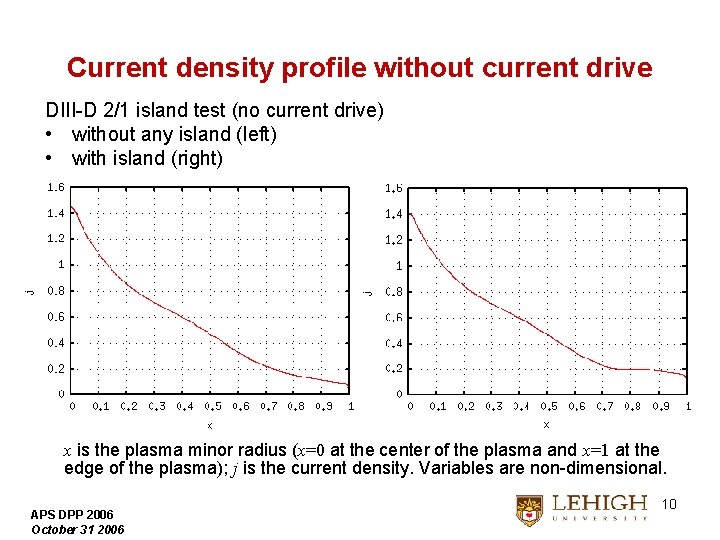
Current density profile without current drive DIII-D 2/1 island test (no current drive) • without any island (left) • with island (right) x is the plasma minor radius (x=0 at the center of the plasma and x=1 at the edge of the plasma); j is the current density. Variables are non-dimensional. APS DPP 2006 October 31 2006 10
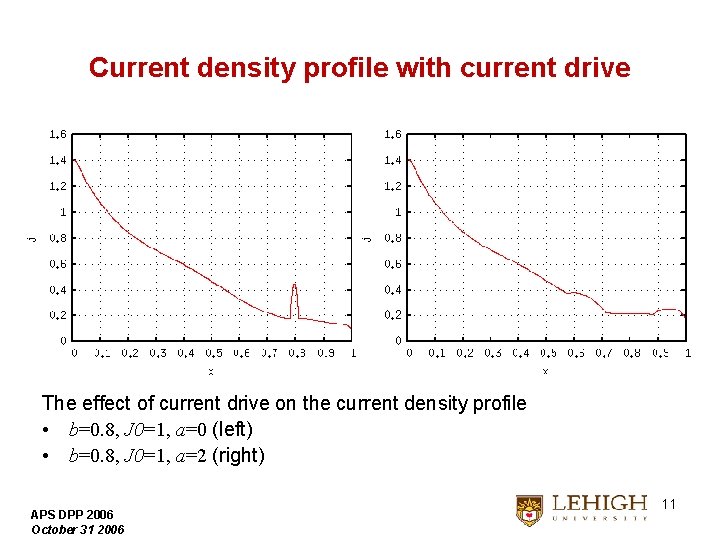
Current density profile with current drive The effect of current drive on the current density profile • b=0. 8, J 0=1, a=0 (left) • b=0. 8, J 0=1, a=2 (right) APS DPP 2006 October 31 2006 11
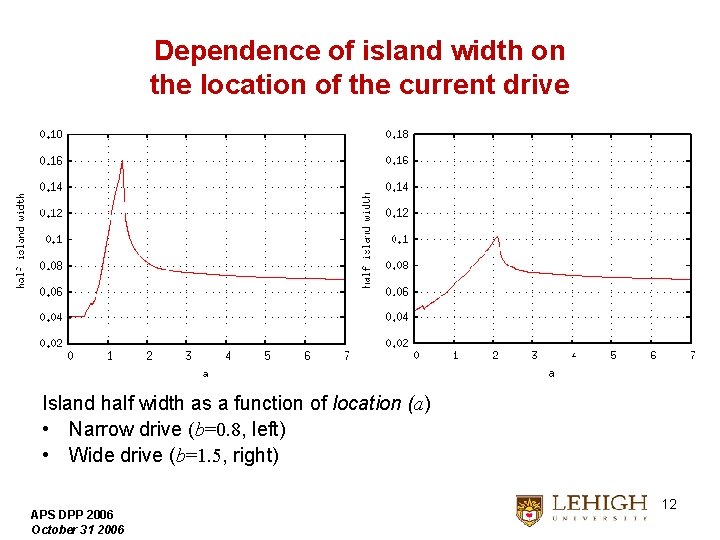
Dependence of island width on the location of the current drive Island half width as a function of location (a) • Narrow drive (b=0. 8, left) • Wide drive (b=1. 5, right) APS DPP 2006 October 31 2006 12
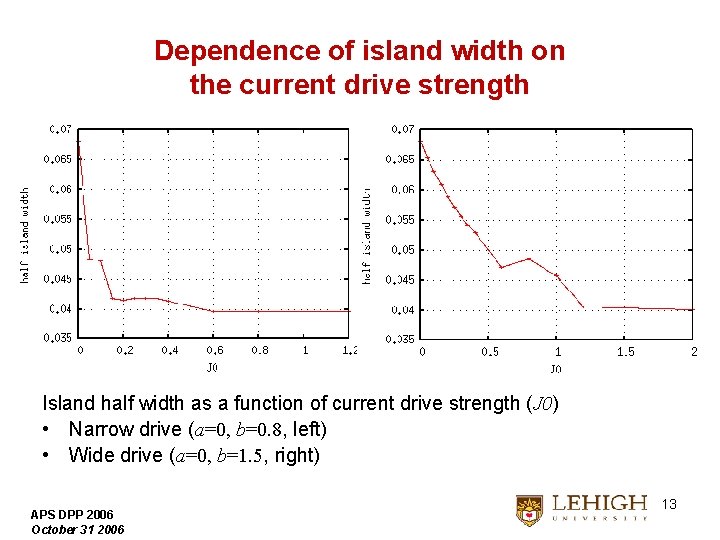
Dependence of island width on the current drive strength Island half width as a function of current drive strength (J 0) • Narrow drive (a=0, b=0. 8, left) • Wide drive (a=0, b=1. 5, right) APS DPP 2006 October 31 2006 13
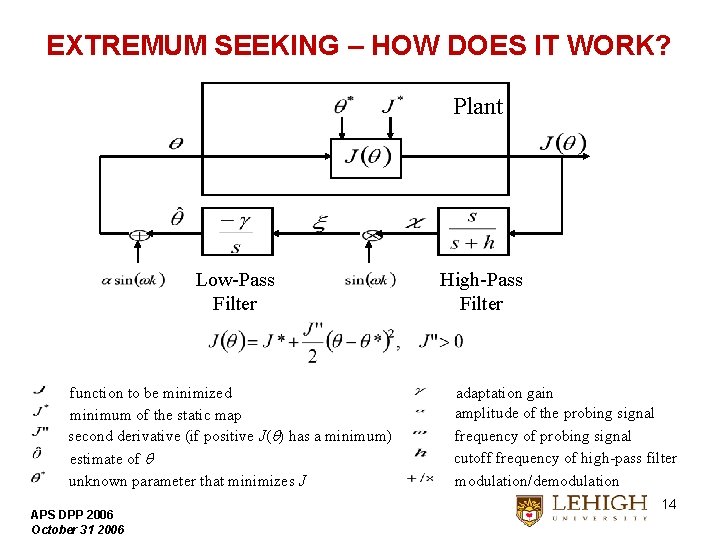
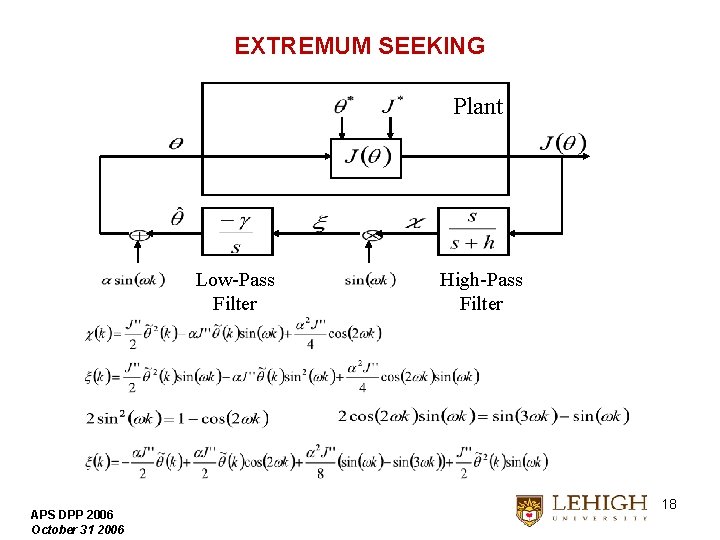
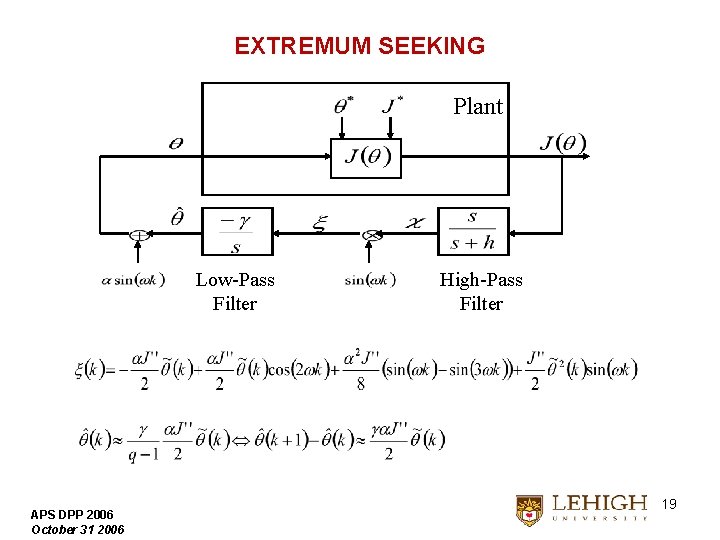
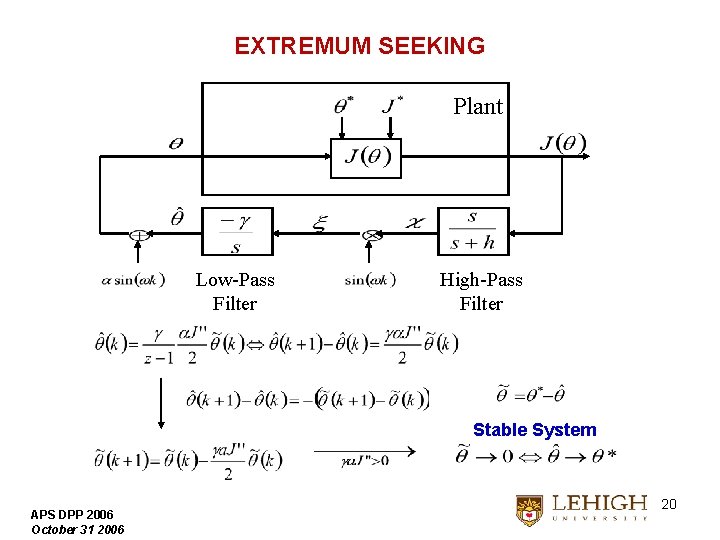
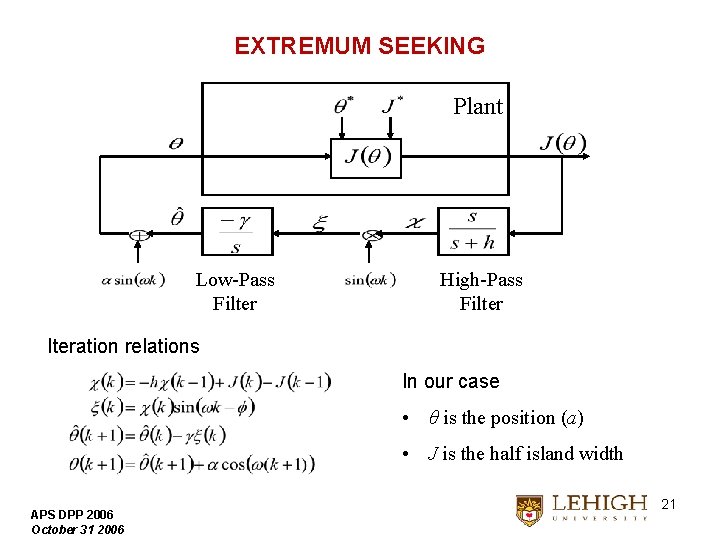
EXTREMUM SEEKING – HOW DOES IT WORK? Plant Low-Pass Filter function to be minimized minimum of the static map second derivative (if positive J( ) has a minimum) estimate of unknown parameter that minimizes J APS DPP 2006 October 31 2006 High-Pass Filter adaptation gain amplitude of the probing signal frequency of probing signal cutoff frequency of high-pass filter modulation/demodulation 14
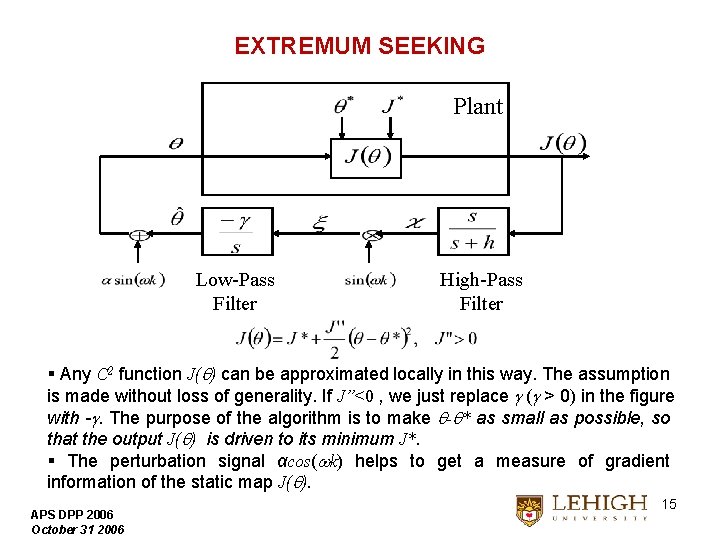
EXTREMUM SEEKING Plant Low-Pass Filter High-Pass Filter § Any C 2 function J( ) can be approximated locally in this way. The assumption is made without loss of generality. If J”<0 , we just replace ( > 0) in the figure with -. The purpose of the algorithm is to make - * as small as possible, so that the output J( ) is driven to its minimum J*. § The perturbation signal αcos( k) helps to get a measure of gradient information of the static map J( ). APS DPP 2006 October 31 2006 15
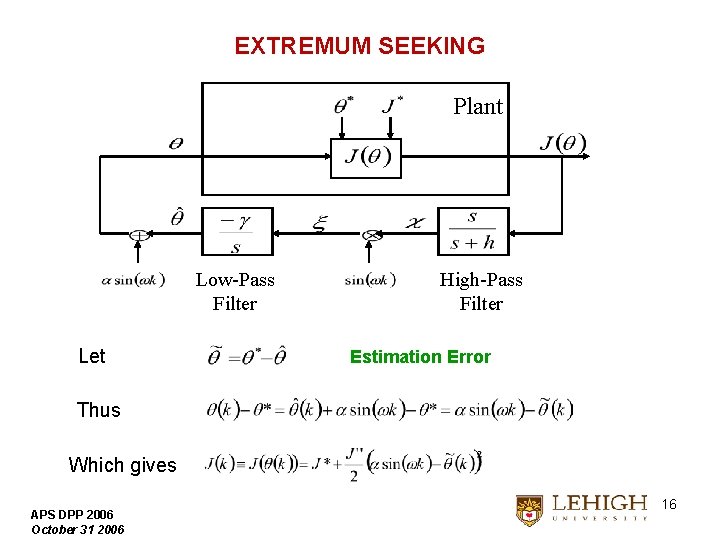
EXTREMUM SEEKING Plant Low-Pass Filter Let High-Pass Filter Estimation Error Thus Which gives APS DPP 2006 October 31 2006 16
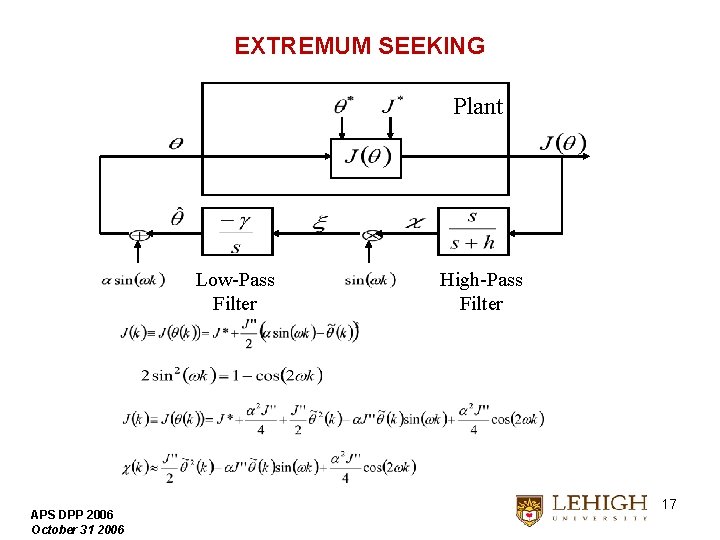
EXTREMUM SEEKING Plant Low-Pass Filter APS DPP 2006 October 31 2006 High-Pass Filter 17
EXTREMUM SEEKING Plant Low-Pass Filter APS DPP 2006 October 31 2006 High-Pass Filter 18
EXTREMUM SEEKING Plant Low-Pass Filter APS DPP 2006 October 31 2006 High-Pass Filter 19
EXTREMUM SEEKING Plant Low-Pass Filter High-Pass Filter Stable System APS DPP 2006 October 31 2006 20
EXTREMUM SEEKING Plant Low-Pass Filter High-Pass Filter Iteration relations In our case • θ is the position (a) • J is the half island width APS DPP 2006 October 31 2006 21
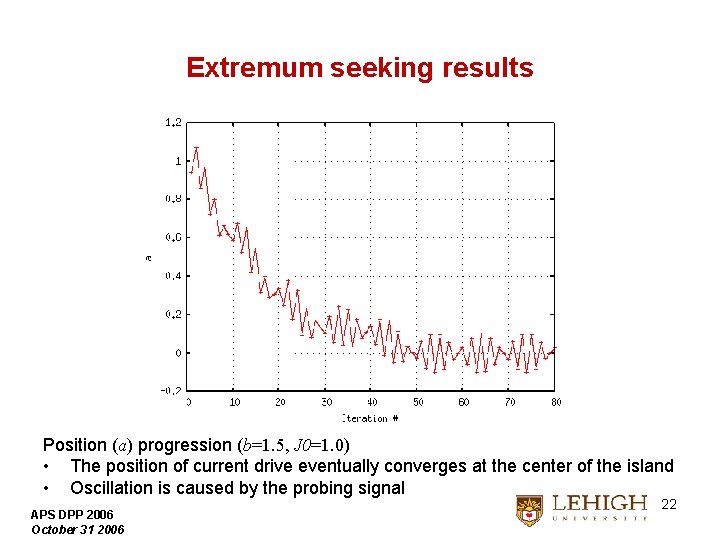
Extremum seeking results Position (a) progression (b=1. 5, J 0=1. 0) • The position of current drive eventually converges at the center of the island • Oscillation is caused by the probing signal APS DPP 2006 October 31 2006 22
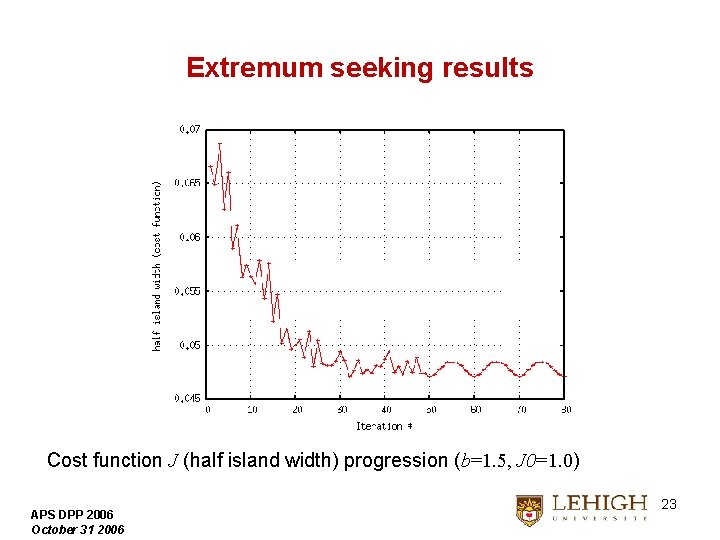
Extremum seeking results Cost function J (half island width) progression (b=1. 5, J 0=1. 0) APS DPP 2006 October 31 2006 23
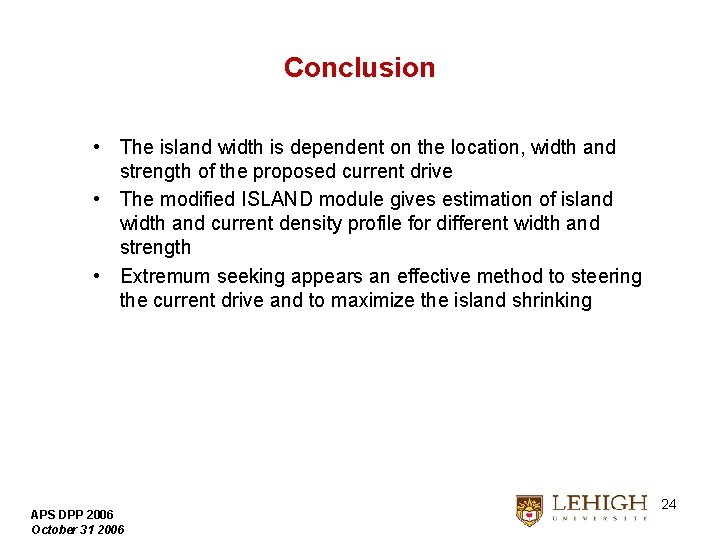
Conclusion • The island width is dependent on the location, width and strength of the proposed current drive • The modified ISLAND module gives estimation of island width and current density profile for different width and strength • Extremum seeking appears an effective method to steering the current drive and to maximize the island shrinking APS DPP 2006 October 31 2006 24
Future Research • A more accurate current drive model • Implementation of off-center current drive model in ISLAND/BALDUR • Extremum seeking feedback stabilization in timedependent simulations • Code optimization for better performance APS DPP 2006 October 31 2006 25