
Adaptive Cache Management for Energyefficient GPU Computing 1

![Benchmarks § § [7] Rodinia [15] Mars [34] CUDA SDK [42] Parboil § HCS](https://slidetodoc.com/presentation_image/00c2d0f0a485e11f5e5aa9964638b36b/image-5.jpg "Benchmarks § § [7] Rodinia [15] Mars [34] CUDA SDK [42] Parboil § HCS")
![Cache Bypassing The PDP Cache Organization § [MICRO ‘ 12] Protection Distance Prediction (PDP)](https://slidetodoc.com/presentation_image/00c2d0f0a485e11f5e5aa9964638b36b/image-10.jpg "Cache Bypassing The PDP Cache Organization § [MICRO ‘ 12] Protection Distance Prediction (PDP)")
![Warp Throttling § [MICRO’ 12] Cache Conscious Wavefront Scheduling (CCWS) – Aims to alleviate](https://slidetodoc.com/presentation_image/00c2d0f0a485e11f5e5aa9964638b36b/image-12.jpg "Warp Throttling § [MICRO’ 12] Cache Conscious Wavefront Scheduling (CCWS) – Aims to alleviate")

- Slides: 36
Adaptive Cache Management for Energy-efficient GPU Computing 1, 2, 3 3 1, 2 3 Xuhao Chen , Li-Wen Chang , Chris Rodrigues , Jie Lv , Zhiying Wang , Wen-Mei Hwu [1] State Key Laboratory of High Performance Computing, National University of Defense Technology, Changsha, China [2] School of Computer, National University of Defense Technology, Changsha, China [3] Department of Electrical and Computer Engineering, University of Illinois at Urbana-Champaign, Urbana, USA
Overview § Our focus: cache management scheme for GPGPUs – Enable GPUs for Irregular applications that is highly cache sensitive – Could be very inefficient due to massive multithreading – Cache contention & resource congestion § Existing management schemes have limitations – Cache bypassing (retain some useful lines instead of always replacing) – Warp throttling (adjust thread counts to avoid over-saturating resources) § We propose coordinated bypassing and warp throttling (CBWT) – Take full advantage of cache capacity & other on-chip resources – Improve GPU performance and energy efficiency
Outline § Introduction § Existing Work § CBWT Design § Evaluation § Conclusion
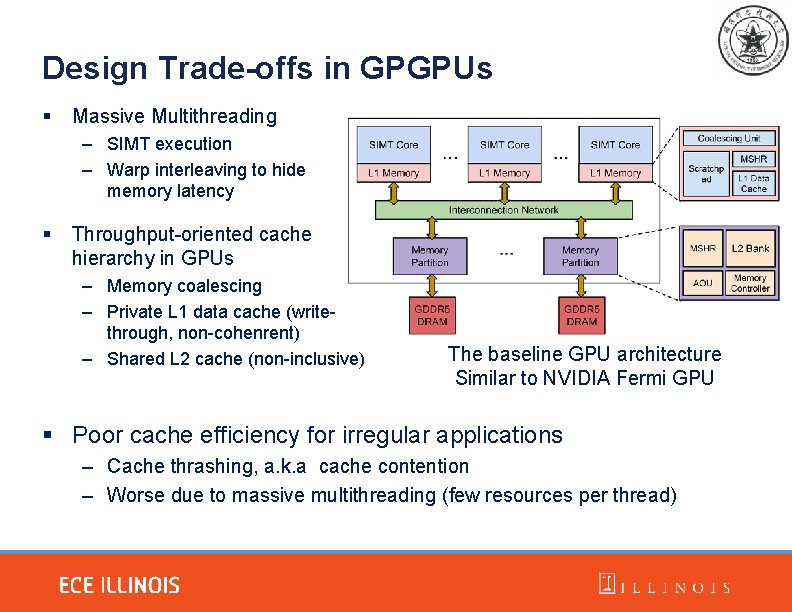
Design Trade-offs in GPGPUs § Massive Multithreading – SIMT execution – Warp interleaving to hide memory latency § Throughput-oriented cache hierarchy in GPUs – Memory coalescing – Private L 1 data cache (writethrough, non-cohenrent) – Shared L 2 cache (non-inclusive) The baseline GPU architecture Similar to NVIDIA Fermi GPU § Poor cache efficiency for irregular applications – Cache thrashing, a. k. a cache contention – Worse due to massive multithreading (few resources per thread)
Benchmarks § § [7] Rodinia [15] Mars [34] CUDA SDK [42] Parboil § HCS (Highly Cache Sensitive) § MCS (Moderately Cache Sensitive) § CI (Cache Insensitive) GPGPU benchmarks Categorized by their cache sensitivity
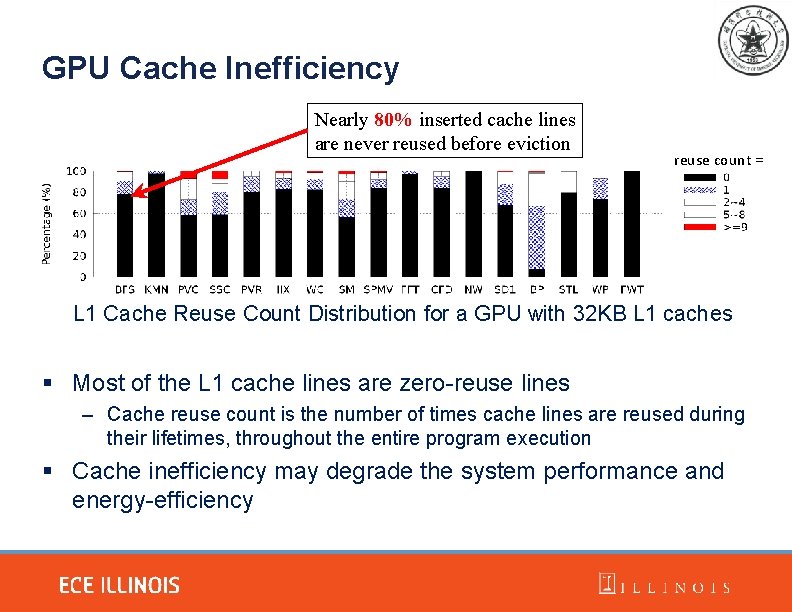
GPU Cache Inefficiency Nearly 80% inserted cache lines are never reused before eviction reuse count = L 1 Cache Reuse Count Distribution for a GPU with 32 KB L 1 caches § Most of the L 1 cache lines are zero-reuse lines – Cache reuse count is the number of times cache lines are reused during their lifetimes, throughout the entire program execution § Cache inefficiency may degrade the system performance and energy-efficiency
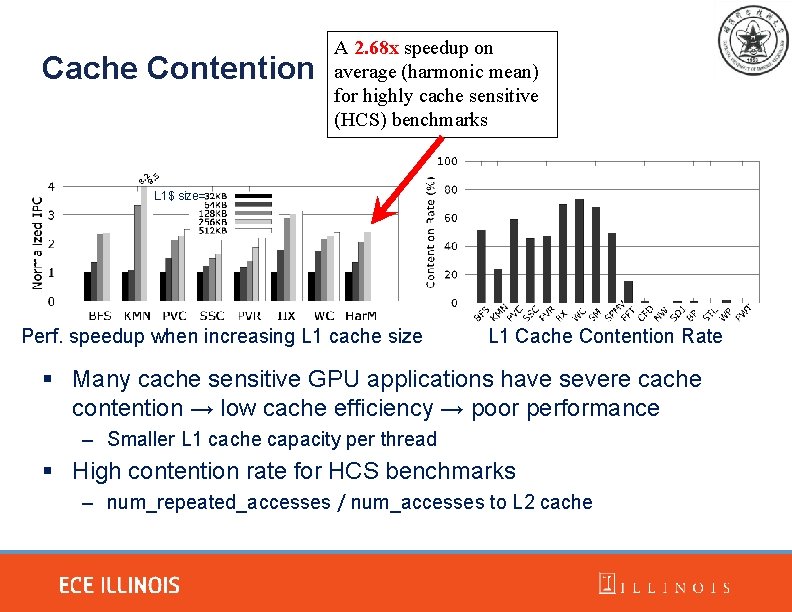
Cache Contention A 2. 68 x speedup on average (harmonic mean) for highly cache sensitive (HCS) benchmarks L 1$ size= Perf. speedup when increasing L 1 cache size L 1 Cache Contention Rate § Many cache sensitive GPU applications have severe cache contention → low cache efficiency → poor performance – Smaller L 1 cache capacity per thread § High contention rate for HCS benchmarks – num_repeated_accesses / num_accesses to L 2 cache
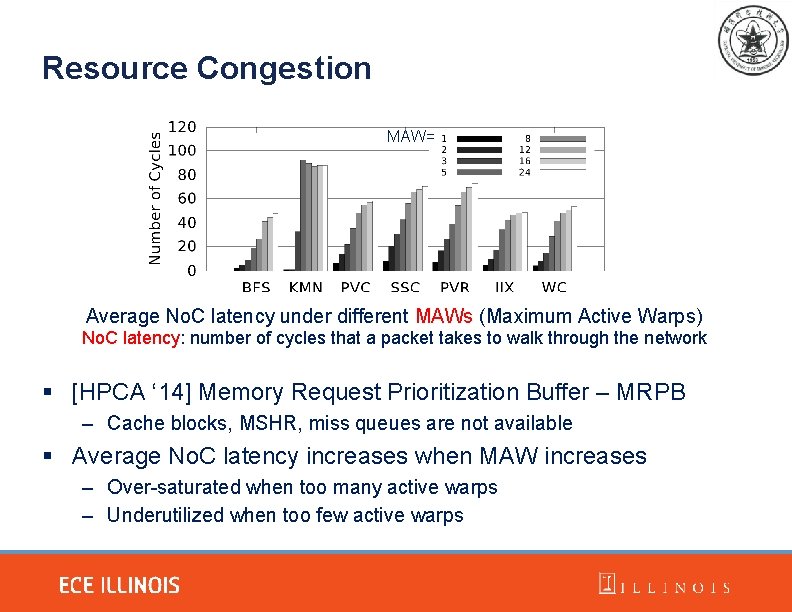
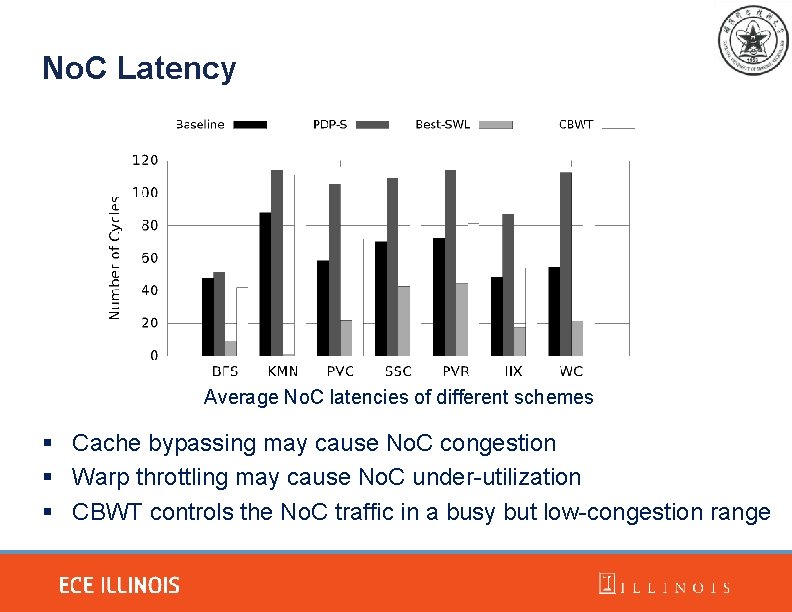
Resource Congestion MAW= Average No. C latency under different MAWs (Maximum Active Warps) No. C latency: number of cycles that a packet takes to walk through the network § [HPCA ‘ 14] Memory Request Prioritization Buffer – MRPB – Cache blocks, MSHR, miss queues are not available § Average No. C latency increases when MAW increases – Over-saturated when too many active warps – Underutilized when too few active warps
Outline § Introduction § Existing Work § CBWT Design § Evaluation § Conclusion
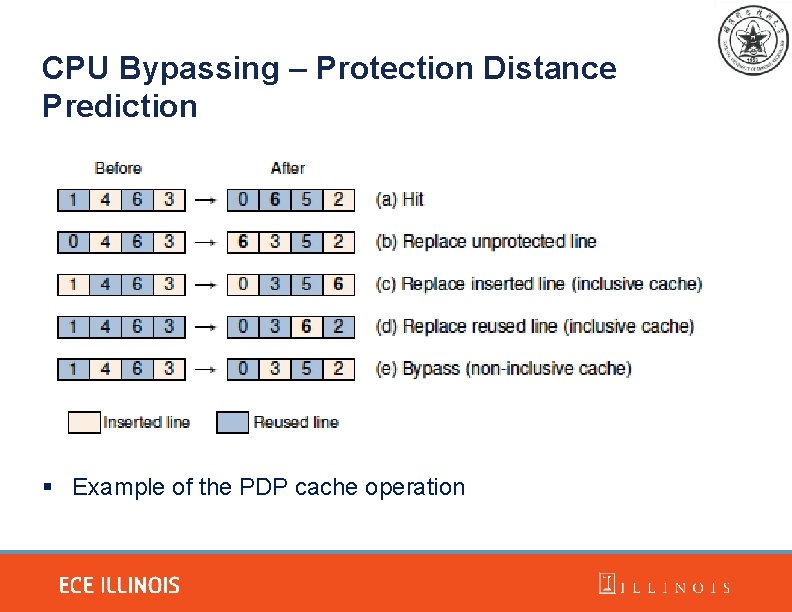
Cache Bypassing The PDP Cache Organization § [MICRO ‘ 12] Protection Distance Prediction (PDP) – – Each cache line is assigned a protection distance (PD) (>0) Decrement PD for each access to the set Bypass an incoming request when no PD=0 line found SPDP-B and Dynamic PDP (PDs are estimated at runtime by sampling)
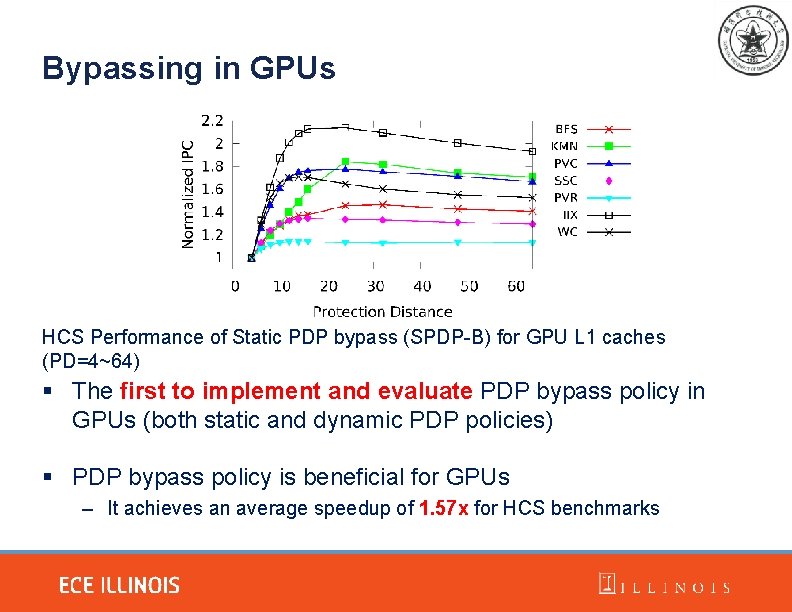
Bypassing in GPUs HCS Performance of Static PDP bypass (SPDP-B) for GPU L 1 caches (PD=4~64) § The first to implement and evaluate PDP bypass policy in GPUs (both static and dynamic PDP policies) § PDP bypass policy is beneficial for GPUs – It achieves an average speedup of 1. 57 x for HCS benchmarks
Warp Throttling § [MICRO’ 12] Cache Conscious Wavefront Scheduling (CCWS) – Aims to alleviate inter-warp cache contention and improve cache hit rate – Basic idea: suspend warps when severe contention is detected – Static and dynamic CCWS (calculates Lost Locality Score at runtime)
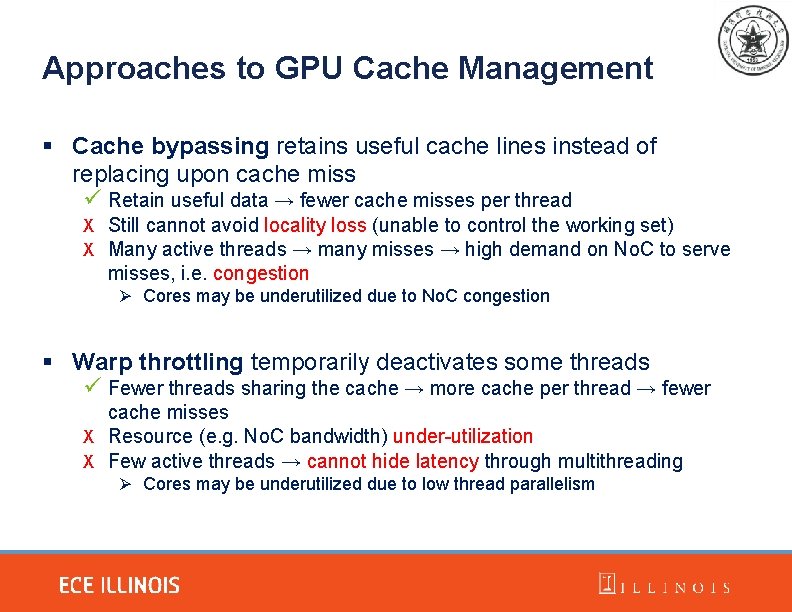
Approaches to GPU Cache Management § Cache bypassing retains useful cache lines instead of replacing upon cache miss ü Retain useful data → fewer cache misses per thread X Still cannot avoid locality loss (unable to control the working set) X Many active threads → many misses → high demand on No. C to serve misses, i. e. congestion Ø Cores may be underutilized due to No. C congestion § Warp throttling temporarily deactivates some threads ü Fewer threads sharing the cache → more cache per thread → fewer cache misses X Resource (e. g. No. C bandwidth) under-utilization X Few active threads → cannot hide latency through multithreading Ø Cores may be underutilized due to low thread parallelism
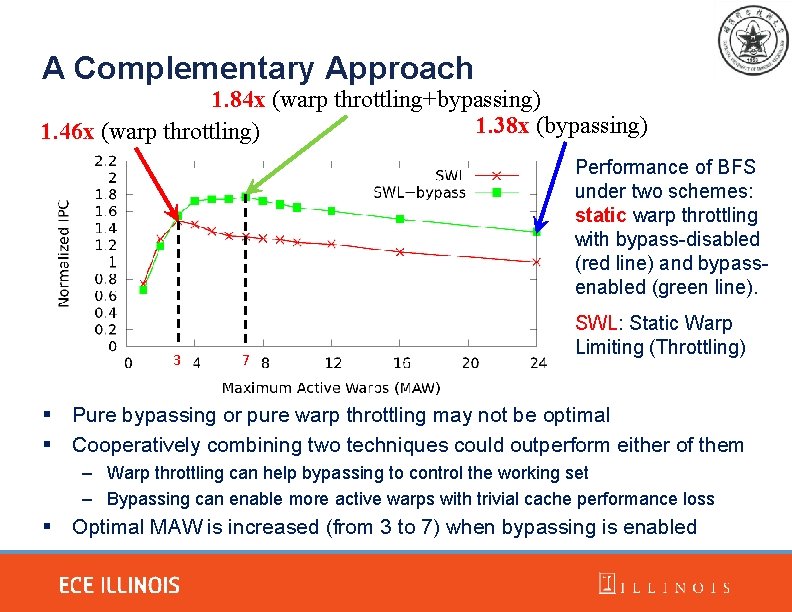
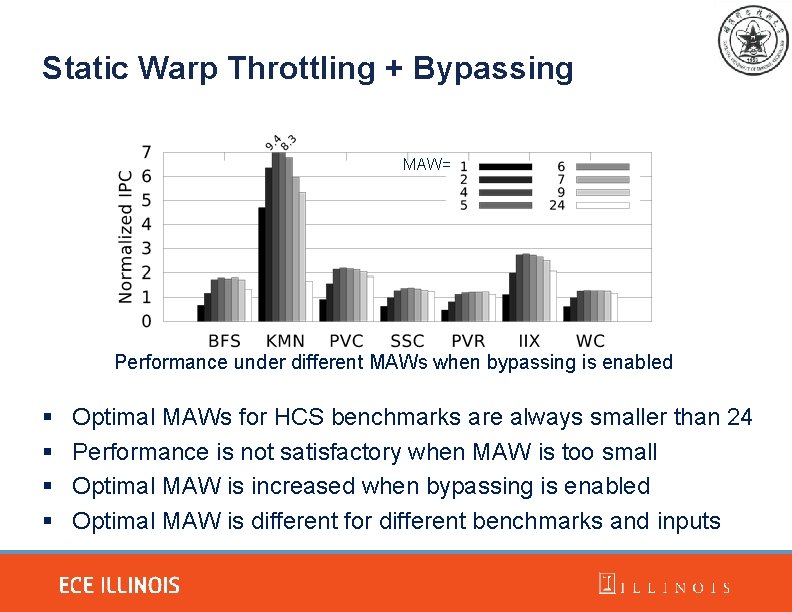
A Complementary Approach 1. 84 x (warp throttling+bypassing) 1. 38 x (bypassing) 1. 46 x (warp throttling) Performance of BFS under two schemes: static warp throttling with bypass-disabled (red line) and bypassenabled (green line). 3 7 SWL: Static Warp Limiting (Throttling) § Pure bypassing or pure warp throttling may not be optimal § Cooperatively combining two techniques could outperform either of them – Warp throttling can help bypassing to control the working set – Bypassing can enable more active warps with trivial cache performance loss § Optimal MAW is increased (from 3 to 7) when bypassing is enabled
Outline § Introduction § Existing Work § CBWT Design § Evaluation § Conclusion
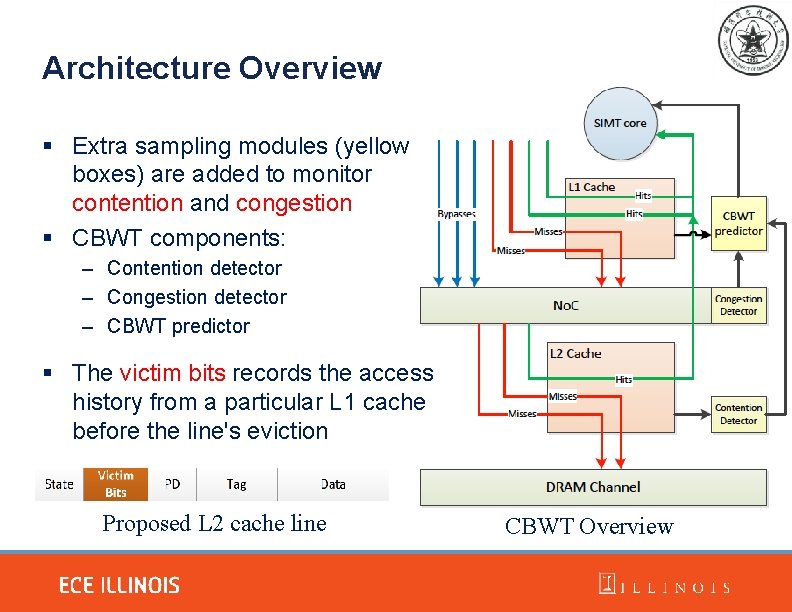
Architecture Overview § Extra sampling modules (yellow boxes) are added to monitor contention and congestion § CBWT components: – Contention detector – Congestion detector – CBWT predictor § The victim bits records the access history from a particular L 1 cache before the line's eviction Proposed L 2 cache line CBWT Overview
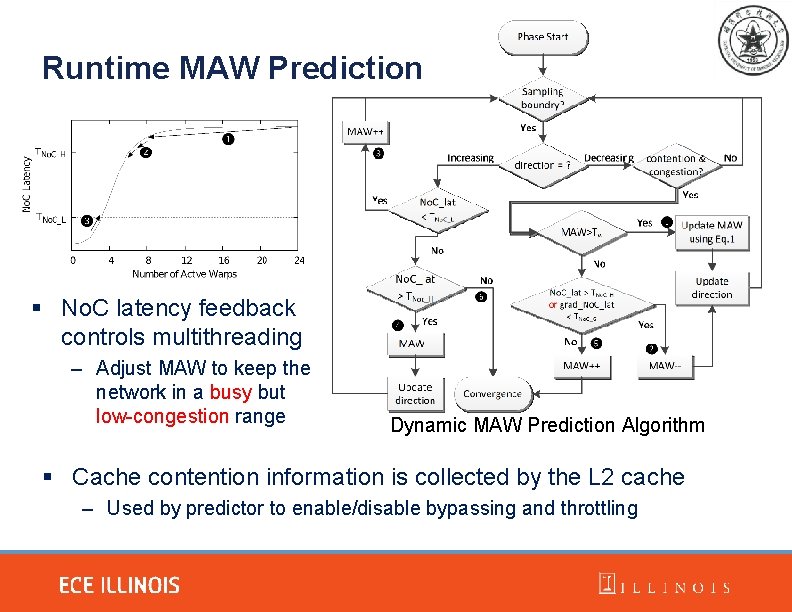
Runtime MAW Prediction § No. C latency feedback controls multithreading – Adjust MAW to keep the network in a busy but low-congestion range Dynamic MAW Prediction Algorithm § Cache contention information is collected by the L 2 cache – Used by predictor to enable/disable bypassing and throttling
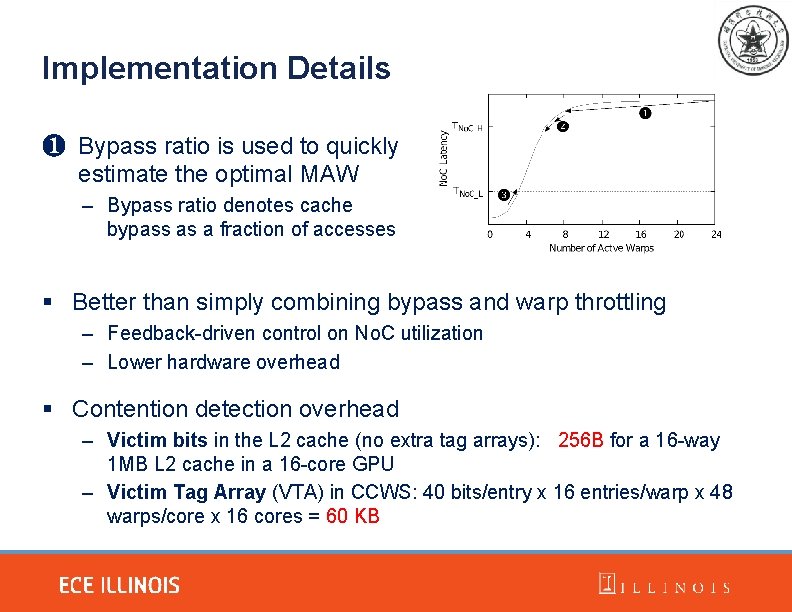
Implementation Details ❶ Bypass ratio is used to quickly estimate the optimal MAW – Bypass ratio denotes cache bypass as a fraction of accesses § Better than simply combining bypass and warp throttling – Feedback-driven control on No. C utilization – Lower hardware overhead § Contention detection overhead – Victim bits in the L 2 cache (no extra tag arrays): 256 B for a 16 -way 1 MB L 2 cache in a 16 -core GPU – Victim Tag Array (VTA) in CCWS: 40 bits/entry x 16 entries/warp x 48 warps/core x 16 cores = 60 KB
Outline § Introduction § Existing Work § CBWT Design § Evaluation § Conclusion
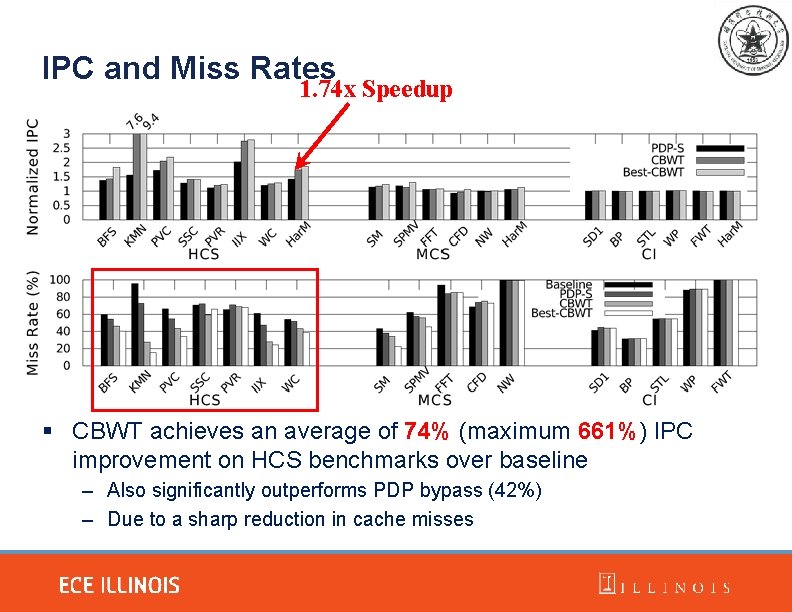
IPC and Miss Rates 1. 74 x Speedup § CBWT achieves an average of 74% (maximum 661%) IPC improvement on HCS benchmarks over baseline – Also significantly outperforms PDP bypass (42%) – Due to a sharp reduction in cache misses
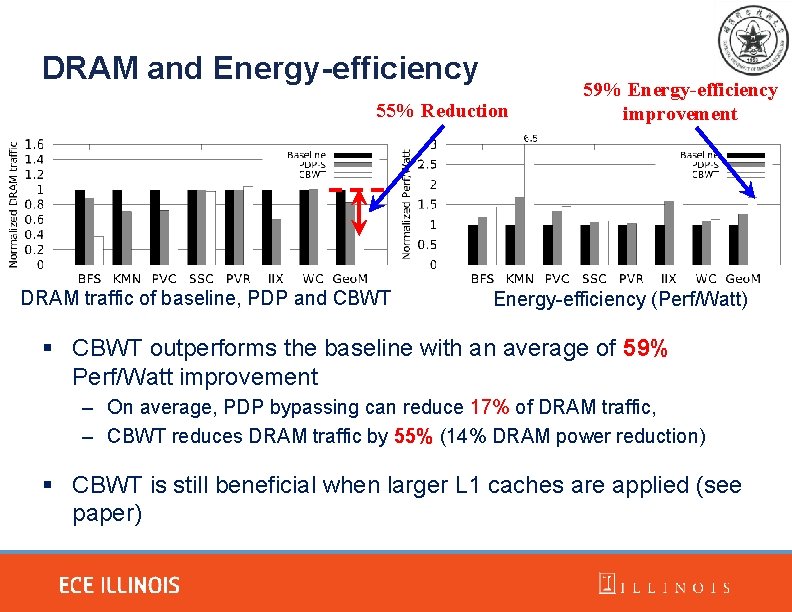
DRAM and Energy-efficiency 55% Reduction DRAM traffic of baseline, PDP and CBWT 59% Energy-efficiency improvement Energy-efficiency (Perf/Watt) § CBWT outperforms the baseline with an average of 59% Perf/Watt improvement – On average, PDP bypassing can reduce 17% of DRAM traffic, – CBWT reduces DRAM traffic by 55% (14% DRAM power reduction) § CBWT is still beneficial when larger L 1 caches are applied (see paper)
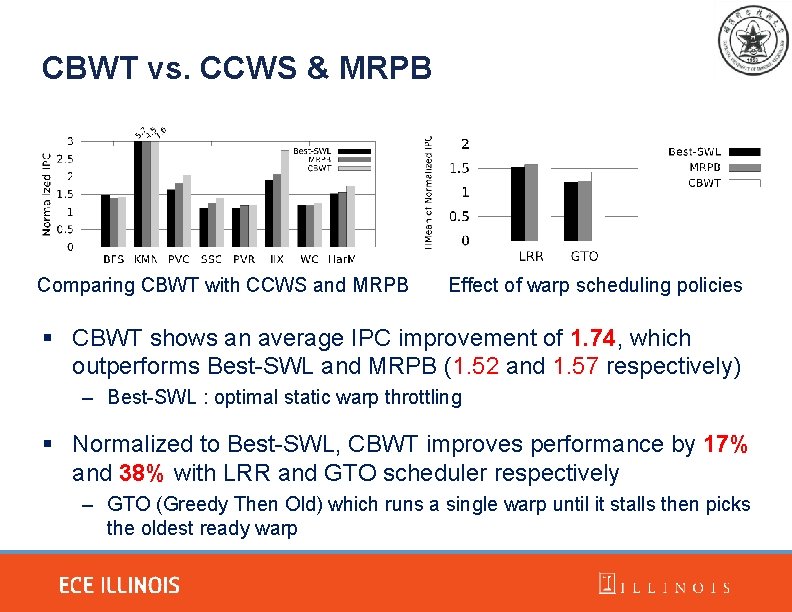
CBWT vs. CCWS & MRPB Comparing CBWT with CCWS and MRPB Effect of warp scheduling policies § CBWT shows an average IPC improvement of 1. 74, which outperforms Best-SWL and MRPB (1. 52 and 1. 57 respectively) – Best-SWL : optimal static warp throttling § Normalized to Best-SWL, CBWT improves performance by 17% and 38% with LRR and GTO scheduler respectively – GTO (Greedy Then Old) which runs a single warp until it stalls then picks the oldest ready warp
Outline § Introduction § Existing Work § CBWT Design § Evaluation § Conclusion
Conclusion This work aims to enable GPGPUs for irregular applications from memory hierarchy’s point of view § Evaluation and analysis on the current GPU cache design and state-of-the-art management schemes – Further understanding memory access behavior of GPU applications – Understanding the limitations of existing approaches § CBWT significantly outperforms existing management schemes in terms of performance and energy efficiency – Demonstrating the benefit of cooperatively combining two techniques § The cost-effective CBWT design is more practical to implement in real hardware – A novel cache contention detection mechanism (leveraging the L 2 cache)
Thanks! Q&A
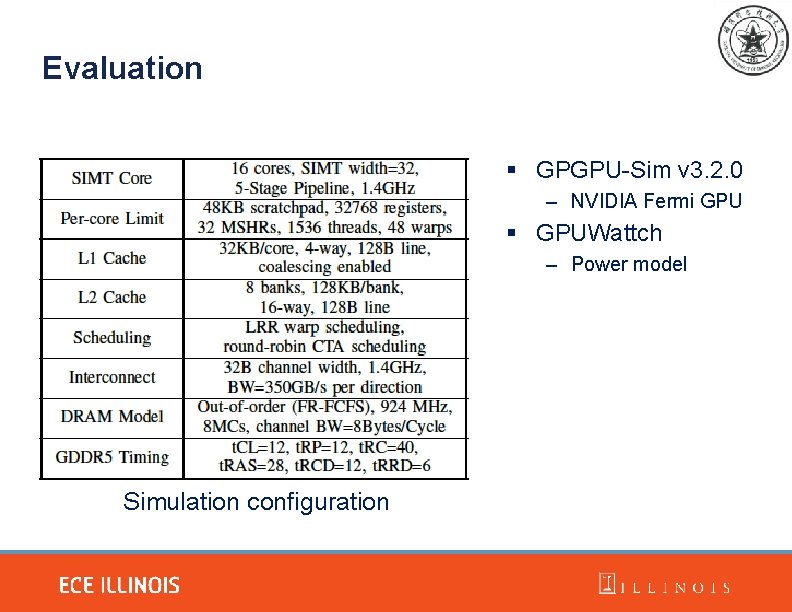
Evaluation § GPGPU-Sim v 3. 2. 0 – NVIDIA Fermi GPU § GPUWattch – Power model Simulation configuration
CPU Bypassing – Protection Distance Prediction § Example of the PDP cache operation
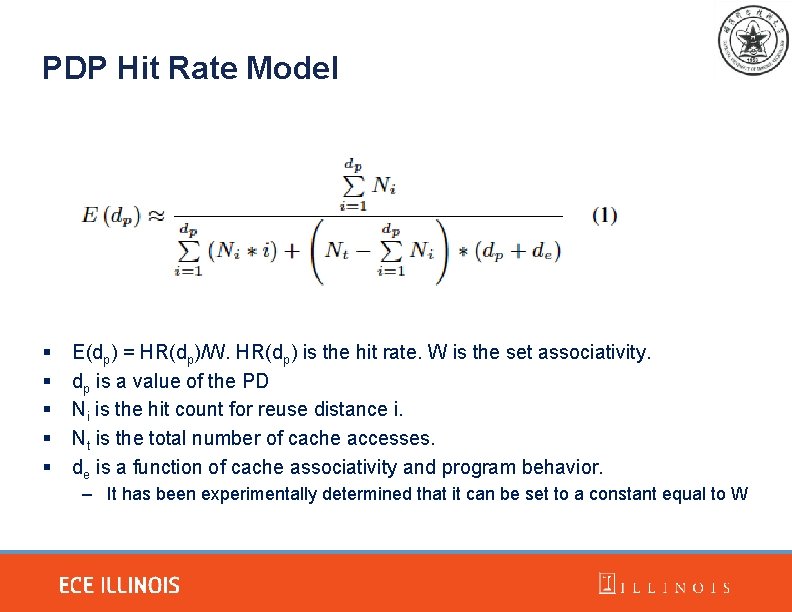
PDP Hit Rate Model § § § E(dp) = HR(dp)/W. HR(dp) is the hit rate. W is the set associativity. dp is a value of the PD Ni is the hit count for reuse distance i. Nt is the total number of cache accesses. de is a function of cache associativity and program behavior. – It has been experimentally determined that it can be set to a constant equal to W
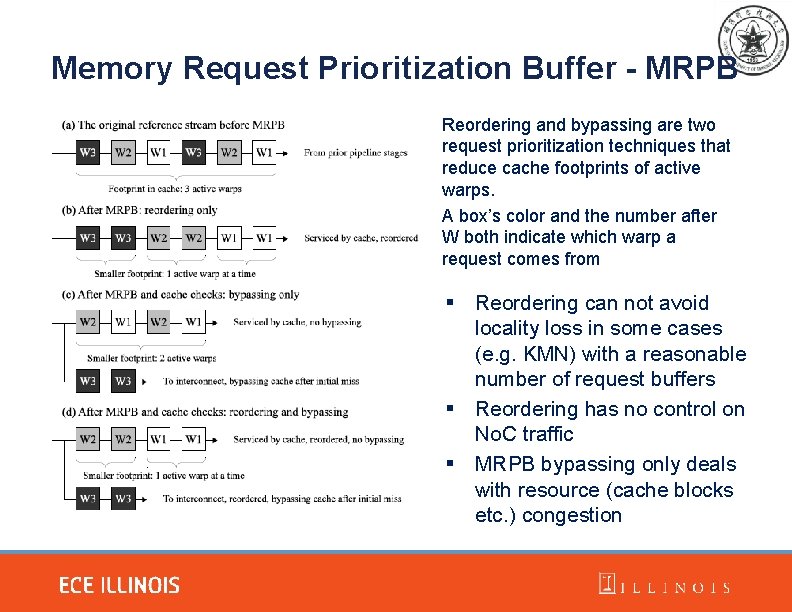
Memory Request Prioritization Buffer - MRPB Reordering and bypassing are two request prioritization techniques that reduce cache footprints of active warps. A box’s color and the number after W both indicate which warp a request comes from § Reordering can not avoid locality loss in some cases (e. g. KMN) with a reasonable number of request buffers § Reordering has no control on No. C traffic § MRPB bypassing only deals with resource (cache blocks etc. ) congestion
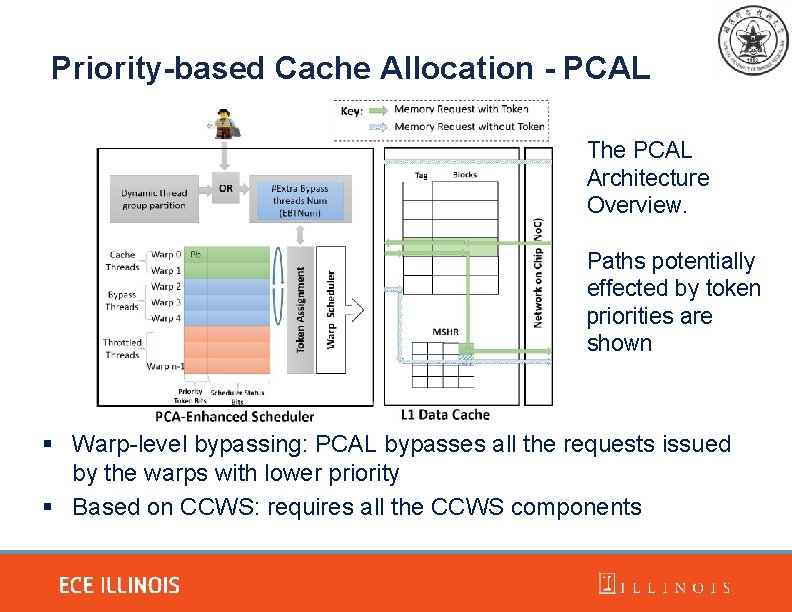
Priority-based Cache Allocation - PCAL The PCAL Architecture Overview. Paths potentially effected by token priorities are shown § Warp-level bypassing: PCAL bypasses all the requests issued by the warps with lower priority § Based on CCWS: requires all the CCWS components
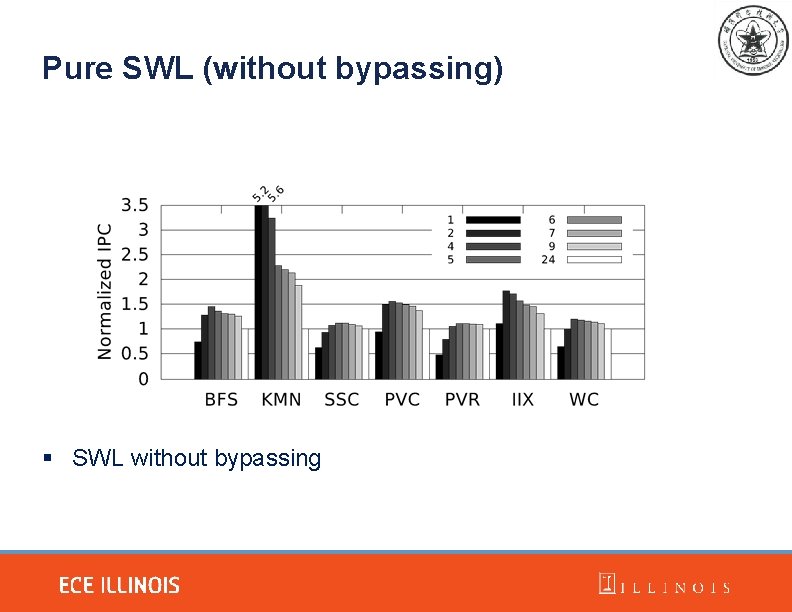
Pure SWL (without bypassing) § SWL without bypassing
No. C Latency Average No. C latencies of different schemes § Cache bypassing may cause No. C congestion § Warp throttling may cause No. C under-utilization § CBWT controls the No. C traffic in a busy but low-congestion range
Static Warp Throttling + Bypassing MAW= Performance under different MAWs when bypassing is enabled § § Optimal MAWs for HCS benchmarks are always smaller than 24 Performance is not satisfactory when MAW is too small Optimal MAW is increased when bypassing is enabled Optimal MAW is different for different benchmarks and inputs
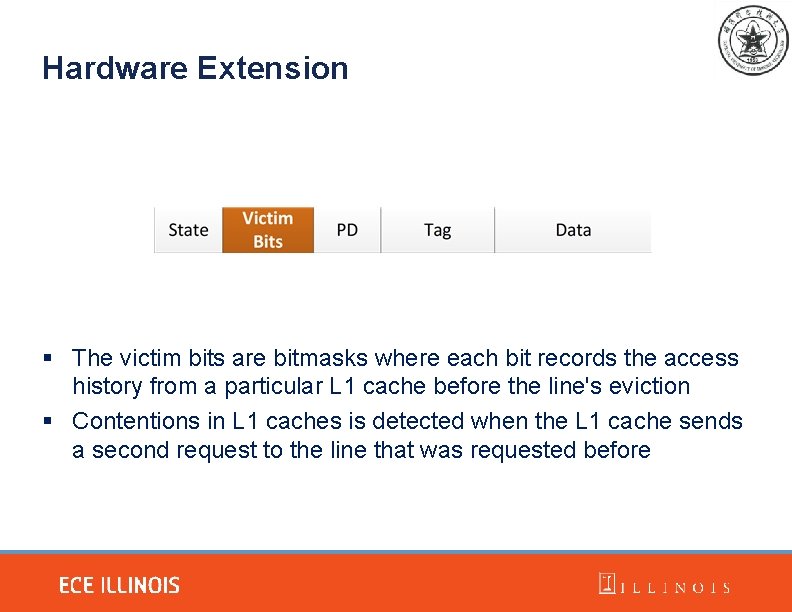
Hardware Extension § The victim bits are bitmasks where each bit records the access history from a particular L 1 cache before the line's eviction § Contentions in L 1 caches is detected when the L 1 cache sends a second request to the line that was requested before
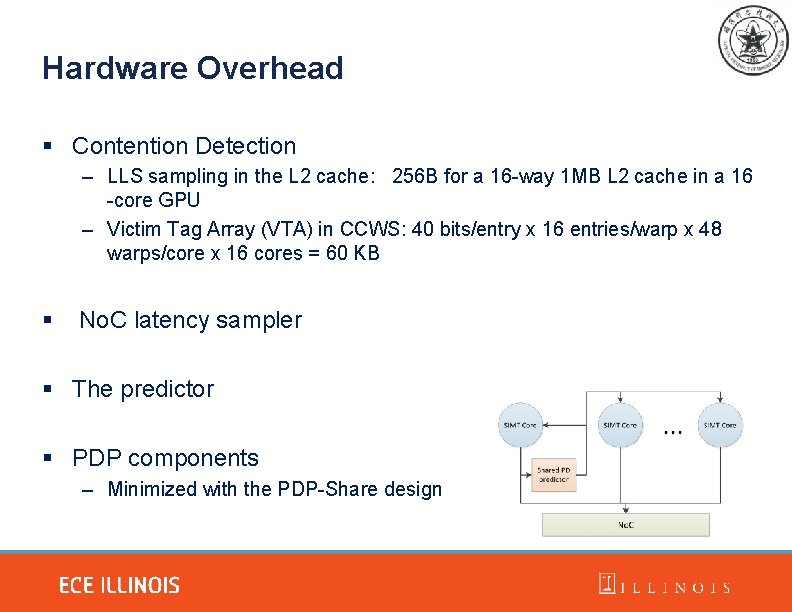
Hardware Overhead § Contention Detection – LLS sampling in the L 2 cache: 256 B for a 16 -way 1 MB L 2 cache in a 16 -core GPU – Victim Tag Array (VTA) in CCWS: 40 bits/entry x 16 entries/warp x 48 warps/core x 16 cores = 60 KB § No. C latency sampler § The predictor § PDP components – Minimized with the PDP-Share design
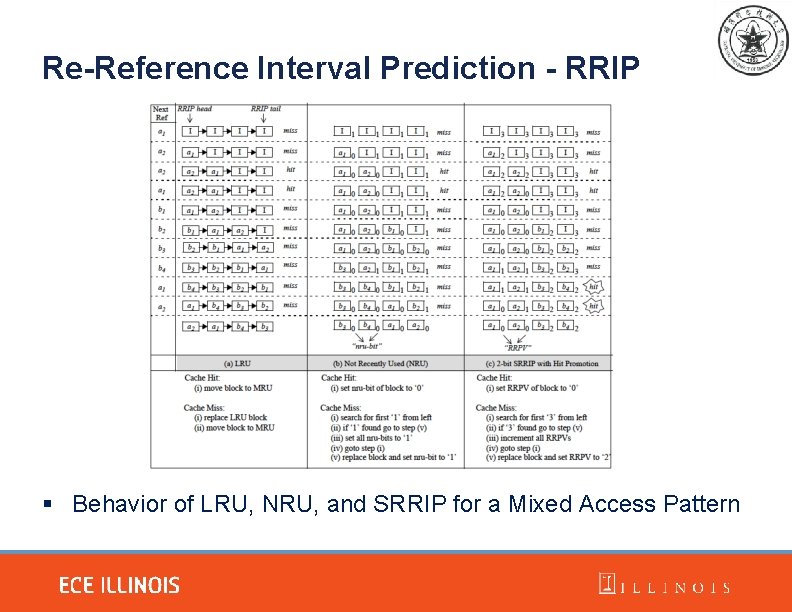
Re-Reference Interval Prediction - RRIP § Behavior of LRU, NRU, and SRRIP for a Mixed Access Pattern