
Adapting Using Progressions of Learning Mathematics K5 Pathway






![ADAPTING: USING PROGRESSIONS OF LEARNING (GRADES K– 5) Adapting Assessment Approach Prerequisite Skills [STANDARDS]](https://slidetodoc.com/presentation_image/65cf73736ebce8950b7c6ab6c0a28368/image-40.jpg "ADAPTING: USING PROGRESSIONS OF LEARNING (GRADES K– 5) Adapting Assessment Approach Prerequisite Skills [STANDARDS]")

- Slides: 47
Adapting: Using Progressions of Learning Mathematics K-5 | Pathway 2 | Day 2 1
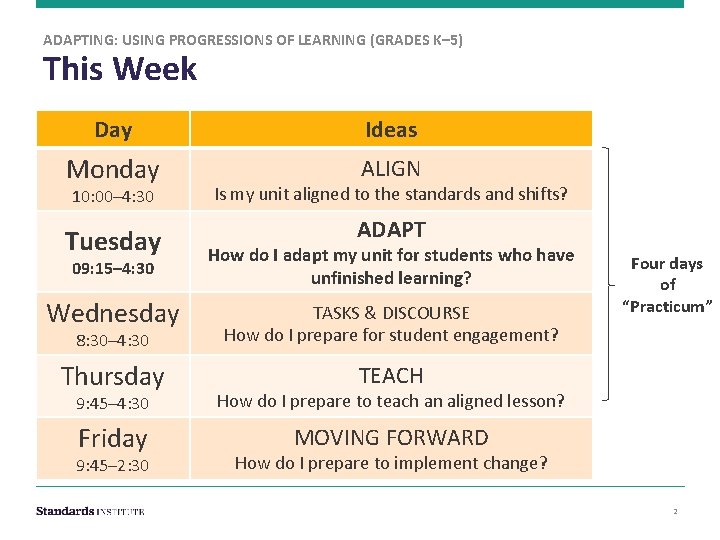
ADAPTING: USING PROGRESSIONS OF LEARNING (GRADES K– 5) This Week Day Ideas Monday ALIGN 10: 00– 4: 30 Tuesday 09: 15– 4: 30 Is my unit aligned to the standards and shifts? ADAPT How do I adapt my unit for students who have unfinished learning? Wednesday 8: 30– 4: 30 TASKS & DISCOURSE How do I prepare for student engagement? Thursday TEACH 9: 45– 4: 30 How do I prepare to teach an aligned lesson? Friday MOVING FORWARD 9: 45– 2: 30 Four days of “Practicum” How do I prepare to implement change? 2
ADAPTING: USING PROGRESSIONS OF LEARNING (GRADES K– 5) Thank You For Your Feedback + 3
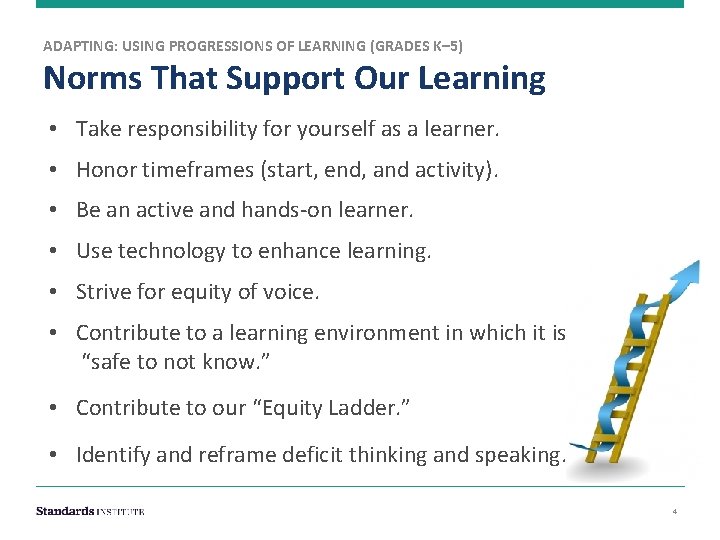
ADAPTING: USING PROGRESSIONS OF LEARNING (GRADES K– 5) Norms That Support Our Learning • Take responsibility for yourself as a learner. • Honor timeframes (start, end, and activity). • Be an active and hands-on learner. • Use technology to enhance learning. • Strive for equity of voice. • Contribute to a learning environment in which it is “safe to not know. ” • Contribute to our “Equity Ladder. ” • Identify and reframe deficit thinking and speaking. 4
ADAPTING: USING PROGRESSIONS OF LEARNING (GRADES K– 5) Review Yesterday and Icebreaker What did we do? • Alignment! • Use the Content Guides to help us focus on how to improve our materials or find evidence of alignment » Explored the use of Mathematical Learning Routines as a strategy to increase the access to concepts through access to the language in the tasks • List of Commitments (like we need another one, right? !) At your table groups, share: • One example of something on your to-do list and how it got there • One problem you’re still thinking about how to solve regarding alignment 5
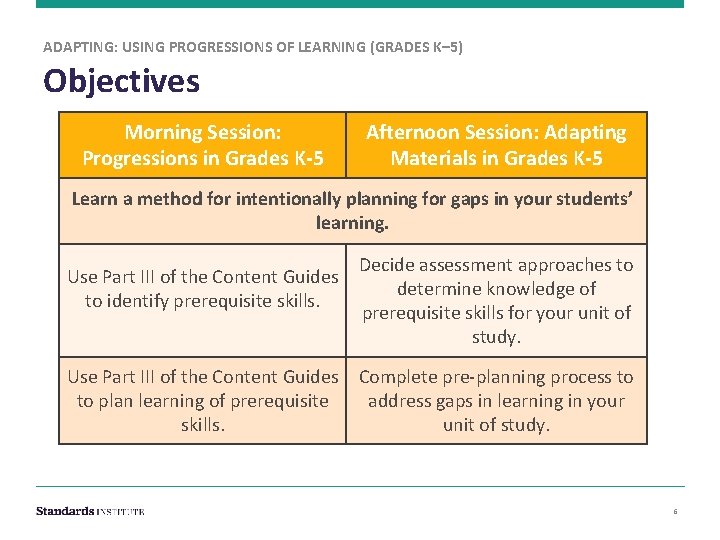
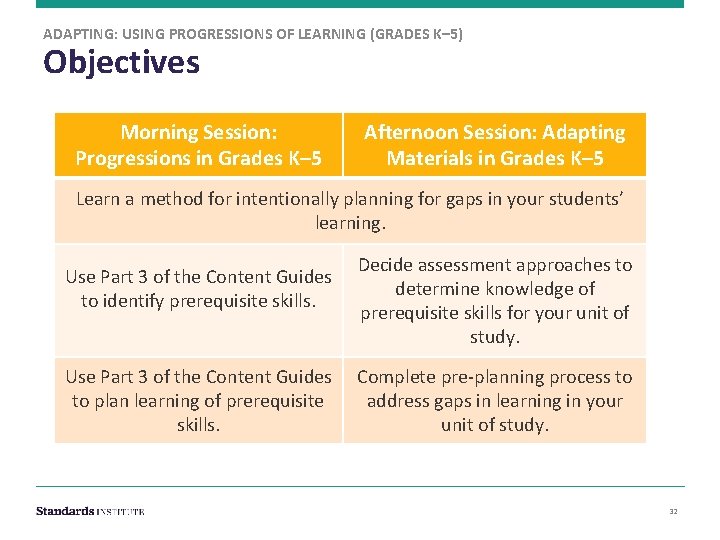
ADAPTING: USING PROGRESSIONS OF LEARNING (GRADES K– 5) Objectives Morning Session: Progressions in Grades K-5 Afternoon Session: Adapting Materials in Grades K-5 Learn a method for intentionally planning for gaps in your students’ learning. Use Part III of the Content Guides to identify prerequisite skills. Decide assessment approaches to determine knowledge of prerequisite skills for your unit of study. Use Part III of the Content Guides Complete pre-planning process to to plan learning of prerequisite address gaps in learning in your skills. unit of study. 6
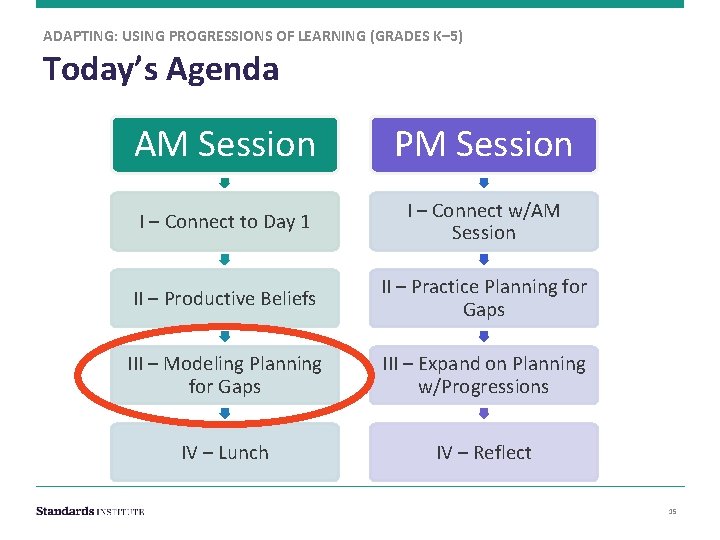
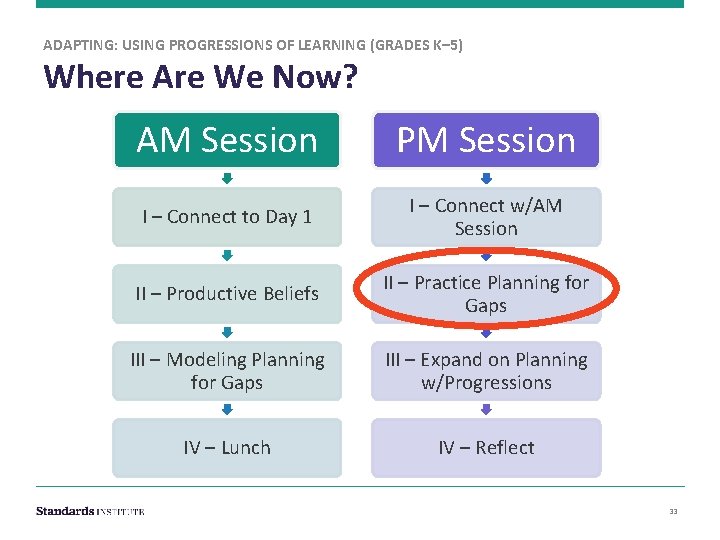
ADAPTING: USING PROGRESSIONS OF LEARNING (GRADES K– 5) Today’s Agenda AM Session PM Session I – Connect to Day 1 I – Connect w/AM Session II – Productive Beliefs II – Practice Planning for Gaps III – Modeling Planning for Gaps III – Expand on Planning w/Progressions IV – Lunch IV – Reflect 7
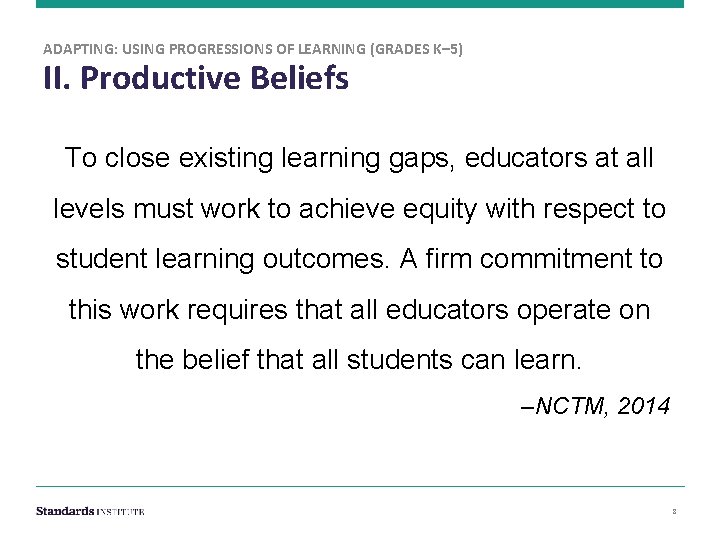
ADAPTING: USING PROGRESSIONS OF LEARNING (GRADES K– 5) II. Productive Beliefs To close existing learning gaps, educators at all levels must work to achieve equity with respect to student learning outcomes. A firm commitment to this work requires that all educators operate on the belief that all students can learn. –NCTM, 2014 8
ADAPTING: USING PROGRESSIONS OF LEARNING (GRADES K– 5) II. Productive Belief Game TRUE FALSE 9
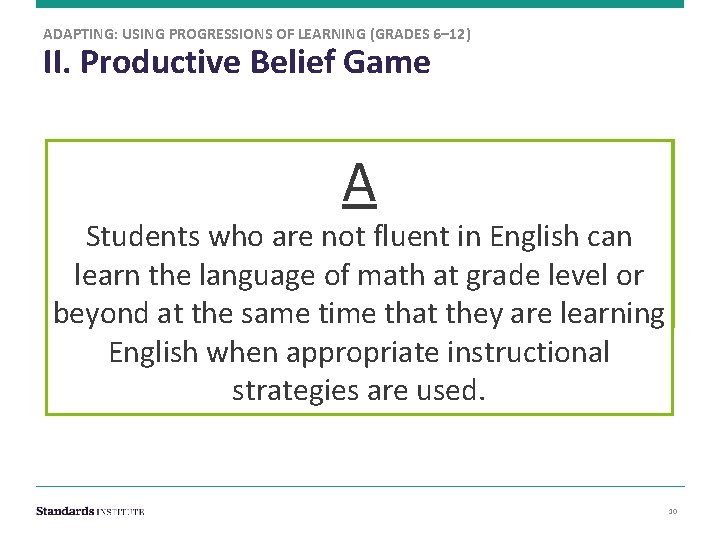
ADAPTING: USING PROGRESSIONS OF LEARNING (GRADES 6– 12) II. Productive Belief Game C D B A Students who are not fluent in the English language Students living in poverty lack the cognitive, Equity — ensuring that all students have access Students who are not fluent in English can are less able to learn mathematics and therefore to high-quality curriculum, instruction, and the emotional, and behavioral characteristics to must be in a separate track for English language participate and achieve in mathematics. supports that they need to be learn the language of math at grade level or learners (ELLs ). successful — applies to all settings. beyond at the same time that they are learning English when appropriate instructional strategies are used. 10
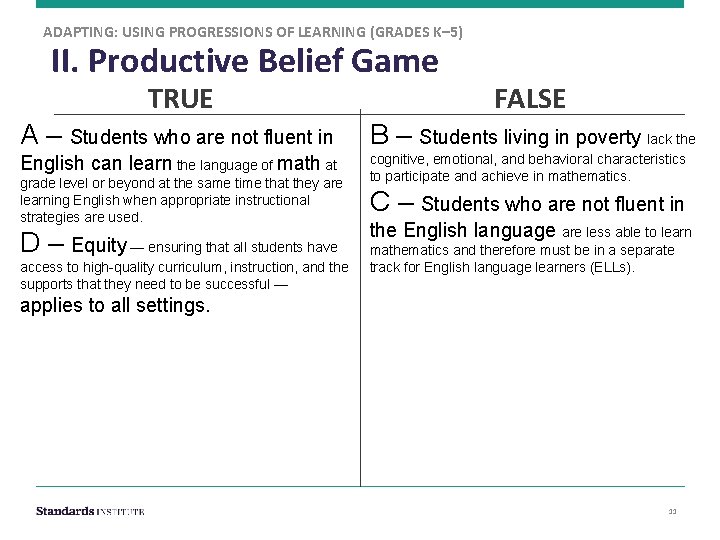
ADAPTING: USING PROGRESSIONS OF LEARNING (GRADES K– 5) II. Productive Belief Game TRUE FALSE A – Students who are not fluent in B – Students living in poverty lack the English can learn the language of math at cognitive, emotional, and behavioral characteristics to participate and achieve in mathematics. grade level or beyond at the same time that they are learning English when appropriate instructional strategies are used. D – Equity — ensuring that all students have access to high-quality curriculum, instruction, and the supports that they need to be successful — C – Students who are not fluent in the English language are less able to learn mathematics and therefore must be in a separate track for English language learners (ELLs). applies to all settings. 11
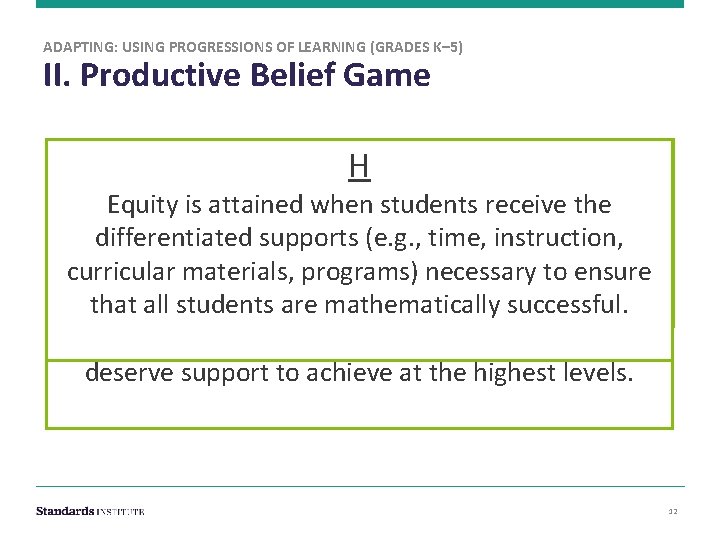
ADAPTING: USING PROGRESSIONS OF LEARNING (GRADES K– 5) II. Productive Belief Game G F H A C E D B Tracking promotes students’ achievement by allowing Mathematics ability is a function of opportunity, Equity is attained when students receive the Students who are not fluent in English can learn the Students who are not fluent in the English language Students possess different innate levels of Students living in poverty lack the cognitive, Equity — ensuring that all students have access students to be placed in “homogeneous” classes and experience, and effort — not of innate intelligence. differentiated supports (e. g. , time, instruction, language of mathematics at grade level or beyond at ability in mathematics, and these cannot be changed are less able to learn mathematics and therefore to high-quality curriculum, instruction, and the emotional, and behavioral characteristics to groups where they can make the greatest learning Mathematics teaching and learning cultivate curricular materials, programs) necessary to ensure the same time that they are learning English when by instruction. Certain groups or individuals have it must be in a separate track for English language participate and achieve in mathematics. supports that they need to be gains. mathematics abilities. All students are capable of that all students are mathematically successful. appropriate instructional strategies are used. while others do not. learners (ELLs ). successful — applies to all settings. participating and achieving in mathematics, and all deserve support to achieve at the highest levels. 12
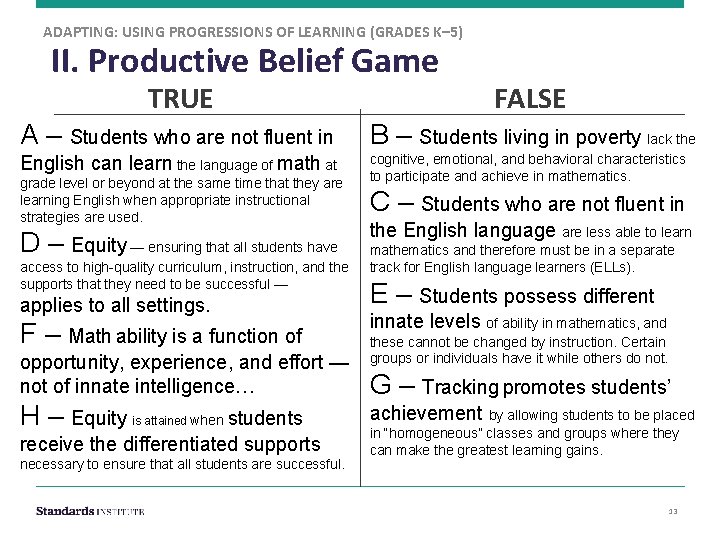
ADAPTING: USING PROGRESSIONS OF LEARNING (GRADES K– 5) II. Productive Belief Game TRUE FALSE A – Students who are not fluent in B – Students living in poverty lack the English can learn the language of math at cognitive, emotional, and behavioral characteristics to participate and achieve in mathematics. grade level or beyond at the same time that they are learning English when appropriate instructional strategies are used. D – Equity — ensuring that all students have access to high-quality curriculum, instruction, and the supports that they need to be successful — applies to all settings. F – Math ability is a function of opportunity, experience, and effort — not of innate intelligence… H – Equity is attained when students receive the differentiated supports necessary to ensure that all students are successful. C – Students who are not fluent in the English language are less able to learn mathematics and therefore must be in a separate track for English language learners (ELLs). E – Students possess different innate levels of ability in mathematics, and these cannot be changed by instruction. Certain groups or individuals have it while others do not. G – Tracking promotes students’ achievement by allowing students to be placed in “homogeneous” classes and groups where they can make the greatest learning gains. 13
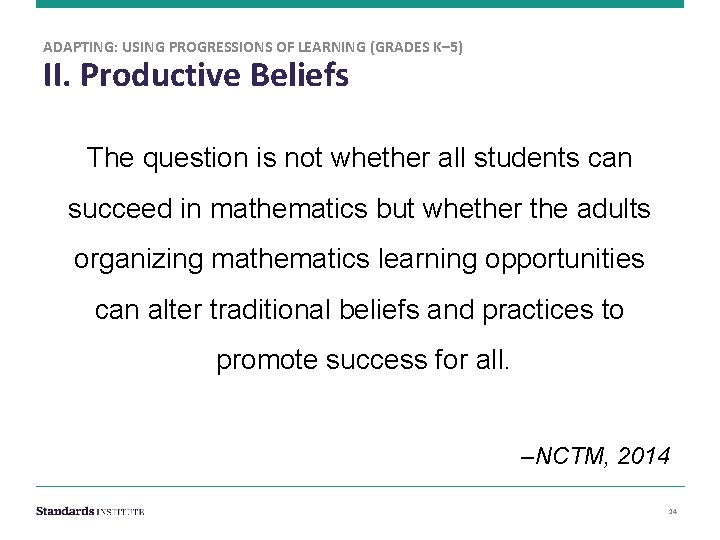
ADAPTING: USING PROGRESSIONS OF LEARNING (GRADES K– 5) II. Productive Beliefs The question is not whether all students can succeed in mathematics but whether the adults organizing mathematics learning opportunities can alter traditional beliefs and practices to promote success for all. –NCTM, 2014 14
ADAPTING: USING PROGRESSIONS OF LEARNING (GRADES K– 5) Today’s Agenda AM Session PM Session I – Connect to Day 1 I – Connect w/AM Session II – Productive Beliefs II – Practice Planning for Gaps III – Modeling Planning for Gaps III – Expand on Planning w/Progressions IV – Lunch IV – Reflect 15
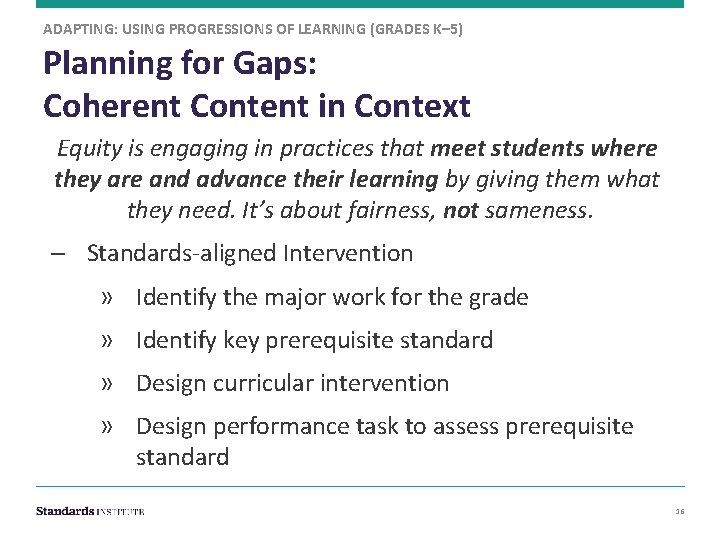
ADAPTING: USING PROGRESSIONS OF LEARNING (GRADES K– 5) Planning for Gaps: Coherent Content in Context Equity is engaging in practices that meet students where they are and advance their learning by giving them what they need. It’s about fairness, not sameness. – Standards-aligned Intervention » Identify the major work for the grade » Identify key prerequisite standard » Design curricular intervention » Design performance task to assess prerequisite standard 16
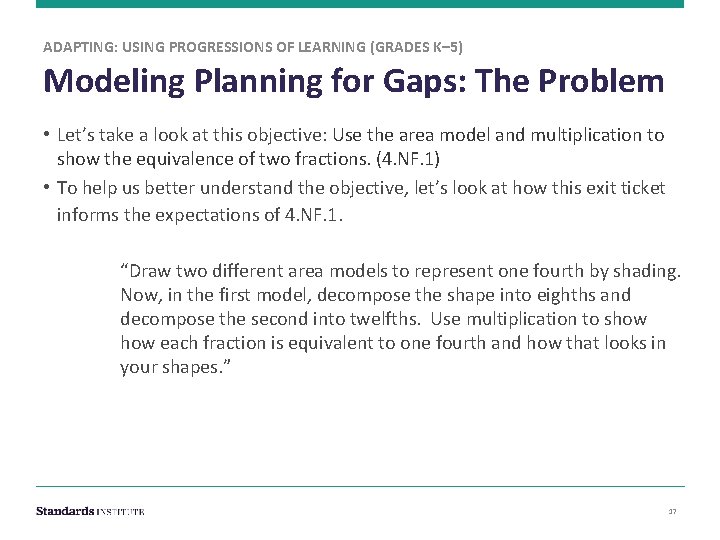
ADAPTING: USING PROGRESSIONS OF LEARNING (GRADES K– 5) Modeling Planning for Gaps: The Problem • Let’s take a look at this objective: Use the area model and multiplication to show the equivalence of two fractions. (4. NF. 1) • To help us better understand the objective, let’s look at how this exit ticket informs the expectations of 4. NF. 1. “Draw two different area models to represent one fourth by shading. Now, in the first model, decompose the shape into eighths and decompose the second into twelfths. Use multiplication to show each fraction is equivalent to one fourth and how that looks in your shapes. ” 17
ADAPTING: USING PROGRESSIONS OF LEARNING (GRADES K– 5) Modeling Planning for Gaps: The Problem • • TURN AND TALK: What are some of the prerequisite standards students need to be successful on the exit ticket? How did you come to know that? Discuss in your group; table leaders will share out big ideas. 18
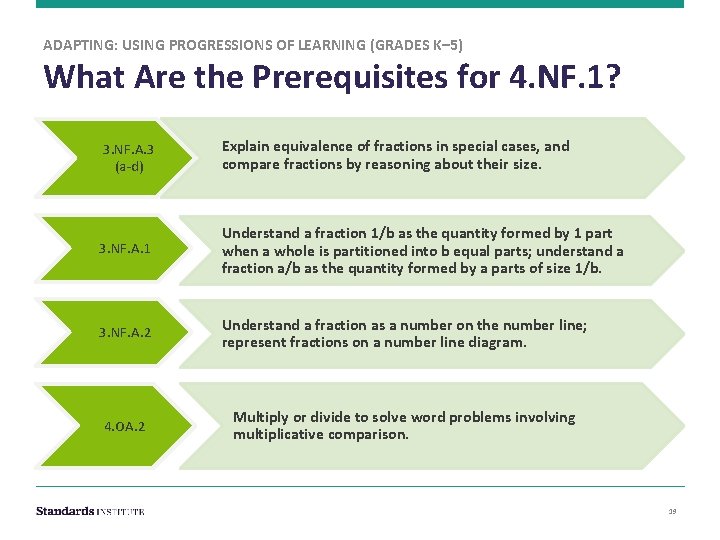
ADAPTING: USING PROGRESSIONS OF LEARNING (GRADES K– 5) What Are the Prerequisites for 4. NF. 1? 3. NF. A. 3 (a-d) Explain equivalence of fractions in special cases, and compare fractions by reasoning about their size. 3. NF. A. 1 Understand a fraction 1/b as the quantity formed by 1 part when a whole is partitioned into b equal parts; understand a fraction a/b as the quantity formed by a parts of size 1/b. 3. NF. A. 2 Understand a fraction as a number on the number line; represent fractions on a number line diagram. 4. OA. 2 Multiply or divide to solve word problems involving multiplicative comparison. 19
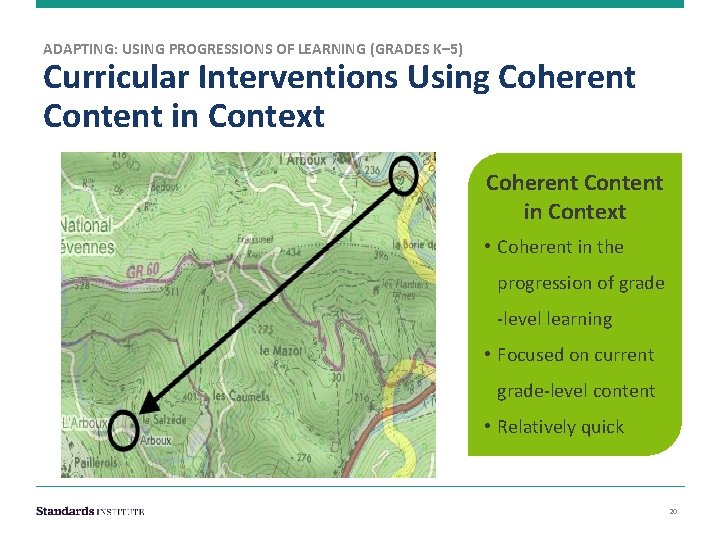
ADAPTING: USING PROGRESSIONS OF LEARNING (GRADES K– 5) Curricular Interventions Using Coherent Content in Context • Coherent in the progression of grade -level learning • Focused on current grade-level content • Relatively quick 20
ADAPTING: USING PROGRESSIONS OF LEARNING (GRADES K– 5) Curricular Interventions Using Coherent Content in Context Okay. Looks like 3. NF. 3 is huge in order for kids to be ready for 4. NF. 1. I look back at ENY for some materials to support my review. Surprise! It’s almost two weeks long! I don’t have time for this, what do I do now? What are some curricular interventions that we could insert to address the gaps? • What are the least invasive interventions? • What are the most invasive interventions? • What are some benefits and drawbacks to each? 21
ADAPTING: USING PROGRESSIONS OF LEARNING (GRADES K– 5) Curricular Interventions Using Coherent Content in Context Okay. Looks like 3. NF. 3 is huge in order for kids to be ready for 4. NF. 1. I look back at ENY for some materials to support my review. Surprise! It’s almost two weeks long! I don’t have time for this, what do I do now? Because I knew students have struggled here in the past, I’m going to choose two lessons to insert, because I can get that done without destroying my year. I’m picking Lessons 22 and 23. And, I’m going to teach them before I get into 4. NF. 1. Take a few minutes and look at Lessons 22 and 23 ENY Grade 3, Module 5: https: //www. engageny. org/resource/grade-3 -mathematics-module-5 -topic-e -lesson-22 TURN & TALK: Do we like this plan? Do these lessons address skill gaps? 22
Modeling Planning for Gaps: Curricular Interventions Using Coherent Content in Context 23
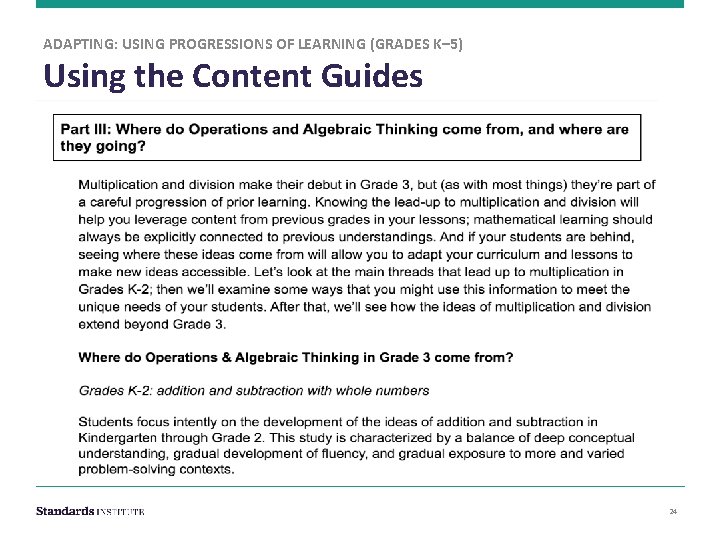
ADAPTING: USING PROGRESSIONS OF LEARNING (GRADES K– 5) Using the Content Guides • words 24
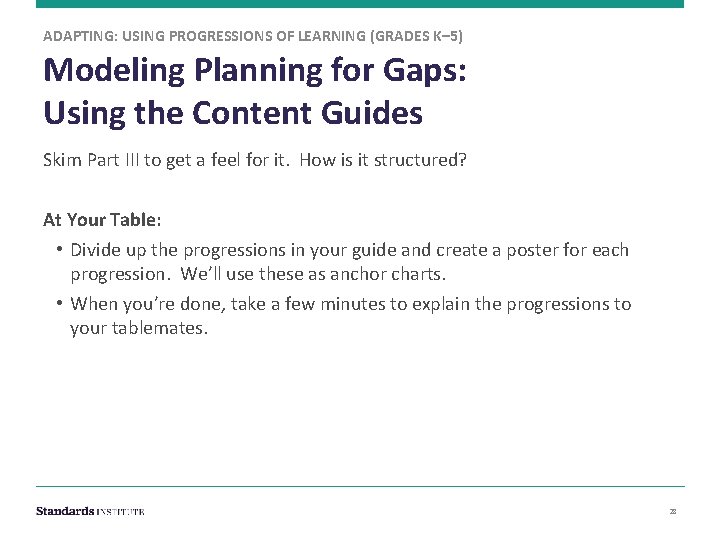
ADAPTING: USING PROGRESSIONS OF LEARNING (GRADES K– 5) Using the Content Guides Skim Part III to get a feel for it. How is it structured? At your table: • Divide up the progressions in your guide and create a poster for each progression. We’ll use these as anchor charts. • When you’re done, take a few minutes to explain the progressions to your tablemates. 25
ADAPTING: USING PROGRESSIONS OF LEARNING (GRADES K– 5) Modeling Planning for Gaps: Using the Content Guides Skim Part III to get a feel for it. How is it structured? At Your Table: • Divide up the progressions in your guide and create a poster for each progression. We’ll use these as anchor charts. • When you’re done, take a few minutes to explain the progressions to your tablemates. 26
Break
ADAPTING: USING PROGRESSIONS OF LEARNING (GRADES K– 5) Modeling Planning for Gaps: Using the Content Guides Skim Part III to get a feel for it. How is it structured? At Your Table: • Divide up the progressions in your guide and create a poster for each progression. We’ll use these as anchor charts. • When you’re done, take a few minutes to explain the progressions to your tablemates. 28
ADAPTING: USING PROGRESSIONS OF LEARNING (GRADES K– 12) Modeling Planning for Gaps: Mapping It All Out How can we plan for this in a focused manner? Assessment Approach Prerequisite Skills Curricular Intervention [TOOL] + [TIME] [STANDARDS] / [KNOWLEDGE] / [SKILLS] [TYPE] + [RESOURCE] 3. NF. A. 3. A: Not able to Give G 3 M 5 L 21 exit slip at identify equivalent end of class Friday before fractions using visual M 5 L 1 fraction models and number lines. ? Teach 2 full lessons on equivalent fractions on the number line using Engage. NY G 3 M 5 L 22 -23 ? 29
Lunch Break!
Welcome Back! 31
ADAPTING: USING PROGRESSIONS OF LEARNING (GRADES K– 5) Objectives Morning Session: Progressions in Grades K– 5 Afternoon Session: Adapting Materials in Grades K– 5 Learn a method for intentionally planning for gaps in your students’ learning. Use Part 3 of the Content Guides to identify prerequisite skills. Use Part 3 of the Content Guides to plan learning of prerequisite skills. Decide assessment approaches to determine knowledge of prerequisite skills for your unit of study. Complete pre-planning process to address gaps in learning in your unit of study. 32
ADAPTING: USING PROGRESSIONS OF LEARNING (GRADES K– 5) Where Are We Now? AM Session PM Session I – Connect to Day 1 I – Connect w/AM Session II – Productive Beliefs II – Practice Planning for Gaps III – Modeling Planning for Gaps III – Expand on Planning w/Progressions IV – Lunch IV – Reflect 33
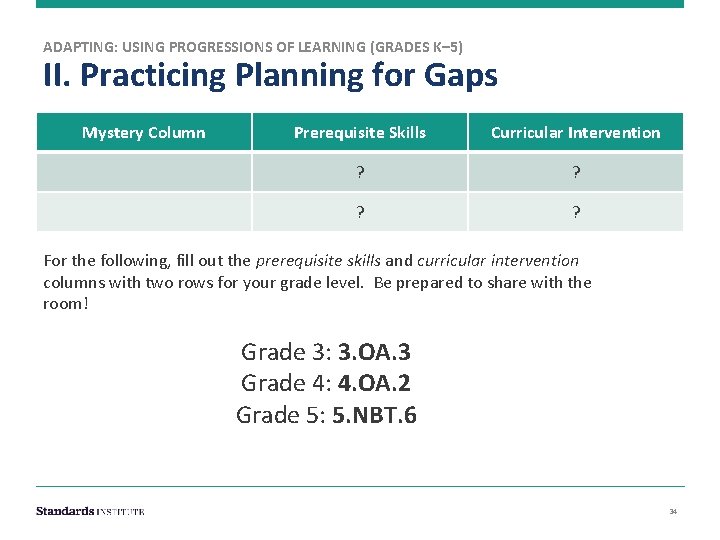
ADAPTING: USING PROGRESSIONS OF LEARNING (GRADES K– 5) II. Practicing Planning for Gaps Mystery Column Prerequisite Skills Curricular Intervention ? ? For the following, fill out the prerequisite skills and curricular intervention columns with two rows for your grade level. Be prepared to share with the room! Grade 3: 3. OA. 3 Grade 4: 4. OA. 2 Grade 5: 5. NBT. 6 34
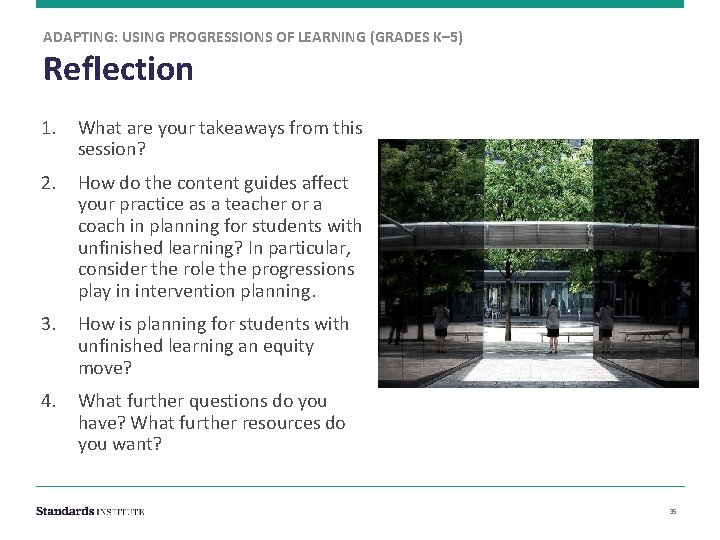
ADAPTING: USING PROGRESSIONS OF LEARNING (GRADES K– 5) Reflection 1. What are your takeaways from this session? 2. How do the content guides affect your practice as a teacher or a coach in planning for students with unfinished learning? In particular, consider the role the progressions play in intervention planning. 3. How is planning for students with unfinished learning an equity move? 4. What further questions do you have? What further resources do you want? 35
Completing the Puzzle… 36
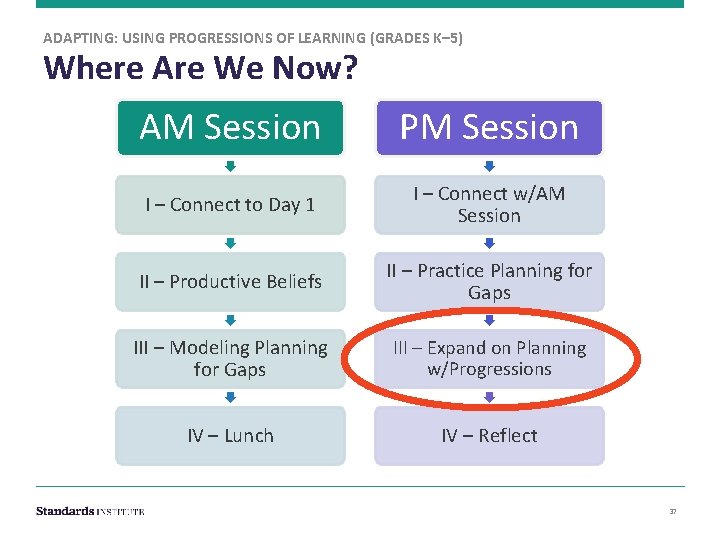
ADAPTING: USING PROGRESSIONS OF LEARNING (GRADES K– 5) Where Are We Now? AM Session PM Session I – Connect to Day 1 I – Connect w/AM Session II – Productive Beliefs II – Practice Planning for Gaps III – Modeling Planning for Gaps III – Expand on Planning w/Progressions IV – Lunch IV – Reflect 37
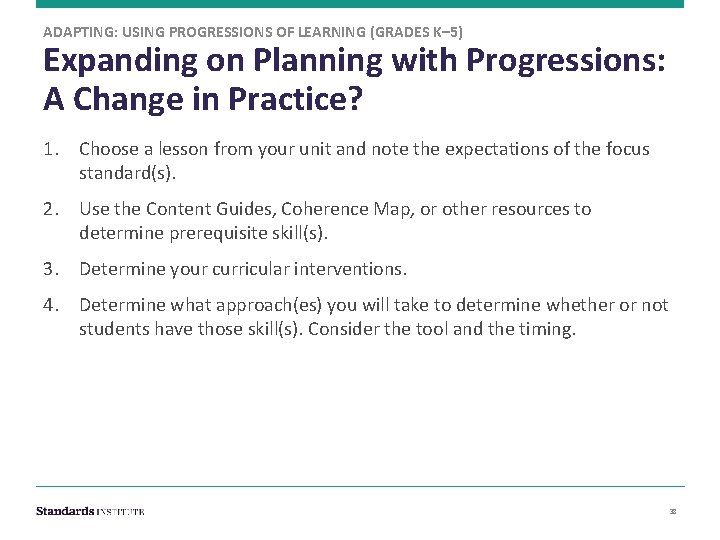
ADAPTING: USING PROGRESSIONS OF LEARNING (GRADES K– 5) Expanding on Planning with Progressions: A Change in Practice? 1. Choose a lesson from your unit and note the expectations of the focus standard(s). 2. Use the Content Guides, Coherence Map, or other resources to determine prerequisite skill(s). 3. Determine your curricular interventions. 4. Determine what approach(es) you will take to determine whether or not students have those skill(s). Consider the tool and the timing. 38
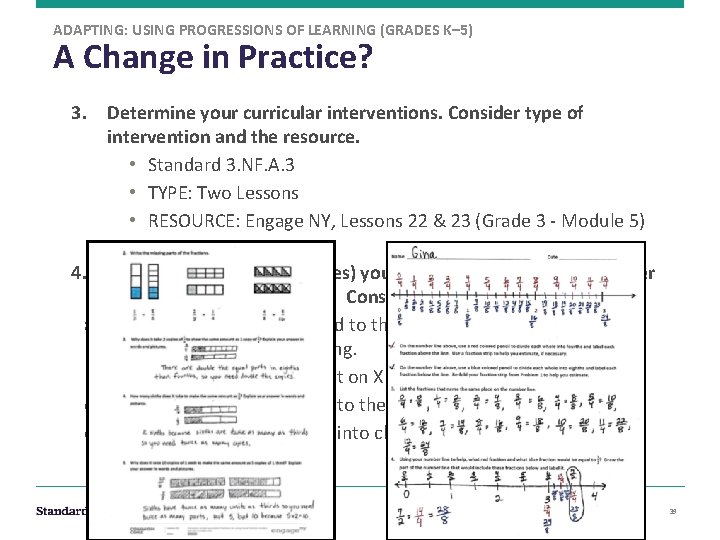
ADAPTING: USING PROGRESSIONS OF LEARNING (GRADES K– 5) A Change in Practice? 3. Determine your curricular interventions. Consider type of intervention and the resource. • Standard 3. NF. A. 3 • TYPE: Two Lessons • RESOURCE: Engage NY, Lessons 22 & 23 (Grade 3 - Module 5) 4. Determine what approach(es) you will take to determine whether students have those skill(s). Consider the tool and the timing. a) Exit ticket from ENY aligned to those standards given one week before, to allow for planning. b) Observation during my unit on X previously in the year. c) Add additional problem(s) to the exit ticket from previous week. d) Add additional problem(s) into classwork a day or two before. 39
ADAPTING: USING PROGRESSIONS OF LEARNING (GRADES K– 5) Adapting Assessment Approach Prerequisite Skills [STANDARDS] / [KNOWLEDGE] / [SKILLS] [TOOL] + [TIME] a) Give G 3 M 5 L 20 exit ticket at end of class Friday before starting Module 4. b) Assessment data from previous year? c) Add additional problem(s) into class work a day or two before. Curricular Intervention [TYPE] + [RESOURCE] 3. NF. 3 – explain equivalent fractions; recognize and generate equivalent fractions using multiple representations Teach 2 full lessons on equivalent fractions on the number line using Engage. NY G 3 M 5 L 22 -23 ? ? 40
ADAPTING: USING PROGRESSIONS OF LEARNING (GRADES K– 12) Where Are We Now? AM Session PM Session I – Connect to Day 1 I – Connect w/AM Session II – Productive Beliefs II – Practice Planning for Gaps III – Modeling Planning for Gaps III – Expand on Planning w/Progressions IV – Lunch IV – Reflect 41
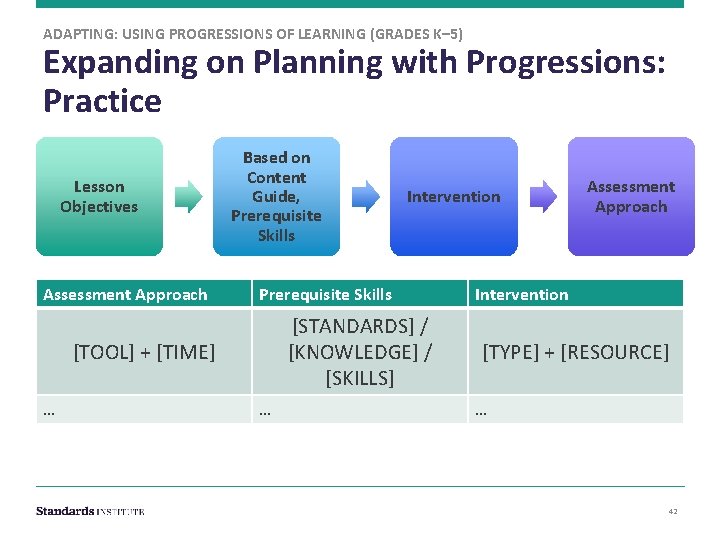
ADAPTING: USING PROGRESSIONS OF LEARNING (GRADES K– 5) Expanding on Planning with Progressions: Practice Lesson Objectives Assessment Approach Based on Content Guide, Prerequisite Skills [STANDARDS] / [KNOWLEDGE] / [SKILLS] [TOOL] + [TIME] … Intervention … Assessment Approach Intervention [TYPE] + [RESOURCE] … 42
ADAPTING: USING PROGRESSIONS OF LEARNING (GRADES K– 5) Where Are We Now? AM Session PM Session I – Connect to Day 1 I – Connect w/AM Session II – Productive Beliefs II – Practice Planning for Gaps III – Modeling Planning for Gaps III – Expand on Planning w/Progressions IV – Lunch IV – Reflect 43
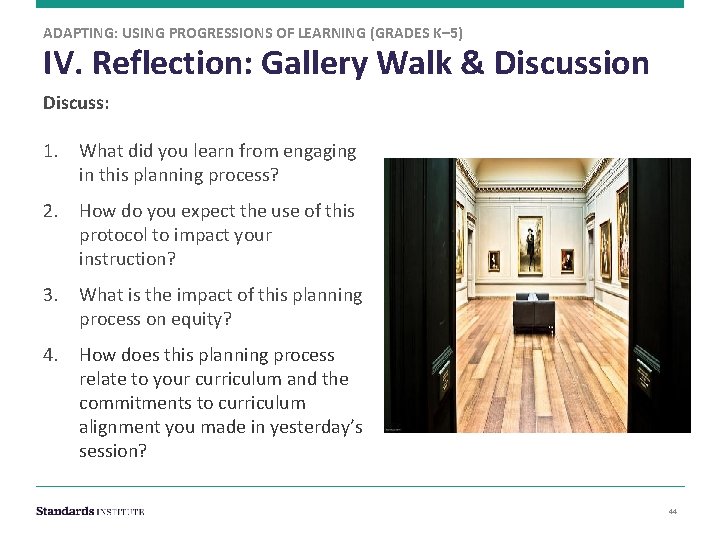
ADAPTING: USING PROGRESSIONS OF LEARNING (GRADES K– 5) IV. Reflection: Gallery Walk & Discussion Discuss: 1. What did you learn from engaging in this planning process? 2. How do you expect the use of this protocol to impact your instruction? 3. What is the impact of this planning process on equity? 4. How does this planning process relate to your curriculum and the commitments to curriculum alignment you made in yesterday’s session? 44
Feedback Please fill out the survey located here: www. standardsinstitutes. org • Click “Winter 2018” on the top of the page. • Click “Details” on the center of the page. 49
Reference List Slide Source 8 Grade 7, Module 2, Lesson 2 (teacher version) from Engage. NY. org of the New York State Education Department is licensed under CC BY-NC-SA 3. 0. 11 Grade 6, Module 3, Lesson 1 (teacher version) and Grade 6, Module 3, Lesson 2 (teacher version) from Engage. NY. org of the New York State Education Department are licensed under CC BY-NC-SA 3. 0. 13 Unbound. Ed Grade 7 Mathematics Guide: https: //www. unbounded. org/content_guides/5 46
Image References Slide Source 16 “Talk” by Matus Laslofi (Flickr) 18 Untitled by Open. Clip. Art. Vectors (Pixabay). 20 “Brain” by dierk Schafer (Flickr) 23 “Aunty’s Almonds” by studio tdes (Flickr) 26 Untitled by Kaboompics (Pixabay). 27 Untitled by Web. Donut (Pixabay) 31 “mirrors” by Chris (Flickr) 32 “The last piece of the puzzle” by Bruce Guenter (Flickr) 40 “Gallery” by Adam (Flickr) 47