
Adapting to the challenges of demographic change Richard

- Slides: 17
Adapting to the challenges of demographic change Richard Marshall FIA 15 October 2018 willistowerswatson. com © 2018 Willis Towers Watson. All rights reserved.
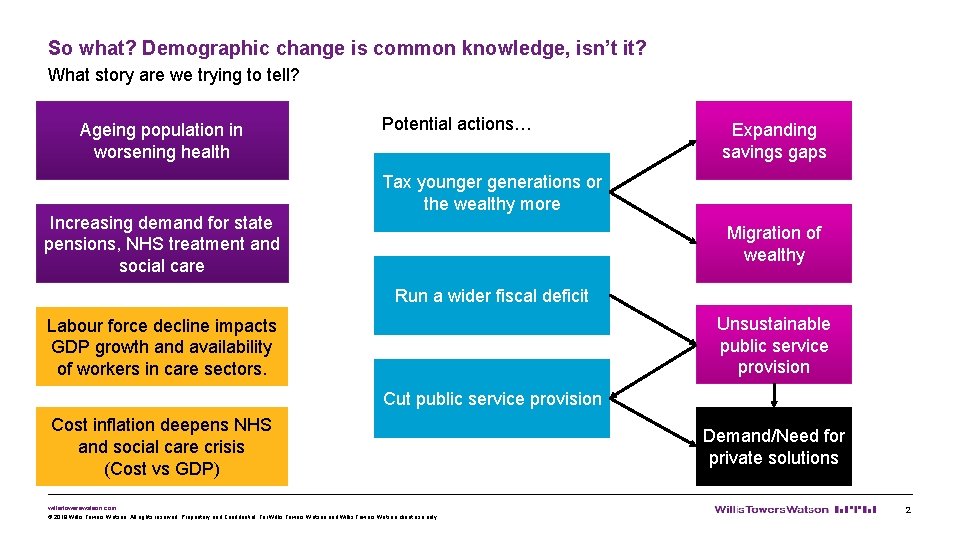
So what? Demographic change is common knowledge, isn’t it? What story are we trying to tell? Ageing population in worsening health Increasing demand for state pensions, NHS treatment and social care Potential actions… Expanding savings gaps Tax younger generations or the wealthy more Migration of wealthy Run a wider fiscal deficit Unsustainable public service provision Labour force decline impacts GDP growth and availability of workers in care sectors. Cut public service provision Cost inflation deepens NHS and social care crisis (Cost vs GDP) willistowerswatson. com © 2018 Willis Towers Watson. All rights reserved. Proprietary and Confidential. For Willis Towers Watson and Willis Towers Watson client use only. Demand/Need for private solutions 2
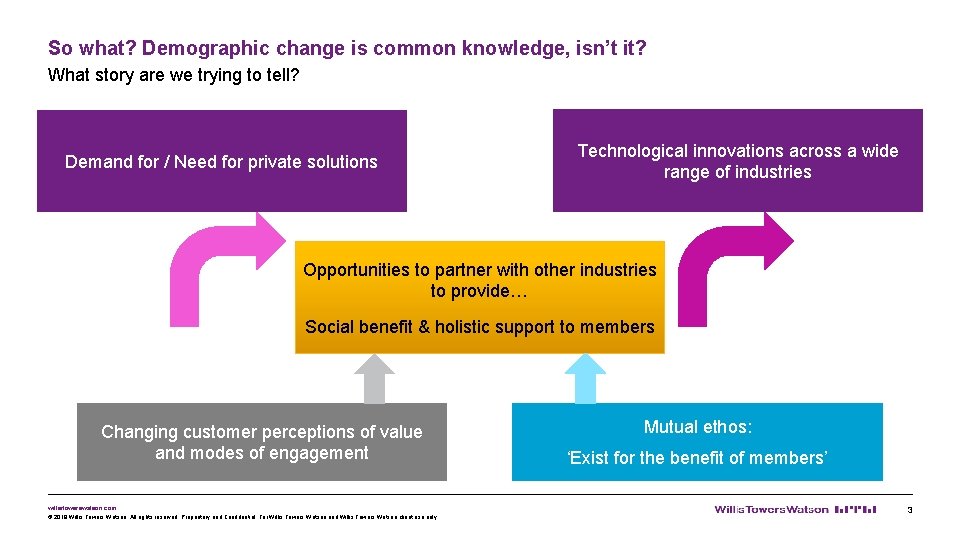
So what? Demographic change is common knowledge, isn’t it? What story are we trying to tell? Demand for / Need for private solutions Technological innovations across a wide range of industries Opportunities to partner with other industries to provide… Social benefit & holistic support to members Changing customer perceptions of value and modes of engagement willistowerswatson. com © 2018 Willis Towers Watson. All rights reserved. Proprietary and Confidential. For Willis Towers Watson and Willis Towers Watson client use only. Mutual ethos: ‘Exist for the benefit of members’ 3
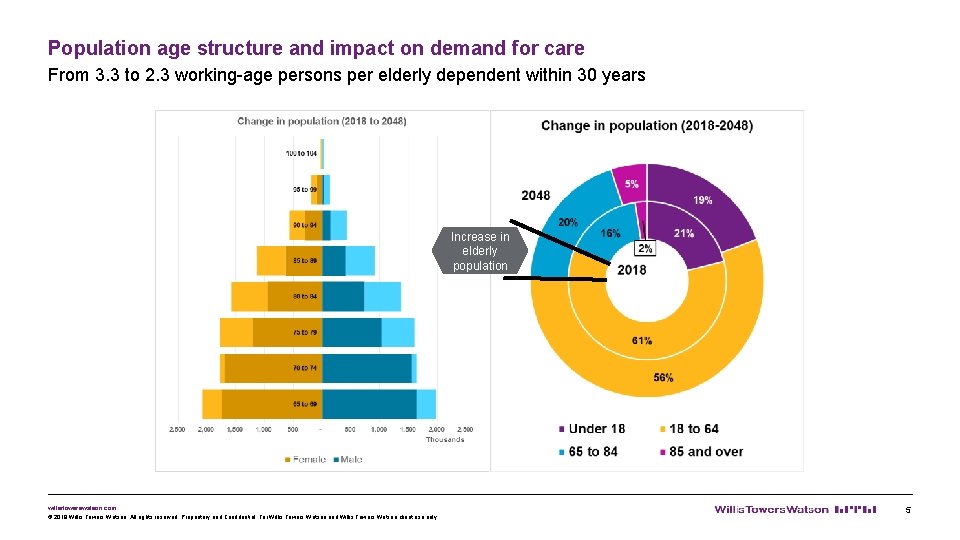
Population age structure and impact on demand for care From 3. 3 to 2. 3 working-age persons per elderly dependent within 30 years Increase in elderly population willistowerswatson. com © 2018 Willis Towers Watson. All rights reserved. Proprietary and Confidential. For Willis Towers Watson and Willis Towers Watson client use only. 5
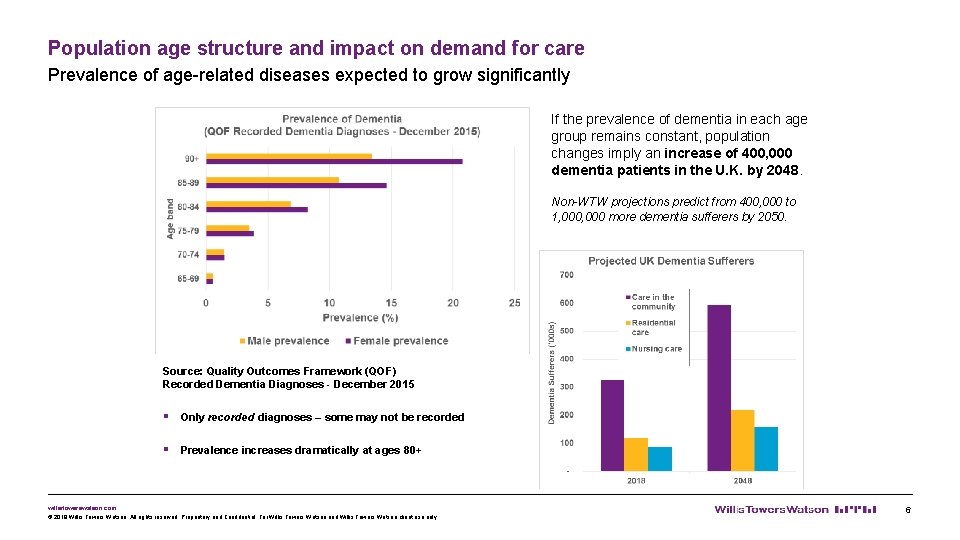
Population age structure and impact on demand for care Prevalence of age-related diseases expected to grow significantly If the prevalence of dementia in each age group remains constant, population changes imply an increase of 400, 000 dementia patients in the U. K. by 2048. Non-WTW projections predict from 400, 000 to 1, 000 more dementia sufferers by 2050. Source: Quality Outcomes Framework (QOF) Recorded Dementia Diagnoses - December 2015 § Only recorded diagnoses – some may not be recorded § Prevalence increases dramatically at ages 80+ willistowerswatson. com © 2018 Willis Towers Watson. All rights reserved. Proprietary and Confidential. For Willis Towers Watson and Willis Towers Watson client use only. 6
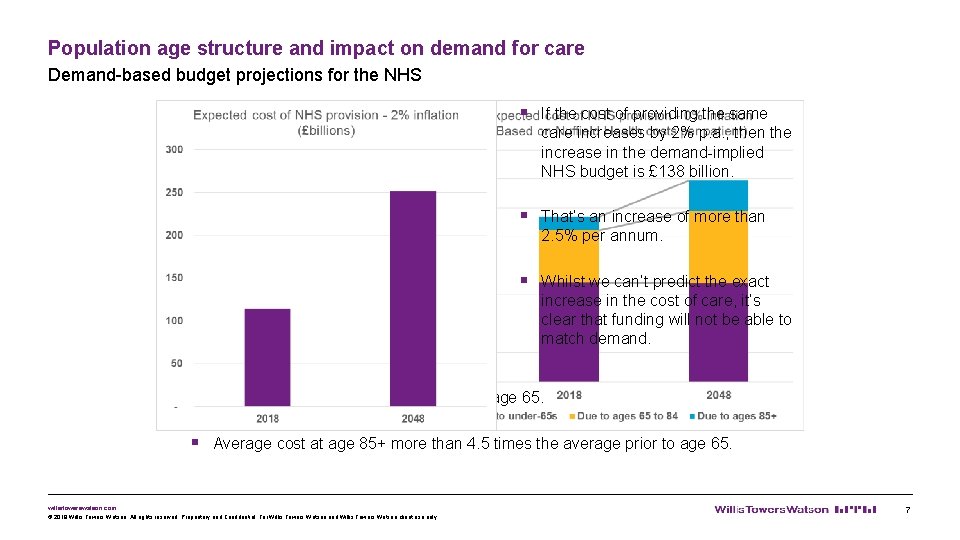
Population age structure and impact on demand for care Demand-based budget projections for the NHS § Assuming no inflation of cost per patient over the period 2018 -2048: § Annual cost of demand for NHS care increases by £ 25 billion. § This increase is entirely due to the increase in the population aged over 65 – a 55% increase in costs for this group. Male Female § If the cost of providing the same care increases by 2% p. a. , then the increase in the demand-implied NHS budget is £ 138 billion. § That’s an increase of more than 2. 5% per annum. § Whilst we can’t predict the exact increase in the cost of care, it’s clear that funding will not be able to match demand. § Rapid increase in cost per patient after age 65. § Average cost at age 85+ more than 4. 5 times the average prior to age 65. willistowerswatson. com © 2018 Willis Towers Watson. All rights reserved. Proprietary and Confidential. For Willis Towers Watson and Willis Towers Watson client use only. 7
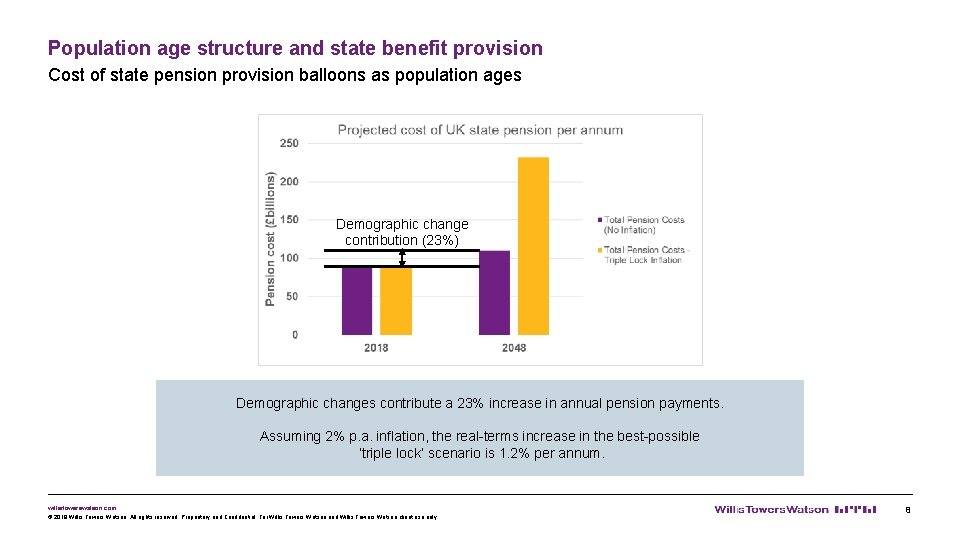
Population age structure and state benefit provision Cost of state pension provision balloons as population ages Demographic change contribution (23%) Demographic changes contribute a 23% increase in annual pension payments. Assuming 2% p. a. inflation, the real-terms increase in the best-possible ‘triple lock’ scenario is 1. 2% per annum. willistowerswatson. com © 2018 Willis Towers Watson. All rights reserved. Proprietary and Confidential. For Willis Towers Watson and Willis Towers Watson client use only. 8
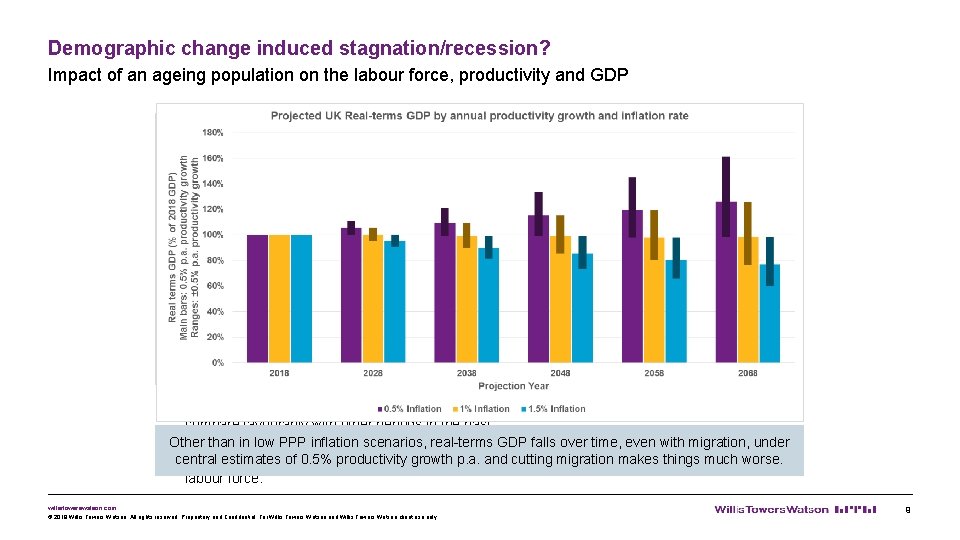
Demographic change induced stagnation/recession? Impact of an ageing population on the labour force, productivity and GDP § Ageing of population leads to fall labour force, do not Increases in productivity over the in past 10 years unless replenished significant net immigration compare favourablyby with other periods in the past. (similar most recent observed levels). thantointhe low PPP inflation scenarios, real-terms GDP falls over time, even with migration, under §Other Automation could improve productivity, but may also central of 0. 5% p. a. and cutting migration makes things much worse. reduceestimates employment ratesproductivity and hencegrowth the effective labour force. willistowerswatson. com © 2018 Willis Towers Watson. All rights reserved. Proprietary and Confidential. For Willis Towers Watson and Willis Towers Watson client use only. 9
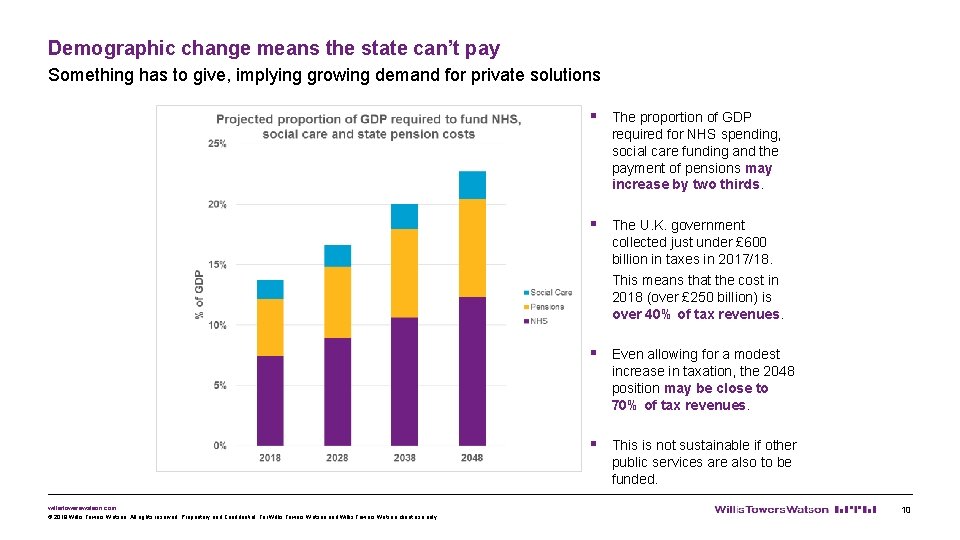
Demographic change means the state can’t pay Something has to give, implying growing demand for private solutions § The proportion of GDP required for NHS spending, social care funding and the payment of pensions may increase by two thirds. § The U. K. government collected just under £ 600 billion in taxes in 2017/18. This means that the cost in 2018 (over £ 250 billion) is over 40% of tax revenues. willistowerswatson. com © 2018 Willis Towers Watson. All rights reserved. Proprietary and Confidential. For Willis Towers Watson and Willis Towers Watson client use only. § Even allowing for a modest increase in taxation, the 2048 position may be close to 70% of tax revenues. § This is not sustainable if other public services are also to be funded. 10
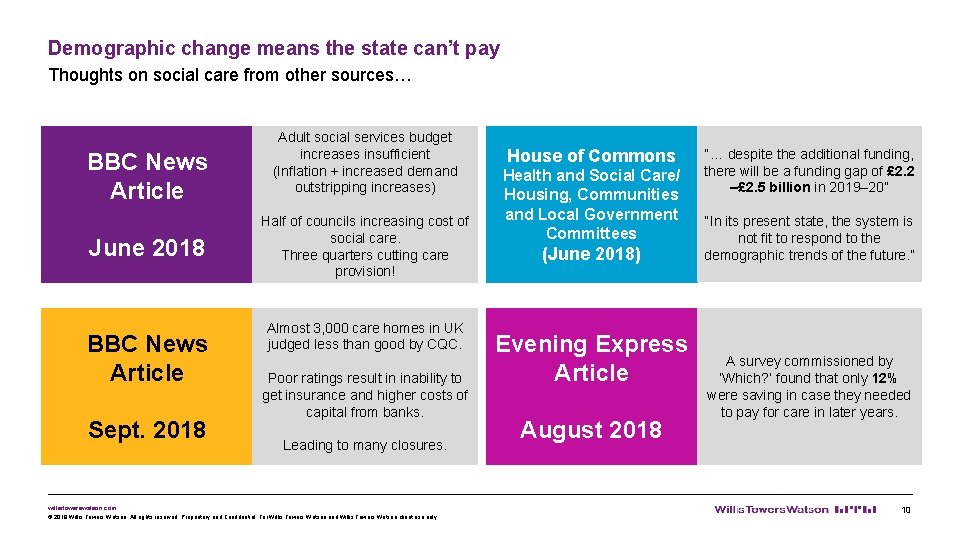
Demographic change means the state can’t pay Thoughts on social care from other sources… BBC News Article June 2018 BBC News Article Sept. 2018 Adult social services budget increases insufficient (Inflation + increased demand outstripping increases) Half of councils increasing cost of social care. Three quarters cutting care provision! Almost 3, 000 care homes in UK judged less than good by CQC. Poor ratings result in inability to get insurance and higher costs of capital from banks. Leading to many closures. willistowerswatson. com © 2018 Willis Towers Watson. All rights reserved. Proprietary and Confidential. For Willis Towers Watson and Willis Towers Watson client use only. House of Commons Health and Social Care/ Housing, Communities and Local Government Committees (June 2018) Evening Express Article August 2018 “… despite the additional funding, there will be a funding gap of £ 2. 2 –£ 2. 5 billion in 2019– 20” “In its present state, the system is not fit to respond to the demographic trends of the future. ” A survey commissioned by ‘Which? ’ found that only 12% were saving in case they needed to pay for care in later years. 10
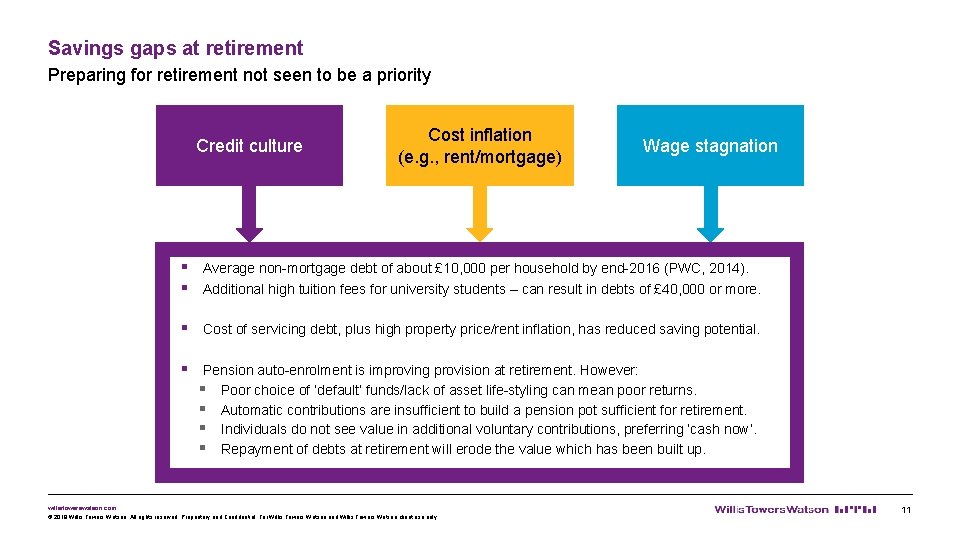
Savings gaps at retirement Preparing for retirement not seen to be a priority Credit culture Cost inflation (e. g. , rent/mortgage) Wage stagnation § § Average non-mortgage debt of about £ 10, 000 per household by end-2016 (PWC, 2014). Additional high tuition fees for university students – can result in debts of £ 40, 000 or more. § Cost of servicing debt, plus high property price/rent inflation, has reduced saving potential. § Pension auto-enrolment is improving provision at retirement. However: § Poor choice of ‘default’ funds/lack of asset life-styling can mean poor returns. § Automatic contributions are insufficient to build a pension pot sufficient for retirement. § Individuals do not see value in additional voluntary contributions, preferring ‘cash now’. § Repayment of debts at retirement will erode the value which has been built up. willistowerswatson. com © 2018 Willis Towers Watson. All rights reserved. Proprietary and Confidential. For Willis Towers Watson and Willis Towers Watson client use only. 11
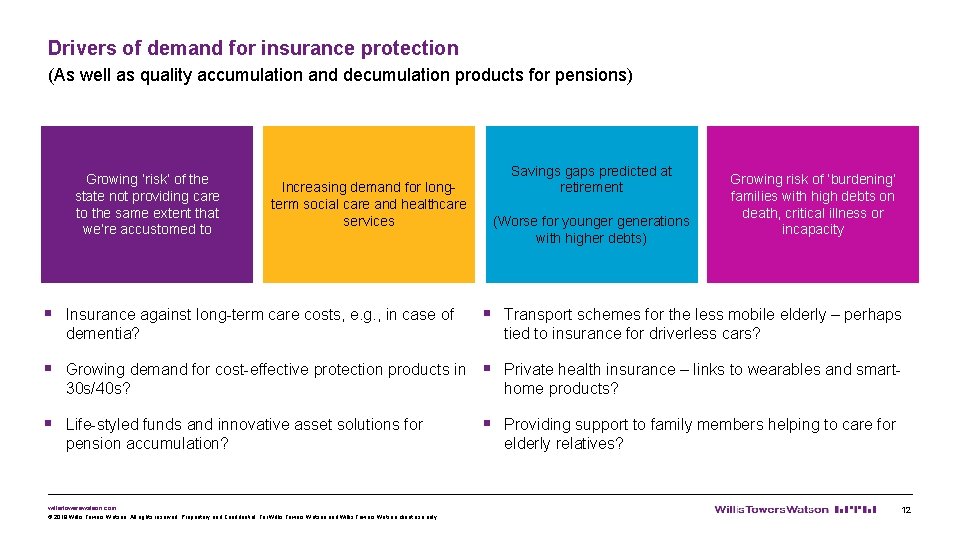
Drivers of demand for insurance protection (As well as quality accumulation and decumulation products for pensions) Growing ‘risk’ of the state not providing care to the same extent that we’re accustomed to Savings gaps predicted at retirement Increasing demand for longterm social care and healthcare services (Worse for younger generations with higher debts) Growing risk of ‘burdening’ families with high debts on death, critical illness or incapacity § Insurance against long-term care costs, e. g. , in case of dementia? § Transport schemes for the less mobile elderly – perhaps tied to insurance for driverless cars? § Growing demand for cost-effective protection products in 30 s/40 s? § Private health insurance – links to wearables and smarthome products? § Life-styled funds and innovative asset solutions for pension accumulation? § Providing support to family members helping to care for elderly relatives? willistowerswatson. com © 2018 Willis Towers Watson. All rights reserved. Proprietary and Confidential. For Willis Towers Watson and Willis Towers Watson client use only. 12
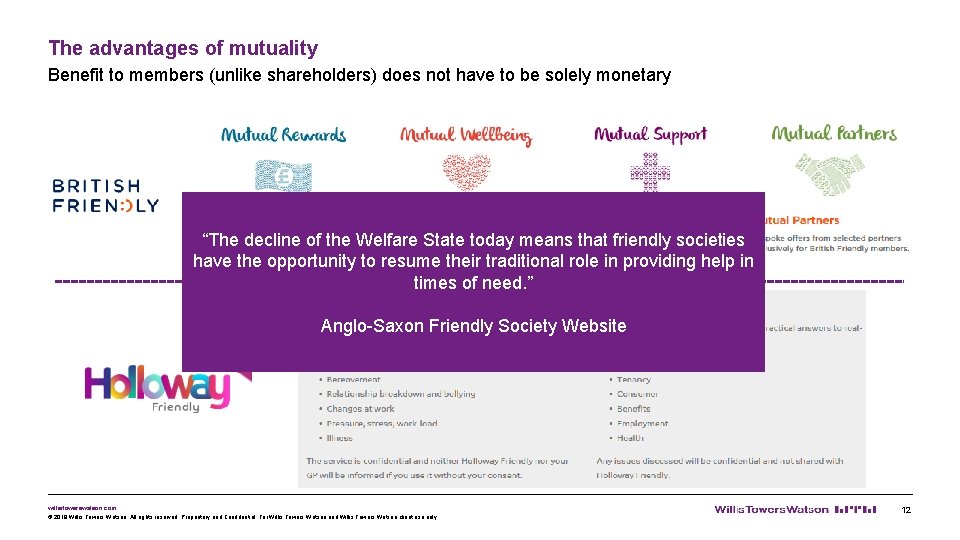
The advantages of mutuality Benefit to members (unlike shareholders) does not have to be solely monetary “The decline of the Welfare State today means that friendly societies have the opportunity to resume their traditional role in providing help in times of need. ” Anglo-Saxon Friendly Society Website willistowerswatson. com © 2018 Willis Towers Watson. All rights reserved. Proprietary and Confidential. For Willis Towers Watson and Willis Towers Watson client use only. 12
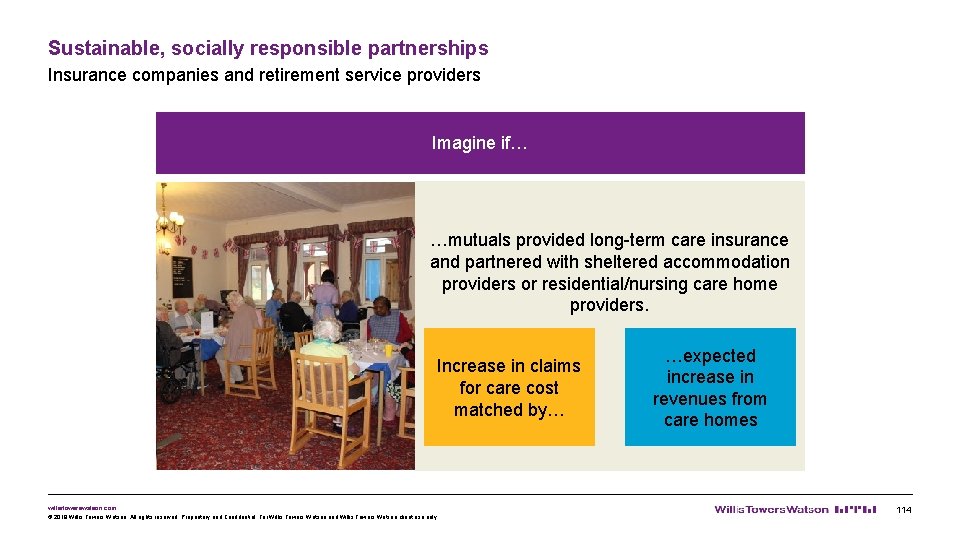
Sustainable, socially responsible partnerships Insurance companies and retirement service providers Imagine if… …mutuals provided long-term care insurance and partnered with sheltered accommodation providers or residential/nursing care home providers. Increase in claims for care cost matched by… willistowerswatson. com © 2018 Willis Towers Watson. All rights reserved. Proprietary and Confidential. For Willis Towers Watson and Willis Towers Watson client use only. …expected increase in revenues from care homes 114
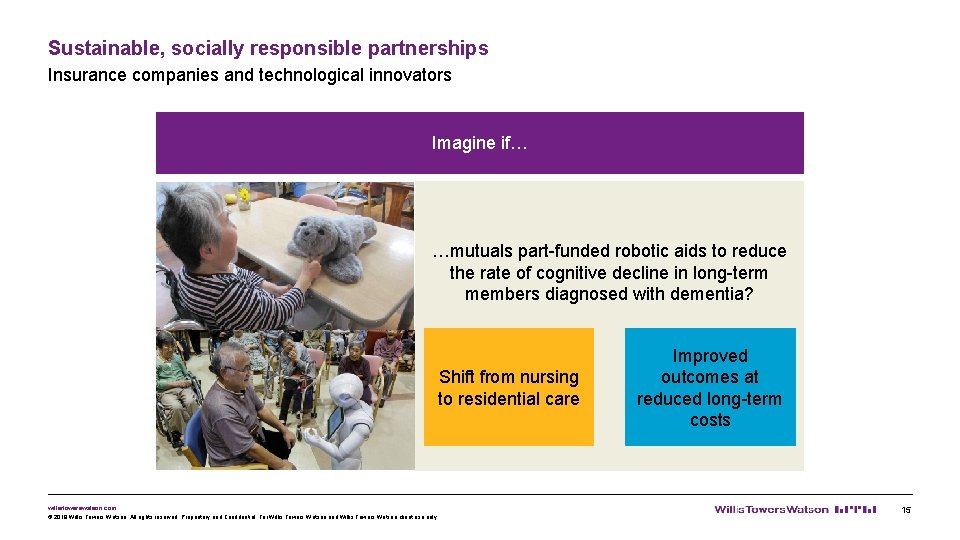
Sustainable, socially responsible partnerships Insurance companies and technological innovators Imagine if… …mutuals part-funded robotic aids to reduce the rate of cognitive decline in long-term members diagnosed with dementia? Shift from nursing to residential care willistowerswatson. com © 2018 Willis Towers Watson. All rights reserved. Proprietary and Confidential. For Willis Towers Watson and Willis Towers Watson client use only. Improved outcomes at reduced long-term costs 15
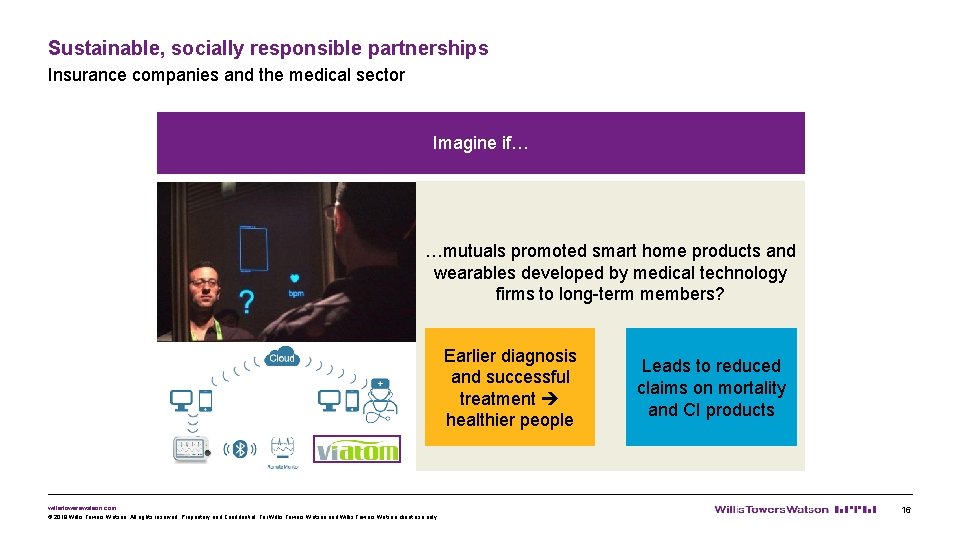
Sustainable, socially responsible partnerships Insurance companies and the medical sector Imagine if… …mutuals promoted smart home products and wearables developed by medical technology firms to long-term members? Earlier diagnosis and successful treatment healthier people willistowerswatson. com © 2018 Willis Towers Watson. All rights reserved. Proprietary and Confidential. For Willis Towers Watson and Willis Towers Watson client use only. Leads to reduced claims on mortality and CI products 16
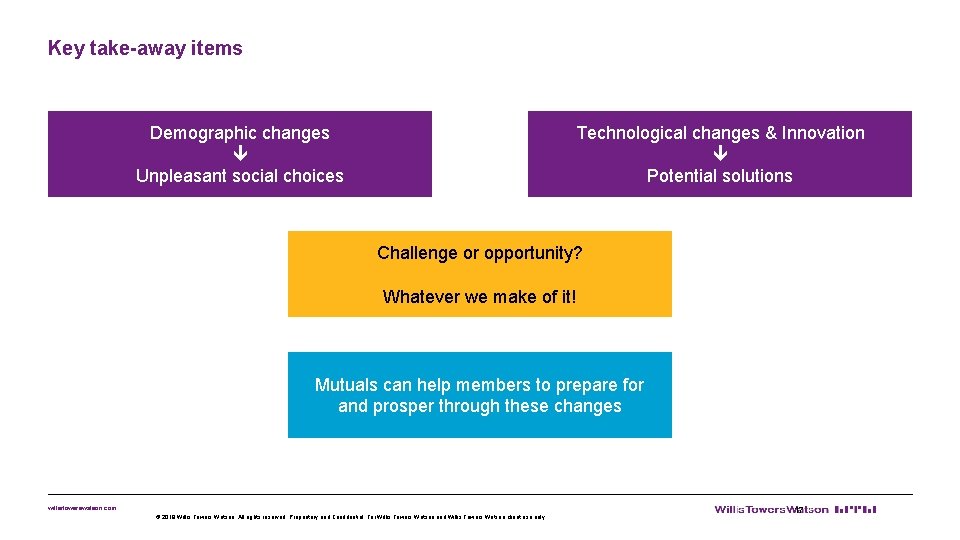
Key take-away items Demographic changes Unpleasant social choices Technological changes & Innovation Potential solutions Challenge or opportunity? Whatever we make of it! Mutuals can help members to prepare for and prosper through these changes willistowerswatson. com © 2018 Willis Towers Watson. All rights reserved. Proprietary and Confidential. For Willis Towers Watson and Willis Towers Watson client use only. 17